College Football PR 101: Academic Bonuses

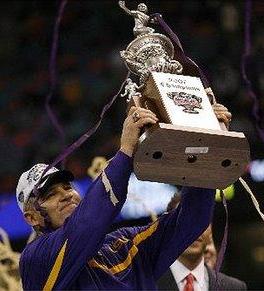
When Louisiana State University coach Les Miles was carried off the field after winning the National Championship game last night, his smile likely reflected more than the pure joy of winning. Miles had already garnered $400,000 in football bonuses for making it to the game. After winning the title, his contract states that his total salary will be adjusted to at least the third-highest salary in all of Division I football which will boost it by about $1.15 million more than hes currently making.
 Thats quite an incentive to win on the field. While watching Miles and the LSU football team revel in its victory, we here at Higher Ed Watch wondered if LSU offers its coach any meaningful incentives to make sure his football players excel in the classroom?
The answer is noacademic performance barely enters into any big-time coachs salary equation. While academic bonuses do exist, they’re simply a public relations tactic, too insignificant to have any real effect on coaches behavior.
In order to get coaches to take academics and graduating their players seriously, colleges need to build different incentive structures. This wont be an easy sell for schools (a slight understatement) and will require outside forces to pressure schools to remember that student-athletes are students first.
Academic Bonuses for the National Championship Contenders: LSU & Ohio State
According to a Bloomberg News compilation of coaching contracts at public schools, LSU coach Les Miles could receive up to $135,000 in bonuses for his students’ academic achievement this yearwhich sounds like a lot of money to most people. But thats only 7% of his current $1.8 million minimum guaranteed salary (a number which doesnt include a slew of other benefits, such as country club memberships and cars).
LSUs football program has a long history of academic failure. We somehow doubt that $135,000 in bonuses got Miles to focus on improving LSUs dismal football graduation rate, which was most recently reported to be 38 percent. And why would he, when he had a $1.15 million carrot urging him to keep his football players on the practice field and in the film room as long as possible.
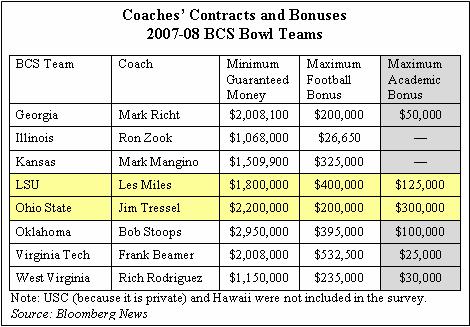
Jim Tressel, the coach of Ohio State, LSUs opponent in the National Championship game, could receive up to $300,000 in academic bonuses this yearor 14 percent of his $2.2 million contract. This is actually the largest academic bonus at any public schoolbut it doesnt seem to have had much of an effect on the academic performance of OSUs football team. OSUs most recently reported graduation rate for its football team is 48 percent, and its Academic Progress Rate of 928a real-time measure of how players are advancing towards degreesis only three points higher than the NCAA cut-off for penalties.
Academic Bonuses vs. Football Bonuses
Of the 81 coaching contracts obtained by Bloomberg News, 29 didnt offer any academic bonuses. And of those schools that did, the academic bonuses were worth on average 5 to 6 percent of the coaches’ total salaries. Football bonuses, on the other hand, were worth on average about 35 percent of the total salaries.
At some schools, the potential bonus for excelling on the football field is greater than the coachs entire base salary. At Arizona State, coach Dennis Erickson makes $625,000 per year, which is on the lower end of the big-time football spectrum. But the maximum football bonus in his contract is 177 percent of his base salary, or $1.105 million. Compare that to the $45,000 maximum academic bonus he can receive.
If you were a coach, which prize would you chooseacademic achievement, accompanied by minimal personal gain, or football glory, accompanied by media attention, hero-type praise, and significant financial benefits?
According to the associate athletic director at Kansas State Universitywhose team didnt make a bowl game this year, but played in the Texas Bowl last year and received a $750,000 payoutacademic bonuses are “public relations; a shell game. Its a feel-good story that suggests we somehow care about this.”
Pressuring Schools to Restructure Contracts
If the academic performance of football players is a priority for a school, then placing meaningful academic incentives in a coachs contract is an easy solution. But unfortunately, most big-time football schools dont care whether or not their football players graduate. They have strong monetary incentives to win on the field as well, and they use these athletes to help them accomplish that goal. The pay-outs from participating in bowl games are substantial, not to mention the value of establishing national recognition and securing future television contracts. The schools that participated in the five Bowl Championship Series games this year received a $17 million payout.
So how can we make schools care about their football players? How can we make schools restructure their football coaching contracts so that academics actually mean something, so that coaches are forced to send their players to class?
Outside pressure is the first step. The NCAA needs to get serious about its academic requirements and enact harsher penalties for those teams that dont meet high academic standards. And if the NCAA wont act to preserve its educational mission, Congress might (and should) step in, as it holds the key to the NCAAs tax-exempt status.
More About the Authors
Issues
Programs/Projects/Initiatives
Related
Like Baylor, the University of Alabama Steered Many Low-Income Families to Parent PLUS Loans

State Legislatures Weighing in on Workforce Pell

A Trump Official’s Thin Legal Case Against Accreditors’ DEI Policies