
Table of Contents
- Prologue: A Personal Need for Spaces for Work and Play
- Introduction: The Rise of Coworking Spaces and the Opportunity to Broaden Access
- Part I. Building Capacity for Families’ Resilience: Stories from Founders and Parents
- Part II. Boosting Opportunity for the Child Care Workforce: Stories from Practitioners and Parents
- Part III. Challenges and Opportunities for Scaling Shared Sites
- Conclusion
Part I. Building Capacity for Families’ Resilience: Stories from Founders and Parents
In almost all of my interviews with founders, many said they were inspired to create intergenerational spaces because of what they needed in their own lives. Many I spoke to also wanted to address not only the inadequate leave policies of their workplaces and the challenges of returning to work after becoming a parent,1 but also societal pressure2 about what “responsible” mothering should look like.
From Texas and North Carolina to Berlin and Sydney, I heard that “having it all” (as in, a job and a family) was not really the issue—it was being perceived as an engaged, present parent at the same time as a conscientious, effective worker that felt impossible. The website of Yalla! Space in San Diego, California, neatly summarizes the co-location niche sector’s vision and value proposition: “What if there was a space that honored the natural rhythm of staying close to your young child while also balancing the realities of modern life? A space where you didn’t have to choose between meaningful work and meaningful presence.” Women are often judged by different standards3 for their efforts in parenting and career aspirations, and they suffered disproportionately in the pandemic.
“I heard that ‘having it all’ was not really the issue—it was being perceived as an engaged, present parent at the same time as a conscientious, effective worker that felt impossible.”
According to the U.S. Chamber of Commerce Foundation, more than half of working parents who left their jobs in 2020 cited child care as the primary reason, with women far more likely to be affected.4 (Even before the pandemic, almost a quarter of parents reported turning down a promotion due to child care instability, and since 2019, there has been a 16 percent increase in women citing caregiving as a factor that holds them back from career development.5)
This section will highlight ways that co-locating care and work can reshape work–life balance and grow much-needed community solidarity.
A Solution from the Washington Sound
The juggle. The puzzle. The endless compromises. The elusive “village” of support. Many parents truly struggle to balance their parenting and professional lives. Kayla Shroader shared with me that she regularly lay awake at night, fretting about this conundrum. She found herself envying the close-knit matrilineal social groups (known as “pods”) of orca whales that visit Puget Sound, near her home in Tacoma, Washington, where the median yearly cost of center-based infant care is $18,881.6
In 2020, after founding her business called The Pod Works, with the idea of blending work and care, she launched The Co-Lab to develop even more flexible co-location options for local families. The Pod offers kid-friendly office spaces with adjacent playrooms staffed with supervisors for work to happen casually alongside the children playing for short blocks of time. The Co-Lab provides staffed, scheduled child care alongside child-free workspace. For $99 per month, members have unlimited use of the offices at either location, call booths, and outdoor workspaces; access to workshops and the playground; and 50 percent off the $24 per hour child care (members pay $12). At Pod Works, memberships are half price for single- and student-parents, with fundraising efforts to help cover costs for local families should they experience economic instability.

Photo by Heather Leacy, used with permission.
The community is further served by a vibrant calendar of family events, toddler and baby meetups, camps, and enrichment programs. The experience of weathering the pandemic bonded member families with friendship and mutual aid. I saw that cooperative practices at businesses like Shroader’s tend to motivate participation that’s rewarding and reciprocal. A strong tradition of giving back to widen access for local parents unable to afford the full fees continues as a core value among the community. In March of 2025, a family counseling provider, doula birth professionals, and even a balloon and party decor business all took office space above the coworking space, evidencing that this kind of neighborhood “hub” can attract and encourage diverse programs and services.
Innovating in Indiana
Founders like Emily Vanest, of Switchboard, are moving beyond the WeWork model and seeking to build on “what truly works” for families, serving their communities by offering care. “We’re middle-aged mothers, not tech bros,” she laughed as we compared prioritizing child care licensing processes over kombucha on tap. Switchboard offers a three-hour child care session on weekday mornings for children aged six weeks to five years old, priced at $9 an hour in addition to a $99 per month coworking membership.
While many coworking spaces cluster downtown to promote entrepreneurship and collaboration, Switchboard’s addition of child care sets it apart from the others. As I interviewed mothers, many said they were choosing to work on-site at places like Switchboard, with close proximity to care. “You’re walking with parents, literally and spiritually,” reflected Vanest. “Here, folks wander to the space from their homes, chatting in the morning; they share good and bad news. There’s an intimacy and authenticity to relationships when you’re not wasting energy separating parenting from your working life.”
Meeting Families’ Needs in Iowa and New York
In Des Moines, Iowa, Rebecca Wolford, the founder of a family-friendly coworking network nonprofit, Creative Habitat, couldn’t agree more: “We’re the moms just out here doing the work, believing there just has to be a way to create spaces that provide better work–life balance for families.” Wolford runs pilots and pop-ups offering coworking and child care in places families frequent, such as the Des Moines Children’s Museum and local libraries. She’s a fan of the cooperative model where parents take turns overseeing child care. Here too, blocks of care are offered rather than full-time or long-term enrollment, but Wolford hopes to grow from pilots into a permanent space. She recently explored renovating a school bus in order to physically take her offering to neighborhoods and events, delivering the solution where and when it’s needed.
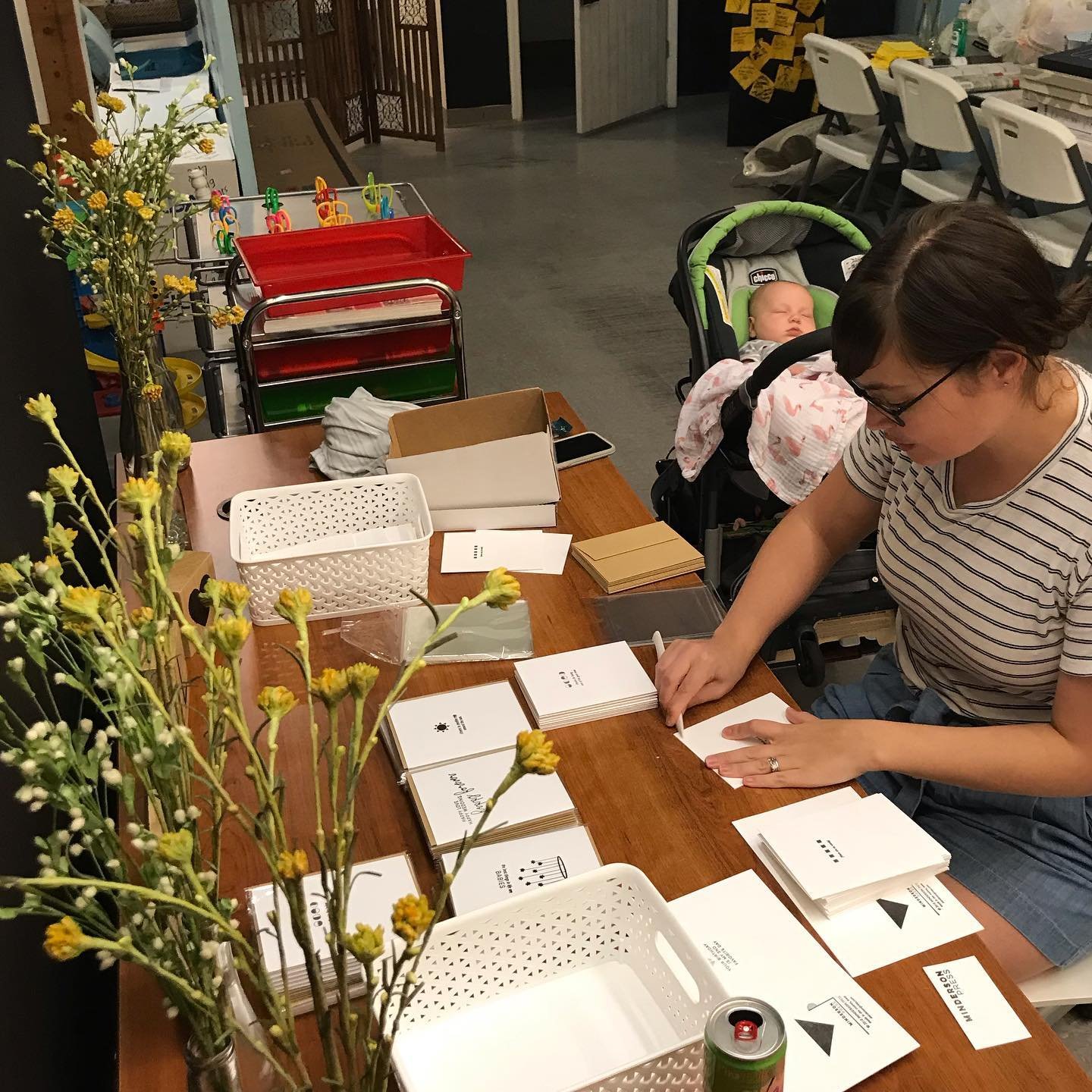
Photo by Rebecca Wolford, used with permission.
Mutual aid, cooperative practices, and time- or skill-sharing were common across the co-located organizations I researched. Many served as incubators for community bonds that extended to benefit their wider neighborhoods. In Brooklyn, New York, for example, Jessenia Rios—co-founder of Lola+Tots with her sister—described how federal employees impacted by layoffs in early 2025 found support through their coworking space and its child care and after-school program offerings. A crowdfunding campaign to help these workers continue their Lola+Tots memberships raised $7,000 in a matter of days. The effort built on a similar drive to support single moms’ access to their community the prior year. Because parents are actively taking part in the community and developing the bonds and understanding that come from working and raising children in close proximity, there’s goodwill and a sense of gratitude that motivates mutual aid, Rios noted.
Making Spaces for Mothers in North Carolina
Alison Rogers’s struggle to work from home during the pandemic, with a three-year-old at home and an older child attending school online, concluded with her being laid off in December of 2020. Despite having worked in marketing for 25 years, her tech company employer hadn’t been particularly responsive to requests for flexible working. It wasn’t surprising, then, that the women who sought these accommodations were the ones they let go. With more time on her hands, she started thinking about what the ideal conditions would be for her next chapter of work and parenting. She wanted a workplace where she could focus on her job while also feeling like a present parent too. She also found herself deep in online discussions on the topic of the gender pay gap and the underrepresentation of women in senior roles.
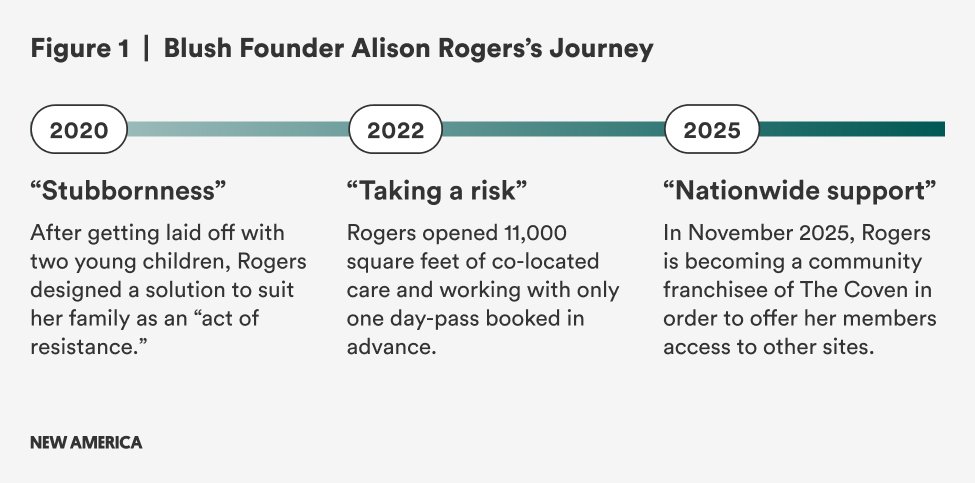
When Twitter banned her account for reposting too many links on the topic, it spurred Rogers into action. After over a year of searching, she finally found a physical space that suited her vision and opened Blush in Cary, North Carolina, in 2022. Providing a coworking space offering deskspace, private offices, and on-site child care was her solution for empowering women in her local community. She did it for herself, but also as a quiet act of defiance for women everywhere juggling care and work responsibilities (see Figure 1). “Good things happen when you meet local needs in a compassionate manner; when you create conditions for everyone concerned to thrive,” she said, reflecting on the way a strong community can be built despite skepticism about her idea from other businesses in her area.
For Rogers, flexibility was core to the business’s membership model, and paying her workers more than the going rate was a key principle. The trick would be ensuring a stable income while also making access affordable for families. At $22 an hour and a 40-hour week, pay for the child care team was significantly higher and more stable than the local average of $15.7 At $250 per month, membership fees for hot-desking fell below the local average for similar arrangements, which started around $300 per month.8 The cost of the child care is $11 an hour at Blush, but the total cost to parents is still less than finding daycare independently, and traveling to and from the care setting.9 Rogers secured enough members and leased enough offices for her business to be sustainable and grow steadily. And, staying true to her values of transparency and fairness over profit, she recently lowered membership costs to broaden access to her community.
Many parent members I spoke to found the practical logistics of collapsing the boundaries between work and care to be especially rewarding. Simply walking into an adjacent space from work to feed a baby, for example, felt “transformative” for members I met at Blush. One told me, “To be near my child and also feel I can access the focus and the support system necessary to take a huge step and go to graduate school, is liberating.” She continued, “I was able to prove myself as a conscientious parent to family members at the same time.” A surprising proportion of the parents I met using co-located spaces have changed careers, started their own ventures, or simply felt they now had the safety net to branch out.
“The idea of mixing work with family still seemed unthinkable to all of the coworking spaces I toured,” marvels Monica Richardson, a former public high school teacher, Blush member, and a mom of three who also lives in Cary. “Pets are usually welcome [at these spaces], but not babies! So when I discovered Blush—[an] office space including child care—it was such a huge relief…and I never could have imagined [the] kind of benefits and support network this would provide personally and professionally.” Richardson runs a nonprofit dedicated to supporting local families with educational events and resources. When it grew significantly during the pandemic, she set about finding office space to take operations out of her garage. At the time, Richardson had four part-time employees with babies or young children in tow—much to the surprise of building owners, who were accustomed to renting to local small businesses. Even in Raleigh, the remote-work capital of the eastern United States, where 24.5 percent of its workforce works remotely—just half of a percentage point behind Austin, Texas, for the national title—this was unusual.10
Richardson joined Blush and immediately discovered benefits beyond the convenience she’d anticipated. There were many overlaps between her team’s initiatives uplifting local mothers and the members of the coworking space. Richardson began hosting events at Blush, and the on-site care helped more local families feel confident about attending. Several members volunteer their time with her nonprofit, and a board member from her nonprofit joined Blush. She’s maximizing the use of the space in and out of working hours and recruiting new members for Blush.
Founding a Family Franchise from Rhode Island to Illinois
For this group of families around the world who participated in a cowork plus child care solution, I heard repeatedly that the pandemic was not weathering, but was actually a time of flourishing if they had access to a co-located space. This represented, in many cases, a live experiment for families seeking to assemble their desired conditions for overall well-being. In interviews with parents who had joined coworking spaces with child care at the same location—in settings as varied as the suburban Pacific Northwest; central Berlin, New England, or London; subtropical Uttar Pradesh, India; and temperate Boulder, Colorado—all reported that unifying their professional and parenting identities was key to the way their families coped and adapted throughout the pandemic.
This sentiment felt like something of an awkward secret among some interviewees, whispered conspiratorially for fear of insensitivity—that the global pandemic experience was “actually an opportunity to support one another, be valued and vulnerable, and that it was also just really fun at times, being freed-up from the old routine and old ways,” according to a London-based parent who uses co-located services.
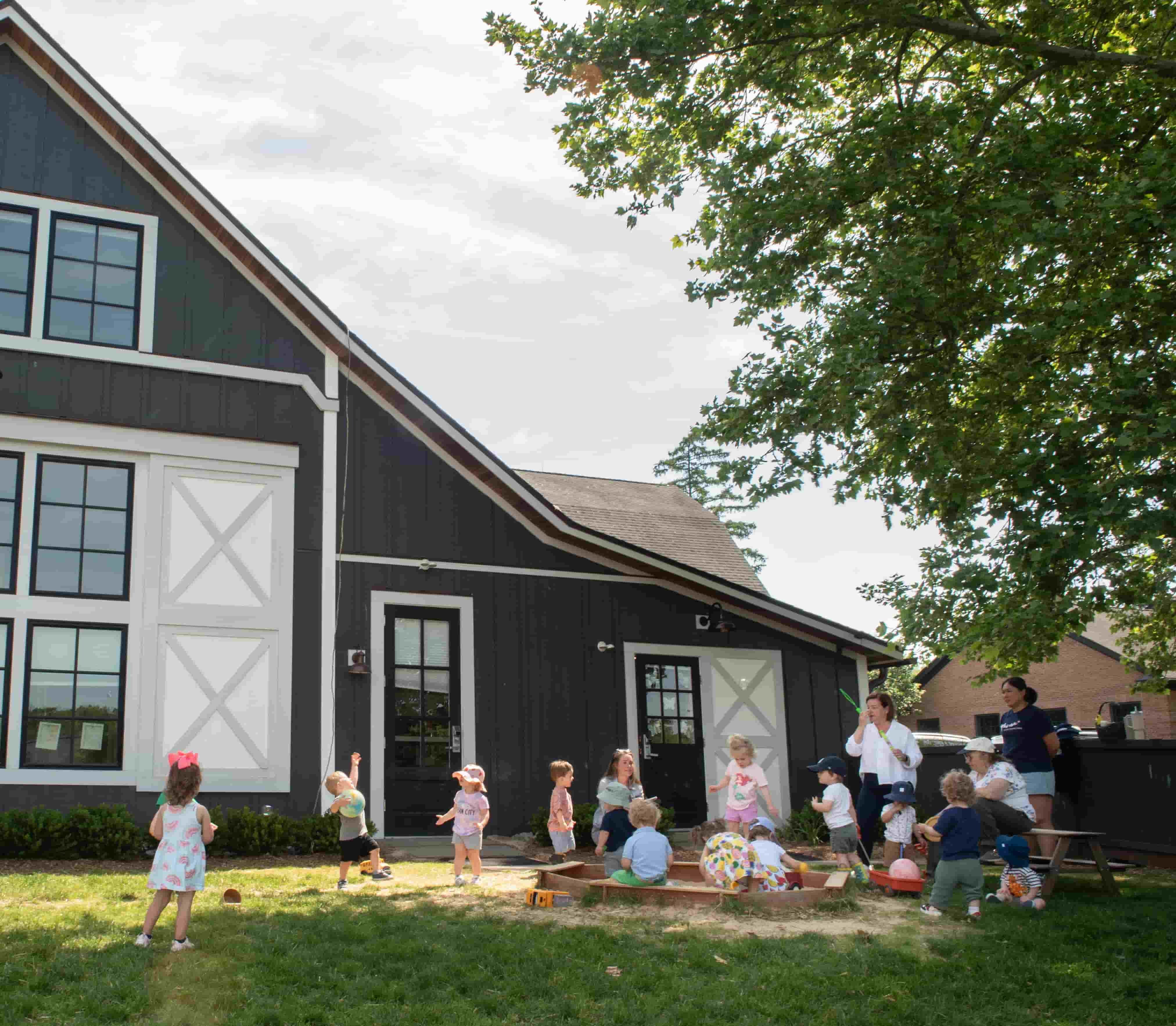
Photo by Britt Riley, used with permission.
That sentiment is also what many founders I spoke with valued most. “It’s a bit like first hearing about [weight loss drug] Ozempic—you’re like, really? There’s a solution where I can take matters into my own hands, maybe get healthier, feel happier?” laughed Britt Riley, the founder of the Haven Collection, a co-location setting that now has franchises in Rhode Island, New Jersey, and the Chicago area. Uniting early-years care and education with parent coworking and well-being facilities such as gyms and spas is how Riley believes we can attend to the needs of multiple generations simultaneously. Moving from talking about “child care” and “work” as so distinct, to a progressive banner of what she calls “family care.” Her goal is to build an “ecosystem” of services for local families that meet their personal and professional needs.
Not Having to Compromise Work or Care in Maryland
Tammira Lucas spent 11 years running a nonprofit empowering moms in underserved communities before founding The Cube in Baltimore, Maryland. The Cube, the largest Black woman–owned coworking space with child care, offers on-site working office space, child care services, and a content creation studio. Offering child care under the same roof as coworking was a practical solution, she said, to remove barriers for the women she supports with entrepreneurship training. Lucas believes that “normalizing having a family and running a business” is a strong starting point for helping mothers build their own businesses. Despite there being coworking spaces and incubators located in Baltimore already, Lucas noted that there were none that fit the needs of parents: “Where are the children while parents are working? Do these parents who are launching a business or running a small business really have the funds for full-time child care?”
In her previous role as a research analyst for the City of Baltimore, Lucas became an expert in understanding where investment positively impacted communities. She began applying for grants to realize her own vision. Then, worried that grants weren’t a sustainable model in the long term, a crowdfunding campaign she initiated enabled her to purchase the site. Offering care at $30 for up to three hours, the babysitting space is largely staffed by grandmothers Lucas met in the local community. Here, the child care fee is an add-on to a $35 ad hoc day rate (or $165 per month for unlimited coworking). There are options to book a conference room or a private office space for a small team.
“Our proudest moments are rooted in defying the expectations placed on us as Black women and moms entering industries where we are underrepresented,” Lucas said. “Every day that we unlock our doors, serve our community, and provide employment opportunities within that community is a moment of pride. It’s a testament to our resilience, vision, and commitment to creating spaces that empower and uplift.”

Photo courtesy of Lucas, used with permission.
The journey of founding The Cube sounded strikingly similar to social enterprises in places thousands of miles away. In Athens, Greece, for example, Stella Kasdagli and Pinelopi Theodorakakou opened WHEN Hub in 2024 to offer coworking with child care to better serve the beneficiaries of the nonprofit organization they’d been running since 2012. A decade of career coaching, training, and delivering research and advocacy for local women inspired Kasdagli that simply co-locating in-person services like child care and offering flexible event space was the most valuable resource she could create to boost women’s entrepreneurship.
Meanwhile, in Edinburgh, Scotland, Karina De Souza, a medical researcher and mom to a toddler, was having coffee with a friend at the place in their neighborhood that seemed to have the most reliable free WiFi—a café inside a sports center. In the southeast quadrant of the city, there weren’t any of the upscale coworking clubs they’d seen in pop up affluent areas. The women bemoaned the critical need to have “another place, not home but near it, and not our employers’ premises,” to get a bit of work done with their children nearby: “Even just an hour in between naps or feeds!” To fulfill the vision of this hybrid concept, De Souza spent the year assembling grants, running crowdfunding campaigns, and working nights and weekends to develop the Work+Play after securing the wing of a local community center as her premises.
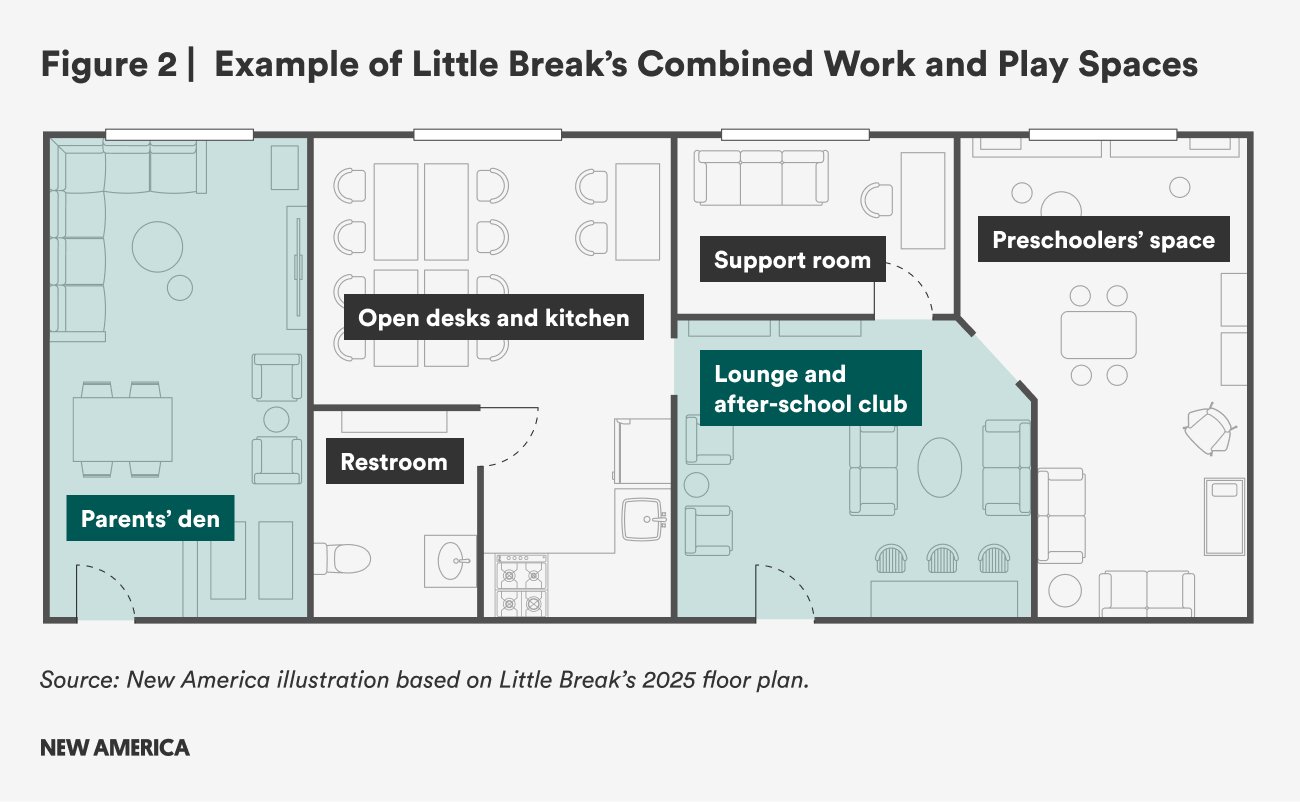
In Ann Arbor, Michigan, Little Break opened in March 2025, offering drop-in sessions or tiered memberships. It was started by Ariel Wan, founder of the Mama’s Network, a nonprofit aiming to improve support systems for families, via an initial donation of $5,000 from a supporter whose employer matched that amount, and built upon a pilot program she ran offering workspace with an adjacent playspace the year before. Figure 2 below visualizes how the space is organized, including a lounge where school-age siblings hang out and a “den” space for parents to do yoga or relax. It’s an example of how a small space can host distinct needs. The founders I spoke to often said that the layout and interiors were something they worked hard on to give each generation a happy space.
Expanding the Model in New Jersey, Texas, and Beyond
At Bloom Child Care and Coworking in Montclair, New Jersey, it’s the relationships between caregivers and parents that are foundational to building what founder Amanda Krochik considers a “nurturing community where both family and work life flow side by side…allowing our members to focus on their professional goals without compromising their family culture.” Krochik, a former educational leadership coach, started Bloom in her own home when local child care options didn’t feel right. “I couldn’t help but feel that nothing was good enough for my baby. It wasn’t a difficult decision: I would create exactly what I wanted, as a mother and educator, for my son.” The workspace for parents on the floor above the child care and education space was a physical way to foster greater collaboration between families and caregivers. She found that proximity allowed their care to be more responsive and tailored as everyone got to know each other well.
The descriptive and marketing language used by co-located settings like Bloom tends to reach beyond simply selling convenience for working parents, aiming instead to capture the hope of harmony between work and care. As with Haven founder Bridget Riley’s “family care” vision, Krochik believes new vocabulary is needed for what lies beyond the traditionally separate worlds of work and care. Just as some child care workers with educational qualifications have sought to better represent their work under the title of “educarer,” a portmanteau for early care and educator, our current language often falls short when it comes to describing an integrated world of parenthood, childhood, neighborhood, and livelihood.
Krochik was supporting local entrepreneurs and those who worked flexibly by starting Bloom, and she built connections with the local chamber of commerce, finding partnerships and being part of community events. Moving the co-located spaces out of her own home and into a beautifully custom-fit commercial space in a small local strip mall in 2023 was a testament to the demand that’s grown since the pandemic. Krochik’s significant expansion into private office spaces also included treatment rooms for local therapeutic practitioners to lease. Bringing services in-house is a bonus for members, adding to the list of convenient benefits of a family-friendly community.
Citations
- Maven Team, “Flexible Hours & Working From Home,” Maven Clinic, October 9, 2024, source.
- Suzanne Barnecut, “Working Moms Need a New F-Word: Flexibility,” Zendesk, accessed October 9, 2025, source.
- “The Motherhood Penalty,” American Association of University Women, accessed October 9, 2025, source.
- U.S. Chamber of Commerce Foundation, Piecing Together Solutions: The Importance of Childcare to U.S. Families and Businesses (U.S. Chamber of Commerce Foundation, October 14, 2023), source.
- “Elevating Women’s Power and Influence in the Workplace,” Economist Impact, accessed October 9, 2025, source.
- “Child Care Prices as a Share of Median Family Income by Age of Children and Care Setting 2022,” U.S. Department of Labor, January 1, 2025, source.
- See SalaryExpert data for child care worker salaries in Cary, North Carolina: source.
- See Regus site data for locations in Cary, North Carolina: source.
- See Care.com data for Cary, North Carolina: source.
- Laura Pop-Badiu, “The Evolution of WFH: A Decade of Changing Work Habits in America’s Top Metros,” Coworking Mag, source.