
The Case for Child Care Plus Coworking
Table of Contents
- Prologue: A Personal Need for Spaces for Work and Play
- Introduction: The Rise of Coworking Spaces and the Opportunity to Broaden Access
- Part I. Building Capacity for Families’ Resilience: Stories from Founders and Parents
- Part II. Boosting Opportunity for the Child Care Workforce: Stories from Practitioners and Parents
- Part III. Challenges and Opportunities for Scaling Shared Sites
- Conclusion
Abstract
The child care industry is a messy market failure. Work is increasingly exploitative, and the United States remains an outlier among comparable nations in its lack of support for families. And yet, amid systemic gaps, there are pockets of joy and resilience among parents and child care workers nationwide. This report explores the model of co-locating early childhood care and education under the same roof as desk space for parents. Initiated by mothers of young children, these hybrid spaces proliferated in the wake of the COVID-19 pandemic’s disruption of boundaries between work and care. Distinct from employer-based on-site child care, these businesses and social enterprises are typically in residential neighborhoods, intentionally integrating the needs of parents, children, and care practitioners alike. They offer networking and entrepreneurship opportunities for parents in close proximity to loving play and learning spaces for children. At a moment when work and child care options are increasingly precarious, these settings are evolving into neighborhood service hubs that strengthen social connections and support, offering more sustainable lifestyles. To provide families with the choices they need to combine work and care and thrive, an equitable, universal child care system should include this model, with ways to make it available to a wider range of workers.
Acknowledgments
Support for this report was made possible by a child care reporting grant from the Better Life Lab at New America. The author also thanks Mark Swartz.
Editorial disclosure: The views expressed in this report are solely those of the author and do not reflect the views of New America, its staff, fellows, funders, or board of directors.
Downloads
Prologue: A Personal Need for Spaces for Work and Play
What got you through the pandemic? Many families struggled to reconcile how work and the care and education of children, once so separate and distinct, might be possible simultaneously in the home. When I started working from someone else’s home around the corner, and my two-year-old son accompanied me to play in the garden microschool there, we discovered a simple way that both generations could thrive. Playhood, in London, England, offered coworking space for parents on the same site as a preschool. A woman in my neighborhood, Karen Partridge, had previously worked in creating community spaces and bringing people together to share their skills and access public amenities. She decided to turn her home into just such a space when she discovered that child care options for her son tended to keep parents at arm’s length. She started small, turning a ground-floor apartment space in the north London suburb where I lived at the time into a devoted office for us adults, who arrived to remote work each morning after dropping our children in her garden behind the house. There, a little fence and gate demarcated the devoted space for our children: areas for playing and growing plants and a studio space fitted out as a classroom that was all overseen by two licensed Montessori-trained teachers. We spent four days a week just 80 adult steps (160 toddler paces) away from each other in our own distinct spaces, and yet it quickly became clear that there were many overlaps and connection points throughout the day.
In addition to Partridge, her two-year-old son, and us, two other local families initially signed up for this dual proposition at Playhood, which opened in June 2020. I soon discovered it was a step change from the hands-off experience I’d had with my older son back when he started nursery school. There, it felt as if the teachers only saw me as a mother who occasionally forgot the rainboots or snuck in chocolate. And, though I received reports about his week and diligently filled out every form required, it felt distant and impersonal—and sometimes uncomfortable and unfair even—that the drop-off door separated our worlds so completely.
Anecdotes from Co-Designing a Community
In my personal experience, the parents and staff embarked on a journey together to create both a conducive coworking space for parents and a high-quality, loving early childhood care and education experience for the children, at the same site. We found ourselves working in collaboration with each other, and increasingly with the teachers, to build a supportive local community for very unusual times. We contributed ideas and resources to the teachers’ design of the curriculum, based on discussion of our children’s emerging interests, seasons, or the festivals important to each family. Parents would give workshops and visit for observations. The teachers took turns to eat lunch with the parents. We had a chance to get to know each other, become friends, and develop a deep understanding and appreciation for the important work of teaching young children. And when crisis or illness hit, the community readily sprang into action, caring for one another’s children, bringing meals, and sharing advice. Reciprocity and grace for vulnerability established deep bonds, making the fun social connections and shared celebrations the benefits that came along with that earned trust.
For about $2,000 a month membership fee, I had a light, warm, clean, and quiet place to work flexibly between the hours of 9 a.m. and 5 p.m. Meanwhile, my son had a stimulating and joyful experience with a handful of friends aged 18 months to four years old. In between the two zones was the open-plan kitchen, centralizing the lunch and snacks and offering a place to casually gather for breaks. Visitors often worried that the children in such a setting would become dysregulated if they glimpsed at their parents and wanted to be with them. That is the experience oftentimes with traditional child care programs, where extricating is tricky for all concerned or a parent’s appearance can disrupt the day. Interestingly, at Playhood, the children seemed to find a real sense of safety in the awareness of their parents’ proximity. One of the older toddlers summarized, “At first I cried, but now I know mummy is just in the house doing her work.” In fact, they came to true pride and ownership of their own space.
The children understood the symmetry: As my son, just three years old at the time, said one morning to me, “We both take our backpacks and our water bottles. I’ve got a Show-and-Tell, and you’ve got your notebook.” There were many mirror lines in our days. A postpartum fitness session in the parents’ outdoor space would be humorously copied by the kids in their garden who spotted the moms from their climbing apparatus. When they headed out to the park or off on a neighborhood adventure, they’d wave through the workspace windows hollering, “Hello! Love you! See you later!” We each had a window into the other’s world and could come and go harmoniously, working or playing, neither privileged nor competing. “There’s no boss at Playhood!” announced a child one day—and it represented to me the possibility of flattening hierarchies in how we work and care.
Looking Beyond Our Walls
The Playhood community grew eventually to eight children and their parents each day, serving a total of 20 families in a north London suburb between 2020 and 2025. I remember the day I realized that I was giving my son the best possible start in life, hands down, even as I was able to build my career. And all while we are living through a pandemic. I wanted to explore the notion that something special was happening, beyond the convenience factor of a set-up without a commute or separate drop-off, and I began to wonder if others anywhere else were experimenting with this model. Did co-location elsewhere similarly unlock more than simplifying family routines?
To explore this, I first began searching on Google Maps, looking for coworking spaces that also listed child care facilities. I came across others sharing their story on Instagram, and decided to track what I found in a spreadsheet in order to compare the iterations of the model.
Having a background in research and strategy uncovering insights about family life to help brands develop products and services for parents, I worked with Karen Patridge, the founder of Playhood, on a case study about our model. We talked about new metrics for the success of the community, including professional networking benefits where our members had helped one another find work, and the money families saved by using our toy library and the redistribution of used kids’ scooters, bikes, and books. I’d been tracking reports about the shift to remote work and the impact of COVID-19 on the child care sector, and I knew that the feeling of resilience and thriving that we in the Playhood community were feeling was absolutely not the norm. As I continued searching, happily, it turned out that other grassroots communities and entrepreneurial partnerships discovered positive experiences of mutual aid, solidarity, and support with similar models of co-located independent work and care. I began reaching out to connect with founders and practitioners to attempt to document this emerging phenomenon and compare notes. Many founders I met were mothers themselves in search of their own work and care solutions, like Partridge. I also found that, far from a mother-only space, more fathers were becoming interested and involved in the model.
Interest from academics in examples of strong caregiver–parent partnerships, especially during a time of child care shutdowns, school closures, and social distancing, sparked exciting conversations with social entrepreneurs looking to rethink how we arrange work and care. The more I connected with others in the space, crossing borders of nation and culture, the more I discovered how transformative the experience of meshing our work, parenting, and child care could be for a wide range of families. I heard things like, “If I’d had a solution like this earlier, we would have had another child.” I heard how proximity to their babies and toddlers and peer support enabled moms suffering complex trauma to gain enough confidence to re-enter the workplace. I learned that businesses can be radically transparent and adaptable in collaboration with their service users. I saw that very young children could comprehend their parents’ work, rather than it being so hidden from them. I observed how community and neighborhood connections were strengthened, and how conversations moved fluidly from talking about miscarriage support to coaching for job interviews.
“The more I connected with others in the space, crossing borders of nation and culture, the more I discovered how transformative the experience of meshing our work, parenting, and child care could be for a wide range of families.”
These discoveries grew into a personal mission. I wondered if a model that got a handful of families through a pandemic could help many more cope in the face of new challenges to family, work, care, and well-being.
I wanted to shine a light on the shift from the moms-only membership model to shared use of the coworking space by partners, believing the growing participation of dads I was hearing about pointed towards greater relationship equity. At the same time, the respectful working conditions, fair remuneration principles, and investments in professional development for child care teachers and workers pointed to the possibility of uplifting a long-devalued child care workforce, in which immigrant women and women of color are overrepresented. In addition, the visibility of care-as-work, and the ability for young children to see their parents’ multifaceted identities close up, placed caregivers and parents shoulder-to-shoulder as equals in powerful ways for both. I knew these human stories had to be shared more widely so that the valuable learning didn’t get sidelined in a looming return to pre-pandemic norms.1 I set about interrogating how this model could be part of potential lasting structural change in how we work and care.
Applying for the Innovative Child Care Reporting Grant from the Better Life Lab in the spring of 2025 allowed me to carry out initial revelatory visits to co-located businesses in New Jersey and North Carolina to compare with the United Kingdom setting I knew so well. I conducted video interviews and virtual tours with founders, parents, and child care workers in Colorado, Georgia, Indiana, Iowa, Maryland, New York (Manhattan and Brooklyn), Oklahoma, Pennsylvania, Rhode Island, Washington, and Virginia. The list grew as I kept finding more small, independent settings. Some offered informal, drop-in care for three hours a day, others more structured, long-term work and care arrangements like my son and I experienced at Playhood. It turned out that very few even knew of each other’s existence: Founders were so focused on serving their immediate local communities, they’d not yet accessed any kind of peer support. Each was testing out hyperlocal and site-specific ways to grow a business. The next step in my desk research was to study and evaluate other settings I found operating in Arizona, California, Florida, Illinois, Massachusetts, Minneapolis, Ohio, Texas, and Wisconsin, collating findings in a spreadsheet to keep track of the types of child care provision (ad hoc or full-time programs) and workspace amenities (hot desking or private offices) along with details like their costs and membership terms. While reviewing their websites, media coverage, and social media accounts, I kept notes on descriptive language about their origin stories and services offered to analyze business value propositions and brand positioning, along with content and marketing strategies.
Venturing Even Further Afield
I sought to understand the wider context by interviewing five child care policy experts and leaders of neighborhood development organizations and looking up historical examples of co-location. I discovered that the model had been explored since at least 2008,2 but had repeatedly proven unsustainable. I looked at 22 co-located child care and coworking ventures in 12 countries that had closed down to understand the limitations of this model. I researched how, though some coworking spaces seek to meet the needs of female entrepreneurs, job-seekers, or families of color, most programs tend to reach middle-class knowledge workers who typically have more resources and options than single parents or those who work in hourly, service, and retail jobs. I looked into how the lack of public funding in the child care sector,3 particularly in the United States, limits possibilities for all kinds of child care, including this innovative model.
This fueled the determination to find out what the crucible of the pandemic could offer to catalyze a more stable, lasting solution. So I went global with the project and set about interviewing founders in Australia, Canada, Germany, Greece, and Scotland, while adding analysis of settings in Austria, Brazil, Chile, Colombia, the Czech Republic, Egypt, France, India, Italy, New Zealand, Russia, Singapore, Spain, Sweden, Switzerland, Taiwan, and Ukraine. It was astonishing and heartwarming to hear that essentially the same very simple idea was being piloted, primarily by mothers who’d decided to switch careers in order to establish care and work solutions for their communities, in such a diverse range of places and policy backdrops.
Given that this project was conceived as a narrative change effort aimed at envisioning an equitable, universal child care system in the United States that works for all families, this report begins with a brief introduction to coworking spaces, followed by a focus on sharing the stories of the families who founded these centers where work and care are jointly nurtured, as well as the parent community members who have benefitted from them. The second section delves into the workforce that enables co-located settings to thrive, showcasing their experiences and challenges. The final section of the report highlights promising early evidence from my investigation that benefits can extend beyond parent members and caregiver employees to include support for other local families and boost neighborhood engagement. It also recognizes current limitations of the coworking model, now available primarily to knowledge workers who can work at a computer, and proposes solutions to make it available to a broader array of workers, particularly hourly and service workers, as well as measures to improve sustainability. Finally, I call for the creation of a coalition of co-located settings founders to share their learnings with one another and collaborate globally to meet the needs of families with children everywhere.
Three Reasons Why We Need These Stories Right Now
This is a critical moment to recognize and explore this trend because the window of opportunity may be closing. There are three reasons for this.
- Remote work—an essential ingredient in hybrid spaces—is becoming increasingly precarious, thanks to a growing wave of back-to-office mandates.4 Economists say this backlash has contributed to many women, college-educated mothers in particular, being forced out of the workforce.5
- Accessible co-designed caring communities might be a grassroots counterweight to the growing number of premium private “family clubs.”6 These exclusive spaces focus on leisure and well-being or dining activities, along with spaces for parents to work and for children to play, for those who can afford the high-end membership fees.
- The social enterprise potential of the neighborhood co-location model offers further resistance to the trend towards private equity–backed care operations.7 These chains are buying up small child care settings and raising prices or shuttering locations in economically struggling communities, at a time when reliance on family, friend, and neighbor care is increasingly the choice or necessity for families. Care by families, friends, or neighbors accounts for almost 40 percent of child care in the United States today and is growing.8
Citations
- Valentina Duarte and Jennifer Liu, “5 Years into the Remote Work Boom, the Return-to-Office Push Is Stronger than Ever—Here’s Why,” CNBC, March 23, 2025, source; Theara Coleman, “Trump’s Federal Return-to-Office Mandate Descends into Chaos,” The Week, April 9, 2025, source.
- “Cubes & Crayons, California,” Coworking Wiki, accessed September 10, 2025, source.
- Jackie Mader, “Child Care Crisis Deepens as Funding Slashed for Poor Families,” Hechinger Report, November 1, 2025, source; Larry Handerhan, “The Hidden Cost of HHS Cuts: Why Every Family Should Care,” Center on Poverty and Inequality, Georgetown University Law Center, May 15, 2025, source.
- Duarte and Liu, “5 Years into the Remote Work Boom, the Return-to-Office Push Is Stronger Than Ever,” source.
- Matthew Nestler, “The Great Exit,” KPMG, October 1, 2025, source.
- Kim Velsey, “Here Come the Urban Country Clubs,” Curbed, July 16, 2025, source.
- Elliot Haspel, “‘The End User Is a Dollar Sign, It’s Not a Child’: How Private Equity and Shareholders Are Reshaping American Child Care,” The 74, April 22, 2024, source.
- Lauren Coffey, “Majority of Parents Rely on Friends and Family for Child Care, Report Finds,” EdSurge, May 2, 2025, source.
Introduction: The Rise of Coworking Spaces and the Opportunity to Broaden Access
In 1989, a British entrepreneur spotted the chance to provide serviced offices to those who were traveling on business.1 His insight was that technology was increasingly networked, allowing people to continue working even when at a distance from their usual office. The International Workplace Group (IWG), formally known as Regus, grew via a range of investments and acquisitions to dominate the business center market and is the largest flexible workspace owner today. It is telling that WeWork, one of the largest and probably the best known of the coworking companies, has an official dog policy but no accommodation for children.2 In the shadow of these behemoths, and in a sector consisting of 35,000+ spaces worldwide, I found just 115 coworking spaces that specifically integrate child care.3
Alongside the corporates, early grassroots coworking spaces were started by artists and as hackerspaces for tech workers in the 1990s in Berlin and later in San Francisco.4 Neighborhood spaces catered to the growing number of freelancers, contract and gig workers, independent consultants, and entrepreneurs who could work flexibly from anywhere, usually with a laptop, but sought collaboration and camaraderie. They wanted to feel part of a community, rather than be isolated at home or work, in noisy coffee shops, or committed to an IWG office lease.
As technology accelerated to facilitate remote engagement, by 2020, many workers found a happy medium in sharing desks and relevant services. The pandemic hit the sector hard,5 and a majority of coworking spaces reported significant drops in revenue or wound up closing. But the sector recovered strongly from the pandemic’s pause. The workers tend to be young (the average age is 36) and white.6 And, despite long being associated with tech bros, the demographics are split fairly evenly between men and women.7 Broadening perceptions of “coworking” alongside child care necessarily involves wrangling connotations away from cookie-cutter and trendy chains in business districts to embrace a more expansive definition of what work increasingly looks like for parents who want to more closely combine their work and care lives.
Coworking spaces are expected to continue to increase as the 60 million U.S. freelancers and the number of self-employed and “gig economy” workers grow.8 It’s imperative to explore the ways in which coworking spaces are used for a wide range of endeavors when we talk about flexible working. The model of shared working spaces has a number of positives: The autonomy of working on one’s own combined with the conviviality of coworking reportedly reduces feelings of isolation and can benefit both professional networking and social connections.9 A large majority in research collated by TeamStage, a project management software company, say they find the environment conducive to focus and productivity, and discover a sense of belonging.
From the start, many parents, primarily mothers, wanted these spaces to offer child care.10 But few did. And while research on the dynamics of coworking is extensive, there has been scant attention paid to models that accommodate mothers and fathers of young children and to the coworking spaces that successfully incorporate child care. The U.S. Office of Planning, Research, and Evaluation in the Administration for Children and Families funded a study between 2020 and 2023 that found centralizing community services had many benefits and positively impacted low-income families.11 This report is my effort to start to marry the business and economic evidence for the co-location model with neighborhood development initiatives that currently seek to support families with child care and workforce empowerment in siloed ways.
Citations
- “International Workplace Group,” Wikipedia, last modified March 30, 2025, source.
- WeWork Support Team, “What Is WeWork’s Dog Policy?,” WeWork Help Center, accessed October 17, 2025, source.
- “Main Coworking Statistics You Need to Know in 2024,” Flexas, October 3, 2023, source.
- Alberto Di Risio, “History of Coworking Spaces: From 2005 to 2021,” CoworkingResources, April 5, 2021, source.
- Carsten Foertsch, “How the Pandemic Is Affecting Coworking Spaces,” Deskmag, January 25, 2021, source.
- Andreea Neculae, “More Space, Fewer Places: Consolidation Takes Hold as Industry Matures,” CoworkingCafe, October 16, 2024, source.
- Carsten Foertsch, “Coworking Space Members: It’s a Girl!,” Deskmag, March 10, 2020, source.
- “Freelance Forward 2022,” Upwork, December 13, 2022, source.
- “Coworking Statistics: Shared Workspace in 2024,” TeamStage, accessed September 10, 2025,source.
- Meg Graham, “Coworking Spaces Hit a Wall When it Comes to Offering Child Care,” Chicago Tribune, April 13, 2015, source.
- Carly Morrison, Kimberly Foley, Akanksha Jayanthi, et al., Under One Roof: Findings from the Understanding the Value of Centralized Services Study (U.S. Administration for Children & Families, March 14, 2023), source.
Part I. Building Capacity for Families’ Resilience: Stories from Founders and Parents
In almost all of my interviews with founders, many said they were inspired to create intergenerational spaces because of what they needed in their own lives. Many I spoke to also wanted to address not only the inadequate leave policies of their workplaces and the challenges of returning to work after becoming a parent,1 but also societal pressure2 about what “responsible” mothering should look like.
From Texas and North Carolina to Berlin and Sydney, I heard that “having it all” (as in, a job and a family) was not really the issue—it was being perceived as an engaged, present parent at the same time as a conscientious, effective worker that felt impossible. The website of Yalla! Space in San Diego, California, neatly summarizes the co-location niche sector’s vision and value proposition: “What if there was a space that honored the natural rhythm of staying close to your young child while also balancing the realities of modern life? A space where you didn’t have to choose between meaningful work and meaningful presence.” Women are often judged by different standards3 for their efforts in parenting and career aspirations, and they suffered disproportionately in the pandemic.
“I heard that ‘having it all’ was not really the issue—it was being perceived as an engaged, present parent at the same time as a conscientious, effective worker that felt impossible.”
According to the U.S. Chamber of Commerce Foundation, more than half of working parents who left their jobs in 2020 cited child care as the primary reason, with women far more likely to be affected.4 (Even before the pandemic, almost a quarter of parents reported turning down a promotion due to child care instability, and since 2019, there has been a 16 percent increase in women citing caregiving as a factor that holds them back from career development.5)
This section will highlight ways that co-locating care and work can reshape work–life balance and grow much-needed community solidarity.
A Solution from the Washington Sound
The juggle. The puzzle. The endless compromises. The elusive “village” of support. Many parents truly struggle to balance their parenting and professional lives. Kayla Shroader shared with me that she regularly lay awake at night, fretting about this conundrum. She found herself envying the close-knit matrilineal social groups (known as “pods”) of orca whales that visit Puget Sound, near her home in Tacoma, Washington, where the median yearly cost of center-based infant care is $18,881.6
In 2020, after founding her business called The Pod Works, with the idea of blending work and care, she launched The Co-Lab to develop even more flexible co-location options for local families. The Pod offers kid-friendly office spaces with adjacent playrooms staffed with supervisors for work to happen casually alongside the children playing for short blocks of time. The Co-Lab provides staffed, scheduled child care alongside child-free workspace. For $99 per month, members have unlimited use of the offices at either location, call booths, and outdoor workspaces; access to workshops and the playground; and 50 percent off the $24 per hour child care (members pay $12). At Pod Works, memberships are half price for single- and student-parents, with fundraising efforts to help cover costs for local families should they experience economic instability.

Photo by Heather Leacy, used with permission.
The community is further served by a vibrant calendar of family events, toddler and baby meetups, camps, and enrichment programs. The experience of weathering the pandemic bonded member families with friendship and mutual aid. I saw that cooperative practices at businesses like Shroader’s tend to motivate participation that’s rewarding and reciprocal. A strong tradition of giving back to widen access for local parents unable to afford the full fees continues as a core value among the community. In March of 2025, a family counseling provider, doula birth professionals, and even a balloon and party decor business all took office space above the coworking space, evidencing that this kind of neighborhood “hub” can attract and encourage diverse programs and services.
Innovating in Indiana
Founders like Emily Vanest, of Switchboard, are moving beyond the WeWork model and seeking to build on “what truly works” for families, serving their communities by offering care. “We’re middle-aged mothers, not tech bros,” she laughed as we compared prioritizing child care licensing processes over kombucha on tap. Switchboard offers a three-hour child care session on weekday mornings for children aged six weeks to five years old, priced at $9 an hour in addition to a $99 per month coworking membership.
While many coworking spaces cluster downtown to promote entrepreneurship and collaboration, Switchboard’s addition of child care sets it apart from the others. As I interviewed mothers, many said they were choosing to work on-site at places like Switchboard, with close proximity to care. “You’re walking with parents, literally and spiritually,” reflected Vanest. “Here, folks wander to the space from their homes, chatting in the morning; they share good and bad news. There’s an intimacy and authenticity to relationships when you’re not wasting energy separating parenting from your working life.”
Meeting Families’ Needs in Iowa and New York
In Des Moines, Iowa, Rebecca Wolford, the founder of a family-friendly coworking network nonprofit, Creative Habitat, couldn’t agree more: “We’re the moms just out here doing the work, believing there just has to be a way to create spaces that provide better work–life balance for families.” Wolford runs pilots and pop-ups offering coworking and child care in places families frequent, such as the Des Moines Children’s Museum and local libraries. She’s a fan of the cooperative model where parents take turns overseeing child care. Here too, blocks of care are offered rather than full-time or long-term enrollment, but Wolford hopes to grow from pilots into a permanent space. She recently explored renovating a school bus in order to physically take her offering to neighborhoods and events, delivering the solution where and when it’s needed.
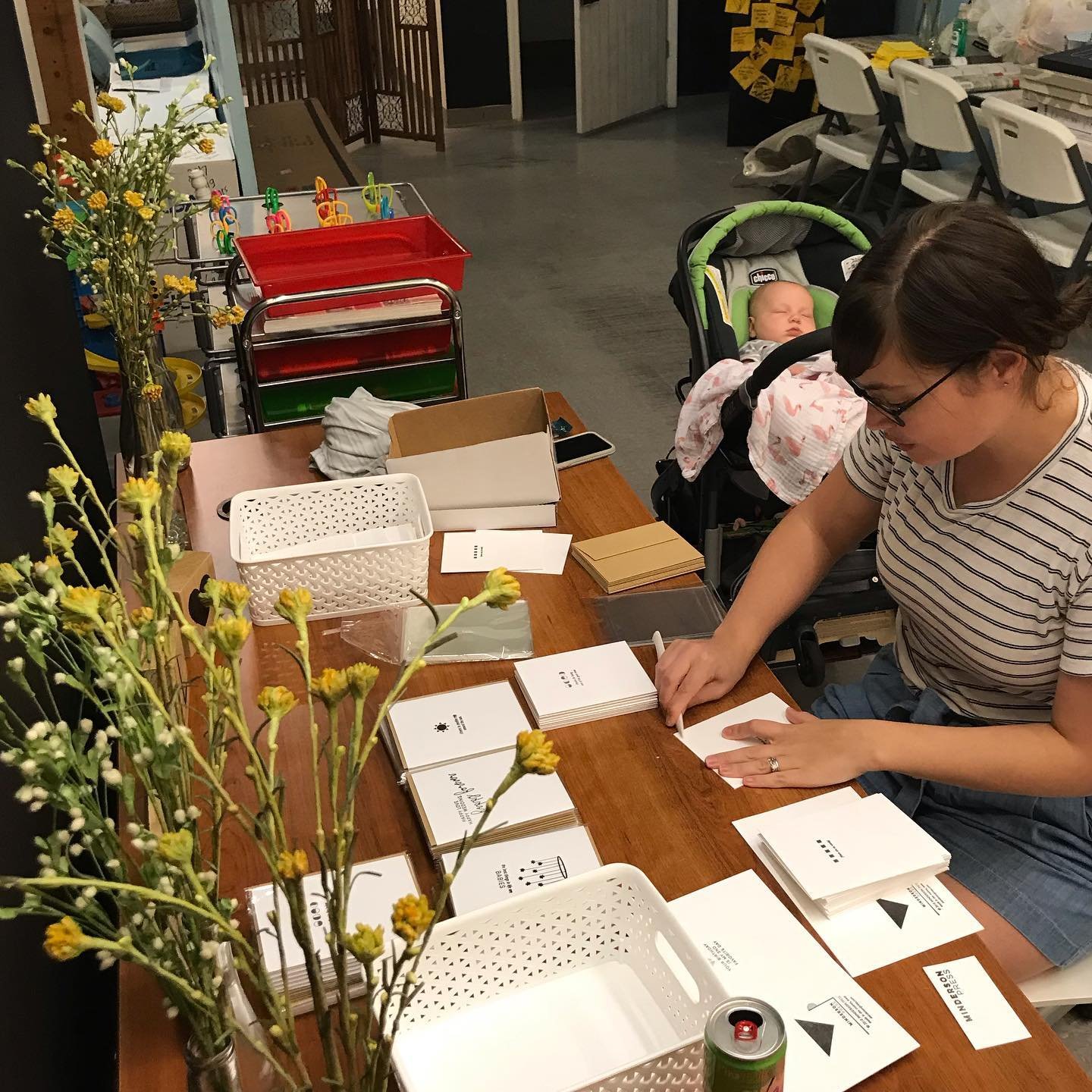
Photo by Rebecca Wolford, used with permission.
Mutual aid, cooperative practices, and time- or skill-sharing were common across the co-located organizations I researched. Many served as incubators for community bonds that extended to benefit their wider neighborhoods. In Brooklyn, New York, for example, Jessenia Rios—co-founder of Lola+Tots with her sister—described how federal employees impacted by layoffs in early 2025 found support through their coworking space and its child care and after-school program offerings. A crowdfunding campaign to help these workers continue their Lola+Tots memberships raised $7,000 in a matter of days. The effort built on a similar drive to support single moms’ access to their community the prior year. Because parents are actively taking part in the community and developing the bonds and understanding that come from working and raising children in close proximity, there’s goodwill and a sense of gratitude that motivates mutual aid, Rios noted.
Making Spaces for Mothers in North Carolina
Alison Rogers’s struggle to work from home during the pandemic, with a three-year-old at home and an older child attending school online, concluded with her being laid off in December of 2020. Despite having worked in marketing for 25 years, her tech company employer hadn’t been particularly responsive to requests for flexible working. It wasn’t surprising, then, that the women who sought these accommodations were the ones they let go. With more time on her hands, she started thinking about what the ideal conditions would be for her next chapter of work and parenting. She wanted a workplace where she could focus on her job while also feeling like a present parent too. She also found herself deep in online discussions on the topic of the gender pay gap and the underrepresentation of women in senior roles.
When Twitter banned her account for reposting too many links on the topic, it spurred Rogers into action. After over a year of searching, she finally found a physical space that suited her vision and opened Blush in Cary, North Carolina, in 2022. Providing a coworking space offering deskspace, private offices, and on-site child care was her solution for empowering women in her local community. She did it for herself, but also as a quiet act of defiance for women everywhere juggling care and work responsibilities (see Figure 1). “Good things happen when you meet local needs in a compassionate manner; when you create conditions for everyone concerned to thrive,” she said, reflecting on the way a strong community can be built despite skepticism about her idea from other businesses in her area.
For Rogers, flexibility was core to the business’s membership model, and paying her workers more than the going rate was a key principle. The trick would be ensuring a stable income while also making access affordable for families. At $22 an hour and a 40-hour week, pay for the child care team was significantly higher and more stable than the local average of $15.7 At $250 per month, membership fees for hot-desking fell below the local average for similar arrangements, which started around $300 per month.8 The cost of the child care is $11 an hour at Blush, but the total cost to parents is still less than finding daycare independently, and traveling to and from the care setting.9 Rogers secured enough members and leased enough offices for her business to be sustainable and grow steadily. And, staying true to her values of transparency and fairness over profit, she recently lowered membership costs to broaden access to her community.
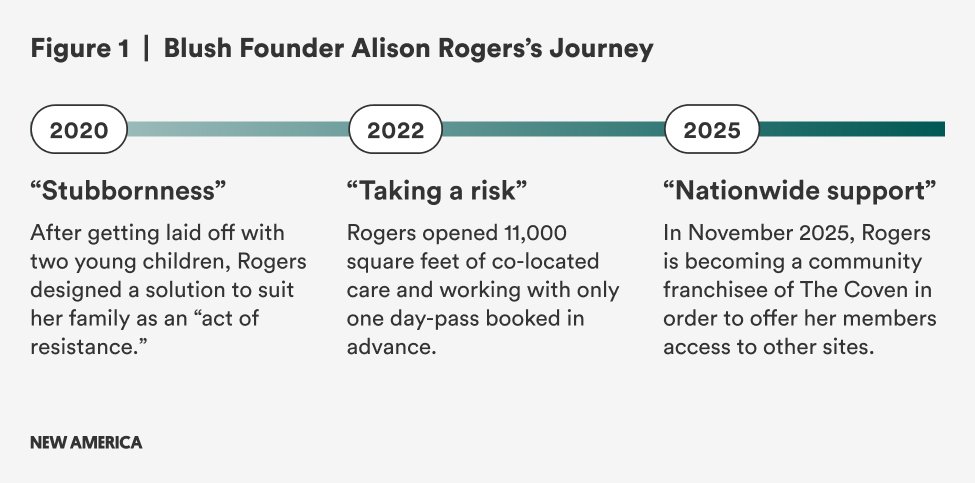
Many parent members I spoke to found the practical logistics of collapsing the boundaries between work and care to be especially rewarding. Simply walking into an adjacent space from work to feed a baby, for example, felt “transformative” for members I met at Blush. One told me, “To be near my child and also feel I can access the focus and the support system necessary to take a huge step and go to graduate school, is liberating.” She continued, “I was able to prove myself as a conscientious parent to family members at the same time.” A surprising proportion of the parents I met using co-located spaces have changed careers, started their own ventures, or simply felt they now had the safety net to branch out.
“The idea of mixing work with family still seemed unthinkable to all of the coworking spaces I toured,” marvels Monica Richardson, a former public high school teacher, Blush member, and a mom of three who also lives in Cary. “Pets are usually welcome [at these spaces], but not babies! So when I discovered Blush—[an] office space including child care—it was such a huge relief…and I never could have imagined [the] kind of benefits and support network this would provide personally and professionally.” Richardson runs a nonprofit dedicated to supporting local families with educational events and resources. When it grew significantly during the pandemic, she set about finding office space to take operations out of her garage. At the time, Richardson had four part-time employees with babies or young children in tow—much to the surprise of building owners, who were accustomed to renting to local small businesses. Even in Raleigh, the remote-work capital of the eastern United States, where 24.5 percent of its workforce works remotely—just half of a percentage point behind Austin, Texas, for the national title—this was unusual.10
Richardson joined Blush and immediately discovered benefits beyond the convenience she’d anticipated. There were many overlaps between her team’s initiatives uplifting local mothers and the members of the coworking space. Richardson began hosting events at Blush, and the on-site care helped more local families feel confident about attending. Several members volunteer their time with her nonprofit, and a board member from her nonprofit joined Blush. She’s maximizing the use of the space in and out of working hours and recruiting new members for Blush.
Founding a Family Franchise from Rhode Island to Illinois
For this group of families around the world who participated in a cowork plus child care solution, I heard repeatedly that the pandemic was not weathering, but was actually a time of flourishing if they had access to a co-located space. This represented, in many cases, a live experiment for families seeking to assemble their desired conditions for overall well-being. In interviews with parents who had joined coworking spaces with child care at the same location—in settings as varied as the suburban Pacific Northwest; central Berlin, New England, or London; subtropical Uttar Pradesh, India; and temperate Boulder, Colorado—all reported that unifying their professional and parenting identities was key to the way their families coped and adapted throughout the pandemic.
This sentiment felt like something of an awkward secret among some interviewees, whispered conspiratorially for fear of insensitivity—that the global pandemic experience was “actually an opportunity to support one another, be valued and vulnerable, and that it was also just really fun at times, being freed-up from the old routine and old ways,” according to a London-based parent who uses co-located services.
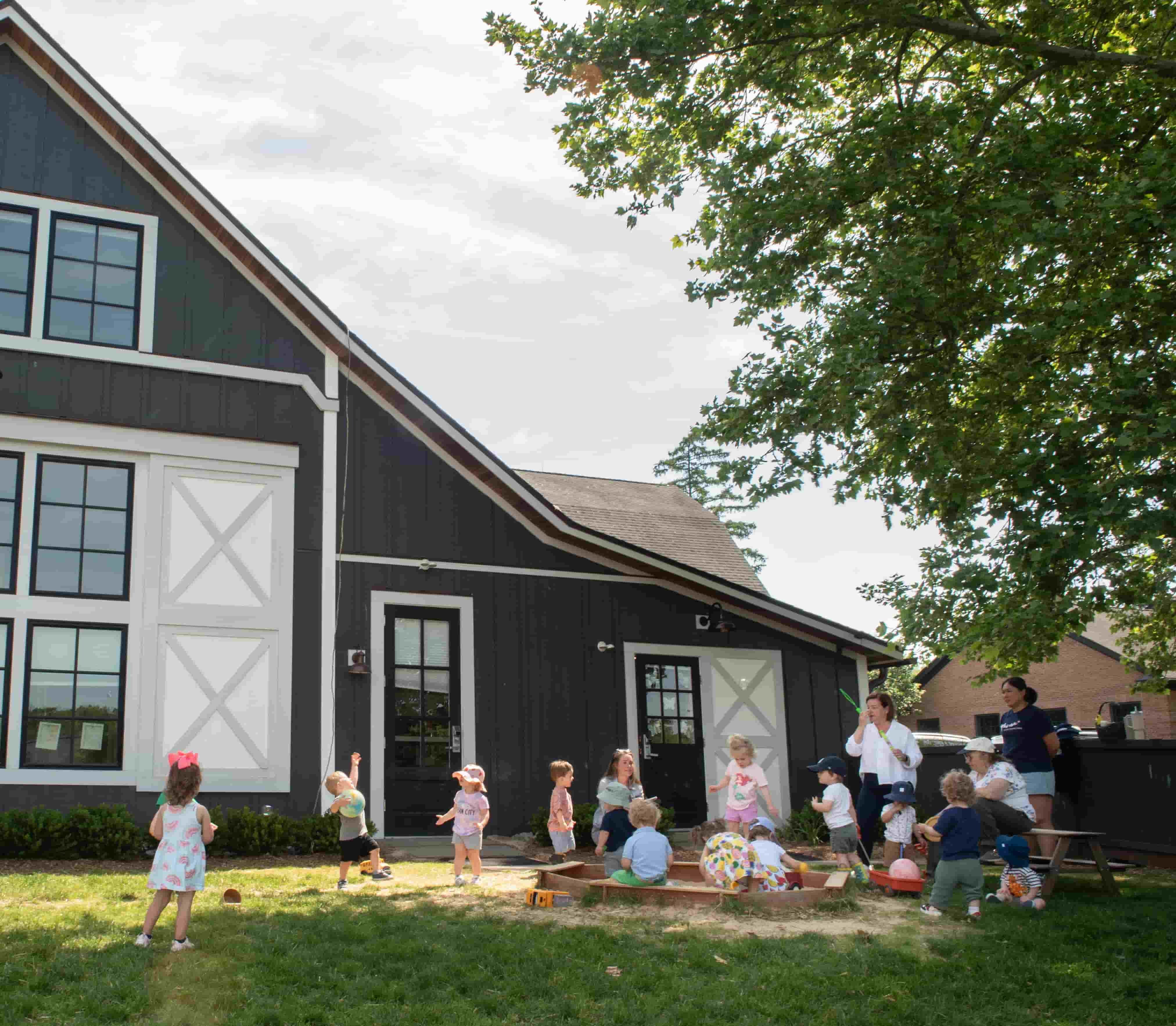
Photo by Britt Riley, used with permission.
That sentiment is also what many founders I spoke with valued most. “It’s a bit like first hearing about [weight loss drug] Ozempic—you’re like, really? There’s a solution where I can take matters into my own hands, maybe get healthier, feel happier?” laughed Britt Riley, the founder of the Haven Collection, a co-location setting that now has franchises in Rhode Island, New Jersey, and the Chicago area. Uniting early-years care and education with parent coworking and well-being facilities such as gyms and spas is how Riley believes we can attend to the needs of multiple generations simultaneously. Moving from talking about “child care” and “work” as so distinct, to a progressive banner of what she calls “family care.” Her goal is to build an “ecosystem” of services for local families that meet their personal and professional needs.
Not Having to Compromise Work or Care in Maryland
Tammira Lucas spent 11 years running a nonprofit empowering moms in underserved communities before founding The Cube in Baltimore, Maryland. The Cube, the largest Black woman–owned coworking space with child care, offers on-site working office space, child care services, and a content creation studio. Offering child care under the same roof as coworking was a practical solution, she said, to remove barriers for the women she supports with entrepreneurship training. Lucas believes that “normalizing having a family and running a business” is a strong starting point for helping mothers build their own businesses. Despite there being coworking spaces and incubators located in Baltimore already, Lucas noted that there were none that fit the needs of parents: “Where are the children while parents are working? Do these parents who are launching a business or running a small business really have the funds for full-time child care?”
In her previous role as a research analyst for the City of Baltimore, Lucas became an expert in understanding where investment positively impacted communities. She began applying for grants to realize her own vision. Then, worried that grants weren’t a sustainable model in the long term, a crowdfunding campaign she initiated enabled her to purchase the site. Offering care at $30 for up to three hours, the babysitting space is largely staffed by grandmothers Lucas met in the local community. Here, the child care fee is an add-on to a $35 ad hoc day rate (or $165 per month for unlimited coworking). There are options to book a conference room or a private office space for a small team.
“Our proudest moments are rooted in defying the expectations placed on us as Black women and moms entering industries where we are underrepresented,” Lucas said. “Every day that we unlock our doors, serve our community, and provide employment opportunities within that community is a moment of pride. It’s a testament to our resilience, vision, and commitment to creating spaces that empower and uplift.”

Photo courtesy of Lucas, used with permission.
The journey of founding The Cube sounded strikingly similar to social enterprises in places thousands of miles away. In Athens, Greece, for example, Stella Kasdagli and Pinelopi Theodorakakou opened WHEN Hub in 2024 to offer coworking with child care to better serve the beneficiaries of the nonprofit organization they’d been running since 2012. A decade of career coaching, training, and delivering research and advocacy for local women inspired Kasdagli that simply co-locating in-person services like child care and offering flexible event space was the most valuable resource she could create to boost women’s entrepreneurship.
Meanwhile, in Edinburgh, Scotland, Karina De Souza, a medical researcher and mom to a toddler, was having coffee with a friend at the place in their neighborhood that seemed to have the most reliable free WiFi—a café inside a sports center. In the southeast quadrant of the city, there weren’t any of the upscale coworking clubs they’d seen in pop up affluent areas. The women bemoaned the critical need to have “another place, not home but near it, and not our employers’ premises,” to get a bit of work done with their children nearby: “Even just an hour in between naps or feeds!” To fulfill the vision of this hybrid concept, De Souza spent the year assembling grants, running crowdfunding campaigns, and working nights and weekends to develop the Work+Play after securing the wing of a local community center as her premises.
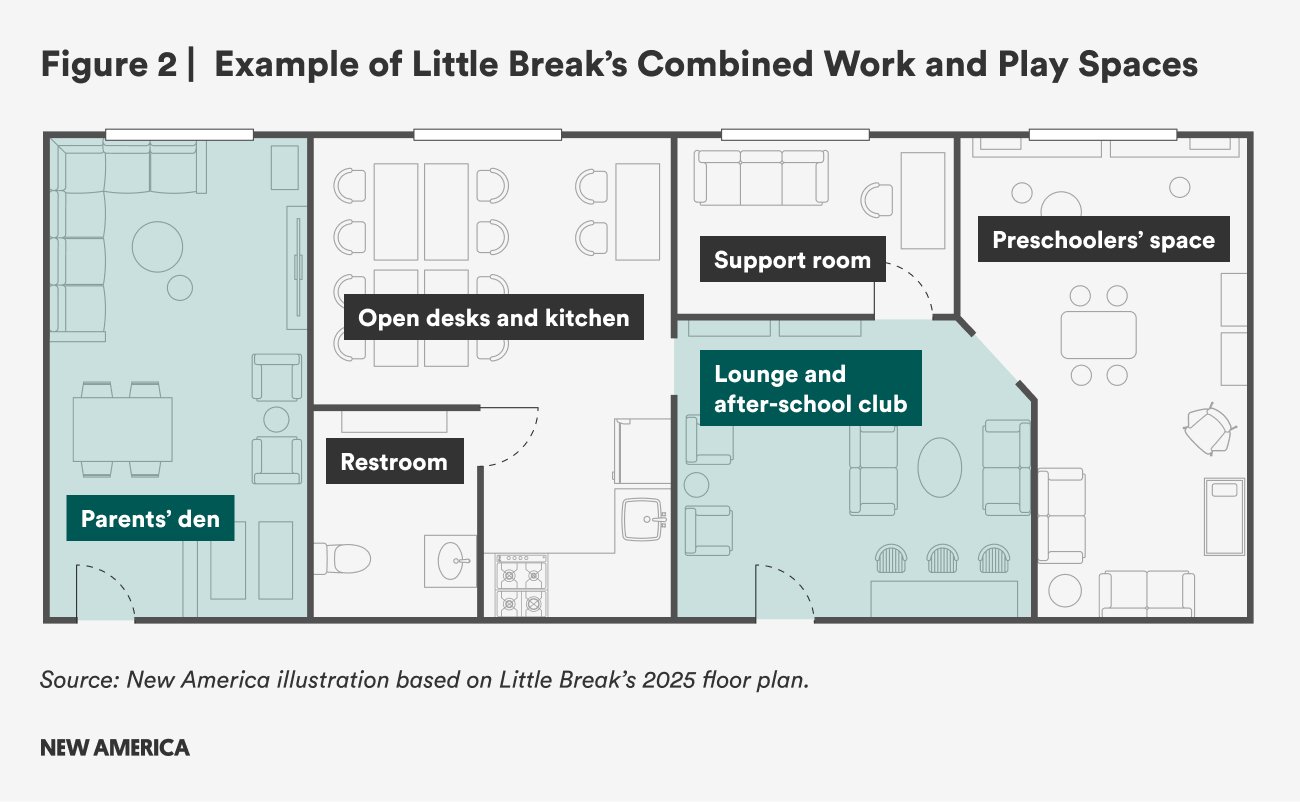
In Ann Arbor, Michigan, Little Break opened in March 2025, offering drop-in sessions or tiered memberships. It was started by Ariel Wan, founder of the Mama’s Network, a nonprofit aiming to improve support systems for families, via an initial donation of $5,000 from a supporter whose employer matched that amount, and built upon a pilot program she ran offering workspace with an adjacent playspace the year before. Figure 2 below visualizes how the space is organized, including a lounge where school-age siblings hang out and a “den” space for parents to do yoga or relax. It’s an example of how a small space can host distinct needs. The founders I spoke to often said that the layout and interiors were something they worked hard on to give each generation a happy space.
Expanding the Model in New Jersey, Texas, and Beyond
At Bloom Child Care and Coworking in Montclair, New Jersey, it’s the relationships between caregivers and parents that are foundational to building what founder Amanda Krochik considers a “nurturing community where both family and work life flow side by side…allowing our members to focus on their professional goals without compromising their family culture.” Krochik, a former educational leadership coach, started Bloom in her own home when local child care options didn’t feel right. “I couldn’t help but feel that nothing was good enough for my baby. It wasn’t a difficult decision: I would create exactly what I wanted, as a mother and educator, for my son.” The workspace for parents on the floor above the child care and education space was a physical way to foster greater collaboration between families and caregivers. She found that proximity allowed their care to be more responsive and tailored as everyone got to know each other well.
The descriptive and marketing language used by co-located settings like Bloom tends to reach beyond simply selling convenience for working parents, aiming instead to capture the hope of harmony between work and care. As with Haven founder Bridget Riley’s “family care” vision, Krochik believes new vocabulary is needed for what lies beyond the traditionally separate worlds of work and care. Just as some child care workers with educational qualifications have sought to better represent their work under the title of “educarer,” a portmanteau for early care and educator, our current language often falls short when it comes to describing an integrated world of parenthood, childhood, neighborhood, and livelihood.
Krochik was supporting local entrepreneurs and those who worked flexibly by starting Bloom, and she built connections with the local chamber of commerce, finding partnerships and being part of community events. Moving the co-located spaces out of her own home and into a beautifully custom-fit commercial space in a small local strip mall in 2023 was a testament to the demand that’s grown since the pandemic. Krochik’s significant expansion into private office spaces also included treatment rooms for local therapeutic practitioners to lease. Bringing services in-house is a bonus for members, adding to the list of convenient benefits of a family-friendly community.
Citations
- Maven Team, “Flexible Hours & Working From Home,” Maven Clinic, October 9, 2024, source.
- Suzanne Barnecut, “Working Moms Need a New F-Word: Flexibility,” Zendesk, accessed October 9, 2025, source.
- “The Motherhood Penalty,” American Association of University Women, accessed October 9, 2025, source.
- U.S. Chamber of Commerce Foundation, Piecing Together Solutions: The Importance of Childcare to U.S. Families and Businesses (U.S. Chamber of Commerce Foundation, October 14, 2023), source.
- “Elevating Women’s Power and Influence in the Workplace,” Economist Impact, accessed October 9, 2025, source.
- “Child Care Prices as a Share of Median Family Income by Age of Children and Care Setting 2022,” U.S. Department of Labor, January 1, 2025, source.
- See SalaryExpert data for child care worker salaries in Cary, North Carolina: source.
- See Regus site data for locations in Cary, North Carolina: source.
- See Care.com data for Cary, North Carolina: source.
- Laura Pop-Badiu, “The Evolution of WFH: A Decade of Changing Work Habits in America’s Top Metros,” Coworking Mag, source.
Part II. Boosting Opportunity for the Child Care Workforce: Stories from Practitioners and Parents
A RAND study conducted in the spring of 2024 found the stress level of pre-K teachers in public schools to be nearly twice the rate of comparable working adults in other kinds of jobs, with low wages being a top stressor.1 The median wage for the child care workforce sits at $13.07 an hour, which is lower than 97 percent of all other professions in the United States.2 Showing respect for—and properly compensating—trained early childhood educators and caregivers is foundational to the Haven Collection in Rhode Island. As Haven Collective founder Britt Riley underscored, “Anything we can do to nurture talent among those with the special vocation to work with children and families, we must—as this work is of the greatest importance. And we’re losing those with this calling to places like fast food outlets.” Solutions that address the decline in those entering training, working in the child care workforce, and staying in the sector are urgently needed.3 Such businesses are evidence of the broader potential for integrating caregiving and workforce development, bringing staff and parents in sync—one that might blaze a trail towards greater equity and opportunity.
That’s very much the approach at Blush in North Carolina. Founder Alison Rogers explained that, beyond offering the convenience of the enterprise’s co-located services to fee-paying members, her mission is to empower local women looking for work who’ve historically been disadvantaged by a lack of access to training and child care. She knew the uncertainty and anxiety of losing her job back in 2020. Winning a small business grant in 2023 and then crowdfunding additional resources enabled the launch of a program offering job-seeking women the opportunity to use Blush’s professional office space to do interviews and borrow laptops or even clothing.

Photo by Jonathan Fredin, used with permission.
Many co-located organizations raise equity by paying care workers above living wages, offering decent benefits, and empowering staff career development. Larissa Christie was hired as a caregiver at Blush, but she was able to use the workspace herself to work toward getting her teaching license, crossing the physical threshold from paid work in the child care area to sitting at a desk along with the paying parents. “They actually feel like my coworkers,” she said, nodding to the solidarity achieved by seeing parents at more than just drop-off and pick-up times.
In the United Kingdom, Jana Baluchova, a care worker at Playhood where I worked, served herself a plate of coconut chicken curry and rice at the kitchen counter and took a seat at a long table, around which parents of the children she cares for were enjoying their lunch, too. Baluchova moved to London from rural Slovakia, where she’d grown up on a farm, to become a nanny in England in the early 2000s. She learned English and went on to work in nursery schools, including one of the largest daycare chains in the United Kingdom and United States. “The staffroom at some of the nurseries is mainly a place to vent about the lack of respect from parents,” Baluchova shared. “The relationships felt really broken, hostile even, with little trust. There was so much paperwork and tokenistic ways to make parents feel informed.” But this year she’s completing her Montessori training online in the evenings and on-the-job at Playhood. It’s a world away from the low-wage, high-stress work environments she’d experienced in more formal child care settings.
“When the parents are working where I am also working, they’re visible to the kids when we head out to the woods or shops with them, and on the same clock as the nursery,” Baluchova said. “There’s just so much more meaningful connection and mutual respect. The staff appreciate more about who [the parents] are, and it definitely works the other way too. I’ve had support for my side hustle, gotten lots of advice and ideas, and even been able to fulfill my dream of getting the diploma [that] advances my career.”
Playhood founder Karen Partridge believed co-location has the potential for better working conditions for all, as care-as-work is more visible. In fact, all forms of work are more understood by children, practitioners, and parents alike, and collaboration happens more readily. Mollie Giannikaki has two children, now aged four and six, who both attended the preschool at Playhood while she utilized the coworking space. She’s one of approximately a quarter of members there who changed course, in her case from working in design for a large corporation to becoming self-employed as a caterer. She noted the close bonds that develop between parents and care workers: “The fact that the parents [and care workers] became friends who work alongside each other was fertile ground for encouraging honest conversations about career aspirations. A feeling of support, without judgement or pressure, is what allowed me to take the plunge into a cooking career that I’d previously only dreamt about.”
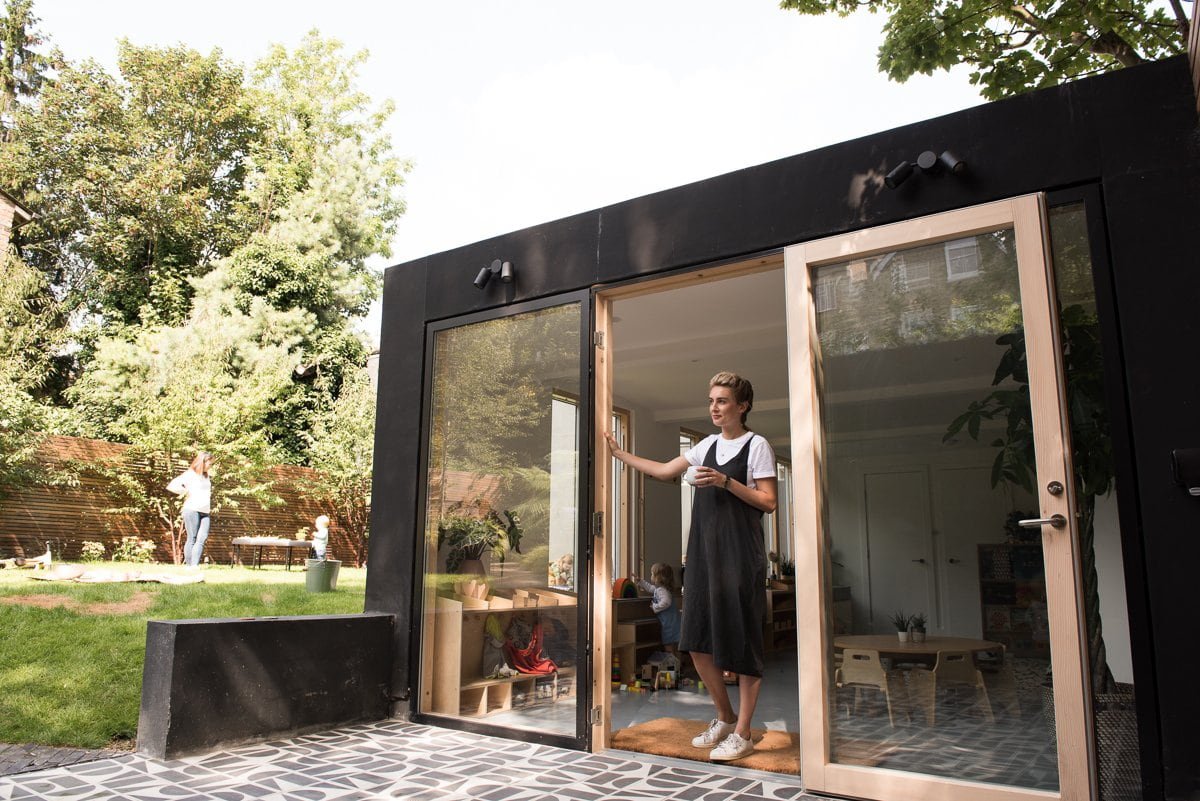
Photo by Catriona Campbell, used with permission.
For all the benefits, it’s clear that this model is difficult to sustain for a host of reasons, and ensuring living wages for child care workers and educators is chief among them. Amanda Munday founded The Workaround in Toronto, Canada, in 2018, after she observed the difficulties of finding and affording child care: “There were three-year-long waitlists and fees of $2,000 CAD per child!” (That translates to about $1,430 in U.S. dollars). Despite surviving through the pandemic, the business closed in 2023. Munday found the burden of carrying a commercial lease, insurance, and the principle of paying her staff fairly while offering flexibility to an audience of mostly single parents, freelancers, and part-time workers, heartbreakingly hard to reconcile. “This is a delicate type of organization to build,” she explained. “Care work is best done as a collective. You have to find the right staff prepared to work so collaboratively with parents—in a sector where these often marginalized and minority workers have not been treated so well elsewhere—and build the relationships over time. Community doesn’t happen the minute you open your doors; you have to earn it.”
“Care work is best done as a collective… Community doesn’t happen the minute you open your doors; you have to earn it.”
Munday found what others in any other child care model have found: Without a dedicated source of public funding to cover the real costs of providing child care, it is simply unworkable. As former U.S. Treasury Secretary Janet Yellen has said, “Child care is a textbook example of a broken market.”4 Relying on private-sector solutions or expecting already-strapped parents to shoulder the bulk of the cost for care has left the United States with a patchwork child care system where no one benefits: Most families pay nearly as much (or more) for child care as their mortgage or rent,5 many child care workers make poverty-level wages so low that they qualify for public assistance, and providers operate on razor-thin margins that keep their centers perpetually at risk of closing. The co-location model offers a structured solution for both employed and freelance people to organize their working day with commitment and accountability, all while simplifying their families’ routine with convenient child care. And if the relational benefits of proximity I heard about so consistently are nurtured, then both parties’ social and economic well-being can improve.
Citations
- Bryce Covert, “Pre-K Teachers Are Stressed and Say They Want to Quit,” The 74, June 16, 2025, source.
- Caitlin McLean et al., “Early Educator Pay & Economic Insecurity Across the States,” in Early ChildhoodWorkforce Index 2024 (Center for the Study of Child Care Employment, 2024), source.
- Center for the Study of Child Care Employment, Child Care Sector Jobs: BLS Analysis (University of California, Berkeley, September 10, 2025), source.
- “Remarks by Secretary of the Treasury Janet L. Yellen on Shortages in the Child Care System,” U.S. Department of Treasury, September 15, 2021, source.
- Chabeli Carrazana, “Paying More for Child Care than Your Mortgage? You’re Not Alone,” The 19th, June 23, 2025, source.
Part III. Challenges and Opportunities for Scaling Shared Sites
Addressing the Equity and Accessibility Challenges Across Gender, Race, Ability, and Class
In February 2025, remote work accounted for a quarter of paid workdays among Americans aged 20 to 64.1 The rate is consistently higher for parents of children under age eight, and for women. It’s crucial to note that the desired remote-working rates exceed actual rates in every major demographic group—just more so for women, workers with young children, and workers without college degrees.2 Throughout my research, I found that hybrid coworking spaces specifically designed for parents offered a feasible structural solution to the pressure to “return to the office.” And yet, barriers to the approach seem to be increasing with every return-to-office mandate.
Gender
Despite the loud headlines, office occupancy rates have not returned to 2019 levels.3 Calls to return to on-site working are often driven by narrow political and corporate interests.4 Daniella Cornue, founder of LeVillage, a coworking space with child care in Illinois and Wisconsin, calls return-to-office mandates like those from the Trump administration and major corporations “an attack on working parents.”5 She argues that coworking spaces with embedded child care offer a practical alternative solution that could help many parents reconcile their caregiving responsibilities with their work ones.
Remote work is a powerful driver of inclusion—it offers a diverse workforce with diverse needs the flexibility to support their families.6 And it urgently needs defending. Cornue’s solution proactively fights the “motherhood penalty” that has been shown to limit women’s careers and economic potential, and it also challenges the associated “fatherhood bonus” that often casts parenting as a positive catalyst in men’s work. Children are not the true barrier to meaningful paid work: It’s a matter of unequal relationships and gender expectations. The United States is truly an outlier in lacking systemic support for parents7 and needs the political will to act to close these gaps. The stakes are high: Over 200,000 women over the age of 20 left the workforce in the first eight months of 2025, according to the U.S. Bureau of Labor Statistics, while 44,000 men entered it.8 There’s been a steady, and now increasing, exodus of mothers, specifically.9 The labor force participation rate between January and June alone declined 3 percentage points for those with children under five. In previous years, flexible working policies directly correlated to women’s increased workforce participation, and now return-to-work policies and lack of child care are harming that trend.10
Race and Ability
Parents are not alone in their preference for flexible and remote work. According to one study, in 2021, only around 22 percent of women (Black and white) and only about 16 percent of Black men desired a return to the office.11 Instead, many preferred working remotely, free from the “identity labor” demanded by the institutionalization of male- and white-coding of professionalism that calls back to the office reinforce.12 A 2024 study of resumes across SpaceX, Apple, and Microsoft revealed that return-to-work mandates led to an exodus of talent.13 Many workers with disabilities or neurodiverse conditions prefer flexible and remote work, saying they’re better able to focus on getting work done and being productive.14 (And remote workers who moved to rural areas for quality of life helped breathe new life into their adopted communities.15 Many of those communities want them to stay.)
Class
When exploring the close tie between child care access and women’s workforce participation, I became hopeful that addressing the gap via practical care solutions embedded within physical workspaces might advance equity for other marginalized groups, too. Just as communities historically excluded from opportunity, such as people of color, rural families, and low-income households, are disproportionately affected by insufficient child care options, it’s likely that they also have more limited access to coworking spaces. Hourly, retail, and service workers and those in jobs not tied to desks and computers are less likely to be able to conduct work that’s not in-person: Compared to 36 percent of workers in management, and professional occupations working hybrid or remotely, just 5.5 percent of service occupations, 3.5 percent of construction and maintenance occupations, and 2.8 percent of production and transportation occupations work remotely.16 And those lines are often drawn along race and class. For instance, the U.S. Bureau of Labor Statistics data shows fewer Latinos working in the remote sector.17 Children growing up in homes with low incomes and children of color are less likely to be enrolled in formal child care and are more likely to have parents who work,18 but that work is less likely to be done with autonomy or remotely. It’s both ambitious and urgent that we address both of these problems.
Offering this model for low-wage and hourly workers will require creatively rethinking and repurposing community spaces. The Local Initiatives Service Corporation (LISC) is now researching underutilized neighborhood spaces nationwide, building on existing community development work to explore situating child care adjacent to other resources, as they have already piloted with elder and health care.19
Coworking, Care, and Community Development
After interviewing the founder of Switchboard, I learned that Indianapolis is the site of extensive community coalition-building in partnership with LISC, which saw particular success with its quality-of-life planning process there to bridge gaps in investment and projects in underresourced neighborhoods.20 This approach leverages the strengths and untapped potential of neighborhoods, appointing local leaders during the initial analysis to determine collaborative strategies and set goals. A culture of “adaptive prosperity” was established, which led to tactical investments to boost community assets.21
To advance the potential of the coworking-plus-care model as a lever for equity, further research might consider developing an “impact calculator” that could build on recent work by LISC on co-locating child care with community development projects to evaluate key metrics of ongoing success for the approach.22 LISC has collated examples of projects where child care provision is part of broader community revitalization efforts with research into long-term outcomes for children. In the same vein, Brilliant Cities has initiated an exemplary neighborhood stakeholder-led approach to revitalizing locales with early years care and education at the heart of the model.
This model offers the opportunity to reinvent in-home child care.23 One avenue might be through hosting parents on-site, while also exploring the use of flexible shared spaces such as community centers, retirement homes, and libraries, as some recent research has explored. The Aspen Institute’s Ascend Network, which reaches over 15 million families via its 600 organizations, is also dedicated to finding specifically intergenerational solutions for family prosperity and well-being, could offer another venue for further research.24 A senior volunteer program at Heinsch House (a coworking space with child care in Atlanta, Georgia) is already embracing a third generation of on-site child care.25
Tackling Founding Challenges and Building Awareness
Establishing a co-located care and work solution isn’t easy. All of the female founders I interviewed spoke of the tenacity required to establish businesses that bridge zoning regulations or don’t fit neatly into a single known category. Many of the settings actually fly beneath the radar of licensing because the parents are on-site and child care supervision is provided in three-hour blocks. However well-intentioned the regulations, this circumstance is ironic because the proximity and access to their children (often with background checks on the coworking adults) proved to be more reassuring for many parents than the stringent safeguarding and state-level inspections that accompany scaled, center-based child care. A further irony is that these founders may have figured out an ideal set-up for many families, but because their hybrid spaces are unlicensed, they are often ineligible for many funding streams.
There are several areas of deeper study required to round out the case for co-located work and care. First, awareness of alternative and experimental models is generally low. The foundational importance of the first 1,000 days of life—and the importance of support for parents and quality care partnerships—is finally being championed more widely. Awareness-raising campaigns to valorize early years caregivers are needed because the essential pipeline of recruitment and training is under threat. Relatedly, empowerment of business owners and entrepreneurs in early childhood is possible via blended and braided public investment (block grants for owners and tax credits for parents) and responsible employer program approaches.26 The opportunity to reimagine physical spaces for integrated work and care is ripe, too—for example, through partnerships with urban planners, architects, or designers.
The success stories provided in this report could inspire models for scaling the potential in the nonprofit and private sectors, where capital could flow from investors, philanthropy, the public sector, and from parents who could afford memberships, to enable wider access on a sliding scale for more families in neighborhood wrapped-service hubs. In some cities where the model had been tested, I found new co-located sites seemed to pop up from there, indicating that local awareness-raising of the model could encourage more entrepreneurs to develop their own version and serve even more families.
Public Investment in Child Care Is Needed to Give Families Choices
Without public investment for child care in the United States, parents are often left to their own devices in trying to create their own, better care solutions. Grassroots solutions are precious because families invest so much faith in partnerships during their child’s earliest days. From my conversations, it seemed that this is why families are increasingly turning to the neighborhood model, relying on local help because there’s often more trust and it’s cheaper. An effective child care system gives parents a choice of centers; home-based, faith-based, or secular settings; and trusted caregivers. Employer-sponsored benefits unfortunately tend to focus funds on one type of care and often disproportionately flow to large for-profit child care chains (who regularly lobby against public investment to protect their own interests).27 As author and policy expert Elliot Haspel puts it, “Employers are not a sustainable core solution for the problem of child care…Public or social goods are simply not delivered through the employer-employee relationship.” Haspel proposes that employer-based taxes or direct investment in care infrastructure simply work better.28
The coworking plus child care model offers fresh evidence that functioning social safety nets translate to economic advantage because preventing absences for caring duties is usually cheaper than lost productivity. Situating work in closer proximity to children instead of the employer site can allow parents to be both productive and present.29 What’s more: Reducing economic inequality translates to greater national happiness.30 And yet, despite the business case that shows how child care efficiently raises labor supply, especially for women, workers have found themselves vulnerable when programs get withdrawn for cost-engineering or benefits “lock” them into one approach.31 Worse, employer subsidies do not address systemic issues like an unstable workforce and “child care deserts,”32 nor do they reach all workers. Data on the hemorrhaging of women’s talent from corporations when return-to-office is demanded also correlates with the lack of public investment in child care.33
If we believe that the well-being of all children is society’s shared responsibility, then policy must support that belief—and yet many observers contend that this vital dimension of how we structure our society has come up short. Policy reflecting what families want and need has been set back and sidelined for decades, thrusting the United States into an even lonelier hinterland compared to other developed nations’ standards for investment in child care.34 Leading experts agree that public investment cannot be postponed any longer.35
An overwhelming majority want the government to take action on child care, seeing it as a good use of federal funds, according to data from First Five Years Fund and UpOne insights from March 2025.36 There’s no real solution without permanent public funding, which is how every other country makes child care work—following the percentage-of-GDP norm for the ratio of investment.
Exploring Community Solutions to Bolster Sustainability
While the idea of co-locating workspaces with child care seems simple, it can be a complex business to organize and run. Owners must find a way to accommodate the ups and downs of family life (appointments, illnesses) and work (leave allowance, reducing hours) and still turn a profit, or at least break even. To address this challenge, many settings offer a dynamic menu of options, such as The Office in Minneapolis, Minnesota, for example, where options include flexible Friday access to workshops and a happy hour, as well as day passes or “full access” memberships.
Another challenge to sustainability is simply the fact that families grow and change over time. As I’ve shared in this report, many of these businesses started to meet the needs of the founders’ own families. Once the child or children they built their business around move out of child care and into school, their reason for being is often gone. That’s what happened at Playhood, where my son and I shared work and care. When founder Karen Partridge’s children aged out of child care and the family decided to move out of the city, she decided to close Playhood. It had served the purpose she needed. So for some founders, this is a temporary solution by design. But I began to see how a long-term sustainable model is possible if the founder wants to continue serving local families by building other kinds of services into their business plans.
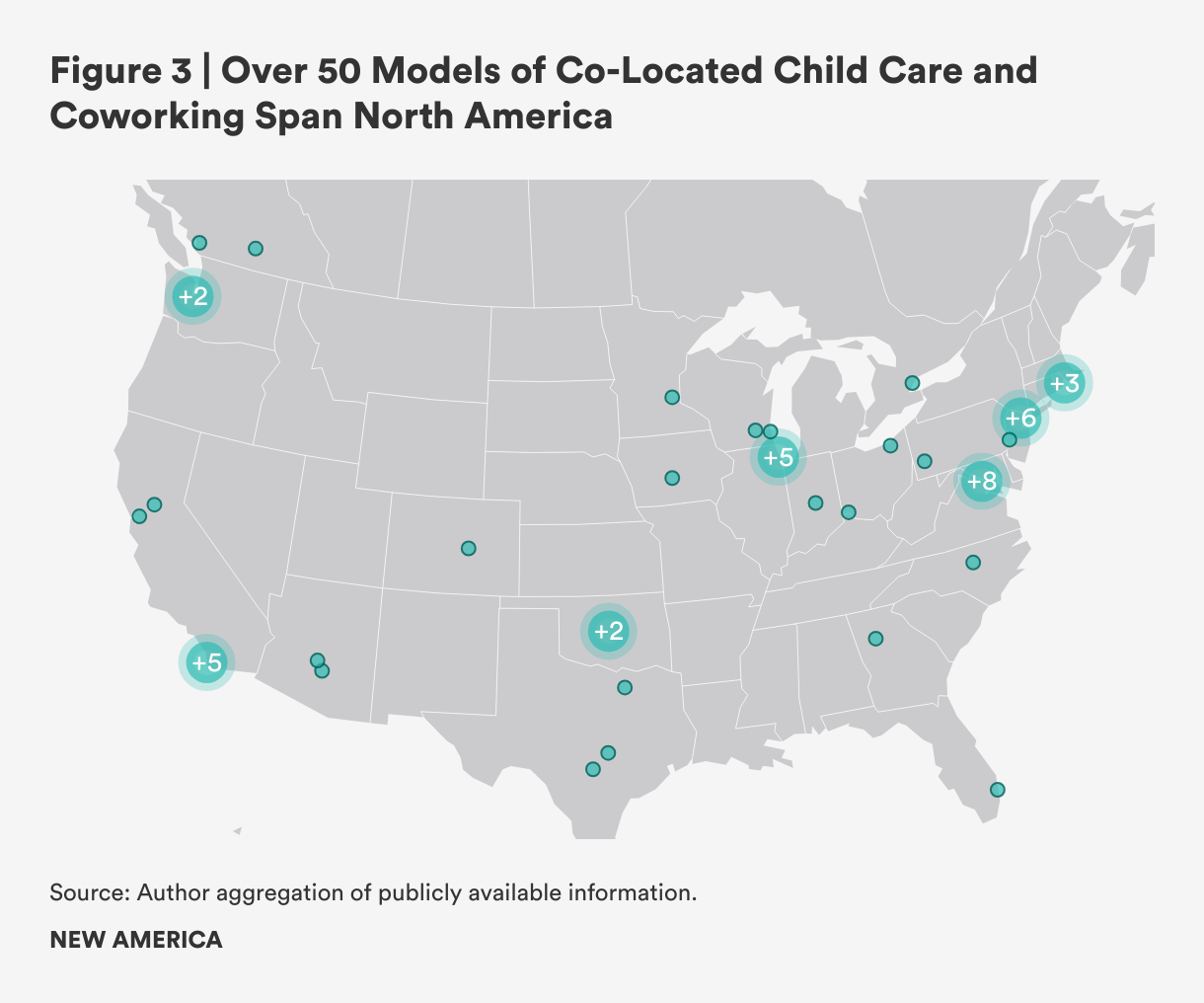
I’d seen the treatment rooms model at OneSpace in Vancouver, Canada, akin to Bloom’s local business-boosting approach. Then I found CoPlay in San Antonio, Texas. Founder Deepika Mittal is seeking to accommodate local businesses looking for premises near potential customers—for example, speech pathology, yoga, college-readiness, and other tutoring services. Mittal told me she wants to simplify families’ suburban journeys and serve all stages of parenting: Following the need for on-site care of preschoolers often comes the need for afterschool and vacation time camps for older children. Co-located enterprises like Lola+Tots in Brooklyn, New York, offer wraparound programs and camps as a natural evolution of their business model. At ProducKIDvity’s community in British Columbia, Canada, 75 percent of their community now uses their extended hour and weekend enrichment options. A similar plan to generate incremental revenue via tiered memberships beyond daily coworking and child care also launched at Workplayce in Manhattan. (See Figure 3 mapping these co-located child care and coworking sites across North America.)
When I contacted the founder at Workplayce and then at Collective Kind (also in New York City), I learned of lively programs of workshops, support, and networking for parents, too. And that once their first location was proven to be viable, the same realtors and investors who’d initially hesitated came knocking, offering new sites. I observed that co-location rarely stayed in its “lane”—that is, it rarely remained just a room for parents and a room for children. Rather, several hybrid spaces played host to coalitions of small businesses and events for valuable community connection and support, too.
I also heard from a number of founders about the challenges of expanding—that a coworking with child care proposition offering “flexibility” made investors and realtors nervous, and that some automatically assumed that dual-proposition businesses and child care are risky, operationally and financially. Anna Raborn and Debbie Lee ran a coworking space with child care in their Boston neighborhood during the pandemic, and have now turned to offering support to others integrating child care on-site in a consultancy called Hopscotch Labs. They told me they’d seen clear cases of “bias against founders of hybrid businesses and child care operators.” Yet many founders I met revealed that the initial idea of co-location often leads to the unlocking of additional revenue streams beyond fees alone. The uniqueness and flexibility of spaces for adults and children alike have led some to rent out their premises for events outside of working hours, like Pillar in Lafayette, California, and The New Haven in San Diego, California (which also offers parenting coaching and courses), among others. Some found that sharing space with neighborhood, health, and other relevant services can be a stable, lucrative model. In Watertown, Wisconsin, The Collective offers space to nonprofit service providers so families can “access wraparound supports in one, convenient location,” as their website phrases it, along with office space and professional development initiatives—and an early care and education center for up to 126 children.
Creating Peer Networks to Refine and Expand the Model
The simplest thing we can do to explore the potential of the co-location model is to connect, celebrate, and support those already doing it. To scale up and further support these existing spaces, I propose convening a peer network that could potentially grow into a conference, directory, networking, and mentorship platform—one that shines a light on what’s being learned in the field. I’m hopeful the interest among several interviewees in making connections with other founders will gain momentum, and there are avenues of potential partnership with early childhood academics and innovators and neighborhood development organizations. While there is local nuance in every founder’s story shaping the unique settings I’ve evaluated, there are so many areas of common ground for owners of these co-located settings and their members. Across sites, founders experienced similar early missteps, indicators of success, and outcomes that boosted families’ resilience and reduced barriers between work and care. But there could be a strong and united voice tying these discrete efforts together—to push the advocacy work forward, campaign for investment, and enable more and more entrepreneurs to enter this space and connect.
Compiling evidence and sharing knowledge is critical. In this global space of child care and work, it seems there’s only an Instagram chat group for a handful of the commercial co-located settings so far. An assembly could join hands with those in the care movement to share resources (a la Eve Rodsky’s Fair Play) or take inspiration from the Impact Hub model for ongoing communication, research, and impact measurement.
Citations
- Shelby Buckman, Jose Maria Barrero, Nicholas Bloom, and Steven J. Davis, “Measuring Working from Home,” National Bureau of Economic Research Working Paper 33508, February 2025, source.
- Zoe B. Cullen, Bobak Pakzad-Hurson, and Ricardo Perez-Truglia, “Home Sweet Home: How Much Do Employees Value Remote Work?,” National Bureau of Economic Research Working Paper 33383, January 2025, source.
- Brian Elliott, “The Great Office Divide,” The Work Forward, March 26, 2025, source.
- Moira Forbes, “The Cost of Corporate Inflexibility: Reshma Saujani on the Risks to Working Mothers,” Forbes, March 11, 2023, source.
- Daniella Cornue, “Blending Coworking and Child Care,” interview by Jamie Russo, Everything Coworking, January 21, 2024, source.
- Data from the “Implications of Remote Work” conference, Stanford Institute for Economic Policy Research, September 17, 2023, source.
- Vivek H. Murthy, Parents Under Pressure: The U.S. Surgeon General’s Advisory on theMental Health and Well-Being of Parents (U.S. Department of Health and Human Services, 2024), source.
- Bureau of Labor Statistics, “The Employment Situation—September 2025,” U.S. Department of Labor, September 5, 2025, source.
- Alana Semuels, “Why So Many Women Are Quitting the Workforce,” TIME, August 4, 2025, source.
- Brian Elliott, “The Flex Index,” Work Forward, October 2025, source.
- Angelica Puzio, “Who Wants to Return to the Office?,” FiveThirtyEight, August 11, 2021, source.
- Angelica Leigh and Shimul Melwani, “Am I Next? The Spillover Effects of Mega-Threats on Identity Threat, Identity Labor, and Withdrawal,” Academy of Management, July 26, 2021, source.
- David Van Dijcke, Florian Gunsilius, and Austin Wright, “Return to Office and the Tenure Distribution,” University of Michigan, May 8, 2024, source.
- Danielle Abril, “The Workers Who Feel Left Behind,” Washington Post, April 19, 2025, source.
- David Fulton, “How Return-to-Office Mandates Are Quietly Reversing Rural America’s Recovery,” LinkedIn, April 1, 2025, source.
- “Current Population Survey: Telework or Work at Home for Pay,” Bureau of Labor Statistics, tables retrieved May 12, 2025, source.
- Connor Borkowski and Rifat Kaynas, “Telework Trends,” Beyond the Numbers (blog), Bureau of Labor Statistics, March 24, 2025, source.
- National Academies of Sciences, Engineering, and Medicine, Monitoring Educational Equity (National Academies Press, 2019), source; Linda Smith, Brittany Walsh, Victoria Owens, et al., Building Bipartisan Support for Child Care Toolkit: 2023 Update (Bipartisan Policy Center, February 16, 2023), source.
- “Building Innovation for Child Care,” Local Initiatives Service Corporation, source.
- James Capraro and Joel Bookman, Building Sustainable Communities: Moving from Quality-of-Life Planning to Implementation (Local Initiatives Service Corporation, October 31, 2014), source.
- Capraro and Bookman, Building Sustainable Communities, source.
- “Launch of the Child Care Co-Location Impact Calculator Tool,” Local Initiatives Service Corporation, July 15, 2024, source.
- “Rural Homes Early Childhood Initiative,” Rural Homes Colorado, source.
- “The 2GEN Approach,” Ascend Aspen Institute, source.
- “Senior Volunteering,” Heinsch House, source.
- Emmy Liss, “Blending and Braiding to Build an Equitable Early Care and Education System—Lessons from New York City,” Children’s Funding Project, March 21, 2023, source.
- J.D. McMurray and Julia Carpenter, “Can Child Care Be Big Business?,” New York Times, December 16, 2022, source.
- Elliot Haspel, Questioning the Promise of Employer-Sponsored Child Care Benefits (New America, February 22, 2024), source.
- Emily Kos, Kelsey Clark, Nicole De Santis, and Tyler Joseph, Child Care Benefits More Than Pay for Themselves at U.S. Companies (BCG, March 26, 2024), source.
- Madeline Fitzgerald, “Americans Are Unhappy. Here Are the 5 Happiest Countries in the World,” Quartz, March 20, 2025, source.
- Kos, Clark, De Santis, and Joseph, Child Care Benefits More Than Pay for Themselves, source.
- “Child Care Sector Jobs,” Center for the Study of Child Care Employment, September 10, 2025, source.
- Jane Their, “‘The System Is Not Working for Women’: Companies with Return-to-Office Mandates Are Hemorrhaging Female Talent,” Fortune, July 23, 2024, source.
- Elliot Haspel, “The Aftershock Child Care Disaster of 1975,” Family Frontier, March 4, 2024, source.
- Rachel Cohen Booth, “This Workplace Benefit Is Helping Parents—and Boosting Businesses. Could It Backfire?,” Vox, February 26, 2025, source; Robin Buller, “How Did Child Care in the U.S. Become So Absurdly Expensive?,” The Guardian, March 24, 2025, source.
- “New Poll: GOP Voters Call on Congress, White House to Act on Child Care,” First Five Years’ Fund, February 12, 2025, source.
Conclusion
A seemingly utopian vision for a “community of opportunity” comes into focus when you spend time in spaces that integrate early childhood education, care, and work. The model’s benefits are seemingly limitless: It could empower and lift up child care workers who often go undervalued and underpaid; provide parents with reliable, quality care support and greater well-being; build relationships and mutual aid networks; and plant the seeds for even greater feelings of belonging and civic engagement.
Achieving fair and fulfilling work alongside quality, safe, and nurturing early childhood care in more connected neighborhoods is possible. It requires embracing work as integrated and distributed, and elevating and acknowledging child care as an uncompromising public good, built around loving, consistent care delivered collaboratively.
Blending workspaces with early childhood care and education is greater than the sum of its parts: Yes, it is convenient. But more importantly, it can free up space and time for stronger local relationships, foster social cohesion, and show the next generation what it looks like to have real autonomy and agency in how we work and live.
If you’re interested in exploring opportunities for child care and work co-locations in your area, or finding out more about how to support the development of a care–work network and pilot programs, please contact Georgia Norton.
More About the Authors

Georgia Norton
Journalist and Researcher