Centering Racial Equity in PIT Work: A Panel Discussion
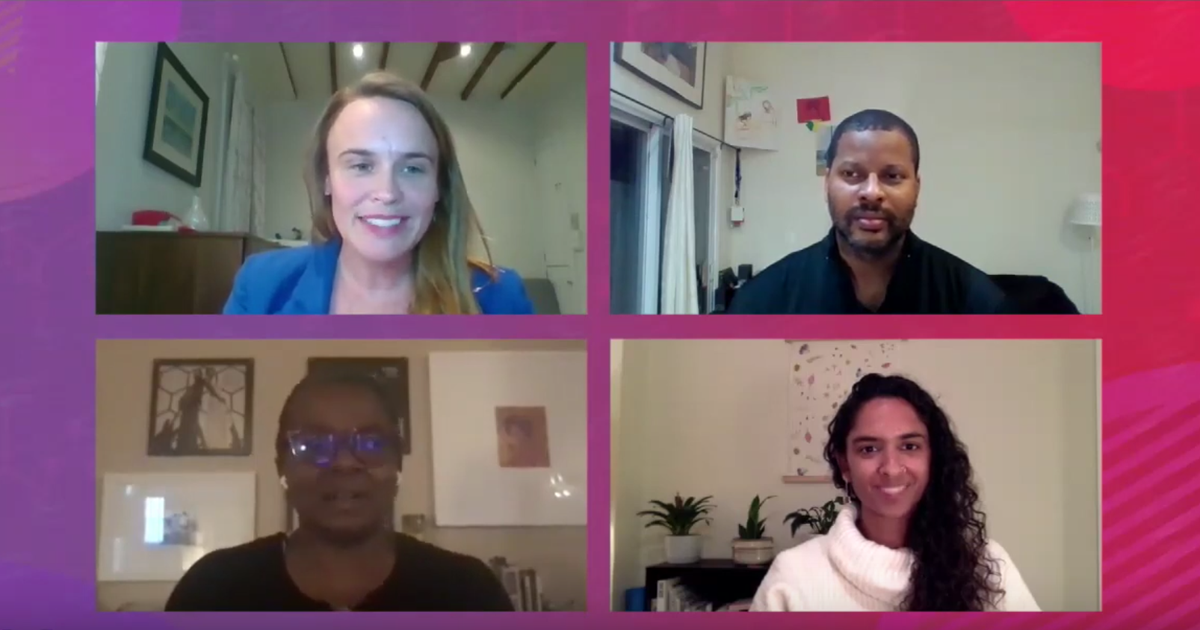
This summer members of New America’s New Practice Lab spent eight weeks interviewing Black and Latinx workers who lost jobs due to the Covid-19 pandemic. The topic: their experiences navigating the unemployment insurance system. Elizabeth Garlow, the deputy director of New America’s New Practice Lab (NPL) and Vivian Graubard, the senior advisor for the Public Interest Technology program, as well as the rest of the NPL found rampant racial inequities and biases. That work was the basis of the Public Interest Technology University Network’s 2020 Convening keynote, Centering Racial Equity in PIT Work.
The panel brought together experts in the field of unemployment benefit issues in Black and brown communities including former New Practice Lab fellow Monée Fields-White, AFL-CIO’s Working America Matthew Morrison, and Umbreen Qureshi, a designer at Civilla.
Garlow started the discussion with a call to arms: Increasing access to unemployment insurance in a way that centers racial equality in that work. “We believe that — whether automated or manual — racism and bias must be rooted out of all processes especially when they are being used to determine someone's ability to receive critical benefits,” she explains. “Marginalized communities and communities of color have so often had to navigate a system that not only was not designed for them but is also designed often to penalize them.”
Morrison, executive director of Working America, the community organizing arm of the AFL-CIO union added that, among eligible workers, very few Black and brown people even file for unemployment benefits.
“We've come to this project more recently focusing on trying to answer this really simple question. In the last major recession back in 2007 Black workers who were otherwise eligible for unemployment insurance only 26 percent of them filed and collected those benefits,” he says. “What we've done is try to bring all of our organizing skills, all of our observations, all of our analytics, to bear and [dissect] why is this happening. People need the income in their lives. Why aren't they applying? What are the impediments? How do we help build community that moves them past that in a specific way that is measurable and therefore replicable?”
His team found that the fact that one issue may be that a large percentage of Black and brown workers are part of the gig economy. This presents a problem since filling out UI benefits forms requires workers to provide work history going back 18 months.
“They have to go back 18 months and find every single piece of information for each of the jobs that they've worked. When they started, when they ended. They need to know their employer information, their EIN numbers, which often isn't given to them [so] they have to find it on a W-2,” he explains. “Once they do that they need access to their employer who has to approve these for them. What we’re finding is that this becomes a massive complicated web people are having to navigate on their own.”
Morrison points out that applicants have so many hurdles to pass before they can gain access and his team has seen people who have been eligible for full benefits having to wait 20 or even 30 weeks before they got paid. One example was an anecdote about people with “funny-sounding names” who are subject to greater scrutiny than someone with a more generic-sounding name. He also points to specific job sectors that are less efficient and effective when it comes to helping laid off staffers access the UI system.
Indeed, even when they do apply, they may be thwarted at every step of the process, agrees Qureshi of Civilla, a non-profit, human-centered design studio based in Detroit.
“Black and Latinx communities pointed to difficulty navigating applications as one of the biggest barriers to entry of unemployment [insurance benefits]. What Civilla has been doing over the past four years is really understanding what the basis of these applications is and how are they affecting people's access to benefits,” she says.
All of the panelists discussed how public interest technology can help improve access to critical services and benefits as well as redesigning policy. The discussion closed out with insights from Fields-White, who conducted the bulk of the interviews over the summer. She gave real world examples of people who have been unable to access the system over the short and long term and how their experiences can (and should) inform public interest technologists and their work. In the end, though, she and the rest of the experts say we may need to start from scratch to fix these problems.
Added Fields-White: “You can fix websites. You can add staff to deal with the volume of calls but at the end of the day the system itself is still broken by design. When you look at the work search requirements, when you look at African Americans being the ones who have the longest duration of being on unemployment, those things start to come into play,” she says. “And then you throw in the digital divide where Black and Latinx families are less likely to have wi-fi or a computer at home and if they are accessing these websites they're accessing them via their mobile phones and most of those sites are not mobile-friendly…if you're not dealing with the actual systems and the external factors that impact that system you're not really making much change.”
To watch the entire panel and hear more about how public interest technology practitioners can get involved in solving the UI dilemma, click here.
More About the Authors
Issues
Programs/Projects/Initiatives
Topics
Related

Executive Branch Announces $100M in New Funding for Public Interest Technology

New Report on Latines in Tech Underscores Need for PIT Pathways
Beyond Elections: PIT & Civic Engagement