Table of Contents
- Introduction
- Chicago: Centering Residents in Neighborhood Development Decisions
- Gainesville: Protecting Historically Black Neighborhoods During Development
- Milwaukee: Youth Organizers Lead the Way on Reforming Public School Safety
- Bushwick: A Community Collaborates on a Zoning and Development Plan
- Colorado: Innovation and Persistence on Paid Leave
Bushwick: A Community Collaborates on a Zoning and Development Plan
We are grateful for the collaboration and support of Betsy MacLean from Hester Street. This case study draws heavily from the Bushwick Community Plan, which can be accessed here.
Introduction
In 2013, members of Brooklyn’s Community Board Four began to notice incongruous real estate development in the Bushwick neighborhood. Luxury and high-rise apartment buildings were appearing in a neighborhood of affordable two- to four-story apartments. The Community Board brought their concerns about this development trend, which threatened not only the built character of the neighborhood but also the tenure of long-time residents who could not afford rising rents, to City Council Members Antonio Reynoso and Rafael Espinal. Zoning in the neighborhood—in which Bushwick had only one designation for the entire neighborhood, commercial corridors, and residential side streets alike—created a loophole for developers to buy up adjacent low-slung buildings and build a tower on the merged lot. This led to standalone towers on residential side streets and an influx of high-income renters, fueling a broader trend of gentrification and resultant displacement in the area. In the hopes of closing the development loophole and creating the conditions for long-time residents to stay in their neighborhood, the council members initiated a community-driven process to develop a comprehensive plan for equitable neighborhood development.
The Bushwick Community Plan is the result of collaboration among local residents, community groups, elected officials, and city agencies. The process used to create this document represents a novel model in community planning. Typically, the city and community groups engage in an antagonistic process where they develop separate plans in parallel and then negotiate adversarially. In Bushwick, by contrast, local residents, community groups, city agencies, and elected officials worked side-by-side from the outset to co-develop a plan founded in the community's priorities that also took into account real-life policy and resource constraints. This plan is representative of a co-governance approach to neighborhood planning and development—one in which communities play a leadership role in identifying problems and developing solutions, grappling with tough trade-offs, and engaging with the government as collaborators.
The Bushwick Community Plan is a comprehensive vision for the neighborhood’s future, which includes strategies for protecting existing affordable housing, increasing opportunities for new, deeply affordable housing, improving infrastructure, and increasing economic opportunities. It is intended to communicate local priorities to decision-makers, while also aiding community organizations in their work and educating local residents on ways in which they can become engaged in local issues. This is a living document and is not the final word on the community’s growth and development.
Bushwick’s dynamism is what has led so many people to call it home. The neighborhood has changed over the years, but has maintained a deep commitment to its community. It is that commitment that serves as the guiding force for this plan. The strength and effectiveness of this plan will ultimately depend on local power to implement and sustain it over the long term.
Why Does Bushwick Need a Community Plan?
Bushwick’s central location, public transit infrastructure, and proximity to the increasingly gentrified neighborhood of Williamsburg have combined to make the neighborhood evermore attractive for real estate investors and an influx of a more affluent new population. By many measures, the Greenpoint-Williamsburg area has experienced the most rapid and significant transformation since the year 2000 of any neighborhood in New York City. The 2005 rezoning opened a huge swath of the historically industrial East River waterfront to high-density residential development, greatly accelerating the economic and demographic change already underway. From 2000 to 2015, the median income of Greenpoint-Williamsburg rose from $39,550 to $67,830, and the percentage of apartments renting at $2,000 a month or higher rose from less than 1 percent to 40 percent.1
Over several decades, Bushwick has become a community of predominantly Latinx immigrant families. In 2016, 84 percent of Bushwick households were renting and 51 percent were experiencing rent burden, paying over one-third of their income toward housing.2 Only 16 percent owned their homes.3
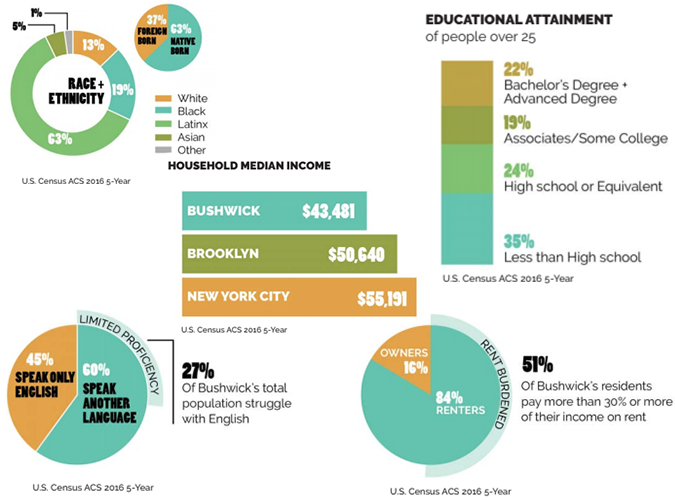
These graphics and images were sourced from the Bushwick Community Plan.4
The dramatic changes in Greenpoint-Williamsburg have had ripple effects on all surrounding neighborhoods. The area of Bushwick Community Board Four is especially poised for significant new residential development: No rezoning action is necessary to open Bushwick to an influx of market-rate residential construction. Since 2008, over 5,000 new units of housing have been built in Bushwick’s R6 zoning—a designation that allows a developer to build new housing without any height limit or requirement for affordable housing.5
A major result of this has been the creation of out-of-scale buildings, often in the middle of a block, as developers take advantage of Bushwick’s strengthening real estate market. These shifts are not only compromising the physical character of the neighborhood, previously distinguished by mostly two- to four-story buildings, but also the lived experiences of long-term residents. Landlords are pushing residents out of rent-stabilized apartments, small business owners are struggling to keep their roots in the neighborhood, and trains and buses are more crowded than ever. Rents in Bushwick are climbing at a steep rate as people with higher incomes move into the neighborhood.
According to an analysis by the Association for Neighborhood and Housing Development (ANHD), as many as 7,000 more market-rate housing units could result from Bushwick’s current zoning if no action is taken, spread throughout the neighborhood with no regard for the scale of existing buildings. Thanks to R6, a uniform zoning designation that has been left untouched since 1961, the neighborhood is moving along a clear trajectory toward gentrification, disruption, and displacement.
Community plans have the power to address these zoning-related issues, as well as other housing and real estate considerations that affect resident communities. Without community planning, those 7,000 new units in Bushwick would also lack additional open space, commercial space, industrial space, community facilities, or other forms of infrastructure and investment to help the neighborhood keep up with the growth.
There is precedent in New York City for the formation of community plans to address proposed rezoning. In 2015, East New York residents and community-based organizations created a community plan in response to the city’s rezoning plan. In 2016, groups and residents in East Harlem similarly created a community plan–this time in advance of an anticipated city rezoning.
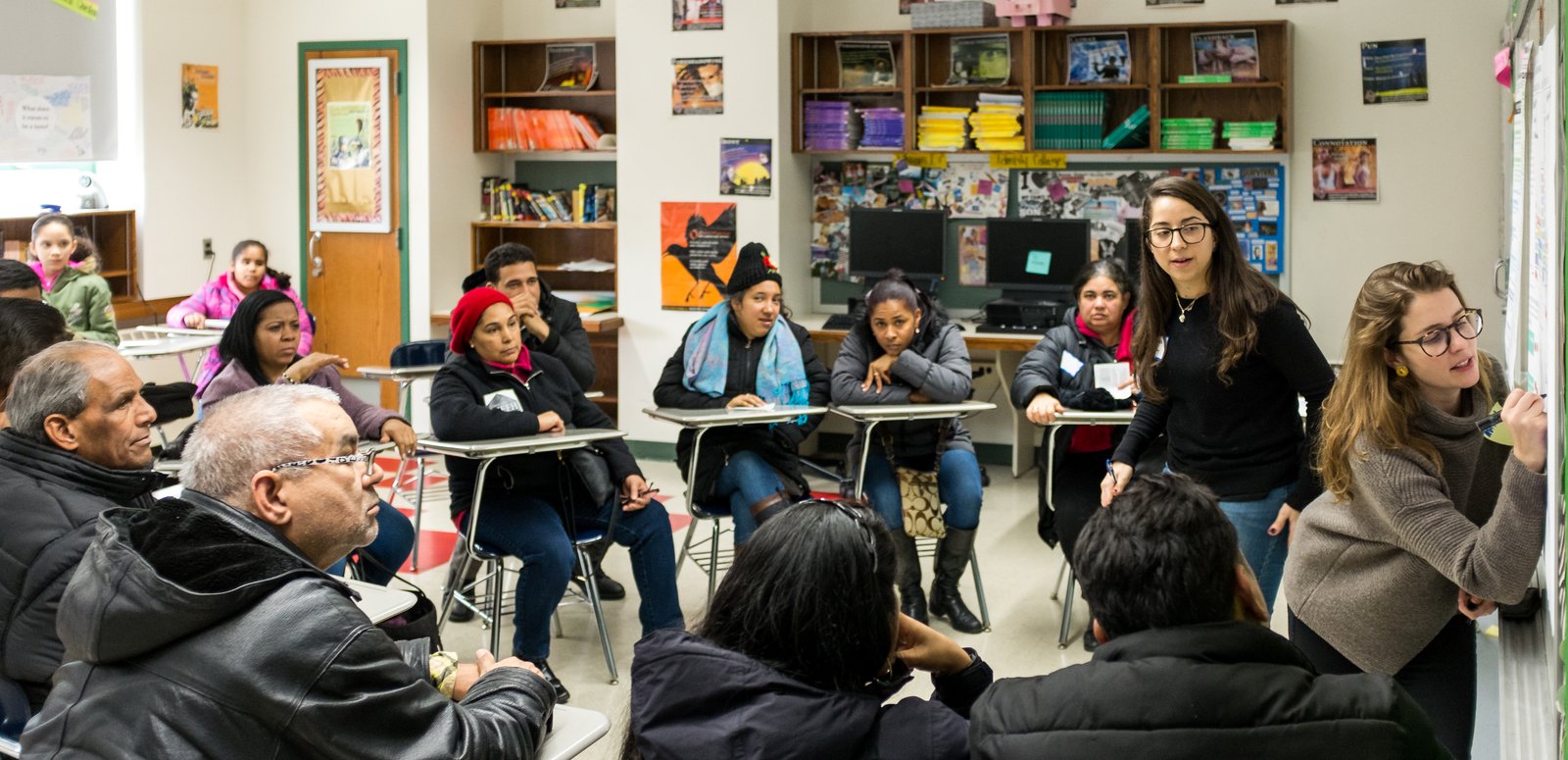
The Bushwick Community Plan is different from many community plans because, from the beginning, it stemmed from a partnership among city agencies, organizations, and residents. Although at this point, city agencies have distanced themselves from the process, the work prior to the winter of 2018 was collaborative. Even in its current form, the Bushwick Community Plan is different in that it has included several community-based organizations, city agencies, elected officials as well as residents. Aside from the city agencies, the remaining stakeholders are continuing to work together with the hopes to re-engage city agencies once again through a rezoning process that reflects the priorities of the Bushwick community, as identified in this plan.
The outcome reflects agencies’ and residents’ combined local knowledge, priorities, analysis of trade-offs, and long-term vision. This is especially evident in some of the programs and policies that the Department of Housing Preservation and Development have amended and established since the drafting of the housing recommendations in this document.
Bushwick deserves investments from the city to preserve existing affordable housing, upgradeinfrastructure, and improve employment opportunities and neighborhood services. Rather than reacting to real estate plans and playing catch-up, a proactive plan like this one can help the community determine its own future.
The Planning Process
The community plan’s story started in 2013 when members of Community Board Four noticed out-of-context development appearing in the neighborhood and approached the two local city council offices and the Department of City Planning to request a rezoning. Community boards are local representative bodies of 50 unsalaried members appointed by the respective borough president, half of whom are nominated by city council. Soon after, Council Members Antonio Reynoso and Rafael Espinal initiated a community-based planning process, inviting residents and local organizations to create a vision for Bushwick’s future. This group met to identify top-priority neighborhood issues and develop potential solutions to meet these challenges, eventually becoming a steering committee.
The council members convened over 10 community meetings throughout 2014 and early 2015 to discuss zoning, existing conditions, goals, and community visioning on issues such as housing, open space, and economic development. These events included four visioning town hall meetings with over 200 participants, five zoning workshops, and three meetings on specific priority issues. Based on feedback from the town halls, the two council members—together with the Departments of City Planning (DCP) and Housing Preservation and Development (HPD)—launched a planning and zoning study to guide the future of Bushwick. In the summer of 2016, the council members invited Hester Street Collaborative, a community planning, design, and development nonprofit, to provide structure and facilitation to the process.
The plan’s steering committee iterated with community members on a neighborhood vision, challenges, and recommendations, with the support of six issue-specific subcommittees. Subcommittee membership was open and inclusive; each subcommittee included relevant city agencies, local advocates, and residents. The subcommittees all reviewed the priorities from the 2014–2016 town halls and worked with relevant city agencies to craft objectives and recommendations that addressed the neighborhood’s needs. Subcommittees organized large public summits in 2017, during which they informed Bushwick residents about existing and planned resources and programs and solicited input on community plan recommendations.
This process was truly a joint effort. Council members, the City Council Land Use Division, and until February 2018, representatives from DCP and HPD played important roles. An executive committee provided strategic leadership and process oversight; its members were community residents, organizational representatives (from Make the Road New York, Churches United for Fair Housing, Brooklyn Legal Services Corp. A, and RiseBoro Community Partnership), and Brooklyn Community Board Four leadership. Hester Street provided structure and facilitated the planning process. The result is a plan that is collaborative, holistic, and grounded in community vision.
Outcomes
The wide-ranging group of residents, agency staff, elected officials, and community-based organizations that developed the Bushwick Community Plan successfully ran a deeply collaborative, generative process. Though there was clear disagreement and continuous tensions along the way, the broad team of community members, local city council members, and agency officials also discovered alignment along with many steps of this journey.
The comprehensive planning process surfaced the following key community priorities that guided the process:
- Be proactive and intentional about how and where development happens;
- Create affordable housing;
- Develop new tools to preserve existing affordable housing;
- Increase opportunities for small businesses in Bushwick; and
- Work closely with city agencies to direct resources to the community for open space, infrastructure, transportation, and other neighborhood needs.
The process resulted in a series of recommendations in seven areas: housing, zoning and land use, historic preservation, economic development, open space, community health and resources, and transportation and infrastructure.
A critical leg of this collaboration came after the community plan process ended. At this point, all those who participated in creating the community plan are poised to ensure it moves to completion and implementation. If no rezoning recommendations are carried out, the current rate of development will be destructive for the community; as many as 7,000 market-rate housing units could be built without the construction of a single affordable unit. Clearly, this path will fail to meet locally-identified goals for affordability, infrastructure, and open space.
The Bushwick Community Plan is the product of deep collaboration across government and community groups that was created through an inclusive and comprehensive process. The plan includes proposals to create and preserve affordable housing, while also considering the broader needs of the neighborhood, according to the people who live and work there. The process was innovative among NYC rezoning plans in that both community and city stakeholders shaped it together from the beginning, and numerous ripple effects will emerge from this effort, including strengthened community-city relationships and long-term civic engagement among them.
Citations
- U.S. Census Bureau, American Community Survey 5-year estimates. Census data for Greenpoint-Williamsburg PUMA cited in the Bushwick Community Plan.
- U.S. Census Bureau, American Community Survey 5-year estimates, retrieved from Census Reporter Profile page for NYC-Brooklyn Community District 4–Bushwick PUMA, NY, 2019, source.
- U.S. Census Bureau, American Community Survey 5-year estimates, retrieved from Census Reporter Profile page for NYC-Brooklyn Community District 4–Bushwick PUMA, NY, 2019, source.
- Bushwick Community Plan, (New York, NY: Hester Street, September 2018), source.
- Bushwick Community Plan