
Unleashing_Worker_Power_Building_Good_Jobs_Beyond_the_Traditional_Workforce_FI_n2Zk7pU
Abstract
The Good Jobs Collaborative (GJC) is an evolving collaboration focused on transforming the nation’s workforce development system to advance economic justice, racial and gender equity, workers’ needs, and worker voice and power. Over the past year, we have identified and learned from projects where workers are improving jobs through organizing, policy work, workforce training, job restructuring, and more.
We feature three of these cases here: the Healthcare Career Advancement Program (H-CAP), a national labor-management organization; the Restaurant Opportunities Centers (ROC) United, an organization of more than 65,000 restaurant worker members; and the Milwaukee Area Service and Hospitality Workers Organization (MASH), an organization of more than 1,000 service and hospitality workers.
We hope that these cases will inspire interest, innovation, and concrete policy action to build a workforce development system that centers workers, tears down inequity in our labor markets, and raises the quality of jobs for all.
Acknowledgments
We would like to thank the Bill & Melinda Gates Foundation for its generous support of this research. Views expressed here do not necessarily reflect positions or policies of the foundation. This research report is the first in a series from the Good Jobs Collaborative, a diverse coalition that brings policy experts and worker advocates into conversation on how to build a workforce development system that is responsive to the needs of workers first. The report was originally published by New America but is a product of the coalition and cross-posted to other websites.
Downloads
About the Good Jobs Collaborative
The Good Jobs Collaborative is a diverse coalition that brings policy experts and worker advocates into conversation on how to build a workforce development system that is responsive to the needs of workers first. Federal workforce development policy is currently designed to prioritize the needs of employers over workers, with little attention to job quality, workers’ voices, or worker rights. Our goal is to create an alternative framework to guide workforce development policy and practice that is grounded in principles of economic justice, advances racial and gender equity, and builds opportunities for worker voice and power.
The Good Jobs Collaborative includes the following organizations: Advancing Black Strategists Initiative (ABSI), Aspen Institute Economic Opportunities Program, Center for Law and Social Policy (CLASP), New America, Healthcare Career Advancement Program (H-CAP), High Road Strategy Center at the University of Wisconsin–Madison (formerly COWS), Jobs to Move America, Jobs With Justice, Joint Center for Political and Economic Studies, Restaurant Opportunities Centers United (ROC), the Roosevelt Institute, and the Service Employees International Union (SEIU).
Background
Over the course of 2023, the Good Jobs Collaborative convened researchers, worker advocates and organizers, labor organizations, policy experts, workforce development practitioners, and workers from around the country to listen and learn about the challenges facing workers. Specifically, we held roundtable discussions with worker advocates in Atlanta, Chicago, and Los Angeles to learn about the needs of workers—including unemployed and underemployed workers—in the region and the intersection (or lack thereof) between efforts to meet the needs of workers for quality jobs, protections, and training and the services provided by the regional public workforce system.
The convenings revealed a rich set of findings for how to improve workforce development policy and practice to make it more worker-centered and be a source of worker power, particularly in industries and occupations that rely on the public workforce system. The Collaborative used the findings from the regional convenings as the foundation for a set of guiding principles and shared values that, in turn, provide a guide to a thorough reimagining of workforce development policy, from the underlying narrative driving policy design to specific strategies and activities that generate tangible improvements for workers. We also commissioned a series of papers coming out of each convening that will highlight key findings from the regional discussion, including concrete examples of worker-led workforce development that can serve as a model for future policy.
As of January 2024, members of this growing collaboration include: Advancing Black Strategists Initiative (ABSI), Aspen Institute Economic Opportunities Program, Center for Law and Social Policy (CLASP), Center on Education & Labor at New America, Healthcare Career Advancement Program (H-CAP), High Road Strategy Center, U-Wisconsin, Jobs to Move America, Jobs with Justice, Joint Center for Political & Economic Studies, Restaurant Opportunities Centers (ROC), Roosevelt Institute, and Service Employees International Union (SEIU).
Key Definitions
Worker-centered: when workers’ interests, knowledge, and expertise are the driving force in the creation and implementation of policies, practices, structures, and conditions that affect them. Worker-centered systems advance worker power and improve life and job quality for workers and communities.
Worker power: when workers come together to demand, shape, and change the terms of their working conditions within their own jobs; the broader labor market and community; and policies or practices that affect them. Worker power is evident when organized workers’ voices, concerns, and priorities are heard and acted upon and when workplaces, workplace conditions, and the broader community reflect the concerns that workers raise.
Worker-centered workforce development system: when workers are the primary actors and benefactors of the public national, state, and local system of employment and training services and labor protections. A worker-centered workforce development system relies on workers’ voices, actions, and interests; worker-led organizations; and advocates to redress long-standing structural inequity, promote worker power, and raise the floor for all jobs.
Good Jobs Collaborative Principles
A worker-centered workforce development system should:
- Put workers first and build worker power. Public resources and policies should actively be in service to workers first, always center worker interest and needs, and rectify structural inequities in the economy. The system should advance workers’ voices, power, organizing, and unionization.
- Combat the legacy, current conditions, and ongoing impact of structural racism and sexism within our labor market. A worker-centered workforce development system should actively address occupational segregation and systemic and structural racism and sexism in the labor market. The system should advance targeted, race-conscious policies that confront systemic underinvestment in women, workers of color, and immigrants and redress current and past harms.
- Raise the floor on all jobs for all workers. All workers and their families should be able to thrive. A worker-centered workforce development system should engage in activities and direct resources that raise the quality of jobs for all workers, ensure that the full range of workers’ rights are protected, and raise standards across all occupations and industries.
- Connect people to good jobs. A worker-centered workforce development system builds pathways to good jobs for workers who are unemployed or underemployed. This happens through a combination of active labor market policies, high-quality training and career counseling, support services, and prioritizing job quality.
Executive Summary
Every worker deserves a job that provides family-sustaining wages and benefits, workplace protections, and a voice in the workplace. The U.S. labor market fails to meet these minimal expectations, especially for women and workers of color who often face discrimination and disproportionately occupy low-paying positions without adequate benefits. To add insult to injury, the nation’s workforce development system is woefully inadequate, inattentive to job quality, and indifferent to building workers’ rights and power. Despite these challenges, workers across the nation are reimagining and restructuring jobs and training. They are building workforce development strategies outside the national workforce system. Their work showcases the shortcomings of the traditional system and offers concrete examples of what a workforce system rooted in worker power could look like.
With their focus squarely on service sector jobs, each of these three cases shows that workforce development rooted in worker power is possible and full of promise:
- The Healthcare Career Advancement Program (H-CAP), a national labor-management organization, is building the workforce for quality care through worker-centered workforce development infrastructure and training by partnering with unions, workers, employers, health care recipients, and communities.
- The Restaurant Opportunities Centers (ROC) United, an organization of more than 65,000 restaurant worker members, is the country’s oldest and largest restaurant worker-led organization. ROC United works to improve restaurant workers’ lives by building worker power and uniting workers of various backgrounds around shared goals and values.
- The Milwaukee Area Service and Hospitality Workers Organization (MASH), an organization of more than 1,000 service and hospitality workers, is focused on improving job quality and the labor market for service workers in Milwaukee through unionization, community organizing, and work inside the industry to restructure and improve jobs.
These three cases illustrate the influence of workers and worker organizations in shaping workforce development, thereby actualizing the definitions of worker power by the GJC and how that transforms the workforce development system. In these cases, worker power is evident where workers come together through unions or other collective means to improve job quality through policy, organizing, work restructuring, and training strategies, while also using their frontline understanding of jobs to address industry problems. Worker-centered workforce development only occurs when workers have functional power in organizations, worksites, and industries. These cases show that worker power can transform workforce development.
We conclude by discussing how these cases demonstrate and elaborate upon GJC policies and principles and clarify how to improve the workforce development system. Most fundamentally, we hope that these cases will inspire interest, innovation, and concrete policy action to build a workforce development system that centers workers, tears down inequity in our labor markets, and raises the quality of jobs for all.
Introduction
Every worker deserves a job that provides family-sustaining wages and benefits, workplace protections, and a voice in the workplace. Unfortunately, millions of American workers still lack these essentials. The economy and labor market fall short in providing jobs that meet these standards, especially for women and workers of color, who often face discrimination and disproportionately occupy low-paying positions without adequate benefits. Rather than countering these harmful economic realities, our national workforce development system perpetuates inequities, reinforces occupational segregation, and subsidizes low-quality jobs. In this paper, we feature three cases where workers are transforming jobs through strategies that include organizing, policy work, workforce training, and job restructuring. The lessons from these case studies show that it is possible to radically reimagine our workforce development system, making it a force to advance economic justice, racial and gender equity, and workers’ needs, voices, and power.
In today’s economy, women constitute nearly half of the U.S. workforce but represent two-thirds of workers in the 40 lowest-paying jobs, encountering issues such as inadequate benefits, discrimination, and harassment.1 Women earn significantly less than men for the same work, and wage gap disparities are even more stark between Black and Latine women and white men.2 Controlling for age, education, and geography, Black and Hispanic women earn 30 and 35 percent less than white men, respectively.3 Additionally, the Black unemployment rate continues to consistently be twice as high as the white unemployment rate.4 The persistent and widening racial and gender wage gap highlights trends in economic inequality.
The history of occupational segregation and low-wage jobs is a tale of systemic inequity that has disproportionately impacted women and workers of color.5 Historically, women and people of color have been systematically steered into lower-paying occupations, a practice deeply rooted in gender and racial biases. In the early to mid-twentieth century, women were largely confined to professions such as secretarial work, teaching, caregiving, and nursing, which were undervalued and undercompensated. Similarly, people of color faced overt discrimination that limited their access to higher-paying jobs, pushing them into low-wage sectors. While legal strides have been made to address these disparities, occupational segregation persists, with women and people of color still being overrepresented in low-wage and undervalued occupations. These jobs often lack access to essential benefits like health care, retirement, and paid leave and generally offer unpredictable schedules and limited flexibility.6 With limited benefits and protections, workers earning low wages experience challenges in securing housing, food, transportation, and other basic needs. They also often lack advancement opportunities and struggle to shape positive workplaces, resulting in dehumanized work that fails to recognize their contributions.7
Our national workforce system should proactively counter these troubling realities, disrupt occupational segregation, prioritize high-quality jobs, build worker power and voice, lift standards in all occupations, and address systemic racism and sexism in our labor market. Unfortunately, our current system does the opposite. The nation’s primary investment in workforce development, the Workforce Innovation and Opportunity Act (WIOA), was designed to assist jobseekers with accessing employment, education, training, and supportive services to help them succeed in the labor market. In 2023, WIOA allocated approximately $6 billion to employment and training services.8 Resources to support WIOA (and previous federal workforce development programs) have been shrinking over the past 40 years.9 The central priorities of universal and targeted services can reach only a tiny fraction of workers who need support.
As currently structured, WIOA is a relatively weak system that is not using its limited resources to push for higher job quality and equity of access and instead tends to perpetuate existing inequities. WIOA has a historical tendency to reinforce occupational segregation, prioritize the needs of businesses over workers, and steer Black, Latine, and Indigenous workers and women into low-wage jobs. As designed, WIOA further perpetuates racial and gender inequities in the labor market. Data indicate that upon completion of a workforce training program, Black workers, despite having the highest employment rates, consistently earn the lowest wages among all other racial and ethnic groups.10
WIOA prioritization of employers over workers reflects a potential imbalance in its objectives. While the act aims to enhance workforce development and collaboration between businesses and training programs, its focus on meeting the needs of employers can overshadow the interests and well-being of workers. WIOA’s emphasis on immediate job placement and industry-driven training leads to a more employer-centric approach, where training programs are tailored to meet specific industry demands rather than meeting the needs of workers. The risk is that this focus on employer satisfaction compromises workers’ rights, wages, and job security, potentially perpetuating a system where the workforce is treated as a commodity rather than a group with distinct needs and aspirations. Further, the system, which carefully parses the eligibility of program participants, tends to take an “all comers” approach to employers, but not all employers are the same. In fact, the employers interested in services from the system include those with the highest turnover rates. Failing to make a systemic assessment of employer quality and focusing on the best employer possible leaves the system answering the needs of some of the worst employers. Without a radical transformation in the narrative and policy objectives of the workforce development system, the majority of investments merely bolster the low-wage sectors of our economy. Our workforce system must not only address employers’ needs, but also support building organizational power for workers to ensure a fair and equitable workforce development system.
WIOA also perpetuates occupational segregation because it often channels individuals from marginalized communities into low-wage occupations.11 WIOA’s emphasis on short-term training for immediate job placement often neglects to assess the long-term viability of those placements or the capacity of those jobs to provide support for individuals or families over time. This prioritizes swift job placement, with just a fraction of resources spent on worker training. The predominant focus on industries like building trades and technical careers perpetuates a historical exclusion of women and people of color, resulting in continued underrepresentation within these professions. Additionally, systemic barriers such as discrimination, bias, and limited access to networks may hinder individuals from underrepresented groups in pursuing non-traditional fields. To truly address systemic inequities, we must critically re-evaluate and reshape the workforce development system, ensuring that it not only places individuals into jobs promptly but also fosters meaningful employment opportunities that promote inclusivity and economic sustainability.
The nation’s workforce development system currently falls short of meeting the needs of workers and communities. We must radically reimagine our workforce development system with the goal of sustaining high-quality jobs, incorporating job quality standards, disrupting occupational segregation, strengthening unions and work organizations, and empowering workers. While WIOA must be reformed, the rights and opportunities of the nation’s workers are also systematically impacted by our laws and enforcement of basic labor standards, workplace safety, union rights, health care and child care structures, and immigration law—to name only a few of the systems that are shaping workers’ lives and opportunities. A comprehensive approach to workforce development must recognize and address all the current policies and systems that harm workers, perpetuate low-quality jobs, and stifle workers’ rights.
Across the country, workers and organizations are forging paths beyond the traditional and publicly funded workforce development system. They are actively improving the quality of jobs, refining training systems, and securing policy changes to optimize job opportunities and standards for every worker. Their efforts offer a glimpse of a workforce development system rooted in worker power and provide valuable insight into the potential transformation of the system through fundamental restructuring. The GJC—which advocates for reforming the workforce development system to better serve all workers, especially women; Black, Latine, Indigenous, Asian American, and Pacific Islander workers; LGBTQIA+ and nonbinary workers; and immigrants—seeks to amplify the transformative work being led by workers across the nation. Here we highlight and draw lessons from ROC United, MASH, and H-CAP. These organizations played a crucial role in shaping the principles and strategies outlined in this report, with the aim of influencing policy decisions on the future of work, worker rights, and worker representation. They embody the principles of a workforce development system that fosters economic stability, mobility, equity, respect, and a voice for workers. We offer these cases to highlight their inspiring work and draw policy lessons from them that can guide future improvements in the workforce development system.
Citations
- Jasmine Tucker and Julie Vogtman, Hard Work is Not Enough: Women in Low-Paid Jobs (Washington, DC: National Women Law Center, July 2023), source.
- Elise Gould and Katherine deCourcy, “Gender Wage Gap Widens Even As Low-Wage Workers See Strong Gains,” Working Economics (blog), Economic Policy Institute, March 29, 2023, source.
- Gould and deCourcy, “Gender Wage Gap Widens,” source.
- See Center for Law and Social Policy analysis of Chart 2 averaging Q1–Q4 2022 of each race/ethnicity. The Black unemployment rate was 6.1 percent, compared to 3.2 percent for white people. Lawrence S. Essien, Michael Daniel Levinstein, and Greg Owens, “Unemployment Rate Returned to its Prepandemic Level in 2022,” in Monthly Labor Review (Washington, DC: U.S. Bureau of Labor Statistics, June 2023), source.
- Jeremy Rosen, Militza Pagán, and Wendy Pollack, Low-Wage Workers Speak Out: The Emerging Future of Work is Not Improving Their Jobs (Chicago, IL: Shriver Center on Poverty Law, September 2022), source.
- Scott Brown, Radha Roy, and Jacob Alex Klerman, Leave Experiences of Low-Wage Workers (Rockville, MD: Abt Associates, November 2020), source.
- Jonathan Rothwell and Steve Crabtree, Not Just a Job: New Evidence on the Quality of Work in the United States (Washington, DC: Gallup, November 2019), source.
- Center for Law and Social Policy analysis includes Subtotal, Training, and Employment Services, as well as Job Corps. See U.S. Department of Labor, “FY 2024, Department of Labor, Budget Summary Tables,” source.
- Anna Cielinksi, “Federal Investment in Employment and Job Training Services Has Declined Over the Last 40 Years,” Center for Law and Social Policy, December 2017, source.
- Alex Camardelle, Principles to Support Black Workers in the Workforce Innovation and Opportunity Act (Washington, DC: Joint Center for Political and Economic Studies, October 2021), source.
- Marie Kurose and Bob Giloth, “Building a Workforce Equity Agenda Starts with Dismantling White Supremacy,” Prism, November 10, 2021, source.
Case Studies on Alternative Worker Training Models
To help clarify its unique focus and priorities, the GJC has defined worker power, worker-centered, and worker-centered workforce development (see key definitions). The three cases below exemplify the practical application of these abstract definitions, where ideas relating to worker power are central to the identity and success of the project. Each case is attentive to the power of workers inside programs and industries and in each of these cases, workers not only possess power within the organizations but also actively build and amplify their power through the organization. Worker power serves as both the foundation and goal of these cases. Workers are engaged as integral members, staff, and leaders; workers and members alike have a frontline understanding of jobs and use that insight to build projects that solve industry problems.
In these cases, workers join together to demand and create better jobs through policy, organizing, restructuring of work, and training and workforce strategies. Worker power is expressed in the ongoing project of improving well-being, training, scheduling, and job advancement. By joining together in their own unions and organizations, workers wield power independent of that conferred by employers and can use that power to define the terms and conditions of employment. Each case builds workforce strategies, but in the context of consciously and simultaneously developing worker power. In each case, workers exercise the power and agency to define job quality and, by extension, the quality of their lives. Worker power is foundational. In this way, each of these cases make worker power real.
The Healthcare Career Advancement Program (H-CAP)

The Healthcare Career Advancement Program (H-CAP) is a national labor-management organization building the workforce for quality care through worker-centered workforce development infrastructure and training by partnering with unions, workers, employers, health care recipients, and communities.1 H-CAP’s national network2 of 15 affiliated labor-management training partnerships and projects convenes over 1,000 leading health care employers and thousands of Service Employees International Union (SEIU) members to design worker-centered, industry-responsive training, programming, and employee benefits at the forefront of health care education today.
Across 17 states plus Washington, DC, H-CAP delivers evidence-based, adult-learner-centric career education options and benefits directly to over 630,000 health care workers in sectors that include home care, nursing facilities, hospitals or health systems, and behavioral health. The work of H-CAP and its national network of labor-management training partnerships is primarily funded through the collective bargaining process between unions and employers and supplemented with public and private grants. Annual funding across the network of organizations totals approximately $240 million. In addition to the high-quality training and benefits administered by H-CAP’s network, H-CAP is also a national leader in expanding the Registered Apprenticeship model to health care, serving as a national industry intermediary3 contractor with the U.S. Department of Labor and providing technical assistance, subject matter expertise, shareable resources, and capacity-building infrastructure.
H-CAP and its network focus on meeting industry-specific workforce development needs through innovative worker-centered programming that creates family-sustaining careers across the health care sector and builds worker power by increasing access to good union jobs, especially for women; Black, Indigenous, and people of color (BIPOC); and immigrant workers. Its approach works by bringing diverse stakeholders to the table to solve ever-evolving industry challenges and collaboratively meet the needs of workers, employers, and communities. At the core of H-CAP’s organizational mission is confronting occupational segregation in health care and building toward transformative, systemic changes in care delivery, training, and education across sectors. In support of its equity-building mission, H-CAP recently launched its Center for Equity initiative,4 a national hub focused on advancing innovative worker-centered policy and narrative change work on racial equity and job quality in long-term care.
Centering Workers in a Challenging Health Care Landscape
H-CAP’s efforts to advance equity in health care workforce development respond to a challenging labor market context and persistent legacy of structural racism, misogyny, and xenophobia that devalues health care work. While health care is the fastest-growing job sector and largest sector by employment in the United States, the field is one of the most intensely occupationally segregated in the country. According to the Census Bureau, women comprise over three-quarters of all full-time U.S. health care workers.5 Black women and Latina workers are over-concentrated in entry-level, lower-paying, lower-quality jobs like nursing assistant and personal care aide.6 The COVID-19 pandemic exposed the many inequities and challenges that frontline health care workers have long faced; their sacrifices were met with low pay and little opportunity to advance in a career. Growing national staffing shortages extend across the sector,7 from registered nurses, nursing assistants, and home care aides to medical and lab technologists and behavioral health technicians. No matter the specialty, difficult working conditions and intractable burnout threaten employers’ ability to recruit and retain staff.
Traditional workforce development approaches to recruiting and training new and incumbent workers in the health care industry often ignore how rampant inequities and poor job quality cause workforce shortages. As a result, employers struggle to meet the need for trained workers of every race, gender, and life experience to provide culturally competent care and services in diverse communities. Workforce development efforts often focus on shorter-term, classroom-based learning and certification attainment, with entrance exams, tuition and fees, and inflexible mandatory classroom attendance policies that can create barriers for adult learners juggling education with full-time work. A worker attempting to access traditional health care workforce development offerings may find it difficult to receive credit for prior learning or experience, which forces incumbent workers to unnecessarily start from scratch with no guarantee of a high-quality, family-sustaining job if they do successfully graduate.
H-CAP’s Worker-Centered Partnership Model for Health Care Workforce Development
In contrast to the one-size-fits-all approaches that lack worker voice, H-CAP and its network of labor-management training partnerships (LMTPs) have pioneered an equity-forward, worker-power-building model for workforce development. H-CAP and its network bring health care labor and employer stakeholders together to respond to industry-specific challenges and collaborate on delivering innovative worker-centered programming. This model intentionally focuses on creating opportunities for family-sustaining careers in health care and supporting access to good union jobs for BIPOC workers, immigrants, and women, who have historically been locked out of higher-paying union jobs by racist, sexist policy choices. H-CAP and its partners enroll workers from targeted populations in high-quality health care training programs administered by state and local LMTPs that emphasize placing and retaining workers in quality, union health care jobs upon completion.
H-CAP’s skill-based, adult-learning oriented training programs are available across the health care sector, from acute care and behavioral health to long-term care in nursing facilities and home- and community-based services, providing career pathways, advanced specialization training, and certification programs to health care workers. Examples range from licensed vocational nurse to registered nurse career pathways; Registered Apprenticeships to become hospital technicians and medical coders; and orientation, training, and advanced role programs for home care aides. H-CAP pioneered applying the Registered Apprenticeship model to health care, which awards workers a portable, industry-recognized credential at the full performance level for the occupation upon completion of the apprenticeship. The employer administers paid, on-the-job training and a minimum of 2,000 hours of structured and supervised instruction. Increases in skills and competencies are tied to increased earnings for participants. Nationally registered health care apprenticeship programs created by H-CAP include:
- Ambulatory coder
- Assistant case manager
- Central sterile processing technician
- Certified nursing assistant
- Community health worker
- Early childhood education
- Emergency medical technician
- Home health aide + specialties
- Hospital coder
- Interventional radiologic technologist
- Licensed practical nurse
- Medical assistant
- Optical dispenser
- Support & retention coordinator 1 + 2
- Surgical technologist
In addition to creating and delivering health care Registered Apprenticeships across the sector, H-CAP and its network partners offer first-of-their-kind training programs and wraparound supports in the long-term care sector, especially in home care, a sector disproportionately staffed by Black and brown women providing vital care to low-income older adults and people with disabilities through state Medicaid programs. In the absence of any federal training requirements for home care workers, labor-management partnerships provide a diverse array of training opportunities to home care workers across nine states, ranging from orientation for newly hired home care workers to basic and advanced training on a wide variety of topics. In the absence of LMTPs’ programming, many home care workers do not even receive new hire orientation and safety training, which is required in many states. Through union advocacy, workers in states with LMTPs have won comprehensive new home care worker orientation that lasts between two and five hours and covers a set of core topics, with additional topics covered on a state-by-state basis.8
In addition to orientation and safety training for newly hired home care workers, LMTPs offer additional training for incumbent workers in California, Connecticut, Illinois, Massachusetts, New York, Oregon, Pennsylvania, Rhode Island, and Washington state, which are voluntary or mandatory depending on state law. LMTP curricula for home care workers vary by state and include (1) skills and safety, (2) person-centered care and complex conditions, and (3) topics designed to support the caregiver:9
Skills & Safety
- Body Mechanics and Safe Lifting
- Infection Control/COVID-19 Training
- Fundamental Skills for Independent Providers
- Medication Safety
- CPR, First Aid, and Mental Health First Aid
- Emergency Preparedness
- Reporting Fraud, Abuse, Neglect, and Exploitation
- Communications/Workplace Skills
Person-Centered Care & Complex Conditions
- Caring for People with Alzheimer’s/Dementia Capable Care
- Nutrition and Exercise for People with Disabilities
- Nutrition and Diabetes
- Working Effectively with My Consumers to Solve Problems
- Working with a Consumer Who Is Depressed
- Safe Bathing, Bedmaking, and Grooming
- Crisis De-escalation
- Heart Disease and Hypertension
- Behavioral Health
- Intellectual and Developmental Disabilities
Supporting the Caregiver
- Workers’ Rights and Benefits
- Care for the Caregiver
- Stress Management
- Adult Education Programs
- Understanding Tuition Vouchers
H-CAP’s network of LMTPs is highly effective in improving worker recruitment and retention due to its joint responsiveness to employees’ and employers’ needs. LMTP organizations are accountable to the unionized workers and employers who agreed to create and fund them, usually through the collective bargaining process. During contract negotiations, unionized health care workers—who could have otherwise chosen to bargain for increased wages or other economic improvements—propose dedicating employer funding to creating training and educational programs that enable workers to build their skills and knowledge and access opportunities for career advancement. Employers often agree to fund LMTPs to ensure their workforce can access high-quality training benefits and fill necessary jobs. The resulting LMTP career education and advancement programs are designed to be explicitly worker-centered and focused on adult learners, utilizing evidence-based best practices that help workers access training, succeed in the curriculum, and graduate with a good union job with the ability to grow and advance in the health care field.
Worker-centered educational programming and delivery best practices established by H-CAP’s LMTP network include providing training in multiple modalities (such as virtual, hybrid, and in-person learning options); supporting digital access by providing technological support and coaching; loaning workers equipment and devices with internet access; and optimizing training platforms for mobile devices. LMTPs also offer training in multiple languages and schedule training sessions at favorable times, days of the week, and locations. These scheduling practices enable full-time workers who often balance various responsibilities and priorities to participate. Following recognized adult education practices, H-CAP and its network prioritize offering “earn and learn” training wherever possible to blend work experience with education and provide income for participation, a model the organization hopes to expand due to its positive impacts on program equity and access, outcomes, and participant success rates.10
In addition to delivering worker-centered and employer-responsive health care education, H-CAP and its affiliates provide holistic workforce infrastructure for workers and a place to turn for education and support, acting as the only worker-centered nonprofit health care education infrastructure in some states. Building upon its successes in its core states and DC, H-CAP is working to expand worker-centered health care workforce development infrastructure and build new labor-management training partnerships in states that need it. For example, H-CAP and its partners recently secured a $25 million grant from the state of Michigan to fund a labor-management collaboration that will develop and deliver workforce recruitment, training, and retention demonstration projects in the state’s skilled nursing facilities.11 H-CAP’s approach to building a stable, high-quality workforce to care for Michigan’s nursing facility residents centers on workers’ needs and input, focusing grant funding on several key areas. The grant applies proven H-CAP strategies, focusing resources on implementing worker-centered training that fosters a culture of continuous learning and peer mentorship and includes wraparound supports for workers such as assistance with transportation, child care, and peer support programs. Critically, the labor-management collaborative will also work to stabilize the workforce in the state by turning lessons from the demonstration projects into recommendations to the state, including recommendations for improved compensation packages for nursing facility workers. This comprehensive approach benefits staff, residents, and their families by increasing job satisfaction, workers’ voices, and confidence, ultimately increasing job retention and improving the quality of care.
Working inside and outside the System: Obstacles and Opportunities
Much of H-CAP’s innovative work currently occurs outside what many would consider the “traditional” workforce development system, including federal WIOA investments, job placement centers, and community college education. Administrative fragmentation of the federal workforce development system at the state and local levels stymies participation. While labor-management practitioners in H-CAP’s network successfully meet workforce development challenges and navigate significant population-specific needs, complex state and local laws, and regulations and health care system differences, many practitioners report that much traditional workforce infrastructure neglects to value their worker-centered, equity-forward efforts. For example, H-CAP network partners note that labor stakeholder participation on many state and local workforce development boards is often token at best. These boards lack direct input from workers, particularly low-income women and BIPOC and immigrant health care workers, who comprise the majority of out-of-work and incumbent workers seeking quality health care jobs across H-CAP’s network. Without hearing directly from workers experiencing the challenges of the health care labor market compounded by the structural disadvantages of racism, sexism, and xenophobia, it is no surprise that many investments and interventions targeted at addressing health care workforce shortages fail.
In addition to the lack of worker voice and labor participation often plaguing the traditional workforce system, H-CAP and its network face a cyclical obstacle linked to the legacy of poor job quality and occupational segregation in health care that its practitioners are working to address, in partnership with members of the SEIU, the nation’s largest health care workers union. The traditional workforce development system often excludes and disparages interventions focused on the low-paid, primarily BIPOC-, women- and immigrant-staffed health care roles that experience the highest turnover and lowest recruitment due to poor job quality. The system prioritizes moving people “up and out” from entry-level or bedside health care positions into more lucrative positions. By focusing on placing workers in “higher-quality” roles without addressing occupational segregation or ongoing quality issues like low pay, few to no benefits, and little opportunity for advancement in high-demand positions like nursing assistant, behavioral health technician, or home care aide, the system persistently underfunds and under-supports these essential professions.
H-CAP’s Center for Equity initiative addresses issues like these through participatory research with health care workers to advance solutions that increase recruitment and retention.12 By engaging with Black and brown women of color working in health care and centering their policy perspectives, H-CAP pinpoints labor-management partnership solutions supported by workers, practitioners, and employers alike, such as compensating workers for attendance at LMTP training programs, providing wraparound supports and benefits tailored to participant needs, and establishing career ladders with wage increases upon graduation. While the innovative solutions pioneered by H-CAP primarily occur outside traditional workforce development with little federal investment, H-CAP and its partners strive to transform the system to center the workers served. Federal policy backing, with substantive funding for labor-management partnership approaches to workforce development, would be essential to bring equity-forward, worker-centered interventions to scale and reach millions more health care workers nationwide.
Restaurant Opportunities Centers (ROC) United
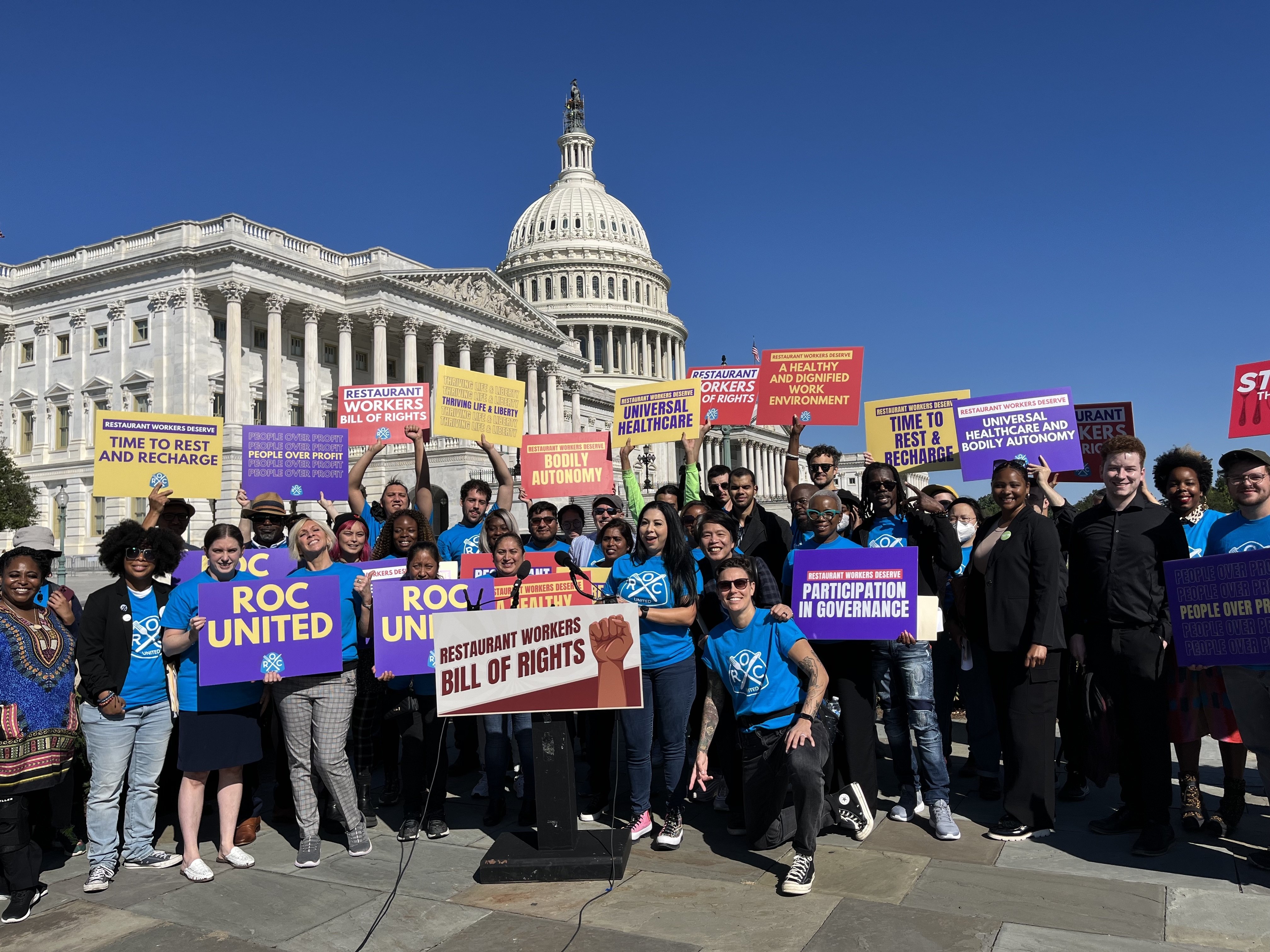
The Restaurant Opportunities Centers (ROC) United formed out of tragedy. On September 11, 2001, 79 union restaurant workers at Windows on the World, the restaurant that occupied the top two floors of the World Trade Center’s North Tower, died in the largest terrorist attack in U.S. history. Two hundred of their coworkers who were not working that day survived the attack, but they were both mourning the loss of their coworkers and instantly unemployed. In their efforts to support one another and to protest the reopening of Windows on the World in a new location with new staff, ROC United was born.
Today ROC United has more than 65,000 restaurant worker members and is the country’s oldest and largest restaurant worker-led organization. ROC United works to improve restaurant workers’ lives by building worker power and uniting workers of various backgrounds around shared goals and values. Through this work, the organization has grown to 10 staffed chapter offices in Chicago, Los Angeles, New Orleans, New York, Pennsylvania, San Francisco/Oakland Bay Area, Michigan, Mississippi, Minnesota, and Washington, DC.
ROC United envisions a society that treats restaurant workers with dignity and respect and an industry that prioritizes racial and gender equity and strives to increase the standard of living for all working-class people. Organizers and member-leaders enact this vision by organizing a base of restaurant workers across the country to push for change in their own restaurants and advocate for broader policy improvements for all workers. This work begins by organizing restaurant workers who work for the same restaurant or owner and addressing issues like wage theft, workplace discrimination, or sexual harassment. With ROC’s support, workers file claims with the appropriate city or state offices and engage in collective action to encourage restaurant owners to address ongoing or past workplace issues or illegal practices. In several cities, ROC organizes leaders from different restaurants to come together in citywide workers’ committees, which strategize how to improve the industry beyond campaigns at individual restaurants.
Through organizing and outreach, political education, and policy and advocacy efforts, ROC United has won millions of dollars in back wages, helped to pass minimum wage increases in more than 20 states and 20 cities, and has played an instrumental role in winning policy advances on paid sick days and wage theft in more than 15 states.
The State of Workers in the Restaurant Industry
Approximately 12.5 million people were employed in restaurant, bar, and related food services positions in 2022, with a median wage of $14.25 an hour, or $29,640 a year.13 In the restaurant industry, however, wages vary significantly based on a worker’s position and the type of establishment where they are employed. In the front of the house, where employees interact with customers, hosts, servers, and bartenders tend to earn more than bussers and runners. In the back of the house, where the food is prepped and cooked, chefs and cooks earn more than prep cooks, dishwashers, and cleaners. The type of establishment also plays a major role in wages, with workers in full-service fine dining establishments earning significantly more than workers in casual dining and fast-food restaurants. ROC United estimates that 20 percent of restaurant workers earn a living wage, with those positions concentrated within the highest-paid positions at fine dining establishments.14
The restaurant industry is also plagued by occupational segregation. White males are overrepresented in the highest-earning positions, such as servers and bartenders, in fine dining establishments. Women, who are two-thirds of tipped restaurant workers in the United States,15 are overrepresented in server positions in casual dining restaurants. Workers of color—primarily Black and Latine workers—are overrepresented in lower-paying positions like bussers, runners, and food preparers in casual restaurants and in all positions in fast-food restaurants.16
Many workers in the restaurant industry toil under a federal subminimum wage that has remained stuck at $2.13 per hour since 1991.17 Seven states have eliminated their tipped subminimum wage, while 27 states and Washington, DC, require employers to pay tipped employees a minimum cash wage above $2.13 per hour (22 of these maintain the subminimum below $7.25). Sixteen states, mostly located in the South, maintain a tipped minimum wage equal to the federal floor of $2.13 per hour.18
ROC United’s Workforce Development Programs
In recognition of the rampant occupational segregation in the restaurant industry and as part of its goal to lift the floor of all restaurant workers while building ladders of opportunity to better-paying positions, ROC United began the COLORS Hospitality Opportunities for Workers (CHOW) Institute in 2006.19 The CHOW Institute now operates in eight cities—Chicago, Detroit, Los Angeles, New Orleans, New York, Oakland, Philadelphia, and Washington, DC—and has trained more than 10,000 workers.
The CHOW training programs combine industry training that helps restaurant workers advance their careers with critical Know Your Rights training and other political education components. CHOW classes like the Art of Service combine skills such as proper table setting and understanding point-of-service software with education on the federal and state laws that govern the restaurant industry, helping workers understand their rights under the law. ROC United’s curriculum ensures that workers can both excel within the restaurant industry and improve their workplaces by understanding their rights as workers, the obligations of their employers, and the improvements to the industry won through worker-led campaigns.
In New York, CHOW programs partner with the State University of New York (SUNY) system to offer college credits for training courses and past work experience, encouraging further formal education pathways for members and reducing overall education costs. Upon completion of training courses, 60 percent of CHOW participants obtained an hourly wage increase of $2 to $3 per hour. Some of CHOW’s training programs include:
- The Art of Service: Teaches workers the essentials of restaurant service, including the importance of point-of-service software, professional phone etiquette, taking reservations, proper wine and beer opening techniques, federal and state laws that govern the restaurant industry, how to address sexual harassment in the workplace, and an understanding of high-road employers.
- Front-of-the-House Service 101 and 102: Provides basic and advanced knowledge of fine dining restaurants, food and wine pairings, current industry trends, and practice serving tables.
- Culinary Arts: Provides an introduction to food preparation, including an understanding of kitchen stations, vegetable prep, knife skills, properly storing meat and food, and basic recipes.
- Food Handler Certification: Provides basic food safety and handling skills, including handling plates and glassware properly, using thermometers and understanding food storage, understanding local health codes and laws regulating food safety and hygiene, and understanding allergies and food-borne illnesses.
- Soft Skills Training: Focuses on the soft skills that can help workers land jobs in the restaurant industry and excel at their work, including interview etiquette and techniques, resume writing, communication skills, conflict resolution, and time management.
- Advanced Level Management: Supports established restaurant workers in taking the next step in their career to manage a team and supervise work. Coursework includes how to motivate your team to provide excellent customer service, timing the customer experience, how to set sales goals, and financial literacy.
- OSHA 10 Certification: Provides official Occupational Safety and Health Administration (OSHA) 10 certification, training workers on how to spot, avoid, and report safety risks; understanding the employer’s responsibility for workplace safety; learning the rights OSHA gives workers; and what to do when workplace safety obligations are not met.
- Restaurant Worker Protection Training Initiative: ROC partners with OSHA’s Susan Harwood Training Grant Program to provide training to restaurant workers on the dangers of and safety precautions around extreme heat exposure, educating workers around their safety and rights, and informing employers about adjustments to the workplace needed to meet safety standards.
- Gender-Based Violence and Harassment Training. ROC partners with the Fostering Access, Rights and Equity program in the U.S. Department of Labor’s Women’s Bureau to train restaurant workers on how to prevent gender-based violence and harassment in the workplace.
CHOW programs are generally funded through private philanthropy, with no cost to workers or their employers. Unfortunately, the CHOW Institute operates outside of the current federal workforce development systems and does not receive support from WIOA funds or workforce boards. Rather than support worker-centered training programs like the CHOW Institute, federal training dollars in the restaurant industry often flow through the National Restaurant Association, the nation’s largest food service trade association that represents and lobbies on behalf of the restaurant industry;its partner organization, the National Restaurant Education Fund; and their more than 50 state affiliates.
In addition to monopolizing public restaurant training dollars, the National Restaurant Association advocates for a political agenda that fights against job quality improvements, worker protections, and regulations in the restaurant industry. The association and its affiliates are the driving force behind lobbying efforts to keep the minimum wage and tipped minimum wage low and to prevent federal and state-level initiatives like paid sick days and paid leave. When the National Restaurant Association is unable to prevent the passage of bills, it lobbies, often successfully, to exclude restaurants and restaurant workers from these bills’ provisions. The association’s training and lobbying efforts work in concert, with fees from food safety classes run by its subsidiary ServSafe, fueling the association’s anti-worker lobbying efforts.20 In contrast, the ROC United training programs take a worker-centered approach that responds to workers’ needs. This includes prioritizing building restaurant worker power to support workers in their individual career development and the collective efforts of restaurant workers to pass policies that increase workers’ economic security and improve job quality standards in the industry.
Obstacles to Expansion
ROC United’s innovative power building and worker-centered training program faces multiple obstacles to addressing job quality and carrying out a robust workforce development program, and the biggest one is funding. ROC United is excluded from federal and state workforce dollars and relies solely on private philanthropy, which is a fraction of what is available federally and can be an inconsistent and unreliable source of revenue. The outsized influence of restaurant owners and the National Restaurant Association within the current workforce system and on workforce development boards means that employer and industry-led training programs, rather than ROC United’s worker-centered curriculum, are the exclusive beneficiaries of federal workforce dollars.
ROC’s mission to improve working conditions and job quality also faces steep obstacles in the restaurant industry. Insufficient labor protections and enforcement permit employers to skirt wage and hour regulations, resulting in rampant wage theft. The complaint-based approach to enforcing wage and hour laws is woefully inadequate to meet the scale of the problem and requires workers to be proactive in filing their own complaints—which can often lead to employer retaliation—and only addresses wage theft after the violation has occurred. Chronic underfunding of wage and hour enforcement at the federal level has slashed the number of workplace investigators, enabling restaurant owners to violate the law with near impunity.
Antiquated and insufficient labor laws also hamper restaurant workers’ ability to exercise their right to organize and collectively bargain. Current labor law requires workers to form unions at individual restaurants, the majority of which are small businesses that use a common playbook to avoid unionization. When workers come together to sign union cards, demand recognition, or petition for a union election, restaurant owners simply close down their businesses and re-open under a different name and limited liability company license. Improving wage and hour violation enforcement—including robustly funding enforcement agencies and empowering federal, state, and local agencies to strategically target the restaurant industry—and significant labor law reform are critical to improving job quality and working conditions in the restaurant industry.
Milwaukee Area Service and Hospitality Workers Organization (MASH)
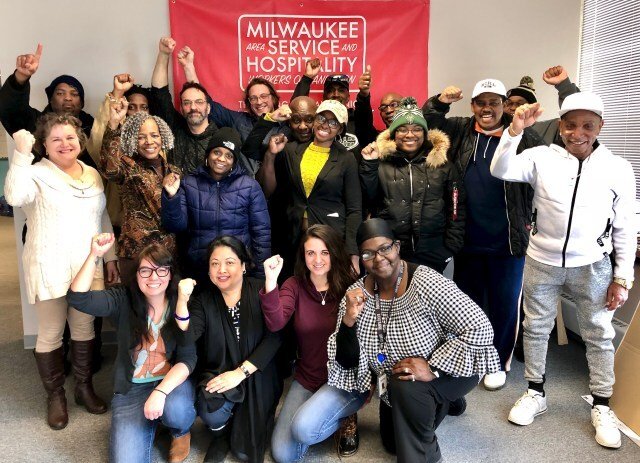
The Milwaukee Area Service and Hospitality Workers Organization (MASH) is an organization of service and hospitality workers in Milwaukee focused on improving job quality and the labor market for service workers.
Rooted in a Community Benefits Agreement, Raising Standards in the Service Sector
MASH combines the functions of a labor union, workforce intermediary, and worker center under one organizational roof. Through these, MASH weaves together complementary and interlinked aspects: the traditional union work of organizing workers and winning industry-leading collective bargaining agreements; workforce strategies to align the needs of workers and employers in the industry; and aggressive and effective involvement in local public affairs to shape ongoing economic development accountability toward service sector work and build a sectoral approach to raising standards for service jobs. The membership of the union, roughly 1,000 workers (and growing) across nine worksites, leads and drives the complete range of MASH strategies inside and outside worksites. The union’s contracts provide infrastructure and resources for the full range of strategies as well.
Labor and community organizers launched MASH to challenge the twin crises of economic and racial inequality that define Milwaukee. Addressing these crises requires transforming the city’s service industry, which employs tens of thousands of workers, predominantly Black and brown individuals and women of all races. MASH’s roots go back to 2016, when community demands around a new basketball arena development were formalized in a community benefits agreement (CBA). Labor peace required by the CBA allowed arena workers to create their union, MASH, three years later. Today, MASH continues to build power and union representation across Milwaukee’s service sector, in part by seeking to create similar CBAs for new developments. The original CBA explicitly tackled interconnected economic and racial inequities by improving job quality for the service workers who would work at the arena. The CBA guaranteed these workers union rights and wage standards. Not only does this raise the bar on service jobs in Milwaukee, but it also ensures access to and support in family-sustaining employment to Black and brown individuals. And it has created a fighting organization of working people who continue to grow and expand their reach.
MASH’s Three Interconnected and Mutually Reinforcing Strategies
To raise the floor under Milwaukee service work, the three components of MASH are critical, mutually reinforcing, and necessarily simultaneous. The first of the components of MASH’s work is building a democratic and dynamic union. Service workplaces need to be organized; service workers need contracts to raise job quality, representation to defend contract standards, and the collective work and solidarity that a union allows. In Wisconsin, with anti-union “right to work” rules in place, MASH is doing direct union work—recruitment and representation of members, bargaining, and enforcing contracts—at its worksites. In this way, MASH is building worker power on the job. MASH is also organizing new worksites, responding to calls from interested workers, and seeking other means of engaging more workers. At the core of MASH’s work is a strong member-led union, fighting for good contracts for its members.
Even as MASH secures industry-leading wages and work standards, it is also working to improve the structure of work in the sector in ways that respond to the needs of both employers and members. The second component of MASH’s work is partnership with represented employers to solve industry problems in recruitment, skill, job quality, and workforce development. This “win-win” work sits solidly in places that more traditional unions would not engage. MASH staff work to co-determine schedules with employers, mobilize workers for available work and shifts, and analyze and plan for workforce challenges while taking the lead on implementing solutions. This work seeks to rationalize and improve schedules for workers in ways that create more steady employment, which will reduce staff turnover. This is similar to the intermediary work that union hiring halls have done, and MASH is increasingly working on scheduling strategies that allow workers to work in multiple occupations and venues. This strategy is enshrined in the union’s collective bargaining agreements. Employers support the union to do this work: In the most recent MASH contract, employers have agreed to support the cost of a full-time labor and workforce coordinator at MASH who will work on scheduling and other strategies to improve the workforce structure for arena workers. MASH engages in this work because members prioritize improving job quality and reducing turnover, and it is successful at doing this work because workers have the insight needed to rationalize and improve structures and schedules. Having strategies that support employers helps both employers and policymakers see the union making active contributions to Milwaukee’s service sector. For all these reasons, this strategy is at the core of MASH’s work.
Finally, MASH’s third strategy is to focus on economic development in the city and ensure that union rights reach more service workers. This requires an organizational strategy that attends carefully to public and private development in Milwaukee, monitoring economic development proposals, and urging elected officials to use their leverage to secure stronger service job standards. Often this work harkens back to the roots of MASH, which came out of a struggle to define and enforce a CBA from Milwaukee’s basketball team, the Bucks. This CBA explicitly structured union representation for service workers into the agreement. MASH is the union that was born from this CBA. The positive results of this policy and union innovation is clear for workers in and around the arena. MASH works to ensure that this model is held up as the standard for every development project in downtown Milwaukee. This work is expressly political, pitting the interests of workers who want stronger standards for downtown service work against developers who hope for public subsidies but no accountability to the community.
This is a comprehensive approach to improving service sector job quality in Milwaukee and is workforce development work that directly responds to employer needs and leverages the insights and connections of MASH members and leaders to improve jobs. This is win-win work that carefully cultivates the labor/management partnership and builds spaces of trust to improve jobs. Simultaneously, MASH represents workers, enforces the contracts, and seeks to improve job quality at worksites by building worker power. MASH is fighting for service sector workers in the arenas of public opinion and public policy, seeking to create a Milwaukee consensus around the fact that there should be no public investment in projects that do not guarantee decent jobs, and allowing workers to define and secure that decency through union representation.
Funding Sources and Connections to the Traditional Workforce System and Training
MASH’s principal source of funding is membership dues. That the organization is funded by members agreeing to pay union dues is one example of the power of MASH’s workers. (Remember that Wisconsin is a so-called “right to work” state where unions must recruit each new hire and get workers’ agreement to pay dues. This is a much more intensive form of organizing than is required in states without this legislation, where workers pay dues to their union if they are hired into a union-represented job.)
Given that its members’ dues are the principal funding, MASH must stay true to member interests and be responsive to workers’ demands. MASH has also participated in grant-funded projects that expand the capacity and reach of the organization, but these take considerable time to secure and sometimes come with reporting expectations or other requirements in excess of MASH’s capacity.
Importantly, MASH does not relate to the traditional workforce system—the local workforce board, the technical colleges, and other programs. These resources do not address the problems of service and hospitality work in the ways that are priorities for MASH members. Among other shortcomings, the traditional workforce system does not attend to job quality or account for the defining characteristics of the majority of work in this sector—which is part-time, casual, and contingent—and where workers and employers are responsible for navigating all labor market friction without coordination.
The most essential workforce development project in the sector is to better organize the work and allow workers to build stronger schedules. MASH is building a workforce system at the center of the labor market that coordinates between workers and multiple employers, establishes and enforces common economic standards, provides a home for non-wage benefits, and creates and manages a pool and pipeline of workers. All of this is important workforce development and job quality work, but it is neither in line with standard public workforce development resources nor is it training per se.
Obstacles to Expansion
MASH is building a unique model, but progress is not easy. The work requires battling against deeply held assumptions about the nature of the service industry, especially when it comes to job quality in food service, janitorial, and security jobs. Public leaders and public discourse have abandoned these jobs, assuming that low-quality, chaotic jobs without benefits for tens of thousands of Black and brown workers in Milwaukee is natural and inevitable. Leaders talk endlessly about economic development in the city, but they focus more on hopes for manufacturing’s resurgence or start-ups, looking away from the necessity of and potential for changing these service jobs. Too many think of demands for truly decent wages and work structures for Milwaukee’s service workers as economically untenable. The inertia and resistance to raising the floor under service work is substantial.
Overcoming this service sector blind spot and substantially raising standards for these jobs will take a long-term effort, as well as a shift in public opinion and the ideas and priorities of regional leaders. For this reason, MASH works in partnership with researchers at the High Road Strategy Center (formerly Center on Wisconsin Strategy) at UW Madison, to develop papers making a strong case for service sector job standards. Two papers—The Crisis in Milwaukee’s Service Industry and Facts from the Frontline—offer clarity on the structure of the jobs, their wages, and the workers holding these jobs.21 These papers provide data that are used in negotiations, public campaigns, and member education. They focus on a proposed soccer complex in Milwaukee and the consideration of public investment in it. The papers review the limited public impacts of soccer stadium investments in other areas to encourage greater public scrutiny of deals that hand money to developers. The papers also hold up the stadium community benefits agreement and its labor peace and workers’ rights provisions as the most effective model for securing true benefits for service workers in cases of public investment. These papers were provided to zoning and economic development committees, as well as elected officials and other leaders.
Another obstacle is the result of MASH’s commitment to worker-member leadership. MASH leaders come from MASH worksites. They know these service jobs, the reality inside worksites, and the community. MASH could be staffed by professionals, with backgrounds in communications, negotiations, organizing, or human resources. Such professionals would likely make the organizational work more “efficient.” This is not their goal. MASH is a democratic workers’ organization and members are devoted to building a strong organization from the membership up.
Overcoming this obstacle requires constant attention to leadership development and union democracy. It will take more time and resources to train worker-member leaders in the kind of work otherwise given to the aforementioned professionals. The necessity of being a worker-led organization allows the membership to dictate the goals, tactics, and urgency of specific issues, such as the expansion of coverage to new worksites and contract negotiations. However, this commitment to worker leadership also implies a commitment to having workers be the ones to carry out this work. It is a resource-intensive process, to train workers who are skilled in their jobs and knowledgeable about their worksites in the kind of analytic work needed to carry out MASH’s three-pronged approach.
Citations
- For more information, see their website at https:// www.hcapinc.org/.
- Healthcare Career Advancement Program, “Education Association Affiliates,” source.
- Healthcare Career Advancement Program, “Registered Apprenticeships,” source.
- Center for Equity, source.
- Jennifer Cheeseman Day and Cheridan Christnacht, “Your Health Care Is in Women’s Hands,” United States Census Bureau, August 14, 2019, source.
- Janette Dill and Mignon Duffy, “Structural Racism and Black Women’s Employment in the U.S. Health Care Sector,” Health Affairs 41, no. 2 (2022): 265–272, source.
- Health Resources & Services Administration, “Projecting Health Workforce Supply and Demand,” source.
- Terri Harkin, Essential Workers, Essential Education: The SEIU Labor-Management Training Partnership Model for Home Care Workforce Development (New York: Healthcare Career Advancement Program, September 2022), source.
- Harkin, Essential Workers, Essential Education, source.
- Annelies Goger, Desegregating Work and Learning Through ‘Earn and Learn’ Models (Washington, DC: Brookings Institution, December 9, 2020), source.
- Healthcare Career Advancement Program, “Michigan: $25 Million Grant for Nursing Home Workforce Stability,” September 13, 2023, source.
- Breanna Betts, Recruiting and Retaining Caregivers: Top 5 Solutions from Care Workers (New York: H-CAP Center for Equity, August 2023), source.
- U.S. Bureau of Labor Statistics, “Occupational Employment and Wage Statistics,” May 2022, www.bls.gov/oes/.
- Ending Jim Crow in America’s Restaurants: Racial and Gender Occupational Segregation in the Restaurant Industry (New York: Restaurant Opportunity Centers United, 2015), source.
- National Women’s Law Center, “Women and the Minimum Wage: State by State,” January 12, 2021, source.
- Ending Jim Crow in America’s Restaurants: Racial and Gender Occupational Segregation in the Restaurant Industry (New York: Restaurant Opportunity Centers United, 2015), source.
- The Leadership Conference on Civil and Human Rights, “The Tipped Minimum Wage Has Been Stuck for Nearly 30 Years,” February 13, 2020, source.
- U.S. Department of Labor, Wage and Hour Division, “Minimum Wage for Tipped Employees: Historical Tables,” September 30, 2023, source.
- To learn more about Restaurant Opportunities Centers United’s COLORS Hospitality Opportunities for Workers (CHOW) Institute, see their website: source.
- David A. Fahrenthold and Talmen Joseph Smith, “How Restaurant Workers Pay for Lobbying That Helps Keep Their Wages Low,” New York Times, June 20, 2023, source.
- L. Dresser, P. Aquiles-Sanchez, and A. Kanter, The Crisis in Milwaukee’s Service Industry (Madison, WI: Center on Wisconsin Strategy, 2022), https:// highroad.wisc.edu/publications/the-crisis-inmilwaukees-service-industry/; P. Aquiles-Sanchez and L. Dresser, Facts From the Frontline: Getting By in Milwaukee’s Abundant Low Wage Service Jobs (Madison, WI: Center on Wisconsin Strategy, 2023), source.
Making Worker Power and a Worker-Centered Workforce Development System Reality
The case studies of H-CAP, ROC United, and MASH provide examples of potential directions for policy and practice. Each of these cases is successfully pursuing worker-centered workforce development organizations and working largely outside of the traditional workforce development system. The programs improve job quality, provide training programs informed by the needs of workers themselves, and expand workers’ power to improve their workplaces. These cases demonstrate the existence of a robust workforce development system, which offers valuable lessons for informing national policy.
In combination, these case studies and the GJC principles point to necessary improvements to our existing national workforce system and highlight the need for policies that integrate workers’ rights and protections into workforce development. Here, we extract these lessons to solidify the GJC policy priorities:
Put Workers First and Build Worker Power
Public resources and policies should actively be in service to workers first, always center worker interest and needs, and rectify structural inequities in the economy. The system should advance workers’ voices, power, organizing, and unionization.
To center workers’ interests and needs, our workforce development system should actively create platforms and engagement structures to incorporate workers’ voices and experiences, including giving equal power and voice to workers, unions, worker centers, and community-based organizations in state and local workforce funding decisions. Engagement should ensure that workers, worker centers, and unions representing workers in the region are at the planning and decision-making table, with power equal to or greater than employers, to influence workforce development interventions and provide input on how to best identify and extend opportunities to high-road employers.
To advance worker power and worker rights, our workforce development system must support pathways for workers to organize, form unions, and collectively bargain for wages, benefits, and other working conditions, as well as address community issues both within individual jobs sites and across sectors and industries. The workforce system should fund and support worker-centered training provided through worker organizations and labor-management partnerships. This training should include programming to enforce workplace rights such as wage and hour laws, the right to collectively bargain, and workplace safety. These training programs should aim to deepen relationships with agencies that enforce workers’ rights, wage and hour regulations, safety standards, and organizing aspects of labor law. Union membership leads to higher incomes, better benefits, greater workforce stability, improved industry-wide standards, and labor-management partnerships that effectively bring in and retain new workers. Workforce policy should explicitly support the expansion of unions and the rights of workers to form unions and bargain collectively.
Strategies:
- Give workers, worker centers, and organizations that represent workers a seat at the table where state and local workforce funding decisions are made. To ensure that worker input, experience, and recommendations are considered, workers and worker organizations must have decision-making power equal to or greater than employers.
- Provide stronger worker rights, union rights, and job quality materials and training throughout the system, including training state and local workers in the national workforce system on these issues.
- Prioritize funding to worker-centered programs like the CHOW Institute, H-CAP, and MASH, which are grounded in the expressed needs of workers and emphasize creating pathways to better jobs while building worker power and advocating for a floor of job quality within the industry as a whole.
- Reduce the barriers to win and service federal grants by eliminating burdensome paperwork and reporting requirements that can be difficult for smaller organizations to navigate. Where administrative burdens cannot be eased, Congress should establish specific funding streams that help organizations meet the requirements. Current reporting and tracking requirements necessitate significant human resources capacity that many worker-based organizations struggle to maintain.
- Create funding streams focused on all incumbent workers within high-road partner employers and reduce funding restrictions on which populations can be served. Groups like ROC United and labor-management training partnerships must be allowed to train all members, regardless of their immigration status. Undocumented immigrants are the engines of the restaurant industry and must be able to take advantage of workforce development programs without restrictions.
- Bring established unions and worker-oriented organizations to the table, along with industry representatives, to develop sectoral training standards where they do not exist. Sectoral training standards should require high-road education and training programs that lead to sustainable, longitudinal career pathways and placements in high-quality jobs, and minimize ad hoc, one-off training programs that are not part of a comprehensive employment strategy and do not improve job quality for workers.
- Invest in innovation in workforce strategies where workers have a structured capacity through unions and other forms of independent organizing to suggest and secure job improvement.
Combat the Legacy, Current Conditions, and Ongoing Impact of Structural Racism and Sexism within the Labor Market
A worker-centered workforce development system should actively address occupational segregation and systemic and structural racism and sexism in the labor market. The system should advance targeted, race-conscious policies that confront systemic underinvestment in women, workers of color, and immigrants and redress current and past harms.
Systemic barriers such as discrimination, bias, and limited access to networks may hinder individuals from underrepresented groups from pursuing non-traditional fields. Specifically, our workforce development system must confront systemic anti-Black racism. WIOA reinforces occupational segregation by directing individuals, particularly Black workers, into fields that offer low wages, rather than addressing the root causes of inequality and promoting access to high-quality occupations.1 Our workforce development system must build greater accountability and protect workers from occupational segregation by ensuring that programs include racial and gender equity goals and benchmarks that proactively combat discrimination.
Strategies:
- Fund targeted, race-conscious programs and create funding streams that redress the specific harms inflicted on workers of color by the workforce development system and broader labor market policies and set target goals to counter occupational segregation.
- Require that reporting data be disaggregated by race at the program level and make future funding contingent on progress toward racial and gender equity program goals.
- Include support for uninterrupted wages and benefits for participants in training and workforce development programs. Funding should also be provided for whole-person supportive services for workforce development program participants that recognize the needs of women and workers of color, such as child care, dependent care, transportation, access to technology and tech training, ongoing coaching and peer mentorship, and case management support.
Raise the Floor on All Jobs for All Workers
All workers and their families should be able to thrive. A worker-centered workforce development system should engage in activities and direct resources that raise the quality of jobs for all workers, ensure that the full range of workers’ rights are protected, and raise standards across all occupations and industries.
The U.S. labor market is awash in low-quality jobs, and millions of workers struggle to make ends meet. We must take a holistic approach to workforce policy that includes creating universal labor standards and protections and other policies that support workers and increase workforce participation.
Strategies:
- Strengthen the right to organize by updating antiquated and ineffective labor laws through comprehensive labor law reform, including passing the Protect the Right to Organize Act and addressing the specific obstacles facing restaurant workers in their efforts to form unions.
- Enact fair scheduling laws that help create predictable schedules and incomes for hourly workers, including passing the Schedules That Work Act and the Part Time Worker Bill of Rights. Unpredictable schedules, inadequate hours, and “just-in-time” scheduling practices are shown to harm workers, their families, and their communities.2
- End the tipped minimum wage and raise the federal minimum wage to a family-sustaining level that increases annually with the cost of living.
- Pass the Family and Medical Insurance Leave Act, ensuring workers can take paid leave from their jobs to welcome a new child, care for a sick family member, or care for their own medical conditions. Paid family and medical leave has been shown to increase labor market participation, improve worker retention, and reduce turnover.3
Connect People to Good Jobs
A worker-centered workforce development system builds pathways into good jobs for workers who are unemployed or underemployed. This happens through a combination of active labor market policies, high-quality training and career counseling, support services, and prioritizing job quality.
All workers are entitled to baseline job quality standards that ensure a prosperous family-sustaining wage, robust benefits, and safe working conditions, irrespective of employment arrangement. Our workforce system must include a job quality framework that sets standards for family-sustaining wages and essential benefits like health care, paid leave, retirement savings plans, and the freedom to join a union. Federal workforce dollars should be geared toward partnerships with high-road employers that meet this standard. Additionally, federal workforce dollars should provide incentives and accountability for low-road employers in low-wage, occupationally segregated sectors so they become high-road employers and develop good quality jobs. Employer partnerships should also support unionizing efforts by creating pro-union and pro-worker organization policies, including sectoral standards and approaches to increase worker power. Workers participating in workforce programs should be guaranteed high-quality employment after training, and federal dollars should not subsidize employers that do not offer worker protections and worker empowerment. Prioritizing job quality is essential for breaking the cycle of low-wage jobs and advancing a more inclusive, equitable, and resilient workforce. This will lead to sustained prosperity for individuals and communities.
Strategies:
- Condition public workforce dollars on the program’s or employer’s ability to offer high-quality jobs with family-sustaining wages, robust benefits, and the free and fair choice to form a union.
- Define and measure job quality metrics for public workforce investment. Require recipients of public funding to report and be assessed on the metrics with the goal of using public funding to improve job quality for workers, in addition to job attainment. Develop job quality metrics in collaboration with unions and worker organizations with clearly defined mechanisms for transparency and accountability. Disaggregate data and require impact evaluation of investments for specific targeted worker populations.
- Prioritize funding and policy support for interventions led by labor-management partnerships where they currently exist, and encourage partnership formation by bringing labor unions and employers together to collaborate on solutions where formal collaborations do not yet exist.
- Support expanded and diversified Registered Apprenticeship programs as a proven pathway to good jobs that will allow participants to secure training and employment opportunities.
- Seek to establish industry-wide standards for job quality, with a process for establishing a wage and benefit floor. This includes using wage and benefit pass-through models in which portions of public funds are required to be used directly for wages and benefits; and establishing tripartite industry boards to set wages, rates, and job quality standards (as recently seen with California’s Fast Food Accountability and Standards Recovery Act, fast food industry standards boards, and other successful state and local boards4). Public funding or public approvals should be conditioned on adherence to industry-wide job quality standards, as with the Davis-Bacon Act’s requirements that construction companies working under federal contract pay workers prevailing wages and benefits.5
Citations
- Camardelle, Principles to Support Black Workers in the Workforce Innovation and Opportunity Act, source Principles-to-Support-Black-Workers-in-theWIOA.pdf.
- Daniel Schneider and Kristen Harknett, “Working in the Service Sector in Michigan,” Shift Project, February 2023, source.
- National Partnership for Women & Families, “Paid Family and Medical Leave is Good for Business,” October 2023, source.
- Aurelia Glass and David Madland, “Worker Boards Across the Country Are Empowering Workers and Implementing Workforce Standards Across Industries,” Center for American Progress, February 18, 2022, source.
- U.S. Department of Labor, Wage and Hour Division, “Davis-Bacon and Related Acts,” source.
Conclusion
The workforce development system must undergo a significant transformation to create a worker-centered paradigm. This requires re-evaluating policies, regulations, and funding structures to prioritize workers’ needs and aspirations over corporate interest. This transformation must encompass the establishment of good jobs, thriving wages, and comprehensive benefits, forming the cornerstone of a system that prioritizes the well-being and prosperity of the workforce. Moreover, the integration of workers’ voices and power reflects a commitment to inclusivity by recognizing the invaluable perspective of workers.
By championing a holistic approach to job quality and embracing the principles of workers’ rights and protections as an integral part of workforce development, organizations can foster an environment where workers thrive individually, while also contributing meaningfully to the success of their respective industries. A worker-centered system not only acknowledges the importance of family-sustaining wages and benefits, but also empowers workers as active participants, leaders, and advocates within their organizations, industries, and communities.
As we continue to navigate the ever-evolving landscape of workforce development, these three cases stand as a testament to a collective dedication toward creating a more equitable, sustainable, and empowering economy for workers. Through the ongoing collaboration of workers and organizations, the aspirations for a workforce development system rooted in worker well-being, voice, and power is not just a vision, but a tangible reality shaping the future of work.
More About the Authors

Emily Andrews
Director of Education, Labor & Worker Justice, Center for Law and Social Policy

Breanna Betts
Labor Policy and Research Consultant

Laura Dresser
Associate Director, High Road Strategy Center

India Heckstall
Senior Policy Analyst, Center for Law and Social Policy (CLASP)

Peter Rickman
President, Milwaukee Area Service and Hospitality Workers Organization

Teófilo Reyes
Chief Program Officer, Restaurant Opportunities Center (ROC) United

Deborah Schwartz
Director of Workforce Equity and Innovation, Healthcare Career Advancement Program

Prabhu Sigamani
Director, Restaurant Opportunities Center United-NY