
Introduction
Technology impacts every facet of daily life, from scrolling through your social media feeds to determining eligibility for a credit card. However, these ubiquitous technologies can reinforce the marginalization of traditionally underrepresented groups.1 Given the increased recognition of this shortcoming, support for the field of Public Interest Technology (PIT) has grown.2 As a burgeoning area of interest, several definitions of PIT exist. The Ford Foundation, for example, defines PIT as “technology used to serve the public good,”3 while New America states that, “Public Interest Technology adopts best practices in human-centered design, product development, process re-engineering, and data science to solve public problems in an inclusive, iterative manner — continuously learning, improving, and aiming to deliver better outcomes to the public.”4 More recently, a New America working group of academics have defined it as the “study and application of technology expertise to advance the public interest/generate public benefits/promote the public good.”5
Given multiple definitions of the field, we should explore who should be included in the PIT ecosystem. New America states that the field “should include people who may not identify as technologists but are at the forefront of equalizing access to technology and promoting inclusive tech policy.” Supporting this sentiment, the Beeck Center for Social Impact and Innovation, believes in the importance of bringing as many people to the conversation as possible. These two examples illustrate the differing view of public interest technology and the goal of incorporating more voices into the field. In addition, it is vital that the PIT space be intentional in including and empowering diverse voices. Critics of the “public interest technology” framing view it as a top-down approach that lacks diversity. Feedback from practitioners in the field reported that it was “predominantly White, male, D.C. focused, and funder-driven.”6
Although the term public interest technology is recent, interest in PIT began nearly twenty years ago and has gained a foothold across the government, non-profit, and private sectors.7 A range of terms are used to refer to work leveraging technology to advance the public interest, the common good, social justice, government and corporate accountability.8 This work has been known in the government sector as “civic tech” and “digital government.”9 PIT gained significant recognition during the Obama administration with the creation of the Open Data Initiatives, establishment of the Presidential Innovation Fellowship and the commitment to tech training programs via the TechHire Initiative, and the creation of the Office of Social Innovation and Civic Participation.10 In contrast to the public sector, PIT efforts in the non-profit sector are less known; however, they do exist. A report from the Tech for Social Justice Project called #MoreThanCode identified over 40,000 nonprofit organizations working on PIT initiatives.11 Even more unrecognized are the PIT efforts undertaken in the private sector, in which companies often work on PIT projects through corporate social responsibility efforts.12
Our study provides more clarity on the PIT ecosystem by examining the private sector to better understand tech social entrepreneurs and the impact they are having through their social ventures. The research considers the lived experiences and a racial equity lens when considering tech social entrepreneurs in the context of public interest technology and thus examines BIPOC tech social entrepreneurs given their unique characteristics important to policy making and implementation. Using a mixed-methods, dual-pronged approach we sought to meet the following research objectives:
- Gain a better understanding of the socio-demographic landscape of PIT entrepreneurs in the United States.
- Identify and document the career paths of BIPOC PIT entrepreneurs and develop an understanding of the constraints they face.
- Develop and implement an effective experiential learning course that provides an understanding of PIT and career pathway into the field.
BIPOC Tech Social Entrepreneurs
The term social entrepreneurship first appeared in the social change literature in the 1960s and 1970s13 and although the term has been used in scientific discourse for several decades, there is no conclusive agreement on a definition.14 For our study, we have defined tech social entrepreneur based on an adaptation that adheres to Dee’s (1998) definition:
“Social entrepreneurs play the role of change agents, in the social sector, by; adopting a mission to create and sustain social value (not just private value) [through the creation or use of technology]; recognizing and relentlessly pursuing new opportunities to serve that mission; engaging in a process of continuous innovation, adaptation and learning; acting boldly without being limited by resources currently in hand; and exhibiting heightened accountability to the constituencies served and outcomes created.”15
Through the creation of or use of technology, tech social entrepreneurs seek to address social problems caused by shortcomings in existing markets and government systems.16 These entrepreneurs often collaborate with stakeholders across sectors and disciplines; synthesizing learnings and developing innovative solutions. As the proliferation of technology continues, it is critical to shape PIT into a more diverse, inclusive, and equitable environment for tackling social problems. Because technological solutions are often designed to reflect the lived experience and education of their creators, our study focuses specifically on tech social entrepreneurs that identify as Black, Indigenous, Person of Color (BIPOC).17 By definition, BIPOC tech social entrepreneurs share many qualities of public interest technologists. Despite this, a report from the Tech for Social Justice Project called “#MoreThanCode,” found that over half of the 188 people interviewed did not self-identify as working in the field of public interest technology, or as the Ford Foundation has defined as “technology practitioners who focus on social justice, the common good, and/or the public interest.”18
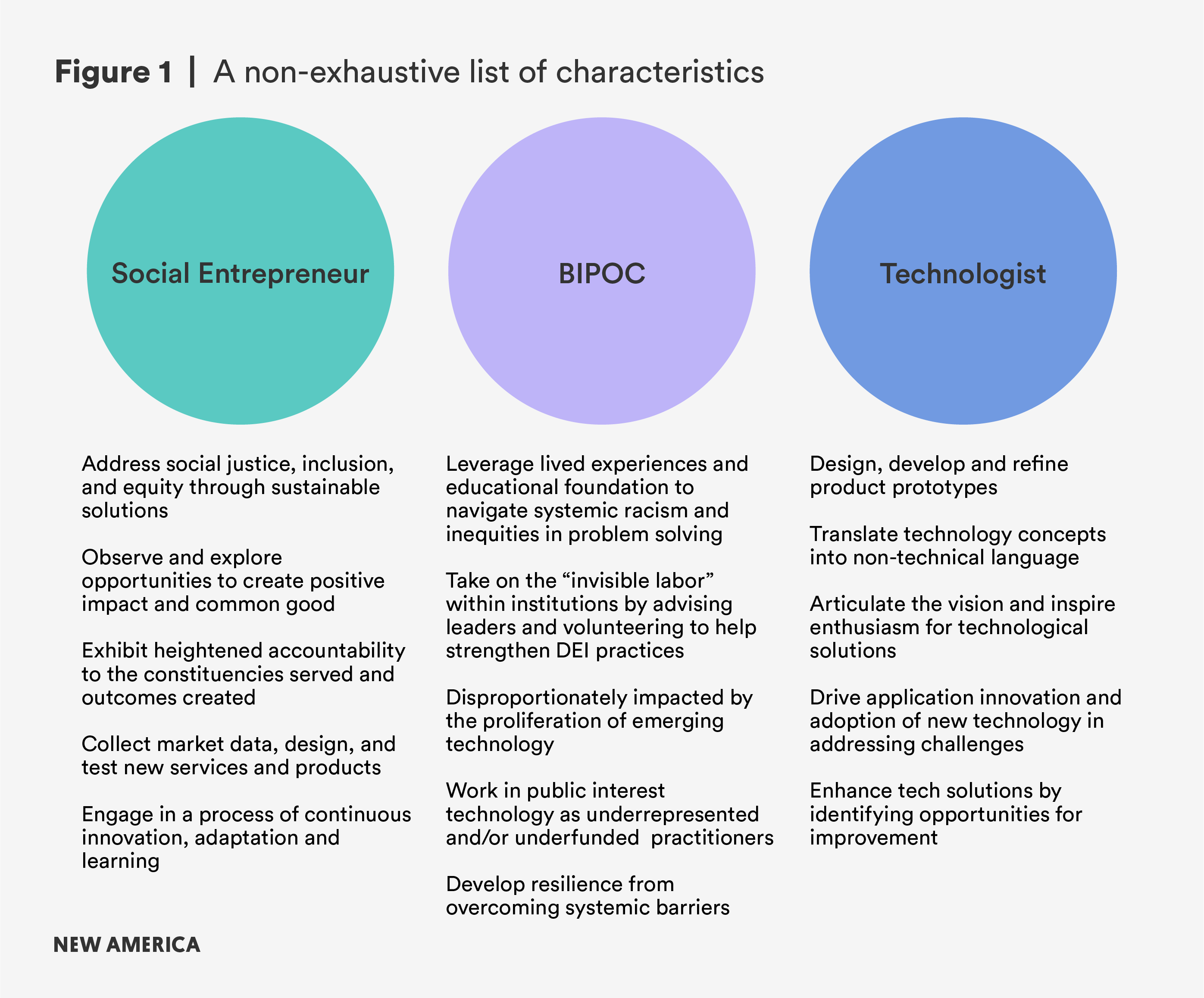
When examining the literature on tech social entrepreneurs and public interest technologists, many shared defining characteristics exist. A non-exhaustive list of these attributes are provided below:
Tayo Fabusuyi, Jessica Taketa, and Raymar Hampshire
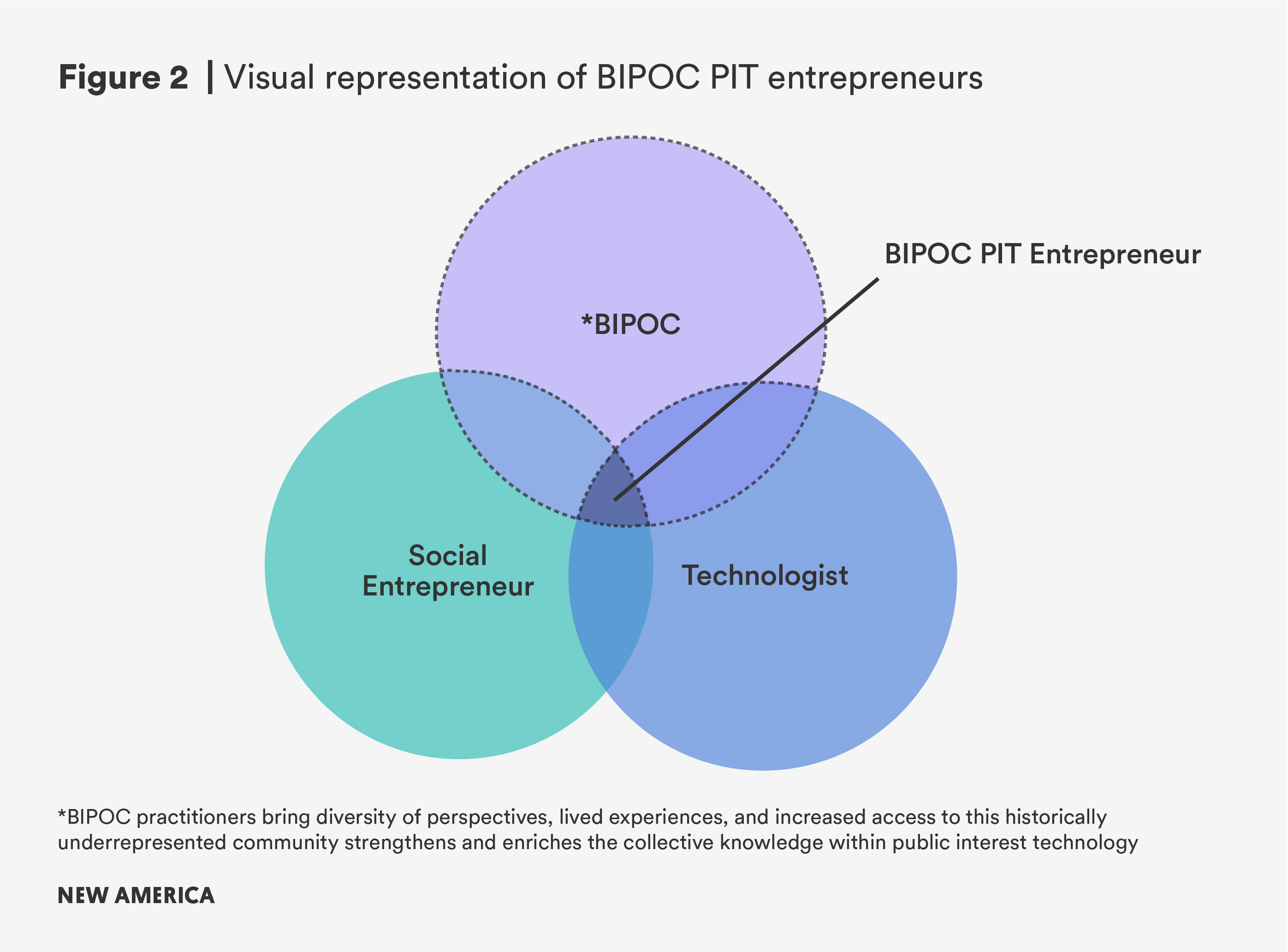
Given the overlap in defining characteristics, we consider tech social entrepreneurs to reside within the PIT ecosystem and we refer to them as “PIT entrepreneurs.” BIPOC PIT entrepreneurs bring a diversity of perspectives and proximal experiences of being marginalized into problem solving. Access to this segment of the population can strengthen and enrich the collective knowledge of the public interest technology field:
Tayo Fabusuyi, Jessica Taketa, and Raymar Hampshire
Citations
- Harrison, Dominique. 2020. Civil Rights Violations in the Face of Technological Change. The Aspen Institute.
- Hines, Michael. 2020. As public trust in the tech industry wanes, support for the field of public interest technology has grown; In 2016, the MacArthur, Ford, Knight, Open Society and Mozilla foundations announced $18 million worth of grants in support of PIT initiatives, and by 2020 43 universities from across the country had formed the Public Interest Technology University Network with the goal of collaborating to expand the PIT field.
- The Ford Foundation. 2021. Public Interest Tech.
- The New America Foundation. 2021. Public Interest Technology.
- Eaves, David, et al. Defining Public Interest Technology.
- Sasha Costanza-Chock, Maya Wagoner, Berhan Taye, Caroline Rivas, Chris Schweidler, Georgia Bullen, & the T4SJ Project, 2018. #MoreThanCode: Practitioners reimagine the landscape of technology
- Hines, Michael. 2020. As public trust in the tech industry wanes, support for the field of public interest technology has grown.
- Sasha Costanza-Chock, Maya Wagoner, Berhan Taye, Caroline Rivas, Chris Schweidler, Georgia Bullen, & the T4SJ Project, 2018. #MoreThanCode: Practitioners reimagine the landscape of technologyfor justice and equity. Research Action Design & Open Technology Institute
- Beeck Center for Social Impact + Innovation. 2020 Public Interest Technology Workforce Survey.
- U.S. White House. 2016. Technology.; U.S. White House. 2009. The President's Social Innovation Agenda.
- Sasha Costanza-Chock, Maya Wagoner, Berhan Taye, Caroline Rivas, Chris Schweidler, Georgia Bullen, & the T4SJ Project, 2018. #MoreThanCode: Practitioners reimagine the landscape of technologyfor justice and equity. Research Action Design & Open Technology Institute.
- Hines, Michael. 2020. As public trust in the tech industry wanes, support for the field of public interest technology has grown.
- Gray, E. (2012). For-profit social entrepreneurship. In T. S. Lyons (Ed.), Social entrepreneurship: How businesses can transform society (pp. 47–70). CA: ABC–CLIO.
- Light, Paul. (2005). Searching for social entrepreneurs: Who they might be, where they might be found, what they do. Paper presented at the Annual Meetings of the Association for Research on Nonprofit Organizations and Voluntary Action. Washington, D.C., Nov. 17 – 19.; Mort, Gillian, Weerawardena, Jay, and Carnegie, Kashonia. (2003). Social Entrepreneurship: Towards Conceptualization. International Journal of Nonprofit and Voluntary Sector Marketing, 8(1), 76-87; Peredo, Ana, and McLean, Murdith. (2006). Social Entrepreneurship: A Critical Review of the Concept. Journal of World Business, 41(1), 56-65; Seelos, Christian, and Mair, Johanna. (2004). Social Entrepreneurship: The Contribution of Individual.
- Dees, J. G. (1998). The meaning of social entrepreneurship. Innovation, 2006(11–4–06), 1–6. doi:10.2307/2261721
- Mair, J., J. Robinson and K. Hockerts: 2006, ‘Introduction’, in J. Mair, J. Robinson and K. Hockerts (eds.), Social Entrepreneurship (Palgrave Macmillan, Houndmills, Basingstoke, Hampshire).
- Coleman, Emma and Lili Gangas. 2018. You get better design when there’s a diverse representation of lived experiences.
- Sasha Costanza-Chock, Maya Wagoner, Berhan Taye, Caroline Rivas, Chris Schweidler, Georgia Bullen, & the T4SJ Project, 2018. #MoreThanCode: Practitioners reimagine the landscape of technology