
Table of Contents
Key Findings from Lumina Foundation’s Survey
In the summer of 2016, Lumina Foundation fielded a 17-item survey to better understand the growing ecosystem of embedded industry certifications, and the policies and practices associated with the strategy.1 In total, 96 institutions of higher education responded, about 80 percent of which were community and technical colleges.
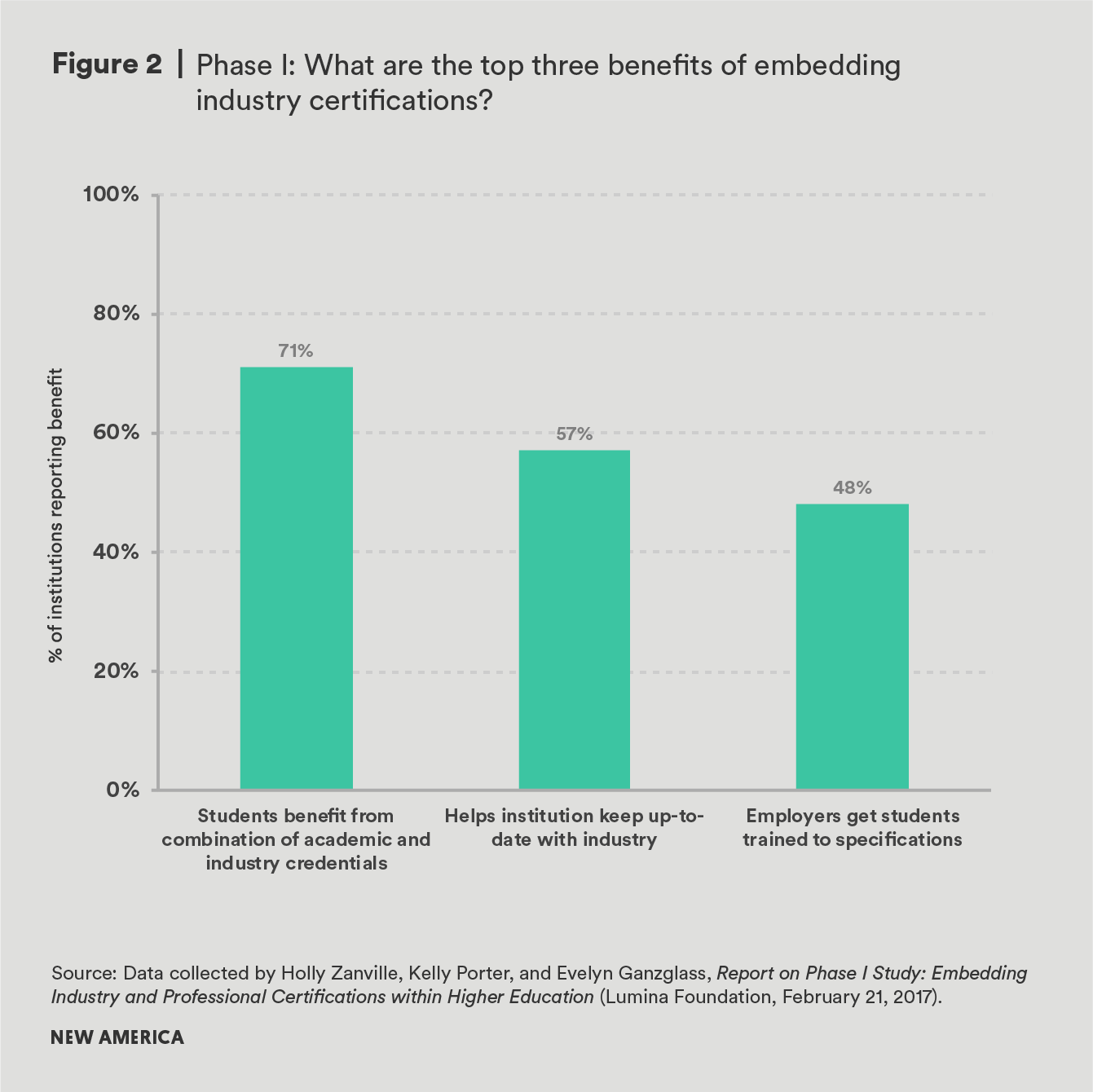
The survey revealed valuable information about the types of institutions and programs with embedded certifications as well as the perceived benefits and challenges to the practice. Survey respondents indicated that they were embedding industry and professional certifications across more than 16 different industry sectors, primarily in their workforce-oriented certificate and associate degree programs. The most commonly cited benefit of the practice—indicated by nearly three-quarters of responding institutions—was that it enabled students to earn valuable industry and academic credentials at the same time. It also helped the colleges and universities to align their curricula with prevailing industry standards, and to strengthen their partnerships with area businesses and industry associations.
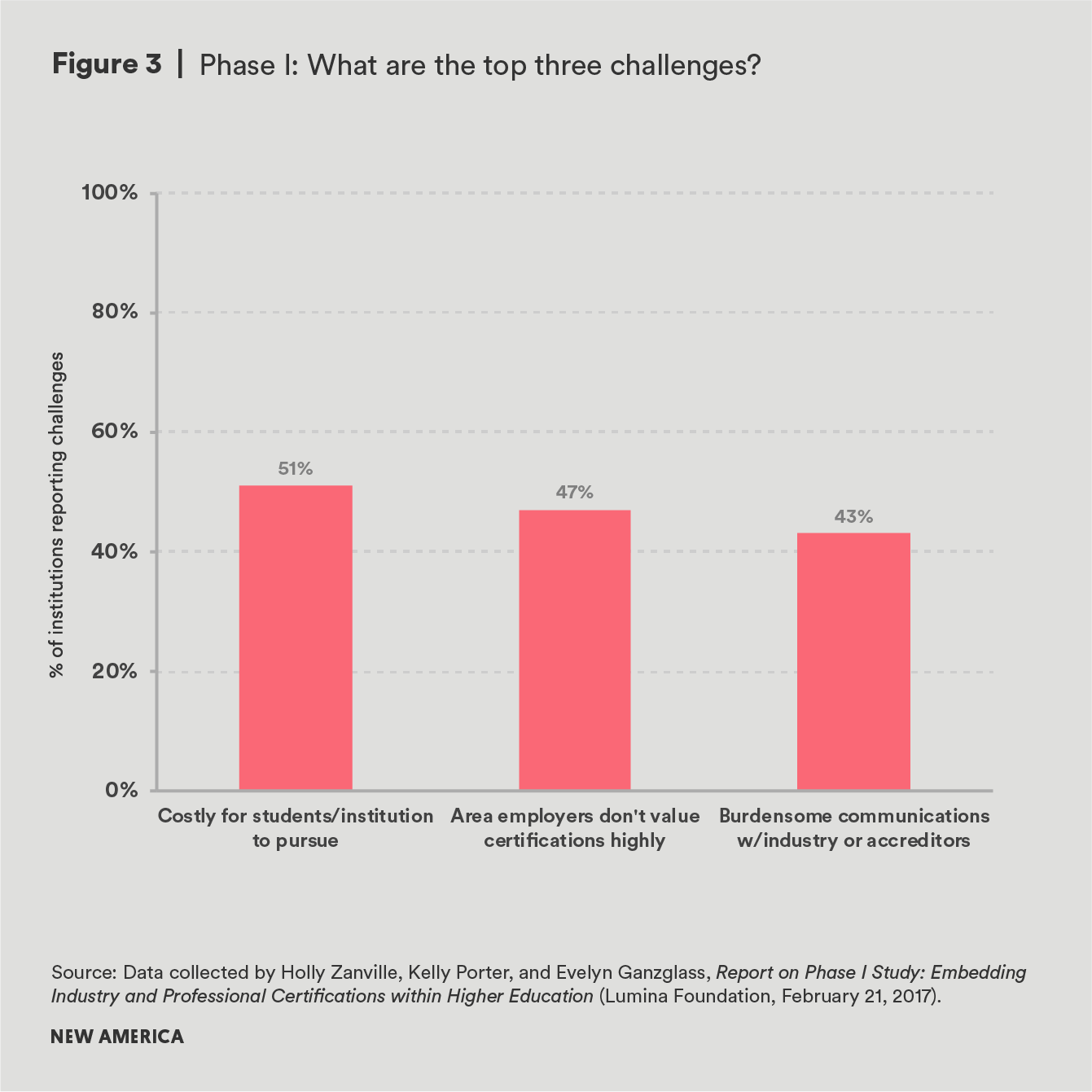
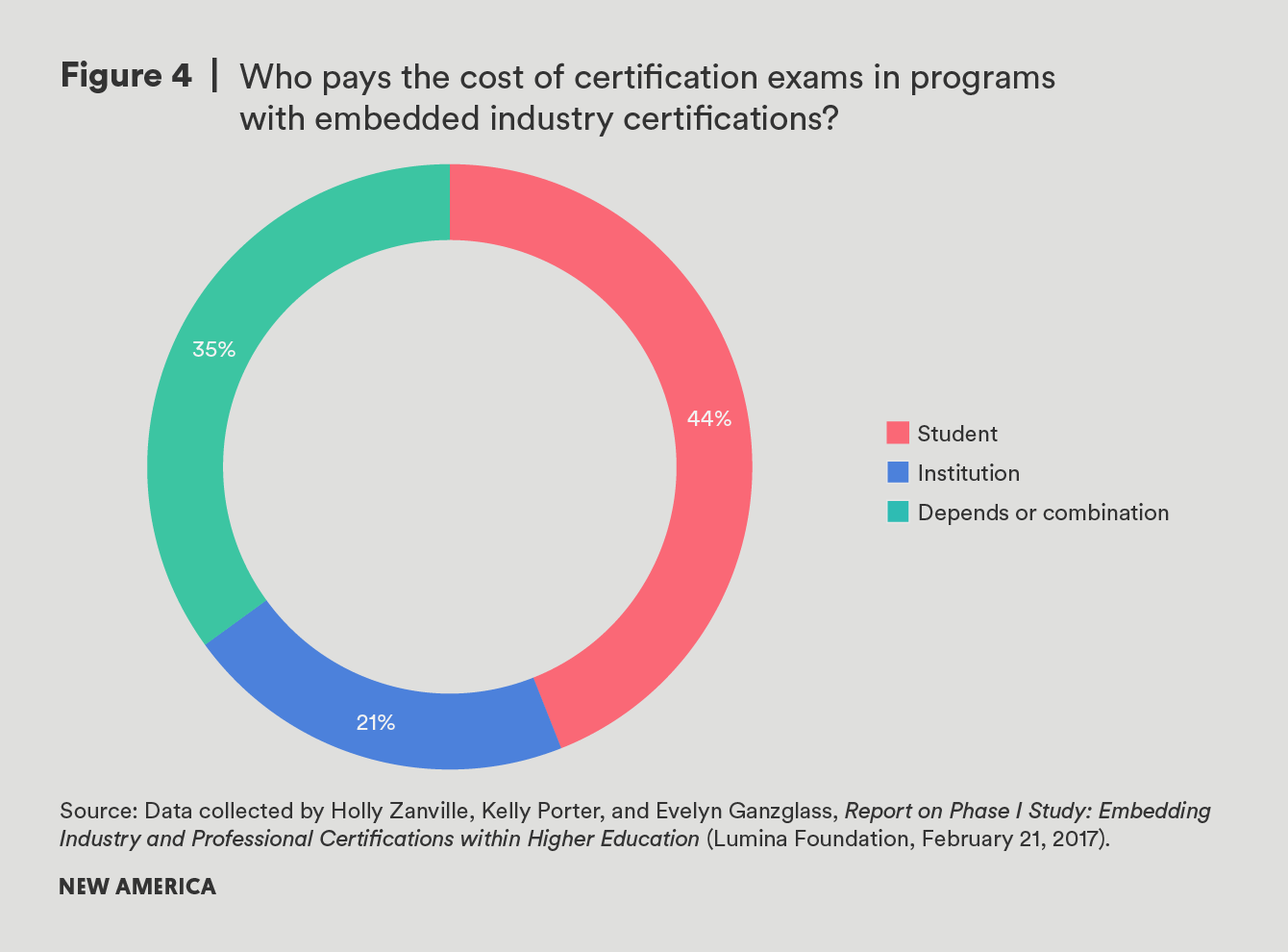
The survey also surfaced a common set of challenges facing institutions, particularly related to expanding or scaling up the practice of embedding certifications into degree programs. The most widely cited challenge was the cost of certification exams and the lack of resources to pay for them. Most respondents indicated that certification exam fees were paid by students, either as part of their tuition and fees or as a separate, additional cost. Certification exam costs can range anywhere from about $60 for the basic OSHA 10 safety certification to over $700 in the case of CISSP cybersecurity certification and the Certified Public Accountant exams. Asking students to shoulder the cost of exams raises a host of other questions around how colleges design and price their degrees. For example, should the college require students to earn a certification in order to complete the degree program, or should it be optional? Should the cost be rolled into the tuition, or should the student pay the certification body directly? And how does the college decide a certification is worth the expense? How does it ensure and monitor the labor market value of any certifications it expects or encourages students to earn?
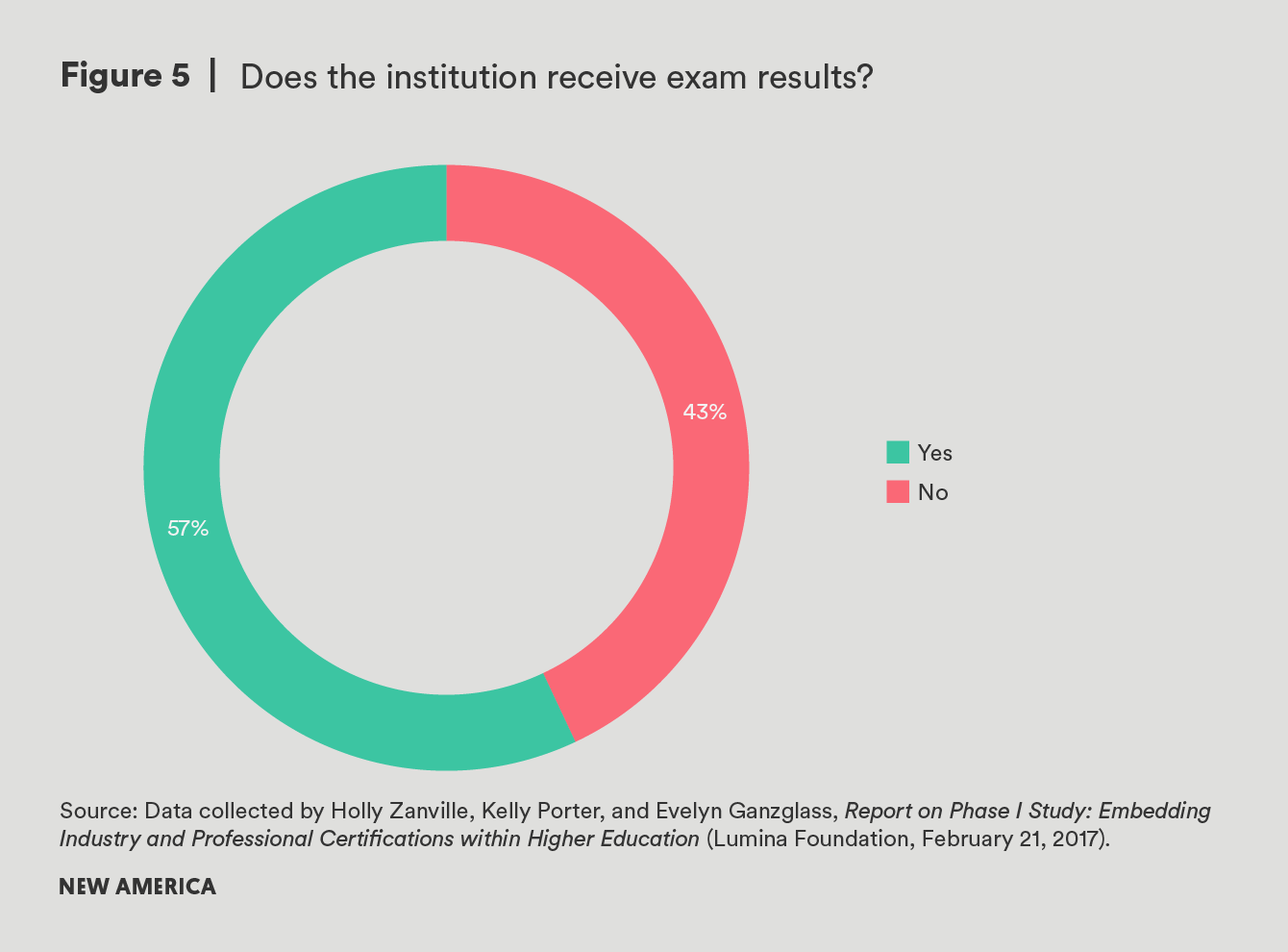
That brings us to another commonly cited challenge: lack of institutional access to employment outcomes, or even to exam results, for students who complete programs with embedded certifications. Given the finding that students themselves are often paying for their certifications, the lack of outcome data is of particular concern. If an institution does not know whether students with certifications have better employment and earnings outcomes than students who do not, why should it expect students to pay for them?
The survey also pointed to “considerable variation in what educators mean when they say they embed credentials in their programs of study.”2 In some cases, institutions required that students pass certification exams to obtain the certificate or degree, while in others earning the certification was optional. Some students earned certification along the way as part of a “stackable” sequence; others took exams at the end of the program, as a capstone. It was also clear that institutions sometimes conflated certifications with licenses and certificates.
Finally, the survey generated some conflicting responses that bear closer examination. For example, though 48 percent of institutional respondents indicated that a key benefit for embedding certifications was to provide employers with prospective employees trained to their specifications, 47 percent also cited a primary challenge in the lack of employer interest in using certifications for hiring. The requirements of external funders, such as federal grant programs or state agencies, was another important reason that institutions cited for embedding certifications, raising questions as to just how much the practice is employer-driven. Similarly, the primary benefit of embedding certifications into degree programs cited by respondents was that students could earn academic and industry credentials at the same time, presumably increasing their employability. However, almost none of the institutions were able to track student employment outcomes. As the report notes:
Though postsecondary institutions typically track whether students pass certification exams, few collect employment data on students who have completed programs and certifications. Even fewer institutions get feedback from employers on the job readiness of former students, and fewer still obtain information on whether employers must provide training for educational institutions that issue the credential (e.g., to improve teaching of the industry-required portion of the curriculum).3
While also revealing some important contradictions and unanswered questions, the survey provided an important first look at the types of institutions of higher education that are embedding certifications into degree programs, why they are doing it, and the practical challenges to building and sustaining these new degree designs.
Citations
- The channels for survey dissemination were: 1) the Connecting Credentials website and newsletter, 2) Connecting Credentials co-sponsors, 3) networks and grantees of the US Department of Labor and Education, 4) the National Manufacturing Association’s network, 5) CompTIA’s partner colleges, and 6) the American Council on Education’s newsletter. Holly Zanville, Kelly Porter, and Evelyn Ganzglass, Report on Phase I Study: Embedding Industry and Professional Certifications within Higher Education (Indianapolis, IN: Lumina Foundation, January 2017), 6, source .
- Ibid., 3.
- Ibid.