
Table of Contents
How Broward College is Rebundling Degrees with Certifications
There was one notable exception to this general pattern: Broward College. Located in southeastern Florida, Broward's wide range of degree programs with embedded certifications set it apart from other participating institutions. These included the automotive repair, aviation, and healthcare programs seen at many other schools, but also degree programs in supply chain management, marine engineering, insurance and risk management, and public safety. Broward's IT degree programs embedded a very wide range of certifications, including more advanced certifications in cloud computing and cybersecurity,1 and the college was actively exploring opportunities to embed certifications into other disciplines, including financial and banking services and property management. The college also stood out for the sheer number of certifications its degree-seeking students earn.
Given the results in Broward, we conducted a series of follow-up interviews and a site visit to better understand how the college has succeeded in embedding certifications into so many degree programs, and how it has overcome the challenges of finance, selection, and implementation that other colleges now face. We found that state agencies can play a critical role in addressing the challenges of financing and selecting certifications, which in turn frees up college leadership to develop incentives and innovative implementation strategies to support embedding certifications into degree programs.
State Financing: The Career and Professional Education Act
In 2007, Florida passed the Career and Professional Education (CAPE) Act, which reimburses schools for the examination fees of students who earn specific industry certifications. Originally designed to improve the quality of high school career and technical education programs by better aligning them with the needs of industry, the program was expanded to include students at public postsecondary institutions in 2014. Students must be in credit-bearing programs, and reimbursements of up to $1,000 are allocated to institutions for each qualifying certification exam.2
We found that state agencies can play a critical role in addressing the challenges of financing and selecting certifications, which in turn frees up college leadership to develop incentives and innovative implementation strategies to support embedding certifications into degree programs.
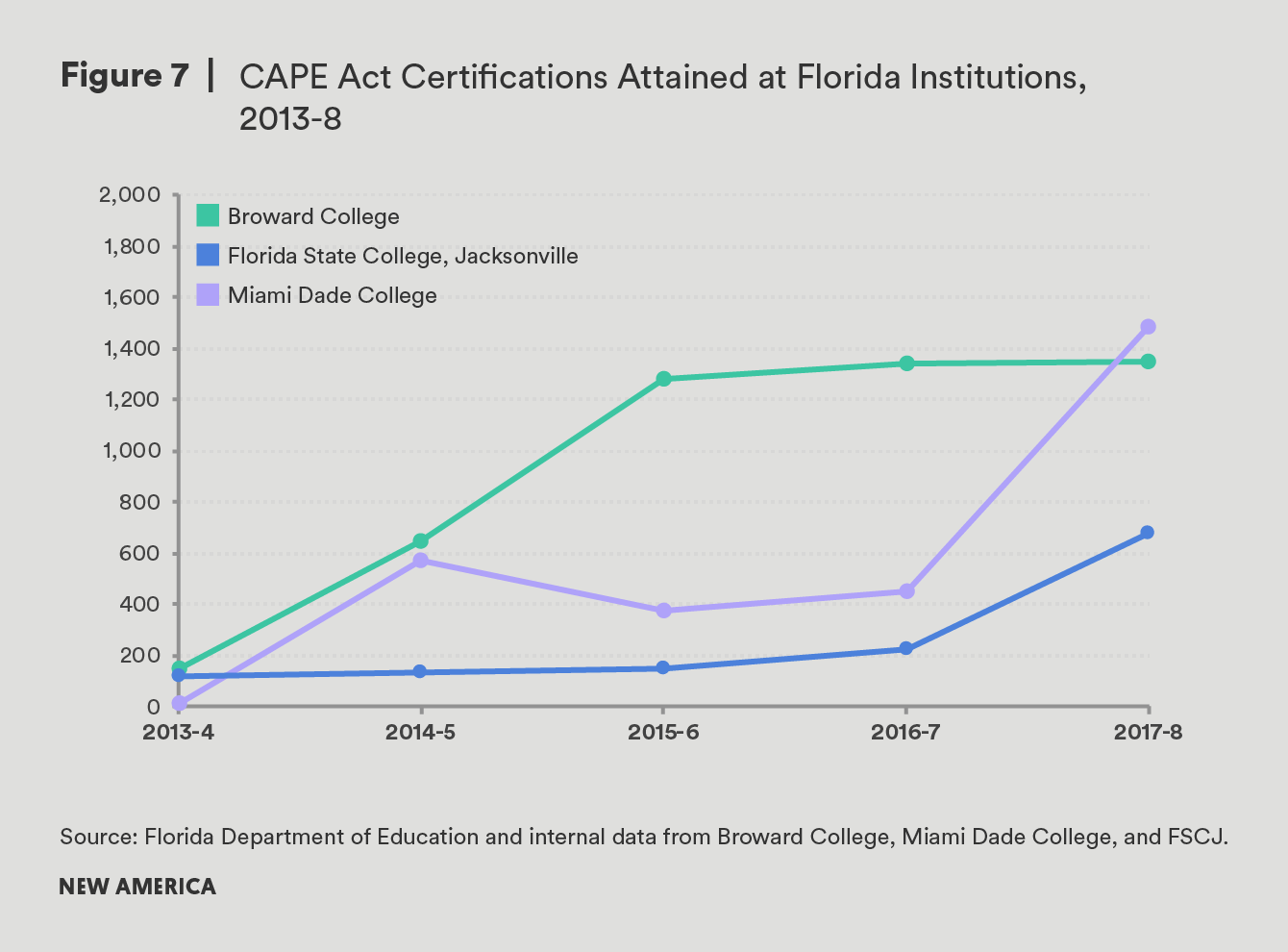
Since its expansion to postsecondary institutions, colleges across the state have used CAPE reimbursements to defray student costs for industry certifications and to build up institutional resources that have supported significantly increased certification attainment. The number of eligible certifications earned by Broward students increased from 148 in 2013-14, the first year the incentive was offered, to 1,349 in 2017-18.3
Before CAPE, Broward had a long-standing practice of reimbursing some certification exams using Perkins funding. Certification fees associated with Broward’s three TAACCCT projects were also paid out of grant funding while the projects lasted, but the CAPE incentive has allowed Broward to expand subsidies to many more certification exams, offering fee vouchers to eligible students. Michael Coburn, who has taken eight certification exams in his time at Broward and plans to take three more before he finishes his bachelor’s, has paid nothing extra for them thus far.
Keeping certifications affordable in the absence of grant funding will be a challenge, however. If CAPE expires, acknowledges Renee Law, dean of workforce education and career services, Broward would have to think carefully about which embedded certifications to preserve. For those that it keeps, the college will continue to use Perkins funding to offset student costs.
Selection: State Generated Lists of In-Demand, High-Quality Certifications
Broward and the two other Florida colleges we examined, Miami Dade College and Florida State College at Jacksonville, have an additional advantage over other schools: access to three lists of high-quality, in-demand industry certifications that have been vetted by the state’s education and workforce agencies. The original list of credentials of value was developed by the state to facilitate reporting on “technical skills attainment” (TSA) by students in programs funded through the Perkins CTE Act. More recently, beginning in March 2013, the state developed a second list of “Gold Standard” certifications that assigns college credit weights for an array of industry certifications connected to Florida’s CTE pathways.4 These Gold Standard certifications can save a student between $315 and $1,250 each through advance credit.
The third list was developed in 2014 to designate certifications eligible for CAPE Act reimbursement at the postsecondary level. To make this third list, certifications had to meet a set of quality criteria, including demonstrated demand from employers in the state, college-level learning outcomes, and rigorous third-party assessments. The CAPE list includes just over 300 certifications, all vetted by the state department of education’s division of Career and Adult Education.
The state’s three certification lists (for state reporting under Perkins CTE, for guaranteed credit articulation, and for institutional reimbursement under CAPE) made it much easier for Broward to select the certifications it would embed into degree programs. As in other institutions participating in our interviews, Broward's faculty and staff still had to engage with local employers to understand their skill needs and determine appropriate certifications to embed into programs, but at least they were not starting from scratch.
Implementation: A College-Wide Vision and Strategy
In contrast to other colleges we interviewed, integrating certifications into degree program is a college-wide priority at Broward, closely tied with other efforts to ensure student success such as guided pathways and career coaching. Certification attainment is measured, rewarded, and actively promoted to students, employers, and internal college stakeholders. In fact, increasing certification attainment is a primary goal of the college’s current five-year strategic plan.5
Broward's faculty and staff still had to engage with local employers to understand their skill needs and determine appropriate certifications to embed into programs, but at least they were not starting from scratch.
While state funding and vetting of certifications provides essential support for Broward’s efforts to integrate certifications into degree programs, the practice would never have reached its current scale without the vision and commitment of college leadership. Broward’s three TAACCCT grants, the first of which began in 2012, were an important precursor to its successes following the expansion of the CAPE Act. The goal of TAACCCT grants was to build programs that met the needs of adult learners and local employers for in-demand skills and to make it easier for students to transition into the labor market. College leaders saw that certification could serve a critical signaling function, helping students and employers find one another.
TAACCCT grants provided funding for the development of programs in supply chain management and information technology that included industry certifications. They also helped the college build its capacity to work with employers and faculty around the use of certifications. In the case of supply chain management, Broward worked directly with an industry association, the Council of Supply Chain Management Professionals (CSCMP), to develop the series of certifications that were then embedded in the degree program. The project started as a way to satisfy local firms’ unmet needs for entry-level employees, who at the time had no pathways—in Florida or anywhere else—that would allow them to acquire both the academic and industry credentials needed to demonstrate job-readiness in the absence of prior experience. The end product, the SCPro Fundamentals certification sequence, is a genuine industry certification whose standards are owned and maintained by CSCMP, and which has been adopted by other colleges. Though the sequence can be pursued outside of an academic program, it is the first we know of that was purpose-built as an embedded certification, intended to match the joint academic and industry credential requirements of modern supply chain management jobs.
After 2014, funding through the CAPE Act provided an opportunity for the college to sustain and expand its efforts to embed certifications into degree programs. Broward’s president at the time, J. David Armstrong, instituted a variety of creative measures to entice department heads and faculty to embed certifications into their degree offerings. For example, he agreed to split the state’s reimbursement of the certification exam costs with the department delivering the program, creating an important financial incentive for department heads to expand certification use. In March 2014, Broward’s Division of Career and Workforce Education and Economic Development hired Renato Cortez for a new role as a full-time CTE certification specialist. Cortez focuses exclusively on implementing and evaluating the college’s industry certification initiatives, and on designing program modifications to respond to the needs of employers in Broward’s environs. Following Broward’s example, nearby Miami Dade College created a part-time role modeled on Cortez’s, which will be expanded to full-time status this year.
President Armstrong also expanded on-campus testing centers to ensure that each of its three main campuses can provide as many certifications as possible, all on-site and during student-friendly windows. Though its testing centers were not unique among our interviewees, Broward’s focus on certification attainment has led it to leverage its centers even more ambitiously. For example, the IT department has begun offering yearly boot camps to allow students to collaboratively study and practice for certification exams. Last year, Information Technology Dean Tom Ayers estimated that about 100 students dropped in each day, earning over 90 certifications during the week-long boot camp session alone.
Broward’s 1,349 CAPE-reimbursed certifications in the 2017–18 academic year represent an over threefold increase over its 2013–14 attainment, and its success has not gone unnoticed by other colleges in the state. Several other Florida colleges have adapted elements of Broward's programs and strategies: in 2017, after several visits to Broward, the much larger Miami-Dade College finally surpassed it in the total number of CAPE-eligible certifications awarded to students in its degree programs.
Broward College’s success in designing and launching a wide range of degree programs that include industry certifications shows what is possible with a combination of well-targeted financial incentives and committed leadership. State resources—both the lists of high-quality certifications and the funding dollars allocated for them—allowed Broward to overcome some of the most vexing challenges to embedding certifications into degrees, and to make the practice a college-wide initiative rather than a feature of one or two programs. But even with state support and buy-in across the college and among employers, Broward is still struggling to measure the impact of its innovative degree designs on student outcomes.
Citations
- CompTIA Cloud+, Microsoft CSE, and ISC2 CCSP, ISC2 SSCP and—for more experienced students—CISSP.
- The exact amount reimbursed to institutions for each certification depends on the annual appropriation and the number of certifications earned system-wide. In 2017-8, for example, the annual allocation of $4.6 million meant that institutions were ultimately reimbursed about $680 for each certification attained.
- By comparison, Florida State College at Jacksonville increased its CAPE-eligible certification attainment from 117 in 2013-4 to 676 in 2017-8. Miami Dade College has experienced even more impressive increase, from 17 in 2013-4 to 1,428 in 2017-8—surpassing Broward’s total for the first year. The vast majority of MDC’s eligible certifications—544 of them—were the national nursing exam, the NCLEX-RN.
- The 2016–17 Gold Standard Career Pathways list establishes credit weights for 124 certifications. By contrast, Alfred State College’s more recent effort to define credit weights for industry certifications currently applies to four certifications. See the Gold Standard list source and Alfred State’s eligible certifications source
-
The other four institutional “Soar” strategies listed in Broward’s 2017-22 plan are to engage faculty in the use of career exploration tools; to increase enrollment in bachelor’s programs; to increase work-based learning experiences and job placements; and to expand seamless transfers to partner institutions. See Broward’s strategic plan:
source