Bringing Americans Home 2021
Table of Contents
- Foreword
- Executive Summary
- 1. Introduction
- 2. A Brief Examination of U.S. Hostage Policy: 1960’s–Today
- 3. Methods, Limitations, and Definitions
- 4. Perceptions of the U.S. Government’s Hostage Recovery Enterprise
- 5. Key Concerns Among Hostage and Unlawful or Wrongful Detainee Families
- 6. Conclusion
- Appendix A: Requests Regarding Mental Health, Physical, and Financial Support for Returning Hostages and Unlawful or Wrongful Detainees
- Appendix B: Hostage Interview Responses
- Appendix C: Unlawful or Wrongful Detainee Interview Responses
Abstract
This report, conducted by the James W. Foley Legacy Foundation (JWFLF), is a continuation of JWFLF’s initial assessment of the efficacy of the 2015 U.S. Hostage Policy Review and the implementation of PPD-30 and EO 13698. Based on confidential interviews with 42 participants, this report seeks to convey the perspectives of U.S. hostages, unlawfully or wrongfully held detainees, their family members, representatives, advocates, former senior military officials, and current and former U.S. officials. It, however, does not represent the perspectives of all former hostages, detainees, and their families, but only presents the perspectives of those who participated in this study. This study is intended to spark and inform discussions that will continue to improve the U.S. government’s provision of support to hostages, unlawful wrongful detainees, and their families.
Dedication
The author dedicates the report to the memory of all former hostages and unlawful or wrongful detainees who have tragically lost their lives and to those who are currently fighting for their freedom. You are remembered. We won’t stop. We won’t quit—until you’re home.
Acknowledgments
First, I would like to thank all of our participants who trusted me with their hostage and wrongful detainee-related experiences. Without your support, none of this would have been possible. Even though this report has a single author, it represents many stories and would have never been possible without continued support from those within the hostage and wrongful detainee community at large.
I would like to extend my sincerest gratitude to Diane Foley, president and founder of the James W. Foley Legacy Foundation, as well as the Foundation’s Board of Directors. Thank you not just for supporting me in writing this report, but also for trusting me to represent the Foundation as I engaged with former hostages, wrongful detainees, and with families of Americans who continue to remain in captivity. To Margaux Ewen, our executive director, thank you for contributing to the report in numerous ways and for seeing it through to the end. Your encouragement throughout this process has helped in more ways than I can mention here.
I owe a debt of gratitude this year, as in years past, to Peter Bergen and New America, whose generous support continues to make this report possible. I would also like to thank David Sterman and Melissa Salyk-Virk for helping me get this product over the finish line and for their outstanding editorial edits. Your handling of the subject matter was done deftly and with nothing short of brilliance. To Jordan Vest and Conner Ingleson, who each provided assistance with researching parts of this report—thank you for your support and for re-energizing me when the tasks required for this report were, at times, arduous and looming.
This year’s report benefited, as well, from the expertise of many current and former U.S. government officials. To Eric Lebson, thank you for investing so much of your time in challenging me and helping me think critically about these issues. You are a true advocate, through and through. Many others, however, who participated in this report I cannot name due to confidentiality constraints. I am exceedingly grateful to several I spoke with early in this effort. Our conversations in early May, August, and September, helped frame this report and bring it to the next level. Your service to our country and to the hostage community writ large, is nothing short of admirable and humbling at the very least. Your contributions to hostages, wrongful detainees, and their families are often unheralded. While I would like nothing more than to highlight your valiant efforts and dedication, I also understand your advocacy is stronger if done quietly. My hope is that former hostages, wrongful detainees, and their families read this knowing that there are many wonderful, dedicated people working relentlessly behind the scenes on their behalf.
Last and most certainly not least, I would like to extend my enormous gratitude towards my husband, Seth Loertscher, for his unwavering support throughout the year. Thank you for always being my sounding board and for your overwhelming generosity in sharing your expertise on the subject matter.
About the James W. Foley Legacy Foundation
The James W. Foley Legacy Foundation advocates for the freedom of all Americans held hostage abroad and promotes the safety of journalists worldwide. Find out more at www.jamesfoleyfoundation.org and by viewing the documentary, Jim, the James Foley Story.
Downloads
Foreword
I am honored to write the foreword to the 2021 edition of Bringing Americans Home. This is a pivotal year for the effort to bring Americans home safely.
Much of the news from the U.S. government is encouraging. This year brought to office the third consecutive president committed to the reforms agreed in 2015. With the Robert Levinson Hostage-Recovery and Hostage-Taking Accountability Act now codified into law—enacted under one president and Congress and now being implemented under their successors—the institutions and policies important to bringing Americans home have the stability needed to grow.
Too many Americans remain in prisons and unknown locations, however. Every day that they are gone is a loss for all of us who care about the safety of our fellow citizens. The Biden administration has pledged strong support for their return. Many of the officials involved now lived through the searing failures that gave rise to the 2015 policy, supported that policy, and have pledged to do their best. As the new administration puts in place its policies and people there will be many opportunities to see that the return of Americans is a priority in practice. The James W. Foley Legacy Foundation will have much to say about how well that works, and it will have much to contribute as well.
Two systematic challenges stand out. The first concerns the treatment of Americans held illegitimately by foreign governments. When the 2015 reforms were put in place much of the focus was on Americans held by non-state actors. This made sense. The hostage structures were new, and these Americans and their families needed a voice and partner dedicated to them. The Hostage Recovery Fusion Cell (HRFC), headquartered at the FBI and with representatives from all relevant agencies, put much of its effort into these cases.
Even in the initial mandate of the presidential envoy’s office, however, it was made clear that some Americans detained abroad by governments would receive help from the office. These Americans, just like those being held by nongovernmental groups, were being held illegitimately and often because those detaining them wanted something from the United States. Just as with hostage families, their families needed support within the U.S. government to understand their options and advocate for the safe return of their loved ones. And when these Americans returned home, they needed the same help that former hostages did, with medical care, government documents, and the practical problems of lives interrupted.
From the start, the principals of the department consulted quickly about how to address these situations. Many cases were handled, often very well, through traditional diplomatic channels, while others came to the Special Presidential Envoy for Hostage Affairs (SPEHA) office. Over time, more cases and conversations followed, and successive administrations learned more about how to do better.
Problems remained. The families and cases often arrived at the office informally, and after months or years. The cases were subject to different rules on information sharing than those of people held by nongovernmental groups, and this made it difficult to cooperate with the families and communities hoping to support their loved ones. There also were relatively few U.S. government resources available automatically to help families and people returning from detention by governments. (Most routinely available U.S. government resources came from the Department of Justice and were available when someone was named as having been the victim of a criminal act such as kidnapping.) The State Department stood up its own, comparable system, which depended on extraordinary interventions from senior officials. This often came long after someone had been detained.
We were learning as we went. I—and I believe my successors, Robert O’Brien and Roger Carstens—felt that after some experience we knew enough to change the rules. The Levinson Act provides an opportunity to do this. As Bringing Americans Home makes clear, some changes to State Department regulations will make it easier to share information and should make available resources that will help families and people returning. We will see in 2022 whether the promise of these changes has been met and that a regular process has replaced improvisation.
A second challenge is that the successes too often are treated as unusual or idiosyncratic. They are in fact a pattern that should be talked about and repeated. Across conflict zones since 2015, in Syria, Yemen, Iraq, and Afghanistan at least, we have seen that Americans come home when U.S. negotiators place priority on their return.
There is an interesting point worth emphasizing. The safe return of Americans helps the pursuit of peace. The release of a prisoner, especially a non-combatant journalist, aid worker, or businessperson, is an irreversible, simple step that can be taken early without prejudicing larger issues in the negotiation. It establishes credibility without straining the enterprise.
I saw this around the world years before becoming the hostage envoy. In one instance, the Bosnian peace talks were essentially stopped for days while Serb authorities were asked to release an American journalist. The calculation from the lead international negotiator was simple: If the other side could not order soldiers to release one person it would probably not order the same soldiers to surrender territory. Every negotiator should be asked to evaluate whether he or she can make the same effort and, if not, to explain why not.
Fortunately, there will be a vibrant community making this case, and this is another welcome development evident in this report. The James W. Foley Legacy Foundation, Hostage US, and newer groups bring rich experience to discussions of how Americans and others can come home safely. They have earned their knowledge, often at the cost of terrible tragedy and always from careful study and application to the issues at hand. Families can rely on this community, and—after their years of experience—government officials would be wise to regard them as partners and advisers as well.
The existence of this community, brought together in organizations like the Foley Foundation, means that Americans can rely not just on individuals but on institutions, in government and outside of it. The U.S. administration and Congress, in successive terms, have signaled that they are committed to maintaining what has been gained and to improving further. And the Foley Foundation shows how a community can come together to hold the government to its promises. Together they can help Americans come home to live safely. That is how it should be.
James C. O’Brien
Former Special Presidential Envoy for Hostage Affairs
Executive Summary
This report, conducted by the James W. Foley Legacy Foundation (JWFLF), is a continuation of JWFLF’s assessments of the efficacy of the 2015 U.S. Hostage Policy Review and the implementation of Presidential Policy Directive 30 and Executive Order 13698. This study seeks to convey the perspectives of U.S. hostages, unlawfully or wrongfully held detainees, their family members, representatives, advocates, former senior military officials, and current and former U.S. officials. It, however, does not represent the perspectives of all former hostages, detainees, and their families, but only presents the perspectives of those who participated in this study.
This report is based on confidential interviews with 42 participants, of whom 28 were former hostages or unlawful or wrongful detainees, family members, advocates, and representatives of current and former hostages and detainees and 14 were former or current U.S. government officials or former senior military officials. It provides insights into how the U.S. government’s 2015 reforms of its hostage recovery enterprise continue to impact the families of Americans held hostage. Additionally, this report examines the support that U.S. nationals detained unlawfully or wrongfully abroad, and their families receive from the U.S. government. All interviews were conducted between March 2020 and April 2021. This study is intended to spark and inform discussions that will continue to improve the U.S. government’s provision of support to hostages, unlawful wrongful detainees, and their families.
Key Findings and Recommendations
1) The changes to the hostage recovery enterprise enacted by Presidential Policy Directive 30 (PPD-30) and Executive Order 13698 remain durable and effective. The Robert Levinson Hostage Recovery and Hostage-Taking Accountability Act codified these changes into law in December 2020. Together, this policy and legal framework created a foundation to coordinate and support U.S. nationals held hostage or unlawfully or wrongfully detained abroad. At the same time, there are indications that this framework will require continued adjustments in order to provide leaders within the hostage recovery enterprise with the authority they need to prioritize the release and recovery of U.S. hostages and unlawful or wrongful detainees held abroad.
- Executive Order 13698 and PPD-30’s establishment of the Hostage Recovery Fusion Cell (HRFC) and the Special Presidential Envoy for Hostage Affairs (SPEHA) took the coordination of hostage-taking responses out of the National Security Council and created organizations dedicated to focusing on hostage and unlawful or wrongful detainee recovery. These organizations filled a void present in hostage policy prior to PPD-30 and play a critical role in supporting families. In addition, creating these organizations whose sole purpose is hostage and unlawful or wrongful detainee recovery have created a level of continuity for these issues missing in previous U.S. hostage policy. However, while hostage policy is important in establishing a foundation to coordinate hostage recovery strategies and it enables the U.S. government to engage with families, families stress the importance of not overly bureaucratizing the system since all cases are unique and require flexibility and creative solutions to resolve them. The U.S. government should strive for continuity within the organizations in the hostage recovery enterprise both to better support families and to maintain expertise on how to respond to hostage-taking and wrongful or unlawful detentions but should remain flexible in how it achieves that goal.
- While PPD-30 and the Robert Levinson Hostage Recovery and Hostage-Taking Accountability Act have established mechanisms to increase the priority of hostage and wrongful detainee issues in the U.S. government, there are indications that these are, for the most part, only effective when the president and interagency1 leadership prioritize hostage and wrongful detainee recovery. Increasing the authority and stature of the HRFC, for instance, may be necessary for hostage recovery to be a priority in the face of competing demands for national security attention. The U.S. government should continue to assess whether the changes made under PPD-30 and codified with the Robert Levinson Hostage Recovery and Hostage-Taking Accountability Act have established organizations with the proper authority to make hostage and detainee recovery an enduring priority.
2) Overall, former U.S. hostages, unacknowledged detainees, and their families continue to benefit from the U.S. government’s 2015 reforms. At the same time, however, families and U.S. government officials indicated that there remain some gaps in the support provided to these hostage families and in the U.S. government’s ability or willingness to prioritize the recovery of U.S. hostages.
- Hostage families shared concerns about the U.S. government’s ability to continue to declassify and share information regarding their loved ones’ cases. In addition, the pace of declassification efforts was raised as a concern, where some participants reported that U.S. government declassification efforts lagged behind the pace of hostage-taking responses, rendering the information families received less effective when it was disclosed. The U.S. government should examine whether the intelligence community issue manager for Hostage Affairs has the standing and authority to make declassification of information a priority in the interagency.
- While hostage families generally reported satisfaction with the priority that the U.S. government placed on the recovery of their loved ones, hostage advocates, third parties, and U.S. officials indicated that the leadership of the hostage recovery enterprise struggled to make hostage issues a priority within the interagency. As the interagency focus transitions from counterterrorism to great power competition, it will become more difficult for the hostage recovery enterprise to elevate hostage issues and align assets against requirements to generate the intelligence needed to recover U.S. hostages. The Hostage Response Group at the National Security Council will play a key role in supporting the prioritization of hostage recovery during this transition. In addition to the president and the secretary of state, prioritizing the recovery of U.S. hostages must be a focus for the special assistant to the president and senior director for counterterrorism, as well as the national security advisor.
- The HRFC, currently housed within the Federal Bureau of Investigation (FBI) headquarters, was originally conceived as operating independently. In addition, the HRFC was designed to function as the dedicated interagency organization outside of other U.S. departments and agencies to serve as the primary operational coordinator for hostage-takings. Since its inception, the director of the HRFC has served as a section chief, a lower-level position within the FBI. This places the director approximately five steps below the director of the FBI and other principals. In contrast, the SPEHA office was designed to exist only one step below the principal level and the SPEHA reports directly to the secretary of state. While the office of the SPEHA and the HRFC coordinate and work closely together and the SPEHA’s standing in the State Department is necessary for his or her diplomatic engagements overseas on behalf of hostages and detainees, this difference in standing within the government clouds clear delineation of responsibility for these cases. Placement of the HRFC within the FBI headquarters has blurred the independence of the organization, and thereby, the director’s position and authority to operate as the primary coordinator for hostage-takings. The U.S. government should elevate the position of the director of the HRFC and evaluate whether the placement of the HRFC is positioned appropriately in order to fully engage and act as the U.S. government’s primary interagency body to direct and coordinate activities at the operational level for all hostage-takings.
- Former hostages and family members of former and current hostages seek further support from the HRFC and the office of the SPEHA in providing proof of life of their loved ones, identifying the location and retrieving their loved ones’ remains, and pursuing cases where captors have not been brought to justice. In some cases, prioritizing hostage issues requires supporting efforts to secure justice and accountability, which can continue long after the outcome of hostage-taking.
- Hostage advocates remain concerned about the fates of hostages who remain in Afghanistan, as al-Qaeda promises “war on all fronts” against America.2 Advocates reported fearing that once U.S. troops leave Afghanistan, it will become more difficult to generate the intelligence needed to find Americans and conduct rescue operations for current hostages held in the area. They also fear that the further reduction of U.S. physical presence in the country is an erosion of the leverage needed to make progress on resolving these cases. It is perceived by some advocates that securing the release of these hostages was not made a precondition for any settlement during the peace talks in Doha, Qatar with the Taliban. Prioritizing hostage recovery requires that securing the freedom of U.S. nationals be a factor in negotiations with groups holding Americans hostage. It is possible this can be done without the provision of concessions through making their release a precondition to initiating talks or securing a negotiated settlement. The continued holding of U.S. hostages undermines the credibility of any negotiation or deal on other topics with the hostage holders.
3) Since 2020, families of unlawfully or wrongfully detained U.S. nationals have increasingly benefitted from the U.S. government’s 2015 policy reforms. Families report having more direct access to the SPEHA and cite improved information sharing and coordination regarding their loved ones’ cases. Despite not receiving detailed information on recovery options, the overall perception of families is that the SPEHA’s prioritization of wrongful detention cases has improved. The passage of the Levinson Act into law is viewed as a substantial move in the right direction. While there have been recent advances, former unlawful or wrongful detainees, family members of individuals with current cases, as well as potential incoming unlawful or wrongful detention cases, require additional support.
- Unlawful or wrongful detainee participants shared that it took eight months to two and a half years to gain access to the SPEHA’s office. Without access to the SPEHA’s office, these cases often languish in Consular Affairs alongside thousands of lawful detentions that occur overseas each year, getting the standard treatment of wellness visits, but not diplomatic advocacy for their favorable resolution. For these lawful detentions, adjudication through the foreign government’s judicial system is highly likely, but unlawful or wrongful detentions are far less likely to receive any judicial process, let alone due process. This is because these unlawful or wrongful detentions typically occur in countries where the foreign governments show hostility towards the United States and the U.S. nationals are being held to affect changes in U.S. policy, force prisoner exchanges, and/or extract other forms of political concessions from the United States. The complex nature of the relationships between the United States and these countries requires both high-level diplomatic engagement and the prioritization of unlawful or wrongful detainee recovery in the relationship with these countries. In addition, while they are being held, unlawful or wrongful detainees undergo continuous interrogations, experience inhumane treatment such as living in unsanitary conditions, solitary confinement, and some undergo physical and psychological torture. Therefore, unlawful or wrongful detention cases must receive high-level U.S. government and SPEHA diplomatic engagement as well as prioritization within the interagency, something that is not in the remit or practice of Consular Affairs. Delaying access to the SPEHA’s office slows the resolution of these cases and increases the trauma suffered by the detainees and their families. The U.S. government should reconsider how cases are assessed and the process of reassignment to the SPEHA’s office in order to reduce unnecessary trauma to the families and reduce the time each case spends being vetted by Consular Affairs.
- As of this report’s writing, there is not a systematic process for family members to alert the office of the SPEHA of a potential unlawful or wrongful detention case. This report finds that these types of cases can reside within the Bureau of Consular Affairs at the State Department for up to two years before getting the attention of the SPEHA's office through State Department channels. As a result, the most effective method currently to gain a “point of entry” into the SPEHA’s office is either through a consular officer, a nongovernmental organization, or from within the SPEHA’s office itself. Unlawful or wrongful detentions require high-level U.S. diplomatic engagement with foreign governments holding U.S. nationals who try to leverage detention cases for political purposes. Therefore, their cases must not remain in Consular Affairs, which does not engage in diplomacy as an advocate for the wrongfully detained. In addition, the State Department should create a point of entry for family members to notify the SPEHA office whose loved ones have been unlawfully or wrongfully detained overseas.
- In official U.S. government definitions of hostage-taking, the term is defined broadly, focusing on the coercive nature of the act. While this definition of hostage-taking could be used to describe both individuals held by non-state and state actors, the U.S. government functionally excludes those Americans held by foreign governments from the term “hostage.” Despite the U.S. government’s delineation between hostage and unlawful or wrongful detainee cases, some wrongful detentions are essentially hostage-takings conducted by state actors. The victims of these “state hostage-takings” are held primarily for their coercive potential against the United States and often receive the same torture and abuse typically associated with terrorist hostage-takings. Due to U.S. government classifications, however, they receive different levels of support upon their return home. The U.S. government should create a mechanism to provide better support for victims of state hostage-takings, and broaden its functional definition of the term hostage to include these types of cases.
- Unlawful or wrongful detainee advocates and other participants raised serious concerns about reviving nuclear negotiations with Iran while U.S. nationals are currently being held in Iran. In addition, advocates noted the opportunity to release those individuals held in Iran would decrease if the U.S. rolls back sanctions and pressure as incentives to resume talks on Iran’s nuclear program. These advocates also expressed their concerns that Iran was detaining U.S. nationals specifically to achieve leverage during these negotiations and that U.S. and allied detainees needed to be released prior to any official negotiations. Advocates and unlawful or wrongful detainee participants are unified in their demand for the release of U.S. nationals before the United States engages in official negotiations with Iran.
4) Returning hostages and unlawful or wrongful detainees require more mental health, physical, and financial support upon returning home from captivity.
- Mental health, physical, and financial support are significant areas where hostages and unlawful or wrongful detainees require significant assistance. Most often, hostages and detainees come home with their credit scores ruined and face enormous fines for not paying their taxes or credit card bills during the time they were held abroad against their will. Some hostages and unlawful or wrongful detainees struggle to support themselves or even find a place to live upon their return home. In addition, they are often left on their own while suffering from trauma caused by the physical and psychological torture they experienced while in captivity. In the past, there have been cases where some of these individuals committed or attempted suicide in response to their trauma. The U.S. government should explore both how it can help address these critical but unmet needs of returned hostages, unlawful or wrongful detainees, and their families, and whether the government can provide greater support and resources to nongovernmental organizations that might be better placed to address these challenges.
- Many returning unlawful or wrongful detainees specifically require financial reintegration support from the SPEHA office upon returning home from captivity. They often face late fees, interest that was assessed, penalties from the IRS, and destroyed credit while being detained abroad. Mechanisms supporting hostages in remediating these issues are often unavailable to unlawful or wrongful detainees. Former unlawful or wrongful detainees request a dedicated person or desk within the office of the SPEHA that is dedicated to personal finance matters for while they are being held against their will and for when they return home.
Citations
- For the purpose of this report, the term interagency is defined as “of or pertaining to United States government agencies and departments, including the Department of Defense.” See: Department of Defense, “Joint Publication 3-08: Interorganizational Cooperation,” p. I-3, source
- Nic Robertson and Saleem Mehsud, “Al Qaeda promises 'war on all fronts' against America as Biden pulls out of Afghanistan,” CNN, April 30, 2021. source
1. Introduction
In November of 2014, the Obama administration ordered a “comprehensive review of the U.S. Government policy on overseas terrorist-related hostage cases.”1 The review came in the wake of several tragedies resulting in Americans held overseas by terrorist groups. In the summer of 2014, American journalists James Foley and Steven Sotloff and humanitarian aid worker Peter Kassig were brutally murdered by the Islamic State (ISIS) in Iraq and Syria. In 2013, photojournalist Luke Somers was killed with South African Pierre Korkie in Yemen during a failed rescue attempt to free them from al-Qaeda in the Arabian Peninsula (AQAP).2 While the review was ongoing, further tragedy struck. In January 2015, American hostage Warren Weinstein was accidentally killed along with an Italian hostage, Giovanni Lo Porto, in an airstrike against the Haqqani network in Pakistan.3 A few months later, American humanitarian aid worker Kayla Mueller, also held by ISIS, was killed while she was held by her captors.4
The U.S. government’s hostage policy review, led by Lieutenant General Bennet Sacolick of the National Counterterrorism Center (NCTC), conducted extensive interviews with former hostages and families of hostages who provided “courageous and generous contributions…and reinforced the critical importance of a comprehensive, coordinated, and coherent approach to hostage recovery efforts.”5 The poor experiences of the families of the ISIS hostages and their interactions with the U.S. government6 brought light to the need for a “specific emphasis on examining family engagement” as a part of the review of U.S. hostage policy.7
At the same time, the challenges to trying to recover the ISIS hostages held in Syria, the failed rescue of Luke Summers, and the death of Warren Weinstein highlighted issues beyond family engagement and signaled a need for the U.S. government to take a broader view of the changes that were needed in order to improve its ability to respond to hostage-taking events. In addition to engagement with family members, the review focused on coordination within the U.S. government, engagement with external stakeholders, intelligence sharing and collection, and broader U.S. hostage policy.8
In 2019 and 2020, the James W. Foley Legacy Foundation (JWFLF) published its assessment of the efficacy of the 2015 U.S. Hostage Policy Review and the implementation of Presidential Policy Directive 30 (PPD-30) and Executive Order (EO) 13698.9 This report is an extension of that work, continuing to examine the way that the U.S. government creates and implements policy in support of U.S. nationals, and their families, who are taken hostage or unlawfully or wrongfully detained abroad.
The report is divided into six sections including this introduction. The second section provides a brief history of U.S. hostage policy. The third section explains the method and limitations of the survey conducted as part of this report. The fourth section discusses results from the survey regarding perceptions of the U.S. hostage recovery enterprise. The fifth section discusses concerns raised by former hostages and detainees along with their families, advocates, U.S. government officials, and senior military officials. The sixth section provides concluding remarks. Appendix A provides a list of requests for support made by participants. Appendix B and Appendix C provide further detail on the survey responses for hostage case and wrongful detainee case participants respectively.
Citations
- John Parkinson, “President Obama Orders Full Review of Hostage Negotiation Policy,” ABC News, November 17, 2014. source
- W. J. Hennigan and David S. Cloud, “U.S. hostage Luke Somers killed in Yemen during rescue attempt,” Los Angeles Times, December 6, 2014. source
- Despite being killed in airstrikes in January 2015, Weinstein and Lo Porto’s deaths were not made public until April 2015. See: Jim Miklaszewski, Tracy Connor and Robert Windrem, “Americans Warren Weinstein and Adam Gadahn Killed in U.S. Drone Strikes,” NBC News, April 23, 2015. source
- James Gordon Meek and Luis Martinez, “US commandos searching Syria for executed hostages' remains: Officials,” ABC News, February 12, 2018. source
- White House, Report on U.S. Hostage Policy. Washington D.C., June 2015, p.5. source.; Jen Easterly, “Foreword,” in Cynthia Loertscher, “Bringing Americans Home: The First Non-Governmental Assessment of U.S. Hostage Policy and Family Engagement” (New America / James W. Foley Legacy Foundation, June 24, 2019), p. 5. source.
- Lawrence Wright, “Five Hostages,” The New Yorker, June 24, 2015. source
- John Parkinson.
- The White House, “Report on U.S. Hostage Policy,” June 2015, p. 4. source
- Cynthia Loertscher, “Bringing Americans Home: The First Non-Governmental Assessment of U.S. Hostage Policy and Family Engagement,” James W. Foley Legacy Foundation and New America, June 2019; Cynthia Loertscher, “Bringing Americans Home: A Non-Governmental Assessment of U.S. Hostage Policy and Family Engagement,” James W. Foley Legacy Foundation and New America, April 2020.
2. A Brief Examination of U.S. Hostage Policy: 1960’s–Today
It is important, when examining PPD-30 and the reorganization of the hostage recovery enterprise, to understand when and how the United States first dealt with hostage-taking events and how U.S. hostage policy developed. Many of the United States’ early experiences with terrorism involved hostage-taking, including the kidnapping of diplomats and the hijacking of aircraft with U.S. citizens aboard. In the late 1960’s and early 1970’s, the Nixon administration grappled with kidnappings of U.S. diplomats in Latin America. During these early terrorist kidnappings, the United States took the stance that host governments were responsible for the protection of the diplomats within their country and that, should U.S. diplomats be kidnapped, those host governments were responsible for their safe return.1 This, in practice, meant tacit—and sometimes actual—U.S. support for host government concessions to kidnappers, including the release of prisoners and the payment of ransoms, providing it would secure the release of U.S. officials.2
As the tactic spread and kidnappings and hijackings became a recurring phenomenon, the U.S. stance on conceding to terrorist demands began to harden. This was especially the case as demands were leveraged directly against the United States, as opposed to the host government. In 1971, during a hostage crisis in which four U.S. airmen were kidnapped in Turkey,3 U.S. officials privately signaled the Nixon administration’s emerging no-concessions policy when a $400,000 ransom was demanded from the United States as a means to resolve the crisis. In a since declassified State Department cable to the U.S. Embassy in Ankara, the U.S. stance was described by Assistant Secretary of State for Near Eastern Affairs Joseph Sisco as “opposed as a matter of principle to the payment of ransom” because doing so “would be an open invitation to others in other countries to take similar action.”4 In more detailed guidance that followed two days later, the connection between the U.S. government’s thinking on the no-concessions policy and the increase of kidnappings was drawn out. The decision not to pay the ransom demanded by the terrorists was described as “quite literally … an agonizing question for the highest levels of this Government” but that “painful experience over the years convinces us that payment of ransom to kidnappers would only encourage terrorist groups to kidnap Americans all over the world.”5
This unofficial internal U.S. government discussion regarding concessions became a public stance during the 1973 kidnapping of two U.S. diplomats in Khartoum, Sudan by Black September terrorists. The year prior, after Black September’s hostage taking and execution of Israeli athletes during the Olympic Games in Munich, the Nixon administration’s perspective on conceding to terrorist demands changed and administration officials circulated an unofficial no-concessions policy.6 In the Sudan case, Black September demanded the release of a number of prisoners in Israel, Germany, and the United States—among them was Sirhan Sirhan, Sen. Robert Kennedy’s assassin. When asked during a press conference if he was willing to concede to this demand, President Nixon answered, “As far as the United States as a government giving in to blackmail demands, we cannot do so and we will not do so.”7 When the leadership of Black September learned of the president’s statement, they executed a Belgian official and both American hostages.8
The United States was again confronted with hostage-taking in 1979 when 52 Americans were taken captive as Iranian students overran the U.S. embassy in Tehran. The ensuing crisis consumed the remainder of the Carter administration, and the public perception of his inability to resolve the hostage-taking contributed greatly to his loss in the 1980 presidential election to Ronald Regan.9 Recognizing the important and disruptive impact of hostage-taking, in 1981, President Reagan10 signed the International Convention Against the Taking of Hostages, adopted by the United Nations in December 1979.11
In 1984, as the Reagan administration completed its first directive comprehensively addressing terrorism,12 National Security Decision Directorate 138: Combating Terrorism, Reagan also sent four bills to Congress to “support a more systematic and strengthened effort to combat international terrorism.”13 In recognition of the threat of hostage-taking to U.S. citizens, two of these bills focused on hostage taking and aircraft hijacking. President Reagan described the bill providing federal jurisdiction over kidnapping, the Act for the Prevention and Punishment of the Crime of Hostage-Taking, as essential for demonstrating that the United States “is serious about its efforts to deal with international terrorism.”14
Two years later, after a review of the U.S. government’s counterterrorism policies and programs by a task force led by then-Vice President George H. W. Bush, the Reagan administration released National Security Decision Directive 207 (NSDD 207): The National Program for Combatting Terrorism.15 In stark contrast to previously released U.S. policy on terrorism and hostage-taking, NSDD 207 unequivocally stated that the United States would “pay no ransoms, nor permit releases of prisoners, or agree to other conditions that could serve to encourage additional terrorism.”16 “The policy,” the document states, “is based upon the conviction that to accede to terrorist demands places more American citizens at risk. This no-concessions policy is the best way of protecting the greatest number of people and ensuring their safety.”17 The Reagan administration thus codified the shift in the United States’s unofficial policy from tacit approval of concessions towards a no-concessions policy that occurred during the Nixon administration.
NSDD 207 affirmed the importance of recovering U.S. citizens held hostage, stating that “every available resource will be used to gain the safe return of American citizens who are held hostage by terrorists.”18 While much of the document remains classified, an unclassified version indicates that it also sought to “expand the State Department’s outreach to hostage families.”19 At the same time, however, U.S. government action on behalf of U.S. citizens, as opposed to government officials or military service members, was uneven. Hijackings, like that of TWA Flight 84720 or the cruise ship Achille Lauro,21 would garner presidential attention, as would dramatic events like the long running Iranian hostage crisis22 or kidnappings associated with other national security crises, such as the abductions of Americans in Lebanon.23 In less dramatic situations, where American citizens who were not officials or members of the military were kidnapped, the U.S. government “sometimes declined to review” the cases.24
Throughout the majority of the Clinton administration, there was little change in U.S. hostage policy. Hostage-takings were replaced by terrorist attacks on U.S. soil as the preeminent concern for the President, 25 whose counterterrorism efforts early in the administration were focused on disrupting attacks within the U.S. and extraditing those who conducted those attacks and fled overseas. While hostage-taking was not a central issue, the Clinton administration’s counterterrorism policy, codified in PPD-39, 26 reaffirmed the no-concessions policy adopted by previous administrations. Late in the Clinton administration’s tenure, however, Americans were kidnapped by militant groups in both the Philippines and Ecuador, prompting the administration to initiate a review of U.S. hostage policy that continued into the Bush administration.27
In February 2002, as the U.S. government grappled with the abduction of Daniel Pearl by Pakistani terrorists, the Bush administration,28 led by the Deputy National Security Adviser for Combatting Terrorism General (Ret.) Wayne Downing, published the first presidential directive to focus specifically on hostage-taking—National Security Policy Directive 12 (NSPD 12): United States Citizens Taken Hostage Abroad.29 While NSPD 12 remains classified, a New York Times article citing unnamed administration officials described the examination of U.S. hostage policy as resulting in an effort to review “every kidnapping of an American overseas for possible action.”30 Administration officials described a broader response to hostage incidents than the United States had previously undertaken. “The new policy,” said one official, “ensures that the government will no longer ignore cases simply because a private citizen is involved, or because the kidnapping seems to be motivated primarily by money rather than political goals.”31 The policy also indicated that the families of hostages and companies who employed them could be “entitled to basic administrative support” from U.S. embassies in the countries they were kidnapped, as well as support from the U.S. government in communication and advice about negotiation strategies.32 In 2008, NSPD 12 was updated with the addition of an annex and appendix, and disseminated to help the U.S. government’s departments and agencies better prevent, prepare for, and respond to hostage-takings and other isolating events.33 The 2008 update was designed to integrate “existing [personnel recovery] mechanisms”34 across the interagency and to bring together technical information and intelligence that could “assist in the recovery of Americans missing overseas.”35 Its goal was to give “every federal department the same vision, goals, and framework with regard to the safe return of our people.”36
NSPD 12 was important for a few reasons. First, as an administration directive separate from the National Strategy for Counterterrorism, NSPD 12 dealt with the issue aside from other counterterrorism responses, something that had not occurred in other administrations. Second, it focused on emphasizing the recovery of U.S. citizens held abroad beyond U.S. government officials and military service members. Third and finally, NSPD 12 and its 2008 updates attempted to generate a framework to pull the different agencies and departments of the U.S. government together for a whole-of-government response to hostage-taking events.
As important as NSPD 12 was, it did not completely address issues surrounding the response to hostage-taking. For instance, one issue revolved around the classification of the document. The sensitivity of the recovery mechanisms discussed in NSPD 12 necessitated a high level of classification. In an interview for this report, one former U.S. government official described it as a read-only document with a limited distribution.37 This limited distribution throughout the U.S. government worked at odds with the goal of creating a whole-of-government response. Additionally, the policy’s classification impacted its goal of engaging with and supporting hostage families. While NSPD 12 expanded the U.S. government’s focus to the kidnappings of U.S. citizens and provided expanded support to hostage families, its level of classification made it difficult for U.S. officials to meaningfully engage with hostage families and third parties working on their behalf to discuss plans and strategies to recover their loved ones or share the status of each case. The policy’s classification also prevented U.S. government officials from detailing the U.S. policy toward hostage-taking for both hostage families and U.S. allies, which ultimately created confusion about what U.S. policy actually said. 38
NSPD 12 also fell short on coordinating the interagency efforts to respond to hostage taking events. The 2008 update was designed to create a framework for dealing with hostage-recovery for the interagency and to strengthen existing response mechanisms with the goal of “integrating capabilities into a unified national [recovery] response.”39 Despite this goal, the directive to examine and update existing responses effectively allowed U.S. departments and agencies to approach their own hostage related equities independently and did nothing to better synchronize the interagency response. In the words of the Obama administration’s 2014 Report on Hostage Policy, NSPD 12 “created no mechanism to coordinate a whole-of-government approach to recover hostages.”40
The Impact of U.S. Hostage Policy Pre-PPD-30
U.S. hostage policy before PPD-30 closely linked responses to hostage-taking events with the overall counterterrorism policy of each presidential administration. As discussed above, it was not until the Bush administration’s NSPD 12 that responses to hostage-takings were discussed outside counterterrorism policy. Because of these linkages, responding to hostage-taking incidents was primarily done by U.S. government entities that also had counterterrorism responsibilities. Few organizations focused specifically—or tangentially—on hostage-taking. This meant that while people across the U.S. government would work toward the resolution of a hostage-taking event should a crisis arise, they did so as part of their daily duties and responsibilities, not as a hostage-taking subject matter expert. In short, while many people worked on counterterrorism issues for the U.S. government, it had little in the way of dedicated expertise to respond to hostage-taking events.41
Agencies that played a role in resolving a hostage-taking incident were spread across the U.S. government’s interagency, and there were few connections bringing them together in support of hostage recovery. Due to the lack of another coordinating body, it fell to the National Security Council to synchronize the U.S. government’s response to hostage-taking events. This seems to have been effective when hostage-takings were large enough in scale or the victims were able to capture the attention of U.S. officials and the U.S. government. When American citizens were kidnapped in smaller, less dramatic events, however, coordination at the National Security Council level was less effective, especially when other major events pulled policy focus away. For instance, shortly after beginning a tour at the National Security Council as the director of strategy and military affairs in late 2001, Admiral, then-Captain, William McRaven discovered that despite Americans Martin and Gracia Burnham having been kidnapped by Abu Sayyaf militants in the Philippines six months prior, relatively little had been done to work toward their release.42 While the National Security Council’s Hostage Coordination Group was responsible for coordinating interagency responses to hostage-takings, the reality of the pressures of the global war on terrorism meant that prior to McRaven’s arrival in the office reenergizing the effort, little focus had been given to the Burnhams’ case.43 Prior to PPD-30, without a coordinating body other than the National Security Council, hostage responses continued to be uneven, conductive, and personality-driven.44
This construct, where the National Security Council managed the response to hostage-takings, created challenges for continuity and maintaining expertise in the response to these events. Hostage-taking by terrorist groups tends to be a cyclical concern, rather than a consistently high threat.45 Turnover in the National Security Council and changes in administrations cycled U.S. officials with experience responding to these events in and out of government. During the George W. Bush administration, for instance, U.S. officials gained experience in responding to these complicated and challenging events as they grappled with a surge in kidnappings in Iraq.46 Between 2003 and 2007, more than 43 U.S. citizens were kidnapped in Iraq, 14 of whom were executed,47 including Nicholas Berg whose execution was video-taped and distributed widely on the internet.48 This experience with hostage-taking, in many ways, provided a glimpse of the challenges the U.S. government would face with the ISIS kidnappings in Syria. However, because coordination of the interagency was done at the National Security Council, when the Obama administration began to contend with the challenges of attempting to recover hostages from a terrorist organization holding them deep in denied terrain, they did so without much of the expertise gained from the U.S. government’s last significant hostage crisis 10 years before.
The 2015 Hostage Policy
The Obama administration’s 2015 review of U.S. hostage policy grappled with many of these issues. How could the U.S. government better coordinate responses to hostage-takings? How should it place more priority on these often long, drawn out, and deeply personal crises? What should the U.S. government do to organize in such a way that expertise was maintained in response to an issue that waxed and waned? How could the United States do better to engage with and support the families of hostages held overseas?
The outputs of the 2015 review, PPD-30 and EO 13698, restructured the U.S. hostage recovery enterprise, overhauling it to create entities with specific charters to oversee these complex issues. First, in order to increase the priority given to hostage cases, PPD-30 established the Hostage Response Group, a sub-deputies’ group at the National Security Council.49 As a sub-deputies’ group, the Hostage Response Group was elevated above the Hostage Coordination Group used in the Bush administration. The Hostage Response Group is chaired by the special assistant to the president and senior director for counterterrorism in the National Security Council, and is primarily responsible for coordinating, developing, and implementing U.S. hostage policy, strategies, and activities at the National Security Council level. In addition, the Hostage Response Group provides policy guidance to the HRFC and prioritizes hostage related issues at the highest levels of the U.S. government.50
In order to ensure the U.S. government had a dedicated organization to coordinate the response to hostage-takings and to maintain continuity in its ability to manage these crises, the policy created the HRFC. The HRFC, as the entity charged with coordinating the U.S. government’s recovery efforts and family engagement, consists of an intelligence section, an operational section to coordinate interagency action, a family engagement team, an external engagement component, and a legal team.51 In addition, the directive also created the office of the Special Presidential Envoy for Hostage Affairs (SPEHA) within the State Department to coordinate diplomatic efforts (Please see “Understanding of U.S. Official and Departmental Roles” in Section 4 for further discussion).
The Obama administration’s changes to the hostage recovery enterprise were maintained by the Trump administration, which sought continuity in the approach to recovering American hostages.52 Furthermore, in December 2020, Congress passed—and President Trump signed—the Robert Levinson Hostage Recovery and Hostage-Taking Accountability Act which, among other things, codified the establishment of the HRFC and Hostage Response Group into U.S. law.53
While PPD-30 and the structural changes followed by the issuance of EO 13698 are important steps towards “ensur[ing] that the government was well organized to take rapid, coordinated action in response to a hostage-taking event,”54 the continued, adaptive nature of hostage-taking requires that U.S. policy on hostage-taking continuously evolve. JWFLF’s annual nongovernmental assessment of U.S. hostage policy and family engagement is intended to provide insights to the U.S. government as well as inform discussions on hostage and unlawful or wrongful detention related issues as they continue to evolve in the current geopolitical landscape.
Citations
- Brian Michael Jenkins, “Does the U.S. No-Concessions Policy Deter Kidnappings of Americans?” (Santa Monica, CA: RAND Corporation, 2018), p. 5. source
- Ibid, p. 5.
- “4 U.S. Airmen Kidnapped by Extremists in Turkey,” The New York Times, March 5, 1971. source
- J. J. Sicso, “Department of State telegram #36285, March 4, 1971,” in Margaret Krahenbul, “Political Kidnappings in Turkey, 1971-1972,” (Santa Monica: CA, RAND Corporation, 1977), p. 113. source
- F. E. Cash, Jr. “Department of State telegram #38109, March 6, 1971,” Margaret Krahenbul, “Political Kidnappings in Turkey, 1971-1972,” (Santa Monica: CA, RAND Corporation, 1977), p. 114. source
- David A. Korn, Assassination in Khartoum (Bloomington, IN: Indiana University Press, 1993), pp. 113 – 115.
- Brian Michael Jenkins, “Does the U.S. No-Concessions Policy Deter Kidnappings of Americans?” p. 7.
- Ibid.
- Lee Sigelman and Pamela Johnson Conover, “The Dynamics of Presidential Support During International Conflict Situations: The Iranian Hostage Crisis,” Political Behavior 3:4 (1981), pp. 303 -318; Elaine Kamarck, “The Iranian hostage crisis and its effect on American politics,” Brookings Institution, November 4, 2019. source
- Marian Nash Leich, “Four Bills Proposed by President Reagan to Counter Terrorism,” The American Journal of International Law 78:4 (1984), p. 915; This, however, would not be ratified by the U.S. Congress until the passage of the Act for the Prevention and Punishment if the Crime of Hostage-Taking in October 1984.
- The adoption of the Convention by the United Nations, without objection, was the culmination after a four-year effort to develop a measure to stop what, at that time, was an increase in terrorist activity designed to garner publicity and international attention. See: Elizabeth R. P. Bowen, “Jurisdiction Over Terrorists Who Take Hostages: Efforts to Stop Terror-Violence Against United States Citizens,” American University International Law Review, 2:1 (1987) pp. 153-202; Robert Rosenstock, “International Convention against the Taking of Hostages: Another International Community Step against Terrorism,” Denver Journal of International Law & Policy, 9:2 (1980) pp. 169 – 185.
- While the Reagan administration addressed terrorism in its 1982 National Security Decision Directive 30: Managing Terrorism Incidents, the directive focused on assigning responsibility for managing terrorist incidents across the interagency. It did not address U.S. policy toward international terrorism or hostage-taking. See: White House, “National Security Decision Directive – 30: Managing Terrorism Incidents,” April 10, 1982. source
- Office of the Press Secretary, “President’s Anti-Terrorism Legislation,” April 26, 1984. source
- Ibid.
- The White House, “National Security Decision Directive 207: The National Program for Combatting Terrorism,” January 20, 198, pg. 2. source
- The White House, “National Security Decision Directive 207: The National Program for Combatting Terrorism,” January 20, 198, pg. 2. source
- Ibid, pg. 1.
- Ibid, pg. 1.
- Ibid, pg. 4-9.
- George P. Shultz, Turmoil and Triumph: My Years as Secretary of State (Charles Scribner’s Sons, New York: 1993), pp. 653 – 668.
- “Statement by Principal Deputy Press Secretary Larry M. Speakes on the Achille Lauro Hijacking Incident,” Ronald Reagan Presidential Library, October 10, 1985. source
- Margaret G. Hermann and Charles F. Hermann, “Hostage taking, the presidency, and stress,” in Walter Reich, Origins of terrorism: Psychologies, ideologies, theologies, states of mind (Woodrow Wilson Center Press: Washington D.C., 1998), pp. 211 – 229.
- Bernard Weinraub, “39 American Hostages Free After 17 Days,” New York Times, July 1, 1985. source ; Bruce Hoffman, U.S. Policy Options to the Hostage Crisis in Lebanon (Santa Monica, CA: RAND Corporation, 1989).
- Judith Miller, “U.S. Plans to Act More Rigorously in Hostage Cases,” New York Times, February 18, 2002. source
- For example, just over a month into the Clinton administration’s tenure, two significant terrorist attacks occurred on U.S. soil: the January 1993 shooting of two CIA employees outside CIA headquarters by Mir Amal Kansi, an Islamic extremist from Pakistan, and the bombing of the World Trade Center by a cell led by Ramzi Yousef. See: Thomas H. Kean, et al, “9/11 Commission Report,” The National Commission on Terrorist Attacks Upon the United States, July 22, 2004, pp. 71 – 107.
- The White House, “Presidential Policy Directive 30: U.S. Policy on Counterterrorism,” June 21, 1995. source
- Judith Miller.
- Ibid.
- Liana W. Rosen and John W. Rollins, “U.S. Hostage Policy: Recent Developments,” Congressional Research Service, August 31, 2015; William McRaven, Sea Stories My Life in Special Operations (New York: Grand Central Publishing, 2019), pp. 166-168.
- Judith Miller.
- Ibid.
- Ibid.
- MAJ Chad Sterr, “Strategic Rescue: Vectoring Airpower Advocates to Embrace the Real Value of Personnel Recovery,” Air & Space Power Journal, XXV:3 (Fall 2011), pp. 29-30.
- Ibid.
- “What is Personnel Recovery,” Defense POW/MIA Accounting Agency, available from source
- Ibid.
- Author Interview, 2020.
- Brian Dodwell, “A View from the CT Foxhole: Mark Mitchell, Principal Deputy Assistant Secretary of Defense for Special Operations/Low-Intensity Conflict,” CTC Sentinel, 11:11 (2018): p. 14. Author Interview, 2020.
- Sterr, pp. 29-30.
- White House, “Report on U.S. Hostage Policy,” p. 18.
- There were, of course, some exceptions to this. The Intelligence Community Prisoner of War / Missing in Action (POW/MIA) Cell was created in 2001 to support personnel recovery intelligence gathering, and its mission was “subsequently expanded to include U.S. civilians, and designated foreigners held hostage, kidnapped, or missing.” The Joint Personnel Recovery Agency, formed in 1999, has responsibility for situations where DoD personnel become “isolated,” either evading capture, detained by a foreign government, held hostage, or held as a prisoner of war. While the bulk of Joint Personnel Recovery Agency’s efforts focus on U.S. government personnel, in 2009, DoD Directive 3002.01 expanded directed the Chairman of the Joint Chiefs of Staff to expand those supported by DoD’s personnel recovery efforts to include “others designated by the President or Secretary of Defense.” Joint Special Operations Command and U.S. Special Operations Command, as well, focused on hostage issues, as the military component responsible for hostage rescue and recovery. See “DIA efforts to recover POWs/MIAs: then and now,” DIA Office of Corporate Communications, November 24, 2014. source; Col Lee Pera, Paul D. Miller, Darrel Whitcomb, “Personnel Recovery: Strategic Importance and Impact,” Air & Space Power Journal, 26:6 (Winter 2012), pp. 83-112 source; Andrew Feickert, “U.S. Special Operations Forces (SOF): Background and Issues for Congress,” Congressional Research Service, December, 11, 2020. source
- William McRaven, pp. 166-168.
- Ibid. McRaven’s involvement reinvigorated the process – including the alignment of technical assets to gather intelligence to locate the hostages and the deployment of a Special Operations Task Force to the Philippines. The task force, TF-510, was officially tasked with training the Armed Forces of the Philippines’ (AFP) Light Reaction Company, but the recovery of the Burnhams was the unstated reason behind increasing the AFP’s special operations’ capabilities. See: McRaven, pp. 166-170; Maj Gen Richard Comer, “Winning: Operation Enduring Freedom-Philippines,” The Year in Special Operations (2012-2013), p. 133; Linda Robinson, Patrick B. Johnson, Gillian S. Oak, “U.S. Special Operations Forces in the Philippines, 2001 – 2014,” (Rand Corporation: Santa Monica, CA: 2016), p. 23.
- Seth Loertscher, “A View from the CT Foxhole: Rob Saale, Former Director, U.S. Hostage Recovery Fusion Cell,” CTC Sentinel, 13:1 (2020), p. 24.
- Ibid, p. 23.
- Thomas Hegghammer, The Iraq Hostage Crisis: Abductions in Iraq, April – August 2004 (Kjeller, Norway: Norwegian Defense Research Establishment, 2004); Seth Loertscher and Daniel Milton, Held Hostage: Analyses of Kidnapping Across Time and Among Jihadist Organizations (West Point, NY: Combating Terrorism Center, 2015), p. 30.
- Seth Loertscher and Daniel Milton, “Held Hostage Database,” Combating Terrorism Center, available from: source.
- Brian Michael Jenkins, “World Becomes the Hostage of Media-Savvy Terrorists,” TheRANDBlog, August 22, 2004; Judith Tinnes, “Although the (Dis-)Believers Dislike it: A Backgrounder on IS Hostage Videos – August -December 2014,” Perspectives on Terrorism, 9:1 (2015), p. 77.
- The White House, “Presidential Policy Directive — Hostage Recovery Activities,” June 24, 2015.
- Jen Easterly, “Foreword,” p. 6; and Interview 14, April 2021.
- Seth Loertscher, “A View from the CT Foxhole: Rob Saale, Former Director, U.S. Hostage Recovery Fusion Cell,” p. 22.
- Seth Loertscher and Nick Kramer, “A View from the CT Foxhole: Chris Costa, Former Special Assistant to the President and Senior Director for Counterterrorism,” CTC Sentinel , 13:7 (2020), pp. 17 – 18.
- Juan Pachon, “Senators Menendez, Rubio, Leahy, Coons, Shaheen Celebrate Expected Passage of Robert Levinson Hostage Recovery and Hostage-Taking Accountability Act,” United States Senate Committee on Foreign Relations, December 21, 2020.
- Jen Easterly, “Foreword,” p. 6.
3. Methods, Limitations, and Definitions
This report is based on a series of 42 interviews with individuals personally connected to a case in which an American was held hostage or unlawfully or wrongfully detained, hereinafter referred to as participants. In every hostage or unlawful or wrongful detainee case, each participant was a U.S. national.1
Interviews with hostages, unlawful or wrongful detainees, and their families consisted of a series of questions focused on thematic areas drawn directly from PPD-30 to provide a qualitative understanding of the experiences of hostages, wrongful detainees, and their families. Each interview also included a quantitative assessment of the effectiveness of PPD-30 by assigning a numerical value indicating the degree to which each participant agreed or disagreed with a variety of statements asked during the interview process.2 JWFLF sought to ensure confidentiality throughout the interview process. In an attempt to prevent bias and protect the identity of the hostages, wrongful detainees, and their families, JWFLF assigned a random six-digit serial number to each case and permanently discarded each participant’s name. Analysis of each case was then carried out using the six-digit serial number.
Definitions
To more closely align with the U.S. government’s hostage recovery enterprise classification and terminology, this report distinguishes within its analysis the difference between hostage cases and cases of unlawful or wrongful detention.
JWFLF uses the conventional definition of a hostage as a person detained and under the threat of death, injury, or continued detention by an individual or group (but not a state) in order to compel a third party to do (or abstain from doing) any act as an explicit or implicit condition of the person’s release.3 For this report, a hostage-taking event includes U.S. nationals held by non-state actors, specifically by terrorist organizations, militants, criminal groups, pirates, or unknown captors.
JWFLF does not include individuals who were involved in (1) kidnapping attempts resulting in the immediate death of the victim, or the victim was killed before being taken to a secondary location; or (2) if a person has been reported missing and there is no evidence, open-source reporting, or indication from family members that the individual was taken hostage by a terrorist organization, militants, criminal groups, pirates, or unknown captors.
Where the actor holding a U.S. national is a state, JWFLF includes the case where the detention is wrongful or unlawful. JWFLF considers the detention of a U.S. national to be unlawful or wrongful based on criteria found in the Robert Levinson Hostage-Recovery and Hostage-Taking Accountability Act adopted into law on December 27, 2020.4 Cases in which a foreign government acknowledges that it has detained a U.S. national may be considered unlawful or wrongful if:
- U.S. officials receive or possess credible information indicating innocence of the detained individual;
- The individual is being detained solely or substantially because he or she is a U.S. national;
- The individual is being detained solely or substantially to influence U.S. government policy or to secure economic or political concessions from the U.S. government;
- The detention appears to be because the individual sought to obtain, exercise, defend, or promote freedom of the press, freedom of religion, or the right to peacefully assemble;
- The individual is being detained in violation of the laws of the detaining country;
- Independent nongovernmental organizations (NGOs) or journalists have raised legitimate questions about the innocence of the detained individual;
- The U.S. mission in the country where the individual is being detained has received credible reports that the detention is a pretext for an illegitimate purpose;
- The individual is detained in a country where the Department of State has determined in its annual human rights reports that the judicial system is not independent or impartial, is susceptible to corruption, or is incapable of rendering just verdicts;
- The individual is being detained in inhumane conditions;
- Due process of law has been sufficiently impaired so as to render the detention arbitrary; or
- U.S. diplomatic engagement is likely necessary to secure the release of the detained individual.5
Limitations
One of the challenges in this study was obtaining a consistent number of responses for every question asked during the interview process. In some cases, not all questions were applicable to each participant’s experiences. In other cases, it was difficult to obtain a response to all questions because of the emotional impact of the interview question. JWFLF put the safety and emotional needs of the participants above its ability to glean information from the participant’s difficult experiences. For example, participants were given the opportunity and were encouraged to refrain from answering questions that made them feel uncomfortable. In some instances, interviews were shortened, or questions were omitted at the interviewer’s discretion if the participant showed signs of increased anger, stress, and/or anxiety. It was not the intent of the interviewer for the participant to relive traumatic events, but to allow each of its participants the opportunity to be heard. Many families who have experienced a hostage-taking or a wrongful detention find it extremely difficult to recount and are understandably unwilling to examine their trauma any further.
Another limitation of this report derives from the provision of anonymity to interviewees. All sources agreed to be interviewed on the condition that they remain confidential. Specific dates and locations of interviews were omitted. In addition, countries, regions, terrorist organizations, prisons, specifics on dates, and timeframes of captivity were also omitted in order to protect the participant’s and/or their respective loved one’s identities.
This effort to keep interviewees confidential has its drawbacks. It can leave the reader without a clear understanding of the full context of the issues discussed in the report. In addition, only providing feedback from anonymous sources may leave the reader questioning the author’s ability to access the most credible sources and their ability to provide the most accurate and timely information on the intended subject. This places an added responsibility on the author to select sources with utmost care, all while seeking additional sources from similar high-level positions, to gain well-rounded perspectives on issues discussed in the report. Information from interviews was verified with other sources, further corroborating an accurate representation of the information gathered during each interview.
On the other hand, protecting a source’s identity has many benefits. It encourages candor and allows the participant to speak more freely, it protects the participant’s loved ones who are currently held in captivity, and it allows participants to advocate for hostages or unlawful or wrongful detainees without repercussions from the hostage recovery enterprise.
Another limitation derives from the complexity of the issues involved and the speed with which conditions can change. About half of the participants were interviewed more than once as hostage or unlawful or wrongful detainee issues continue to evolve at a rapid pace. While this can introduce a level of variability into their answers, it allowed participants and their concerns to be more fully heard as hostage and unlawful or wrongful detainee issues continue to evolve.
Interviewed Participants
Of the 42 participants interviewed for this report, 28 were associated with a specific hostage or unlawful or wrongful detention case. The remaining 14 interviews were conducted with current or former U.S. officials and former senior military officials. These 14 interviews were not included in the quantitative numerical rankings portion of the report (Section 4 and Appendices B and C). Instead, their responses helped inform discussions and provide more context to the issues discussed in Section 4 and Section 5.
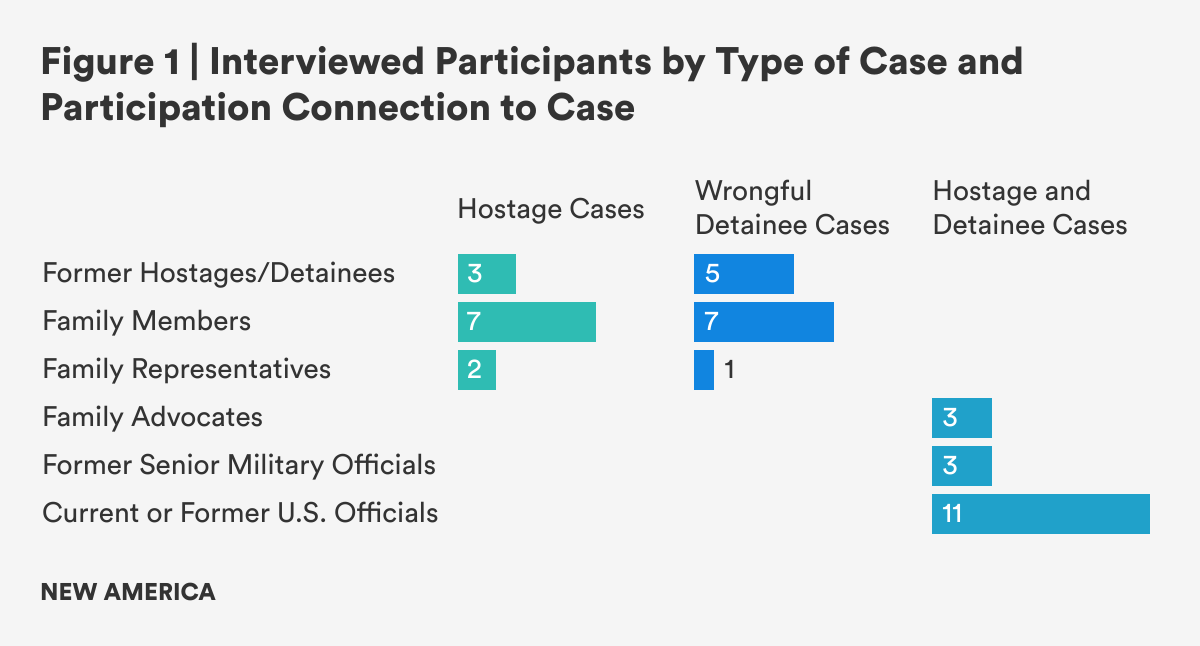
Of them, 28 participants interviewed for the report who were associated with either a hostage or unlawful or wrongful detention case, three were advocates (who dealt with both hostage and detainee cases), three were family representatives, and 22 were former hostages, unlawful or wrongful detainees, or family members of current or former hostage and unlawful or wrongful detainees.
In total, this study represents 18 individual hostage and unlawful or wrongful detention cases. It includes eight hostage cases (including unacknowledged detainee cases), and 10 unlawful or wrongful detainee cases. Participants involved in hostage cases included three former hostages, seven family members, and two family representatives, in addition to the three family advocates involved in both hostage and unlawful or wrongful detention cases. Participants involved in unlawful or wrongful detention cases included five former detainees, seven family members, and one family representative as well as the three advocates. Figure 1 provides the breakdown of participants.
The cases represented in this study took place from the 2010s through the present. However, including more specific dates would have a negative impact on the participants’ confidentiality. Ten of the 18 cases represented in this study are currently active. In the remaining eight cases, the hostages or detainees in question have either returned home or are no longer in captivity. These cases are still being pursued by the U.S. government, and all but one participant is currently working with the U.S. hostage recovery enterprise.6
Citations
- While U.S. lawful permanent residents (LPRs) were not represented in this study, they are considered U.S. persons and are covered under current U.S. hostage and detainee policy. Both U.S. Nationals and LPRs are included in the James W. Foley Legacy Foundation’s advocacy work with families, and in its research on the total number of publicly known cases of U.S. persons held hostage and wrongfully detained abroad.
- Participants were provided with five options to respond: Strongly agree, agree, neutral, disagree, and strongly disagree.
- Language from Article 1 of the International Convention Against the Taking of Hostages (United Nations, 1979). source
- Juan Pachon, “Senators Menendez, Rubio, Leahy, Coons, Shaheen Celebrate Expected Passage of Robert Levinson Hostage Recovery and Hostage-Taking Accountability Act.”
- “Robert Levinson Hostage Recovery and Hostage-Taking Accountability Act,” pp. 2-3. source
- In the one case that is not ongoing, the participant was notified by the U.S. government that the case had been closed, even without receiving any resolution.
4. Perceptions of the U.S. Government’s Hostage Recovery Enterprise
This report builds upon the 2019 and 2020, Bringing Americans Home reports, providing a nongovernmental assessment of the implementation of EO 13698 and PPD-30.1 This section analyzes the efficacy of EO 13698 and PPD-30 by drawing upon interviews conducted with and survey responses from:
- Former U.S. hostages and unlawful or wrongful detainees
- Families of current and former U.S. hostages and unlawful or wrongful detainees
- Family representatives and advocates
- Third-party intermediaries, interlocutors, and human rights lawyers
This section also draws upon interviews with the following participants but they were not included in the survey response sample, as the survey’s aim is to convey the views of hostages, detainees, and their families.
- Current and former U.S. government officials
- Former senior military officials
This section will discuss how accessible the agencies and offices that make up the U.S. government’s hostage recovery enterprise are to the families of hostages and unlawful or wrongful detainees. In addition, this section will examine how well the U.S. government shares information with these families and how clear the roles of these agencies and offices are to them. This section also discusses the partnership between families and the U.S. government for recovery efforts, the priority that families perceive the U.S. government assigns to their cases, and how well families understand U.S. hostage policy. Each of these discussions will address the perspectives of both hostage participants and unlawful or wrongful detainee participants.
For the purpose of this report, the evaluation of the State Department’s support to unlawful or wrongful detainees will focus on interactions with Consular Affairs and the SPEHA’s office. It will exclude interactions between families and U.S. embassies, since unlawful or wrongful detentions do not always occur in regions where the United States has an open or existing embassy.
Access to the U.S. Government’s Hostage Recovery Enterprise
A hostage-taking event or an unlawful or wrongful detention is a difficult and traumatic experience that launches families into a crisis where they have to orient themselves within the hostage recovery enterprise and navigate the geopolitical landscape where their loved one is being held. While access to U.S. government agencies may not be essential for a small number of cases,2 it is “absolutely critical”3 for the majority of families advocating for the release of their loved ones.
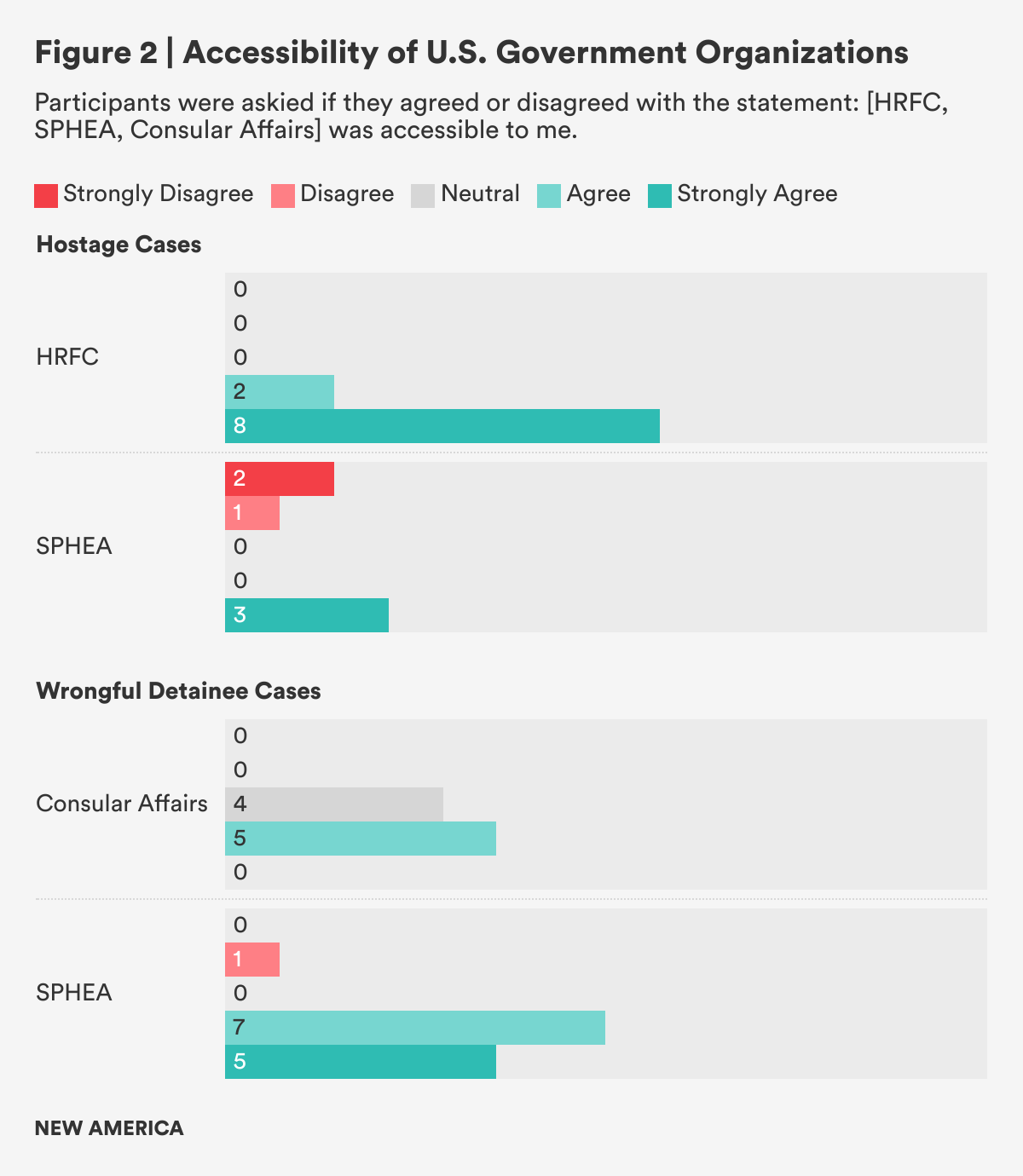
JWFLF asked its participants to what degree the HRFC, Bureau of Consular Affairs (hereafter Consular Affairs), and SPEHA’s office was accessible to them after learning of their loved one’s captivity. Hostage participants generally agreed that the HRFC was accessible. However, fewer hostage participants interacted with the SPEHA’s office than from previous participants in Bringing Americans Home reports. 4 Unlawful or wrongful detainee respondents reported gaining more access to the SPEHA’s office than in the 2019 and 2020 reports.5 Overall, the data from the 2020 and 2021 reports supports the assertion that reforms to the SPEHA’s office have improved families’ ability to access the government.
Hostage Case Participant Responses
All hostage participants agreed (two) or strongly agreed (eight) that the HRFC was accessible to them. When asked about their ability to access the SPEHA’s office, three participants strongly agreed that the SPEHA’s office was accessible, whereas one participant disagreed, and two participants strongly disagreed (Figure 2).
Fewer than half of the hostage participants interviewed reported working with the SPEHA’s office. The other participants interviewed who were not accessing the SPEHA’s office indicated that they or their loved ones were no longer actively held in captivity and their cases were being handled under the direction of the Federal Bureau of Investigation (FBI) rather than the SPEHA. On the one hand, this drop in engagement with the SPEHA’s office represents the fact that there are fewer active hostage cases than in years past. At the same time, however, there were concerns among hostage participants and advocates that the SPEHA’s office was spending less time reaching out to hostage families because of its current engagement with unlawful or wrongful detainee cases.6
Hostage participants, in addition to discussing their access to the HRFC and the SPEHA’s office, shared the importance of having access to their senators and representatives, who were described as “essential” advocates for their cases. One hostage and unlawful or wrongful detainee family advocate described Congress as a “very important tool for hostage and detainee families.”7 Specifically, they highlighted that families are able to access their loved ones’ two senators and congressional representative, as well as their own senators and representative, providing each family with a potential for up to six advocates whose social media presence and ability to write letters to the president of the United States can raise the profile of their case.8
Outside the U.S. government, hostage participants also shared the importance of working with organizations such as the Richardson Center, which provides support to negotiations for U.S. hostages; Hostage US, which provides day to day support for families of Americans taken hostage or wrongfully detained abroad and supports hostages and detainees when they return home; and the James W. Foley Legacy Foundation, which advocates for the freedom of all Americans held hostage and wrongfully detained abroad through research aimed at strengthening U.S. policy. An advocate interviewed for this report agreed with the importance of these organizations, commenting that while it is important for families to understand they have a central team working on their case inside the government (the HRFC), it is also important that they are aware of other potential advocates who can also be of assistance to their case and work on their behalf.9
Unlawful or Wrongful Detainee Case Participant Responses
A slight majority, (five of nine) unlawful or wrongful detainee participants agreed that Consular Affairs was accessible to them while the remaining participants neither agreed nor disagreed (four). Families who shared mixed reviews of Consular Affairs commented that their concerns generally derived from issues with the respective consular officer’s ability to access their loved ones. When U.S. citizens are unlawfully or wrongfully held by foreign countries, having consular access is a high priority for family members since their loved ones often experience life threatening medical conditions, poor nutrition, inhumane treatment, and in some cases, torture.10 Families shared that foreign governments were not allowing consular officers access to the detained Americans due to COVID-19 restrictions or other issues stemming from poor relations between the United States and the foreign country holding their loved one. From their perspective, they felt these issues were very likely excuses by the foreign government to prevent access to the detained Americans and wanted to see a more concerted effort made by the consular officer to gain access to their loved ones.
Participant responses regarding access to the SPEHA’s office were more favorable, with the majority (twelve of thirteen) of participants either agreeing (seven) or strongly agreeing (five) that the SPEHA’s office was accessible to them. Only one participant disagreed that the SPEHA’s office was accessible (Figure 2).
It is important to note that having a loved one’s case classified as an unlawful or wrongful detention, and thus gaining access to the SPEHA’s office, is not a simple process. A family’s belief that their loved one is being held by a foreign government unlawfully or wrongfully does not immediately gain them access to the SPEHA’s office. This access, something that is a high priority for these families, requires each case to be evaluated and approved by Consular Affairs, the Bureau of Democracy, Human Rights, and Labor, various legal offices and regional desks within the State Department as applicable, and then by the SPEHA’s office itself. Once all these offices have agreed it should be designated a wrongful detention, the case then gets elevated to the secretary of state for a final determination.11
Access to the SPEHA’s office, much like in the 2020 report,12 remains the number one issue for unlawful or wrongful detainees and their families. In fact, the individual who disagreed that the SPEHA’s office was accessible did so because their case was not classified as an unlawful or wrongful detention by the State Department. In addition, over the course of the interviews and drafting of this report, three respondents changed their responses from disagree to agree because they ultimately made it through the lengthy process to gain access to the SPEHA’s office. Access to the SPEHA’s office, especially for incoming families, remains a concern because families perceive that working with the SPEHA’s office “adds more credibility to their case.”13 Not only does it make their loved one’s case a "real" case, but it also allows families to work with an ambassador who can develop and lead diplomatic engagements on behalf of their loved one. This level of attention is what families believe is necessary to work toward their loved one’s release.
One participant shared, “When my [loved one] was first wrongfully detained, the State Department would send Consular Affairs to deal with our case, with no SPEHA representation… it took two and a half years to get any recognition from the SPEHA’s office. It wasn’t until the transition over to Ambassador Roger Carstens where [the Office] was more hands on. Ambassador Carstens made himself available to us saying if we need anything that we could call or email him at any time. There have been times where we’ve had to call and ask for help. It’s much better… [we] feel like he’s really there for the families.” Another family member shared similar sentiments, “I have felt that Roger Carstens has been completely available for my family. I feel like they’re [State Department] definitely going in the right direction.”14
JWFLF participants shared that it took between eight months to two and a half years to gain access to the SPEHA’s office, and that official certification that their loved one’s cases was an unlawful or wrongful detention was often missing. While all but two participants shared that the State Department categorized their case as an unlawful or wrongful detention, many family members indicated that they have not received any official documentation stating that their loved one has been unlawfully or wrongfully detained from the State Department. This makes some families nervous that their support from the SPEHA’s office is not necessarily durable. “The thing is,” one participant said, “we don’t know why they [the SPEHA’s office] are working with us or how long they’ll be working with us. It could all end tomorrow, we don’t know!”15 On the other hand, families report that documentation from the State Department acknowledging their loved one’s case is an unlawful or wrongful detention provides a level of support. Not only does such documentation give families or returning detainees “credibility needed to gain better access to their state Senators or state Representatives,”16 it also gives them the “capability to work with the IRS regarding unpaid taxes, creditors and/or debt collectors after defaulting on payments or loans while being unjustly held in captivity.”17 Some participants reported having written documentation acknowledging their unlawful or wrongful detention; they also commented that “it didn’t have the same effectiveness that returning hostages receive.”18
One of the issues with access to the SPEHA reported by family members, as well as family representatives, was their initial lack of knowledge that the SPEHA’s office even existed. “Currently, there isn’t a [specific] mechanism in place [to raise cases to the SPEHA] for family members whose loved ones are being held for political purposes.”19 A few participants reported that they only learned of the SPEHA’s office through NGOs or by a consular officer who independently reached out to the SPEHA’s office signaling that there was a potential unlawful or wrongful case. Families, as well as advocates, indicated that “there needs to be a better way to access the SPEHA’s office,” or to “contact the SPEHA’s office directly” so they can be made aware of a potential case. Most often families find themselves stuck in Consular Affairs where their cases can potentially sit alongside more than 3,000 lawful overseas detentions.20For comparison, there are currently over 50 publicly disclosed unlawful or wrongful detentions of Americans overseas.21 Separating this small number of unlawful or wrongful cases from the thousands of lawful detentions is a complicated task and, without a clear process to elevate these cases from Consular Affairs, will continue to remain a challenge.
Lawful detentions occur in countries all over the world, even in allied countries of the United States. However, unlawful or wrongful cases are generally different from lawful detentions because
- They typically occur in countries where the foreign government is hostile towards the United States.22
- The detainees in question are being held for the purpose to affect change in U.S. policy and its national security decision making processes, force prisoner exchanges, and/or extract other forms of concessions from the United States.23
While with lawful detention cases, the probability that the offence can be adjudicated through the foreign government’s judicial system is high, unlawful or wrongful detentions are far less likely to receive due process or even a fair trial. Therefore, these cases “must receive high-level U.S. engagement because they require more diplomacy and engagement with top-level government officials, something that Consular Affairs does not do.”24
Access to the President of the United States, National Security Advisor, and Secretary of State
Families work tirelessly to gain access to the government’s hostage recovery enterprise, but “nothing replaces having access or getting the attention of the President of the United States or the Secretary of State.”25 Families of hostages and unlawful or wrongful detainees, including third-party intermediaries and interlocutors, shared that they had relative success in gaining access to former President Trump and then National Security Advisor Robert O’Brien likely owing to the latter’s previous role as the SPEHA.
During the transition to the current administration, family members, third-party intermediaries, and interlocutors saw the outreach of National Security Advisor Jake Sullivan, and Secretary of State Antony Blinken to family members on behalf of their loved ones’ cases as a signal that they would have access to higher levels of government and that their cases would receive presidential priority. While families remain hopeful that there will be continued engagement and progress on their cases, some families have expressed concerns that Sullivan has become less available, which is perceived as hindering their ability to obtain access to President Biden. All hostage and unlawful or wrongful detainee participants stressed the importance of maintaining access to the highest levels of government for the purpose of advocating for the release of their loved one.
Consistency, Accuracy, and Coordination of U.S. Government Briefings
A common concern amongst family members was the importance of consistency and accuracy of information shared during meetings with the U.S. government regarding their case. In addition, remaining in constant communication to receive updates, as well as observing a well coordinated flow of information across the different agencies and third-party intermediaries, was also of great importance to family members. During interviews for this report, there were a variety of responses, both favorable and unfavorable, with satisfaction with the consistency and accuracy of information shared during meetings and briefings with the U.S. government. For a more in-depth discussion on information sharing during briefings, see the following section.
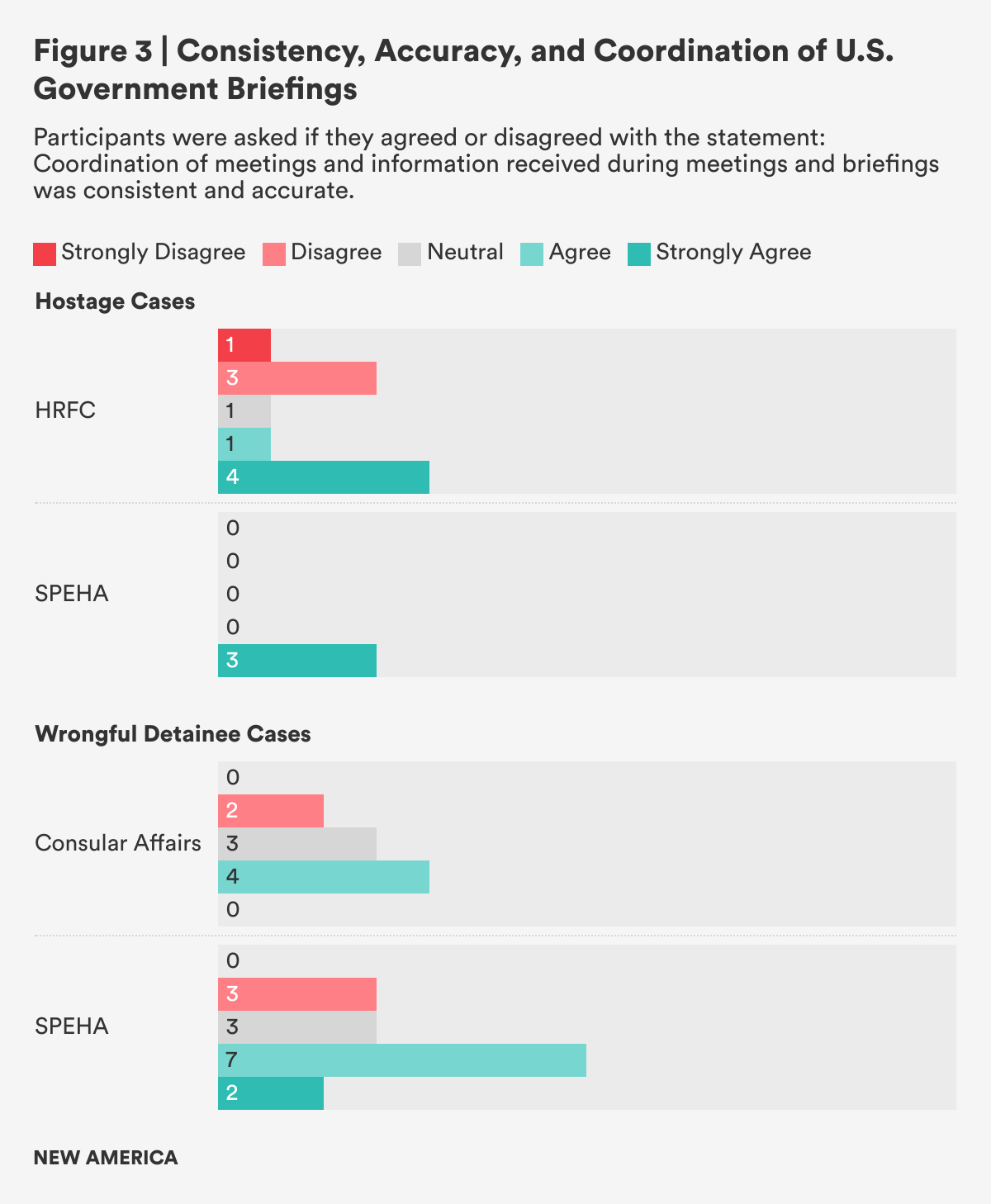
Hostage Case Participants Responses
All the hostage participants (three) that had access to the SPEHA’s office strongly agreed that U.S. officials communicated clearly and were well-coordinated during meetings and briefings with the office (Figure 3). While all three participants strongly agreed that the SPEHA’s office was well coordinated and had communicated very well during briefings, one participant expressed concern over the new staff being brought on board. “It’s not the same” and “it’s starting to feel more bureaucratic.”26 However, the participant remained hopeful that the perceived shift was temporary while the new staff was settling into their new roles. Overall, participants commented on how much they look forward to engaging with the leadership of the SPEHA’s office regarding their case.
There are participants who expressed concern over not being able to access the SPEHA’s office. While they do have a working relationship with the HRFC, they know that their case requires “diplomatic engagement at the highest levels within the State Department” to work towards the release of their loved one.27 In addition, they raised concerns over whether the SPEHA’s office has focused more on unlawful or wrongful detention cases this year rather than hostage cases. In particular, “the issue bothering [the family member] is that it has become evident that the SPEHA is in regular contact with detainee families.”28 In addition the SPEHA “has never contacted us”29 in regard to handling their hostage case.
In another statement referring to the State Department as a whole, a participant commented that their “relationship with other components of the U.S. government, primarily the State Department, has been less favorable. As in prior years, little if any substantive information has been provided by the State Department, promises from senior officials have gone unmet, and ‘briefings’ have tended to be pro forma, or worse, media events.”30
For hostage case participants working with the HRFC, half of respondents (five of 10) strongly agreed (four) or agreed (one) that the HRFC communicated clearly and that officials were well-coordinated during meetings and briefings, whereas one participant neither agreed or disagreed, and four participants either disagreed (three) and strongly disagreed (one) (Figure 3).
One participant shared that “both the HRFC and SPEHA’s office have been excellent at reporting back to us and telling us information.”31 Another participant who’s been working with the HRFC for some time shared, “I’m actually astounded. They [the HRFC and victim’s specialist] are very good to me and have accomplished a great deal this year. They’ve been very open and frank and have shared a lot of information. They’ve been wonderful and have done way more than I would have ever asked.”32
Another participant shared that their FBI case agents and victim’s specialist were “exceptionally good to me, way more than I would ever have expected.” The participant was especially touched when their victim’s specialist and case agents would visit and “help me… all while COVID is going on. They are really, really good to me.”33
In addition, a participant said that sharing information across all the different agencies as well as coordinating as much as possible with third-party intermediaries was “most impactful.” “That’s what’s made the most difference!”34 Regarding coordination, a participant shared, “Initially, it was good to have several briefings with all the different parties involved, the FBI, State Department, Special Envoy, and so on. I got a sense that people were all on the same page. Previous to PPD-30, there was absolutely no coordination at all. People were not on the same page and did not share information. The State Department hardly talked to the FBI, it was pretty incredible. That changed very slowly, but it changed.”35
However, not all hostage participants shared positive experiences working with the HRFC. One hostage case participant shared that, while their initial meeting with the FBI agent investigating their loved one’s case was successful, unfortunately, from the perception of the family, all of the information gathered by the agent did not get communicated back to the HRFC. This led the family to believe that the “Fusion Cell doesn’t talk to each other as well as they should,” and that “their communication with each other was very poor.” It is important to note that the family working with the FBI agent thought that he was, “excellent, highly professional, and made several references to other hostage cases… he knew his stuff.” The agent was also “very respectful and knew not to ask long-winded questions… because [the family member] couldn’t handle any more than what they were asking.”36
Another issue raised regarding communication, coordination, and briefings with the HRFC was the pace with which families received regular calls and/or updates on their loved one’s case. Families feel intense pressure to act quickly when their loved ones are first taken hostage. According to one U.S. official, “It’s important to move quickly during the first two weeks of someone who has been taken hostage. After that the trail starts to go cold.”37 A participant whose loved one was in the early stages of a hostage-taking shared that the HRFC told them to wait “at a specific time [for] a clerk from the local field office to call [them] to give updates once a week.”38 Families have the expectation of working at a very rapid pace and, “being told to sit and wait around for somebody to call once a week, and then have them not give any new information, that was not going to work for us.”39 Ultimately, the family felt that the HRFC was “slowing [them] down” and they walked out of their meeting with the HRFC saying, “We’re on our own.”
Another participant shared challenges with working with their victim’s specialist. After receiving paperwork regarding their case, the participant noticed that their loved one’s name was incorrect. “They had the wrong name! [Even though], it was human error, it just showed a lack of caring, especially since it came from the victim’s specialist. It was just disheartening to me. I can’t explain why, because I know it was a human error…but it showed me that it wasn’t important to that person, I guess. I know [they] meant the right thing, sending us the information, all that was lovely, all that was great, but the fact that they didn’t even have [my loved one’s] name in there, was disheartening. It felt just very bureaucratic and insensitive.”40
Unlawful or Wrongful Detainee Case Responses
When asked about their interactions with Consular Affairs, four participants agreed that U.S. officials communicated clearly and were well coordinated during meetings and briefings, while two disagreed and three respondents neither agreed nor disagreed (Figure 3). With regard to the SPEHA’s office, the majority of respondents (nine of 15) either agreed (seven) or strongly agreed (two) that U.S. officials communicated clearly and were well coordinated during meetings and briefings. The remaining respondents neither agreed nor disagreed (three) or disagreed (three) that U.S. officials communicated clearly and were well-coordinated while engaging with that office (Figure 3).
Initially, the perception of the SPEHA’s office was more positive, with all respondents agreeing that the SPEHA’s office communicated clearly and was well coordinated during meetings and briefings. Throughout the course of the year, however, the interviewer was contacted by five participants to change their responses after their initial respective interviews. Of the five participants, three changed their response from agree to disagree, whereas, two participants changed their response from agree to neither agree nor disagree. These participants cited their perception of a change in policy resulting from the new administration and the addition of new staff at the SPEHA’s office. “We’re getting more bureaucratic responses now and less actionable information,” one family member stated, “it’s like we moved backwards four years.”41
In general, the majority of families were very happy with their interactions with the SPEHA’s office, specifically during the Trump administration. Several families expressed satisfaction with weekly calls, in-person meetings, being provided rough timelines, and being able to ask specific questions for which they received satisfactory responses. This was even the case when the SPEHA could not answer some of the questions due to classification concerns. “It’s been great actually,” was the response of one participant. “The SPEHA is very straightforward with us and we believe what they’re saying is what they are going to do. We don’t get the sense of getting pushed around or being paid lip service.”42
Similar to the 2019 and 2020 Bringing Americans Home reports, the turnover rate at the State Department remains a problem. For some participants, their loved ones’ cases have been going on for several years or more. While they know there will be a constant change in personnel, families expressed frustration over being asked basic questions about their loved ones’ cases time and time again. “We’re still being asked if [my loved one] is a dual national. It’s like they don’t share the information to the upcoming people, and we continue to have to start over. It’s least reassuring when these are the people taking over my [loved one’s] case. Overall, there is a lack of transfer of information to the incoming personnel.”43 Additionally, this same participant noted, referencing both the SPEHA’s office and Consular Affairs, “It takes a long time to build trust and relationships with State officials and once we’ve gained their trust, they’re off to their next job.”
Another participant raised a similar issue with staff members not reviewing their cases before meetings and briefings, saying, “We have been working our case for several years now and we are still being asked about [our loved one’s] nationality, who we’re working with, and other basic information. … [That is] great for a new case, but it raises many questions for cases like ours. Do they not have this information already in a file somewhere? It feels like they’re starting over. We’ve done this several times already, why not look at our file?”44
In addition, participants shared that in at least one instance, a large number of unlawful and wrongful detainee families were asked to participate in a large meeting with other families where they were asked questions regarding the health of their loved ones and about personal issues that they were experiencing. “These are private matters and are issues we don’t want to discuss in front of other detainee families. It can be very embarrassing and humiliating! Especially, when discussing certain medical issues [my loved one] is suffering from. There are also other detainee family members who are suffering from [their own medical issues], which I don’t feel should be our business and I feel bad for them that this was their way to share the struggles they are all facing. If the official looked at the files and had an individual phone call with us, it would have gone over much better, and they probably would have gotten more information from us.”45 Additionally, this participant shared, “If this official would have contacted us individually and was more proactive by saying, ‘I’ve reviewed your case,’ and then asked specific question about gaps that remained in our file, that would have been fine. Instead, we felt like they were starting from scratch.” The expectation for families to share personal information and medical information regarding their loved ones’ health conditions in a group setting, one participant stated, is not only “dehumanizing and humiliating, it’s demoralizing for family members,” it also showed a “lack of empathy and compassion.”46
Another important issue that was raised by participants revolved around needing representation from the broader State Department within the SPEHA’s office. The State Department manages a diverse and wide-ranging diplomatic portfolio, involving everything from conducting negotiations with foreign states to participating in discussions of providing foreign aid and the application of sanctions. These activities can, at times, occur at sensitive moments within negotiations to release unlawful or wrongful detainees. There is a perception among families that these diplomatic activities are often undertaken without consideration for their impact on their loved one’s case. If State Department officials are “talking to policymakers and discussing whether they’re going to pursue sanctions or not, we want [the SPEHA] to be part of those discussions because they have an impact on our case. We feel like they keep making decisions without taking [our loved one’s case] into consideration.”47
In addition, families shared concerns over the SPEHA’s office appearing to not know what is going on politically within Congress. Families feel that there has been missed opportunity to encourage bipartisan representation, which could potentially be important for their case. The lack of coordination with Congress is confusing to some family members who see the influence that U.S. lawmakers have as being an important tool to leverage in support of their loved one’s case. These families feel that coordinating recovery efforts with Congress should be a key function for the SPEHA’s office in unlawful or wrongful detention cases.
Information Sharing
As discussed above prior to the release of PPD-30, the U.S. government’s hostage policy was codified in NSPD 12, United States Citizens Taken Hostage Abroad. NSPD 12’s classification, however, made it difficult for U.S. officials to engage with hostage families and discuss what the United States was doing, or could do, on their behalf. With the issuance of PPD-30, a mostly unclassified document, family engagement and declassification of information became a higher priority across the hostage recovery enterprise.
The HRFC is mandated by EO 13698 to “provide a forum for intelligence sharing and, with the support of the Director of National Intelligence, coordinate the declassification of relevant information.”48 Further, PPD-30 directs the director of national intelligence to “provide for centralized management of hostage-related intelligence in order to coordinate the Intelligence Community's efforts on hostage-takings and provide synchronized intelligence support to the HRFC.” 49 The intelligence community broadly is also directed to “make proactive efforts to declassify relevant and reliable information or provide unclassified summaries to a hostage's family.”50
In response to this, an issue manager for hostage affairs position was established within the Office of the Director of National Intelligence. This position is responsible for declassifying information in support of hostage families, as well as working with the interagency to “ensure focused and prioritized intelligence support for hostage cases.”51 The declassification of information in support of hostage families is one area that family members consider extremely important and has been consistently raised by families in the previous 2019 and 2020 reports.52 Receiving information in a timely and consistent manner helps provide them the support they need to work on their loved one’s behalf. According to one senior U.S. official, however, getting the intelligence community to prioritize the issue is challenging. “This is the one area,” they said, “that [the hostage recovery enterprise] needs to continue to push on the interagency to make sure the interagency overall understands that they must work to declassify information.”53 “It’s [the HRFC’s] job [to support this],” they continued, “it’s the ODNI [Office of the Director of National Intelligence] Issue Manager’s job to go out across the interagency and get those declassified talking points [families can use].”54 One U.S. government employee noted, however, that the issue manager had limited influence within the interagency and that they had observed information get declassified much faster if the national security advisor engaged directly with the intelligence community.55
Declassifying information at a faster rate is also extremely important for hostage families in order to match the pace of the constant changes that occur in hostage cases. One hostage family shared that the HRFC became less relevant to their case because “they weren’t sharing information fast enough… we were operating at a much quicker pace while they were still trying to get information declassified.”56 In addition, one participant shared, “During the 2015 process resulting in PPD-30, the government spoke a lot about opening and speeding declassification of confidential information for families, even to the point of hiring staff specifically for this purpose. We’ve seen no evidence that this promise has been fulfilled.”
As in the 2019 and 2020 reports, information sharing remains a challenge raised by several participants in this year’s report. Hostage case participants, in particular, remain concerned about the level of completeness of the information they receive, while unlawful or wrongful detainee participants’ satisfaction with the level of information being shared from the U.S. government seems to have improved from the 2020 report.
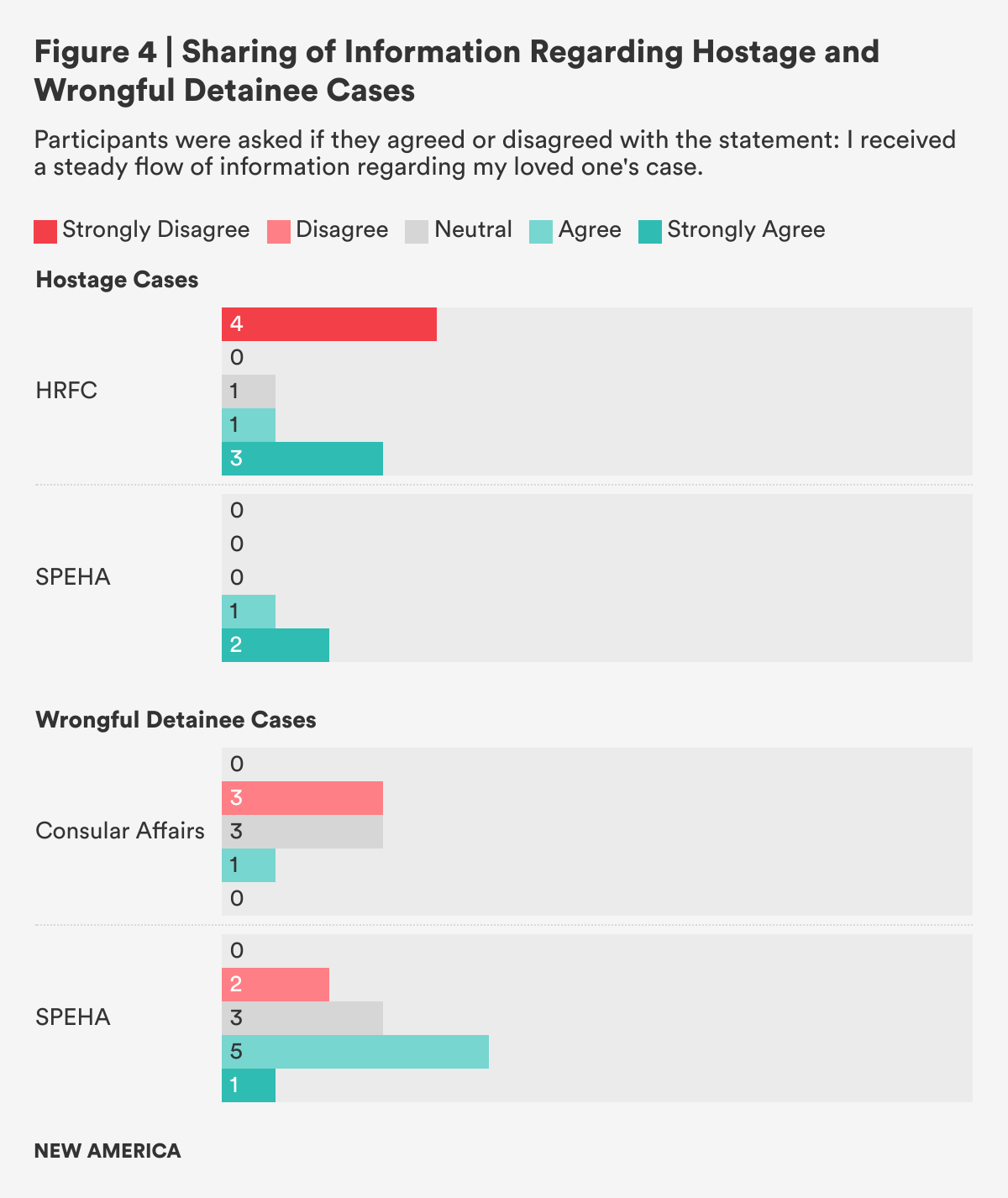
Hostage Case Participant Responses
About half (four of nine) of participants who interacted with the HRFC strongly agreed (three) or agreed (one) that they received a steady flow of information regarding their loved one’s case, while the other half (four) strongly disagreed (one individual neither agreed nor disagreed). Usually, when there is a bimodal distribution in the data, there are common factors that relate to the disparity. However, in this case, there are no clear differences between the cases of those who agreed and those who did not, nor do the cases of those who agreed or disagreed all have common dynamics. Neither duration of the hostage case, whether the case was in its early to late stages, verification of proof of life, nor location of the hostage appear to have been determining factors for the discrepancy in responses (Figure 4). In contrast with the HRFC, hostage families working with the SPEHA’s office all had positive responses regarding their perceptions of information sharing. All participants either strongly agreed (two) or agreed (one) that they received a steady flow of information regarding their loved one’s case (Figure 4).
Information sharing between the U.S. government and families has remained a challenge, as seen in both 2019 and 2020 JWFLF reports.57 Family members expressed a continuing concern regarding the “overly strict” and “unnecessary withholding of information”58 by the U.S. government. Families report that information continues to be withheld from them and there continue to be limits on their ability to share information with their non-governmental primary advisor and/or negotiator.
Similar to the 2019 and 2020 reports, families perceived that while they continue to share information they generate with the U.S. government, the government “continues to withhold information from us.”59 In one case, the family directly asked the HRFC if the U.S. government’s inability to share the requested information was due to legal issues or administrative issues. An individual working for the HRFC reportedly commented that it was an administrative issue. Since it was not a legal issue, the family interpreted that as the “desire and position of the government” and that the government was choosing to withhold information when there was no legal requirement to do so.60
In another instance, a family was at a critical point in their case where they required information from the U.S. government in order to make important and timely decisions. The family knew that the U.S. government had information that could inform their decision-making process. Ultimately, the HRFC did not share the information. “We were told that the reason was that some of the underlying information came from a foreign government… However, it’s our position that [we] have demonstrated [years of trust] and that we present zero risk of disclosure of information.”61
One hostage advocate shared the importance for hostage families of having independent sources of information and support so they can make informed decisions on their own. “Regardless how well aligned the relationship is between a hostage family and the government, it’s important that hostage families have independent sources of information and support so they can make informed decisions that they own. And those choices have to be informed with independent information so they’re not just being fed something by one source.”62
Unlawful or Wrongful Detainee Case Participant Responses
Of the seven responses associated with unlawful or wrongful detainee cases, three participants disagreed that they received a steady flow of information from Consular Affairs and three other participants neither agreed nor disagreed. Only one participant agreed that they received a flow of information regarding their loved one’s case from Consular Affairs. When asked about information flow from the SPEHA’s office, results were more favorable. Over half of the unlawful or wrongful detainee participants (six of 11) agreed (five) or strongly agreed (one) that they received a steady flow of information from the office. Of the remainder, two of the 11 respondents disagreed and three neither agreed nor disagreed (Figure 4).
In contrast to the 2020 report,63 unlawful or wrongful detainee families shared an overall satisfaction with the flow of information they’re receiving from the SPEHA’s office. “Talking to [the SPEHA] has been great. We get the sense that he’s telling us all that we can know even though there’s information he can’t share due to classification issues.”64 In addition, “Roger Carstens is different from other SPEHA’s we’ve interacted with. He’s straightforward with what he can share with us and we get the sense that he’s working on our behalf.”65
One family member shared concerns with the declassification efforts of the SPEHA’s office, however. “When it comes to declassifying information,” they said, “I have asked to be read in on to classified information and was basically told with wrongful detentions and the way things are set up at the moment, they would have to go to the individual agencies and to get permission from each one of them to share the information… There’s still no formal methodology for families of wrongful detentions to obtain in any meaningful way classified information without an in-person visit with the SPEHA which isn’t going to happen every week. That said, I think they’re trying their best. Overall, there’s been improvement from the previous year and I’m happy to see that it’s going to continue to improve.”66
Understanding of U.S. Official and Departmental Roles
PPD-30 directs that the interagency responsible for coordinating the U.S government’s response to hostage-takings is the HRFC. Housed within the FBI, the HRFC consists of an intelligence section, an operational section to coordinate interagency action, a family engagement team, an external engagement component, and a legal team.67 Due to its responsibilities for coordinating the interagency’s activities on behalf of hostages, several agencies are represented within the HRFC. The Department of Defense, Department of Justice, State Department, Department of Treasury, the FBI, and intelligence community all have representatives within the HRFC’s operational section, all of whom are dedicated to bringing U.S. nationals home.68 Typically, the HRFC leads hostage cases where U.S. nationals are held by non-state actors such as terrorist organizations, other militant groups, criminals, and/or pirates. In addition, the HRFC also has the lead on cases where U.S. nationals are suspected of being detained by foreign governments, but where those governments have not acknowledged their detention (also known as an unacknowledged detainee). In addition to its role in coordinating interagency efforts on behalf of U.S. citizens, the HRFC is also responsible for developing and coordinating hostage recovery strategies, coordinating intelligence sharing and the declassification of information, and coordinating family engagement support for hostages and their families on behalf of the U.S. government.
The SPEHA, another innovation of PPD-30, is a presidential appointee who reports to the secretary of state and leads and coordinates all the government’s diplomatic engagements on overseas hostage-related matters. The SPEHA also coordinates diplomatic engagements supporting cases in which a foreign government acknowledges that it has detained a U.S. national but the U.S. government deems the detention to be unlawful or wrongful. The creation of the SPEHA’s office centralized hostage and unlawful or wrongful detainee issues within the State Department under a single leader, who, as a presidential appointee, effectively represents the president within the State Department.69 In addition to the SPEHA’s access to the secretary of state, the SPEHA has been given the authority to access senior leaders in foreign governments and negotiate on behalf of the U.S. government.70 The SPEHA also plays an important role in developing relationships with other governments and international organizations who can play key roles in assisting the United States in obtaining the release of a U.S. national held hostage or unlawfully or wrongfully detained abroad.71
However, access to these organizations over the years has been uneven and, in the past, there has been confusion over which entity was the lead for certain cases. In addition, each organization provides different types of support to hostage and/or unlawful or wrongful detainee families. This is further complicated, in the SPEHA’s office, by the cumbersome entry pathway which requires Consular Affairs to sift through the thousands 72 of detainee cases in order to identify unlawful or wrongful detainee cases.
JWFLF asked participants whether they felt they had a good understanding of the roles that U.S. officials and departments within the HRFC, SPEHA, and Consular Affairs played in support of bringing their loved one’s home. Hostage respondents for this year’s report generally said they understood the roles of the HRFC and SPEHA. Unlawful or wrongful detainee respondents, however, were somewhat more mixed in their assessment of whether they clearly understood the role Consular Affairs played in their case, though all understood the role of the SPEHA’s office. Frustrations over Consular Affairs roles were generally related to perceived inactivity on behalf of their loved ones and a lack of correspondence in dealing with their respective cases. While the majority of JWFLF’s participants shared that they understood the departmental roles across the hostage recovery enterprise, the conversation often shifted to personnel changeover, such as the position of the director of the HRFC, in particular.
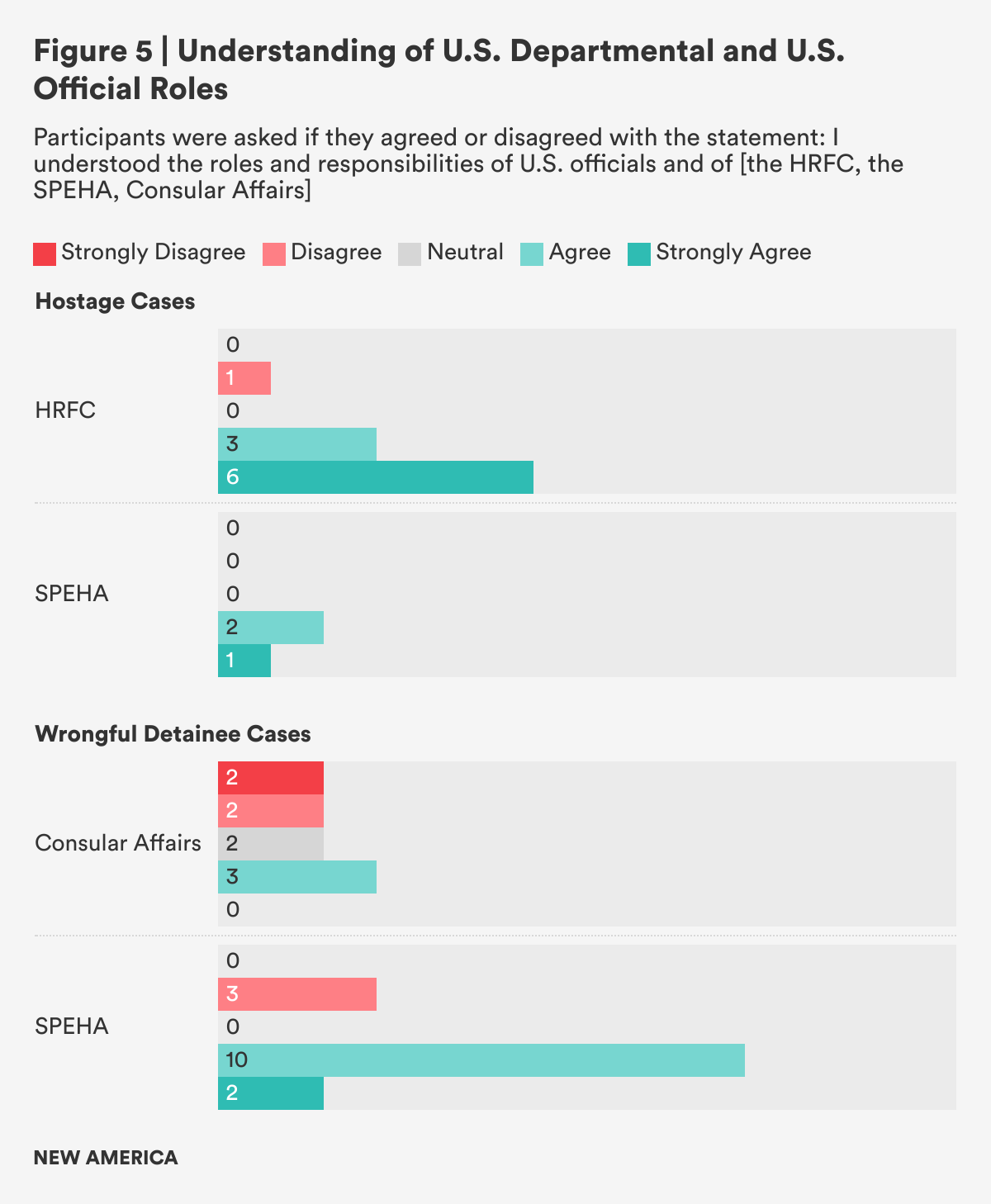
Hostage Case Participant Responses
The majority (nine of 10) of hostage participants who interacted with the HRFC strongly agreed (six) or agreed (three) that they understood the role the HRFC plays in support of hostage recovery and family engagement (Figure 5). Only one participant disagreed that they had a clear understanding of the HRFC’s role.
One participant shared that they “especially found that the tenure of Kieran Ramsey as the Director of the HRFC brought an entirely different approach to interacting with us. He was refreshingly frank and honest.”73 In addition, another participant shared, “I have been extremely impressed by the professionalism and integrity and warmth of the people I work with in the FBI, my agents… the folks over at the FBI in Washington who handle the hostage cases are pretty outstanding people. I trust them a great deal. They’ve been very, very honest with me.”74 This honesty and frankness seems to have driven a better understanding of what families can expect from HRFC support and the role they are playing in the recovery of their loved ones.
During these discussions, however, the tenure of the HRFC’s director emerged as a concern. Families seem to have attributed, in part, their clarity on the HRFC’s role to the leadership of the director and are concerned that during the transition in leadership this may change. One participant commented that they thought “an important point for consideration is the FBI policy of rotating senior officials as frequently as they do.”75 In their perspective, the HRFC is a body within the U.S. government and that “having its leader rotate out routinely every two years or so robs the HRFC, families, and especially hostages of the institutional body of knowledge and the relationships each Director has developed.” While families understand that no individual is assigned permanently within the government, continuity is an important consideration for them when to feel confident that they understand the role the HRFC will play in the recovery of their loved ones.
All three hostage respondents working with the SPEHA’s office either agreed (two) or strongly agreed (one) that they understood official and departmental roles regarding the SPEHA’s office (Figure 5).
One issue related to the role of the SPEHA raised by hostage advocates in the interviews for this report revolved around its role in the negotiations with the Taliban regarding troop withdrawals in Afghanistan. Hostage advocates did not understand how the United States could negotiate with the Taliban while they likely held two Americans hostage and not address the issue. They were also concerned that once U.S. troops leave the country, it will become more difficult to generate the intelligence needed to find Americans currently being held hostage. These advocates were specifically confused by the SPEHA not having a role in the negotiations. “As the one official who is supposed to take the lead in negotiations to free hostages,” said one advocate, “you would think he would be involved if we were negotiating with a group holding Americans hostage.”76 Instead, according to advocates and U.S. officials, “everything is being handled by the Special Envoy to Afghanistan [now the Special Representative for Afghanistan Reconciliation (SRAR)].”77 According to these advocates, hostage issues were not prioritized nor was the return of U.S. hostages made a precondition for any settlement during the peace talks in Doha, Qatar with the Taliban.
Administration officials, in a recent Washington Post article, have refuted these claims, saying that discussions regarding hostages “were often one-on-one and behind closed doors.”78 They claimed that the release of American hostages were part of the discussions with the Taliban and that, as a result, the Taliban had taken custody of an American hostage who had previously been held by the Haqqani Network.79 It is beyond the scope of this report to adjudicate these different perspectives; however, it appears relatively clear, from the perspective of JWFLF's participants, that the SPEHA’s office has had limited involvement in the negotiations. Despite U.S. officials’ likely concerns about the precedent set by including a kidnapped U.S. citizen’s release in a major negotiation—for fear that it will encourage more kidnappings—that does not mean the SPEHA’s office should not be involved. Having the SPEHA’s office involved both provides the family a sense of being heard and offers the possibility that the office is able to find a creative solution to use the leverage created by the negotiations to recover any and all U.S. citizens being held by the Taliban.
Unlawful or Wrongful Detainee Case Participant Responses
Unlawful or wrongful detainee participants reported mixed levels of understanding of official and departmental roles of Consular Affairs. About half (four of nine) of the participants who interacted with Consular Affairs strongly disagreed (two) or disagreed (two). Others neither agreed nor disagreed (two) or agreed (three) (Figure 5).
The main concern raised by unlawful or wrongful detainee participants regarding the role of Consular Affairs was a lack of clarity of the relationship between Consular Affairs and the SPEHA’s office. “How much do they communicate with the SPEHA’s office regarding our [loved one’s] case,” one participant asked.80 “What impact do they have on elevating our case to the SPEHA’s office?”81 “How can they prioritize our case if they’re dealing with several other [lawful] detention cases?”82 While the role of Consular Affairs differs case to case depending on where an unlawful or wrongful detainee is being held, it is clear that these relationships are not clearly understood.
Questions were raised over what family members can “ask Consular Affairs to do and the SPEHA to do.”83 Specifically, families reported confusion about the role of the Hostage Affairs Unit within Consular Affairs’ Office of America Citizens Services and Crisis Management and generally sought more clarity about the unit’s role. For example, one participant shared that during phone calls regarding their case with the SPEHA’s office, personnel from the Hostage Affairs Unit have been on the call. This participant was unclear why. “Are they some kind of liaison?” they asked, adding, “What kind of impact do they have on our case?”84 Another participant commented that they were “somewhat clear on what my rep [in the Hostage Affairs Unit] is supposed to do and how that interaction works. These people are wonderful in trying to tell me what they know.” “However,” they commented, speaking about relationships between the Unit, Consular Affairs, and the SPEHA’s officer “I don’t understand the nuance of how some of these people interact or how some of the information [gets disseminated].85
When asked about their familiarity with the roles and responsibilities of the SPEHA’s office and its personnel, most unlawful or wrongful detainee participants either agreed (10) or strongly agreed (two) that they understood the roles. Three participants, however, disagreed that they understood the office’s roles or those of its personnel.
Much like the hostage case participants, conversations about understanding roles turned to consistency and continuity in the leadership of the office. During these discussions, several families commented that they were happy the Biden administration retained Roger Carstens in the SPEHA position. “It’s important for consistency purposes,” said one participant. “Whenever there’s turnover it’s disappointing and we then we have to start over and share our story with an entire new team, which gets exhausting.”86
While pleased with the leadership of the SPEHA’s office, some participants raised concerns over understanding the role of the new staff within the SPEHA’s office, which is currently growing. The growth, families commented, has somewhat confused roles within the office. Families, in discussing the arriving staff members, suggested that “it would be more helpful if they presented what their roles are and what they can do.”87 Families shared specific concerns over the new family engagement coordinator’s position and its role in the office, despite being supportive of the growth overall. Their major concern is that it has the potential to create an additional layer between the SPEHA and the family, and whether they will continue to have the ability to directly contact and/or communicate with the SPEHA. Even though these comments came from the respondents who said they disagreed that they understood roles and responsibilities within the SPEHA’s office, this seems to be an increasing concern, with one individual reaching out in recent months to change their response from agree to disagree.
Family members expressed their satisfaction with Chief of Staff Carolee Walker and SPEHA Roger Carsten’s “sense of urgency,” “directness,” and their ability to “take charge.”88 One participant commented that “the people over at, both State and the SPEHA’s office, have really been wonderful and extremely motivated.” Overall, families remain hopeful that the incoming staff will reflect these attributes of the office’s leadership.89
While not specifically an issue in understanding the role of the SPEHA’s office, some participants raised a concern about the office’s title and wondered if it had a negative impact on the overall mission of the SPEHA’s office. Unlawful and wrongful detainee participants raised concerns about the use of the term hostage within the office’s title, wondering if it would hurt the ability of the SPEHA to gain access to foreign governments and advocate for their loved ones. “If you’re using the word hostage and you’re trying to get a wrongful detention resolved… it forces people to sit back on their heels [in terms of beginning negotiations].”90 Families worried about the perception of foreign countries and the impact on negotiations. “How will other countries respond to a meeting with a U.S. official with ‘hostage’ in their title? Will other countries be forced to reply with ‘we charged [the individual] properly, you’re supposed to respect our judicial process, [they’re] not a hostage… Therefore, we’re not going to talk to you.’?”91
Recovery Efforts Shared with Hostage and Unlawful or Wrongful Detainee Participants
Recovering American hostages or unlawful or wrongful detainees is a critical, but complicated effort that requires coordination across the interagency, strategic diplomatic efforts, third-party actors, and in some cases, law enforcement or military responses. Most often, hostage cases occur in war-torn countries or in areas where foreign governments are either hostile towards the United States or have minimal control over their sovereign territory.92
Similar to hostage-takings, unlawful or wrongful detentions occur in countries hostile towards the United States as well as countries who are in competition with the United States, and even in countries allied with the United States.93 These types of detentions are often conducted for the purpose to influence or change U.S. foreign policies towards the country or region, yet are also used to persuade the United States to engage in prisoner exchanges and/or pay concessions.94 Hostage-takings conducted by non-state actors also seek to tempt the U.S. government to concede through changes in its policies, release of prisoners, and/or pay ransoms.95 Additionally, terrorist actors have recently displayed a willingness to use hostages, specifically their executions, for propaganda purposes.96
In June 2015, PPD-30 and EO 13698 directed critical structural and organizational changes within the U.S. government needed to support a coordinated response to a hostage-taking event.97 With these new organizational changes, the U.S. government is better postured to handle the challenges in recovering a U.S. national held abroad.
Executive Order 13698 was also instrumental in restructuring the government’s hostage enterprise in an attempt to sync up what President Obama described as “sincere, relentless efforts within the government” with families whose loved ones were taken hostage. This was an important step in ensuring families were treated as “partners” in the effort to recover their loved ones.98
From the perspective of hostage and unlawful or wrongful detainee participants, receiving candid assessments about the U.S. government’s efforts to recover their loved one is one of the most vital ways the U.S. government can partner99 with families during the recovery phase.
In the 2019 and 2020 reports, responses varied when JWFLF asked questions about the level of information sharing regarding recovery efforts. In the 2019 report, pre-PPD-30 participants generally disagreed that the U.S. government shared information regarding hostage recovery plans while post PPD-30 participants generally agreed that they did.100 In the interviews conducted for the 2020 report, hostage responses were mixed, while wrongful detainee responses were overwhelmingly in disagreement that recovery plans were shared.101 2021 participants reported similar results to the 2020 report, indicating that hostage and unlawful or wrongful detainee participants would like more information about any candid assessments of recovery efforts for their loved ones.
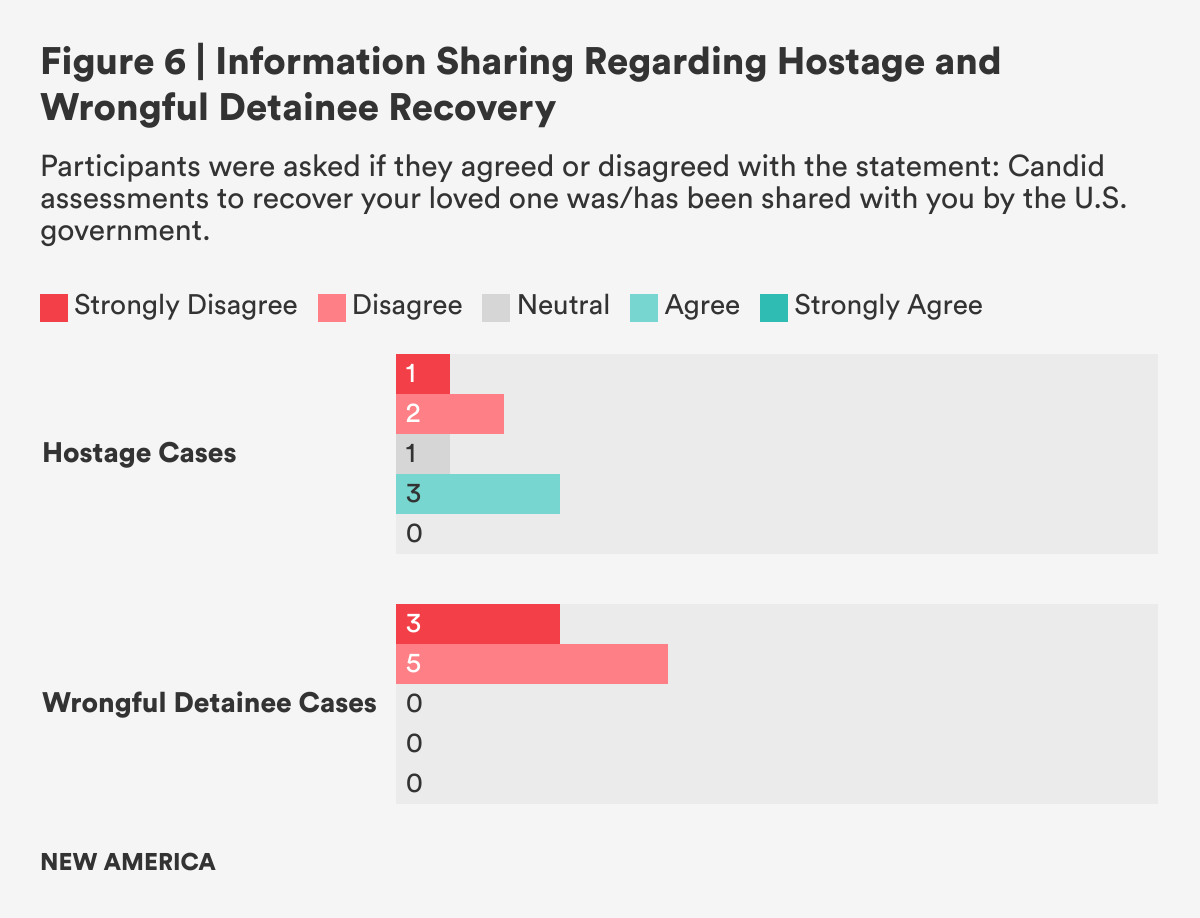
Hostage Case Participant Responses
In order to gauge participants’ engagement with the U.S. government’s efforts focused on recovery of loved ones, JWFLF asked participants if the U.S. government shared candid recovery assessments for their loved ones and if they felt like they had a good partnership with the U.S. government during the recovery phase of their loved one’s case. In addition, participants were asked to share their personal recommendations on how the government could cultivate a better partnership with families during the recovery phase of a hostage case.
The seven hostage participant responses were mixed. Three hostage participants agreed, one neither agreed nor disagreed, and three participants either disagreed (two) or strongly disagreed (one) that the U.S. government shared candid recovery assessments and that they felt like partners (Figure 6).
Overall, participants, advocates, and family representatives expressed their concerns that steps toward recovering hostages appear to be taking longer under the new administration. “Things seem to be taking a bit longer,” one participant shared, adding, “There seems to be more steps to go through [under the current administration], more procedures.”102 Under the Trump administration, the participant commented that their experience was that “one person would have to sign off and we were able to move forward a lot faster.” Another participant shared similar sentiments: “We’re waiting on the new administration to pick up and start working. The national security advisor called and reached out and he was very supportive, but we’re still waiting for things to move forward.”103 While many of these families recognize that there tends to be a lull in progress for their cases when administrations change, early signs of outreach to the families indicated that recovery of their loved ones was a priority. Secretary of State Antony Blinken’s call with the families of hostages and unlawful or wrongful detainees in February 2021, for instance, was described as a promising signal.104 As of April 2021, however, families and advocates have expressed a growing consensus that there appears to be a decrease in activity by the U.S. government to bring Americans home.105 One hostage advocate shared, “There seems to be a pause on active cases, specifically, in terms of negotiations.”106
Discussing the U.S. government’s recovery efforts, almost half of this year’s hostage participants, including current U.S. officials, shared the importance of the government involving third parties. NGOs, third-party intermediaries, interlocutors, and former U.S. officials with regional expertise were all described as playing important roles in the recovery of U.S. hostages. “It is very complex to bring people home, that is a given,” said one participant.107 “That is why the government cannot do it alone. The government needs to be candid about what they’re willing to do and to do their part well and to work with other experts outside of government to support NGOs and other experts who can help make this a true priority so Americans can come home.” “That way,” this participant continued, “it’s not all on the government and it’s not all on the private sector. They [the U.S. government] need to recognize so that everyone plays a role, and everyone needs to do the best they can. It’s a complex issue—all the way from getting [U.S. hostages] home to supporting them in their reintegration.”108 Another participant shared a similar perspective. “It’s very important for the U.S. government to look at other experts outside the government,” they said. “The Soufan Center, Atlantic Media, and the Richardson Center have been a huge help, as have international human rights lawyers, Jason Poblete, president of the Global Liberty Alliance and Jared Genser, managing director of Perseus Strategies. In the view of this participant, “People need the help of other real experts because a lot of these hostage situations are really complicated.”109 Another hostage participant agreed, saying “families need the help of experts as well as the government.”110
Third-parties are important, according to one individual, for helping the families connect with the people and organizations that can support their cases. “I don’t know Washington [D.C.],” said this participant, adding, “I didn’t know who to reach out to, I didn’t know how to get into the White House. It’s very hard to do if you don’t have someone in the know.” Another benefit of working with outside experts, according to several participants, is that they can be “more transparent,” both on what they are doing on behalf of families as well as with the information they have uncovered. At the same time, however, one participant shared that third party assistance, in most cases, should be used as something to supplement U.S. government support, not replace it. “The U.S. government has a big role to play,” they said. “Trying to figure out how to get a loved one home on their own is very difficult for families and I think the [Hostage Recovery Fusion] Cell should be the first entity that helps families come up with a plan.”111
Unlawful or Wrongful Detainee Case Participant Responses
JWFLF also asked unlawful or wrongful detainee participants if the U.S. government shared candid recovery assessments with them and if they felt like they had a good partnership with the U.S. government during the recovery phase of their loved one’s case. Like hostage participants, JWFLF also asked participants if they could share personal recommendations on how the government could cultivate a better partnership with families.
All the unlawful or wrongful detainee participants either disagreed (five) or strongly disagreed (three) that they felt like partners in the recovery of their loved one, and that the U.S. government shared candid recovery assessments with them. (Figure 6).
Many of the participants indicated that the U.S. government has not shared recovery options with them in their respective loved one’s case. One participant, when asked this question, responded simply, “No, not at all.”112 Some respondents, due to the lack of sharing, questioned if the U.S. government had a plan. “To be honest, I don’t think they’ve ever had a plan,” one said. “If they do, the SPEHA’s office and/or Consular Affairs is not on the same page with the rest of the State Department.” From this participant’s perspective, there was a disconnect between those in the State Department working on their behalf and “the part [of the State Department] that discusses policy and whether or not to implement sanctions. … It seemed like every time there was some type of [negotiation] effort or window of opportunity, they [the broader State Department] didn’t seem to know it was happening and efforts were blocked.”113 Another participant commented that the lack of shared recovery options signaled that the interagency was not on board with any potential plans that have been discussed. In the words of another participant, “I have no clarity at this moment whether or not the State Department has a list of recovery options or preliminary items to approach the Department of Justice or Treasury, to get [my loved one] released.”114
Participants who disagreed that the U.S. government had shared recovery plans, however, commented that they had seen a recent shift. One participant said, “Until we started working with this team [in late 2020], people didn’t seem to be connected to what was going on in [the country where my loved one is being held] and who the key players are and why we were asking for certain things to get done. Now with this team, they have a little bit of experience with [the country where my loved one is being held] and they know who the players are, so we don’t have to explain ourselves as much.”115 In the past, the participant commented they felt like they were “constantly explaining the geopolitical situation to State Department officials who are dealing with my [loved one’s] case.”116
Another participant shared that they felt that whenever the United States put pressure on the country holding their loved one, there was a level of progress in their case. “For us,” they said, “we found that we were able to move the needle on our case after the U.S. government applied constant pressure in many different ways. It took [a long time] to get the government to do this, but that’s how we finally got [the country holding my loved one] to do anything because they were done with the attention from it.”117 Other participants expressed a desire for the U.S government to provide that same pressure in their cases through coordinated action across the interagency, including Department of Justice, Department of Treasury, the Secretary of State, and the White House. “We’ve seen all sorts of things that can be done, but [the U.S. government is] not doing things that we believe could open up the door to get [my loved one] released. We’d like to see them [the U.S. government] take more opportunities and leverage the country holding [our loved one].”118
Prioritization of Hostage and Unlawful or Wrongful Detainee Cases
One of the most pressing concerns for hostage and unlawful or wrongful detainee families is the level of priority their cases get within the U.S. government. In large measure, it was a lack of priority on these cases that drove the 2015 reorganization of the hostage recovery enterprise. When asked whether they felt like their case was a priority for the U.S. government, the majority of both hostage and unlawful or wrongful detainee participants answered that they did feel their case was a priority. In the 2020 report, hostage participants generally agreed that the U.S. government considered their case a priority, yet unlawful or wrongful detainee responses this year are an improvement over the 2020 findings, when more than half, seven of 11, of detainee respondents reported feeling that the U.S. government did not prioritize their case.
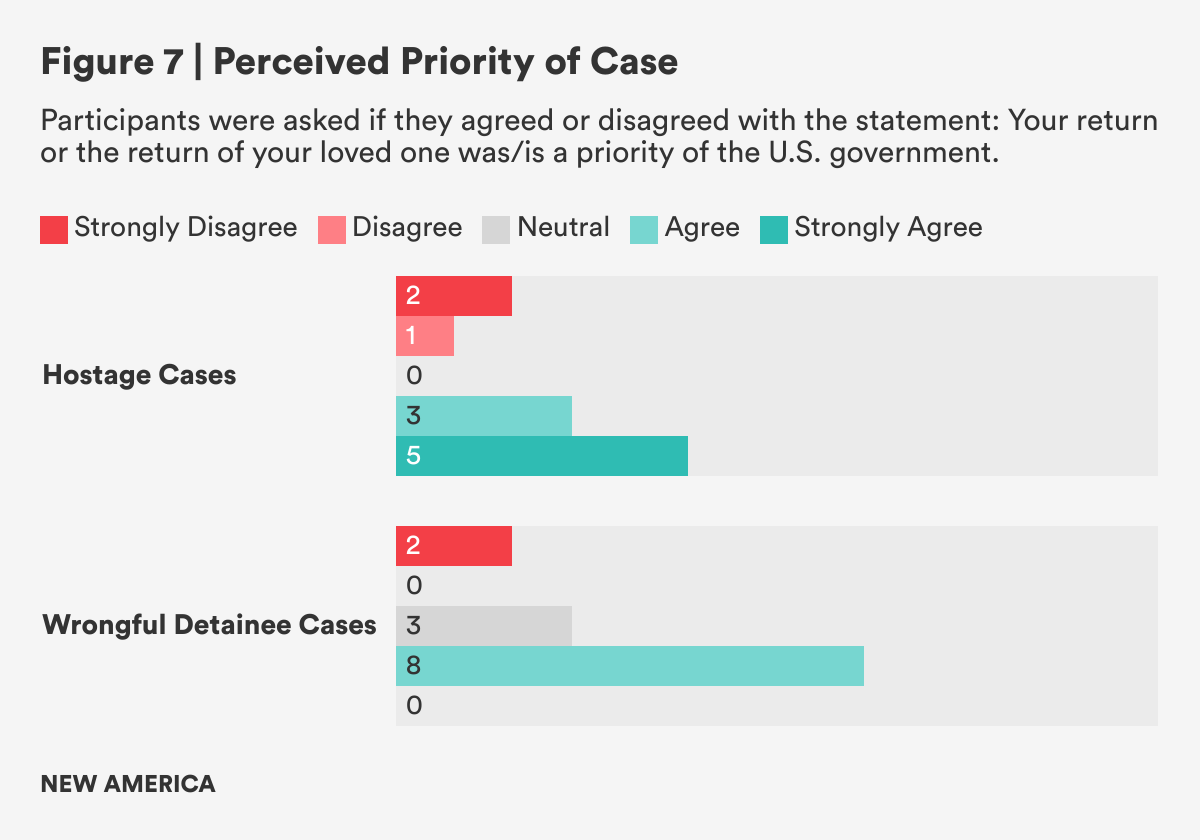
Hostage Case Participant Responses
The majority (eight of 11) of hostage participants said that they agreed (three) or strongly agreed (five) that their loved one was a priority of the U.S. government. One respondent disagreed and two other respondents disagreed with the statement that they believed their loved one’s cases were a priority of the U.S. government (Figure 7).
As in the 2020 Bringing Americans Home report, hostage families generally agreed that the U.S. government prioritized their loved one’s case. One family member happily shared, “Yes, I would agree! We have seen that in terms of the amount of effort, time, and money the FBI has put into this, and for following every path and lead. All the people who are involved in the investigation are doing far more than what I would have ever expected. And the fact that they’re sharing their information with me and working with my third-party intermediary is much more than what I would have expected.”119Another participant, a former hostage, shared that they felt their case was “absolutely a priority.” “What I’ve gathered,” they continued, “was that the U.S. government put a lot of time and effort into bringing me home… [putting] a lot of time and energy, resources, and prioritized me. I don’t have any questions about that!120
One family member commented that while they felt their case was a priority overall, specifically for the HRFC, it was less of a priority for some departments and agencies across the interagency. “Overall I think the prioritization of [my loved one’s] case was appropriate, especially by the FBI and the HRFC,” they said. “The only times we felt that prioritization was a problem was when there were specific requests for other foreign governments that were addressed through State Department channels [outside the SPEHA’s office]. In those cases, we never received results and it appeared clear to us that the requests themselves were low priorities for the U.S. embassies in each of the countries.”
While prioritization across the interagency is important to JWFLF’s hostage participants, families also recognize the importance of their cases having the prioritization of the president of the United States. “The problem is that a lot of these issues come from the top. That’s where the president’s desire to prioritize this issue in the National Security Council is huge. Without [the President’s] decision, the military isn’t going to go and rescue anyone. They’re good at being ready and having a plan, they’re ready to go, but if the President doesn’t say go, it’s not going to happen.”121
The importance of presidential support for hostage issues highlights the role played by the Hostage Response Group and the special assistant to the president and senior director for counterterrorism. In order for issues to be raised to the president through the National Security Council system, they work their way up through a variety of committees. Prior to reaching the president, issues are taken up in a principals committee, “the senior interagency forum for consideration of policy issues affecting national security.”122 This committee consists of the heads of various agencies and departments, such as the secretary of state, secretary of defense, and the attorney general, among others.123 Before reaching the principals committee, these issues are discussed in the deputies committee, chaired by the principal deputy national security advisor. The day-to-day management of interagency coordination for national security policy occurs in a step below the deputies committee in a variety of interagency policy committees chaired by individuals designated by the national security advisor.
For hostage issues, this committee is the Hostage Response Group, created by PPD-30 and chaired by the special assistant to the president and senior director for counterterrorism. This committee is responsible for resolving disputes in the interagency regarding hostage policy, raising issues to the deputies committee as needed, and recommending hostage recovery options to the president through the deputies and principals committees.124 This makes the role of the special assistant to the president and senior director for counterterrorism a critical one for U.S. hostage policy, as they are responsible for raising issues out of the Hostage Response Group to the president through the National Security Council process. Without a senior director for counterterrorism committed to hostage recovery, there is a chance that fewer issues will reach a deputies committee meeting, or higher, for consideration.
Unlawful or Wrongful Detainee Case Participant Responses
The majority (eight of 13) of unlawful or wrongful detainee participants agreed that their loved ones were a priority of the U.S. government. An additional three participants neither agreed nor disagreed and two participants strongly disagreed (Figure 7). This year’s results are a substantial improvement from the 2020 Bringing Americans Home report, where the majority (seven of 11) participants either strongly disagreed (four) or disagreed (three) that the U.S. government prioritized their loved one’s case.125
This improvement was due to better access to and better relationships with the SPEHA and key personnel within the office. Families shared that having direct contact and communication with the SPEHA and having the SPEHA share candid information with them, “showed us their level of commitment” and “level of urgency.”126 To families, this improved their perception about the office’s prioritization of their loved one’s case. Families also reported that being able to meet with high-level U.S. government officials, including the national security advisor and president of the United States, showed the importance of their case. In addition, this year’s participants saw the U.S. government take significantly more action against regimes holding their loved ones, i.e., the application of sanctions and the designation of individuals associated with their loved one’s cases. “It was then when we thought the government was taking our case seriously. Until then, I don’t think our case was much of a priority.”127
Advocates and other participants interviewed for this report, raised the issue of reviving nuclear negotiations with Iran when discussing their perspectives on the U.S. government’s prioritization of the recovery of detainees. Both families and advocates mentioned their concerns that the chance to release those individuals held in Iran would decrease if the United States rolls back sanctions and pressure as part of an effort to resume talks on Iran’s nuclear program. They also expressed their concerns that Iran was detaining U.S. nationals specifically to achieve leverage during these negotiations and that U.S. and allied detainees needed to be released prior to any official negotiations.
Support for Returning Hostages, Unlawful or Wrongful Detainees
Returning hostage and unlawful or wrongful detainees face several challenges coming home after being held in captivity. Mental health, physical, and financial support are the areas where hostages and unlawful or wrongful detainees require the most support. One former unlawful or wrongful detainee shared, “Most often, these people come home with their credit scores ruined, face enormous fines for not paying their taxes or credit card bills while being held against their will, some can’t find jobs to support themselves right away or even have a difficult time finding a place to live… they’re often left on their own and are suffering from the trauma they endured from all of the physical and psychological torture they experienced while in captivity.”128
Psychological and physical torture is a common experience for hostages and unlawful or wrongful detainees, and it can often have life-long effects. One former hostage shared, “I’d wake up and there’d be marks drawn on my chest and abdomen, outlining where my organs were. They’d constantly threaten me to say that they were going to sell my organs on the black market, or ‘so and so’ needs a new kidney.”129 There were no anesthetics. “I’d also go through daily mock executions, they’d put a gun to my head or hold a knife to my throat… often telling me that America isn’t coming for you.”130 Another participant shared that they found comfort when they heard U.S. drones overhead. “It was comforting knowing that the U.S. was nearby. While it could have ended poorly… they [also] may not have been looking for me, but maybe they were.” One family member reported that their loved one’s captors called their home demanding a ransom, all while torturing their loved one in the background while on the call. One family member, interviewed for the 2019 report, shared that their loved one’s captors would continue to call and demand money even after they murdered their loved one. “They would call and call, demanding more and more money. All the while, they killed my [loved one] and we didn’t know… nobody would help us.”
Unlawful or wrongful detainees also shared similar experiences to hostages. They too experienced mock executions and were threatened to have body parts removed during what seemed like endless interrogations. Most were left in solitary confinement for several months with lights kept on for 24 hours a day. Several detainees were left sleeping on concrete floors with no access to any bedding and lived in unsanitary conditions surrounded by rats and their own waste. Due to the inhumane conditions and lack of medical treatment, several participants reported suffering from continued medical conditions developed or exacerbated while in captivity.
One former detainee shared, “There are so many situations when people come back and deal with severe depression, they have problems in their relationships, many marriages don’t make it through the initial months, and some may attempt or commit suicide. We’re a small group of people who are incredibly vulnerable when we come home. It’s not a huge expense to care for these folks and to get them on the right track.”131
One problem that was shared includes: “When a lot of these people come home, often because they’ve been held for many years, they have absolutely no medical insurance or insurance for any mental health services whatsoever. It takes too long for them to access medical insurance and mental health support. It would also be helpful to get some sort of welfare type support for a certain number of years or even just a year. Some returning hostages have been completely destitute. In some cases, people who held them stole their credit cards and funds and all they have. ”132
Another significant issue reported by returning hostages and unlawful or wrongful detainees was coming home to deal with the financial devastation that occurred while they were in captivity. “After [years] of being home, I’m still trying to get the IRS to reverse penalties against me that were amassed while I was being held hostage. And they won’t do it! They won’t do it because the State Department sends the IRS a list of hostages every year and I was never on that list.”
Similar to the previous JWFLF reports, former hostages and unlawful or wrongful detainees continue to report that they are still “on the hook for late fees and interests that were assessed” while being held hostage or detained. One participant shared, “People’s credit is often destroyed once they come home. It shouldn’t be something that they should have to work very hard at getting corrected. There should be a person or desk in the in the Office of the SPEHA that is dedicated to just these personal finance matters for when they’re gone and for when they return.”133
In addition, families of unlawful or wrongful detainees also need financial or legal support for their loved ones detained overseas. One former wrongful detainee shared, “We get no financial or legal support, and in fact, the U.S. government stays away from giving any guidance or advice to detainees… Some legal representatives were trying to charge us over $150,000, which we didn’t have… I can’t tell you how angry it makes me that my own personal resources have been depleted… It’s impossible for me to explain just how devastating this has been to our family and I’m sure to other families.”134
Citations
- Cynthia Loertscher, “Bringing Americans Home: The First Non-Governmental Assessment of U.S. Hostage Policy and Family Engagement,” James W. Foley Legacy Foundation and New America, June 2019; Cynthia Loertscher, “Bringing Americans Home: A Non-Governmental Assessment of U.S. Hostage Policy and Family Engagement,” James W. Foley Legacy Foundation and New America, April 2020.
- Author Interview, 2020; Author Interview, 2020.
- Author Interview, 2021.
- Cynthia Loertscher, “Bringing Americans Home: The First Non-Governmental Assessment of U.S. Hostage Policy and Family Engagement,” June 2019, pp. 18 – 26; Cynthia Loertscher, “Bringing Americans Home: A Non-Governmental Assessment of U.S. Hostage Policy and Family Engagement,” April 2020, pp. 16 – 19.
- Cynthia Loertscher, “Bringing Americans Home: The First Non-Governmental Assessment of U.S. Hostage Policy and Family Engagement,” pp. 57 – 61; Cynthia Loertscher, “Bringing Americans Home: A Non-Governmental Assessment of U.S. Hostage Policy and Family Engagement,” pp. 16 – 19.
- Author Interview, 2021; Author Interview, 2021.
- Author Interview, 2021.
- Author Interview, 2021.
- Author Interview, 2021.
- Author Interview, 2020; Author Interview, 2020; Author Interview, 2020; Author Interview, 2020; Author Interview, 2020; Author Interview, 2020.
- Author Interview, 2021; Author Interview, 2020.
- Cynthia Loertscher, “Bringing Americans Home: A Non-Governmental Assessment of U.S. Hostage Policy and Family Engagement,” pp. 18 – 19.
- Author Interview, 2021.
- Author Interview, 2020.
- Author Interview, 2020.
- Author Interview, 2020.
- Author Interview, 2021.
- Author Interview, 2021.
- Author Interview, 2021.
- During interviews for this report, U.S. officials and human rights lawyers commented that there can be up to 3,000 to 5,000 detentions overseas. It is important to note that the vast majority of these cases are lawful detentions. While the exact number of U.S. citizens lawfully and unlawfully detained is likely not easily ascertained, it is important to understand the scope of the detention issue and why it can be difficult for unlawful or wrongful detentions to move out of Consular Affairs and get the attention of the SPEHA’s office. Author Interviews, 2020.
- For an understanding of the current number of Americans unlawfully or wrongfully detained abroad see the JWFLF website: source.
- Author Interview, 2020.
- Author Interview, 2020; Author Interview, 2021; Author Interview, 2020; Author Interview, 2020.
- Author Interview, 2020; Author Interview, 2020.
- Author Interview, 2021.
- Author Interview, 2021.
- Author Interview, 2021.
- Author Interview, 2021.
- Author Interview, 2021.
- Author Interview, 2021.
- Author Interview, 2021.
- Author Interview, 2020.
- Author Interview, 2020.
- Author Interview, 2020.
- Author Interview, 2020.
- Author Interview, 2020.
- Author Interview, 2020.
- Author Interview, 2020.
- Author Interview, 2020.
- Author Interview, 2021.
- Author Interview, 2021.
- Author Interview, 2020.
- Author Interview, 2021.
- Author Interview, 2021.
- Author Interview, 2021.
- Author Interview, 2021.
- Author Interview, 2021.
- Executive Order 13698 of June 24, 2015 Hostage Recovery Activities, Federal Register Vol. 80, No. 124 Monday, June 29, 2015, source
- The White House, “Presidential Policy Directive — Hostage Recovery Activities.”
- Ibid.
- Jen Easterly, “Foreword,” p. 6.
- Ibid.
- Author Interview, 2020.
- Author Interview, 2020.
- Author Interview, 2020.
- Author Interview, 2020.
- Cynthia Loertscher, “Bringing Americans Home: The First Non-Governmental Assessment of U.S. Hostage Policy and Family Engagement,” pp. 31 – 33; Cynthia Loertscher, “Bringing Americans Home: A Non-Governmental Assessment of U.S. Hostage Policy and Family Engagement,” pp. 24 – 27.
- Author Interview, 2021.
- Author Interview, 2021; Author Interview, 2021.
- Author Interview, 2021.
- Author Interview, 2021.
- Author Interview, 2021.
- Cynthia Loertscher, “Bringing Americans Home: A Non-Governmental Assessment of U.S. Hostage Policy and Family Engagement,” p. 28.
- Author Interview, 2020.
- Author Interview, 2020.
- Author Interview, 2021.
- Seth Loertscher, “A View from the CT Foxhole: Rob Saale, Former Director, U.S. Hostage Recovery Fusion Cell,” p. 22.
- Author Interview, 2020; Author Interview, 2020.
- Author Interview, 2020.
- Author Interview, 2020.
- Author Interview, 2020.
- During interviews for this report, U.S. officials and human rights lawyers commented that there can be up to 3,000 to 5,000 detentions overseas. It is important to note that the vast majority of these cases are lawful detentions. While the exact number of U.S. citizens lawfully and unlawfully detained is likely not easily ascertained, it is important to understand the scope of the detention issue and why it can be difficult for unlawful or wrongful detentions to move out of Consular Affairs and get the attention of the SPEHA’s office. Author Interviews, 2020.
- Author Interview, 2020.
- Author Interview, 2020.
- Author Interview, 2021.
- Author Interview, 2021.
- Author Interview, 2021.
- Susannah George, “U.S. plan to withdraw from Afghanistan prompts fears that U.S. hostage held by Taliban will be left behind,” Washington Post, April 23, 2021.
- Ibid.
- Author Interview, 2020; Author Interview, 2020.
- Author Interview, 2020; Author Interview, 2020; Author Interview, 2020.
- Author Interview, 2020; Author Interview, 2020.
- Author Interview, 2020.
- Author Interview, 2021.
- Author Interview, 2020.
- Author Interview, 2021.
- Author Interview, 2021.
- Author Interview, 2021.
- Author Interview, 2021.
- Author Interview, 2021.
- Author Interview, 2020.
- Author Interview, 2020.
- Author Interview, 2020.
- Author Interview, 2020.
- Seth Loertscher and Daniel Milton, Held Hostage, pp. 45-46
- Judith Tinnes, Although the (Dis-) Believers Dislike it: a Backgrounder on IS Hostage Videos – August – December 2014. Perspectives on Terrorism. Feb. 2015, V.9, No. 1 Issue 1. Pg. 76-78.
- Jen Easterly, “Foreword.”
- “Statement by the President on the U.S. Government’s Hostage Policy Review” (White House Office of the Press Secretary, June 24, 2015), source
- President Barack Obama, “Statement by the President on the U.S. Government's Hostage Policy Review,” The White House, June 2015. source
- Cynthia Loertscher, “Bringing Americans Home: The First Non-Governmental Assessment of U.S. Hostage Policy and Family Engagement,” pp. 33 – 35.
- Cynthia Loertscher, “Bringing Americans Home: A Non-Governmental Assessment of U.S. Hostage Policy and Family Engagement,” pp. 27 – 30.
- Author Interview, 2021.
- Author Interview, 2021.
- Jennifer Hansler, “Blinken speaks with families of U.S. hostages and wrongful detainees,” CNN, February 2, 2021. source.
- Author Interview, 2020; Author Interview, 2021; Author Interview, 2021.
- Author Interview, 2021.
- Author Interview, 2021.
- Author Interview, 2021.
- Author Interview, 2021.
- Author Interview, 2021.
- Author Interview, 2021.
- Author Interview, 2021; Author Interview, 2021; Author Interview, 2020; Author Interview, 2020; Author Interview, 2020.
- Author Interview, 2021.
- Author Interview, 2020.
- Author Interview, 2021.
- Author Interview, 2021.
- Author Interview, 2020.
- Author Interview, 2021.
- Author Interview, 2020.
- Author Interview, 2020.
- Author Interview, 2021.
- The White House, “Memorandum on Renewing the National Security Council System,” February 4, 2021.
- Ibid.
- The White House, “Presidential Policy Directive — Hostage Recovery Activities.”
- Cynthia Loertscher, “Bringing Americans Home: A Non-Governmental Assessment of U.S. Hostage Policy and Family Engagement,” p. 31.
- Author Interview, 2021; Author Interview, 2020.
- Author Interview, 2021.
- Author Interview, 2021; Author Interview, 2021.
- Author Interview, 2021.
- Author Interview, 2021.
- Author Interview, 2021.
- Author Interview, 2021.
- Author Interview, 2021.
- Author Interview, 2020.
5. Key Concerns Among Hostage and Unlawful or Wrongful Detainee Families
This report has examined the feedback from interviews with hostage participants, unlawful or wrongful detainee participants, advocates, and current and former U.S. officials and senior military officials to evaluate the effectiveness of PPD-30’s organizational changes intended to improve government coordination and engagement with hostage families. In the previous section, much of this examination has been quantitative, using numerical rankings that participants provided, often compared against the same type of rankings from the 2019 and 2020 Bringing Americans Home reports. This section addresses some of the thematic issues and overarching concerns drawn from the interviews, where many voices shared common challenges or concerns. To the extent that JWFLF can provide a recommendation based on the input of participants and experts, we have done so, but in other cases we have simply tried to raise awareness about concerns shared by the families of hostages and wrongfully held detainees.
Many of the key concerns identified in this section revolve around the particular situation of wrongful detainees. Such concerns include unclear definitions, particularly those differentiating hostages from wrongful detainees, as well as the limited and unclear access to the HRFC for wrongful detainees, questions over how the wrongfulness of a detention is determined, and concern over the extent to which detainees are able to access other resources seemingly provided by current policy. In addition, both wrongful detainee and hostage participants flagged concerns regarding the vacancy of the SPEHA position and their level of access to senior policymakers.
Unlawful or Wrongful Detainees or State-held Hostages?
In official U.S. government definitions of hostage-taking, the term is defined broadly, focusing on the coercive nature of the act. PPD-30 clearly defines hostage-taking “as the unlawful abduction or holding of a person or persons against their will in order to compel a third-person or governmental organization to do or abstain from doing any act as a condition for the release of the person detained.”1 While this definition of hostage-taking could be used to describe both individuals held by non-state and state actors, the U.S. government excludes those Americans held by foreign governments from the term hostage. PPD-30 highlights this distinction by stating that the directive “does not apply if a foreign government confirms that it has detained a U.S. national.”2 Thus, in practice, the U.S. government defines those individuals held by non-state actors, such as terrorist organizations, militant and criminal groups, and pirates, as hostages and those held by state actors as detainees, and in specific cases, known as unlawful or wrongful detainees.3 As mentioned in Bringing Americans Home 2020, this delineation is based on the U.S. government’s approach to handling these different types of cases. In general, unlawful or wrongful detainees require a more focused diplomatic response, whereas resolving hostage cases requires more military, intelligence, and law enforcement focus.4
Despite the U.S. government’s delineation between hostage and detainee cases, however, there can be striking similarities between the two. This is especially the case when Americans are being held by countries with which the U.S. government has an adversarial relationship or where bilateral relationships with the United States are strained or virtually non-existent. In these cases, like hostages, some unlawful or wrongful detainees are subjected to similar inhumane treatment: physical, sexual, and psychological abuse or torture, solitary confinement, mock executions, continuous interrogations, poor nutrition, lack of medical treatment, and in some cases, executions.5 The experiences these families endure are also very similar—their loved ones are suddenly missing, without contact, and they fear for their loved ones’ safety. Getting their loved ones home is outside their control, requiring them to engage in a long, complicated process to engage with the U.S. government on their loved ones’ behalf and advocate for their release. One interviewee, formerly held by a foreign government, commented that “in a way, wrongful detentions are even more sinister than a terrorist organization hostage-taking because they’re using loopholes of the international justice system to abuse ordinary citizens.”6
There are similarities from the U.S. government’s perspective as well. Both hostages and unlawful or wrongful detainees are used in attempts to extract concessions from the U.S. government, or to make the United States look weak and incapable. The U.S. government’s criteria for what makes a case an unlawful or wrongful detention, listed in the Robert Levinson Hostage Recovery and Hostage-Taking Accountability Act, signed into law on December 27, 2020, points to this motivation. In language echoing PPD-30’s definition of a hostage, one criteria states a case would be considered an unlawful or wrongful detention if the foreign government was holding the American “solely or substantially to influence United States Government policy or to secure economic or political concessions from the United States Government.”7 In addition, when foreign states hold U.S. citizens captive, they, like terrorist groups, can use the detentions to constrain the options the United States has in acting against the state holding them. The continued imprisonment of U.S. citizens can be used to provide a “potential source of leverage in broader political disputes.”8
Despite the similarities, however, definitional differences between hostages and detainees result in significant differences in the treatment of these cases within the U.S. government. First, the terms hostage and detainee can have implications for the attention that the cases receive and the priority that is placed on their resolution. Individuals held hostage, in common language, are perceived as having done nothing wrong and are being held against their will. Those who have been detained, on the other hand, may be seen as having committed some infraction. In fact, as it is currently employed, the term unjust or unlawful detainee is exceptionally broad in scope. It encompasses cases where Americans are effectively the victims of hostage-taking by state actors and those who committed crimes abroad, but whose charging, trials, or sentencing have lacked due process. These latter cases impact the perception of the term detainee and, despite more extreme cases having such close similarities with hostage-takings, they often fail to receive the same levels of attention and treatment.
These definitional differences also shape the support that the victims of these state hostage-taking cases and their families receive. Hostage families, for instance, are able to receive support from the HRFC for a variety of issues through the Family Engagement Coordinator. While the SPEHA’s office is creating a similar position, unlawful or wrongful detainees generally do not receive the same level of support. In addition, American hostages who have returned home also receive reintegration support consisting of medical treatment, psychological, physical, and financial support. Despite the similarities between the experiences of these individuals and unlawful and wrongful detainees who are effectively held hostage by state actors described above, the support that hostages receive upon their return home extends beyond the support provided to these unlawful or wrongful detainees.
In instances where unlawful detainee cases have more similarities with hostage-takings, the disparities between the treatment of hostages and detainees are in stark contrast. Where adversarial governments hold U.S. citizens against their will on trumped up charges in order to put pressure on the U.S. government, they and their families should be entitled to the same support as those held hostage by terrorist groups. There are, of course, difficulties in distinguishing between those cases where individuals are being held for coercive purposes and those where U.S. citizens have broken the laws of foreign countries, but some mechanism must be developed to elevate the support received by these state-held hostages.
Hostage Recovery: National Security Council, Department of Defense, and Intelligence Community Prioritization
Hostage-taking events are, in general, exceptionally difficult to resolve. This is especially true when Americans have been kidnapped and are being held by terrorist groups. Such groups hold U.S. citizens as a means to seek some concessions and/or for their propaganda value, making releases difficult to secure. In addition, when Americans are kidnapped, they are often kept in secure, remote locations, limiting a hostage’s ability to escape. This, then, leaves the rescue of a hostage as one of the last viable options to secure the safe recovery of U.S. citizens held abroad. Hostage rescue operations conducted by U.S. Special Operations Forces (SOF), however, are complicated and risky and, in order to conduct them, they require both high levels of approval within the U.S. government and a considerable amount of detailed, timely intelligence.9
The complexity and difficulty of planning hostage rescues makes them, in the words of a long-time commander of SOF forces interviewed for this report, “high-risk ventures.”10 The risk of a hostage dying during the rescue attempt, either from being caught in the crossfire11 or being murdered by the kidnappers,12 is significant, as is the risk of the death of one or more rescuers.13 In a recent study examining hostage rescue attempts, Think Twice: Deterring Transnational Kidnapping through Rescue, Peter Dyrud highlighted the risky nature of these operations, concluding through his data collection that 19.7 percent of “forcible hostage rescues” resulted in either a hostage’s death or the death of a member of the rescue force.14 In 18.2 percent of the cases he examined, Dyrud notes, it was a hostage that was among those killed during an operation. In a report by the Combating Terrorism Center at West Point, Held Hostage: Analyses of Kidnapping Across Time and Among Jihadist Organizations, Seth Loertscher and Daniel Milton argue that the recovery of hostages from jihadist terrorist groups were dangerous propositions. They found that during attempts to rescue Westerners held by jihadist groups, hostages were four times more likely to be killed than during rescue attempts for other militant groups.15 Dyrud’s work focused on hostage rescue operations as the unit of analysis, and Loertscher and Milton used individual hostages as theirs. In addition, New America’s 2017 study, To Pay Ransom or Not Pay Ransom: An Examination of Western Hostage Policies, Christopher Mellon, Peter Bergen, and David Sterman also concluded that attempts to rescue hostages by jihadists resulted in deaths of hostages 20 percent of the time.16 Each of these studies point to the same conclusion—hostage rescue operations are dangerous, difficult, and risky.
The risk in hostage rescue operations comes from the unique mission of preserving the life of the hostage while, at the same time, eliminating the threat from the terrorists holding them. This often requires military forces to operate deep inside remote territory potentially controlled by terrorist groups, doing so while able to achieve surprise, and securing a hostage likely closely guarded by the group. These operations place both the hostages themselves and the military forces at risk. One senior military officer interviewed with extensive SOF experience commented that the number one priority, from a military perspective, in conducting a hostage rescue operation is evaluating the “risk to the hostage and risk to the force.”17 The officer went on to describe the significant investment in time and effort the U.S. military makes to evaluate this risk, as well as gathering intelligence and assessing the qualifications of any indigenous forces in the operation—both of which also impact the assessment of risk.18 Another senior military commander interviewed for this report highlighted the role of this risk assessment in securing the approvals within the U.S. government needed to authorize such operations. “Acting immediately after a hostage is taken is the best chance to getting them back,” they noted, that in order to do that the “risk assessment is highly important.”19
An important part of assessing this risk is the development of intelligence. Intelligence collection, however, must go beyond simply establishing which groups are holding Americans captive to include where and when a hostage will be in a particular location as well as, ideally, what type of force is guarding them. This type of information becomes the key to the development and authorization of a hostage rescue operation, as well as the evaluation of the risk to the hostage, the tactical risk to the rescue force, and the overall strategic risk within the region.20 “Once you have actionable intelligence,” said a senior U.S. Army commander, “you can then conduct your risk assessment.”21 “Only after corroboration of intelligence and evaluation of the risks,” they continued, “can a hostage rescue operation take place.”22
The development of timely, accurate intelligence is important as well, not just for the military’s ability to assess risk, but for the overall success of the operation. Without the information to place a hostage at a precise location and time, the odds that any hostage rescue operation will ultimately succeed in freeing the hostage plummet dramatically.23 Thus, corroborating intelligence and building confidence in the information received is an important aspect to gathering intelligence. This may be a place where increased connections between families and the government would prove helpful. In some cases, family members of hostages or third-party intermediaries believe that they have pertinent information regarding their case that may help point to the location of their loved one. Such information, one senior official commented, would be helpful if it could be confirmed. “When [we] get a piece of intelligence, we try to corroborate things,” they commented. “It’s not a function of not believing [the source], it’s about improving confidence in what we’re seeing and understanding on the ground.”24 While neither senior military officer interviewed said they knew of their commands ever receiving information from family members regarding a hostage case, one senior military officer believed that this was an area where the HRFC and Hostage Response Group could play an important role by sharing information received by families with the military.25
During interviews for JWFLF’s 2019 Bringing Americans Home report, for instance, pre-PPD-30 family members shared that they had information regarding the exact location of where their loved ones were being held captive. They believed, however, that the information that they shared with the U.S. government was not being disseminated across the interagency.26 It is important to note that during these pre-PPD-30 cases, the HRFC was not in existence, yet this remains an example of both the importance of interagency coordination and why collaboration with families in sharing information is vital to hostage recovery.
There are some concerns that the U.S. government broadly, however, has not been prioritizing the recovery of Americans held abroad and the development of hostage recovery operations, especially in cases where U.S. citizens have been held for a long length of time. According to one former senior U.S. official, when cases go dormant it becomes a defining moment for U.S. efforts.27 In these cases, they shared hostage cases require more dedicated assets to develop the intelligence needed to support a hostage rescue. In addition, according to this official, current intelligence collection has relied on the employment of drones and aerial footage. The United States, however, needs to place more emphasis on mapping out the networks. Otherwise, additional technical assets will have a limited impact on intelligence collection.28 In addition, they shared, the Department of Defense and intelligence community should dedicate its “HUMINT [human intelligence] and deception apparatus” to generating the intelligence needed to “stimulate the network” and find American hostages. From their perspective, however, this was largely not a priority for the Department of Defense which is instead largely focused on realigning assets away from counterterrorism and toward “great power competition.”29
It is important to note, however, that the decision to initiate a hostage recovery operation or develop the intelligence to support one is not a unilateral military decision. Oftentimes, as one senior officer commented, approval for these operations is held at the highest levels of government.30 Presidential administrations have to weigh the risks to hostages and U.S. military forces described above, as well as the broader strategic implications of these operations, the risk to hostages of allied countries being held by the terrorist group, the risk to any and all hostages in the event of a failed operation that leaves the hostage in the control of the terrorist group, as well as the fallout from authorizing an operation that results in the death of a U.S. citizen. Presidential administrations are also responsible for providing guidance to the interagency and, according to one former senior U.S. official, for placing emphasis – or not – on the development of hostage rescue operations.31 This is especially important in a world of competing demands for intelligence collection and national security focus. These considerations and tensions highlight the need for hostage recovery to be a priority within presidential administrations.32 In order to provide the U.S. government the confidence it needs to act and to encourage its departments and agencies to prioritize hostage rescue, cabinet-level officials and individuals within the National Security Council need to emphasize the importance of hostage recovery and to direct the interagency to task the resources required to develop the intelligence needed to create viable plans to conduct hostage rescue operations.33
Senior Hostage Recovery Fusion Cell Position
One concern raised, both specifically and tangentially, by families, advocates, and U.S. government officials is the HRFC’s ability to carry out its role of coordinating the government’s efforts and ensuring that the “information, expertise, and resources” from across the interagency are brought to bear to “develop individualized strategies to secure the safe recovery of U.S. nationals held hostage abroad.”34 As discussed in the introduction to this report, one of the challenges that the U.S. faced in developing effective hostage policy was the lack of coordination of U.S. government activity as it related to hostage-taking incidents. In the 2015 review of Hostage Policy, the NCTC review team “recognized significant challenges in coordinating day-to-day operational activities both during and after a hostage incident.”35 Addressing the issue in more detail, the authors commented:
Generally, departments and agencies individually determine courses of action based on their respective missions, authorities, and capabilities as opposed to doing so collectively. Existing policies and statutes have created conflicting “lead” roles for departments and agencies, making it unclear which entity is ultimately responsible for coordinating and directing activities at the operational level.36
In order to fill this gap, PPD-30 and EO 13698 directed the creation of the HRFC. The HRFC was given, in addition to its family engagement responsibilities, the task of being “the Government’s primary interagency body to drive and coordinate activities at the operational level for all hostage-takings of U.S. Nationals abroad.”37 PPD-30’s original vision of the HRFC contains two important points.
First, the HRFC was designed to function primarily as a dedicated interagency organization outside of other departments and agencies. While the HRFC is currently housed within FBI headquarters, it was originally conceived as operating independently. The HRFC’s original placement at FBI headquarters stemmed, according to former U.S. government officials, largely from the Bureau’s previous experience with investigating hostage-taking incidents, as well as the FBI’s existing infrastructure capable of providing the HRFC access to the Sensitive Compartmentalized Information Facility (SCIF) space and classified communications required to coordinate hostage recovery operations.38 Other organizations, such as the Department of State, lacked this infrastructure, and the establishment of an independent headquarters would have taken years to establish. While the placement within FBI headquarters was expeditious, it has also blurred the independence of the organization, leading some to refer to it as the “bureau’s hostage recovery cell,”39 or “an FBI-led hostage recovery fusion cell.”40
The second key point, raised by PPD-30, was the expectation that the HRFC would “coordinate diplomatic, intelligence, law enforcement, and military components of hostage recovery efforts.”41 Specifically, the HRFC’s Director was envisioned as serving “as the federal government’s primary operational coordinator for responding to overseas hostage-takings.”42 There are concerns, however, that both the HRFC’s placement at the FBI and the status of the HRFC director creates challenges for his or her ability to effectively coordinate the U.S. government’s hostage related activities.
Since the inception of the HRFC, the director of the HRFC has served as a section chief, one of the lower levels of FBI management. In interviews for this report, the HRFC’s reporting chain was described as running through the assistant director of the Counterterrorism Division and the executive assistant director of the National Security Bureau to the deputy director and director of the FBI.43 This chain of command places the director of the HRFC five steps below the director of the FBI and other principals (See Figure 8). In contrast, the SPEHA’s office was designed to exist only one step below the principal level and the SPEHA, formerly operating as an ambassador, reports directly to the secretary of state. While the Office of the SPEHA and the HRFC coordinate and work closely together and the SPEHA’s standing in the State Department is necessary for his or her diplomatic engagements overseas on behalf of hostages and detainees, this difference in standing within the government clouds clear delineation of responsibility for these cases. As mentioned in the 2020 report’s discussion on the clarity of U.S. government roles, families have, at times, struggled to understand which organization has the lead for their loved one’s case.44 Several U.S. government officials interviewed for this report also expressed being confused about the ownership of hostage cases.45

In addition, the HRFC director’s standing impacts their ability to coordinate hostage recovery across the interagency. The director is, according to an interview with a senior U.S. government official, unable to direct the activities of other departments and agencies. “Ultimately, [the Director] can tell these agencies ‘you should,’ but [they] don’t have the [authority] to say, ‘you will.’”46 According to a senior Department of Defense official, this has created issues for the clarity of the HRFC’s role, particularly given the important role that the department plays in intelligence gathering and conducting hostage rescues. “Who is the main entity who has the lead [in hostage-taking]?” they asked rhetorically during the interview.47 “Is it the FBI? Is it DoD? There is no…conclusion about this [within the Department of Defense].” This “disaggregation and diffusion of responsibility between the DoD and FBI” allows either agency to “do whatever they want” and to do “as much or little as they want,” they continued in words strikingly similar to the 2015 NCTC review team’s finding quoted at the beginning of this discussion.
Coordinating U.S. governmental action is not a new issue. The U.S. government has long struggled to coordinate activities conducted across the interagency, especially in the face of issues with emerging importance. For instance, when confronted with terrorism’s rising importance on the international stage as a result of the hostage-taking at the 1972 Munich Olympics, the Nixon administration’s initial response was to establish a coordinating body within the White House—the Cabinet Committee on Terrorism48—the action arm of which was a working group led by Ambassador Armin H. Meyer, who was also named as a special assistant to the secretary ofsState, coordinator for combatting terrorism,49 and the working group led by Meyer.50 The language creating the committee was forceful. In order to assist the U.S. government to move vigorously against terrorism,51 the committee would determine “the most effective means by which to prevent terrorism here and abroad” and would also “take the lead in establishing procedures to ensure that our government can take appropriate action in response to acts of terrorism swiftly and effectively.”52 In reality, however, Ambassador Meyer found himself to be “a general without an Army,” whose mandate was unclear, and who was unable to advance the policies he was directed to enforce.53
This is not a problem solely of the past, however. In the wake of the 9/11 attacks, as the need to secure the U.S. homeland came to the forefront, President Bush also initially attempted to respond by creating a cabinet-level coordinating body within the White House—the Office of Homeland Security. Led by former Gov. Tom Ridge (R-Pa.), the Office was given the mandate to “coordinate the executive branch’s efforts to detect, prepare for, prevent, protect against, respond to, and recover from terrorist attacks within the United States.”54 Like Meyer before him, however, Ridge found himself charged with coordinating interagency responses without the power to direct. He could encourage agencies to cooperate with one another, but he could not force any department or agency to do so. “He lacked,” as Dr. Donald Kettle writes in his book on the challenges of modern governance, “any leverage but the power of persuasion.”55, 56
As these examples show, the challenges of coordinating government actions are not unique to a particular time period or issue. In fact, when the U.S. government raises up an individual and charges them with “coordinating governmental policy on important problems,” Dr. Kettle writes, they face challenges regardless of what the issue is they have been tasked with correcting. These challenges are often the same: “they start their jobs with strong presidential support, high-level public attention, and a broad mandate. But they typically find… that without power over agency budgets and the authority to issue orders to federal employees, they must rely on the job’s bully pulpit.”57
The HRFC represents, then, the adoption of a standard U.S. government tactic to address problems—that of creating a coordinating body, this time applied to hostage-taking. In some important ways the HRFC is structurally different from Ambassador Meyer’s working group or Governor Ridge’s office. It has received resourcing, staffing and has been legally codified through the Robert Levinson Hostage Recovery and Hostage-Taking Accountability Act, all giving a basic level of permanence. At the same time, the HRFC’s mandate is to coordinate without controlling and it faces the same challenges encountered by Ambassador Meyer and Gov. Richardson (D-N.M.). Given a broad mandate to coordinate hostage recoveries, strong support from then-President Obama, and a public and interagency still traumatized by the ISIS hostage-takings, the HRFC’s influence, regardless if the director’s rank was higher. Five years after its establishment, two presidential administrations removed, and faced with a public and interagency focused on a number of other pressing issues and threats, the HRFC may find it difficult to encourage the cooperation of the interagency and make hostage recovery a priority. This is complicated by the organization’s placement within the FBI and the status of the director. If, a senior official is being obstructionist and unwilling to commit resources to generate intelligence needed to recover U.S. hostages,58 the HRFC’s director would require more standing to influence combatant commanders. Understanding the limits of the coordinating body approach, PPD-30 does provide for the Hostage Response Group, a sub-deputies committee at the National Security Council to be the arbiter of disputes between agencies. This approach, however, may be limited in practice by the priority which the National Security Council places on the recovery of hostages, as multiple crises and national concerns vie for attention even within the National Security Council’s counterterrorism directorate.
The United States government will not and should not, as was done with the Office of Homeland Security, respond to the challenges of hostage-taking by reorganizing the government to place all intelligence assets and military units with hostage-taking responsibilities under a single new department. Coordinating government action is likely going to remain the HRFC’s mandate. If that is the case, however, U.S. government officials interviewed for this report commented that the HRFC should be given “more permanence and a little more independence.”59 One individual, a senior official, commented that, while the 2015 reorganization of the hostage recovery enterprise was important, “it’s time to mature the enterprise.”60 From their perspective, the enterprise is overly bureaucratized and is currently stuck and that “the system needs to be updated.” In their opinion, hostage recovery was not receiving the appropriate prioritization from agencies like the Department of Defense and Central Intelligence Agency (CIA). In order to raise the prominence of the HRFC, they recommended, it should be “pulled out of the FBI.”61 Another senior U.S. government official shared this perspective during the interview process. The HRFC, in their opinion, has “a unique interagency makeup and [the Director is] often dealing with presidential or political appointees” as well as “one-, two-, and three-star Generals within the DoD.”62 In order to encourage coordination and prioritization of hostage cases, the HRFC director’s position should “be [at] a higher level,” either independent from the FBI or answering to the executive assistant director of the national security branch.63 Both individuals were concerned that there was limited appetite within the relevant departments and agencies to make these changes on their own and felt that any changes to the HRFC’s current status would require congressional legislation.
Citations
- The White House, “Presidential Policy Directive — Hostage Recovery Activities.”
- Ibid.
- There is one notable exception. Those Americans who have likely been detained by foreign governments, but whose detentions have not been confirmed, are known as unacknowledged detainees and are provided the same status and support as hostages. See: The White House, “Presidential Policy Directive — Hostage Recovery Activities.”
- Cynthia Loertscher, “Bringing Americans Home: A Non-Governmental Assessment of U.S. Hostage Policy and Family Engagement,” pp. 35.
- Author Interview, 2020; Author Interview, 2020; Author Interview, 2020; Author Interview, 2020; Author Interview, 2020; Author Interview, 2021; Author Interview, 2021; Author Interview, 2021; Author Interview, 2021.
- Author Interview, 2021.
- “Robert Levinson Hostage Recovery and Hostage-Taking Accountability Act,” p. 2. source
- Stephen M. Walt, “Why ‘Hostage Diplomacy’ Works,” Foreign Policy, February 17, 2021. source
- Scott Neuman, “When to Act? The Dilemma In Every Hostage Crisis,” NPR, January 18, 2013; Howard Altman, “Centcom: hostage rescue mission called back mid-flight,” Tampa Bay Times, September 9, 2016.
- Seth Loertscher and Daniel Milton, p. 41; Author Interview, 2020.
- For instance, Linda Norgrove, a British aid worker kidnapped in Afghanistan, was killed by a grenade thrown by a U.S. Navy SEAL during an attempt to rescue her. See: Sean Naylor, Relentless Strike: The Secret History of Joint Special Operations Command (New York: St. Martin’s Press, 2015), p. 371-375.
- W. J. Hennigan and David S. Cloud.
- In May 2019, for instance, two French special operations soldiers, Cédric de Pierrepont and Alain Bertoncello, were killed during the rescue of one American, one South Korean, and two French hostages in Burkina Faso. See Tara John, Barbara Wojazer, Ryan Browne and Barbara Starr, “Two soldiers killed in French-led rescue of four hostages in Burkina Faso,” CNN, May 11, 2019.
- Peter Dyrud, “Think Twice: Deterring Transnational Kidnapping through Rescue” (Doctorial thesis, Harvard University, Cambridge Massachusetts), January 2021, p. 390.
- Seth Loertscher and Daniel Milton, p. 37.
- Christopher Mellon, Peter Bergen, and David Sterman, “To Pay Ransom or Not To Pay Ransom,” New America, January 2017, p.5.
- Author Interview, 2020.
- Author Interview, 2020.
- Author Interview, 2020.
- Author Interview, 2020.
- Author Interview, 2020.
- Author Interview, 2020.
- For instance, in the U.S. SOF operations to rescue the Americans held by ISIS in Syria in 2014 and an American and Australian hostage held in Afghanistan in 2016the operations were successfully executed in that SOF were able to infiltrate enemy territory and seize their designated objectives. In both operations, however, the terrorists’ movement of the hostages prior to the operation meant that U.S. SOF were ultimately unsuccessful in securing the safe return of the hostages. See: Anna Mulrine, “Why US special forces failed to rescue James Foley,” Christian Science Monitor, August 21, 2014; Howard Altman, “Centcom: hostage rescue mission called back mid-flight,” Tampa Bay Times, September 9, 2016.
- Author Interview, 2020.
- Author Interview, 2020.
- Author Interview, 2021; Author Interview, 2018.
- Author Interview, 2021.
- Author Interview, 2021.
- Author Interview, 2021.
- Author Interview, 2020.
- Author Interview, 2021.
- Author Interview, 2021.
- Author Interview, 2021.
- The White House, “Presidential Policy Directive — Hostage Recovery Activities.”
- The White House, “Report on U.S. Hostage Policy,” p. 12
- Ibid.
- Ibid, p. 13.
- Author Interview, 2019.
- Eric Tucker, “Charging the ‘Beatles’: Inside the case against IS militants,” Associated Press, November 30, 2020.
- Erick Tucker, “U.S. hostage families seek better government support, report says,” Associated Press, April 2, 2020.
- The White House, “Report on U.S. Hostage Policy,” p. 8.
- Ibid.
- Author Interview, 2020.
- Cynthia Loertscher, “Bringing Americans Home: A Non-Governmental Assessment of U.S. Hostage Policy and Family Engagement,” pp. 23.
- Author Interview, 2021; Author Interview, 2021.
- Author Interview, 2020.
- Author Interview, 2021.
- Chris Barber, “The Dawn of American Counterterrorism Policy,” Richard Nixon Foundation, September 6, 2016.
- Korn, p. 113.
- Korn, p. 113 – 114.
- Henry Kissinger and John Ehrlichman, “Action to Combat Terrorism,” Memorandum for President Nixon, undated. source
- White House, “Action to Combat Terrorism,” Memorandum from President Nixon to Secretary of State Rogers, September 25, 1972. source
- Korn, p. 113, 121.
- White House, “Executive Office 13288: Establishing the Office of Homeland Security and the Homeland Security Council,” October 8, 2001.
- Donald Kettle, System under Stress: The Challenges to 21st Century Governance (Thousand Oaks, CA: CQ Press, 2014), p. 59.
- Ultimately, as the scope of the coordination challenges within the U.S. government stemming from the investigations into the 9/11 plot became clearer, the creation of an office tasked with coordinating the activities of other departments and agencies was abandoned. Instead, President George W. Bush recommended a reorganization of the U.S. government that more effectively aligned responsibilities, authority, and budgets to address the challenge of securing the United States, thereby creating the Department of Homeland Security. See: Kettle, pp. 61-68.
- Kettle, p. 59.
- Author Interview, 2021.
- Author Interview, 2020.
- Author Interview, 2021.
- Author Interview, 2021.
- Author Interview, 2020.
- Author Interview, 2020.
6. Conclusion
This report examined the support provided to American hostages, unlawfully or wrongfully held detainees, and their families through interviews with 42 individuals either personally connected with these cases or who were active and former U.S. officials with experience in dealing with hostage-takings and unlawful or wrongful detentions. One of the major findings of this report, as in the 2020 report, is the durability of the changes made to the hostage recovery enterprise enacted by PPD-30. Six years after the directive’s issuance and two presidential administrations later, the entities and processes created to synchronize the interagency’s efforts to recover U.S. citizens held hostage overseas and to engage with and support their families remain intact and have now been codified into law through the Robert Levinson Hostage Recovery and Hostage-Taking Accountability Act.
The importance of this achievement in supporting U.S. hostages and their families cannot be overstated. A review of the U.S. government’s history with hostage-taking shows that until PPD-30, no department or agency within the U.S. government focused specifically on the issue of recovering U.S. citizens held hostage, nor was there an organization dedicated to coordinating the U.S. government’s efforts to recover them. United States citizens detained unlawfully or wrongfully by foreign governments had similarly limited options for support within the U.S. government. While PPD-30 specified that the support systems established within the directive did not apply to those cases, the Levinson Act codified support to unlawfully or wrongfully held detainees through the office of the SPEHA. With the continuation, and now codification into law, of these changes to the hostage recovery enterprise, the families of U.S. citizens held hostage and unlawfully or wrongfully detained will always have organizations to turn to for support within the government, something that did not exist prior to PPD-30 and the Levinson Act.
According to the families of hostages and wrongful or unlawful detainees and their advocates, these innovations in the support to families have generally been effective. Families have reported increased satisfaction in almost every category of question asked by JWFLF in both the 2020 report and this year’s report (Appendix B and Appendix C). Families generally report having access to the hostage recovery enterprise and being mostly satisfied with the responsiveness and communication they have with their points of contact. They generally understand the roles of each agency in the hostage recovery enterprise and mostly feel that their cases are a priority. At the same time, however, information sharing and the declassification of intelligence for sharing with families remains a challenge, as does the U.S. government’s sharing of recovery plans. Families and advocates have also expressed concerns about turnover within the HRFC and SPEHA’s office, and the challenges that brings for continuity and the retention of institutional knowledge.
These issues, taken together, as well as discussions with former and current U.S. officials indicate that while PPD-30 and the Levinson Act have established a measure of support previously unavailable to hostages, continued assessment of the effectiveness of the hostage recovery enterprise is critical. While the Hostage Response Group, HRFC, and SPEHA’s office can be successful when the president and interagency prioritize hostage and unlawful or wrongful detainee recovery, questions remain about their ability to do so in the face of competing demands for national security attention. There are indications that these organizations lack the authority, on their own, to increase the level of priority given to hostage and detainee issues within the interagency. This raises questions about the current construct of the hostage recovery enterprise. Should the HRFC remain housed at the FBI or should it become an independent agency, able to hire its own permanent staff? If the HRFC is tasked with coordinating the U.S. government’s response to hostage-takings, does it need more status within the interagency? Does its director need to be elevated in rank within the U.S. government? How can hostage and detainee issues be given more attention at the National Security Council? How can the Department of Defense and intelligence community better develop intelligence for hostage rescue operations? How do we engage the interagency to find creative solutions to bring unlawful or wrongful detainees home? How do we prioritize the return of our citizens without encouraging future abductions? How does the government best support families throughout the process?
These questions have serious impacts on people’s lives. They are also not questions that disappear as the U.S. government shifts its focus away from the counterterrorism operations that have dominated the past 20 years of U.S. policy. In a shifting geopolitical landscape, hostage-taking and the detention of U.S. citizens by foreign governments will continue to be a tactic employed by those seeking to influence the U.S. government. Hostage-taking’s unique ability to place pressure on democratic governments will ensure that it remains a tool our adversaries will employ, be they near-peer competitors, non-state actors, or somewhere in-between. As such, developing effective policy and institutions dedicated to creatively solving these issues is critical, as is the continued development of partnerships between the U.S. government and the families of its citizens whose lives are so brutally disrupted in an attempt by these actors to gain leverage against the U.S. government.
Appendix A: Requests Regarding Mental Health, Physical, and Financial Support for Returning Hostages and Unlawful or Wrongful Detainees
This appendix provides a list of requests for mental health, physical, and financial support for returning hostages and unlawful or wrongful detainees that were voiced by participants. These are presented in no particular order.
- Extended reintegration support from the HRFC and supportive NGOs for hostages
- Reintegration support from the SPEHA’s office for returning detainees
- More access to pro bono psychiatrists, psychologists, and/or counselors with expertise dealing with high level trauma
- Access to welfare (for some cases)
- Assistance getting medical insurance—often difficult when some former captives are unable to work immediately after returning home
- Mental health support for families to deal with depression and anxiety or, in some cases, to deal with arbitrary losses
- More access to pro bono human rights lawyers—often families’ resources get depleted finding legal representation for their loved ones held overseas
- Assist with finding employment after captivity (if able to work)
- Assist with finding housing after returning from captivity
- Financial assistance—working with IRS, credit card companies, and other financial institutions to recoup losses, remove fines and penalties, and help fix credit scores
- Improved handling of tax filings for former unlawful or wrongful detainees
- Inclusion of unlawful or wrongful detainees on the State Department’s list of hostages to pause their IRS accounts while held in captivity
- For the IRS to make exceptions for individuals held hostage or unlawfully or wrongfully detained who cannot pay their taxes while held in captivity against their will
Appendix B: Hostage Interview Responses
Each interview included a quantitative assessment of the effectiveness of PPD-30 by assigning a numerical value indicating the degree to which each participant agreed or disagreed with a variety of statements asked during the interview process. The numbers 1 = “strongly disagree;” 2 = “disagree;’ 3 = “neither agree nor disagree;” 4 = “agree;” and 5 = “strongly agree.”
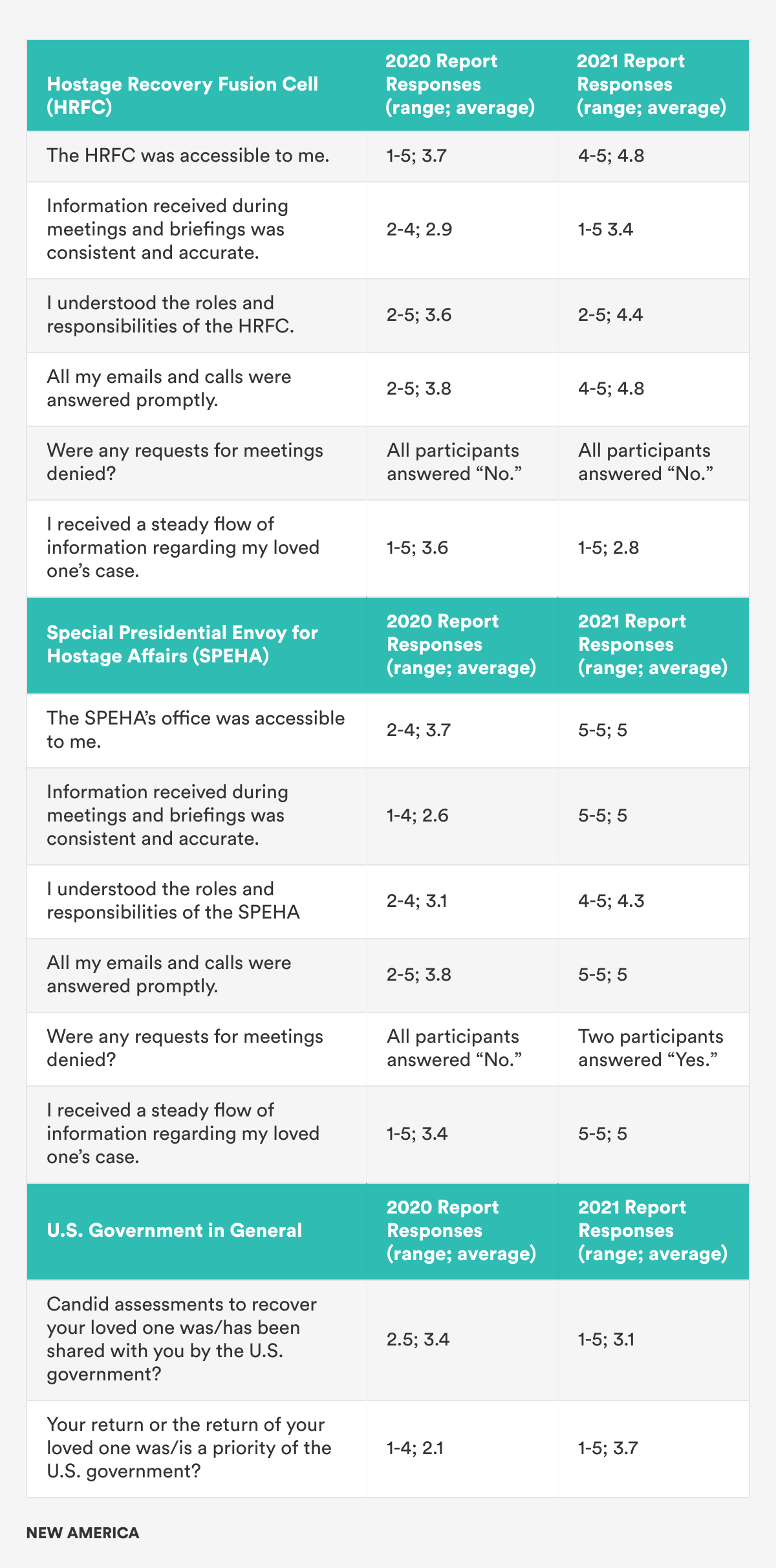
Appendix C: Unlawful or Wrongful Detainee Interview Responses
Each interview included a quantitative assessment of the effectiveness of PPD-30 by assigning a numerical value indicating the degree to which each participant agreed or disagreed with a variety of statements asked during the interview process. The numbers 1 = “strongly disagree;” 2 = “disagree;’ 3 = “neither agree nor disagree;” 4 = “agree;” and 5 = “strongly agree.”
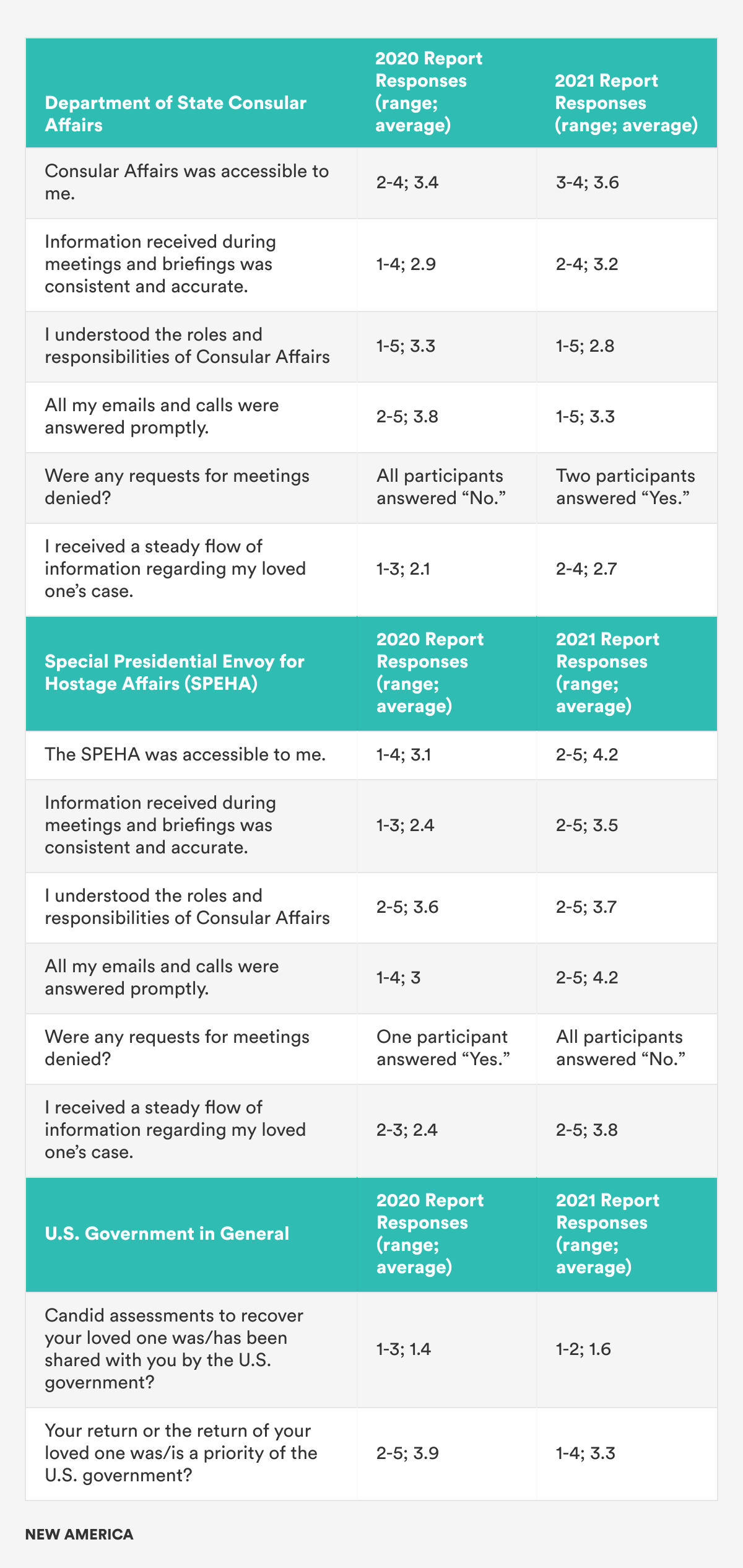
More About the Authors

Cynthia Loertscher

Cynthia Loertscher
James W. Foley Legacy Foundation
Issues
Programs/Projects/Initiatives
Related