Jason Delisle
Director, Federal Education Budget Project

[Editor’s Note: This post ran first on Higher Ed Watch‘s sister blog, Ed Money Watch]
Negotiations over raising the debt ceiling — and what legislative changes should be adopted to reduce the deficit — are now centered around competing proposals from House Speaker John Boehner and Senate Majority Leader Harry Reid. At this time, it seems likely that one of these proposals, or some mid-point, will be passed by Congress in the coming days.
As Ed Money Watch reported last week, any proposal that Congress ultimately adopts to reduce federal spending would include caps on annual appropriations for future years, and would be enforced by across-the-board spending cuts called “sequestration.” These caps on so-called discretionary spending will squeeze education funding over the coming years as nearly all federal education programs are funded through the annual appropriations process.
Both the Reid and Boehner proposals would put such caps and enforcement rules in place for the next 10 years. Both proposals divide the caps between defense spending and non-defense spending, so that one pot of funding cannot be robbed to pay for the other.
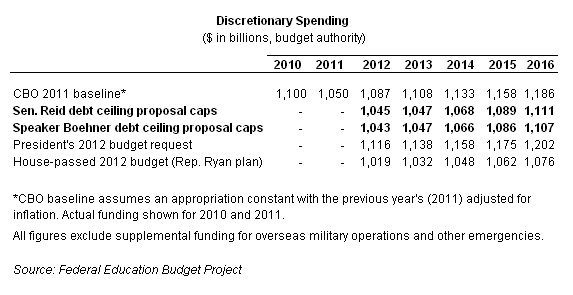
Both proposals take nearly identical steps to shore up the Pell Grant program and mitigate the squeeze that appropriation caps will put on the program — but only for two years. Each proposal would end the “in-school interest subsidy” on subsidized Stafford loans for graduate and professional students and use the resulting 10-year savings to put more money into Pell Grants. The Boehner plan also produces additional savings by ending on-time repayment incentives for student loan borrowers beginning with loans issued after July 2012. This additional proposal would save $3.6 billion over ten years according to the Congressional Budget Office.
Both plans provide supplemental funding for Pell Grants in fiscal years 2012 and 2013, effectively reducing the funding needed through annual appropriations to maintain the program’s current maximum grant of $5,550 in 2012 and an even higher grant the next year. So, the maximum Pell Grant could be maintained with an appropriation of only $25 billion instead of $34 billion in the 2012 appropriation. The table below details Pell Grant funding under both proposals. Note the spike in the appropriation that is required in fiscal year 2014.

As Congress moves closer to finalizing a deficit reduction plan in the coming days, it looks like lawmakers have agreed to provide more supplemental funding for Pell Grants — but at the expense of eliminating interest rate subsidies on federal loans for graduate students. This move makes it much more likely that lawmakers will maintain the maximum grant of $5,550 next year and provide the inflation-indexed increase the following year as enacted under the Student Aid and Fiscal Responsibility Act of 2010. However, the move also continues two recent trends: ad-hoc, one-year emergency funding for Pell Grants, and a Pell Grant program that is fast consuming the entire budget of the U.S. Department of Education.
Director, Federal Education Budget Project