Breaking Down What Erdogan Wants
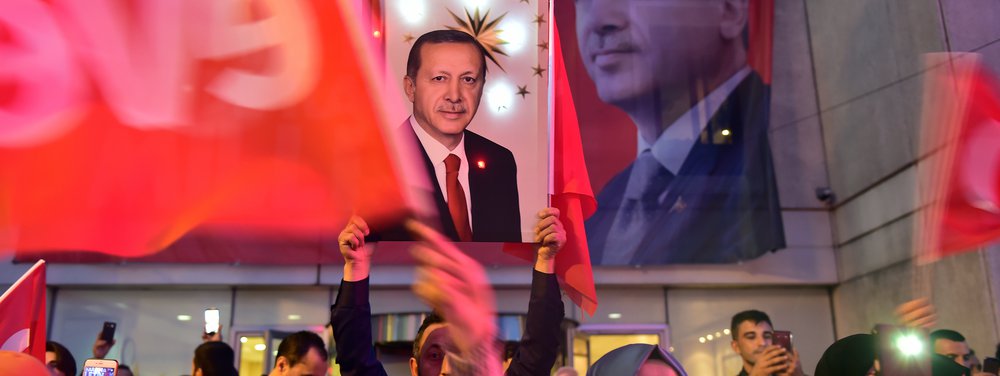
Keep your eye on the ball, so goes the adage. But if the game is rigged, it’s better to keep your eye on who controls the ball.
Since a referendum in 2017, a lot has changed in Turkey: The position of the prime minister, for one thing, was abolished after a close vote, one that turned a parliamentary democracy into a presidential system—with few checks and balances. Previously a ceremonial figurehead, the Turkish president is now both the head of state and government. He also holds concentrated power in an executive presidency, which allows him to issue decrees without parliamentary oversight, declare a state of emergency, and dissolve the parliament.
But to no one’s surprise, much has also remained the same in Turkey.
After the snap elections earlier this summer, the same party, the Justice and Development Party (AKP), is still in power—and the same person is, too. For years, Turkey was a key ally to the United States. After the re-election of President Recep Tayyip Erdogan in June, however, already tense relations between the two countries have been strained even more. For instance, when U.S. demands that Turkey release an American pastor, who was accused of espionage, were denied, the United States responded by putting sanctions in place, which has sent the Turkish economy spiraling. Turkey has responded by increasing tariffs on key imports, including cars, tobacco, and alcohol. President Donald Trump, true to form, stated that there will be “no concessions.”
To better understand the dynamics at play in the recent snap elections—or, to put it more bluntly, to break down what Erdogan really wants—I recently spoke with Nicholas Danforth, a senior policy analyst with the Bipartisan Policy Center’s National Security program. A lightly condensed and edited transcript of our conversation is below.
You’ve written extensively about the snap elections. In your opinion, what led to Erdogan’s victory?
I’d say that Erdogan’s assumption of the executive presidency following this summer’s election represents a fulfillment of a long-standing dream of his. He’s long argued that only a powerful president will be able to lead the country effectively to overcome its many foreign and domestic challenges. And, of course, he’s naturally assumed that he would be that leader.
There were two parts to this. First, the referendum [in 2017] that transformed the constitution to dramatically empower the president was passed. And then the second step was that Erdogan actually had to win the presidency in order to officially assume those powers. De facto, Erdogan was already running the show. There were few checks on his power before the election, but now there are even fewer. He can run the country as he likes in keeping with the constitution instead of in violation of the constitution.
What were the most important factors for voters when they went to the polls?
The assumption is that Erdogan moved the elections forward in order to preempt a potential economic crisis, which Turkey may now be heading toward very rapidly. There was some speculation before the election that, with the economy getting worse—and a number of outside analysts blaming Erdogan’s economic policies for the fact that that it was getting worse—Erdogan might struggle at the polls. And yet, support for Erdogan remained strong. It wasn’t that people didn’t care about the economy, but that they interpreted the news about the economy within their pre-existing political alignments.
Erdogan, in the past, was very successful at bringing real economic benefits to his voters. His narrative has always been that what’s threatening that success is the machinations of Turkey’s enemies. I think that when a lot of voters went to the polls, it wasn’t that they weren’t concerned about the economy, but that they believed that Erdogan, having improved the economy in the past, was the one leader with the courage, skill, and strength to protect their interests and the economy in the face of the threats that it faced.
That concern with outside forces you mentioned reminds me of research about anti-American sentiments in Turkey. Are these sentiments connected to the pastor who’s being detained because of claims that he was involved in the 2016 coup?
The intensity of anti-American sentiment in Turkey is profound; and it’s not limited to Erdogan supporters. Erdogan has taken dramatic steps to take advantage of this anti-American sentiment politically. And I think it’s important to say that, at some level, he genuinely believes some of the conspiracies—for instance, the fact that the United States refuses to extradite [Turkish cleric] Fethullah Gülen, who Ankara blames for leading the 2016 coup.
The case of Andrew Brunson, an American pastor who ran a small church in Turkey, is very striking. For reasons that remain unclear, the Turkish government decided that he had somehow been involved in the coup. This, unsurprisingly, generated backlash in the United States, which only confirmed Turkey’s belief that Brunson had been instrumental to American plots against Turkey. Erdogan, likely to get the United States to abandon some of its more hostile policies, instrumentalized Andrew Brunson as a hostage to try to get concessions from the United States. The refusal of the United States to give all the concessions that Erdogan was asking for, and to respond instead with the threat of sanctions, has created the crisis in U.S.-Turkish relations we’re seeing right now.
And how do you see this affecting U.S.-Turkish relations in the future?
I remain optimistic that a short-term solution can be found. But, the risks of the U.S.-Turkish relationship aren’t going away once this crisis is solved. It’s likely that a new, possibly worse crisis will emerge. Within the last couple of years, the U.S.-Turkish relationship has found ways to reach new lows. This is certainly the worst that it’s been since the Cyprus crisis in 1974—possibly the worst it’s been since the beginning of the relationship after World War II. In the meantime, of course, everyone’s focused on Andrew Brunson.
We were talking about anti-Americanism. I think that the deep belief on the part of not only the Turkish government but also the Turkish people, that the United States is fundamentally hostile to Turkey, makes it very hard to have a functional relationship. Frustration with Turkey is becoming increasingly widespread. Some of the people who thought that it was important to recognize and accommodate some of Turkey’s legitimate concerns are gradually losing ground in internal debates within Washington. I think that we’re going to see a greater willingness on the part of some Americans to use measures like sanctions, which might be effective in achieving certain goals but might, in the long term, further convince people in Turkey of American hostility, increasing the chances of a more fundamental, lasting break in the relationship.
Given these changing dynamics between the United States and Turkey, what might Turkey’s position in a changing global order be?
There’s a surprisingly strong conviction among people writing about foreign policy in Turkey that their country is on the verge of assuming a new and more powerful role in a changing world order—a belief that, in the past, Turkey had been unduly subservient to the United States. At the annual BRICs meeting, Erdogan talked about a global order that has only worked for the benefit of a limited few. He really sees a role for himself as a new power within a changing global order.
This belief is echoed in a number of ways. It’s echoed in Erdogan’s conviction that he can be a leader in the Muslim world, his push to expand the United Nations Security Council, his emerging friendship with Nicolás Maduro in Venezuela, and his desire to promote a newfound relationship with Russia and Iran. This notion that he is a new power is coupled with the idea that, as America is struggling with its own role in the world, it’s becoming weaker, and the previous global order is breaking down.
Moving forward, what would you encourage people to keep in mind as they continue following Turkish politics?
I think that one of things that was most striking about the last election is that Erdogan was able not only to win but to win in a way that even the opposition has, in its own ways, treated as legitimate. For all the oppositions’ frustrations, they seemed prepared to continue to play the game on Erdogan’s terms. I think that puts Erdogan in a very strong position, and it ensures, at the very least, continued domestic stability in Turkey.
Getting to the bigger question of Turkey’s relationship with the West, there are conflicting impulses in Ankara to, on the one hand, be very pragmatic, to offer tactical concessions when necessary to maintain a functional relationship with the United States. On the other hand, you see a much more defiant impulse, one that seems willing to court crisis at the price of standing up to the United States and international markets.
Looking at the situation right now, it’s entirely unclear which of these impulses will win out. But, moving forward, this decision will be fundamental in determining the fate of Turkey’s foreign and domestic policies.
More About the Authors
Related
Tech for the People, by the People: Harmonizing Data for the Environmental Movement with Gabe Watson
A Bureaucratic Shakeup Threatens Future Child Care Research