Our Recommendations for a Better Managed Retreat
To start, it is critical to recognize that the U.S. will not need to buy out all at-risk Americans simultaneously. Nor will all households relocate to the same receiving community. The federal government, its local partners, and the private sector should instead work steadily over the coming decades on a three-pronged approach that (1) stems population inflows to climate-vulnerable areas; (2) encourages at-risk residents to independently move to safer ground; and (3) proactively plans and implements buyouts for anyone remaining. Importantly, federal policymakers and local planners must also work to increase equity within these larger strategies.
So, how can the United States implement gradual and proactive managed retreat strategies?
This long-term planning first requires significant staffing capacity, yet research shows that most U.S. jurisdictions, particularly smaller and poorer ones, lack such resources. To that end, the federal government must adequately fund small municipalities, so in turn they can better staff planning departments, housing agencies, and other units tasked with resilience.
Recommendation #1: More federal funding for small municipalities to staff planning departments, housing agencies, and other local entities tasked with climate resilience.
Reduce Population Inflows to Climate-Vulnerable Areas
Both the federal government and municipalities should discourage, and in some cases outright restrict, people from moving into our most climate-vulnerable areas. Research from the real estate firm Redfin finds that the most at-risk parts of the U.S. are also among the fastest growing. Florida, the state at greatest risk from sea-level rise and hurricanes, was also the fastest-growing state by population percentage increase between 2021 and 2022. In large part, lower costs of living, economic growth, and warmer weather are driving population increases in climate-vulnerable areas across the Sun Belt (and any strategies to reduce these inflows must consider such factors).
Many stakeholders continue to benefit from these population increases and associated economic growth. Real estate developers profit from lucrative coastal developments, while local governments enjoy increased tax revenues. The result in many communities is a fast-growing “climate real estate bubble”: 2023 analysis by First Street Foundation and the Environmental Defense Fund suggests that U.S. properties exposed to flood risk are overvalued by between $121 billion and $237 billion. Once this bubble bursts, owners of flood-prone homes will experience a massive loss of equity and, eventually, an unsellable house. The ripple effects will threaten property values across the entire United States.
One strategy to slow these population flows is to increase the transparency surrounding climate risk to real estate. Roughly one-third of U.S. states lack disclosure laws that require sellers to inform buyers that a house is at risk of flooding or has previously flooded. Meanwhile, outdated and incomplete FEMA flood risk maps do not reflect actual risk.1 Many homeowners consequently may not understand the climate risks to their new properties.
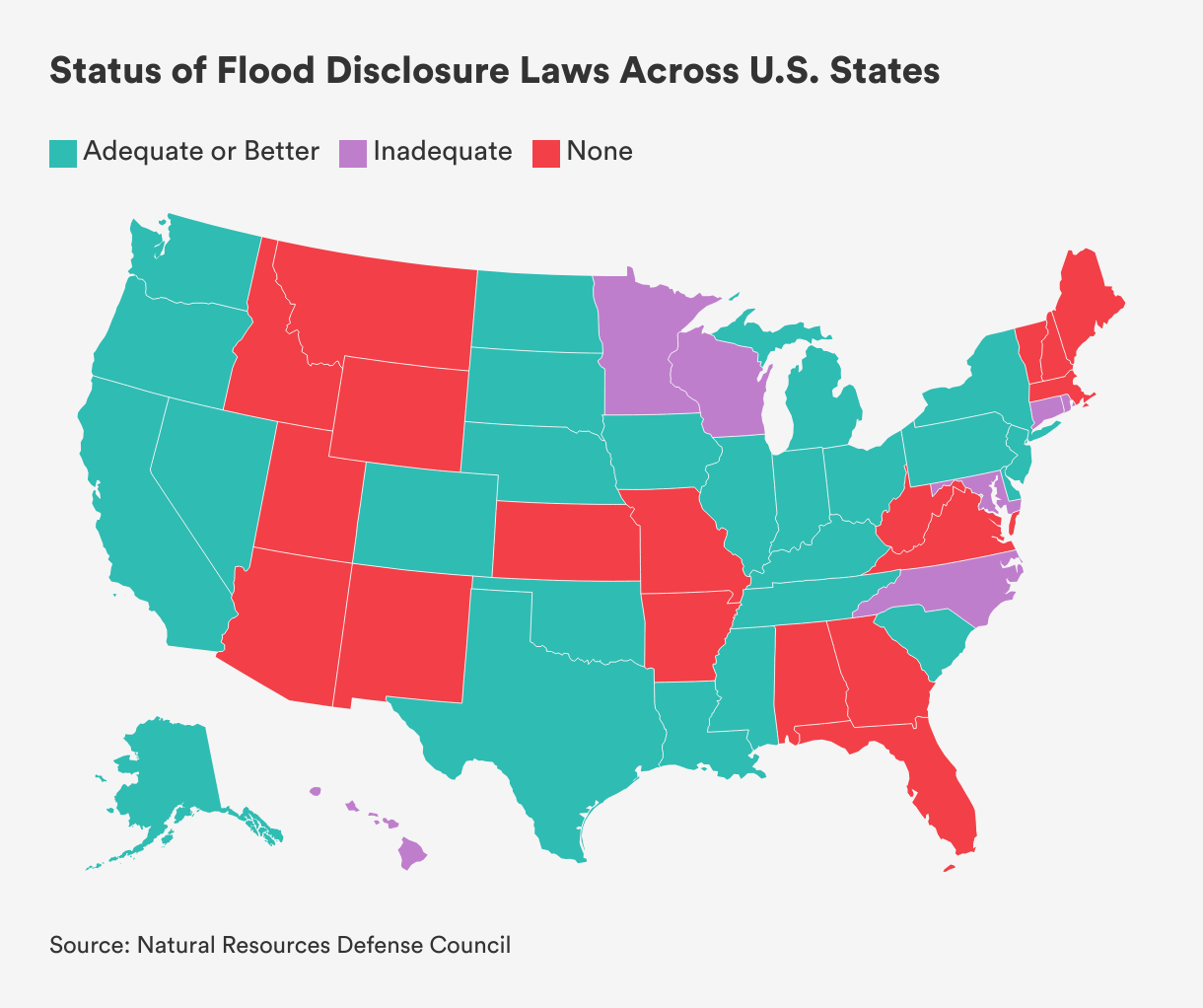
In 2023, flood-prone New Jersey and several other states passed legislation that requires flood disclosure during real estate transactions.2 Additional states should follow suit, or the federal government should establish nationwide flood disclosure requirements, to ensure that buyers are aware of the true risks of moving into dangerous areas.
Recommendation #2: U.S. states without flood disclosure laws should pass legislation, or the federal government should enact nationwide flood disclosure requirements.
But some homeowners may tolerate (or ignore) these risks, even when they are adequately aware of them. In part, this is because FEMA offers heavily subsidized insurance to all residents in high-risk flood zones through the NFIP. Despite recent efforts to align rates with true flood risk, this insurance remains significantly discounted. The availability of NFIP creates a moral hazard, and the federal government should either stop offering the program to new construction in high-risk flood zones or further increase new policies’ rates to accurately reflect risk.
Recommendation #3: Congress must reform the National Flood Insurance Program, either by declining to offer subsidized insurance to new construction in high-risk flood zones or by further increasing rates for new policies to more correctly reflect flood risk.
Another option to slow population growth in climate-vulnerable locations is to limit or restrict new development in high-risk areas. Local governments are well-positioned to promote “climate-resilient development” through their land use management and zoning authority. Historically, racist and classist zoning policies have reinforced inequitable investment patterns and have resulted in marginalized populations’ disproportionate exposure to environmental hazards. But today, holistic, forward-looking, and innovative zoning reforms can address historic inequities, promote sustainable land use, and build community resilience to climate risks.
For example, Norfolk, Virginia, overhauled its zoning code in 2018 to include overlay zones that encourage new development at higher elevation and also place more stringent measures on development in flood-vulnerable areas. These types of policies support growth in areas of greater climate resilience, therefore directing new residents to safer ground.
Recommendation #4: Local governments should limit or restrict new development in climate-vulnerable areas through changes to land use and zoning policies.
Disincentivize Staying in At-Risk Areas, Incentivize Moving to Safer Ground
A second goal is to gradually reduce the amount of people actively residing in vulnerable areas, ultimately to lower the number of residents who will require buyouts and other post-disaster assistance in the long term. The federal government should coordinate with state and local authorities to encourage homeowners to relocate to safer areas, whether by disincentivizing their decision to stay or by making relocation more attractive.
Nationally, Congress should limit the number of times that FEMA can fund the rebuilding of homes repeatedly damaged or destroyed by climate-related disasters. Funding should instead be repurposed for buyouts and other proactive relocation measures. In fact, FEMA itself recommended removing from NFIP coverage any properties repaired four or more times. The proposal is pending Congressional approval as of fall 2023.
Homeowners are often eager to break the cycle of flooding and rebuilding, but are unable to sell their house to a new buyer. To address this challenge, qualifying and interested homeowners should be offered a “guaranteed future buyout.” First proposed by NRDC, a guaranteed future buyout option would involve a homeowner voluntarily committing to accept a buyout of their house if and when it is substantially damaged in a future disaster. The offer could be included as a benefit of NFIP coverage to ensure uptake. In the end, this type of proactive planning should substantially reduce the time to complete buyout processes and provide a sense of certainty and security for homeowners.
Recommendation #5: Congress should reform FEMA’s National Flood Insurance Program to (1) limit the number of payouts for repetitive loss properties and (2) repurpose funding to offer “guaranteed future buyouts” as part of flood insurance coverage to qualifying homeowners.
Local governments can further utilize their land use and zoning powers to implement policies that gradually vacate vulnerable areas. These innovative approaches allow municipalities and their residents to plan for relocation as climate impacts become worse, without forcing immediate moves.
Life estates, which the city of Norfolk is experimenting with, are a land use type that allows residents to live in their flood-vulnerable homes for the remainder of their life, but mandates that the house reverts to government ownership thereafter. Another strategy to incentivize development on higher ground is the use of rolling easements, which gradually move the property line away from the shoreline as sea-level rise and erosion encroach upon the land. Rolling easements allow homeowners to stay on their property in the short term, while planning for eventual retreat.
Other land use and zoning tools are available for local governments to encourage homeowners in climate-vulnerable areas to proactively move to safer ground. For instance, municipalities can use public-private land swap arrangements to advance long-term resilience goals by “swapping” private flood-prone land for property in less-vulnerable areas. The low-lying land can then be converted into wetlands or other green space, providing flood mitigation and other environmental benefits. A related, emerging zoning technique called transferred development rights (TDRs) allows a property owner to cede their development rights within one flood-prone tract and transfer these rights to another, less-risky tract. TDRs can reduce climate risk through market incentives and help shift development away from hazardous areas. And a third tool is the leaseback, in which a local government acquires a climate-vulnerable property and then leases it to the original owner, providing a flexible approach for the eventual relocation of residents. Leases could expire after a standard time period or agreements could require the lessee to vacate if a “triggering event” such as substantial flood damage occurs.
Recommendation #6: Local governments should utilize their land use and zoning powers to implement a number of innovative strategies that gradually vacate climate-vulnerable areas.
As homeowners move, intermunicipal cooperation agreements could ease a local government’s concerns around a diminishing tax base and allow neighboring communities to offer relocation options for vulnerable residents. Smaller towns often hesitate to implement buyouts for fear that dwindling tax revenue will cripple the public service delivery for those who remain. States could address this worry by widening municipal boundaries in at-risk regions or creating cost-share arrangements between outflow and inflow municipalities.
Finally, inland cities such as Buffalo, New York, and Duluth, Minnesota, have begun positioning themselves as “climate havens,“ anticipating that an inflow of residents will boost their economies and reverse post-industrial population declines. While migration to climate havens is still nascent, cities in the Northwest and Northeast could experience a 10 percent growth in population over the coming decades due to climate factors, according to one projection. This future migration will very likely constrain housing supply, raise rents and mortgages, and exacerbate housing insecurity. To mitigate these risks while encouraging climate migration, the federal government might create “climate opportunity zones,“ in which it subsidizes affordable housing and provides tax incentives for new arrivals. Regardless of any federal help, city officials must direct the necessary resources to ensure housing supply meets demand in the future.
Proactively Plan Buyouts
Third, the U.S. government and its local partners need a more proactive buyout strategy for residents who do not relocate on their own. Perhaps most importantly, Congress must decouple buyout funding from disaster declarations to allow for this approach. Most federal buyout dollars only become available after a federal disaster declaration, despite the fact that preemptive relocation is both less costly and less traumatic compared to assistance following a hurricane, flood, or wildfire.
Recommendation #7: Congress must separate the availability of federal buyout funding from federal disaster declarations to allow for more proactive relocation.
In 2022, the Bureau of Indian Affairs (within the Department of the Interior) began to experiment with proactive buyouts by granting $25 million each to two Native Alaskan communities and one Native community in Washington state to relocate to safer ground. The three villages—Newtok and Napakiak in Alaska and Taholah in Washington—are experiencing severe erosion and storm surges that threaten to destroy much of their housing and infrastructure in coming decades. Previously, these small communities were not eligible for buyouts unless impacted by a federally declared disaster, despite existential risks from rising waters. Although these initiatives are new, they offer promise for a reformed strategy.
FEMA and HUD should also fund and provide technical assistance for communities to proactively plan for eventual buyouts. Notably, this will help to address equity issues, as the most climate-vulnerable municipalities are often low-resource and struggle to presently apply for buyout funding. The process could involve locating the most at-risk homes ahead of time, engaging and educating current homeowners about their options, and completing buyout paperwork before a disaster hits. NRDC proposes that Congress authorize FEMA to finance this strategy using NFIP funds. Between 2000 and 2017, NFIP spent $46.6 billion to repair and rebuild policyholders’ homes, with repairs often costing more than the total value of the house. This federal funding could instead be used for proactive planning.
Recommendations #8 and #9: The federal government should fund and provide technical assistance for local partners to plan for future buyout scenarios. The federal government should also provide more funding to complete these proactive buyouts.
In fact, some municipalities are already planning future buyouts as part of their climate resilience and economic development strategies, with funding through local taxes and fees. Houston, Texas, the nation’s fourth largest city, encourages its residents to volunteer for buyouts before a disaster occurs. Meanwhile, the Charlotte, North Carolina, metro area funds a preemptive buyout program with fees from its stormwater utility.
Case Study: Napakiak, Alaska
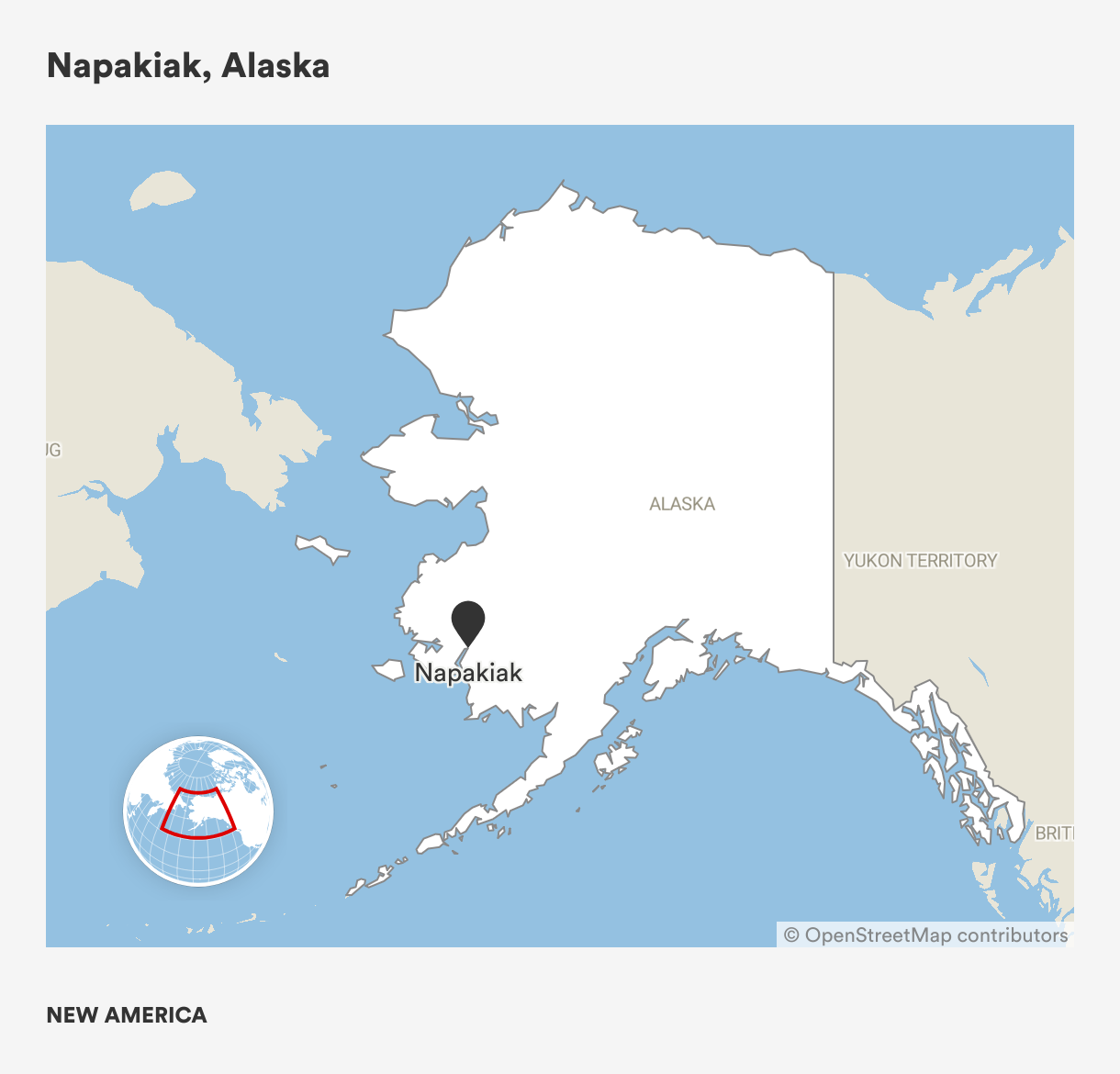
Napakiak is a small, remote Native Alaskan community of 344 residents located in the Yukon-Kuskokwim Delta. The village’s existence is endangered by increasingly rapid and severe riverine erosion, as the community lives along the banks of the Kuskokwim River, the longest free-flowing river in the United States.
Napakiak’s proximity to the river has supported a subsistence lifestyle for thousands of years. But erosion at rates of 25 to 50 feet per year now threatens to destroy nearly all homes and critical infrastructure—including the village’s school and airstrip—by 2030. In response, the community developed Alaska’s first long-term Managed Retreat Plan to relocate to safer ground adjacent to the current site.
Despite Napakiak’s efforts to proactively plan a managed retreat, the community consistently struggled to access project assistance due to systemic barriers within federal programs that disadvantage marginalized groups. For example, the cost-share requirements of most programs, which is the need to match federal funding with local funding, makes it incredibly difficult for small and poor communities like Napakiak to submit an application. Additionally, buyouts were largely inaccessible to Napakiak because the U.S. Stafford Act does not recognize slow-onset disasters like erosion, making the community ineligible for FEMA disaster-based assistance. Lacking this funding, Napakiak was left vulnerable to future storms and erosion, with homes at risk of being swallowed by the river before help arrived.
In 2022, however, the Bureau of Indian Affairs (BIA) awarded Napakiak $25 million for community-led managed retreat. This funding is a first-of-its-kind federal investment to proactively implement managed retreat projects before a slow-moving disaster devastates a community.
While BIA funding is not sufficient to relocate every threatened house or all infrastructure, it will significantly expedite the retreat process.3 Napakiak’s top priority is to relocate imminently threatened structures, including 38 homes, to a new subdivision further inland. BIA funding will substantially advance development of the subdivision and relocation of threatened buildings, which could very well attract additional support from other funders.
Ultimately, this assistance will help to protect tribal sovereignty by ensuring the long-term sustainability of the community in the location they have called home for centuries.
Increase Equity in the Planning and Implementation of Buyout Projects
Most managed retreat projects in the U.S. do not meaningfully incorporate equity into their design and implementation. Consequently, programming can lead to inequitable and unjust outcomes, particularly for marginalized individuals and groups. In general, research shows that the more disaster-related aid an area receives from FEMA, the more inequality increases along lines of race.
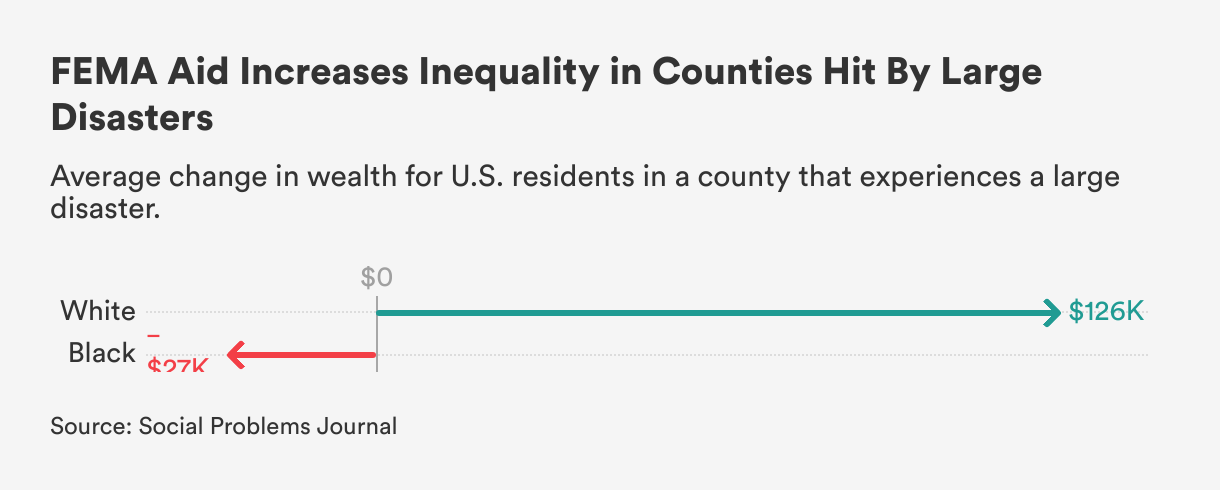
As managed retreat becomes increasingly necessary amid climate change, it is essential that federal policymakers, local planners, civil society organizations, and the private sector work to deliberately incorporate equity within programs. While strategies will differ based on an area’s geographic, economic, and social characteristics, there are common practices that will help to increase equity.
To start, it is worth reiterating that small and low-resource communities continue to struggle to apply for and receive financial and technical assistance from the federal government. Research published in the peer-reviewed journal Science Advances found that counties with larger populations and higher incomes are more likely to implement buyouts.4 Analysis by Rice University similarly concluded that buyouts disproportionately benefit whiter, weather communities. Tiny, short-staffed municipalities need more assistance and resources from the federal government to grow and sustain their capacity to administer buyout programs.5
Development of managed retreat projects at the local level should prioritize the needs of socially vulnerable groups and address their unique challenges. To accomplish this goal, planners must meaningfully include affected communities in the design, planning, and implementation of buyouts. This better ensures that socially vulnerable groups’ perspectives and knowledge are valued and incorporated, leading to more equitable and effective outcomes.6 Good practices from the U.S. Environmental Protection Agency include the provision of culturally appropriate and accessible information, the facilitation of community consultations, and opportunities for residents to voice their concerns, preferences, and aspirations.
Recommendation #10: The development of managed retreat projects should center the needs of socially-vulnerable people and address their unique challenges, and also consider the long-term impacts of relocation for these groups.
An equitable managed retreat framework must also consider the long-term socioeconomic impacts of relocation and work to mitigate the disruptions experienced during the process. Strategies include assistance to both secure employment and access affordable, low-risk housing in the areas people move to after buyouts. Critically, buyout programming should start to include ongoing monitoring of equity outcomes to guide future investments.
Citations
- Of note, the 2021 Infrastructure Investment and Jobs Act allocated $600 million to FEMA to update its flood maps.
- The New Jersey statute also requires landlords to notify prospective tenants if a property is within a flood zone or has previously flooded. Only eight states have similar requirements.
- The program also aims to provide a model for other communities who may need to complete a managed retreat in the future.
- It is worth noting, however, that buyouts in such counties are in fact concentrated in areas of greater social vulnerability.
- See Recommendation #1 above.
- Of note, there were a number of successful community-led managed retreat projects prior to the mid 1990s. Since then, community-led projects are more difficult to implement as a result of a lack in funding and the challenges of interagency coordination within the U.S. government.