Back to the Drawing Board on PreK-3rd

In 1972, the Frank Porter Graham (FPG) Institute for Child Development in North Carolina launched the Abecedarian Project, a high-quality early education initiative for low income children in the state. The Abecedarian program, which produced some of the first evidence to show long-term cognitive, economic and social impacts of early education, has helped fuel the growth in early education programs over the last two decades. Now FPG researchers are asking the question: what more needs to be done?
“What’s evident is there’s a pretty fast moving train in terms of pre-k in schools,” said Sharon Ritchie, a senior scientist at FPG, in a recent video. “But what is equally evident is that there is not a lot of complex thought in terms of what that could or should mean for schools.”
FPG’s answer is FirstSchool, an initiative to design the ideal elementary school experience where traditional notions of “early education” (pre-kindergarten) and “elementary school” (kindergarten through third grade) are woven together in a seamless and dynamic PreK-3rd system.
Researchers at FPG have convened a multi-stakeholder collaboration to design a new framework for PreK-3rd early education. The $2 million effort is led by Ritchie and Kelly Maxwell, who is an FPG scientist and associate director, and funded by several donors, including the University of North Carolina-Chapel Hill, the W.K. Kellogg Foundation, and the Foundation for Childhood Development (which also funds Early Ed Watch).
Right now, FirstSchool is just a concept, but its founders say the framework will represent “what we hope school will be like for young children by 2020.” FirstSchool has also established a partnership with two schools in the Chapel Hill, N.C.c school district, which will pilot the new model framework.
FirstSchool recently released four issue briefs that outline — broadly — its priorities for a PreK-3rd education system. Each brief is accompanied by a useful video featuring an FPG researcher.
Financing Services for 3-and 4-Year Olds in a P-3 School – Reforming early education will require a close look at the complex web of funding streams for early education. Of particular concern are differences in funding between early ed and K-12 classrooms, as well as financing early ed facilities.
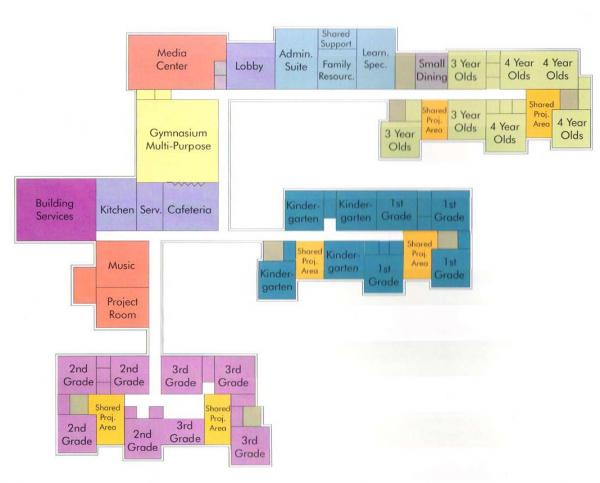
FirstSchool Learning Environments: Supporting Relationships – Curiosity and engagement is a group endeavor, and early education facilities should be designed to foster these relationships. FirstSchool offers a school design (see one schematic drawing from the brief below) that features “clusters” of same-grade classrooms built around a central collaborative project area and spaces for parents and community liaisons that are similar in design to homes, to make them more welcoming.
Using Developmental Science to Transform Children’s Early School Experiences – FirstSchool researchers identified four foundations that research shows predict success in PreK-3rd: self-regulation, representation, memory, and attachment. They then suggest how application of these principles can transform a child’s classroom experience.
Time is of the Essence – Most elementary teachers only have a few hours each week for planning, let alone time for professional development. This brief suggests that schools need to invest more time in building partnerships among teachers, family and related community services.
The development and implementation of FirstSchool concepts is still underway, and more issue briefs are in the works. So if you are searching for big ideas in early education, stay tuned to FirstSchool.
More About the Authors
Issues
Programs/Projects/Initiatives
Related
Confronting Harmful Federal Disability Policy in Health and Human Services

Federal Early Education Update: March 2026
A Bureaucratic Shakeup Threatens Future Child Care Research