
Table of Contents
Phoenix: A Tale of Two Cities
Overview

Phoenix is a city on the rise, characterized by rapid growth, a robust startup community, a growing technology sector, and increasing numbers of the telltale coffee shops, artists’ communities, and farm-to-table restaurants that are the artifacts of knowledge workers.1 Roughly 2,000 people move to Phoenix every week, seeking employment in a region where job growth is set to outpace the national average by more than double and the cost of living remains one of the lowest for big cities in the United States.2 The city itself is growing; cranes are visible all over the region, and Phoenix has among the fastest growth in construction jobs in the country.3
However, Phoenix’s economic opportunity is not shared equally. Phoenix is a city of contrasts. Income inequality is high, and a large share of the workforce works in low-paid jobs. Alongside the increase in high-paid technology and knowledge economy jobs are a portion of Phoenix residents who work for lean hourly wages to eke out a marginal living in the service, hospitality, and retail trades. Hourly wages and educational attainment in Phoenix lag behind national averages.4
What the Data Say: Automation Risk in Phoenix5
In 2018, New America published a first-of-its-kind analysis of automation’s potential impact in the Phoenix region.6 The analysis included four key points:
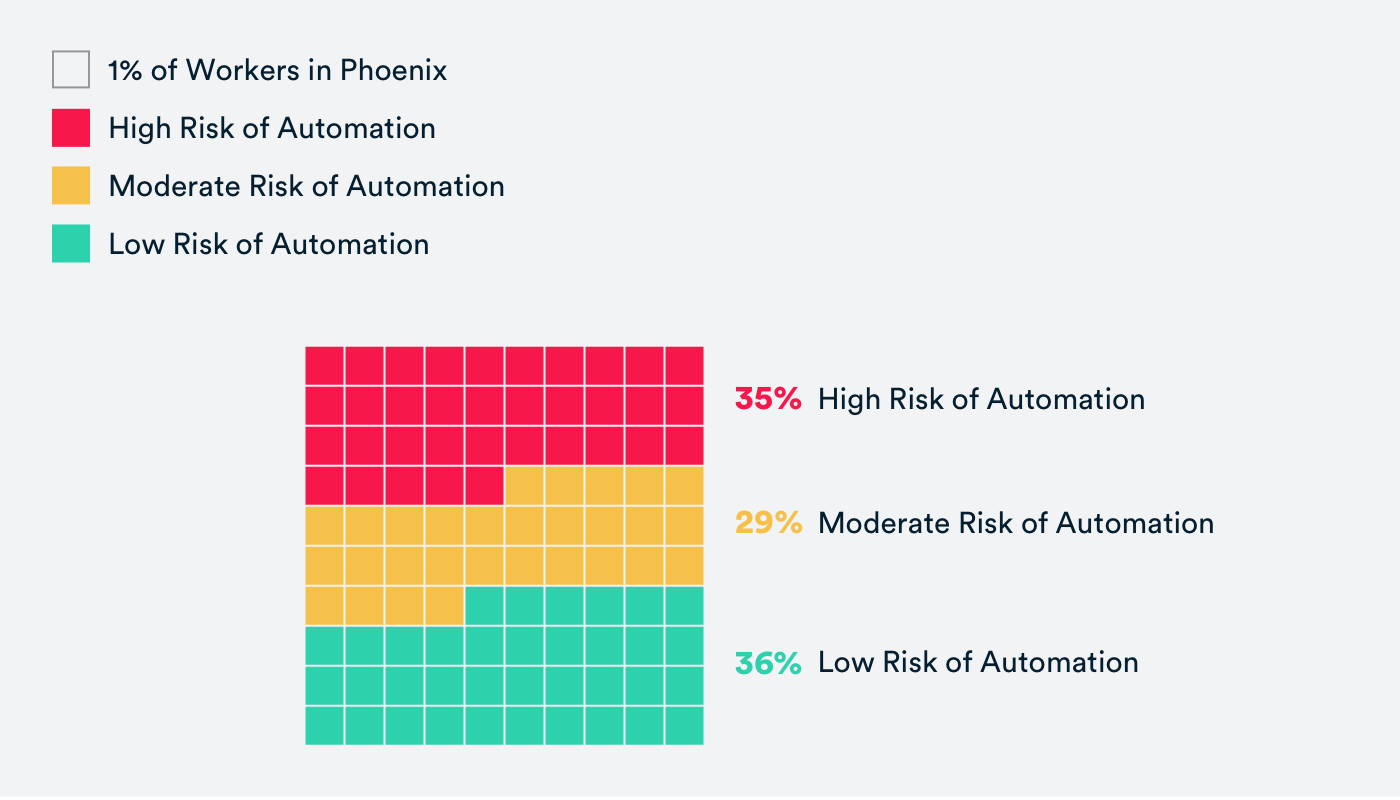
1) Just over one in three jobs in the Phoenix metro area at high risk of automation. According to our analysis, 649,040 jobs are at a high risk of automation in the Phoenix metropolitan area—35 percent of total jobs in the region. Another 537,110 jobs (29 percent of total jobs) are at moderate risk of automation. This risk is slightly above the U.S. national average.
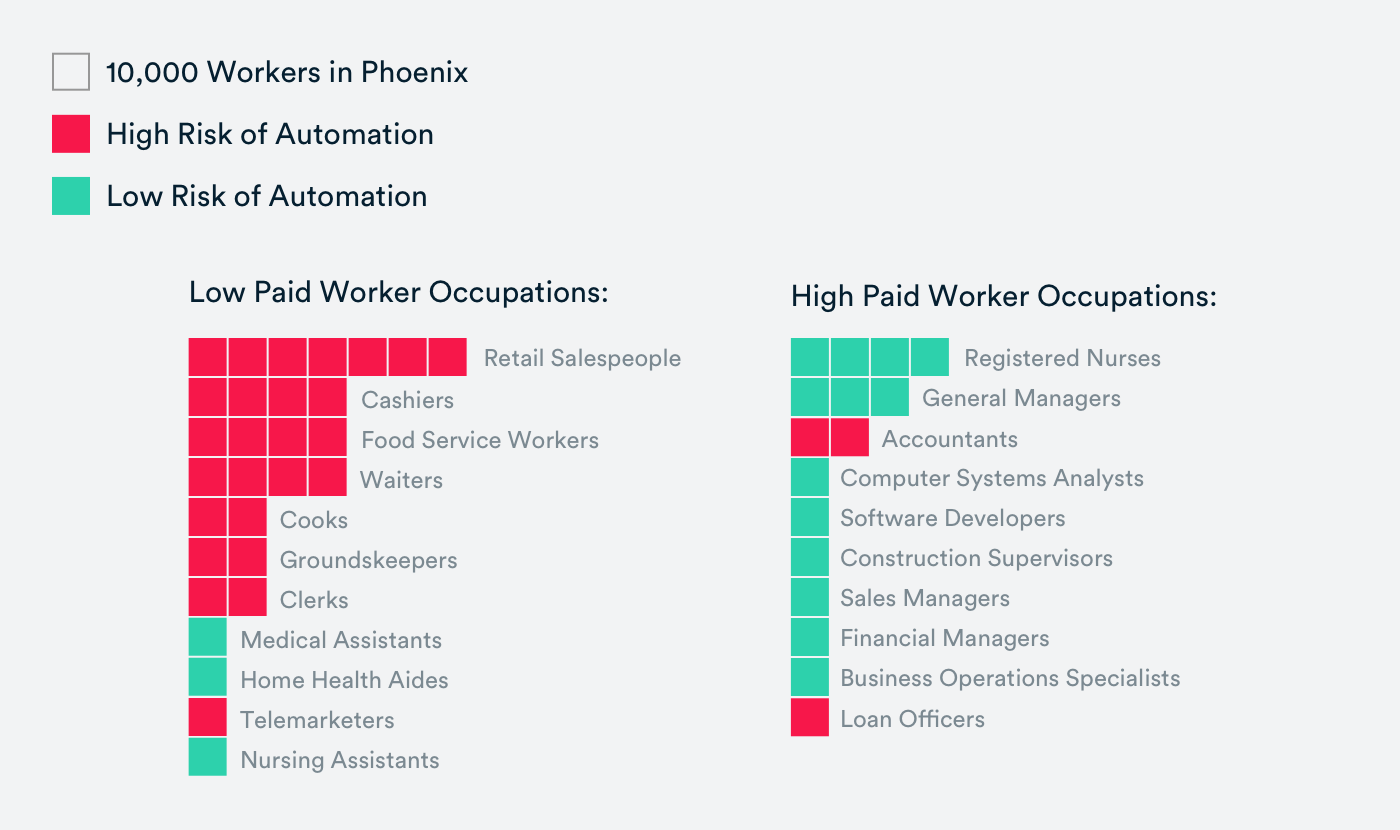
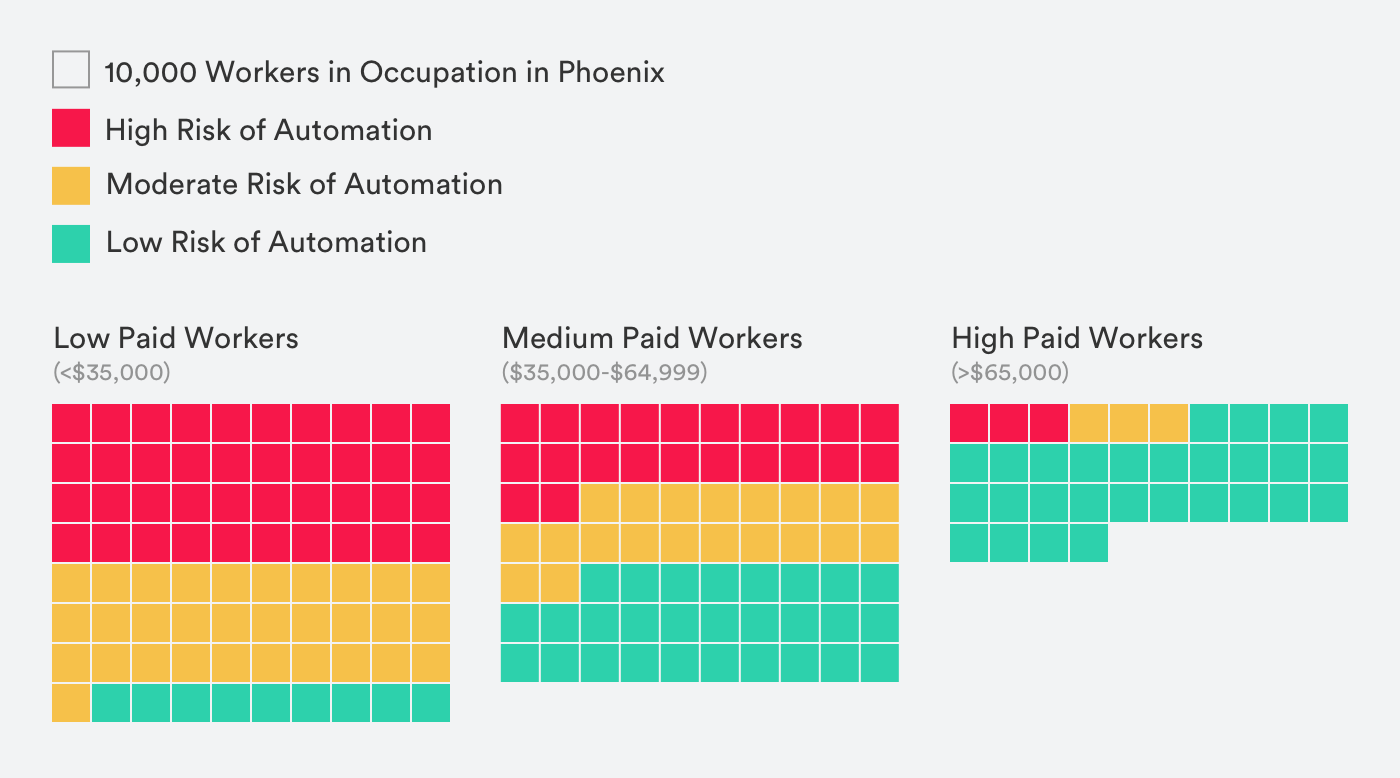
2) Phoenix’s unequal growth presents an uneven risk of automation, with lower-paid workers at greatest risk. In some ways, the Phoenix metro region is better prepared than the rest of the country for automation. As a percentage of its workforce, a higher share of Phoenix workers are in high-paid, low-risk occupations in business, management, computing, technology, and mathematics. Phoenix also has far fewer high-risk manufacturing positions than the national average. However, the region also has a higher percentage of its workforce than the nation overall in low-paid, high-risk jobs in the food industry, retail sales, and office and administrative work. In Phoenix, as in the United States overall, the burden of automation risk falls heaviest on workers in low-paid jobs. Workers making less than $35,000, and especially those earning minimum wage, are at far higher risk than those earning over $65,000.
3) Lags in educational attainment are a red flag for automation risk. Educational attainment is strongly correlated to automation risk. For workers in the Phoenix region with a bachelor’s degree or higher, the risk of automation is orders of magnitude lower than for those with a high school degree or less. The lagging rates of educational attainment pose a risk for the region. Phoenix has 6 percent fewer high school graduates than the national average, and 3 percent fewer college graduates.
4) Women are at higher risk from automation in Phoenix than men. The high-risk occupations in Phoenix disproportionately employ women. Applying national averages of women employed across occupations, women constitute 58 percent of workers in high-risk occupations in Phoenix. Women dominate in many food and retail-related industries that are especially high-risk.
How Phoenix Is Preparing for Technological Change and Automation
The Phoenix region is embracing three approaches to preparing for the future of work: pioneering new lifelong learning opportunities, embracing technology, and organizing around education.
Pioneering Lifelong Learning
A defining feature of the Phoenix approach to the future of work is Arizona State University’s (ASU) leadership in pioneering new ways for people to learn throughout their careers. Arizona State University is not a funder of ShiftLabs, however ASU does fund several New America projects and partnerships. In a recent discussion, ASU president Michael Crow pointed out: “Sixty-five percent of children entering primary school today will ultimately end up working in completely new job types that don’t exist yet”—not just different jobs, but jobs we cannot even conceptualize today.7 ASU has disrupted the traditional model of higher education by engaging learners of all ages and across multiple learning platforms in new ways, with a goal of enabling learning “anytime, anywhere, anything that you want.”8 For example, at the Osher Lifelong Learning Institute, students ages 50 and older can take low-cost courses taught by ASU faculty. Though not traditionally graded, these courses provide students the opportunity to branch out their interests and learn skills applicable to careers besides their own. ASU has also invested heavily in its EdPlus online learning platform to reach full-time students as well as adults in need of continuing education or upskilling. The platform is also explicitly designed to make inclusion a top priority.9 As the country’s largest public university, ASU is well positioned to influence the educational ecosystem in Arizona as well as the country as a whole.
Alongside ASU, several other Phoenix-based programs offer coding and high-tech training programs for high school students and adults, such as Phoenix Coding Academy and Galvanize. Although coding bootcamps and similar programs often serve an already educated population interested in moving into more technical roles, they are an important part of the learning and technology ecosystem.
Embracing Technology, Innovation, and Entrepreneurship
Phoenix city and business leaders have enthusiastically embraced technology in preparation for the jobs of the future. The Phoenix metro area has a thriving technology sector and an especially robust cybersecurity industry, which currently employs more than 11,000 workers and has over 6,000 job openings.10 The hashtag “#yesphx,” initially an easy way to share happenings within the Phoenix startup ecosystem, has spawned a standalone website and event series, assisted in the creation and growth of several successful businesses, and demonstrated the vibrancy of entrepreneurship in the area. Reflecting this culture of entrepreneurism, Arizona was recently ranked in the top 10 states for starting a business.11

Over the past few years, the Phoenix metro area has also become a testbed for autonomous vehicles (AVs). Waymo, Uber, Lyft, General Motors, and Intel are all testing AVs in the area, creating a mini high-tech jobs boom based on the operations of those ventures, and ensuring that Arizona will be one of the first states to see AV deployment when the time comes.12 The Phoenix metro area has several attractive features for testing AVs, including its wide, sprawling freeway system and hospitable year-round driving conditions.
At the state level, Arizona has created a flexible, encouraging regulatory environment, with an eye toward attracting companies and entrepreneurial activity from neighboring California. For example, in 2015, Governor Doug Ducey signed an executive order permitting AV testing, so long as the car had an insurance plan and a passenger with a license was present.13 Escalating the AV arms-race against California, in 2018 Ducey updated the executive order to remove the provision mandating the presence of a passenger, making Arizona one of the most permissive locations for testing fully autonomous vehicle use.14 Arizona also has used its competitive advantage in corporate tax rates (roughly half those of California) to attract business.15
Organizing to Improve Educational Attainment
The Phoenix region, and Arizona overall, lags behind the country in educational attainment. Arizona ranked 46th in Education Week’s 2018 analysis of state education systems, earning a D− rating.16 Only 18 percent of Arizona public high school students will graduate from college in six years.17 Arizona’s college attendance rates are some of the lowest in the nation (40th overall) at slightly greater than 50 percent, well behind the 75 percent attendance rates in top-performing states.18 Furthermore, fewer than 4 of every 10 working adults in Arizona today have earned a certificate or degree.19
Lower levels of postsecondary completion likely will expose the Phoenix metro area to greater risk from automation down the road. The education deficit also presents challenges today; Arizona businesses are struggling to fill high-skilled jobs and recruit talent from outside the state. However, a coordinated civil society movement recently has emerged to galvanize progress. Achieve60AZ, founded in 2016, is an alliance of more than 75 member organizations and more than 40 municipalities working toward the goal of 60 percent of Arizona adults holding a postsecondary credential or degree by 2030. With support from the office of Governor Doug Ducey, Achieve60AZ is the most visible effort in Arizona to improve postsecondary outcomes.
Despite this emerging emphasis on the importance of education, other indicators of the health of the education system, such as teachers’ salaries, still lag behind other states. As a result, Arizona’s teachers walked out en masse in 2017. The #RedForEd movement, led by teachers who demanded higher salaries and more school funding, quickly grew and garnered nationwide media coverage, and in response state leaders proposed increasing Arizona teacher pay by 20 percent by 2020.20
The Unfinished Agenda in Phoenix: Challenges Ahead
The Phoenix region is only at the beginning stages of addressing the challenges of uneven growth, and is even less prepared for tomorrow’s challenges of automation. Phoenix has been largely untouched by the previous waves of automation that hit industrial towns over the past several decades, especially in the Midwest. The current optimistic outlook toward the future risks decreasing the sense of urgency necessary to prepare for challenges brought on by automation. We identified the following challenges that remain unaddressed in current efforts to prepare Phoenix for technological change and a shifting workforce.
Reckoning with Risk in Retail and Front-line Service Jobs and Planning for an Equitable Future of Work
Like so many states in the Sun Belt, Phoenix’s economy gains much of its strength and employment from the retail and service industries. Although the region traditionally is known for its real estate and health sectors, retail also makes up a large portion of its economy and workforce. Twelve percent of the region’s workforce was employed by retailers in 2015, and the retail sector contributed just under $16 billion (8 percent) to the state’s gross regional product.21 That is a higher footprint than nationally, where retail only contributes 5.9 percent to gross domestic product (GDP).22
In our work in the Phoenix metro area, we found low levels of awareness locally about the high levels of risk to automation in these sectors. Training programs, by and large, are not taking into account the reality that technology is likely to disrupt many entry-level retail and service jobs. Overall, like many others, the region lacks a plan for addressing the challenge of an equitable future of work to ensure that workers on either end of the income scale, and those in between, have access to the opportunities that technology provides.
Training programs, by and large, are not taking into account the reality that technology is likely to disrupt many entry-level retail and service jobs.
Confronting the Role of Race in Opportunity, Education, and Automation Risk
One of the striking findings of our data was the higher exposure to automation risk faced by the region’s Latino and African American communities. This automation risk correlates to existing economic vulnerability in terms of wages, occupational mix, and education. Median income for Latinos in Phoenix (41 percent of the total population) was only $37,400, while the median income for whites (42 percent) was $59,600.23 When race emerged as a topic in our Phoenix ShiftLabs discussion, there was uneven acknowledgment of the role that race and racism plays in the region. Compared to other communities, including Indianapolis, there is less consensus and common ground in Phoenix about whether to proactively confront racial dynamics as part of the discussions of economic inclusion and the future of work.
Strengthening Regional Collaboration
A challenge that ShiftLabs participants highlighted for Phoenix is the difficulty of collaborating given geographic constraints. The Phoenix metro area comprises 33 cities and towns, in addition to unincorporated communities, and covers a large geographic area with only limited public transportation. This complicated terrain renders active regional collaboration more difficult. The competition between the East Valley and the West Valley can add further difficulty to efforts to harmonize approaches across the metro area. However, the Greater Phoenix Economic Council and the Arizona Chamber of Commerce have brought cohesion to several efforts, including the creation of Achieve60AZ and Arizona@Work, a statewide workforce development network that helps employers recruit, develop, and retain talent. As new workforce and education efforts blossom, the cities and institutions of the Phoenix metro area will have to prioritize working together to scale the most promising new efforts in order to reach significant portions of the region.
Improving Connectivity Between Education and Industry to Create a Talent Pipeline
ShiftLabs participants voiced the need for greater connectivity between employers and education providers to improve the regional talent pipeline and ensure that Phoenix has the human capital and specific skills that are in demand. Employers in the region struggle to hire the high-skilled talent that they need, leaving thousands of jobs unfilled in sectors like cybersecurity. Employers involved in the ShiftLabs design convening often found that the young people they were hiring lacked the skills they needed to perform well. The skills most often cited as lacking in high school and college graduates were communication, strategic thinking, and problem-solving.
The Phoenix Coding Academy is one high school that actively works to bridge the gap between employers’ needs and its curriculum. The high school was founded with help from employees at large technology companies like Google, and maintains strong relationships with those companies. The school leadership places high school graduates at companies as interns and in entry level roles and regularly seeks feedback about the skills companies are looking for in new employees. The Phoenix Coding Academy then ensures that those skills are embedded in what and how they teach. This is a model that could be replicated in Arizona and elsewhere as educational institutions struggle to keep up with employers’ needs in real time.
Conclusion
There is little question that opportunity will continue to exist in Phoenix, even if automation changes the structure of the workforce. But what will it take to make sure everyone can access opportunity? Will the gains from automation be shared widely, or captured by a privileged few? Technology is not destiny. Decisions made by businesses, elected officials, and community leaders now will determine how opportunity will unfold in Phoenix, who will be able to access those opportunities, and who will benefit from them.
Leaders in the region have focused on harnessing the upside of technology to attract new industries, start businesses, and create high-skilled and highly paid employment. This competitive spirit helped power Arizona’s dramatic turnaround following the Great Recession, where the national housing crisis hit especially hard given Phoenix’s reliance on real estate and construction growth. In fact, as a whole, a greater share of workers in Arizona lost their jobs during the crisis than in any other U.S. state aside from Nevada.24 Now, not only has Phoenix surpassed prerecession employment levels, but it has done so while championing the fast-growing, high-tech jobs of the future. Yet this growth strategy alone will not enable all—or even most—Phoenix residents to thrive in a rapidly changing economy. Growth and technology change will leave far too many Phoenix workers behind unless more is done to prepare for automation’s impact on the region’s jobs.
Citations
- United States Census Bureau, “Census Bureau Reveals Fastest-Growing Large Cities,” Table 1, May 24, 2018, source.
- Organisation for Economic Co-operation and Development (OECD), “Economic Forecast Summary – May 2018,” May 2018, source
- BLS, “Occupational Employment and Wages in Phoenix-Mesa-Scottsdale — May 2017,” April 26, 2018, //www.bls.gov/regions/west/news-release/occupationalemploymentandwages_phoenix.htm.
- Ibid.
- For purposes of this analysis, Phoenix is defined as the Phoenix-Mesa-Scottsdale Metropolitan Statistical Area (MSA), which is inclusive of Pinal and Maricopa counties.
- Kinder, Automation Potential for Jobs in Phoenix.
- Mary Beth Faller, “ASU’s Vision of Future: Learning Across Lifespan — Anytime, Anywhere, Any Age,” ASU Now, March 1, 2018, source.
- Ibid.
- ASU EdPlus, “Why It Matters,” n.d., source.
- Cyber Seek, “Cybersecurity Supply/Demand Heat Map,” 2018, source.
- Adam McCann, “2018’s Best & Worst States to Start a Business,” WalletHub, July 2, 2018, source.
- Cecilia Kang, “Where Self-Driving Cars Go to Learn,” New York Times, November 11, 2017, source.
- Governor Douglas Ducey, “Executive Order 2015-09: Self-Driving Vehicle Testing and Piloting in the State of Arizona; Self-Driving Vehicle Oversight Committee,” Arizona Memory Project, 2015, source.
- Governor Douglas Ducey, “Executive Order 2018-04: Advancing Autonomous Vehicle Testing and Operating; Prioritizing Public Safety,” 2018, source.
- Tax Policy Center, “State Corporate Income Tax Rates,” 2018, source.
- “Quality Counts 2018: Report and Rankings,” Education Week, January 17, 2018. source.
- Achieve AZ, “What’s the Issue”, n.d., source.
- Arizona’s Public University Board of Regents, “College Going, Completion Rates on the Rise in Arizona: New Tool Provides Useful College Consumer Data” (press release), September 14, 2016, source.
- Achieve AZ, “What’s the Issue.”
- Ryan Randazzo, Richard Ruelas and Ricardo Cano, “Ducey Proposes 20 Percent Pay Increase for Teachers by 2020,” Arizona Republic, April 12, 2018, source
- Shawn Neidorf, “Retail Trade in the Phoenix Area,” Center for the Future of Arizona, 2016, source.
- U.S. Bureau of Economic Analysis, “Value Added by Private Industries: Retail Trade as a Percentage of GDP,” Federal Reserve Bank of St. Louis, March 7, 2019, source.
- United States Census Bureau, “ACS 1-Year Estimate,” 2018, source.
- Ronald Hansen, “At Last, Arizona Recovers from Great Recession,” Arizona Republic, March 24, 2016, source.