
Tabatha Abu El-Haj
Professor of Law, Drexel University’s Kline School of Law
U.S. political parties have become hollow, campaign-driven organizations, failing at core functions like representation, candidate development, and governance. This report advances “associational party-building” as an alternative. It presents New York’s Working Families Party (WFP) as a blueprint for how parties, major or minor, might rebuild organizational capacity and reestablish the critical link between citizens and government. Rooted in civic organizations and sustained through year-round engagement, the WFP demonstrates how parties can rebuild community ties, foster participation, and translate electoral leverage into policy wins. Fusion voting is central to this model’s success for a minor party. The case presents a blueprint for how parties, major or minor, might rebuild organizational capacity and reestablish the critical link between citizens and government.
The author is grateful for the feedback and contributions of Jessa Feiler, Didi Kuo, Oscar Pocasangre, Elena Souris, and Maresa Strano. A special thanks to Dan Cantor for introducing the Working Families Party’s work, its leaders, and staff, and to the many interviewees who have shared their stories and made this report possible.
Editorial disclosure: The views expressed in this report are solely those of the author and do not reflect the views of New America, its staff, fellows, funders, or board of directors.
The major parties in the United States are struggling to fulfill the most basic of party functions: developing cohesive policy programs that respond to voters’ needs, recruiting and supporting high-quality candidates, and delivering effective governance. The public is losing faith. Public trust in American democracy—and in political parties—has dropped sharply. The dim view of the two major political parties is shared across racial groups, catalyzing large shares of Americans to shed their party affiliations.
The instinct to eschew political parties is understandable. Parties have ceased prioritizing ties to communities, building communities of voters with shared ideas, and delivering for their supporters. Instead, they increasingly function as fundraising operations and short-term campaign machines.
Yet the good government Americans crave is not possible without political parties. Durable representation and governance require the collective action that only parties make possible. The question is not whether parties matter but, rather, what kind of parties we have—and what kind we need.
This report examines the experience of the Working Families Party (WFP) in New York to show that a better party model is possible. While many argue that party reform should focus on shoring up party leaders and their control over both nomination and campaign funds, an emerging literature stresses the need to prioritize strengthening political parties as organizations with ongoing ties to the voters and communities they represent. This literature argues that a hollowing out of our political parties has negatively impacted the tenor of our politics and undermined the parties’ incentives to develop a cohesive policy program that is responsive to the public and its concerns. Some, however, have reasonably questioned whether the face-to-face politics at the heart of such a reform strategy is possible in an age when politics is dominated by social media and AI bots rather than party clubs and bosses. This report suggests an answer in the affirmative.
The report shows that between 1998 and 2018, the WFP built an associational party: a political organization rooted in membership-based civic groups, structured to support ongoing participation, and capable of converting electoral leverage into legislative returns. The party embedded itself in existing organizations and communities, invested in a year-round staff, and created participatory nomination processes. Individual and institutional members gained access to elected officials normally reserved for big donors, but also a tangible experience of party membership and solidarity. Organizational investments, meanwhile, enabled the party to strategically recruit and cultivate candidates and to leverage the party’s visible electoral support on New York’s fusion ballot line to deliver significant policy returns for its working and middle-class voters.
The WFP does not fit the conventional concept of a party. It rarely runs independent candidates. It does not prioritize voter registration under its own label and often exerts influence through the Democratic primary. Nevertheless, as the report shows, the WFP exists not just as a political brand on the ballot line in New York but as a durable party organization anchored to its constituents. It recruits candidates, coordinates governing action, and continually struggles to hold its broad and diverse membership and coalition together. It also routinely engages in a politics of pragmatism, sacrificing ideological purity to get things done. It thus performs core party functions—the very areas in which the major parties are falling short.
The case of the WFP presents a blueprint for how parties, major or minor, might rebuild organizational capacity and reestablish the critical link between citizens and government.
This analysis draws on interviews with the WFP’s founding leaders, senior staff, affiliated union and community leaders, elected officials who sought or held the party’s endorsement, and activists involved in internal governance. The narrative that emerged from the interviews was triangulated with the public writings of its leaders and secondary sources. Like all case studies, the WFP experience is unique. And yet what it provides is a granular account of party-building that no large-scale quantitative study could. It offers an illustration of how an associational party can work in practice.
First, associational party-building is feasible under contemporary conditions. In an era often described as dominated by candidate-centered campaigns and mass digital media, the WFP constructed a party anchored in organized constituencies rather than donors or candidates.
Second, organizational design reinforced the WFP’s political capacity and power. The decision to draw civic associations into the party fold and adopt a dues-paying structure proved critical not just to the party’s capacity to scale but also its capacity to mediate the internal conflicts associated with a broad, diverse political coalition. Institutionalizing avenues for member participation created an imperfect, but still important, two-way channel between leadership and membership. Members played a meaningful role in shaping endorsements and placing candidates on the ballot even as final decision-making authority remained centralized.
Third, stable access to a fusion ballot line was indispensable to the WFP’s formation of a strong, effective party organization capable of delivering public goods and social benefits. Fusion voting—which allows minor parties to cross-nominate major party candidates—enabled the WFP to scale statewide, measure its support independently of the Democratic Party, and bargain with candidates without acting as a spoiler. The ballot line created a significant incentive for coalition members to remain associated with the party. The ballot line explains the significant advantages of party politics over coalition politics when it comes to mitigating the struggles associated with holding a socioeconomically broad and racially diverse coalition together. Because of its ballot line, the WFP was able to withstand Governor Andrew Cuomo’s political attacks.
Finally, the WFP case challenges formalistic definitions of political parties as organizations. It shows how a political party is much more than the official party committees or what the state deems to be the party. But it is also more than a mere “party blob.” A party is a network of individuals and groups tied together by a ballot line and a shared governing project.
Much contemporary reform debate focuses on leadership authority, primary rules, campaign finance, or electoral design. These approaches often assume that party strength centers on formal leadership and fundraising capacity. The WFP case suggests that organizational capacity deserves equal attention.
For party leaders and reformers interested in strengthening parties, the WFP case offers several lessons. Investments in year-round state and local infrastructure, integration with membership-based civic organizations, and the institutionalization of participatory processes can improve how parties recruit candidates, manage coalitions, and exercise leverage. Where available, fusion voting creates space for minor parties to emerge and build power, filling gaps in representation left by major parties and modeling a healthier, associational style of politics. The strategy offers particular promise at the state and local level.
The WFP’s story demonstrates that hollow political parties, particularly the two that dominate our politics, can, if they choose, transform themselves into the party associations Americans deserve. It offers an analysis of what it takes to build a party with the kind of political power that leads Zohran Mamdani, a rising star in the Democratic Party, to vote on the WFP line, but also why those who dismiss the WFP as a mere faction are mistaken, and, missing the main story.
Americans want the federal government to address their needs, but the Democratic and the Republican parties continue to prove themselves unrepresentative, unresponsive, and unable to solve societal problems. Congress has become a clubhouse for millionaires, distant and removed from the lives and struggles of ordinary Americans. The Anti-Federalists’ fear that the federal Constitution would create a distant government, only weakly accountable to the people that would have enormous discretion to make law and policy, has materialized, and public trust in democracy is at an all-time low.1
The two major parties are largely to blame. As Lee Drutman has said, “Political parties are the infrastructure of modern mass democracy.” Just as roads and bridges are necessary for “a thriving economy,” political parties are essential for representation: They “connect citizens to the government” and “[improve] the collective welfare” of everyone.2 The Democratic and Republican parties are, unfortunately, roads after a long icy winter, full of potholes. In 2024, both parties initially nominated aged and highly unpopular presidential candidates. The previous year, the House of Representatives sat leaderless for a full three weeks during a major international crisis. Congress’s legislative track record is decidedly weak, and it has been unable to address the basic needs of most Americans, including housing, education, and affordable groceries. The provision of affordable health care is illustrative. In 2025, 58 percent of voters expressed a desire for Congress to extend the Affordable Care Act’s subsidies to ensure that Americans with marketplace insurance would not see a dramatic spike in their premium costs. Yet the U.S. Senate sat paralyzed when budget negotiations closed, with Republicans unable to form a majority around any alternative to the subsidies they still refuse to extend.
With both political parties unable to fulfill the basic functions of party institutions—representation, responsiveness, and governance—parties are losing the public’s faith.3 This dim view of the two major political parties is shared across racial groups.
Americans are reacting to their disillusionment with the two major parties by shedding their partisan affiliations and registering as independents.4 In numerous states—Alaska, Arizona, Arkansas, Colorado, Connecticut, Hawaii, Indiana, Maine, Massachusetts, Michigan, Mississippi, Nevada, New Hampshire, North Carolina, Ohio, Oregon, Rhode Island, and Tennessee—independents now outnumber partisans on the voter rolls. The trend is starkest among voters under 25: Only half are willing to affiliate with either of the major parties. Even among Black voters, who historically evidence strong alignment with the Democratic Party, there has been an uptick in the number who now identify as independent or unaffiliated.
While the instinct to eschew political parties is understandable, the responsiveness Americans crave is not possible without political parties and the sustained political organization only parties can provide.5 In their absence, even high voter turnout is unlikely to translate on a sustained basis to policy responsiveness or political accountability.
Efforts to address contemporary democratic dysfunction thus hinge on restoring the functionality of our political parties—not on redirecting politics outside the party system. It requires understanding why today’s party system is failing to deliver for Americans. One significant factor is the increasing hollowing out of political parties. Parties have ceased prioritizing ties to communities, building communities of voters with shared ideas, and delivering responsive governance; instead, they increasingly function as fundraising operations and short-term campaign machines, oriented toward mobilizing for elections.
Political parties, like many of our civic associations, transformed in the mid-twentieth century. Where parties once operated as mass-membership organizations with a significant local presence, they now resemble major corporations channeling money, more and less transparently, through subsidiaries, affiliates, and partners (state parties, PACs, and 501(c)(4)s). Today, parties see themselves as primarily marketing a brand developed by paid consultants and pollsters in a national market in which voters are consumers. Parties are equally disconnected from their candidates. Rather than cultivating and promoting candidates, parties today often compete with upstart, outside candidates, many of whom operate their own (albeit short-lived) political machine. (Barack Obama and his advocacy group, Organizing for America, is a case in point.)
This institutional reconfiguration has come with concomitant substantive changes. As the two major political parties embraced their role as heuristic brands and vehicles for funding elections, they significantly divested in state and local parties, becoming more exclusive, elite, electoral organizations in the process.6 This hollowing out of our political parties has also had considerable consequences on the tenor of our politics and contributed to their inability to solve problems, including developing a cohesive policy program that is responsive to the public.7 Finally, the new configuration offers few tangible ways for ordinary voters to engage with the political parties, leaving many with little faith that their political engagement makes a meaningful difference in politics. Indeed, with this transformation, political parties have largely abdicated any role in conferring actual benefits to supporters, socializing them into democratic politics, or nurturing commitments to democracy.8
While many argue that party reform should focus on shoring up party leaders and their control over both nomination and campaign funds,9 Didi Kuo and I have focused on strategies that enhance the capacity of political parties to deliver for their constituents.10 Restoring public confidence in democracy, we have argued, requires strengthening political parties as organizations and strengthening their ongoing connections to voters. The path to a better politics requires “associational party-building”—an approach to party reform that focuses on investing in local parties that function with ongoing, year-round, face-to-face connections to citizens and local groups rather than shoring up the power of party leaders by enhancing their financial muscle.
Nineteenth-century American parties offer a proof of concept for the kinds of parties to which we should strive and point to the importance of state and local party organization. Corrupt, hierarchical, and exclusionary, nineteenth-century political parties were flawed. They certainly did not mobilize all people equally. Nevertheless, like the card-carrying membership parties of Western Europe, they demonstrate how local party organizations served as mechanisms for grounding party elites, particularly national elites, in the preferences and needs of their constituents. Nineteenth-century parties also show how strong state and local parties—parties housed in local clubs that sponsored Fourth of July parades and handed out jobs—offered a meaningful form of association for members while developing a pipeline of homegrown party leaders and candidates with authentic connections to their communities, allowing American political parties to serve their vital intermediary function and to “link citizens and civic groups to their government.”11
Associational party-building is part of a growing literature refocusing political science on the importance of party presence at the state and local level.12 Its distinct contribution as a reform strategy is its underlying theory: A political party with social breadth and interpersonal depth in the form of face-to-face engagement with voters, including through civic intermediaries, will ground elected officials in the experiences of their constituents. One challenge this new literature has drawn is the concern that it is naïve, nostalgic for a kind of face-to-face politics that is just not possible in an age when politics is dominated by social media and AI bots rather than party clubs and bosses.13 Prior articles, in fact, have outlined examples across the country (most prominently in Texas, Nevada, Georgia, and Florida) of state and local Democrats and Republicans engaging in the associational party-building we prescribed—and outlined how those nascent tendencies could be reinforced and expanded.14
Nevertheless, skepticism has reasonably remained as to whether any of what we suggested is possible. Is it possible to either rebuild the parties we have or build new parties as associational parties capable of providing representation and delivering for the American public? Is it possible to build political parties Americans can believe in? Parties capable of providing representation, of governing in ways that make life better, and of remaining accountable? Parties worthy of public trust in (party) government?
This report uses the experiences of the Working Families Party (WFP) in New York to demonstrate that associational party-building is not just possible but has happened.15 It describes how the WFP used fusion voting to build a meaningful associational third party in New York and analyzes how its choices offer a blueprint for associational party-building for the major American parties, as well as for existing or new minor parties.
The WFP story begins in 1998. Building on the work of Dan Cantor, a longtime political organizer with roots in ACORN, and Joel Rogers, a professor of law and sociology at the University of Wisconsin,16 leaders at a handful of midsize unions and grassroots membership-based civic groups in New York set about to establish a new political party. Formally speaking, what they established was a political association, created with the purpose of eventually becoming a ballot-qualified minor party. New York was chosen for the idiosyncrasies of its fusion election laws, which permit parties to intermittently join forces and cross-nominate a single (typically major party) candidate for office. The availability of so-called fusion voting in New York significantly mitigated the obstacles to forming a viable third party in an electoral system like ours, which combines single-member districts with first-past-the-post vote count rules.17
Today, the WFP exists not just as a political brand on the ballot line but as a party organization with deep ties to civil society and the New York electorate.18 By 2018, it operated as an engine of organization for left-of-center politics in New York. By the early 2000s, the party’s electoral power grew sufficient for it to begin delivering for the working-class voters and voters of color, who had been left behind by the Democratic Party’s embrace of significant elements of Ronald Reagan’s neoliberal economic policy and rejection of the social safety net. The party was a key driver of the repeal of the Rockefeller Drug Laws, New York’s adoption of paid sick leave, and a significant tax increase on wealthy New Yorkers. As one WFP party leader brags, “There was like, you know, a 13-year period where we were…the most powerful organization in New York politics.”19
Whatever the exact truth of that statement, there is little question that the WFP became and remains a key party player in New York politics. On November 4, 2025, Zohran Mamdani made a point of telling reporters that he had voted for himself on the WFP line. A few months earlier, the City Journal ran an article blaming his upstart victory in the Democratic Party on the WFP, which it disparaged as “the New Boss of New York Politics.” What is most surprising about all of this is that Mamdani’s roots are not in the WFP; indeed, the WFP’s old guard view him, correctly, as a Democratic Socialists of America (DSA) prodigy.
This report offers an analysis of what it takes to build the kind of political power that led a DSA Democrat to vote on the WFP line and his rivals to accuse the party of being “the modern equivalent of Boss Tweed”—the most powerful and infamous leader of the city’s nineteenth-century party machine. It details how, over 25 years, the WFP has built and defined a strong brand with significant electoral appeal—the prevailing measure of party strength in political science—and “created a pool of people” for whom casting a vote on the WFP line is a way to signal their values, a “way of saying ‘I’m a liberal,’ you know? ‘I’m a social democrat. I’m for economic justice. I’m for racial justice.’”20
At first glance, the WFP may not fit the conventional view of a political party. It rarely runs its own candidates, does not prioritize voter registration under its own label, and often exerts influence through Democratic primaries rather than general elections. These features have led some observers to dismiss the WFP as a mere faction or a strategic pressure group rather than a party in its own right.
This report rejects that view. The WFP exemplifies a form of party organization that differs sharply from the dominant “party blob” model that characterizes contemporary American politics. It is a party with a clear brand. The clarity of its brand surely is one reason why Mamdani voted on the WFP line. But the WFP’s orientation to party formation also pushed “beyond a view of parties as vehicles for funding elections, policy-demanders, or heuristic brands.”21 As Karen Scharff, a co-founder and party co-chair, recalls, “Forming a new party took an immense amount of work. Hundreds of house meetings, massive volunteer recruitment. Thousands of signatures gathered. Presentation after presentation to civic groups about the value of voting for a new party.”22 The WFP’s story is much more than a story of a party as an ideological messenger or a story of strong party leadership.23
Rather than functioning primarily as a brand, a fundraising vehicle, or a loose network of candidates, the WFP operates as an associational party.
Rather than functioning primarily as a brand, a fundraising vehicle, or a loose network of candidates, the WFP operates as an associational party: a durable organization embedded in civil society that recruits candidates, coordinates governing action, mediates conflict within a diverse coalition, and translates electoral support into policy influence. It has significantly invested in building a party organization and an embodied face-to-face party coalition (a party association)—with all the accompanying struggles of holding its membership and coalition together. As such, the WFP story illustrates the mechanics of associational party-building and its potential as a party reform strategy. It explains why, within just a few years, powerful unions started to come to the WFP for political favors, and why, 25 years later, a hugely popular, upstart New York City mayoral candidate proudly announced he was voting for himself on their line. It also explains why, when Maurice Mitchell, national director of the WFP, walks “around New York with Working Families Party paraphernalia, [he] encounters people all the time [who say], ‘Oh, Working Families Party. Yeah, I vote on your line.’ Or ‘I’m [a] Working Families Party-builder.’” And it explains why those who dismiss the WFP as a mere ideological faction within the Democratic Party are wrong.
The story of its founding thus offers a blueprint for how to go about associational party-building. The fact that the WFP succeeded in New York—the fourth largest state in the country, with a population of approximately 19.5 million—is prima facie evidence that associational party-building is a feasible path to building strong parties.24 What follows details the numerous political and organizational choices that have enabled the WFP to build an associational party. After a brief section defining an associational party, the report explains how the WFP went about building an associational party, what working as an associational party entailed, and finally, how it delivered legislatively as an associational party. The WFP’s story demonstrates that political parties, including the two that dominate our politics, can transform themselves into the party associations Americans deserve.
An “associational party” is a political party where the emphasis is on the party as an association rather than as a vehicle to finance campaigns. Associational parties understand that winning elected office requires figuring out how to address voter concerns and that investment in party organization is critical to the effective and responsive governance that parties are meant to deliver. Any party, including the two major parties, can operate as an associational party.
An associational party has five basic components.1 The first is investment in state and local parties with staff and year-round organizational capacity. Such investment manifests as party organizations with a physical presence across the jurisdiction (city, county, state, or nation) and is critical to building political power at a scale capable of winning elections and governing. Associational parties also invest in staff, understanding that the work of party staff and leadership extends beyond running elections. Year-round parties regularly engage with the people and communities they seek to represent while also cultivating a pipeline of future staff and officeholders. This first element is consistent with a range of other reform proposals.2
Second, an associational party provides an in-person, face-to-face experience of party membership, offering meaningful year-round opportunities for the party faithful—ordinary people who opted to invest in party politics—to engage with the party. The party integrates volunteers and members by providing regular opportunities to engage with the party and bring the fun back into politics, hosting picnics and potlucks, not just get-out-the-vote drives. Associational parties thus make the party tangible to ordinary voters and impart feelings of affiliation, solidarity, and agency. By prioritizing face-to-face communication, they seek interpersonal depth—strong ties—within the party association and institutionalize a participatory form of membership-based politics and association.
Third, beyond engaging with voters as individuals, associational parties integrate existing civic and community organizations into the party fold, focusing first on those that are participatory or membership based. An associational party embeds itself in local communities through connections to civil society, actively seeking to integrate local civic organizations with an active membership, such as churches, unions, and grassroots advocacy groups.
Associational parties complement interpersonal depth with social breadth through their sustained linkages with civic groups, professional associations, and labor unions. When combined with year-round engagement with individual voters, these connections mean local party organizations have deep ties to civil society and the electorate.3 These connections can then be leveraged by the party as it seeks to build power state- or nationwide.
Fourth, associational parties institutionalize mechanisms for hearing from their voters and members. This can take many forms, from listening structures to recruiting and cultivating a pipeline of candidates from the constituencies the party represents, rather than selecting candidates (as major parties do today) primarily based on how much money they can raise through their private networks in advance of the primary. Cultivating candidates who have experiences in common with their constituents requires investment in an operation that works year-round and off-cycle, and an associational party makes the requisite investments.
Finally, an associational party delivers realistic and responsive policies and prioritizes delivering goods back to their supporters—not in a corrupt way but through legislative policies voters favor and other concrete forms of support. They are thus willing to make compromises to deliver tangible goods and services to their voters.
The basic features of associational party-building are captured in Figure 1.
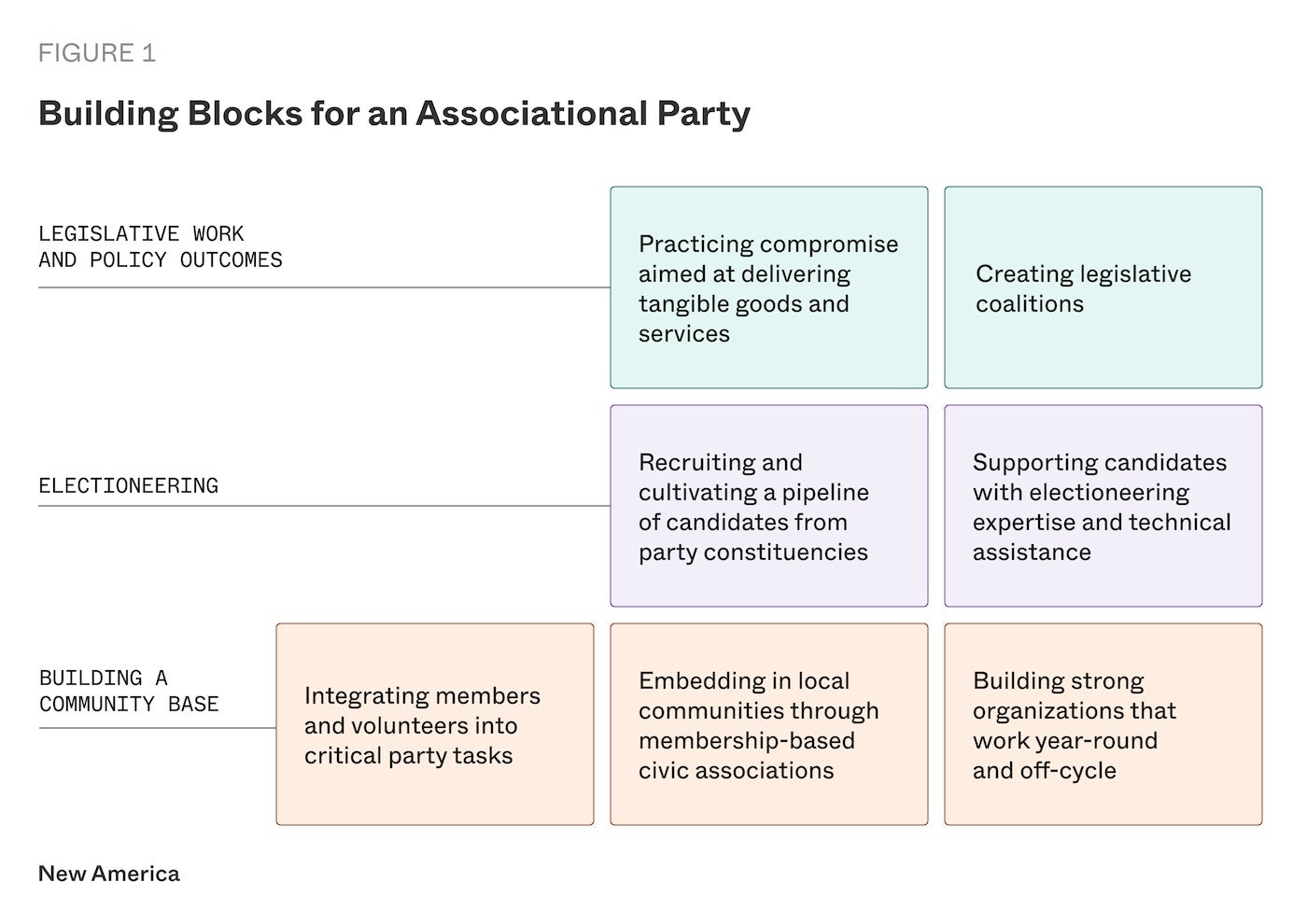
Ultimately, the key difference between an associational party and the parties we have today is the relationship that party leaders have with their constituents and ordinary folk.
Political parties are inevitably elite, but party elites in an associational party understand that the ability to win and govern depends on being attuned to the electorate and its needs. This shapes its every choice, from how it recruits candidates to the partnerships it creates to how it proceeds when in office. Each of these choices, along with the decision to embed in local civic associations and meaningfully engage the party faithful in institutional decision-making, supports a two-way street of communication between party elites and their constituents. They allow associational parties to strengthen their connection to local communities and individual voters and to enhance their capacity to serve their most basic intermediary functions: “link[ing] citizens to their government, socializing citizens into politics, and providing a consistent mechanism for citizens to have a voice in government.”4
Between 1998 and 2018, the WFP built an associational party—a political organization with deep ties to civil society and the electorate through a coalition of membership-based organizations and individuals. By doing so, it strengthened its capacity to function as an “intermediar[y]…linking citizens and civic groups” in New York “to their government.”1 This section explores key elements of that party-building effort and its associational elements.
The WFP’s first critical decision was to ground its new party in existing membership-based civic associations. The strategy of building a party on the backs of membership-based unions and community groups followed the original vision as laid out in a 1990 memo circulated by Cantor and Rogers in the wake of Mayor David Dinkins’ near-loss to Rudy Giuliani in the 1989 New York City mayoral race.2 The strategy fit Cantor’s decades-long experience as an organizer, first as a community organizer with ACORN, a dues-paying membership organization focused on the needs of low-income communities, and then as a labor organizer. Thus, when the WFP party association was formed, in 1998, it was comprised of four membership-based groups: District 1 of the Communications Workers of America (CWA), United Auto Workers (UAW) Region 9 (Western New York), ACORN, and Citizen Action of New York. These founding members were soon joined by others: construction workers in the Laborers’ Union, building service and security guards in SEIU Local 32BJ, hospital and home care workers in SEIU Local 1199, and low- and moderate-income tenants and homeowners in community groups such as Make the Road New York and Community Voices Heard.
Building the party rooted in membership-based organizations had both organizational and electoral advantages. First, it ensured those who entered the party leadership came with both political skill and knowledge.3 ACORN and Citizen Action, the two founding grassroots membership groups, brought significant expertise in canvassing that they shared with their labor partners. ACORN, for example, taught the party that it was possible to canvass for membership dues in low-income neighborhoods: “Most of labor and the white members knew about canvassing in rich neighborhoods…And we’re like, ‘No,…you can actually canvass in the projects.’ You can actually canvass in low-income neighborhoods from poor people, because that’s how we got our membership. We taught labor how to door-knock. Can you believe it?”4 In upstate districts, the WFP often arranged “door-knocking with somebody from Citizen Action and somebody from UAW as a team.”5
The decision to found a political party anchored by membership organizations also had electoral advantages. To establish itself as a party under New York law, the WFP needed to secure 50,000 votes on its line in the 1998 statewide gubernatorial election.6 Political associations in New York that failed to meet this metric were not recognized as political parties by the law and were not guaranteed a ballot line.7 As a party grounded in membership organizations, the WFP began with connections to the actual voters and local communities it sought to organize and represent. Unions brought not only their membership lists,8 but also a loyal base who were accustomed to being canvassed about issues and would vote reliably on election days.
Institutional members thus played an important role when it came to getting out the vote, and the party tapped into those networks for volunteers (and subsequently for leaders and candidates).9 Cantor explains, the CWA “did the same mailer every election. They’d have a picture of the union logo, the union logo, a picture of the candidate that was being nominated and the party logo and the literature always said, ‘Our Union, Our Party, Our Candidate,’ something like that. And we just swapped in a different picture each time: ‘Our Union, Our Party, ____’ because unions are very popular with their own membership.”
The choice of groups, and the effort to include both public and private unions, was critical to organizing at a politically relevant scale in a large and diverse state. Party leaders understood that building a coalition capable of resisting the Clinton Democrats—their embrace of neoliberalist economic policy and their efforts to limit the social safety programs—would require casting a broad net to draw in a cross section of working families across the state. WFP leaders, thus, consciously orchestrated a membership that, through its geographic spread, would provide the statewide presence it needed to enter New York politics. With the decline of manufacturing, as one founding member recalls, there were not a lot of private-sector unions in New York, “but crucially, the group that we did end up getting was Region 9 of the United Auto Workers, which was at that point based in Buffalo and represented what was left of the auto industry in upstate New York, which wasn’t much, but it was a little bit.”10
With the help of its civic partners, in 1998, the WFP became a political party in New York after 51,325 people voted for Peter Vallone, the gubernatorial candidate on its line—“a number that’s etched in [the] memory” of many of its founders. As newbies to the New York scene, the founders did not realize that the election night count is often an undercount and prematurely gave a concession speech, believing they had fallen just short of the 50,000 needed to qualify as a minor party.11
Still, right from the start, the WFP committed to recruiting not just a diverse membership but a hybrid membership. Cantor explains, “We were very clear from the very start that we needed…both institutional actors and free-floating individual actors.” The former “had bank accounts and relationships in Albany and lists of members…They already knew who to get through to in the speaker’s office”; “the free-floating activists,” on the other hand, brought “energy” and “are always on fire.”
Individuals who sought to join the WFP had to prove they were committed to organizing. Cantor expounds, “If you wanted to sit at the leadership table of Working Families, you had to represent someone other than yourself.” Chapters could be as small as 25 people (compared to a union with 40,000 members) “because we actually know how hard it is to organize a group of 25 actual people to be involved, come to meetings, screen candidates, and those sorts of things.” But individuals without a base could not sit at the leadership table of the Working Families Party.
Nearly three decades later, this commitment to a diverse and hybrid table remains and has filtered up to the national organization, which requires any political association that seeks to affiliate with it to commit through its bylaws to “create an internal democracy where no one sector, meaning labor or the community groups or grassroots activists, could run the table.”12
The Democratic and Republican parties do not need to secure their place on the ballot. Nevertheless, integrating with federated membership-based organizations (including churches; local chapters of the ACLU, NRA, the Sierra Club or the League of Women Voters; or mutual aid organizations and YMCAs) would strengthen them as associational parties by providing a direct tie to local communities and, through them, the actual voters the parties seek to organize and represent. Such integration might require some groups to reincorporate (though it also might not, as we will see), but it would have significant electoral advantages. Community organizations would provide organic connections to support voter mobilization, potentially reducing the need to hire a fresh cadre of organizers each cycle while reducing their dependence on commodifying and manipulating voters and the cynicism about parties it breeds.13 Likewise, reintegration with membership-based organizations could bolster the leadership skills of state and local parties.
The WFP’s capacity to build a strong associational party was supported by a panoply of organizational choices. The most important of which was the creation of a dues-paying organization, in the European tradition, within the network of party-affiliated legal structures, and placing the locus of decision-making in that body.14 Technically, dues were paid to the Advisory Council 501(c)(4), not the legal party.15 Established by the State Executive Committee, the Advisory Council operated as an intermediary between those participating in the nomination processes and the State Executive Committee. Many of the same people sat on both the State Committee and its Advisory Council.
Comprised of both institutional members and leaders of regional and local chapters, the Advisory Council embodied the party for members. While the State Committee and other party entities formally retained nominating authority under New York law, it was the dues to the Advisory Council that conferred the “right” to participate in a local chapter and its endorsement process. As such, interviewees emphasized that for its first 20 years, the WFP’s “members were the people and institutions who paid dues and participated in party processes.”16
Dues were not an important financial stream and were not established for revenue purposes, Cantor stressed.17 Instead, dues served two party-building functions. First, dues were designed to create a feeling of membership. As Cantor explained, “You want [dues] because it shows ownership, investment,…then you go get bigger money.” Dues, he continued, are thus different from today’s small online donations. Small donations are “not like membership, that’s just, you know, hair on fire, left-wing money”; when people pay “dues money,…people are saying, ‘No, this is for the organization, not for a candidate,…[but] just to sustain my organization.’”
Dues were also designed with careful attention to how power and conflict would be mediated within the party. The WFP required that all groups (institutional and individual) paid dues for a vote on the Advisory Council. As Bob Master, a key player in the party’s founding and, at the time, the legislative and political director for Communications Workers of America (CWA) District 1, put it, “We wanted [even local chapters] to pay something so that they would have skin in the game. Like, we don’t want it to be a free ride.” But in recognition of their different economic positions, dues were calibrated on an equitable, rather than per capita, basis. Thus, a large union was required to pay dues of approximately $42,500 per year while the grassroots community organizations were required to pay one-fourth of that. Individuals paid even less.
Voting rights were similarly allocated on an equitable basis. Despite owing more in dues, the number of votes that a large union with 25,000 members received was capped to enhance equity at the party table. Party rules also favored representation of local chapters and clubs with floors: “If you had 100 members, you had a few votes, even though a union, with 100 members, didn’t even qualify because there was a recognition that that organizing was much harder to do,” Bill Lipton, a co-founder of the WFP, explained. The decision to set a ceiling on representation was specifically designed to ensure against the future capture of the party by the state’s largest public-sector unions. Lipton continued, “We had the foresight to say, ‘Someday we’re going to be strong, and all these bigger unions are going to want to come in, and we are going to be prepared for that.’”18
These voting rules enhanced the party’s capacity to mediate internal divisions. By providing for rough equity in representation, the party forced its members to form internal alliances in order to sway the party toward their goals. The party’s voting rules thus offered one more mechanism by which to hold the party together through tough political decisions. As Cantor explained, “We didn’t want any group, just because they had a ton of money, to be able to dominate a board vote. So, we set the rules that basically you had to make some friends…It was an incentive to associational-ism…You’re going to get more power if you figure out how to work well with others…And that really held us together.”19
These organizational choices—the decision to require dues and the compromise-forcing voting rule, like the commitment to a diverse table previously discussed—proved critical to the party’s development as an associational party. Were a state chapter of one of the major parties to decide to engage in an associational rebuild, it would be prudent for them to review their internal bylaws to consider how to support investment in the party itself and to incentivize compromise within the party. Without such rules, a political party can become a magnet for activists seeking to vindicate their own political ideological missions, in which the only law is that of the Lord of the Flies, where the powerful (most often those with the deepest wallets) prevail.20
The WFP cultivated itself as an associational party with interpersonal depth by establishing regular and meaningful opportunities for its members, individual and institutional, to engage in face-to-face party politics. These processes facilitated an imperfect, but nevertheless important, two-way street of communication between party leaders and the members they sought to represent.21
One of the WFP’s first strategic decisions was to invest in developing neighborhood clubs and chapters consisting of dues-paying members: “the party faithful.”22 In the early years, the most important of these were the South Brooklyn chapter, Albany chapter, and Western New York chapter. Participants came from institutional affiliates but also arrived independently, bringing their own personal and political networks with them.23
Local chapters provided places for participants to gather and to join in the party’s work. As Cantor explains, “We had our own version of [the Democratic Party] clubs, and our clubs were much more vibrant than the Democratic Party clubs, and that was the basis for the party. We had people who would show up at press conferences; they would go to Albany on lobby days,…[and] the most important thing they would do is screen candidates.”
Local chapters, in their original form, proved expensive to support and difficult to scale. Even though they were entirely informal as a matter of law, the chapters were organized and supported by the party. Scaling them up thus proved expensive given the limited number of paid staff. Some in the leadership also worried about their propensity to be overtaken by individuals with their own private political agendas.
The WFP has thus experimented with different models at different times, eventually settling on the institution of regional councils. Operating at a larger scale, regional councils mitigate the individual take-over problem while maintaining the party’s commitment to “decentralize decision-making to bodies closer to what was happening in their respective geographies on both candidate prospects and issue fights” at a price it can afford.24
The WFP today remains committed to providing a place for the unorganized and institutionally unaffiliated, finding them through their friends and neighbors. Ana María Archila, co-director of the New York Working Families Party, emphasizes that this need is driven by the fact that “the majority of people don’t” have a union or a community organization. “So, there are lots of people who are searching for a place to engage in their politics.”
The WFP did not just cultivate membership; it also worked to integrate them into critical party tasks, from selecting candidates to electioneering to lobbying officials once elected. It demonstrated this commitment early with its very first decision: its name, Working Families Party.
The nascent party did hire professional pollsters to test names, but party leaders decided on the name only after canvassing their membership. A key point of contention was a concern that the proposed name might alienate members of the LGBTQ (then gay) community. At the same time, the name had distinct feminist appeal by suggesting that family was not just a women’s issue but that “We’re all in this together.” To resolve these tensions, the party decided to engage its members. As Bertha Lewis, founding co-chair of the New York WFP and former CEO of ACORN, recalls, “We door-knocked our members at ACORN. We talked to our members. You know, ‘What do you think about this? What do you think of when you think of Working Families?’” ACORN and the other membership-based civic groups pressed the labor unions to do the same, “to actually come and show that they had to engage their rank-and-file members.” After these rounds of consultations, party leaders decided that everyone was part of some family and that most people worked: “You know, if you’re not working, you want to be working. If you are working, you want to work better…And everybody came out of some kind of family. It doesn’t have to be what the traditional family is. You know, if you’re living, you got a mother, somebody birthed your ass,” said Lewis. The process, though arduous, both set the course and proved a solidarity-forming, identity-forming fight—one that would create deep personal bonds within the early leadership. These bonds proved critical during conflicts over policy down the line, according to several interviewees.
After it secured its status as a ballot-qualified political party, the WFP established a range of internal processes that allowed its members to tangibly engage in party politics. For example, it regularly involved its members in lobbying through so-called 500-Person Lobby Days. Cantor explained, “It’s a lot of work to get 500 people on buses to Albany.” Grassroots lobbying required “train[ing] your people so that they were comfortable” and providing them with answers they could use when elected officials responded, “Yeah that’s true, but…were you forgetting about this?” Despite the effort involved, these initiatives were effective for the party because they facilitated face-to-face conversations between elected officials and people from their district. Lobbying days were also meaningful for the party faithful, who would “feel some oomph; they feel some power; they’re in the room,” said Cantor. These efforts were effective for the party.
The central mechanism, however, by which the WFP integrated its members into the party’s work was through the candidate selection process. As Cantor explains, “Hundreds of candidates run under the WFP label each year, and that means there are a LOT of screening interviews. You gotta have local leaders and members for that to happen.”
Candidate selection became the centerpiece of the WFP’s associational party-building. It created the WFP’s party faithful—ordinary people who opted to invest in party politics—and offered them a regular “voice in shaping the party’s decision-making.”25 More importantly, from an associational party-building perspective, it provided an in-person experience of party membership. As Scharff notes, it gave “ordinary folk…a chance to sit in a room with candidates, some of whom were already elected officials” and share their concerns about their block or with their officials’ choices.
Candidates seeking the WFP’s ballot line are required to meet with representatives of the party in their district as a critical part of the screening process. Candidates begin by filling out a questionnaire designed with input from the party’s members. The form itself provides a meaningful opportunity to participate in the party. As one professional associated with Make the Road New York, a largely Spanish-speaking dues-paying membership organization and institutional party member, explains, “Input into the Working Families Party questionnaire…is an important thing for us because, you know, having a political party comes with a certain stamp of legitimacy and power that candidates sometimes feel [an obligation] to respond to that they may not [have for] an individual organization.”26 Following the questionnaire, each candidate appears for an interview. According to Cantor, party staff would hold “pre-meetings” and ask the group, “What are the three most important questions we’re going to ask?” The interviews themselves were then conducted by individual dues-paying members, including those associated with affiliates.
Cantor’s description of such interviews highlights their significance as a face-to-face experience of party association: “So, imagine a room with, you know, 50 people in it and, all day on a Saturday, candidate after candidate comes in basically begging for our support. This made people feel good. These were not big-shot people. These were regular people who gave up a Saturday.” Cantor also emphasizes how unusual the experience was from the candidates’ perspective:
“The great moment of every single one of these literally thousands of interviews that we did over a 20-year period…was the around-the-room introduction…These elected officials are all pros. They’ve gone to talk to a zillion kinds of groups and unions and so on. But this was everybody. So, you’d watch them see 20 people introduce themselves going around the room, ‘Oh, I’m from this union,’ or ‘I’m from this neighborhood,’ or ‘I’m from—I work at the library.’ And you could see them like, ‘Oh this is unusual. Like, I don’t get to just say one thing. I don’t just get to say to the union, ‘I’m with you in your struggle against such and such,’ because, well, what about the, you know, people over here that are worried about affordable housing and the ones over here?”
Scharff also describes the small-d democratic significance of these interview sessions: “We would have these weekends where people would basically spend the entire weekend on our committees doing interviews nonstop of candidates for all different levels of office, and it’s an incredible learning experience for the members. And it’s a chance where they actually are face-to-face with someone who’s in office often and then, if not in office, someone who’s going to possibly be in office and they get to say their thing and say, ‘What are you going to do about it?’ And [candidates] have to answer.”
Like Cantor, Scharff notes that candidates were sometimes disconcerted, describing how in “calls afterwards…especially the incumbents being like, ‘What the hell was that? Why are people going after me? I’ve done, you know, nine out of 10 things you’ve ever asked.’” She would have to gently remind them, “This is what the process is. This is our chance to get you to move on some issues you haven’t moved on and to let you know when we’re unhappy.”
The nomination process, though participatory, did not mean that the party leadership had ceded nominations to local chapters. A local unit’s candidate selections would filter up the party chain, subject to final approval by the State Executive Committee. Party rules, in accordance with New York law, conferred on the State Committee exclusive and final authority to nominate candidates for all statewide races.27 The State Committee, therefore, could legally ignore a local party group’s preference. A strong, if informal, presumption, however, was that nominations would follow the chapter’s choice. Master, who served on its State Committee, emphasized that “we were pretty judicious—like, we really, really needed a reason…to overturn the chapter. We would always meet with the chapter and explain to them. We would never do it in a ham-handed way.”
Nevertheless, the WFP’s nomination process offered the party faithful an opportunity to exercise real, if imperfect, influence over the party’s candidate choices and, indirectly, its platform and impact. They would deliberate and make recommendations. Sometimes this produced “some very big fights, because people would have their favorites, and somebody wins, and somebody loses.” But such processes, even when there were conflicts, reinforced the party as a strong-tie political network and provided a regular forum through which the perspectives of those voting on the party line could filter up to party decision makers. As Archila explains, including individuals is the way the party “guarantees that the Working Families Party is actually in direct relationship [to] and service of poor and working-class people.”28
As a minor fusion party, the WFP was uniquely positioned to offer its members a substantive role in the nomination process. The two major parties, by contrast, are required to nominate by direct primary election in most states. Nevertheless, it would not be impossible for a major party committed to associational party-building to create hybrid-nomination processes that included similar opportunities for meaningful face-to-face experiences of party life. They could, for example, formalize the well-established invisible primary that determines who appears on the primary ballot, transferring the gatekeeping function from moneyed interests to the local party (perhaps reconstituted as an associational party club). Similarly, the two major parties could embrace grassroots organizing, seeing it as an opportunity to shore up engagement with their members while also exerting control on straying officials, rather than leaving such efforts to outside groups or limiting their efforts to organizing opposition to the other party’s policies at town halls.
The WFP invested in building a year-round party organization that was not only active during elections. It invested in its membership and chapters but also in the party as an organization, hiring and nurturing staff through the off-cycles. The magnitude of this investment was on display in 2014, when it maintained 40 full-time staff in New York in addition to a cadre of canvassers who worked both on- and off-cycle. By way of comparison, at the time, the Democratic Party’s permanent, non-canvassing staff was significantly smaller in most states.29 During peak campaign season, the WFP managed about 500 canvassers. Canvassers were paid and given health insurance. When it transitioned from a local affiliate structure to its current regional structure, the party “hired regional directors to manage regional councils to get the politics right, then to hire organizers to build deeper on the ground.”30
This investment in a year-round organization—investments that continue today—ensured a stable staff with critical knowledge and expertise. More importantly, from an associational party-building perspective, WFP leadership combined this investment with an active effort to cultivate a pipeline of party staff and leaders for the future. Even canvassers were mentored and trained, frequently graduating to positions of responsibility within the party organization writ large. Their success, as interviewees readily admitted, fluctuated, and the party has at times had to hire new staff from outside the organization both in New York and nationally, including Mitchell who replaced Cantor. Nevertheless, as Lipton, emphasizes, “[Having] that financial ability to be able to support staff over time, that’s a lot of value, right? Because I know everybody. I know the history. I know the stories. I know how to get things done. I have political capital with lots and lots of people.”
A stable party apparatus makes the WFP a formidable political foe. Even as a minor party, the WFP is able to offer candidates and elected officials the valuable political expertise its staff has developed by running one campaign after another in the same communities.31 Indeed, when asked why candidates wanted the WFP’s endorsement, most interviewees cited the value of this expertise far more than any direct or indirect campaign donations associated with the affiliation. Master’s view is typical: “I think electoral expertise is a really, really key deliverable from the Working Families Party.”
Investment in party staff and year-round organization at the state and local level is just as important for the two major parties. As Didi Kuo and I have argued, investment in party infrastructure at the local level—including in physical gathering spaces—is a vital piece of building political power.32 Running a robust political party requires staff.33 A year-round organization is necessary to support the candidate selection process, electoral campaigns, and grassroots lobbying, not to mention to advise elected officials. The two major parties know this.
Since Howard Dean’s 2004 presidential campaign and subsequent chairmanship of the Democratic National Committee, each party has periodically made the decision to devote resources to staffing the party and creating a local presence.34 The problem has been the intermittent, arguably shortsighted, nature of their commitments. Too frequently, money dries up between presidential elections, and the parties default to leaving these functions to candidates and the satellite organizations in the party network. When political expertise lies with the staff of individual candidates, it may benefit the political party. But as with large individual donors, the benefit is largely indirect; individuals may follow their bosses through the party structure or take their expertise to another candidate’s campaign, but their loyalty is generally to the person rather than to the party. Similarly, even when outside groups are genuinely embedded in their communities, they cannot provide the stability of party-centered expertise and political capital. When these are simply consultants, there is no return to either the party or its network.
A more sustained associational party-building project for the major parties realistically will require a reorientation to state and local politics as a place to achieve political and ideological goals. It will require political reasons to care about state and local elections and thus state and local parties. It is arguably no accident that the WFP’s growth as a party association and as a party organization was tied to its decision to use its electoral leverage to secure concrete policies from New York’s legislative bodies. Its choice, as we will see below, also offers a window into why such a reorientation could well satisfy the desire for responsiveness Americans currently crave.
Ballot access underwrote the WFP’s capacity to build and sustain its organization and further its associational interests. The availability of a fusion ballot line in New York was critical. Fusion frees voters in a first-past-the-post electoral system to abandon their reluctance to vote on a minor party line and associate with the party, permitting them to express their ideological affinity constructively. Fusion thus enabled the WFP, as a minor party, to manifest its associational strength. As Lewis commented without prompting, “Fusion was the basics and what drove the Working Families Party, because it wasn’t just a third party that could be a spoiler, or just a fringe number of people could participate in and identify with.” Fusion meant the WFP’s electoral appeal and strength were apparent, and the party was able to leverage that strength to build the party.
The ballot line also mitigated the several organizational challenges associated with party building. Political movements, especially new ones, face two critical organizational challenges. Facing outward, the association’s challenge is to scale its appeal so that it can be effective (operating statewide at first and nationally over time); facing inward, its challenge is to both generate political energy on the ground and maintain the growing coalition.35 The ballot line mitigates the internal conflicts that come with building a broad coalition, as we will explore later in this report. For now, however, we will focus on the way it helped the party scale and build political power.
Building power statewide, like building power nationwide, depends on cultivating a diverse coalition—socioeconomically, racially, but also geographically. As several interviewees noted, a party cannot deliver legislatively without winning in enough places to matter. One-off successes do not help build power in the legislature. Thus, not only a stable ballot line but also a stable coalition is essential to ensuring that wins are sustained.
A state ballot line provides an instant structure through which to scale up. It ensured the WFP operated across the state right from the start. It meant the party had the capacity (a ballot line) to run candidates (and therefore organize) in upstate New York as well as on Long Island and in New York City. This created instant scale.
The ballot line, unexpectedly, also shifted power dynamics with elected officials. As Lewis explains, the ballot line is “real estate for politicians,” who “need as much real estate on the ballot as they can get.” Two lines are better than one. Certainly, some lobbied for the endorsement simply so that their opponents would not have that second line.
Thus, elected officials across the state almost instantly began approaching the WFP, wanting its nomination and ballot line. Master recalls, “One thing we did not anticipate is [that] if you have a line on the ballot, you have become a significant political player in the state [overnight].” He continued, “I think we endorsed 600 candidates in 1999, one year after we’d gotten on the ballot, in an off year. Like the coroner from Saint Lawrence County wanted us to win. I mean, I’m not making that up. I mean, I don’t remember exactly what the county was, but like…every politician’s like, ‘Well, if I don’t get the line, somebody else might get the line, you know?’ And it made us instantly relevant to the political class.”
Thus, “instead of a power dynamic in which you go to the politician and try to extract the best thing you can, the power dynamic is, ‘I have something you want [our nomination], and I want stuff, too,’” explained another interviewee.36 It turned out that “[in] the general elections, people really wanted that extra 2, 3, 4 percent. It was really, really important, and they would fight for it…We had power because we had the line and our ability to deliver votes on the line…a lot of the big [candidates], like Chuck Schumer, they wanted our line,” Lipton also explains. Candidates eventually came to understand that the WFP’s support also provided sophisticated help in winning office and high-quality advice about how to exercise power once there.
The ballot line also fueled political energy on the ground. Within a few election cycles, not just voters but all manner of players in New York’s center-left political establishment wanted to join the WFP. By the early 2000s, numerous unions sought membership, including a couple that the party turned down, along with their money.37 As Master recalls, “Controlling the disposition of the ballot line becomes something that people want to be part of right away, right?”
Another surprise for the new party was the degree to which the ballot line enhanced the political capital of its constituencies. As the party gained power, candidates approached the affiliated unions in the hopes of securing “some allies at the broader screening and vetting process that the party convened,” Cantor explains. Before its involvement with the WFP, for example, the CWA was politically second tier. As a midsize union in New York, it had some 50,000 members, which, while sizable, was dwarfed by the hundreds of thousands of members in each of the health care or teachers unions. “But [the CWA’s] involvement in the party made them first tier, absolutely powerful, because they had much more reach than they had just on their own.”
The party’s grassroots membership groups experienced an even more pronounced rise in their political capital. Scharff recalls that prior to its involvement with the WFP, Citizen Action of New York had its own political department and engaged in many of the same organizing activities as the future WFP: “We did okay on electing city council and county legislative people, but we weren’t that great at electing state legislators.” The group also struggled to exercise political influence over the candidates it endorsed: “If we endorsed someone and they won, we were not that important to them. So, it didn’t give us a lot of leverage over actually winning issues in the end…We were not seen as ‘serious players’ in Albany. That was reserved for the major party insiders, the lobbyists of the big real estate interests, large unions, and other groups or individuals who make or bundle substantial contributions to candidates’ campaign accounts.”38 “It was very different from having a political party—it was less sustainable from election to election, it was less understood by voters we door-knocked or called…and our work was not that important to most candidates.”39 Scharff recalls being told by legislators that involvement with WFP “increased the visibility and power of Citizen Action in the state legislature as an organization, on our issues.”
The same was true for ACORN, another community organizing institutional member of the party. Despite being “powerful in central Brooklyn,” Cantor said ACORN’s power in Albany was limited: “You can’t get shit done in Albany just because you have a bunch of poor Black people in central Brooklyn. You need allies in Syracuse, Rochester, Albany, the Southern Tier, Long Island.” Indeed, Scharff recalls, the decision to found the WFP was driven in large part by a desire to change that.40 And it worked.
Candidates came to understand affiliate endorsements as a step toward a WFP nomination. Partly this was the result of the party’s own commitment to internal democracy. Cantor remembers telling candidates that approached the party, “Here is the list of the organizations that sit at the WFP table. You want to get our endorsement, you need to go around and get their endorsements…You know, you need to show up at our screening with some friends.” Lipton reflected the ballot line was ultimately critical because it allowed the WFP to “institutionalize some power over time” and enabled the party to be more than “a flash” or “a short-lived thing.” Cantor recalls an emblematic moment:
“After about six years from the party’s beginning in ’98, in 2004, I got a phone call from a guy named Mike Fishman, very important leader of the Building Services Janitors Union. He says, ‘Dan, can you do me a favor?’ And I’m like, ‘Can I do you a favor? What could you possibly want that I could do?’ And he had something that he needed. I was like, ‘Oh my God, we’ve arrived.’ I had been asking this guy for favors for six years. And then he realized, ‘This guy has built something where I can get him to do something.’”
Indeed, a mere 10 years after its first entry into New York politics, at a time when the party’s electoral muscle was particularly strong, elected Democrats and Republicans officials took meetings even when there was no chance the party would nominate them. They scheduled the meetings in the hopes of persuading the WFP leadership to, at least, refrain from running someone against them. The key to such engagement was the nature of the WFP’s appeal: its “ability to deliver votes on the line.”41
The WFP does not typically run its own “stand-alone” candidates—that is, candidates that run exclusively on the WFP ballot line—in New York.1 WFP leaders, moreover, openly acknowledge their efforts to influence the Democratic primary and acknowledge that it is a significant source of their political power in the state. As one state director frankly admitted, the WFP’s power depends on a substantial number of voters sympathetic with its mission to remain Democrats to influence the candidates that emerge from the Democratic primary: “We wanted enough registrants to protect us from being taken over by folks registering in our party or using notaries to collect signatures and run candidates that we didn’t want. But we wanted to engage in the Democratic primary, which was hugely important for us. We wanted to keep a lot of our activists registered in the Democratic primary to push the candidates [the WFP] had endorsed.”2 This director continues, “[It was] kind of a two-headed beast…We had power because we had the line and our ability to deliver votes on the line. But we had even more power, because within that structure we had built a machine that won primaries.”
The WFP also does not energetically seek to register voters.3 That choice reflects both a commitment to a robust conception of party membership and strategic accommodation to several political realities. The first was that in the early years, especially in New York City, sympathetic voters, like some family members and personal friends of party organizers, were reluctant to register as WFP, recognizing that the Democratic primary was “the true election.”4 Second, under New York’s ballot access rules, a larger registration base makes it significantly more resource-intensive to place a candidate on the ballot.5
At first glance, such facts appear to support the objection that the WFP is not really a party but rather an ideologically extreme faction within the Democratic Party—or, alternatively, and perhaps worse, the view that the WFP is a nefarious party that engages in persistent party raiding. Both characterizations are flawed.6 For one, while the WFP is more likely to cross-nominate Democrats, it has, in fact, cross-nominated Republicans in critical elections.7 More importantly, the WFP does not understand itself either as a faction of the Democratic Party or as engaged in party raiding.8
From the party’s perspective, the point is to operate where it matters: For a party that values “real power,” exercising power depends on “mak[ing] people fear their incumbency status in the next election.”9 When the two-party system is uncompetitive, the relevant “next election” is the party primary. Engaging in the Democratic primary is thus simply exploiting a political opportunity “to actually move things.”10 The decision to exercise its electoral muscle in the general election or in the primary is a product of its pragmatic politics. As one interviewee explains:
“In states like New York and Connecticut where we have fusion voting…we have three tools in our toolbox. One is that we can run our own candidates. We rarely do that. We do sometimes. We’ve won some seats, but it’s really kind of like the exception, not the rule…Two is we cross-endorse in close elections that are contests between the Democrats and Republicans. And sometimes that means we’re what we call the margin of victory. And we’re able to help get the more-aligned-with-us Democrat over the finish line…And then the third is like a bank shot on fusion, which is we support Democrats in their primaries because we want to be able to cross-endorse them in the general without spoiling.”11
The party understands that in addition to demonstrating support on the ballot line, it can exercise power by ensuring that the candidates it wants in office come out of the Democratic primary—a strategy that requires that the people aligned with its program remain Democrats.
Indeed, the WFP’s primary involvement could easily be characterized as a strategy to ensure the Democratic Party fuses with its candidates. Unlike the WFP’s nomination process—which, as we have seen, is controlled by its dues-paying members through the screening interviews, subject to the discipline of the State Executive Committee and the Advisory Council and party staff—the Democratic Party relies on a direct primary to select its nominees. This essentially forces the WFP to engage Democratic voters directly to secure a cross-endorsement. Indeed, at times, when the WFP has been unable to persuade the Democratic Party to vote for its candidate during the primary, it has either left its ballot line open or run an independent candidate.12 The key point is that the WFP cannot negotiate an alliance with Democratic Party leaders because, as a legal matter, they are sidelined in the nomination process.
Reflecting this understanding, with respect to Connecticut, one interviewee explains, “We were spending money to give our candidate the best shot at winning the final election, and the best shot of them winning the final elections included them becoming the Democratic nominee and winning the Democratic primary.”13 For WFP candidates (for example, Cynthia Nixon or Jumaane Williams) to have a chance of winning the general election, the party had to persuade Democrats to nominate Nixon over Andrew Cuomo, the incumbent governor, and Jumaane Williams over Kathy Hochul, the incumbent lieutenant governor, in the Democratic primary.14
Any claim that the WFP is a faction of the Democratic Party also ignores the overwhelming evidence laid out in the next two sections that, despite its status as a minor fusion party, the WFP, through its investment in its organization, has built a strong associational party that systematically exercises key party functions, including recruiting candidates, mediating intraparty conflict, and delivering both electoral wins and policy returns for its supporters through its own party formation. The WFP experience thus demonstrates that running independent candidates is not a necessary condition for being a minor party or exercising power. Running independent candidates is not necessary for securing a seat at the legislative table, passing policies, or facilitating constituent services, and it is not necessary for building associational ties, a broad partisan network, or a party organization.
The WFP not only shows that it is possible to build an associational party by investing in an organization but also offers a picture of what it means to work as a party. This section explores how the WFP systematically delivers a variety of essential party functions identified in the literature and how its capacity to perform them is enhanced by its associational qualities. The WFP supports its candidates with electioneering expertise and technical assistance and provides its members with informal access to elected officials, all while facilitating a delicate two-way street of communication among its leaders, candidates, members, and voters. Indeed, the WFP offers a contemporary illustration of a strong associational party.
Despite its strategy of only rarely running stand-alone candidates, the WFP sees candidate recruitment as a central task—a task it has undertaken in both formal and informal ways. Brad Lander, who “identifie[s] as a Working Families-Democrat,” won several races for the New York City Council before winning citywide for comptroller.1 His entry into politics serves as an example of how the WFP, as an associational party embedded in the local community and committed to a face-to-face form of politics, is able to inspire and support candidates who might not otherwise run.2
Lander has publicly stated, “I never would have been interested in running but for the party.”3 As director of the Fifth Avenue Committee, Lander was not infrequently asked whether he was interested in running for office. He remembers responding, “Oh, gross. Like electoral politics is not a space that I would think of as being a place I would want to be.” But that attitude changed. Lander explained in an interview with the author that his decision to run for office emerged from his work with the WFP: “It was through working with WFP that it became—that electoral politics became—more compelling to me.”
The WFP provided key technical support as Lander entered the race. At the time, Lander said, “I was both embedded in its coalitional structure through my organizational housing and progressive planning work and…as a member of South Brooklyn WFP.” He recalls turning to his associates at the WFP and saying, “You know, I’m only doing this if you guys are with me.” WFP leadership responded with critical, concrete advice about becoming a viable candidate, including “the [funding] targets you have to hit and all the people you have to talk to.” Lander recalls a key moment: “I remember Bill [Lipton], like, they sent me an original target of, like, you have to raise $35,000 by the next filing deadline. And I remember then Bill called one day and said, ‘Brad, I’m sorry to do this to you. But I see that Josh Scaller is out there, and I bet he’s going to do that. You have to up your number and raise more than 50[,000].’ And I was like, ‘Bill, I can’t do it. I’m already killing myself at 35[,000].’ And he’s like, ‘No, you have to go do it.’”
Lander raised $51,000, only to learn “Josh Scaller filed with $35[,000]. And, like, had I filed with $35[,000], I would not have been the front-runner.” Once nominated, WFP staff also trained Lander “on door-knocking.” Lander’s experience, while not typical, was also not “unique.” Indeed, Micah Sifry’s account of the WFP in its early years suggests that, for at least some party members, cultivating politicians who identified as WFP members was a central ambition.4
The WFP also invested in formal candidate recruitment processes.5 In 2007, in collaboration with its institutional members SEIU Local 32BJ, Make the Road New York, the Hotel Trades Council, and New York Communities for Change, the WFP funded the Pipeline Project.6 In a 2014 interview, Lipton, the party’s deputy director at the time, explained that the project aimed to identify, train, and run candidates for local offices across the state, focusing on town councils and school boards. The aim was to identify about 1,000 prospective candidates in off-cycle years in order to select about 75 to run; the party hoped this would ultimately mean six to eight candidates would be elected to the state legislature during each election cycle.7 Candidates were intensively vetted and advised about the fundraising targets necessary to demonstrate electoral viability.8 While successful in New York City, the effort did not ultimately produce the anticipated pipeline of statewide candidates and was abandoned.
The WFP’s “homegrown” candidates maintain closer ties to the party. Cultivating and selecting candidates results in a different level of party commitment. As Jasmine Gripper, the current co-director of the New York Working Families Party, explains, “When people come from the party or from our affiliates or our friends, the relationship they have with the party and to progressive issues, they tend to be stronger, especially in those moments of challenge.”9 The homegrown relationship to the party can emerge not just through recruitment but also when the WFP plays an essential role in getting someone reelected during a hard race.10 The WFP does not formally recognize its special relationship with a candidate—such as by providing them with the equivalent of an automatic invitation to its party convention or some other equivalent to a “superdelegate” vote—but these are the candidates to whom the party turns every two years when it needs to meet its threshold level of support to maintain its ballot line.11
As an associational party committed to representing a multiracial coalition of working- and middle-class voters, the WFP has understood the importance of cultivating, training, and supporting a pipeline of candidates from its political networks through both formal and informal strategies. Even as it has eschewed running stand-alone candidates in New York for fear of spoiling, the WFP contributed to reshaping the pool of candidates and elected officials in New York.12
A major political party committed to an associational rebuild could easily replicate this process. Indeed, in 2018 and since, the Democratic Party has invested in candidates with ordinary middle-class backgrounds—nurses, teachers, and waitresses—and military veterans.13 Today, many of these officials hold important positions within the national party and as state governors.14
The WFP’s investment in candidates does not end on Election Day. The party supports newly elected officials with staffing, institutional knowledge, and coordination with other WFP-aligned officeholders—importantly extending its support to the legislative work of those it has brought into office. The WFP thus facilitates homegrown officeholders’ access to legislative powerbrokers but also imposes discipline on its elected officials. Once in office, WFP candidates are expected to prioritize the party’s agenda.
In New York City, WFP’s legislative support has facilitated the formation of a dues-paying Progressive Caucus and the development of shared policy priorities. With its guidance, members of the Progressive Caucus in 2009 (the year Lander and several other WFP-recruited or nominated candidates were elected to the New York City Council) settled, for example, on three legislative priorities, which it has since more or less achieved.15 In Albany, there is no formal structure for the party’s legislative support. Nevertheless, the presence of a cohort of elected officials with strong ties to the WFP and the party’s legislative support communicates to state and local powerbrokers that the party (and its progressive agenda) is a stable force in New York politics. Democrats and Republicans have come to recognize these are not just one-off individual officeholders with rogue progressive dreams, elected based on their charisma. As a former New York WFP director puts it, “It’s not just a one-to-one matchup”; these officials are a coalition, a party, that “also will govern together in some kind of way.”16 And the WFP makes sure it does, even when it involves reminding officials what they agreed to when they accepted the party’s nomination.17
More unusually in contemporary American politics, the WFP also provides its members—the party faithful—with enhanced access to the legislature. WFP membership facilitated constituent services. Elected officials would pick up the phone when community leaders called, providing the level of access that donors currently expect. But party membership also provided more significant access.
Through their affiliation with an associational party with rich social networks, members and local chapters had access to elected officials in ways that are typically only afforded to wealthy donors.
Through their affiliation with an associational party with rich social networks, members and local chapters had access to elected officials in ways that are typically only afforded to wealthy donors.18 Lewis explains that ACORN and Citizen Action, for example, quickly learned that they could “enlist…labor brothers and sisters as allies to help you, you know, to get, you know, to so-and-so or to make an introduction or to the elected official.” The unions’ members, given their long-standing ties to Albany, provided the grease in the political wheels for grassroots membership associations and their individual members.19
One interviewee, a local party leader, described how this played out for the South Brooklyn chapter. Concerned about fracking, the South Brooklyn chapter, under a proactive leader, decided between election cycles to initiate a campaign to ban fracking. The group set about “to make appointments with any assembly member or senator who would meet with us.”20 “I would call up and say, ‘Well, we want to talk about issues that WFP is going to be doing this year in the legislature.’” Much to the chapter’s surprise, the officials agreed: “They were all shocked that there was any group that wanted to meet with them about these statewide issues because they only got lobbied by people with a financial interest or with a local interest.” Once in the room, the group was able to convince its state representatives that fracking was not simply “an upstate issue,” reminding the Brooklyn contingent that they constituted 20 percent of the Democratic caucus in the state legislature. The interviewee admits, “I can’t believe that this actually worked…the 20 Brooklyn assembly members, broadly enough, took up the cause of fracking” because “it didn’t cost anybody anything…They [got] a ban that year.”
A broad and diverse party coalition comes with challenges. Those challenges are exacerbated when the axes of divisions fall along the usual American fractures: class, race, and language. Political parties, especially new ones, must diversify their coalition to achieve support at a scale capable of exercising political power, but this in turn creates the challenge of how the party can maintain the coalition over time. Even within a left-leaning party with strong ideological coherence, bringing together working-class voters (unionized and unorganized) and wealthier liberals created challenges. Add to that race and the intraparty dynamics became even thornier. As Lewis acknowledges, “There was always tension between the groups that made up the WFP.”21
The challenges of holding together a racially and socioeconomically diverse coalition were immediately manifest when it came to organizing. At the organizing level, the party quickly learned that ACORN’s model of grassroots organizing did not transfer well to party organizing. Party organizing depends on building bridges “against the grain,” connecting communities that feel distant from one another and may even see themselves as divided from one another.22 The ACORN model, by contrast, was predicated on organizing in “a community of like people with shared things in common,” often at “the landlord level,” as one party staffer explained.23 The ACORN model was not designed to “bring in people with different racial backgrounds, class backgrounds, and everything, and just, like, you know, make it happen”; “[When] you have a shared landlord, [there’s a] good chance you got a shared ethnic background, too.” A county like Westchester, however, is a totally different ballgame. It is significantly more racially diverse than one might assume. The party adjusted. Its vote share has grown significantly since the early years even as it has maintained and expanded the diversity of its coalition.
Tensions associated with the diversity of the coalition could also emerge during the candidate selection processes. Scharff acknowledges that while the selection process was “a very empowering process for the members who don’t have that access normally,” it was also run by party members, who did not necessarily expect the “very diverse room” in which it would often happen. She recalls, “Sometimes it’s like you have a union member in with a bunch of lefty activists and with a bunch of Citizen Action, you know, older Black members…and [it’s] not easy sometimes to sort that all out, because it creates different opinions about candidates and also different opinions about what’s appropriate to ask and so on.”
When Make the Road New York, a largely Spanish-speaking dues-paying membership organization that works for and with immigrants, joined the party, a new axis of diversity—language diversity—was added to the mix. Local chapters, at the time, took for granted that their nomination meetings would be conducted in English. WFP staff and leadership strategized about how to integrate non-English-speaking members into the process, Scharff said. Like most organizations, “the party has had periods of being really good about figuring out how to create the right setting for those things to work well and periods of being really bad at it, where there have been endorsement interviews that have exploded in charges of racism and people walking out of the room, and, like, bad things have happened because it’s not managed.” Despite these moments, the WFP has not just maintained but expanded its geographically, racially, and socioeconomically diverse coalition.
The WFP’s capacity to mediate the different priorities, preferences, interests, and needs of its multiracial coalition was a product of party culture reinforced by the political power derived from the ballot line. From the start, party leadership viewed the internal axes of division as a source of political strength and worked hard to create a culture where differences did not lead to exit. Master emphasizes, “We tried to create a culture in which people understood they weren’t going to win every debate over who to endorse or not.” The result was that people were willing to tolerate their differences, even lose some battles, knowing that down the line they would get their turn. Mitchell, the current director of the national party, goes further, insisting that intraparty conflict, if properly organized and mediated by party staff, can be “generative” in ways that furthers the party’s ongoing core commitments. So long as “the activists,…the labor institutions, and [the] grassroots organizations…believe the table is strong and fair,” he says, the coalition will hold together. The WFP seeks to inculcate a belief “that the [party] vehicle, ultimately…is more important than the individual decision.”
The ballot line critically reinforced this culture by creating significant incentives for the coalition members to stay put as they built and rode the WFP’s train to power. As one staffer explained, “When you have a ballot line, it makes it more likely that people stick together and allows you to build durable power in the long term because you have something of value.”24 This shared motivation compensated for the escalation of conflict that came with an expanded coalition. Lipton shared that, “We sometimes would say the line provides the glue.”25 The strength of the glue—its capacity to keep the coalition together—was entwined with the political power the party holds.
The ballot line insulated the coalition from fracturing over any individual nomination or policy fight because members saw how it drove tangible political returns to party membership. As one staffer with firsthand experience navigating such moments explained, power was key to holding the coalition through tough fights, continuing, “if you have that power, you can achieve that power in a coalition without a ballot line,” but it is much harder to amass the necessary political power without the ballot line.26 Another explained, “The line…creates a level of permanence to the coalition. There is this thing that exists in the law. It exists because you have 50,000 voters.”27
While the scaling power of the ballot line is specific to a new party, the ballot line serves as glue for all parties. How else does one explain the unity of the Republican Party today? This organizational advantage is why Didi Kuo and I have argued that “outsourcing our political organizations to non-party groups is not a solution…Grassroots and civic organizations struggle to perform the twin tasks of maintaining political energy on the ground and scaling up to be effective statewide or at the federal level.”28 They are generally less likely to be socioeconomically or racially integrated or to reflect the diversity of a jurisdiction. And they are also more fragile because coalitions are also not necessarily well-situated to mediate conflict when it arises, as it inevitably will. The ballot line, by contrast, is a source of power that draws people to it and keeps them there, as the WFP story shows. Without the ballot line, coalitions do not have external pressures holding them together.
Party glue can, of course, fail. In 2018, several of the party’s founding union members did leave the party. But, as Scharff astutely observes, “the biggest departures weren’t over internal fights. It was over Cuomo dividing us on purpose.”29 Even this conflict, however, reveals the power of the ballot. After he had successfully orchestrated the departure of several key unions and their money from the WFP, Governor Cuomo’s immediate next move was to attack the WFP’s ballot line. In 2020, Cuomo led a charge to change ballot access laws to make it significantly more cumbersome and expensive for minor parties to maintain their ballot lines.30 Minor parties in New York would now be required to demonstrate their electoral support biannually (rather than every four years) and to achieve a larger vote share to maintain ballot access.31 Although Cuomo’s aim was to further cripple the WFP, through its ballot line, it had institutionalized enough power by that point that it was able to withstand Cuomo’s assault. Indeed, some argue that Cuomo’s attack backfired by “galvaniz[ing] grassroots energy and participation to the point where, like, you know, if you look at the ballot line numbers in 2020, they were astronomical.”32 Indeed, what is clear is that while the party’s power, like its priorities, has changed, the WFP has stood firm. So firm that, as we have seen, the party was critical to Cuomo’s defeat in 2025, and the mayor who defeated him—a DSA-Democrat—voted on its line.
From the beginning, the WFP’s goal was to build political power and influence governance to secure tangible benefits for its constituents.1 Even today, state directors, including Gripper, still stress that “gain[ing] power to win tangible change for lives…[is] at the core of what party-building is about.”2 Delivering on the policy front is a challenge for a minor fusion party since it cannot control governance.3 For the WFP, votes on the party line became a visible measure of electoral impact and political support.4 Gripper continued, “The ballot line is our superpower…To be able to find and count our voters and our influence is a huge asset.”
The WFP leverages its electoral power into a legislative agenda that benefits its supporters, despite its status as a minor party.5 Democratic and Republican officials, to be sure, sometimes expressed skepticism when the party sought to do so. Speaking of Connecticut, one interviewee recalls: “Sometimes Democrats would say to us, ‘Well, all those people would vote for me anyway, so I don’t really care.’ And our response to that was, ‘There’s only one way to find out.’ And they would be like, ‘Turns out I do care. I don’t want to test my own theory.’”6
The vote count is the objective measure of the party’s political capital in the policymaking process. Thus, while merely voting on the WFP line does not make one a party member, the party is eager to secure votes on its line, and the WFP’s member organizations, especially the CWA in the early years, called on its members to vote on the WFP line. The turning point for this strategy came in the early 2000s, when the WFP was not just amassing votes on its line but provided the margin of victory in critical elections.7 With this development, its cadre of experienced staff began to flex its electoral muscle in the legislative arena.
The WFP’s first major legislative victory was securing an increase in the minimum wage, and it illustrates how the party set legislative priorities and the political pragmatism by which they secured them. In 1998, the year the WFP was founded, New York’s minimum wage was $5.15 (the federal floor). Master, representing a union-affiliate, recalls the decision to work on raising the minimum wage was not terribly controversial within the party. But Lewis remembers things differently: “The community members, their issue was a minimum wage because they needed to make a decent wage. They needed to make a living wage, you know, because they were not part of a union. Never would be.” The union members were skeptical. As Lewis puts it, their attitude was, “But wages—ack! Oh my God, [unions] don’t do that.” ACORN and the other community groups, once again, turned to their members to build their case. Lewis recalls: “So, you know, we began to hash it out and look at the issue that crossed over between community members and union members. And again, what we did on the community side was to identify union members that lived in the community, and that’s how we would hash out different issues.” Eventually, “our union brothers and sisters said, ‘Okay, minimum wage and living wage, because everybody that works is concerned about wages.’”
Cantor offers a slightly different take, one that emphasizes the political pragmatism that union members brought to the table: “For the first six years, the only issue we basically worked on hard was the minimum wage, which affected zero of the unions. Right? Every single unionized worker in New York did not get a raise from us raising the minimum wage. They all [were] making a lot more money than that.” Why then did the unions agree? Because they understood this as a wedge issue: “This was the tip of the spear for both showing that the party could accomplish something and also pushing back ideologically. Remember, this is 1998. The DLC is still in control. The Democratic Leadership Council, you know, who said that—if you remember all this—‘Democratic Party’s gone too far to the left. It’s too pro-union, it’s too pro-Black.’”
Once the WFP had settled on raising the minimum wage as its legislative priority, its leadership devised its political strategy. In 2004, it decided to run two vulnerable, pro-labor Republicans on its line. No one was enamored with these candidates, Cantor recalls, but the upper chamber of the New York legislature was Republican-controlled and had been for nearly six decades. The two candidates, including one who was chair of the Labor Committee, were running in extremely competitive districts and committed publicly during their interviews to the party’s top demand: a $2 increase in the minimum wage. The WFP line proved critical in an election that was ultimately decided by a court after numerous ballots were challenged. Cantor recalls, “The main guy who we endorsed got 2,000 votes on the Working Families Party line, and he won by 18 votes. So, we were clearly the margin of victory.”
Upon assuming office, the two WFP-Republican officials took the lead in pushing the still majority-Republican legislatures to act on the minimum wage. When the initiative was vetoed by the state’s Republican governor, George Pataki, the two again took the lead and secured a legislative override.8 In 2005, New York raised its minimum wage to $6; a year later, it went up to $6.75, and then gradually rose to $7.25 by 2010.9
The WFP’s strategic choice to nominate these two vulnerable Republicans did not come without its costs. For one, the new legislation, sponsored by Republican allies, came with compromises. It decoupled the minimum wage rates for restaurant staff from the new rates, reducing its scope—a compromise the WFP ultimately accepted.10 For another, the decision antagonized Democratic legislator Andrea Stewart-Cousins, whom the WFP had helped defeat. Cantor reflects, “She was right to be angry at us. But I felt like we were right, because a million people got a $2 an hour raise.” Stewart-Cousins soon returned to office and “ended up being very important,” but “it took 20 years” to repair that relationship.
The minimum wage fight was the party’s first major legislative success. It illustrates that the WFP was able to deliver tangible legislative goods to its supporters as an associational party, notwithstanding its status as a minor fusion party. It is also illustrative of the WFP’s broader commitment to delivering legislatively and highlights four aspects of the WFP, as a party, that reinforced its capacity to deliver for its supporters. These four aspects, also evident in later fights and other aspects of the party, are its acceptance of a politics of pragmatism; strategic savviness in converting candidate pledges into legislation; in-person, face-to-face version of party membership; and capacity to mediate intraparty conflict reinforced by its party’s culture.
As a party committed to doing more than making an ideological point about what they took to be the misguided nature of Clinton’s third way, WFP leadership engaged in a transactional politics, sacrificing ideological purity to a politics of pragmatism in order to achieve tangible wins. In competitive elections, for example, it was not uncommon for the WFP to work for candidates that were neither ideologically pure nor particularly charismatic solely because their election would create political leverage, such as developing an ally in a Republican legislature that would shift control of the state legislature.
Both the disciplining and brokering roles played by union members within the WFP were essential to the pragmatic politics that underwrote the party’s political power.11 The unions within the WFP were committed to a left-of-center ideology, but they also had relationships to preserve and believed that ideological commitment “did not mean commit[ing] suicide,” says Cantor. As a union-affiliated interviewee explains, unions necessarily function in a “concrete world.” “Are the lives of our members getting better? Because our job is to improve the lives of our members. That means that we cannot be risking relationships for vague ideals.”12 Union leaders are accountable to their members in a very concrete way: “Members pay our salaries…Members elect the leadership.”13 Such pragmatism can have a downside, but it also has an upside.
The upside was that the “unions enforced a rigor” on the WFP.14 The unions within the party demanded that any “decision to piss off the Democratic establishment was intentional and strategic.” What are we going to get from this endorsement? Is it worth it? As this union-affiliated interviewee further explains, “Because we were accountable to our members, unions were not willing to make enemies if it was going to hurt their members. These elected officials had power over our members. It had to be worth it.” This is not to say the WFP was unwilling to make enemies, or that it never miscalculated, but only that those decisions were made intentionally and only for specific expected returns.15 Indeed, Cantor readily admits that not every decision proved wise or came without electoral costs.16
In Congress, the major parties not only refuse to compromise with each other but police members’ willingness to cross the aisle.
The WFP’s successes engaging in this sort of pragmatic politics, despite its minor party status, remain a lesson for future associational party-building efforts. A major party committed to reconstituting itself as an associational party would have significantly more opportunities to secure tangible legislative goods for its members, especially at the state and local level. The current challenges that Democrats and Republicans face in delivering for their constituents arise from an unfortunate confluence of a tepid commitment to policy responsiveness and a rejection of a politics of pragmatism. In Congress, the major parties not only refuse to compromise with each other but police members’ willingness to cross the aisle to broker deals. This unwillingness reflects a tepid commitment to addressing the problems faced by constituents, whether in the form of affordable health care, lower prices in the grocery store, or a desire for managed immigration (governance). Meanwhile, at the state and local level, political parties are hollowed out to a degree that in too many places, they remain disconnected from the issues people care about. They are no longer offices where you might “go to get access to jobs or find help with parking tickets or attend picnics to meet elected officials.”17 Where local parties are more vibrant, it is largely because they have been captured by ideological extremists, whose refusal to compromise undermines effective governance.
Second, the minimum wage campaign demonstrates how the WFP has used pledges secured during the nomination process to lay the foundation for future legislative demands. Whereas in the minimum wage fight, the dynamic occurred within a single election cycle, the party’s fight for public financing of elections shows how the practice worked over a longer timeframe. Public campaign financing “was considered impossible to win because it’s a meaningful, impactful reform that could change the game in New York state politics,” according to a lobbyist.18 “[Democratic and Republican] leadership didn’t want to see it happen,” knowing their “influence [over] how they do their governing and…[their] power over members” was tied to their control of money.
Over the course of a decade, however, the WFP placed numerous elected officials on record in support of public campaign financing through the nomination process. This meant that “when the moment came [in 2020] when the Democrats were in charge and could actually pass this,…[the Party] had a majority of members in the senate and the assembly on record in support. And the governor.” This experienced lobbyist’s view was unequivocal: “Hands down, [campaign finance reform in New York] never would have happened but for the Working Families Party” and its ability to call in those public commitments.
Today, the major parties generally use money rather than campaign pledges to control their candidates, a strategy that has been weakened by the rising influence of individual donors and so-called outside spending. Still, it is worth recognizing how the specific mechanism of WFP control—pledges given after in-person interviews with local chapters—tethers candidates to their constituents. Were Democrats or Republicans to commit to associational rebuilding, it would be prudent to develop methods to anchor candidates to their constituents and their preferences (as the WFP did with the questionnaires that members developed), not just to central leadership and its money. In an associational party, moreover, the interest gap between membership and leadership would be less stark since leadership would itself be in a more constant and fluid communication with its membership and the party faithful.
Third, the minimum wage fight illustrates, once more, the delicate two-way street of communication between party leaders and members and constituents within the WFP. Sifry’s account of the party’s founding clearly indicates that the decision to pursue a minimum wage increase was made in January 1999 at a convention, where “about 50 of the WFP’s leaders gathered to hammer out the core components of the party’s legislative program.”19
The minimum wage legislative campaign shows how, as a party with deep ties to membership-based civic groups and a commitment to face-to-face participatory processes, party leaders were attentive to, or at the very least forced to reckon with, their members’ perspectives. The nomination interviews and members’ role in designing the candidate questionnaire, as we have seen, provided a regular opportunity for chapter members and the party faithful, including individual members, to influence the party platform. In addition, the WFP continued to hold regular retreats for supporters. A final facet of the two-way street of communication was the way that, as an associational party embedded in the local community, the party was able to inspire, support, and cultivate candidates who might not otherwise have run.20
None of this should be taken to suggest that the party faithful drove its priorities. Neither candidacies nor legislative priorities bubbled up from the membership. Policy platforms, priorities, and strategies certainly emerged from the top with party staff often taking the lead. Archila firmly insisted, “The process never starts, just to be honest, just [to be] clear, never starts with, like, ‘Let’s ask the individuals in chapters what they think the issues should be.’…It’s always at the affiliate and volitional space.” Still, the party’s policy decisions were made by an Advisory Council, the dues-paying entity the party leaders created to ensure a voice for its members.
Moreover, the contrast with the two major parties is hard to overstate. Once every four years, the Democratic and Republican committees hold conventions that draw in the party faithful to negotiate and vote on the party platform. Both parties, however, lack a commitment to routinize such processes. Some party leaders, most recently Republican Jim Banks, have floated approaches to maintain a more constant engagement with the party base, and some state parties are better at it.21 Meaningfully implementing such calls is likely, however, to require the major parties to pivot from individualized, direct appeals to voters and instead to rebuild connections to the electorate by engaging the membership-based civic groups to which its supporters and potential supporters belong. This approach need not be limited to churches and unions. Although traditional face-to-face civic associations have been on the decline, the two major political parties could dig deeper to find the neighborhood groups, soccer leagues, hunting clubs, and knitting circles that continue to bring ordinary Americans into face-to-face association with one another, including through social media.22
Fourth, the minimum wage initiative illustrates how the WFP engages in a constant and complicated process of formulating priorities and forging compromises while mediating the inevitable tension that follows—another quintessential party function. The party’s capacity to navigate its internal conflicts was initially a product of the unique personal ties and trust that existed and developed among its leaders, who were able to air, but also resolve, differences and tensions on the strength of their personal ties. The party has since invested in its staff and leadership to institutionalize this organizational culture and capacity.
The WFP’s subsequent campaign to repeal New York’s Rockefeller Drug Laws offers another illustration of the party’s capacity to set important priorities and mediate the predicted internal fallout. Passed in the 1970s, New York’s Rockefeller Drug Laws imposed stiff and disproportionate sentences on low-level drug crimes, including crack offenses, driving mass incarceration in the state.23 The WFP’s decision in 2000 to make its repeal a priority, unlike the decision to go after the minimum wage, was fraught with risks: The party included ACORN, whose constituents were the Black and brown communities most negatively affected by New York’s drug policies and the associated over-policing, as well as several white working-class unions and their members with “law and order” sympathies.
When asked about how that controversial decision was made, Master, a trusted member of the leadership and legislative and political director for the CWA at the time, explains that, by this point, the white, male leadership of the party, despite their primary commitment to “economic populism,” had come to understand that “you couldn’t really completely duck the social issues if you wanted to be a progressive party in New York State.” Cantor offers a slightly different take, observing that the party’s membership also included public-sector unions and “[the] of-color-led public-sector unions, they’re pretty good on social justice, criminal justice stuff. Not perfect, but pretty good.” And “in this case, the Rockefeller Drug Laws were seen as so degraded” that the public-sector unions threw their weight toward a focus on repeal; “they had nothing to lose.”
Ultimately, the party decided to call for their repeal at the first party convention in 2000. Master was the keynote speaker at the convention that night. One interviewee describes the speech from his perspective as a staff member who sat among the 70 or so white union members he had organized:
“So, Bob and the party decided to do a keynote about Amadou Diallo. The message of the keynote was, ‘My son, Ben, is a redheaded kid who’s 14, and he lives in Park Slope, or whatever. He’s young, and he lives in Park Slope. And I do not worry when he goes out at night. If he were…’ Yada, yada, yada, yada, yada, yada…Well, that was a very controversial thing, even in a left party, or like a left-side-leaning party at that time. And many of the members that I had just spent a whole bunch of time organizing, upped and walked out. I remember the conversations. I was talking to all the firefighters. It’s like…‘My fucking brother’s a cop, man. What the fuck? That’s not what we said. We were building a labor party. My brother works really hard. He’s a good guy.’”24
Master also shared his recollection of the night:
“And Giuliani was the mayor at this point. And the Patrick Dorismond incident happened. And if you remember, there were riots in Crown Heights. And I said, ‘We have got to address this’ and gave a talk from the podium about the disparity in treatment between white kids and Black kids…And one of the CWA local presidents who was in attendance, like, walked out during my talk. I mean, it wasn’t a big thing. There were, you know, a thousand people there. But there was definitely tension over addressing those kinds of issues. But I feel like we had a very robust leadership group for the first 10 or 12 years.”25
In the end, the party formally agreed to pursue the repeal of the Rockefeller Drug Laws. The unions fell into line, largely, according to Cantor, because “everybody thought we were going to lose, but it wasn’t going to hurt the unions.” The loss never materialized. Instead, in 2004, the WFP nominated David Soares to run a primary challenge against Albany’s incumbent district attorney, Paul Clyne, a politician “from a very famous family…[who] had been there for decades.” The primary challenge centered around opposition to New York’s drug laws.
Soares won the primary with the support of the WFP’s machine and additional door-knocking by members of Citizen Action.26 His victory, according to Cantor, turned, at least in part, on the fact that “nobody had ever door-knocked on a criminal justice race before. This is before, you know, [the] Movement for Black Lives. Soares won with a 25 percent margin…Twelve weeks later, the legislature reconvened and took the first step in repealing Rockefeller Drug Laws” by passing the Drug Law Reform Act of 2004.27 In 2009, after Democrats won the state senate, the laws were fully repealed.
Deep bonds and mutual trust within the party leadership ultimately mitigated the internal fallout of pursuing a repeal of the Rockefeller Drug Laws. Indeed, multiple interviewees referred to the “deep trust between the actors.”28 Early debates and hard-fought compromises over the party’s name—like the shared experience of that first election night in 1998, at the Two Boots restaurant in the East Village, when Master prematurely conceded after the Vallone returns appeared to come short of the 50,000 needed to qualify as a minor party—had forged deep solidarity among the early party leaders.29 As Cantor explains, “The thing we had that was hard to replicate was tremendous trust among five or six people, each of whom reflected a very important base…These were people who had a lot of standing. And they were willing to lose. They didn’t demand that every time that they get their own way because they could feel we were building something.” Lipton, similarly, noted that early leaders accepted that “this project was more than any one organization’s perspective, and…that we needed to come together as an organization afterwards, and that it was so important and special that people lost votes and still cared about what we were building.”30 The early WFP thus illustrates what sociologists have long known: strong personal ties make for strong politics.31
The WFP, however, has recognized strong personal bonds and trust arising from shared experience and vision, like charisma and grit, are not a replicable basis for sustaining a party’s mediating capacity. Mediating disparate interests into a functioning platform and set of priorities required constant management by party staff. As Lipton explained, it requires “staff and leaders to really be diligent about listening and charting a path that tried to respect all the parties and push us in specific directions.” Leadership is required because “without a lot of active management,…it could be really unproductive.” Senior staff thus actively managed the Advisory Council and State Executive Committee; they advised potential candidates on electoral strategies; and they managed officials, individually and collectively, when in office. Junior staff managed the maintenance and nomination processes at local chapters and ran specific campaigns. Today, Mitchell similarly acknowledges that it takes “social and emotional skills to be able to manage conflict, to be able to mediate, to be able to facilitate conversation, and to be able to align people around a North Star.” Those skills can and were cultivated.
Political scientists have long identified the capacity to mediate conflict as one of the characteristics of a strong political party. As an associational party, the WFP’s capacity to mediate intraparty conflict was initially the product of the unique strong ties and party solidarity between its leadership. It has been sustained, however, not only by organizational investments in staff but by building a party culture of party over individual. Individuals accept that building political power is worth compromise. They accept that the focus must always be on “the destination,” as Mitchell describes it. The Democratic and Republican parties today operate instead as an amalgam of individuals, and the parties have become simply a hollow vehicle available for ambitious ideologues to take over. The result, as Daniel Schlozman and Sam Rosenfeld argue, is that both major parties, but particularly the Republican Party, transition from one hostile takeover to another.32
The Democratic and Republican parties today operate instead as an amalgam of individuals, and the parties have become simply a hollow vehicle available for ambitious ideologues to take over.
Despite this investment, the strength of the party’s capacity to mediate conflict was challenged by external forces when Andrew Cuomo was elected governor in 2010. From the start, Cuomo was determined to play hardball, and by 2018, he decided it was time to destroy the WFP.33 The immediate precipitating event was the party’s decision to support actress Cynthia Nixon in her primary challenge to Cuomo. In response, Cuomo made it clear to the unions that they “had to make a choice: to have a relation with Cuomo or to have a relation with WFP.”34 His clear message was that any union that stayed with the WFP would have its access to his office cut off. The party’s three most active unions—CWA, the upstate units of the UAW, and SEIU Local 32BJ—all left.
With the departure of the unions, the party lost access to key powerbrokers in the Democratic establishment and experienced a significant shift in its membership and finances. Still, it took the external political force of Cuomo’s strength to divide the party, and it survived. Reflecting on this moment, one interviewee suggests, “When you lose institutions that represent a lot of people, that’s a challenge. And, you know, I think the party has done a good job of, at the same time, responding to that and being, you know—doing more to galvanize grassroots energy and participation to the point where, like, you know, if you look at the ballot line numbers in 2020, they were astronomical.”35 Indeed, as we have already seen, the institutionalized power the WFP had already accumulated through the ballot line, ultimately, protected the party from the full impact of Cuomo’s political offensive.
The first lesson to be taken from the WFP case study is that the associational party path to stronger parties is a viable one. Associational party-building is not just possible in an era of mass media politics but has happened. Between 1998 and 2018, the WFP developed strong ties to elected officials while building a socioeconomically and racially integrated partisan network of party leaders, activists, and civic associations. It then used its political and social capital to deliver policies to its base—a multiracial coalition of working families in New York. In this way, it operated as an associational party grounded in “membership and linkage organizations, rooted in society,” with manifest returns for ordinary citizens. It “channel[led] voters’ interests and translate[d] them into the substance of party competition and policy,” and it connected its members to government—sometimes quite literally.1
The WFP illuminates the essential features of an associational party. More importantly, its story highlights the panoply of organizational choices that enabled it to build a strong associational party. These include the early decision to anchor the party in existing unions and civic groups with extensive ties to voters and to communities; its commitment to offering a face-to-face experience of party membership through participatory processes; its investment in a year-round organization with a stable and talented staff; and, finally, its decision to create a dues-paying party with egalitarian voting rules, which significantly reinforced the idea of party as association.
The party’s associational qualities, moreover, reinforce its political capacity. The synergies between an engaged membership and a stable staff with accrued political capital powered the minor party’s influence on governance decisions in New York, fueling the party’s power to mobilize voters on Election Day and to translate that agenda into policies that addressed the needs of working families in New York. Indeed, the WFP’s most impressive accomplishment has been its capacity to sustain its geographically, racially, and socioeconomically diverse coalition. Its story demonstrates what political scientists mean when they say that a political party’s primary democratic purpose is to serve as a mediating institution to organize and provide coherence in large, diverse, and increasingly multiracial democracies.2 But it also shows how a ballot line contributes to that capacity.
Most importantly, the WFP’s experience fleshes out how “the two-way street of communication” within an associational party works to produce responsiveness. The WFP case study supports the position of the political theorist Lisa Disch, who asserts that parties do not and cannot simply reflect the views of their members (the uncritical conception of representation) because, by and large, constituents do not know what they want.3 Instead, the function of a party is to listen and shape preferences and then mediate conflicts to hold the coalition together around those preferences.
Still, the WFP story illustrates the importance of institutionalizing the listening process. By empowering its members through the nomination process, the party ensured its leaders knew members’ views. The WFP’s choice to regularly put party members in a room and take the time to have everyone introduce themselves ensured not just that regular voters were involved but that party staff—like potential candidates—knew who the WFP’s members were and what they cared about.4 The WFP offers evidence, therefore, that an associational party with local clubs and membership-based institutional affiliates—one that emphasizes member participation—is better positioned to gauge and formulate policies and priorities that resonate for their constituents. It supports the central premise of associational party-building as a reform strategy that “a party with social breadth and interpersonal depth…[goes] a long way to grounding elected officials in the experiences of their constituents through intermediaries” in ways that secure responsiveness.5
A second lesson to be drawn from the WFP’s experience is that fusion offers a promising and realistic path to building meaningful institutional third parties that operate as engines of broad participation in politics at the state level (and across states) even in the twenty-first century. Unlike most contemporary minor parties in the United States, the WFP is not a party in name only. It is neither a mere label for independently wealthy, rogue candidates nor a spoiler.6 Votes on its line are far more than mere “protest votes for the outsider candidacy of a celebrity, wealthy, eccentric, or fugitive establishment politician.”7 Its appeal is not tied to a charismatic candidate,8 and it is not dependent on the talents and chemistry of its original founders. Instead, it regularly holds conventions and mounts a full slate of candidates to run in seriously contested elections across the state every cycle.9
The legality of fusion politics in New York and the access it provided to a non-spoiler ballot line proved vital to the WFP’s development as a sustainable associational party. It enabled the WFP to build a strong and effective party organization, capable of delivering public goods and social benefits in accordance with its left-of-center priorities. Its ballot line also mitigated the two great challenges for new political parties: building to scale and managing the internal conflicts that come with building a broad geographically, socioeconomically, and racially diverse coalition. Indeed, the WFP is one of four third parties that have exercised significant political power in New York in modern times.10
The WFP story, thus, vindicates Pocasangre and Strano’s argument that fusion offers a feasible path for the development of minor parties capable of providing representation to voters otherwise marginalized by our two-party system by “creat[ing] incentives for minor parties to form, develop a brand, and invest in their organizational and mobilization infrastructure.”11 This final lesson is especially important for those who are interested in a transition to proportional representation, insofar as the clear lesson from history is that moves from first-past-the-post, single-member districts to proportional systems generally follow the emergence of a credible third-party threat to the two parties that monopolize political markets.
None of this guarantees that reintroducing fusion in other states will lead to similar positive democratic returns. American politics has changed significantly since 1998 in a variety of ways, and the voters who currently feel marginalized by the two major parties are disconnected from civic associations and extraordinarily difficult to organize. Independents, especially those ideologically committed to individualism, may prove uninterested in joining or live in states with less robust civic infrastructures from which to build associational parties. Political entrepreneurs in the center-right may not be as skilled or committed to investing in and building a party organization as the WFP was.
The WFP was also launched at a time when elections in New York were still somewhat competitive.12 Today, there are very few competitive elections for congressional, state, and local seats. On the other hand, an upstart minor party committed to associational party-building could potentially use this to its advantage. At this moment of immense political disillusionment with the two major parties, an entrepreneurial minor party might have a unique opportunity to expand in potentially realigning ways. The lack of competitiveness is itself arguably a potential opening for minor parties, especially at the state and local level where so many races are uncontested, leaving incumbents extremely detached from their constituents, unresponsive, and thus potentially vulnerable. Indeed, in a smaller state where campaigns are less expensive, a minor party might well benefit from running its own candidates for local office, leaving cross-nomination for statewide and federal offices only.
To succeed, the minor party would need to commit to building up from the local to the national and recognize that it must focus on party-building just as much as on its brand. The party would need to focus on winning office and thus figure out exactly what drives voter dissatisfaction (or, at least, what might contribute to abating it), but it must also commit to devising realistic policies to address the disaffected. It must engage in the type of associational party-building that will draw voters to it and then use the political power it accrues to produce tangible benefits for its supporters.
A final lesson to be taken from this account of the WFP is that the formation of an associational third party, capable of functioning as a party in all ways, does not depend on any precise organizational form or locus of decision-making. Like virtually all political and civic associations today, including the NRA, the ACLU, and the Sierra Club, the WFP operated through multiple corporate structures and legal forms.13 An overlapping set of figures populated each of these official entities. Still, its members, leaders, and the public experienced it “as a single association—just as McDonald’s is experienced as a single corporation.”14
While advocates of stronger parties generally hew closely to a formalistic conception of party, in which the party is the organization with state recognition, the WFP most closely vindicates Michael S. Kang’s observation in his 2005 article, “The Hydraulics and Politics of Party Regulation,” that party officials and leaders “operate within the confines of the official party organization only when it suits their interests.”15 The WFP story reinforces his observation that “the law captures only a small portion of the activity and people referenced when we refer colloquially to a ‘political party,’” and the core constellation of leading actors in a political party extends far beyond the party’s legal apparatus.”
Indeed, the WFP’s local chapters had no formal legal structure. They were genuinely political clubs, truly private political organizations. Their state conventions, similarly, were not strictly party conventions under the law; rather, they included members from across the WFP family of organizations. As Cantor puts it: “The main point is, the formal laws that govern parties in the electoral code are not adequate for a living, breathing party, for organizers. The Advisory Council is an unincorporated something or other. Really, it’s an agreement that we needed a way to have institutional and individual actors engaged for the party to be real…The formal stuff is not necessarily as important as the informal. The Advisory Council isn’t really informal. It just isn’t in the election code.”16 The WFP is best understood as a party association—a network of people and groups—that organize through a variety of legal and corporate structures run by the same people. Most importantly, there is nothing shady about this. Both major parties and most civic groups similarly manifest as a variety of corporate and legal entities. It is only party leaders and their lawyers who pay scrupulous attention to the corporate details.
The key point is that a political party is much more than the official party committees or what the state deems to be the party.17 It is a network of individuals and groups—activists, donors, officeholders, and dealmakers—tied together and to the electorate by the ballot line but also by an internal culture committed to the functions of a party—above all a desire to organize and contest elections in order to deliver for its members. Despite its network-like qualities, the WFP party remains qualitatively distinct from a partisan entity that shares only a vague ideological project. It is decidedly not a party in the style described by Kathleen Bawn and her colleagues at UCLA: a mere partisan network in which there is no distinction between the party and the civic associations, social movements, and interest groups that both support and shape it.18
This should not surprise anyone who has studied nineteenth-century parties. Political parties in that era were private associations, often federated and governed by internal bylaws, but they also had more informal manifestations, supported by particular people, salons, and clubs. For most of the century, individual states did not produce an official ballot so the state had little reason to recognize or define a political party. Certainly, it did not regulate party finances. The federal tax code’s first forays into defining nonprofit organizations did not occur until the early twentieth century.
A political party is a “colloquial shorthand to describe…a loose collection of political relationships, some legal and some nonlegal, among a diverse set of actors and institutions, all of whom perform important work in furtherance of a common [electoral, policy, and ideological] agenda.”19 The only thing that is critical to being a party is that the association has a ballot line and a culture and commitment to a party as an organization with face-to-face, social connections of various strengths. What is critical to democracy, on the other hand, is that political parties are strong and capable of delivering responsible and responsive governance.
Interviews were conducted by Michael L. Thomas and Tabatha Abu El-Haj between October 2023 and February 2024. While names and roles of party officers listed below are real, interviewees marked with an asterisk are pseudonyms.
Ana María Archila
Co-Director, New York Working Families Party; Co-Founder, Make the Road New York
January 18, 2024
Adam Blake*
Legislative Campaigns Director, Working Families Party
January 25, 2024
Dan Cantor
Co-Founder, Working Families Party
October 19, 2023, and November 5, 2025
Aaron Cohen*
Formerly of Make the Road Action
December 15, 2023
Zack Fletcher*
Field Director, New York Working Families Party
January 26, 2024
Jasmine Gripper
Co-Director, New York Working Families Party
January 18, 2024
Leah Hart*
Formerly of SEIU Local 32BJ
January 24, 2024
Brad Lander
Endorsee and member, Working Families Party; Comptroller, City of New York; Member, New York City Council from the 39th District
December 15, 2023
Bertha Lewis
Founding Co-Chair, New York Working Families Party; former CEO ACORN
December 14, 2023
Bill Lipton
Co-Founder, Working Families Party
December 5, 2023
Bob Master
Co-Founder, Working Families Party
November 17, 2023
Kelly Morgan*
Senior Political Strategist, Working Families Party
December 18, 2023
Maurice Mitchell
National Director, Working Families Party
December 13, 2023
Sochie Nnaemeka
Former New York State Director, Working Families Party
January 18, 2024
Kyle Parker*
Connecticut Working Families Party
February 2, 2024
Karen Scharff
Former Co-Chair, New York Working Families Party; former Executive Director, Citizen Action
December 1, 2023
Dorothy Siegel
Former Brooklyn Chair and current Treasurer, New York Working Families Party
January 11, 2024
Professor of Law, Drexel University’s Kline School of Law