
Aspirations Versus Assets in Children’s Savings Accounts

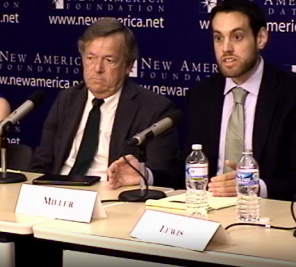
This morning, our colleagues in the Assets Building Program at New America hosted an event around the release of Building Expectations, Delivering Results–a comprehensive bi-annual report that lays out the state of reserach around college savings accounts and presents interesting ideas around how these instruments could be used to help lower-income students. (You can read the whole report and see nice graphical representations of some of the findings at Save4Ed.com and go here to watch the video of the event.) It was an engaging conversation around what research already tells us about accounts, as well as where we still have some tough questions to answer. I particularly recommend listening to Dana Goldstein’s discussion of talking to two students who made differing use of accounts and how it framed their behavior, as well as William Elliott’s challenging assumptions around whether low income families can actually save or not.
Our Assets Building colleagues also kindly invited me to participate on the panel, where I talked about how the structure for accounts would differ a lot from a government perspective based upon whether or not you wanted to maximize asset accumulation or drive increased expectations. I also laid out an idea for how better leveraging state funds through an account-like structure could be a promising way to achieve the latter goal. I’ve posted my remarks after the jump, but I highly recommend giving the report a read.
Prepared remarks for the event
It strikes me that the discussion around accounts focuses on two big benefits: (1) as a tool to help build aspirations so students are better prepared for college and (2) as a way to accumulate assets to help cover costs.
But those two goals are actually quite different and accounts designed to achieve each of them would not look the same. I’d argue that creative use of the account structure would be very effective at building aspirations, but actually seeding them with Federal dollars entails some very significant policy hurdles.
So I wanted to take a couple of minutes to discuss some of the difficulties that would apply in actually tapping into Federal dollars to fund accounts and then suggest an alternative way to consider the account structure that could help with the aspirational goals.
There are three big impediments to a Federal-based account system: cost, infrastructure, and conditions.
Cost is probably the biggest impediment because the largest source of higher ed support for postsecondary education, Pell Grants, are mostly funded through the discretionary process. That means that each year Congress has to come up with sufficient funds to cover the majority of the program’s cost.
What this means is that if you spend Federal dollars today that a kid would otherwise have gotten in the future, you don’t get credit for reduced future spending. It’s treated as a cost. And seeding accounts for millions of kids throughout their elementary and secondary education would probably add billions in additional spending that woudl have to compete with finding dollars to close significant shortfalls in the Pell Grant program over over the coming years.
The next consideration would be infrastructure. The Pell Grant program also provides cash benefits to students, but as a just-in-time voucher when they go to college. But running that program is streamlined because the Federal government relies upon 7,500 middlemen in the form of colleges and universities to actually award the funds, make sure they are properly accounted for, etc.
So a Federal-based account system would require either finding a way to set up accounts with millions of kids on an individual basis or you’d need to find ways to encourage states or someone else to set up their own structures to work with. That’s achievable, but would be very complicated to do.
Finally, Federal dollars come with more strings attached than a marionette. When I was at the Department of Education we worked to set up a savings account demonstration project through GEAR UP, which is a college access program that works with students in middle and high school. But for that structure to work with federal dollars required a series of complicated rules, such as having federal funds be properly maintained in their own separate account, limiting their investment into essentially riskless government assets, not to mention lots of restrictions around withdrawals and oversight. I think these challenges were among the main reasons why no one ultimately applied for the project.
But let’s say instead of being focused on an actual cash transfer, you wanted to optimize accounts to build students’ aspirations and behavior. If that’s your goal, then you could modify what some states are already doing to include accounts and avoid a lot of the challenges I just discussed.
The emphasis here would be less on moving actual dollars and more on having students understand the path that it takes to get to college and telling them about available college resources sooner.
This would be based on what’s known as “promise programs,” which a few states and localities are experimenting with. In these programs, the state signs agreements with low-income middle school students where in exchange for free tuition students agree to do things like take a college prep curriculum maintain a reasonable GPA—like a 2.0—fill out the FAFSA and apply to colleges.
But those programs don’t give students an intermediate sense of building to their goals—you either get the benefit at the end of four years or you don’t.
This is where accounts could help improve these programs. Rather than waiting until the end of four years to receive either all or none of the benefit, states could reward intermediate progress toward the goals by giving students “shares” of a college education. Such a structure strongly indicates how striving and doing well in earlier grades really is directly related to the end goal of college. And could include benefits for major benchmarks on the way to college–such as passing Algebra II.
This structure would be easier to set up, since states could control the details and make use of the funds they already put toward financial aid (especially so-called merit aid) and operating subsidies to cover the costs. You could even leverage the ill-targeted Federal education tax benefits if you were looking for some extra cash to encourage states to act.
Adding a Pell-related role to this structure could also be done through an expansion of existing unused flexibilities. Right now, low-income families find out about Pell eligibility more or less in the spring semester of senior year when they fill out the FAFSA. But that’s really too late to guide aspirations or deal with college cost anxiety that could shape earlier behavior.
So why not expand an existing authorized but never used demonstration program to guarantee Pell awards for students based upon their eighth grade income? This would send a strong message to kids about a significant source of aid availability without needing to stand up a new system. Extra Pell costs would likely be minimal but could be addressed with a few design tweaks.
Again, it’s about what you see as the most important role for accounts. An account funded by state and federal college “shares” would send strong behavioral signals, but lacks the asset accumulation that comes with seeding actual Federal dollars. But that strategy carries a great degree of complications. And so are you think about design and goals its worth keeping in mind what the end result you are hoping for is and the challenges to getting there.
Issues
Programs/Projects/Initiatives
Related

Misrepresenting Accreditation: A Q&A with Melissa Ryan

The Future of Accreditation: A Q&A with Jan Friis