PART 5. ARPANET; Where did it all start again?
There is said
to be a single hook around which much of the scholarship on cyberspace evolved.
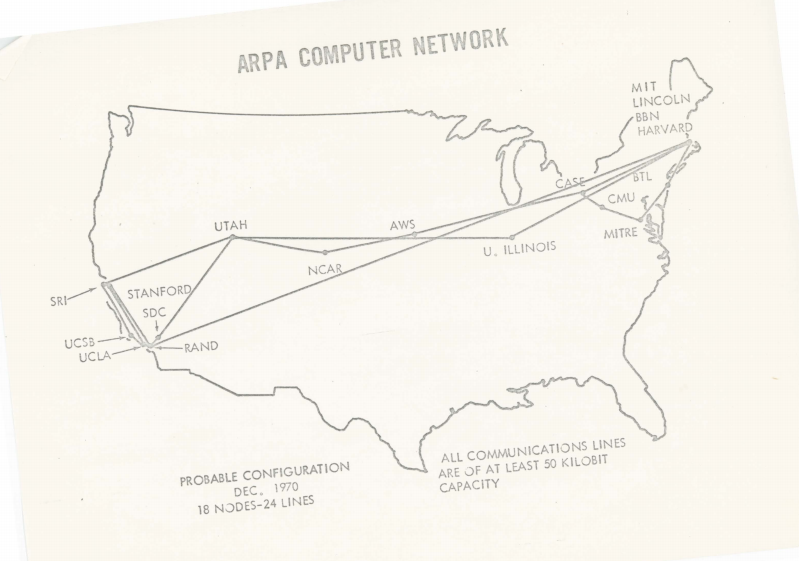
This is ARPANET, which was implemented in October 1969 when four university
computers became interconnected in the United States. ARPANET serves both as an
anchor point for explaining what cyberspace once was as well as way of
expounding the principles underlying cyberspace today.
Yet, there are
still multiple ways of describing this foundational project. From one
perspective, ARPANET is taken to reveal that cyberspace has always been a tool
for political power struggles. According to Roger Hurwitz, “[e]ven liberal regimes have sought
power to police cyberspace… [later] struggles uncannily rewrite in large those
earlier tensions when the federal government owned ARPANET and researchers
fretted that their using it for personal communications might run afoul of the
overseers.”
For others,
ARPANET is mainly proof that the military has always been interested and
involved in cyberspace from the very beginning. It is often pointed
out that
the DARPA funded community—with J.C.R Licklider as the first head of the
computer research program and Ivan Sutherland, Bob Taylor and Lawrence G.
Roberts as his successors—was indeed at the birth of ARPANET. Also one of the
goals of ARPANET was to design a decentralized network which could continue
even in case networks were damaged.
Yet the
feature which is most frequently emphasized is that ARPANET was largely
considered an academic project, with trust and availability trumping security.
Raphael Cohen-Almagor writes, “the culture of the ARPANET
community was one of open research, free exchange of ideas, no overbearing
control structure, and mutual trust.” Similarly, Joseph Nye Jr. states, “ARPANET […] [was] essentially a research tool and the plaything
of a few. In other words, the massive vulnerabilities that have created the
security problems we face today are less than two decades old and are likely to
increase.”
Overall, the existence
of different descriptions for the same foundational project, ARPANET, can be
seen as another means of contest for the concept of cyberspace.
More About the Authors

Max Smeets
Issues
Programs/Projects/Initiatives
Topics
Related

Internet Realities Watch, vol. 6

India’s Data Protection Bill in Geopolitical Context

Making Sense of a Huawei “Partial Ban”