
Table of Contents
- Foreword
- The Development of Smart Water Markets Using Blockchain Technology (Aditya K. Kaushik)
- Civilian Drones: Privacy Challenges and Potential Resolution (Ananth Padmanabhan)
- The Privacy Negotiators: The Need for U.S. Tech Companies to Mediate Agreements on Government Access to Data in India (Madhulika Srikumar)
- Governing Data: Non-Discrimination and Non-Domination in Decision-Making (Joshua Simons)
- Open Transit Data in India (Richard Abisla)
- Blockchain Regulation in the United States: Evaluating the overall approach to virtual asset regulation (Tanvi Ratna)
- Improving India’s Parliamentary Voting and Recordkeeping (Pranesh Prakash)
- India and the United States: The Time Has Come to Collaborate on Commercial Drones (Sylvia Mishra)
- Civic Futures 2.0: The Gamification of Civic Engagement in Cities (Subhodeep Jash)
- Key Differences Between the U.S. Social Security System and India’s Aadhaar System (Kaliya Young)
The Development of Smart Water Markets Using Blockchain Technology (Aditya K. Kaushik)
Aditya K. Kaushik is a project scientist at Divecha Centre for Climate Change at the Indian Institute of Science where his work revolves around developing applied research initiatives and assisting in science policy communication in the area of water. Kaushik holds a master of science degree in electrical engineering from the University of Southern California and a master of arts degree in law and diplomacy from the Fletcher School at Tufts University.
Acknowledgments : The author would like to thank New America for providing an opportunity to part of the 2019 India-U.S. fellowship program. This paper would not have been possible without contributions from Ahmed Jawad, Anik Bhaduri, Allison Price, Awista Ayub, Christopher Mellon, Jennifer Brody, Keerthana Chandrashekar, Melissa Salyk-Virk, Sharon Burke, Tomicah Tillemann, Yulia Panfil and the 2019 India – US fellows. The author would also like to express his gratitude to the New America editing, publishing and the communications team for their support.
Introduction
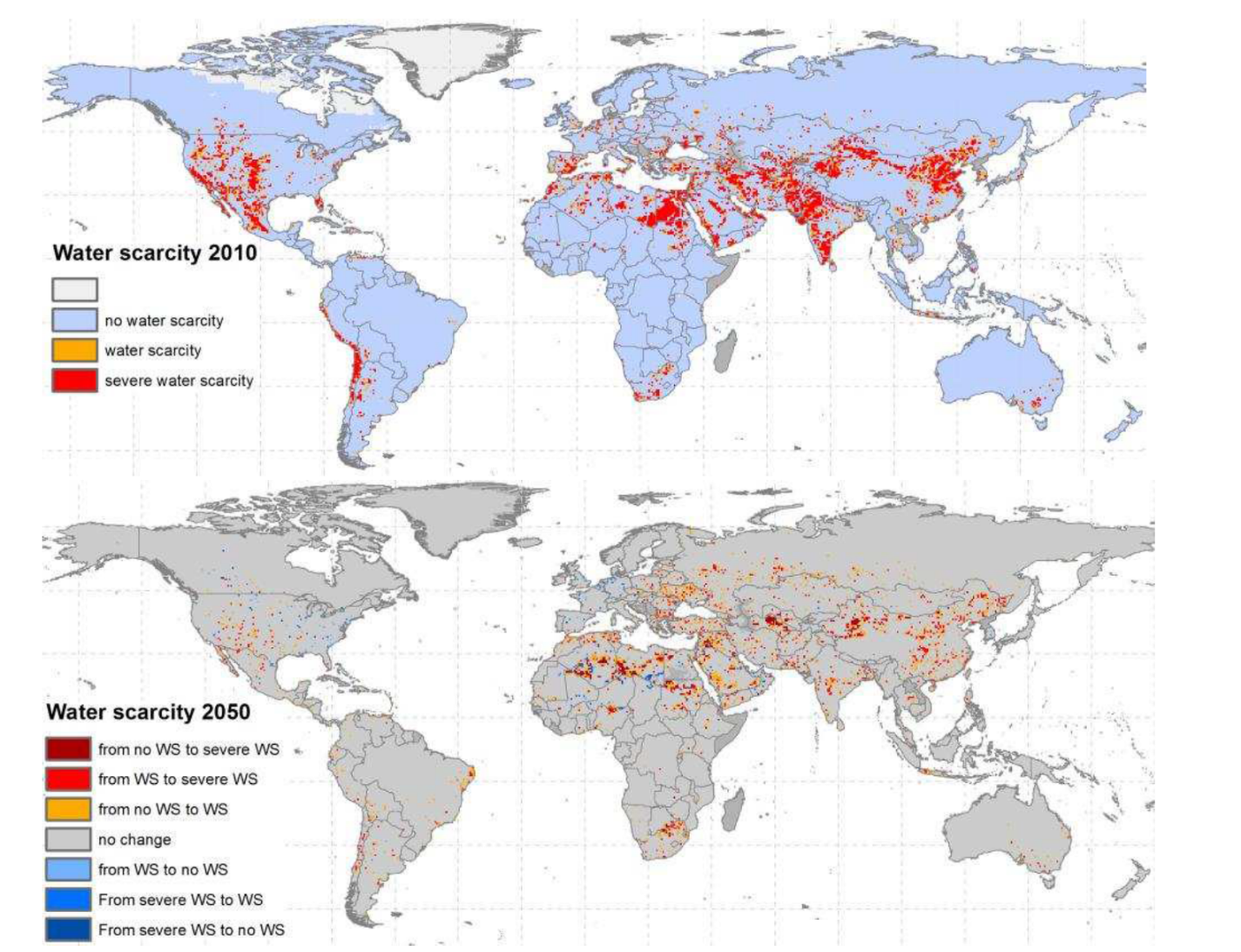
A significant reduction in the quantity of freshwater and deterioration of its quality has pushed the world towards a global water crisis.1 Lack of sufficient water, defined as water scarcity, is exacerbated by current global trends of rampant population growth, rapid urbanization, a rise in consumerism, and climate change (see Figure 1). According to the United Nations World Water Development Report 2018, about 46 percent of people in the world live in water scarce regions at least one month per year. This figure is predicted to rise to about 51–55 percent by the year 2050.2 Meanwhile, the global population is estimated to rise by 32 percent by the year 2050. Within this, the global urban population is expected to increase by over 80 percent, thus, increasing the global water demand, which is estimated to rise by 30 percent by the year 2050.3 Water scarcity is inextricably interwoven with the health, food, and energy sectors which has the capacity to significantly disrupt the economic, social, environmental, and political landscape, extending the problem across multiple development sectors.
Traditionally, the problem of water scarcity has been addressed by augmenting the supply side through a structural approach, such as building dams and reservoirs.4 Supply-side augmentation has yielded tremendous benefits vis-à-vis access to water and water services but it has also been environmentally damaging. Policymakers and city planners are increasingly looking at nonstructural demand-side solutions, such as managing water allocations, to ensure more efficient use of resources to complement the traditional structural approaches.5 In water reallocation projects, the movement of water from abundant areas to water-scarce areas tries to adjust the unequal demand for water over a geographic jurisdiction. Typically, centralized governmental institutions are responsible for water reallocation. These institutions are the main suppliers of water and they predict demand-side responses and while also determining supply and distribution costs. They respond to policies designed by city planners and seldom to the needs of individual buyers. This is partly because individual buyers are unable to signal their needs to the suppliers through such centralized ecosystems. Incorrect mapping of supply and demand requirements lead to the inefficient allocation of water resources. In addition, water management and its use result in several negative externalities.6 It is susceptible to problems related to collective action,7 free rider issues,8 and wastage.
Water markets where water assets are treated as a tradable commodity are cited as a solution to better allocate water and address the problem of water scarcity. Development of any market, especially to manage a good like water, is susceptible to market distortions typically caused by information asymmetry and high transaction costs. These market distortions lead to barriers to trade and thus prevent markets to function efficiently. As water is unlike any other commodity and is essential for life, these market distortions can incur a significant social cost. Thus, water markets have been historically a complicated economic policy instrument to implement. The purpose of this paper is to explore how blockchain-based solutions, based on the cities of Los Angeles and Bengalaru as case studies, can be used by regulators to reduce information asymmetry and high transaction costs and help in the development of efficient and transparent water markets.
Figure 1: Water scarcity in 2010 (upper image) and projected water scarcity in 2050 (lower image)
Source: Burek, P., Y. Satoh, G. Fischer, M. T. Kahil, A. Scherzer, S. Tramberend, L. F. Nava et al. "Water Futures and Solution: Fast Track Initiative (Final Report)." IIASA, Laxenburg, Austria (2016). http://pure.iiasa.ac.at/id/eprint/13008/1/WP-16-006.pdf
What are Water Markets?
A water market is a medium that allows buyers and sellers of a water-related good (wastewater, rainwater, groundwater, water rights, or entitlements) to interact and facilitate an exchange. The primary purpose of a water market is to facilitate efficient allocation of water resources and provide a clear measure of the value of water to incentivize conservation.9 The theory of water markets is based on the principle that trading water allows for better economic efficiency between buyers and sellers by allocating water resources in accordance with the strength of the buyer’s water demand. It also allows for better accounting of externalities like pollution and waste by allowing consumers to respond to changes in the operating environment.10 Water markets allow users with high marginal value to purchase water from users with low marginal value. In other words, water is transferred from low water use areas to high water use areas, allowing for allocation efficiency. The interaction between buyers and sellers and traditional market forces determine the price of water. The price of water is influenced by environmental and economic considerations. When markets are functioning efficiently, the market price of water sends signals and thus incentivizes buyers and sellers to increase or decrease their demand and supply. Typically, water is managed as a service industry where the price of water is determined by governing agencies who are unwilling to change the price based on quantity or quality available. Thus, such a system leads to distortions where water is being underpriced and over-consumed. Some of the more successfully functioning water markets exist in the United States (California’s Central Valley), in Australia (the Murray-Darling Basin), and in Chile (the National Market).11 Water markets are typically created to either meet additional water demands, to limit water use, to improve economic productivity and/or to protect natural ecosystems.
Conditions Necessary to Create Efficient Water Markets
Symmetric information exchange between buyers and sellers
Information asymmetry12 revolves around decisions made during transactions. In a water market setting, underlying gaps in the data ecosystem and institutional mechanisms contribute to three kinds of information asymmetries. First, there is a data inequality issue. For example, some participants might have better access to data than others, or the data that is available is of bad quality, or data is available but important data is hidden away, thus leading to adverse selection.13 Adverse selection occurs when some participants are able to make better decisions than others due to access to certain information. For instance, a seller of a treated wastewater has more information about the product quality than the buyer, thus putting the buyer at a disadvantage. The buyers will be unable to decide whether the price quoted is optimal or not vis-à-vis the quality of water supplied. Adverse selection can act as a barrier to entry for new buyers and can also result in bad quality goods weeding out good quality goods over time. Second, when the data ecosystem is susceptible to tampering and institutional infrastructure does not have the necessary checks, balances, and penalty enforcement mechanisms, it can lead to the problem of moral hazard.14 The moral hazard problem occurs when entities participating in a trade transact in bad faith, provide misleading information, or change behavior post-contractual agreement. For instance, during a transaction, one of the parties can misrepresent the quality of the product and the other party is unable to validate the quality, thus promoting mistrust and perpetuating opaqueness in water markets. Third, the creation of monopolies of knowledge can lead to severe distribution effects.15 For instance, a large buyer of a water good, by virtue of access to more and better information, can affect the price and quantity of the water traded. Thus, such information asymmetries lead to market failures. Symmetric information exchange between buyers and sellers is a necessary condition for the creation of efficient water markets.
Low infrastructure and transaction cost
Development and maintenance of a water market come with associated costs. Infrastructure costs include: 1) Initial cost of setting up an enabling mechanism of water markets; 2) Development and deployment of water entitlements; 3) Connecting buyers and sellers; 4) Monitoring and evaluation of water use and externalities; and 5) Enforcement mechanisms for penalty and reward. Transaction costs include: 1) Participation fees; 2) Information search costs of willing buyers and sellers; 3) Negotiation and bargaining costs; 4) Cost of registration for an exchange; 5) Enforcing contracts; and 6) Cost of checking the veracity of the product. High infrastructure costs and associated maintenance costs act as a barrier to setting up a water market.16 High transaction costs can lead to thin markets.17
Stringent regulation and distribution of water entitlements
Regulators set the framework and rules for establishing a water market. They play a key role in identifying and vetting participants, issuing water rights, administering trade, monitoring and evaluating water use, and externalities; and developing enforcement mechanisms for deterring rule breakers. Regulation is subject to bureaucracy and corruption that can prevent water markets from functioning effectively. In a water market setting, if there are different rules for different participants, and if the buyers and sellers do not perceive equal opportunity gains from transactions, then a market failure can occur.18 A robust regulatory mechanism with necessary checks and balances is necessary for developing, implementing, managing, and sustaining a complex economic instrument such as a water market.
Water entitlements are tradable rights held by users for the exclusive use of a water resource as defined by the regulators. Clarity over water rights and a history of water assets are a necessary condition for the functioning of a water market. Information asymmetry and high transaction costs lead to significant market distortions in any market. Its effects are even more magnified when managing water assets in a market-based setting. A robust regulatory process along with a clear system of water rights is necessary to overcome these distortions in order to create a sustainable water market.
Blockchain Solution and Analysis
Traditionally, in a regulated market place, market distortions such as information asymmetry and high transaction costs are tackled through a system of institutional solutions such as: 1) The establishment of norms and standards that act as binding rules and requirements vis-à-vis processes and quality of the goods; 2) The disclosure and transparency mechanism that requires participants in a market to report process adopted, quality of product produced, cost associated, and so on; 3) The monitoring and traceability provisions that allow for tracking of products, quality, and liability allocation;19 and 4) Contingent contracts that allow for a trade to be completed when specific conditions are met.20 However, the effectiveness of these institutional solutions depends on several intermediaries, an individual’s ability to access these intermediaries, an ability to leverage the available data, and the integration of several disparate systems and stakeholders.21 In addition, these solutions are susceptible to inefficiencies, corruption, bureaucracy, human errors, and tampering.
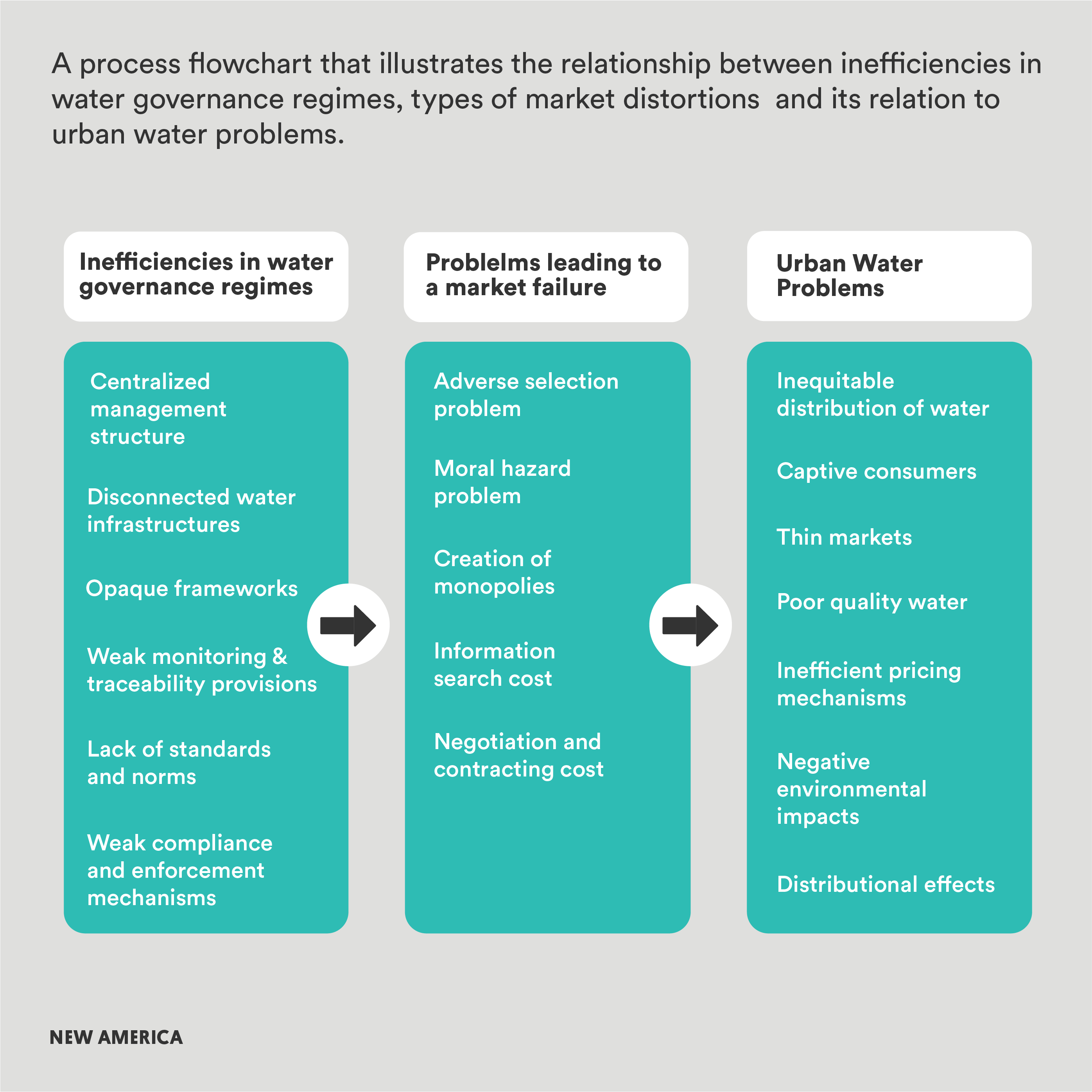
In order to make these institutional solutions more resilient and adaptive, as well as make regulators more accountable, while also setting the conditions that would allow participants to trade, blockchain-based solutions can address these needs. These solutions can be used as a governing tool that can replace intermediaries, modernize the regulatory processes, and act as an accounting, auditing, interlinking and trading platform that enables water markets to function effectively.
Blockchain Technology
As of late, blockchain technology seems like a short-term trend, but some hail it as the best innovation since the internet. Even though the optimism should be handled with caution, blockchain’s key features and potential applications seem well worth the hype. Blockchain is a distributed, decentralized, peer-to-peer database network that allows for fast, secure, and transparent transactions of digital assets. It is a network of ledgers with the capacity to record information, and compute and transact, with each ledger holding an up-to-date copy of the entire network. Each ledger then acts as a node in a network. Unlike in a centralized system, where transactions are validated by a single server acting as a central authority, with blockchain, the veracity of transactions is validated by distributed consensus. For example, if a majority of nodes verify and authenticate a transaction, then the transaction is accepted. This updated version of the transaction is stored in a block. Each block stores a series of transactions and is linked to the previous block of transactions through hashing functions. Through cryptography and complex mathematical puzzles, the blockchain network is virtually immutable. Thus, it can be used to store information and facilitate transactions in a transparent, efficient, and a tamper-proof manner.22
Blockchain for Water Markets
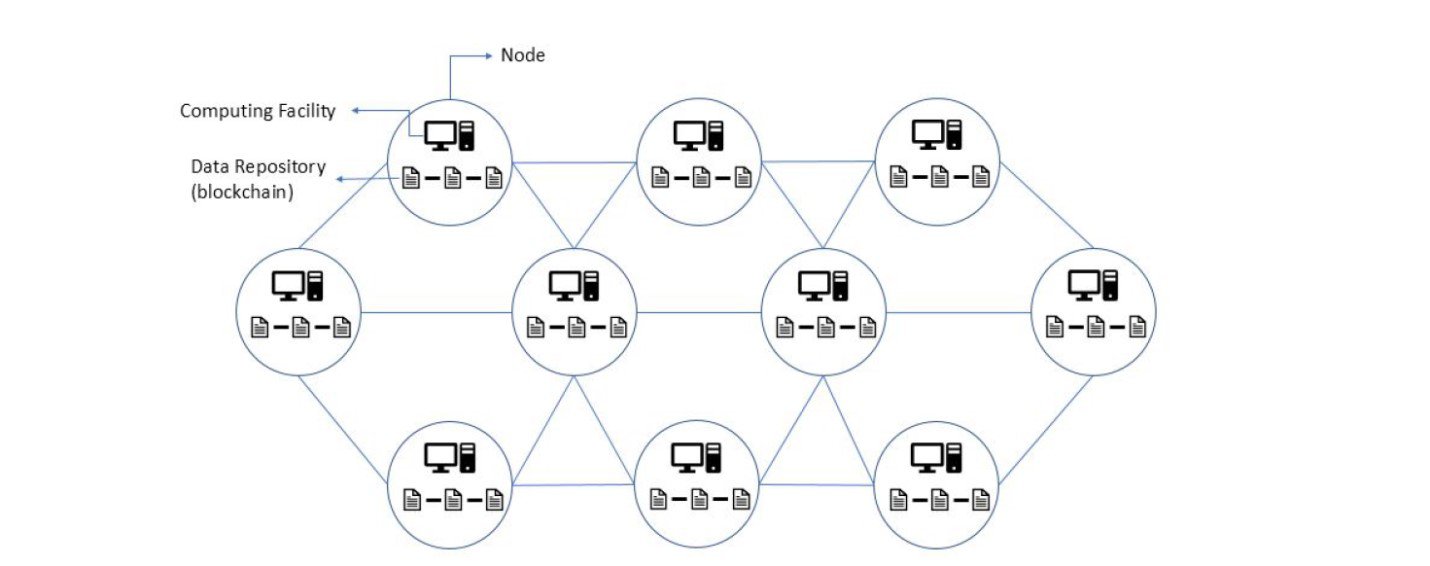
Source: Narang, Shivika, Praphul Chandra, Shweta Jain, and Y. Narahari. "Foundations of Blockchain Technology for Industrial and Societal Applications – A Quarterly Publication of ACCS." A Quarterly Publication of ACCS. (2018). https://acc.digital/foundations-of-blockchain-technology-for-industrial-and-societal-applications/.
The capabilities of blockchain technology can be divided into three fundamental features. First is a shared ledger system that is virtually immutable through a combination of cryptography and distributed consensus algorithm. It protects against the misuse of data and opens up several possibilities in domains where privacy and trust are of critical importance. One of the obvious applications is in securing digital identities. This allows for the creation of a common tamper proof database that facilitates assembling data from multiple sources in a seamless manner. Its distributed consensus mechanism and inherent traceability provisions allow for checking the veracity of this data and validates data sharing. This promotes trust amongst different stakeholders and participants, increases transparency, improves data reliability and reduces audit time. This common tamper proof database facilitates accounting for trades and transfers, prevents double counting, and promotes efficiency in the system. The second feature is tokenization, which is the ability to create coins or tokens that are a digital representation of assets i.e. a unit of a token represents a specific amount of an asset. This paves a path for token economics and allows for faster transactions with better tracking, trading, and transferring of digital assets. The third feature is a “smart” contract, which is a digital protocol that self-executes when certain conditions are met.23 This allows disparate parties to transact in a transparent and trusted manner without a need for an external enforcement mechanism or intermediaries. It facilitates the compliance of participants, enforces negotiations of contracts, and renders transactions traceable. Smart contracts can help reduce transaction costs, human errors, and corruption through automation and thus increase the robustness and resilience of the system.
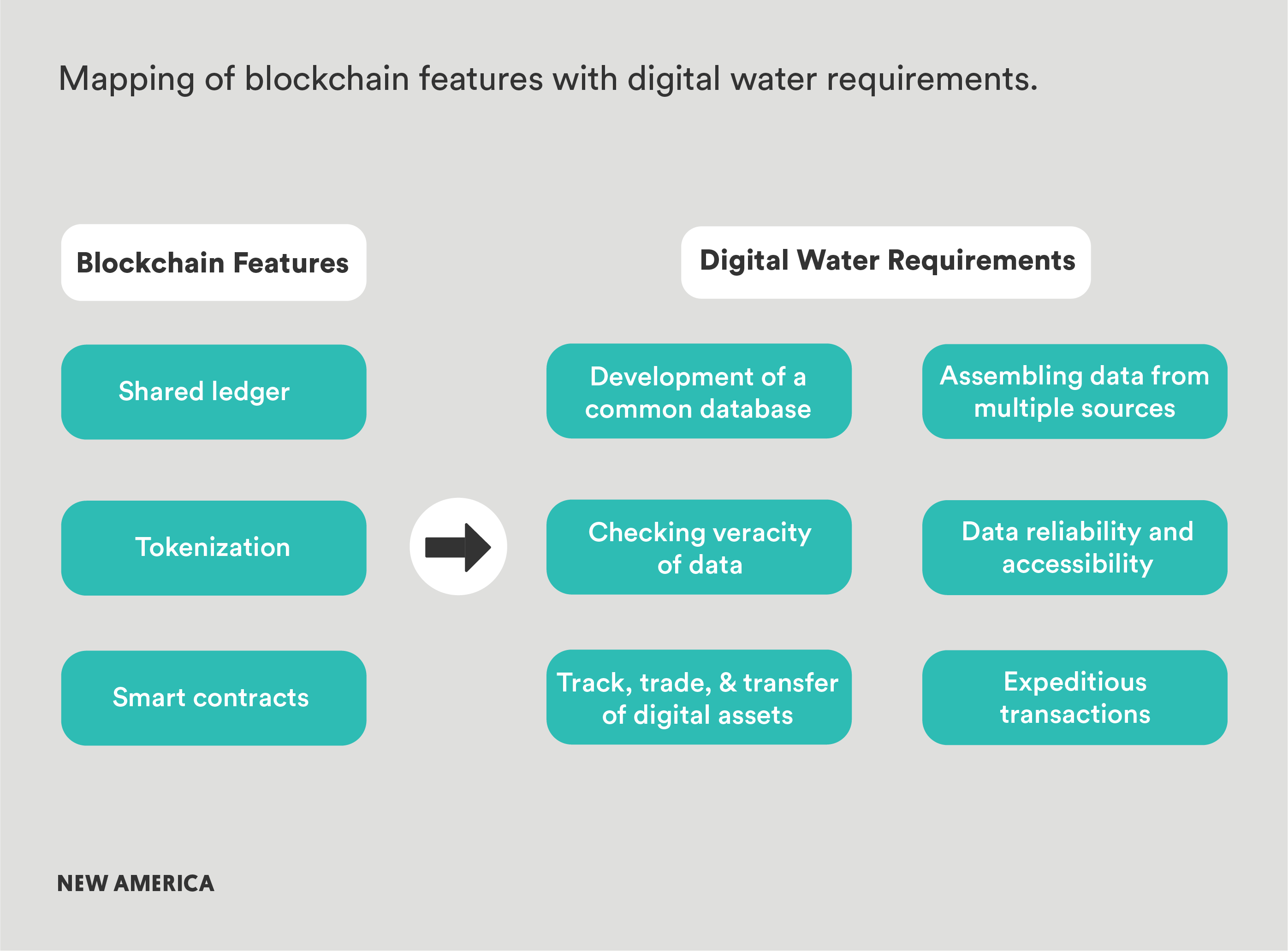
Figure 4: Mapping of blockchain features with digital water requirements
In a water market setting, the convergence of the three features of blockchain—a shared ledger to store information in an immutable fashion, the ability to create currencies that paves a path for token economics, and smart contracts to execute automated functions when certain conditions are met—makes it a useful tool to reduce information asymmetry and transaction cost. To illustrate this, consider the case of a blockchain based peer to peer trading platform called the Water Ledger developed by an Australian based company called Civic Ledger.24
Civic Ledger conducted a feasibility study on whether Water Ledger can increase transparency and improve efficiency in the water trading market of Murray Darling basin in Australia.25 The primary finding of the study was that the complexities of the water market, such as complicated business and operational rules, lack of available water information and presence of intermediaries, excluded nearly 75 percent of potential users from participating in water trades. Simply put, they did not have confidence and could not understand how these markets functioned.26 The Water Ledger platform developed by Civic Ledger provides a single ecosystem without intermediaries that bring buyers and sellers together. The water trading mechanism in Murray Darling Basin allows for buying and selling of water entitlements—permanent rights to share of water and water allocation shares—seasonal rights to share of water distributed to an entitlement holder.27 Through a system of tokenization i.e. by mapping a physical asset such as allowable water allocation shares to a digital signature in the form of a token, the Water Ledger platform provides clarity over the ownership and history of such a water asset. This makes tracking, trading, and transferring of water assets far more transparent. Through its system of consensus algorithms, Water Ledger verifies all water trades and updates all shared digital ledgers and public registries in real time.28 Having such a tamper-proof blockchain network with robust traceability provisions prevents misrepresentation of transactions, or participants from backing out of a trade after a contract is signed. This provides the participants with confidence in the robustness of such a trading system and tackles the problem of moral hazard.29 In addition to all trades being published in real time, business and operating rules are built into the blockchain system. This reduces uncertainties amongst participants. Any change in the rules of trade will immediately be visible to all users.30 Thus by allowing equal access to information and making all changes to the market rules visible to all, Civic Ledger provides a platform that promotes trust and transparency in the water market ecosystem. This, in turn, reduces the problem of adverse selection that participants face in a water market and prevents the creation of knowledge monopolies.
As demonstrated by Water Ledger, the intermediaries in a water market setting play a variety of roles. They manage operations such as connecting buyers and sellers, providing information, and registering trades. These intermediaries charge a fee to manage these operations. The Water Ledger platform allows buyers and sellers to come together in a single market place without any intermediaries and all information is provided at no cost to participants.31 This reduces the transaction cost and transaction time.32 The platform also integrates with other related departments’ data that determine a buyer’s need such as rainfall data and agricultural throughput. This provides buyers with a range of options optimized to their needs. This reduces information search cost. The process of trading is inexpensive and is simplified through a combination of smart contracts and optimized choices based on the selection of specific parameters that is presented to participants. Automatic execution, settlement, and enforcement of contracts based on complex water market rules eliminates costs associated with negotiating and enforcing trades. Finally, the platforms allow for trades to be published in multiple ledgers simultaneously, thus reducing the cost of maintaining and reconciling multiple ledgers.
Reduction of transaction cost and transaction time allows more users to participate as well as allows for more transactions to actualize. This improves the liquidity in the water trading market.33
Thus, blockchain can be used as an effective tool to eliminate market distortions and pave the way for “smart34” water markets to address the problem of water scarcity. Blockchain would act as: 1) An accounting platform that maintains a ledger of accurate tamper-proof information on water rights, quantity, quality, buyers and sellers; 2) An auditing platform that allows regulators to quantify water flows and quality and penalize rule violations; 3) A trading platform that connects buyers and sellers and facilitates transactions of water assets; and 4) A networking/interlinking platform that allows for seamless interaction among different agencies and stakeholders.
Thus, blockchain can be used as an effective tool to eliminate market distortions and pave the way for “smart” water markets to address the problem of water scarcity.
Challenges of Using Blockchain
Use of other technologies
There are several different types of databases that record digital transactions: version control software packages that keep track of every change made to a file, audit management packages to assist in continuous monitoring and scrutinization, trading tools to facilitate transactions, and accounting tools for book-keeping purposes. These individual tools offer specific features that can rival or supplant blockchain. It is possible that these tools are individually cost-effective and offer a faster execution speed. However, integration of multiple such tools to operate across different functionalities, as in the case of water markets, creates inherent complexities that can lead to inefficiencies and higher costs. As illustrated in the previous section, the blockchain database, through its decentralized shared ledger system, consensus algorithms to verify transactions, and tokenization to track assets and smart contracts, provides an integrated functionality of accounting, auditing, and trading and thus provides seamless integration while adding value across the ecosystem.
High energy consumption and increased transaction time
Blockchains are divided into public or private based on who is allowed to participate in the network. In public blockchains, anyone is allowed to participate without permission;in the consensus validation process, in sending transactions over the network, or in viewing all transactions. Thus, public blockchains offer true transparency and decentralization. Such a blockchain system works well in certain applications such as managing digital currencies. However, on the downside, public blockchains increase transaction time and reduce the network speed as there is significant cost vis-a-vis computational power and the time associated with verifying transactions through a such a distributed consensus protocol. As illustrated in the previous sections, blockchain does reduce costs related to data storage, data capture, and search cost. But it also increases costs significantly during the verification process. For public blockchain to function efficiently and to scale, significant computational power will be necessary to facilitate faster transactions. However, in a water market setting, selected participants are allowed to engage in trade while regulators play a role in deciding the rules of the trade. In such a setting, a private blockchain-based model with a permissioned access setting that puts a limit on the number of participants would be an ideal protocol to use. A system with limited players can reduce the inherent cost associated with using blockchain and thus facilitate faster transactions and provide better scalability options.35
Not truly decentralized
Use of a permissioned blockchain system does not eliminate the role of a central authority and thus is not truly decentralized. However, regulators and institutions play a significant role in the management of water markets. They set the rules of the water markets for participation, compliance, operation, and trading. They also continuously monitor water use, take into account water quantity and quality considerations, and observe externalities and third-party effects. All this in addition to developing a penalty and reward system to ensure compliance. In short, they play a role in preventing market failures. A permissioned blockchain protocol offers a way to make the regulators more accountable, make regulations more robust, and help reduce market distortions.
Exploring the Need for Water Markets in Los Angeles County and Bengaluru
Los Angeles County
The water management infrastructure in Los Angeles County, with the help of 215 community water systems, serves over 10 million people.36 Each of the community water systems is administered by government agencies or privately-owned bodies. The water systems are of different capacities in terms of the volume of water that they can hold and the number of customers they cater to. Each of the water systems is unequally supplied with different water resources. The supply of water to each of the water systems is not determined by need, equity, efficiency or the environment, but rather by historical processes. Different water systems are supplied with water from various sources (as seen in Figure 5) resulting in differences in quality. Also, by being dependent on a particular water resource, water systems are susceptible and vulnerable to shocks such as droughts or contamination. In addition, due to an unequal allocation mechanism, some water systems contain more water or less water than the other systems. This results in different pricing mechanisms for each system. There are some water systems that supply water at $2,000 per year for certain households whereas comparable households in other water systems pay around $200 per year.37
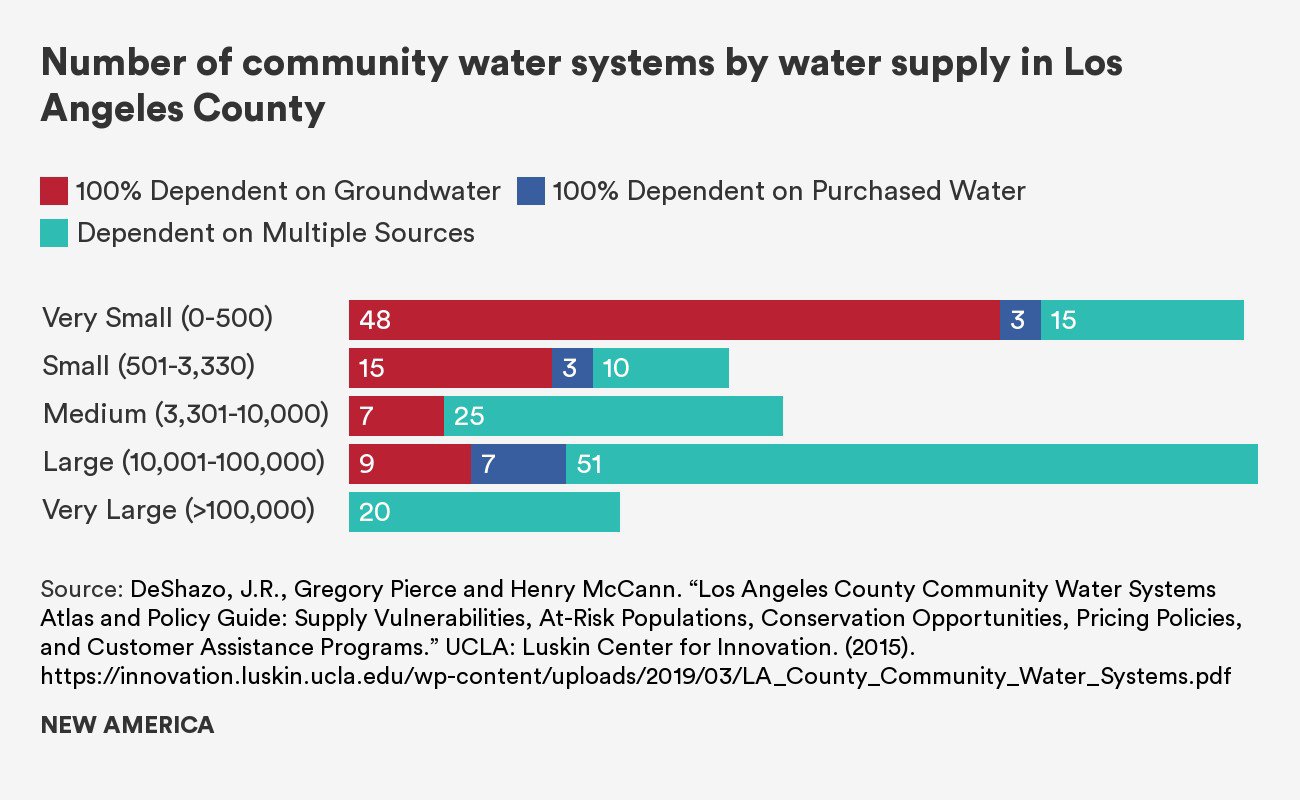
These water systems in Los Angeles County differ in governance regimes, jurisdictional boundaries, and regulations. They are completely decentralized in their management, fragmented in their architecture, and disconnected in their operations. The water systems act as a natural monopoly since consumers have no ability to switch to other suppliers. In addition, there is no systematic or standardized regulatory framework. There is a lack of standardized and accessible databases.38 This results in a lack of supervision, transparency, and accountability in the system, which can lead to an inadequate understanding of water quality and distribution. Governing agencies make assumptions on how to distribute water rather than adequately projecting for future demands and risks. There is also a lack of coordination and oversight as each of the suppliers set their own prices and policies.39
Developing a regional blockchain-based water market that provides a robust regulatory mechanism and an efficient trading platform can help: 1) Reduce inequity by facilitating water systems with surplus water to trade with systems that have a deficit; 2) Develop new revenue streams and local water sources by incentivizing water systems to explore opportunities to tap into new supplies such as rainwater, wastewater, and stormwater; 3) Improve resilience to climate change impacts by facilitating water systems to diversify its supplies; and 4) Creating incentives for water systems to recycle wastewater. 40
Bengaluru
The population of Bengaluru stands at over 10 million; similar in size to that of Los Angeles County.41 However, unlike Los Angeles County, the major supplier of fresh water is a centralized governmental agency called the Bengaluru Water Supply and Sewerage Board (BWSSB). The BWSSB primarily imports water from a single source, the Kaveri river.42 With growing demand and a changing climate, reliance on a single source will make the water system infrastructure vulnerable. The distribution of water by BWSSB is based on a piped water network. There is inter-regional inequity in water distribution as a significant number of urban communities in Bengaluru is not connected to a piped water supply managed by BWSSB.43 Instead, they rely on water supplied by unregulated private companies. These private companies typically extract and sell groundwater.44 Since they can operate under an informal market setting, there is no systematic reporting or regulatory framework to hold them accountable for the quality of water that they supply or the environmental impacts (like falling water tables) that they inflict. In the areas where BWSSB supplies water, the tariffs are low. Such an inefficient pricing model leads to apathy and lack of awareness amongst consumers resulting in overuse and wastage.
In order to reduce the dependence on a single source, there is a need to diversify BWSSB’s water resource portfolio. Thus, there is an opportunity to develop recycled wastewater, catchment and household-scale rainwater, and stormwater as supplementary sources. Financial considerations and management inefficiencies are usually an impediment to developing new local sources. But developing a blockchain-based smart water market that provides a robust accounting, auditing, and trading platform to manage these local sources will bring in new revenue streams, provide access to newer and cheaper water supply options to consumers, improve allocation efficiency, and reduce risk exposure vis-à-vis imported water. These market-based instruments for local water sources can be expanded to include private companies who manage groundwater, thus formalizing the informal water market.
Policy Implications: Beyond Water Markets
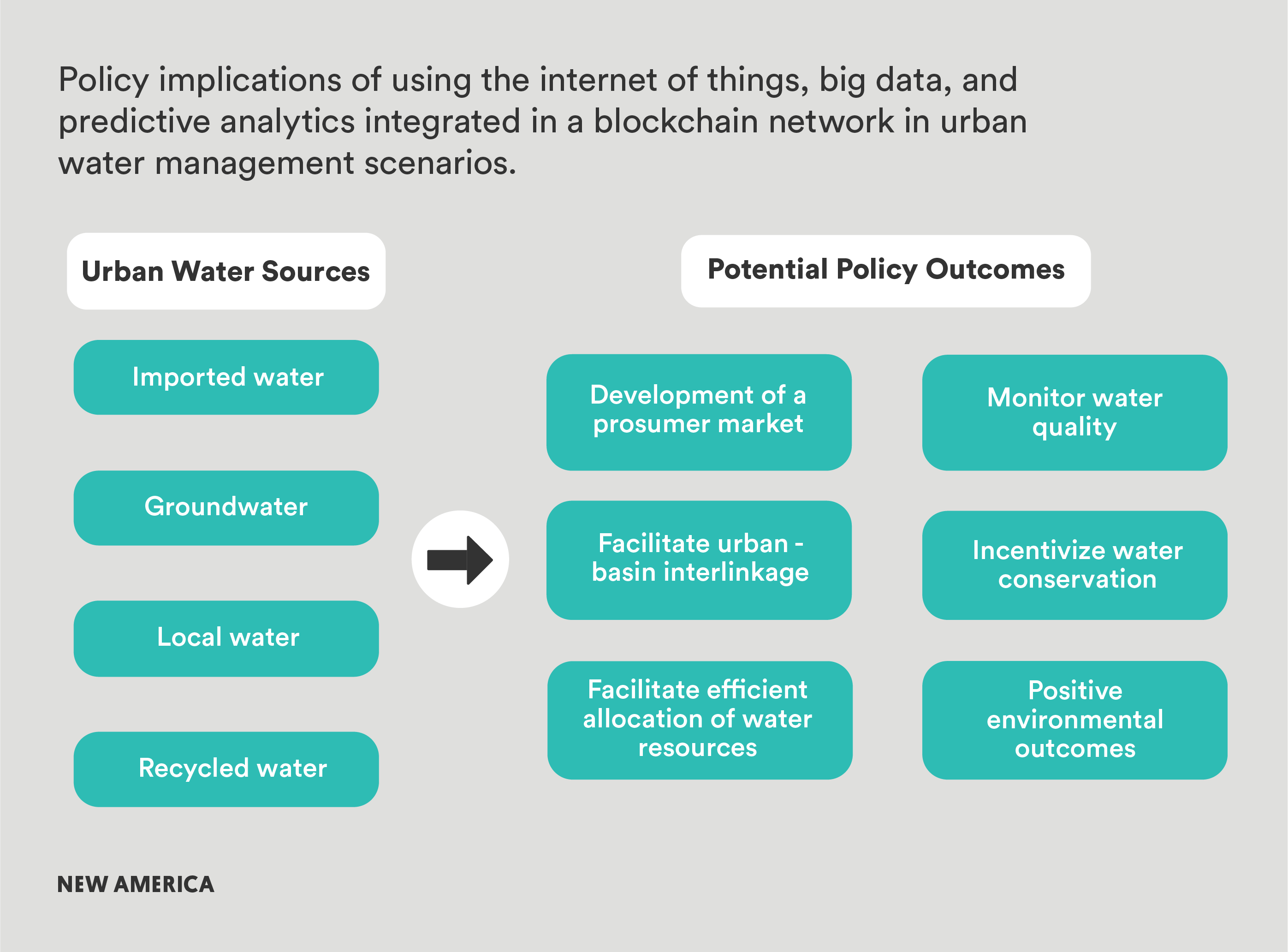
Creation of a prosumer market
In light of current water scarcity problems, alternate sources are being tapped to address water needs. Rainwater harvesting and wastewater reuse are popular alternatives. A blockchain-based system can be used to create peer-to-peer trading platforms, where water users can be incentivized to also act as producers. This lays a foundation for a prosumer market, i.e. production by consumers. Development of a prosumer market reduces dependence on surface and groundwater, incentivizes consumers to use less water thereby assisting in conservation, and creates a socially, economically, and environmentally conscious citizenry.
Monitoring water quality levels
A blockchain system can be built to acquire water quality data from quality measurement equipment and can be used by authorities to monitor the levels of water purity in the distribution system. Through smart contracts, an automatic system can be developed to send alerts to relevant authorities and citizens if water quality level falls below permissible limits. Such a mechanism can help to avoid a crisis related to water quality as seen in Flint, Michigan in the United States where there was an unprecedented level of lead in water.
Facilitation of urban-basin interlinkage
The blockchain system can also be integrated with water meters installed at basins to facilitate seamless information transfer to urban water systems. This can help authorities to better design demand and supply models, assess risks and opportunities, and develop a robust real-time disaster response mechanism.
Future Research
The future work will focus on the economic implications of a blockchain-based water market on society. To illustrate this a bit further, one of the key findings of this paper is that using blockchain as an underlying technology to manage water markets reduces market distortions due to information asymmetry. An interesting question that this finding unlocks is how will a water market operate when buyers and sellers have access to perfect information? Based on the “market for lemons” concept,45 when perfect information is available to buyers regarding different grades of quality of goods that are available, over time poor quality goods will be weeded out due to perfect signaling. This can result in either fewer sellers participating in such a market or fewer products albeit higher quality ones available to meet the demand. In a blockchain-based water market context, with fewer goods available, the price of high quality water goods will increase substantially. Such a scenario can lead to the creation of an exclusive market with only a few participants who are able to afford the products. In addition, sellers of poorer quality water goods will have an incentive to move to a non-blockchain-based market, which will result in market segmentation. Thus, the future work will focus on whether a blockchain based water market will increase or decrease the welfare in society.
Conclusion
Water resources are finite and are becoming increasingly scarce in light of natural and anthropogenic stressors such as extreme weather phenomena, population explosion, rapid urbanization, and consumerism. Regulators who manage water are faced with challenges such as inefficiencies in water allocation, apathy amongst consumers, overexploitation of water resources, and pollution.
Water markets are cited as a solution to address the problem of water scarcity and its associated problems. They are instruments that are used to dynamically allocate water-related goods efficiently. However, water markets are a complex economic instrument to implement, manage and sustain as they are susceptible to market distortions especially due to information asymmetry and high transaction cost. A robust regulatory mechanism is necessary to prevent these market distortions. The research paper makes a case for a blockchain-based system to be used by regulators as an accounting, auditing, trading and an interlinking tool to reduce information asymmetry and transaction costs. This paper also explores the potential of a blockchain-based water market to address the inequitable distribution of water in the community water systems of Los Angeles County; and, the underdeveloped local water sources and unregulated private players in Bengaluru.
A blockchain-based smart water market will be able to effectively allocate water resources.
A blockchain-based smart water market will be able to effectively allocate water resources; empower consumers by providing economic and social value, and incentivize conservation and provide positive environmental outcomes. Thus, it will act as an effective policy instrument to reduce water scarcity.
Citations
- The Global Risks Report 2018 13th Edition, [Geneva: World Economic Forum,2018] source.
- The United Nations World Water Development Report 2018: Nature-Based Solutions for Water, [Paris: WWAP (United Nations World Water Assessment Programme) /UN-Water, 2018, UNESCO] source.
- Martina Flörke, Christof Schneider, and Robert I. McDonald, "Water competition between cities and agriculture driven by climate change and urban growth," Nature Sustainability 1, no. 1 (2018): 51.
- Peter H. Gleick, "Global freshwater resources: soft-path solutions for the 21st century," Science 302, no. 5650 (2003): 1524-1528.
- Ibid.
- Negative externalities are costs that impact a party that does not have a role in its creation. For instance, vehicular pollution generated by a specific individual affecting people nearby. Negative externalities cause market failures.
- Collection action problem occurs when individuals pursuing a common goal do not cooperate due to competing interests.
- Free rider issues occur when individuals who do not pay for a good or service reap its benefit. Too many free riders results in over-exploitation or under-production of the good or service.
- Richard E. Howitt, Richard E. and Kristiana Hansen, "The Evolving Western Water Markets," Choices 20, no. 316-2016-6565 (2005): 59.
- Guy Le MoigneShawki Barghouti, Gershon Feder, Lisa Garbus, and Mei Xie, "Country experiences with water resources management," World Bank Technical Paper 175 (1992).
- Ereney Hadjigeorgalis, "A Place for Water Markets: Performance and Challenges," Review of Agricultural Economics 31, no. 1 (2009): 50-67.
- George A. Akerlof, "The Market for ‘Lemons:’ Quality Uncertainty and the Market Mechanism," Uncertainty in Economics (Academic Press, 1978): 235-251.
- C. Wilson, Adverse Selection, In: Palgrave Macmillan (eds) [London: The New Palgrave Dictionary of Economics, Palgrave Macmillan, 2008]
- Y. Kotowitz, Moral Hazard, In: Palgrave Macmillan (eds) [London: The New Palgrave Dictionary of Economics. Palgrave Macmillan, 2008]
- J.O. Ledyard, Market Failure, In: Palgrave Macmillan (eds)[London: The New Palgrave Dictionary of Economics. Palgrave Macmillan, 2008]
- David S. Brookshire, Bonnie Colby, Mary Ewers, and Philip T. Ganderton, "Market Prices for Water in the Semiarid West of the United States," Water Resources Research 40, no. 9 (2004).
- John Freebairn and John Quiggin, "Water rights for variable supplies," Australian Journal of Agricultural and Resource Economics 50, no. 3 (2006): 295-312.
- A. Dinar, M. Rosegrant, R. Meinzen-Dick, "Water allocation mechanisms: Principles and examples," The World Bank Policy Research Working Paper 1779 (June 1997).
- Jill E. Hobbs, "Information asymmetry and the role of traceability systems," Agribusiness: An International Journal 20, no. 4 (2004): 397-415.
- Max H. Bazerman and James J. Gillespie, "Betting on the future: The virtues of contingent contracts," Harvard Business Review 77 (1999): 155-162.
- Stefaan G. Verhulst, "Information Asymmetries, Blockchain Technologies, and Social Change," Medium, July 24, 2018, source.
- Sloane Brakeville, and Bhargav Perepa, "Blockchain Basics: Introduction to Distributed Ledgers," IBM Developer, March 18, 2018, accessed April 14, 2019, source.
- Nigel Gopie, "What Are Smart Contracts on Blockchain?" Blockchain Pulse: IBM Blockchain Blog, July 02, 2018, source.
- "Civic Use Cases," Helping Governments to Be More Accessible, Efficient and Effective. source.
- "Civic Ledger Pty Ltd.," Australian Water Partnership. source.
- "OECD Blockchain Policy Forum – Distributed Ledgers: Opportunities and Challenges," Releasing the Floodgates: Blockchain for Water Management, Sept. 2018.
- "Water Markets and Trade," Australian Government – Murray-Darling Basin Authority, Sept. 29, 2015. source.
- "About Water Ledger," How Water Ledger Works, source.
- "OECD Blockchain Policy Forum – Distributed Ledgers: Opportunities and Challenges," Releasing the Floodgates: Blockchain for Water Management, Sept. 2018.
- "About Water Ledger," How Water Ledger Works, source.
- Ibid.
- "OECD Blockchain Policy Forum – Distributed Ledgers: Opportunities and Challenges," Releasing the Floodgates: Blockchain for Water Management. September 2018.
- Ibid.
- The term “smart” in this context indicates the use of internet of things, big data, predictive analytics integrated over blockchain network as underlying technologies to facilitate the operations of a water market.
- Jayachandran Praveen, “The Difference between Public and Private Blockchain," Blockchain Pulse: IBM Blockchain Blog, Aug. 06, 2018, source.
- J.R. DeShazo, Gregory Pierce, and Henry McCann, “Los Angeles County Community Water Systems Atlas and Policy Guide: Supply Vulnerabilities, At-Risk Populations, Conservation Opportunities, Pricing Policies, and Customer Assistance Programs,” UCLA: Luskin Center for Innovation, (2015), source; U.S. Census Bureau Quick Facts: Los Angeles County, California," Census Bureau Quick Facts, July 1, 2017, source.
- S. Pincetl et al., “Water Management in Los Angeles County: a Research Report,” Los Angeles: UCLA, Institute of Environment and Sustainability, 2015, source
- Ibid.
- Ibid.
- J.R. DeShazo and Gregory Pierce, "Quantifying the Benefits and Designing Governance Structures for a Water Market in Los Angeles County," [Los Angeles: UCLA, Luskin Center for Innovation, Oct. 2016] source
- Bengaluru Water Board, “Blueprint for Future,” source.
- Bangalore Water Supply and Sewerage Board, "About BWSSB," Bangalore Water Supply and Sewerage Board. source.
- Bengaluru Water Board, “Blueprint for Future," source.
- Malini Ranganathan, "'Mafias' in the waterscape: Urban informality and everyday public authority in Bangalore," Water Alternatives 7, no. 1 (2014).
- George A. Akerlof, "The Market for ‘Lemons:’ Quality Uncertainty and the Market Mechanism," Uncertainty in Economics (Academic Press, 1978): 235-251.