Introduction
What is a terrorist organization? This question has become increasingly important as social media companies wrestle with demands from a wide range of countries and other organizations to moderate and restrict terrorist-related activity. This assessment aims to provide an initial evaluation of the variations in how and whether countries designate, label, and define organizations as terrorist groups.
Currently, United Nations member states are committed to an international framework that undergirds a range of counterterrorism efforts, most notably in combatting terrorist financing. In 2001, the United Nations established the Counter Terrorism Committee through UN Security Council Resolution (UNSCR) 1373 to monitor, promote, and facilitate relevant UN resolutions as they pertain to terrorist activities. In addition to several efforts listed in Resolution 1373, the discussion of terrorist financing states that “all States shall” take a range of actions including criminalizing the possession and collection of funds “by their nationals or in their territories with the intention that the funds should be used, or in the knowledge that they are to be used, in order to carry out terrorist acts.”1 This commitment, affirmed in other resolutions, grounds the development of a system to identify and share information on individuals whose assets should be frozen.
However, when it comes to labeling specific groups as terrorist entities, the international community has repeatedly failed to come to an overarching consensus regarding who should be included.2 As a result, rather than defining which groups constitute terrorist groups, the United Nations has tended to focus on defining specific acts as terrorist acts, allowing member states to outline and designate terrorist groups accordingly.3 Under United Nations Security Council Resolution 1373, states are required to freeze the assets of individuals and groups of individuals who pursue such acts but the decision on which groups should be designated as meeting that criteria is left to each state.4 Each state maintains its own list of those whose assets should be frozen and handles determinations of whether other countries’ actions under UNSCR 1373 meet their standards.5 In 2005, UNSCR 1624 was implemented, which among other points, condemns the glorification of terrorism and calls upon all states to prohibit incitement of terrorist violence, as required by international law.6 In 2006, the UN General Assembly adopted its Global Counter-Terrorism Strategy, calling on member states to have more collaborative efforts in combating the spread of terrorism. This plan is reviewed and updated every two years.7
Despite disagreement, the United Nations has identified some groups that are “designated” thereby committing all United Nations members to freezing their assets. Specifically, UN Security Council Resolution 1267 and follow-on resolutions “obligate jurisdictions to freeze without delay the funds or other assets owned or controlled by Al-Qaida, the Taliban, Usama bin Laden, or persons and entities associated with them as designated by the United Nations Al-Qaida and Taliban Sanctions Committee established pursuant to United Nations Security Council Resolution 1267,” as summarized by an October 2001 Financial Action Task Force (FATF) document.8
This structure was originally aimed at Al-Qaeda and the Taliban and associated groups.9 However, in 2011, UN Security Council Resolution 1989 separated the two lists.10 The decision to split the lists, according to a UN fact sheet, was aimed at recognizing “that some members of the Taliban have reconciled with the Government of Afghanistan, rejected the terrorist ideology of Al-Qaida and its followers, and support a peaceful resolution of the continuing conflict in Afghanistan.”11 The sanctions regime has also seen additions of new groups. In December 2015, the United Nations passed UNSCR 2253, extending the sanctions regime to individuals and entities tied to ISIS.12 The United Nations also issues reports on the threat of ISIS, al-Qaeda, and affiliates, and related efforts to counter those threats.13 What is included in these reports is a possible highlight for member states’ review—-a list of “not listed,” non-designated, but affiliated, members of these aforementioned terrorist groups. So, while the UN is not designating these specific individuals, it draws attention for their review and possible designation by member states.14
In August 2021, the United States withdrew from Afghanistan, the Taliban seized the country, and a major humanitarian catastrophe followed, generating substantial uncertainty concerning the future of sanctions regimes regarding the Taliban on the part of the United Nations and various national governments.15
The United Nations has, at times, used resolutions to call other groups terrorist organizations, though such references generally do not have the same force as the Al-Qaeda-related sanctions regime. For example, in February 2022, the UN Security Council adopted Resolution 2624, which referred to Yemen’s Houthi rebels as the “Houthi terrorist group.”16 The resolution, which expanded prior sanctions and was the first time the United Nations described the group as a terrorist group, followed Russia dropping its opposition to any resolution including such language.17
The United Nations also has other sanctioning authorities and maintains a record of “individuals and entities subject to measures imposed by the Security Council,” known as the Consolidated List.18 However, the Consolidated List includes entities sanctioned for reasons other than terrorism, limiting its usefulness as a record for understanding how nations define terrorist entities.19
Even so, some of the United Nations’ other sanctions regimes apply to groups understood by the United States or other countries to be terrorist organizations. Particularly relevant in this category is Al-Shabaab, which is designated as part of the United Nations’ sanctions regime regarding Somalia grounded in UNSCR 751 and related resolutions that are aimed at sanctioning entities that are “engaging in, or providing support for, acts that threaten the peace, security or stability of Somalia, including acts that threaten the peace and reconciliation process in Somalia, or obstruct, undermine or threaten the Federal Government of Somalia, AMISOM20 or UNSOM by force” along with a variety of more specific inclusion criteria.21 However, Al-Shabaab is not listed under the Al-Qaeda/ISIS sanctions list.22
In addition to the United Nations’ structure, some states are committed to regional governance bodies that have promulgated their own lists of designated terrorist entities. One example is the European Union’s (EU) list of terrorist groups.23 The EU’s process functions as a way of implementing autonomous EU decisions regarding what constitutes terrorism (in part following the mandates of UNSCR 1373) beyond its commitment to the UN Al-Qaeda sanctions regime.24
While these international structures guide practices regarding designating terrorist groups, much of the process remains at the national level. For example, the United States maintains a State Department Foreign Terrorist Organization List linked to its powerful material support statute among other laws as well as its Terrorist Exclusion List, which relates to immigration policy and who is permitted to enter the United States.25 At the national level, the lists promulgated by states can reflect the state’s interpretation of which groups meet the criteria of UNSCR 1373 and similar international commitments but they can also reflect a decision to describe certain groups as terrorist organizations for domestic legal purposes without reference to the UN’s mandates.
As a result, there is also variation at a national level in what countries consider a designation and the extent and character of enforcement tied to designations. For some countries, a designation may mean little more than a declaration that the government considers a particular group to be a terrorist organization. For others, it may trigger criminal statutes, asset freezes and sanctions, denial of entry at the border for a group’s members, or a combination of such actions and more. Further, while a designation may be linked to the ability to impose criminal, economic, or other penalties, that does not mean that such penalties have necessarily been implemented in specific cases.
This assessment seeks to map this variation in national designation practices—understood in the broad sense of any official government labeling of a group as a terrorist organization or entity—and enable future analysis of what factors may generate variations in designation practices and how such variations may impact policy efforts by governments and social media companies that have to deal with multiple national designation processes. In order to do so, it examines the designation practices (or lack thereof) of 196 countries.
The report proceeds in three sections. This first section provides an overview of the designation landscape and the types of authorities and institutions that give rise to it and presents the key findings of our research. The second section delves more deeply into issues that the research sheds light on and that should be the subject of future research. The third section discusses the methods and definitions used in this report. The data underlying the report's findings is available in the appendix.
Findings
- Terrorist designation practices are complex. This complexity limits the ability to compare designation practices cross-nationally.
- Countries vary in whether they define particular organizations or entities as terrorist groups.
- Countries vary in the processes they use to designate groups.
- Some countries have multiple authorities and laws allowing for the definition of an entity as a terrorist group.
- In some cases, countries also make use of legal structures not specifically framed as counterterrorism measures to act against or ban groups considered by other countries to be terrorist organizations.
- The organizations that a country designates can change rapidly with organizations being added or removed from national lists for a variety of reasons.
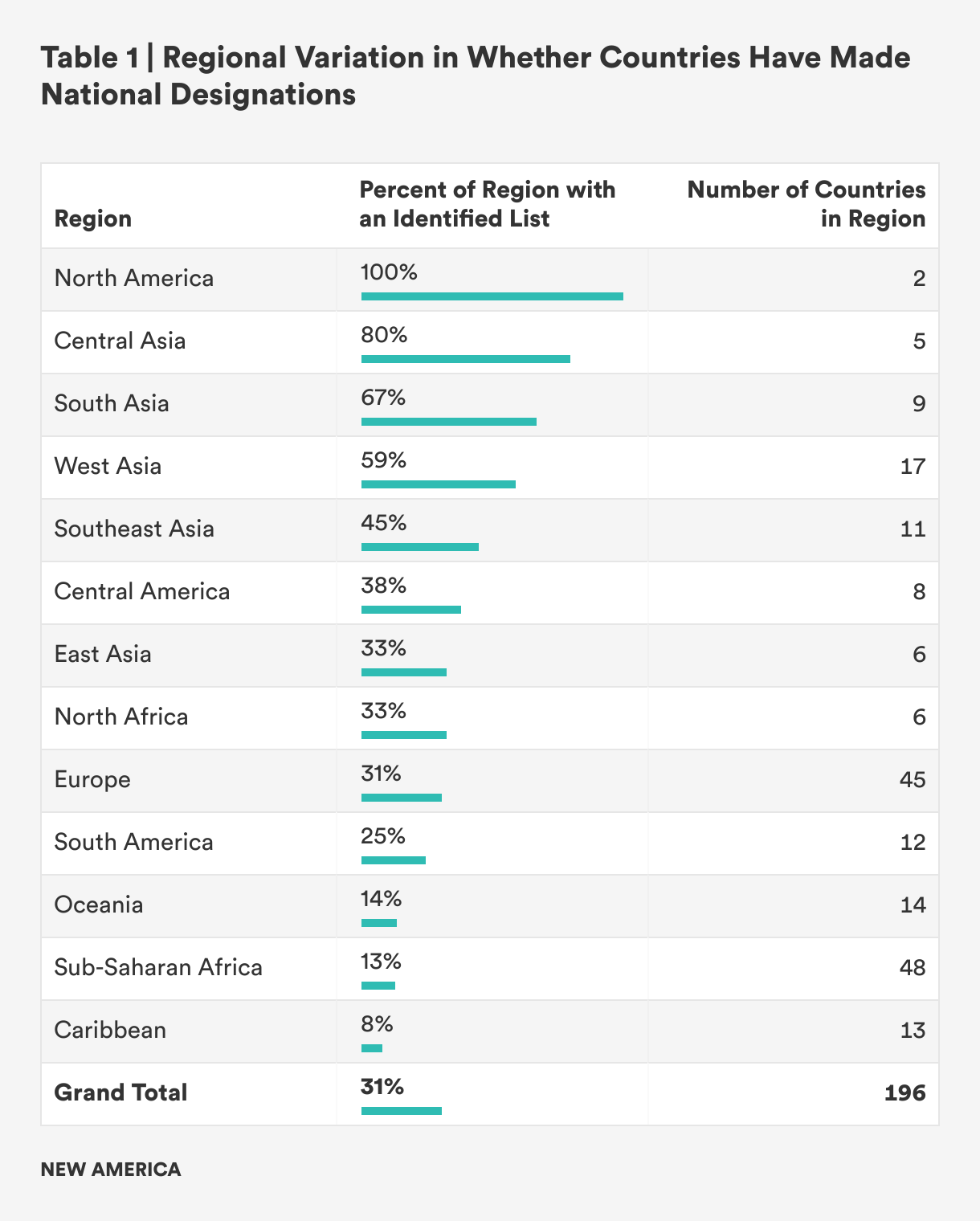
- At least 60 countries have labeled at least one entity as a terrorist organization. This accounts for 31 percent of the 196 countries examined in this assessment.26 These actions are separate from commitments to adhering to lists maintained by international or regional organizations.
- Of the 196 countries examined for this assessment, 49 (82 percent of the 60 countries that have made a designation) have designations that are presented or described in government sources. Eleven countries (18 percent) were coded as having designated a group based only on media mentions.
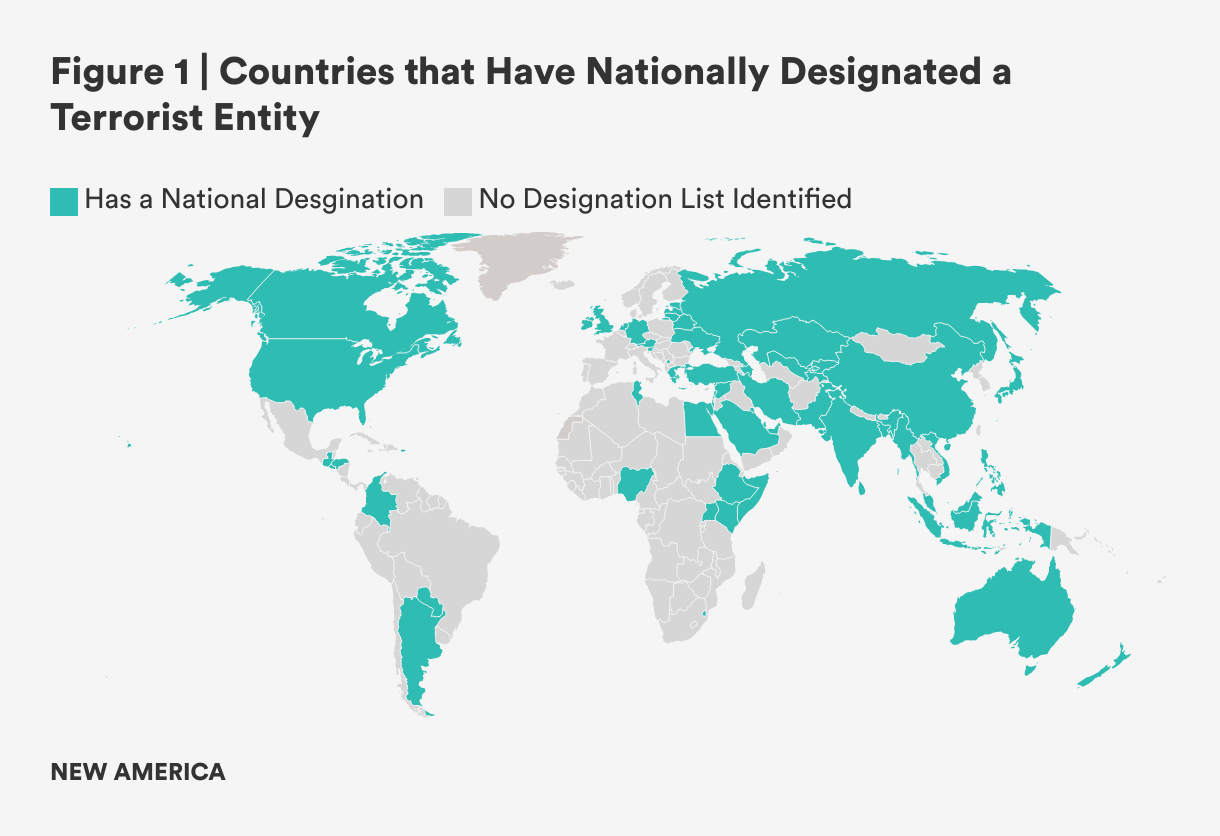
- The geographic distribution of countries that have nationally designated terrorist organizations is uneven (See Table 1 and Figure 1).27
- North America has the highest proportion of countries having made a designation at 100 percent, although it is only made up of two countries. Central Asia, South Asia, and West Asia have the next highest proportions of countries having designated groups.
- The Caribbean, Sub-Saharan Africa, and Oceania have the lowest proportions of countries maintaining designations.
- In Oceania, only New Zealand and Australia appear to have promulgated national designations. This may reflect a difference between these larger states and the various small island states that make up the rest of the region.
- Designation practices also vary within regions.
- The European Union designates only Hezbollah’s military wing as a terrorist organization. Some EU members follow only the EU’s designation list, while others have gone further to designate Hezbollah in its entirety, disputing that any divide exists in the organization.
- Of the 27 members of the EU, seven have taken further designation measures against Hezbollah beyond their EU commitments regarding the group’s military wing.
- Most countries with national designations have designated groups that are domestically based. This stands in contrast to the United States’ reticence to designate domestic organizations.
- Of the 196 countries examined in this study, 43 countries have designated domestic groups. That accounts for 72 percent of the countries that have made a national designation.
- Geopolitical tensions deeply shape designation practices and divide countries over which groups they designate.
- Countries in multiple regions including Europe, South America, the Middle East, and Oceania, are divided over whether and how to designate Hezbollah.
- Middle Eastern countries are also divided over whether to designate the Muslim Brotherhood, reflecting larger geopolitical differences. This regional split reached U.S. policy debates when the Trump administration signaled it was considering designating the Muslim Brotherhood.
- The United States and Iran have designated parts of each other’s governments as terrorist entities. These moves are tied to disputes over specific actions in the region, but have also taken on an element of tit-for-tat retaliation over the designation practices themselves.
- The conflict in Ukraine has seen Russia designate a number of Ukrainian groups, including the Azov Regiment—previously referred to as the Azov Battalion—which is part of the Ukrainian armed forces, as terrorist or extremist organizations while Ukraine classified the Russian-backed breakaway republics as terrorist organizations. This dynamic serves as a cautionary tale about presumptions that designations of white supremacist or far-right groups will not see their own entanglements with geopolitical disputes.
- There have been initial moves to designate white supremacist groups as terrorist organizations. However, such efforts have been limited, particularly compared to the extensive efforts against Al-Qaeda and other organizations linked to jihadist movements.
- A total of 12 groups have been designated at a national level by five countries in an effort seemingly aimed at white supremacist organizations.
- Mapping the designation of white supremacist and far-right groups is complicated by the existence of association bans and other authorities that are not necessarily framed as countering terrorist financing but may increasingly be used and linked to that end.
Citations
- “Resolution 1373 (2001)” (United Nations Security Council, September 28, 2001), source.
- One international institution that outlines recommendations for specific terrorist financing activity is the Financial Action Task Force (FATF). FATF breaks down anti-money laundering (AML) and the prevention of financing of terrorism mechanisms, as well as how they pertain to various international accords and United Nations resolution sanction requirements. FATF even provides “designated categories of offences” related to money-laundering and terrorist financing. FATF defines terrorists based on terrorist acts that are outlined by internationally ratified conventions, as well as its own definition of what a terrorist act is. However, there are only 39 members of FATF (37 jurisdictions and two regional organizations), and “31 international and regional organisations which are Associate Members or Observers of the FATF and participate in its work,” according to the FATF website: source. For more information on FATF recommendations, see: source
- This report highlights that some states choose to designate local or international groups as terrorist organizations, while others refer to groups’ acts as terrorist acts, and others do not designate the act or the group as a terrorist organization for various reasons relating to perceived threat, national law, or otherwise.
- “Resolution 1373 (2001).”
- See for example discussion in: “Technical Guide to the Implementation of Security Council Resolution 1373 (2001) and Other Relevant Resolutions” (Counter-Terrorism Committee Executive Directorate (CTED), 2017), Archived at source; “Recommendation 6: Targeted Financial Sanctions Related to Terrorism and Terrorist Financing,” Caribbean Financial Action Task Force, accessed June 23, 2021, source.
- “Resolution 1624 (2005)” (United Nations Security Council, September 14, 2005), source.
- “A/RES/60/288 (2006)” (United Nations General Assembly, September 8, 2006), source.
- “FATF IX Special Recommendations” (FATF-GAFI, October 2001), source.
- The lists maintained under the Al-Qaeda/ISIS sanctions resolutions include a range of organizations, affiliates, and groups with close links to the Al-Qaeda and ISIS, including groups that are not officially part of the Al-Qaeda or ISIS organizations as the groups see themselves. For example, Lashkar-e-Taiba and the Pakistani Taliban are sanctioned under the list for having assisted and cooperated with a-Qaeda although both are separate organizations. See for example: “Lashkar-e-Tayyiba” (United Nations Security Council, April 17, 2018), source; “Tehrik-E Taliban Pakistan (TTP)” (United Nation Security Council, May 7, 2020), source.
- “Resolution 1989 (2011)” (United Nations Security Council, June 17, 2011), source); Louis Charbonneau, “U.N. Council Splits U.N. Taliban, Qaeda Sanctions List,” Reuters, June 17, 2011, source.
- “Subsidiary Organs of the United Nations Security Council Fact Sheets” (United Nations Security Council, January 8, 2021), source.
- “Security Council Committee Pursuant to Resolutions 1267 (1999) 1989 (2011) and 2253 (2015) Concerning Islamic State in Iraq and the Levant (Da’esh), Al-Qaida and Associated Individuals, Groups, Undertakings and Entities,” United Nations Security Council, accessed January 10, 2021, source.
- For example, see “S/2022/576 (2022)” (United Nations Security Council, July 26, 2022), source and “S/2022/419 (2022)” (United Nations Security Council May 26, 2022), source
- Lauren Fredericks and Matthew Levitt, “The United Nations' List of 'Not Listed' Terrorist Entities,” Lawfare, June 13, 2022, source.
- “Explaining US Sanctions Against Taliban,” Voice of America, February 5, 2022, source; Brian O’Toole, “They Aren’t Listed, but Make No Mistake: The UN Has Sanctions on the Taliban,” New Atlanticist (blog), August 23, 2021, source; “Is Russia Going to Remove the Taliban from Its List of Terrorist Organizations?,” Meduza, August 17, 2021, source.
- “Resolution 2624,” United Nations Security Council, February 28, 2022, source.
- Ephrem Kossaify, “UN Security Council Calls Houthis a Terrorist Group for First Time, Expands Arms Embargo,” Arab News, March 1, 2022, source; Peter Salisbury and Michael Wahid Hanna, “Ending War in Yemen Requires Talk, Not Labels,” Foreign Policy, March 1, 2022, source.
- That list is available at: source.
- On the issues regarding relying on the consolidated list see discussion in Chris Meserole and Daniel Byman, “Terrorist Definitions and Designations Lists” (RUSI/Brookings, July 22, 2019), source.
- The AMISOM mission has concluded and has been replaced by the African Union Transition Mission in Somalia (ATMIS). See “UN Chief Welcomes New Somali Mission, Lauds Work of African Union | | 1UN News,” UN News (United Nations, April 6, 2022), source.
- “Al-Shabaab” (United Nation Security Council, October 29, 2014), source; “Security Council Committee Pursuant to Resolution 751 (1992) Concerning Somalia,” United Nations Security Council, accessed May 26, 2021, source.
- The Al-Qaeda and ISIS sanctions list does designate Al-Itihaad Al-Islamiya (AIAI), a group it describes as having reportedly merged with Al-Shabaab. The AIAI listing points to the Somalia sanctions regime but does not itself list Al-Shabaab even as it notes that Al-Shabaab “was accepted as an affiliate of Al-Qaida.” The resolutions undergirding the Somalia sanctions regime do not reference terrorism as liberally as the Al-Qaeda/ISIS regime. However, at least some of the resolutions do describe Al-Shabaab as a terrorist organization or an organization engaged in terrorist acts. See for example: “Resolution 2331 (2016)” (United Nation Security Council, December 20, 2016), source); “Resolution 2093 (2013)” (United Nation Security Council, March 6, 2013), source); “Resolution 2036 (2012)” (United Nation Security Council, February 22, 2012), source).
- “EU Terrorist List,” European Council Council of the European Union, accessed January 10, 2021, source.
- Kristina Thorne, “Terrorist Designation in the European Union” (Centre for Humanitarian Dialogue, June 2006), source.
- “Foreign Terrorist Organizations,” U.S. Department of State Bureau of Counterterrorism, accessed May 26, 2021, source; “Terrorist Exclusion List” (United States Department of State Bureau of Counterterrorism), accessed May 26, 2021, source.
- The list of countries examined in this assessment was drawn from the Encyclopedia Britannica. The Editors of Encyclopedia Britannica, “List of Countries,” Britannica.com, accessed January 10, 2021, source.
- The regional division we use was drawn from the United Nations’ system here with any countries not in the U.N. list determined by the region given to their neighbors: source. Any determination of regional divisions is likely to miss continuities between countries labeled as in different regions and differences internal to a named region. The aim here is to provide one glance at how designation practices may vary. The map provided in Figure 1 also provides a check on conclusions about regional variation based solely on one system of regional categorization.