Theodore Johnson
Senior Advisor, Executive Office
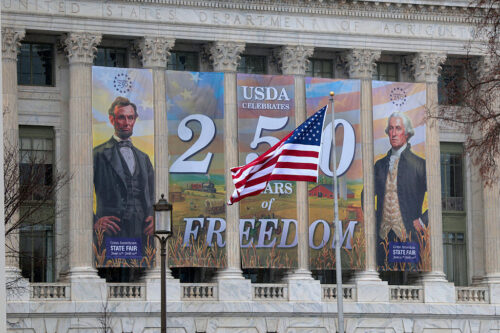

This year, the United States will commemorate 250 years as a nation. The semiquincentennial anniversary arrives at a moment of renewed battle over the country’s identity and purpose. Americans appear more divided and less trusting in our democratic foundations than at any point in recent memory. Sharp ideological shifts, strained economic realities, and widening cultural gaps have left many questioning not only where the country is headed, but what it stands for. While such tensions were not uncommon in the lead-up to past major national celebrations, the stakes of this one feel different. So what’s so pivotal about this moment in 2026?
Us@250 Initiative leader Ted Johnson and fellow M.J. Rymsza-Pawlowska dive into the complexities of American patriotism today, reflect on the historical context of past nationwide anniversaries, and consider how this semiquincentennial could be used not just to look back, but to push the country forward.
TED JOHNSON:
In thinking about the nation’s 250th anniversary—both the semiquincentennial year and the divisive politics that’ve characterized it thus far—what’s your take on the juxtaposition between celebration and strife? Does the contrast between the civic opportunity that should come with this milestone and the ongoing extremely contentious policy debates strike you in any particular way?
M.J. RYMSZA-PAWLOWSKA:
As a historian who works on commemoration, this moment brings the nation’s 1976 bicentennial to mind—the topic of my book on the national celebrations, History Comes Alive. Whenever people ask me a question like this, the thing that really strikes me is how similar 2026 is to 1976. To the 1876 centennial, too. Each came at a moment when the nation was in turmoil—emerging from a tumultuous war, a period of immense change, and during an economic downturn. And yet, the commemorations these moments sparked were meaningful precisely because they gave Americans a venue to address these challenges.
National anniversaries are really an optimum time for reflection—and when commemorations are done well, they are, at heart, about recalibration and resource-building. This is a moment when we can really reckon with our past, take pride in the varying journeys and movements that have gotten us this far, and aspire to do it again, together. Meaningful commemoration is a good opportunity for creating community around these kinds of reflective conversations.
So I personally think there’s no better time than one of upheaval—a time of tension, of strife—to take a moment and make intentional spaces for large-scale reflection.
TED JOHNSON:
I’m with you. What stands out to me is the contrast between the story we tell ourselves about our history and who we actually are today. Our nation’s ideals don’t seem to be reflected in the news cycle. The anniversary should be a time to reflect on all we’ve accomplished, the obstacles we’ve overcome, and the distance we’ve gone—but the world around us feels on fire.
And I sometimes wonder if we’ve ever treated anniversaries as more than just contained observances. In other words, anniversaries and holidays are often framed as a break from the regular world, a vacation from daily stressors. Our observances are filled with food and social gatherings, or community service and memorials. But when there’s injustice and inequality and abuses of power, it feels really hard to check out for an anniversary when all of the things that you’re supposed to be proud of are not being reflected in the world around you.
As someone who has studied and reported on the nation’s past celebrations, could you talk more about how the United States has typically marked these national moments and how the country was at those times?
M.J. RYMSZA-PAWLOWSKA:
There’s lots of complexity in large-scale national commemorations. Lots of conflicting things can be true at once. During the Bicentennial, people were thinking really seriously about the future of government. Nixon had just resigned under the threat of impeachment, many returned from a really difficult war, and there’d been a decade of social movements and protests. All different kinds of people were calling for the government to fundamentally change, to guarantee new types of rights, to put in new safeguards.
Anniversaries have always been contradictory because the American experience is so multilayered. You can be proud of its accomplishments, but you can also acknowledge that things might be precarious or that there is a long way to go. That was certainly true during the bicentennial. There were protests and parades, tall ships and oral history projects, festivals and rallies.
On the centennial, the thing that I always find the most striking is they had a big world’s fair in Philadelphia in 1876, the nation’s first. We tend to think that commemorations are about the past, but the centennial world’s fair was focused on the future. The thing about 1876 was that everyone was talking about what’s next, asking, “What can we do for the future?” Scholars connect this to the possibilities afforded through industrialization and urbanization and a desire to make sense of the larger world, as new technologies prompted people to think seriously about what the next 100 years would bring.
TED JOHNSON:
And yet, the day’s messy politics were also present. I remember reading that there were murals to Civil War victory on display at the 1876 World’s Fair. And Southerners were offended! They sort of side-eyed the centennial: “Why are y’all bringing up old stuff?” They were upset because there were murals of them getting their butts kicked.
Things were supposed to be settled. The centennial was supposed to be a testament to national reconciliation, preparing for the future of the burgeoning industry behemoth that the United States was becoming. But the presidential election that same year was decided in a backroom deal between the parties, bringing Reconstruction to an end.
M.J. RYMSZA-PAWLOWSKA:
Things were not settled.
TED JOHNSON:
Exactly, not at all. So, as you explained, these commemorations are never just about one thing. There’s not just one story. Anniversaries are moments of pride, but also a reminder of what remains to be done, the work left unfinished and the problems left unsolved by previous generations.
For Us@250, the framework of pride, reckoning, and aspiration animates the entire initiative—pride in the nation’s progress, reckoning with its shortfalls and injustices, and aspiration for a just and inclusive future.
Given the moment, how do those three outlooks land for you, and how has the country wrestled with them in previous benchmark commemorations?
M.J. RYMSZA-PAWLOWSKA:
These commemorations are often contested. The stakes are high as there’s constant push and pull over meaning because people are heavily invested in connecting themselves to the American story.
On pride, one thing we should be proud of is our democracy—the ability to participate, the ability to be engaged. It’s the thing that I’m the most proud of about the United States, and I say this as an immigrant, too. The ability and willingness of everyday people to get involved, to get active. It happened in the American Revolution, in every great social movement the country has seen. Pride is the foundation for reckoning, and pride and reckoning are the foundation for aspiration.
I love these three themes because they’re about the past, present, and future. It’s a really nice way of helping to structure participatory commemorations—celebrating the past in a way that helps to structure forward-thinking.
TED JOHNSON:
I love your earlier point that these moments are not national kumbayas—they are contested. And not just for the people’s attention, but over the meaning of the U.S. and its place in the world. Even though the founding principles concerning life, liberty, and the pursuit of happiness may be uniting, the execution of those principles have always been contested.
I’ll be honest: The 250th isn’t playing out like I once thought. For a while, people’s attention was consumed by the looming 2024 presidential election. And once it passed, the semiquincentennial felt more politicized and less like a unifying national moment.
I still think there’s an opportunity here, but I’m curious, what would make this semiquincentennial successful? What would make folks years down the line look back and say the 250th was an important moment for the country?
M.J. RYMSZA-PAWLOWSKA:
I work with a lot of people on the frontlines in museums and at historic sites, and there is definitely a feeling of, “we’re just going to keep our heads down and then we’ll get back to the real work of making people think complexly about the past.” That doesn’t work for me. This moment is the real work.
I’m researching and writing a book about how Americans engage with history, and how those engagements end up informing political perspectives and actions. People care about the past; they think it’s important to learn about it. They’re invested in thinking about the present and the future and in getting involved. People all over the country are looking around and wondering how we got here, and how we can fix it. I mean, what is pulling down Confederate monuments about if not a sign that everyday people are engaged in thinking critically about their role in the nation’s future?
It all makes me really hopeful. So what I would like to see is a commemoration that acknowledges the public’s interest, curiosity, and desire to be better. From town halls here in DC to protests in Minneapolis, more engagement is happening all over the place.
That’s people saying something about who they believe that this country should be for. If you understand all of that as a type of commemorative, or reflective, activity, you have a lot more to work with.
TED JOHNSON:
Agreed. For me, this will be a successful anniversary if it is a tipping point. That’s the bar.
I hope it forces a reckoning, about who we are, who we’ve been, and what the United States is going to be after 250. I hope that we use this moment to confront the deeper questions about who truly belongs and who gets to thrive in America. Otherwise, it’s just a date.
Senior Advisor, Executive Office
Fellow, Us@250