Administration Urges States and School Districts to Invest in Early Education Facilities

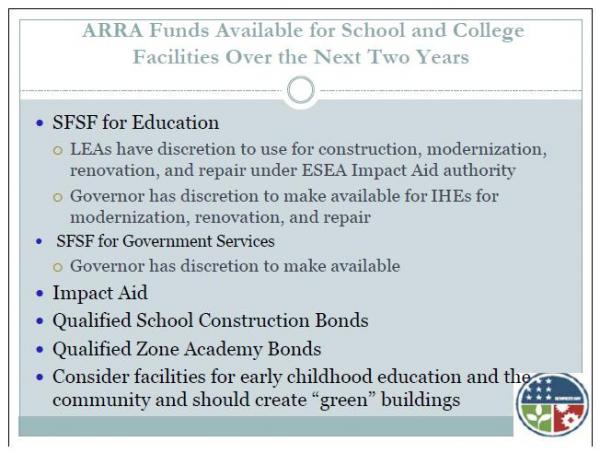
This is a slide from a new Department of Education slide presentation, created by Department officials to provide states, school districts, and education stakeholders with information on when they’ll receive and how they may use funding provided under the American Recovery and Reinvestment Act (ARRA), also known as the stimulus legislation. The Department of Education specifically encourages school districts to include early childhood education facilities in any facilities investments they make using ARRA funds.
That’s a good idea. Lack of access to quality facilities is one barrier to expanding access to high-quality pre-k programs. Further, many existing early childhood programs are in “make do” facilities that aren’t really designed to meet young children’s needs. Investing in quality space for effective early childhood programs is a smart idea that could help expand access over the long-term, but without requiring the same ongoing funding commitments that other investments in expanding pre-k access would involve. During debate over the stimulus legislation, many early education advocates (including Early Ed Watch) encouraged Congress and the administration to use the stimulus to make substantial investments in early childhood facilities. That kind of specific language didn’t make it into the law.
Congress did, however, provide substantial funding for school construction and renovation. Districts can spend their share of $39.8 billion in State Fiscal Stabilization Funds for education on school construction, renovation, or repair. ARRA also provides $22 billion in school constructsion bonds and $2.8 billion in Qualified Zone Academy Bonds, which can be used for repairs or renovation. Early Ed Watch agrees with the Department that school districts should use some of these funds to make needed investments in early childhood facilities, either for district-run pre-k programs or community-based providers.
Districts should also consider using stimulus funds to revamp existing elementary school facilities as PreK-3rd early education academies. Implementing an aligned, coordinated program of early education from pre-k through 3rd grade is a research-based approach to improving student achievement that also provides a compelling vision for whole school reform, and has a track record of success in districts and charter schools across the country. In other words, it’s a strategy that’s totally consistent with the administration’s fourth guiding principle for the use of ARRA Funds: Improve Student Achievement Through Effective Reforms. And the administration’s ARRA guidance for Title I specifically encourages school districts to use ARRA funds to align pre-k and K-3 early education programs.
But implementing PreK-3rd programs effectively may require schools to retrofit their facilities, such as incorporating space for pre-k classrooms, overhauling existing elementary classrooms to meet the needs of small children, and creating common spaces for preK-3rd students and teachers that are separate from those serving older youngsters. Funding these changes can be difficult for school districts, but stimulus funds provide a source of facilities funding that they could use to meet these needs.
Perhaps most importantly, the fact that the administration is encouraging districts to use ARRA funds for early childhood facilities suggests once again that they are thinking seriously about the importance of early education, with the context of both the stimulus and their broader education reform agenda.
That’s essential because the ARRA legislation itself actually gave pre-k programs short shrift. While ARRA makes much needed investments in CCDBG and Head Start, it doesn’t do much to support state pre-k programs, which have grown substantially in the past decade and now serve more children nationally than Head Start. Eighty-one percent of State Fiscal Stabilization Funds under ARRA are distributed directly to school districts and postsecondary institutions, preventing most states from using them to shore up state pre-k programs. While pre-k programs may be able to secure a portion of the 18.2 percent of SFSF funds not specifically set aside for education, they’ll have a lot of competition for that money. And ARRA’s maintenance of effort provisions could further harm state pre-k programs, by creating incentives for governors and legislatures to shift state funds out of pre-k programs and into the K-12 funding formula. The upshot: If we’re going to maintain and improve access to early education programs over the next few years, local school districts are going to have to play a bigger role in funding these programs. So it’s good to see the administration urging them to do so.
Whether districts will be willing to invest stimulus funds in early education remains an open question, however. So far, districts seem primarily interested in using stimulus funding to maintain the status quo–not to implement bold new reforms or think in new ways about their roles in educating young children. The administration is pressing them to try thinking differently, and early education advocates should do the same.
More About the Authors
Issues
Programs/Projects/Initiatives
Related
Confronting Harmful Federal Disability Policy in Health and Human Services
Federal Early Education Update: March 2026
A Bureaucratic Shakeup Threatens Future Child Care Research