
Jeremy Bauer-Wolf
Investigations Manager

This analysis is part of Mythbusting Accreditation, a written and multimedia series from New America’s Education Policy program. It features insights from experts across multiple fields to cut through false narratives about a crucial higher education accountability system.
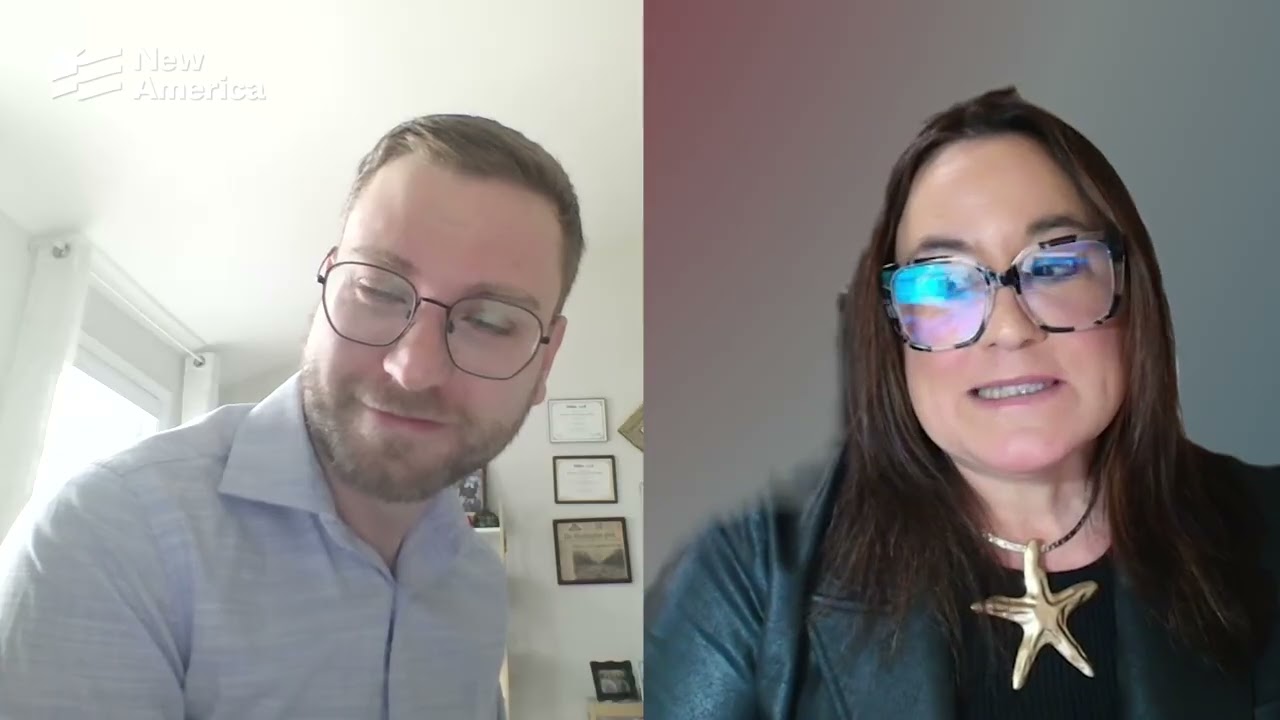
New America’s Jeremy Bauer-Wolf talked with Heather Perfetti, president of the accreditor the Middle States Commission on Higher Education, about how her organization develops its policies and works with colleges.
Jeremy Bauer-Wolf: College accreditation has entered the mediasphere in a way not seen in memory. Headlines about accreditors have become common. Politicians all the way up to the likes of Governor Ron DeSantis of Florida and President Donald Trump have attacked the system publicly, labeling it as woke and in step with the liberal agenda.
But what are accreditors? In essence, they are the gatekeepers of federal financial aid. Accreditors assess colleges by their standards and determine whether those institutions should qualify for aid, which is an $120 billion annual funding stream. But they’re not always portrayed accurately, either by policymakers, the press, and particularly right-of-line media. Welcome to Mythbusting Accreditation, a New America multimedia series where we’ll be discussing the truth of how accreditors and the system actually works.
My name is Jeremy Bauer-Wolf, I’m the investigations manager for New America’s higher ed policy program and today I’m interviewing Heather Perfetti, president of the Middle States Commission on Higher Education, one of the legacy accreditors formerly known as regional accreditors. We spoke about how accreditors really work on the ground and how they evaluate their colleges.
Bauer-Wolf: Heather, thank you for joining me today.
Heather Perfetti: Absolutely. I’m glad to be here with you, Jeremy. Thanks for the invitation.
Bauer-Wolf: Tell me a little bit about the accreditation system. What do you think is the source of the heightened interest around accreditation, both in the public and policy circles?
Perfetti: I think today’s focus stems probably from several years of frustrations, whether real or perceived, with accreditation and with accreditors. And the current political environment allowed those frustrations to come forward in the ways that we are currently seeing. It could also stem from visible negative interactions with accreditors that were very public, along with the growing questions about the value of higher education.
Those two concepts collided in most recent years, despite indicators of the value of higher education for students and communities, and despite our institutions overwhelmingly sharing with us that they are better and stronger because of accreditation. But there has been an agenda that looks differently at accreditation, and that often is based on misperceptions or myths. I know that part of the work that our commission does is trying to educate others about the kinds of myths that exist around accreditation.
That is not to deny that change is not needed. It is why our commission, the Middle States Commission on Higher Education, has seen and supported changes in many ways over the recent years, through changes in the cycle of accreditation, through changes in policy and procedure, and changes in our standards. Looking at the transformation that our commission has done, we are really proud of the work, no matter how or why it is getting the attention that it’s getting right now.
Bauer-Wolf: What are some of the myths that you try to bust?
Perfetti: I think that part of it is that we are the sole arbiters of quality. We obviously operate within the regulatory triad. And so we are partners with states and the federal government in working with institutions and ensuring quality through a different lens and a different perspective.
There are myths about whether we are barriers to innovation. And we challenge any institution that might be saying: “our accreditor won’t let us do that.” A lot of what we do is governed by federal regulation. So our goal is to make sure that any innovative approaches are aligned with regulation and making sure that institutions are going through whatever process we may have to make sure that they are not jeopardizing their status with their state or with their institution.
I also think that there is a myth that data is a foreign concept to accreditors. I’m not sure why that is so persistent or prevalent. I can certainly acknowledge that in years past, data has not been a prominent part of the conversation of accreditors, but data has always been critical to the work that accreditors do. So I’m excited about the ways that outcomes can become a better focus and data through the government or other sources can really help feature the institutions that are doing amazing work. And those who need to move the dial can learn from those institutions and begin to implement some of their practices as well.
Bauer-Wolf: Tell me about how you develop the standards by which you’re evaluating colleges. For the laypeople: Accreditors develop their own standards completely separate from the government, and then evaluate colleges against those colleges. There’s misconceptions around this, like that they might be developed by a single person.
Perfetti: Our standards come from a range of sources, and they start with our regulatory and statutory environment.
We are, as an accreditor, recognized by the secretary of the United States Department of Education. And so that recognition is an important part of who we are and what we do. Our recognition process every five years with the department looks at how well we do around the statutory and regulatory requirements.
So some of our standards are stemming from law, looking at curriculum, faculty, student recruitment and admissions, administrative capacity, and things of that nature. But accreditors also can further develop standards beyond those that are required by law. And our standards, in addition to being mindful of statutory or regulatory authority, are also developed through a collaborative process with constituents.
It’s not one person in a back room developing standards that institutions have to speak to. In the end, our standards come into existence through a vote by our institutional presidents. They vote on the standards, that vote gets presented to our commission. Our commission is at least 25 individuals representing academic areas, representing administrator positions, and public representatives. They then vote on the adoption of those new standards.
Bauer-Wolf: What are some other misconceptions uninformed people might have about accreditation? For instance, there’s a lot of rhetoric around accreditors enforcing a particular ideology.
Perfetti: The one thing that I would highlight, and I always try to highlight, is that we are driven by our focus on institutional mission. And we are not prescriptive as a commission.
I think that makes a world of difference in how we talk about the work of accreditation. We have never told an institution they absolutely must do something or must not do something unless it is a clear violation of state law, federal law, or a clear violation of a commission policy.
We give institutions flexibility around their mission, which means that the evidence they produce, the way that they demonstrate compliance with our standards, differs across our institutions. If you think about the institutions within the Middle States Commission on Higher Education, they are incredibly diverse. We can’t expect them all to demonstrate compliance with our standards in the same ways. So we are not prescriptive, we are respectful of mission, and we give flexibility.
Those who are less informed about accreditation also often misunderstand the process of commission actions. There seems to be this perception that accreditors should strip accreditation early and frequently. It’s just not the way our tools work with our institutions.
We can certainly remove accreditation when it’s warranted and necessary, but we have a significant amount of tools to try to help institutions improve and to give them sufficient time to do that. It is not just one act to withdraw accreditation. It really is about monitoring, making sure there’s progress, giving opportunity. But at the same time, recognizing when that difficult decision has to be made to withdraw accreditation, the commission is prepared to do that.
Bauer-Wolf: What should we be watching in accreditation right now?
Perfetti: We are all watching the volume and pace of regulatory whiplash for all of us, for our partners, for our institutions as well.
I think that the most positive changes are coming through the recent expansion of prison education programs. We have a number of our institutions that are doing incredibly good work in that space. Of course, short-term programs are going to become more prominent, too.
New accreditors have been all over the news. This is something that our commission embraces. We do not fear competition, and we are not looking negatively upon new entrants into the accreditation market, for lack of a better term.
But we all need to watch what that evolution looks like. We need to pay attention to the oversight by the department, but we also need to pay attention to the oversight that those agencies may give to the institutions that come to them. We will see what that looks like as things unfold.
I know we are all prepared for a different environment and what that might mean for us. Improved state and federal policy that can strengthen the work of institutions and the regulatory triad is also another area for all of us to be paying attention. Right now, we have seen a lot of different calls for comments or feedback or notices, and we should all as a community think about what are the kinds of contributions that we can make in response to those calls that can inform the best next step.
I know that everyone is feeling the regulatory burdens and whiplash, but at the same time, I continue to say there is no better time to be at the table around federal and state policy than right now. The moment to influence is right now, and I appreciate the ways that we can continue to do that with all of our partners.
Investigations Manager