Stephen Burd
Senior Writer & Editor, Higher Education

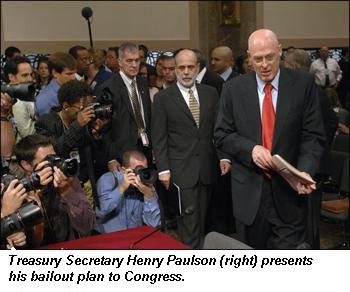
If you haven’t heard yet, Treasury Secretary Henry Paulson quietly inserted a provision in his $700-billion bailout plan designed to come to the rescue of struggling student loan providers. While virtually no details of the plan are yet available, it appears that the proposal would not only focus on federal student loans but would potentially allow loan companies to dump hundreds of millions of dollars of bad private loan debt on the backs of taxpayers. This is a terrible idea.
At Higher Ed Watch, we firmly believe that student loan companies, like Sallie Mae, should have to bear responsibility for the consequences of the predatory private student loan practices they engaged in by pushing high-cost private loans on high risk borrowers. For years, they bore the risk while gladly raking in profits.
 If Congressional leaders go along with this ill-conceived provision and bail out lenders, then we believe they have a fundamental obligation to also come to the aid of financially distressed private loan borrowers who have been victimized by predatory practices. At the absolute least, Congress needs to reverse a 2005 law that made it extremely difficult for borrowers with unmanageable levels of private student loan debt to discharge these loans in bankruptcy. As we have said many times before, it makes no sense that the government has made it easier for people to discharge credit card debt than private loans they took out to attend college.
Over the last two years, we have written extensively about how loan companies’ aggressive marketing practices and cozy relationships with colleges have pushed students to take on unnecessarily high levels of expensive private student-loan debt. In fact, at least one in five private student loan borrowers take out a private loan before they exhaust safer, cheaper federal Stafford loans.
Of particular concern are the sweetheart deals that lenders such as Sallie Mae have forged with some of the most scandal-ridden chains of for-profit colleges, such as Career Education Corporation and Corinthian Colleges. Under Orwellian-sounding “opportunity loan” arrangements, Sallie Mae agreed to provide funds for private student loans, with interest rates and fees totaling more than 20 percent per year, to financially-needy students who normally wouldn’t qualify for them because of their subprime credit scores. Sallie Mae apparently viewed these loans as “loss leaders,” meaning that the company was willing to make these loans, even though it knew that many of them would likely go into default, in exchange for becoming the exclusive provider of more attractive federal and private loans for the tens of thousands of students these schools serve.
Sallie Mae took a huge gamble. They wagered that the additional business they would get from forging deals with for-profit school chains would more than make up for the losses they would endure from making expensive suprime private loans. They were wrong. By all accounts, defaults on these subprime loans have grown alarmingly, and the company has had to spend hundreds of millions of dollars to cover losses from these bad loans. These defaults are not just numbers on a balance sheet, they’re students.
To contain the damage, Sallie Mae has stopped offering subprime loans to students at these poorly-performing trade schools. Speaking of its past practices, Al Lord, the company’s chief executive officer, told The Wall Street Journal in June, “It was obviously a mistake and I’m not going to step away from responsibility because I was either chairman or CEO when those loans were made.” He added, “We got a little too confident in our own view that credit scores are of limited meaning for undergraduates.”
Sallie Mae was certainly not alone in acting irresponsibly. Throughout the year, we have shown how lenders like KeyBank have fueled the growth of unlicensed and unaccredited trade schools by providing high-interest private loans to the at-risk students these schools tend to attract. Many of these schools have shut down unexpectedly, leaving their students heavily indebted and without any meaningful training.
Bailing out these loan companies is not only the wrong thing to do, it would be entirely counterproductive. In the wake of the credit crunch, loan companies are now thinking twice before providing high-cost loans to high-risk borrowers. Trade school chains, which now are using their own money to make private loans to borrowers at their schools, have a much greater incentive to act responsibly and lend to students who have a reasonable chance of paying their loans back. At the same time, low-income students may be beginning to think twice before enrolling in expensive academic programs at schools of dubious quality, when they can take the same courses for a fraction of the cost at their local community college.
Ironically, the credit crunch may provide some “lessons learned” as it relates to predatory lending practices. Lawmakers will be walking away from these lessons if they include a student loan bailout in their greater economic package. If they proceed, should they really be surprised if lenders return to the predatory practices that got us into this mess in the first place?
Senior Writer & Editor, Higher Education