
Table of Contents
- Chapter 1. Introduction and Overview
- Chapter 2. How Pandemic-Era Policies Impacted Study Participants
- Chapter 3. New Key Poverty Narratives
- Chapter 4. The Path Forward: What Families Told Us They Need to Thrive
- Chapter 5. Case Studies
- Appendix A. Methodology
- Appendix B. Ethical Storytelling Guidelines
- Appendix C. Framework for Narrative Change
- Appendix D. Historical Timeline
- Appendix E. Selected Reading
Chapter 5. Case Studies
Two Worlds, One Town: COVID-19’s Devastation of a Navajo Family in Utah
By Haley Swenson
Chantel Valdez, a 36-year-old Navajo-Mexican American, is a single mother to two children and an after-school program coordinator and paraeducator in the small town of Blanding, Utah.1 The COVID-19 virus would soon kill multiple members of Valdez’s Navajo family and wreck the family network she and her kids loved and relied on. The virus disproportionately impacted the Native community compared with the local white community, who at times mocked masking and other precautions. Though the pandemic-era expanded public aid like expanded unemployment, rental assistance, an expanded Child Tax Credit, and Medicaid, which kept her family financially afloat throughout the worst months of the pandemic, these investments were no match for the long-term devastation they faced or the economic hardship that would continue to haunt them after schools were reopened. Four years later, Valdez works two jobs to keep her family fed and housed and no longer qualifies for any public assistance. She continues to seek health and mental health resources to help them process the trauma of their pandemic losses, since the family no longer receives Medicaid.
The COVID-19 Shutdown Reaches Navajo Country
In March 2020, Chantel Valdez and her two children, then six and eight years old, along with her Uncle George, were on their way home from a spring break trip to Magna, Utah, to see family. It was a nearly six-hour drive back home to Blanding, Utah, the largest town in the state’s rural San Juan County, near Four Corners (where the borders of Colorado, Utah, New Mexico, and Arizona meet).2 On the drive home, Valdez decided to stop off for groceries before they entered Blanding’s city limits. They’d been away from home a week and would need to restock their refrigerator for the coming school week.
There is a grocery store in Blanding—just one. But, as anyone on a tight budget like Valdez would have noticed, it was a “resort town” grocery store. Its other locations were in places popular with well-heeled vacationers like Aspen and Sedona. Though Blanding sees its share of tourists—it has dubbed itself “the base camp for adventure”3 due to its relatively close proximity to natural destinations like Moab, Glen Canyon, and Canyonlands National Park—economic opportunity is scarce outside a few retail stores (Valdez can list them all), a mining operation, and government.4
Blanding, Utah, is home to just over 3,000 residents, about 20 percent of whom live in poverty. That’s more than twice the poverty rate of the rest of the state (8.1 percent).5 The median household income is just $61,833, compared with $89,168 in the state as a whole. And Valdez’s family relied on her income alone to make ends meet. The prices at Blanding’s market were so much higher they just couldn’t compete with what Valdez could pick up on the road on her way back to town.
“Have you heard about this coronavirus?” her Uncle George had asked before they’d left for their trip. He’d always been one to follow the news. “Let’s bring plenty of groceries home with us. People are acting crazy. They are stockpiling toilet paper,” he warned as they drove home that day.
Valdez hadn’t given much thought to the virus at the time. She wouldn’t give it much thought until that Sunday, when she stopped off for groceries en route home and discovered multiple stores had been wiped out of their entire supplies of meat, in addition to other important household items. It took several stops to find what they needed. As George drove the car through the town of Price, Utah, Valdez saw something weird as she scrolled through Facebook on her phone. The governor was closing the schools. She texted her supervisor, who told her he did not know much more than she did but that she should still come into work the next day.
Valdez was the grant coordinator for the after-school programs at five elementary schools in the area, including at her children’s school in Blanding and schools on the nearby Navajo and Ute reservations. What was going to happen with the schools? What was she supposed to tell her staff? Was it safe for them to be around each other, around the children? The supervisor didn’t know any more than she did, but answers soon came.
The kids would attend school online from home—a two-bedroom, publicly subsidized, low-income apartment Chantel and the kids shared with their dog, Tank. For employees, the school district instituted a sort of hybrid model at Blanding Elementary, with some staff continuing to report to their school buildings to perform essential services, like program planning and packaging school lunches that parents would pick up for their kids each day.
Within two weeks of the schools closing, the after-school programs were suspended. Valdez and her team were laid off for the rest of the school year. Her supervisor advised them to apply for unemployment, which they did.
When asked what they remember about those early days, the kids, having been much younger at the time, are less sure. “I was being homeschooled when it started,” says Zoey, now age 11. “No,” her mom corrects her, “the homeschooling started because of the pandemic.”
“It was like a zombie apocalypse!” offers Jaxxon, now age nine.
“I wish it would have been a zombie apocalypse!” said Zoe. “I would be prepared. I have a zombie kit ready to go.” She isn’t joking, said Valdez. Since COVID, she likes to plan for worst-case scenarios.
“It felt like the world was ending,” added Jaxxon.
“When we saw footage of the bigger cities closed down,” Valdez clarified, “it looked like a horror movie.”
In Blanding, however, things seemed less apocalyptic. Because Valdez’s kids had already qualified for reduced-price school lunches due to her low income, they immediately also qualified for P-EBT, or Pandemic-Electronic Benefit Transfer. This meant the family had an extra $7.10 per child per day to spend on groceries since they were no longer eating lunch at school.6
That same month, March of 2020, Congress passed the Coronavirus Aid, Relief, and Economic Security (CARES) Act, which approved the creation of Economic Impact Payments, or stimulus checks of $1,200 for every adult and up to $500 for every child under 177 for households with adjusted gross incomes of up to $75,000 for individuals and up to $150,000 for married couples. Since Valdez qualified for unemployment benefits, she also qualified for the Supplemental Nutrition Assistance Program (SNAP) to cover food costs, and the whole family qualified for Medicaid health insurance coverage.
As reports of local COVID-19 cases and the first deaths in Utah rolled in, the entire extended family quickly adopted a series of protocols to keep them safe. Uncle George began making supply runs to stores in Cortes, Colorado, about an hour from Blanding, where grocery costs were cheaper. He bought groceries and household items for both his household and Valdez’s and began masking every time he left the house.
Before the pandemic, if the kids had school and Valdez had to work, she took the kids over to “the grandmas’ house”—a house in Blanding where Valdez’s mother Esther, her mother’s brother George, and the two aging aunts who raised her mother and George and whom Valdez had always called Grandma Mary and Grandma Marie, all lived together. These were Valdez’s Navajo family. She’s Mexican on her father’s side and Navajo on her mother’s side, though she only has a relationship with her mother’s family. This family includes cousins who live on the nearby Navajo reservation. This extended family network was a lifesaver to a single mom long before the pandemic.
Grandma Mary suffered from kidney disease and was on dialysis, and George was her main caregiver, as well as a major source of child care help for Valdez. In the early days of the pandemic, George continued to leave the house for work and then came to Valdez’s house to look after the kids while she was assigned to the school building. The kids at least had basic supervision while she was at work, although school was a struggle for them. Online schooling came with a mountain of homework, and neither George nor Valdez was able to help them with it.
Blanding’s local economy was dependent on passing tourists, but with the pandemic, everything was shut down, and tourists were scant. So the family made a point of supporting their favorite local businesses when they could. The local steakhouse, one of just two sit-down restaurants in town, started selling takeout boxes. The local movie theater sold popcorn and snacks for families to take home for their own movie nights. Valdez and her kids made stops around town to support these businesses and their friends and neighbors who ran them.
“In a way, the first few weeks were kind of fun. We had P-EBT, and the stimulus checks helped, so we weren’t worried about money. We tried to make the most of it, even though everything was so weird. But it felt like everyone was in it together,” said Valdez.
Two Different Worlds in One Town
They’d been so careful. For weeks, only George had come and gone from the house, to his job at the local youth detention center, where he sat almost exclusively by himself, and always masked, in the center’s control room. Still, in May, Grandma Mary contracted COVID-19. The only outing her grandma made was to the dialysis center in town, and that’s where they assumed she must’ve been exposed to the virus.
Grandma Mary was one of about 500,000 people in the United States experiencing kidney failure who typically have to go to a dialysis center three times a week for four-hour treatments to stay alive.8 There, wearing a mask, she would be seated next to others receiving treatments, who may not be socially distancing or taking other precautions. As in much of Blanding outside the Native community, said Valdez, people did not take the threat as seriously, rarely masking, and, as she heard some boasting, even going out in public after testing positive for COVID.
Grandma Mary tested positive for COVID-19 in early May when she had an elevated temperature during a vitals check at the dialysis center. She was immediately taken to an isolation room at the emergency room located in the same building. Later that same morning, she was moved to University of Utah Hospital in Salt Lake City. At the time of that transport, Valdez says the only symptom Mary had was a fever.
It soon felt to Valdez that she was living in a different world from the white population. Even years later, she uses a hushed voice as she describes the local tensions emerging over COVID precautions. “I remember my grandma was in the hospital dying, and I was arguing with someone online about masks, about whether they were worthwhile. And I started crying because it was like they just did not care,” she said.
Even prior to the pandemic, the lines between Native and non-Native people in the area were stark. In 2016, President Obama announced the creation of the Bears Ears National Monument, putting 1.34 million acres of desert land—including land sacred to the surrounding tribes and dense with ancient artifacts and fossils still used for grazing and hunting—under federal protection from artifact looting and exploitation of its natural resources.9
Valdez and her uncle had become activists opposed to the creation of the monument because it would turn what was both sacred and functional land to the Native people into a tourist destination and put it under federal, rather than local control.
That fight, as well as a battle over gerrymandering that led the federal government to intervene against an all-white county commission that had drawn political lines to minimize the impact of Native voters, have drawn national attention to the area.10 The San Juan County Commission pledged to fight the Bears Ears National Monument, arguing that the local population could be better stewards of the land than faraway DC bureaucrats, and it devoted millions of dollars to its legal battle against the designation in federal court.11
Across the United States, Native American or American Indian communities were hit much harder by COVID-19 than the white population.12 In 2020, just less than 1 percent of Utah’s population was American Indian, and yet this group accounted for 3 percent of deaths from COVID in that first year of the pandemic. The case/death rate from COVID was nearly three times as high for American Indians as for the population as a whole, with just six deaths per 1,000 cases of COVID for the state as a whole, but almost 16 deaths per 1,000 cases among American Indians.13
Native communities responded by instituting strict masking, handwashing, and social distancing protocols, which did lessen these disparities as the pandemic went on.14
The lack of formal health infrastructure throughout Navajo Nation was a likely cause of higher mortality rates from infection among Native people.15 Lack of access to ambulances, hospitals, and even testing sites made it take longer for infected patients to seek help. Long-term scarcity of health infrastructure also left many Native people with chronic health conditions known to make COVID more deadly. Even before the pandemic, the Native community in San Juan County had agitated for faster access to emergency medical services—like an ambulance to be stationed on the reservation16—and had been left to fend for itself, despite a legal obligation for the federal government to provide health services.17
“As for the local government and the town, I don’t want to call it racism,” said Valdez, “but discrimination. There’s so much discrimination. I remember when Zoe started school, she came home to me and said, ‘Mom, why can’t I play with the Navajos?’ And I said, ‘What? Baby, you are Navajo!’ And she said, ‘Then why did the girls in my class say we don’t play with Navajos?’”
The unequal toll COVID took on the Native and white communities only emphasized these lines in the sand further. “I couldn’t believe just how bad it was on the reservation compared to in town,” said Valdez. “I heard Navajos asking, like, ‘Are we being targeted?’ Almost conspiracy theories. ‘We heard crop dusters flying low over the reservations at night. Are they spreading something?’ That’s how low the trust was. How did we get hit so bad, and for some people in the same town it was like it never happened?”
How COVID Wrecked a Family’s Support System
In the hospital, nurses and doctors themselves were fearful of contracting this still new and little-understood virus, so no one was allowed to visit patients. Nurses monitored Mary mostly from afar, even skipping her initial dialysis treatments for fear she might pass the virus to them. According to the National Kidney Foundation, COVID-19 caused the first drop in dialysis treatments in 50 years due to shortages in staff and supplies.18 Still, Chantel says Grandma Mary seemed to be doing well at the hospital, where they were able to text her and talk on the phone with her.
Two weeks after Grandma Mary went to the hospital, Uncle George tested positive for COVID-19. He immediately began isolating within the grandmas’ house, eager to stop the spread.
On May 24, 2020, Valdez received the news that her grandma Mary had died. Ultimately, the family suspects she died not from COVID-19 but from a lack of dialysis treatments due to fears of COVID-19. The pandemic had taken the first member of Valdez’s family.
Then came the news that one of Valdez’s aunts on the reservation had died of COVID. They weren’t particularly close—Valdez had just gotten to know this particular side of her mom’s family in the last couple of years. But suddenly, it seemed like COVID was tearing her family apart.
After work, Valdez left her kids at home and brought food for her mom, her aunt, and George, who was still isolated in the basement. Each night, she left a plate at George’s bedroom door. She’d ask how he was doing and what he needed. She couldn’t believe how sick he sounded. And then, one day, she arrived with food to discover the last meal she’d brought was still sitting beside the door. He hadn’t retrieved the tray for yesterday’s meal. Panicked, she knocked and yelled for George. He answered back softly that he hadn’t had the energy to eat.
“George, we have to get you to the hospital,” she told him through the door. She heard him struggle to get himself out of bed. He said he wanted to shower before going to the hospital. She waited outside the room, feeling tortured. George needed help, and she couldn’t provide it. The last thing either of them wanted was for the illness to spread further within the family.
“George,” she said, “I’m going to wait outside. If you can’t get outside in the next 10 minutes, I’m calling an ambulance.”
She waited outside, feeling each minute tick by so slowly it felt like an hour. She held her cell phone close, watching the clock and standing ready to dial 911. Finally, the backdoor opened, and her uncle made his way out of the house. She’d never seen him look so sick, so weak. He walked toward his truck. She wanted to hug him. It felt so wrong not to hug him and help him to his truck.
“I’m going to follow you to make sure you get there safely,” she said. She got in her car and followed him as he drove to the hospital. She watched from her car as a paramedic took George’s vitals in his car, then brought a wheelchair out and moved him into the hospital. It was the last time she would see him.
That night, concerned about George’s oxygen levels, the hospital in Blanding flew him to St. Mary’s Hospital in Grand Junction, Colorado. She texted him and called him a few times over the coming days to see how he was. She could think of little else. At home, her kids, who had just lost Grandma Mary, were worried sick over George, whom they called “Papa.” They were incredibly anxious as they waded through their work and homework each day. George was a father figure to Valdez and the only grandfather-figure her kids had ever known. She tried to reassure them. And though he was nearby, a short drive away in a tiny town, they couldn’t go near him, visit him, or hug him.

Photo courtesy of Chantel Valdez, used with permission.
Both kids started becoming fearful. They’d gone from being active, confident, outgoing kids to being afraid of almost everything, from unexpected noises to unexpected phone calls. They started sleeping with Valdez in her bed.
Ordinarily, it was George who would handle the funeral arrangements for a family member, but he was in the hospital, and his condition was not improving. Valdez and her Aunt Judy, Mary’s daughter who lives in Salt Lake, took over planning for Grandma Mary’s burial.
The last time Chantel and the kids would speak to George was a phone call the night before Grandma Mary’s funeral. The next morning she got a call from the hospital. George’s oxygen levels had gotten so low he had been put into a coma, then intubated and put on a ventilator. He would remain unconscious for the duration of his intubation..
He passed away on June 27, 2020. Valdez worked with San Juan Mortuary to drive to Grand Junction and transport George’s body back to Blanding. When the mortician, Danny Palmer, arrived to collect the body, he was horrified to find that the company tasked with preserving the body until it was picked up had not done anything to begin the embalming process. Even worse, it had not even removed the ports and tubes the hospital had used to intubate him, something Palmer had never seen.
“There were fluids and smells,” Valdez said. “They were afraid to embalm him because of COVID. I guess there was a lot of fear then still.” Palmer, however, felt that this did not do George and his family justice, and he agreed to embalm him as quickly as possible. “He said, ‘I don’t care what he died from, he’s still a person, and he deserves better than this.’’’
Palmer and his wife Amanda, who helps run San Juan Mortuary, remember the case well even four years later. They were shocked and angry to see George treated this way. “It was dehumanizing, and Chantel’s family had already been through so much,” said Amanda Palmer. Danny Palmer said the mortician in Colorado had been fearful of COVID and didn’t want to handle the body. But he suspects George’s body had also been low on the company’s priority list since it wasn’t connected to a funeral they would perform. He said he’s seen too much greed from large funeral corporations like the one that handled George’s body in Colorado and not enough humanity.
Valdez remembers the Palmers’ kindness years later. But the problem of paying for their services still remained. Having just paid for their grandma’s funeral and with little in savings left, she knew it was time to ask for help. Valdez’s mom and the rest of the family were reluctant to ask for charity, but what was the alternative? Valdez felt confident that George would have wanted them to lean on their community to get it done.
So Valdez wrote a Facebook post announcing her uncle’s death. He was well loved in the community and known by many for his cooking. George and the rest of the family ran a food stand selling Navajo tacos all around town and at tourist destinations in the nearby area. “Everyone knew George,” said Valdez.
Payments came pouring in over Venmo from both Native and non-Native acquaintances. Within a day, they’d raised $5,300, enough to give George the burial he deserved.
“That’s the thing about living here, and why I say I couldn’t see living anywhere else, despite everything. People know us and our family—and we help each other when someone needs it. It isn’t perfect, but it is our home. I was so touched by how many people gave. It took a day. And most of them don’t have a lot to give, so it meant a lot,” said Valdez.
She managed to give her uncle a traditional Navajo burial, which she thinks he would have liked. “We put him in fresh, new clothes. Our tradition is we get them new jewelry—I got him a watch and a ring. And then before you bury them, you have to break the jewelry and the watch. We did all that.” They buried George beside Mary.
The family couldn’t gather in the way it normally would have to send someone off. A traditional big family dinner to remember George and Grandma Mary would have to wait until it was safe to gather again. A headstone to mark George and Mary’s graves was not in the budget, so for now, their graves are unmarked. Valdez has begun making payments for a memorial bench that will eventually mark both graves.
From “So Much” to “Nothing Left”
The summer of 2020, the family was wrecked by grief after George’s death. Jaxxon’s anxiety was almost unbearable. Valdez consulted a Navajo medicine man who recommended a Native tea to be ingested each night to treat the anxiety. “My aunt was so low and so anxious. But she said Jaxxon brought her back. He’d remind her, ‘Hey, we get to have our tea tonight, and it’s gonna make us feel better,’ and say, ‘It’s going to be okay,’ and just hold her hand.”
“He’s always been like that. He just lifts your spirits,” said Valdez. “I don’t think she would have made it through if it weren’t for him. But he was so young, and it’s so much to ask of a little kid. It takes a toll.” She said, “He had been so outgoing before the pandemic. Zoe too. Then there was no dance class. No friends. And then we lost our support system.” She continued, “We were really afraid and wanted to be cautious. And this was still before the vaccines. I didn’t know what would happen if we got sick.”
In the fall of 2020, Blanding Elementary was the only one of the schools Chantel worked in to re-open. She rejoined the after-school team at her previous $22 per hour, full-time and benefitted rate. Blanding Elementary also happened to be the school Jaxxon and Zoe attended. But fear of experiencing further loss from a still-mysterious illness, one which few people in town seemed to take seriously, caused Valdez to keep the kids in virtual learning for the year. They began alternating weeks spent at Aunt Judy’s in Salt Lake and visits to the grandmas’ while their mom worked. The schools on the Navajo and Ute reservations remained closed.
The devastation the pandemic wrought on the Navajo population was acute, not just due to the increased rates of infection and deaths from COVID but also its impact on families’ finances. Navajo Nation issued two rounds of stimulus checks to enrolled tribal members, amounting to a few thousand dollars. The first, in 2021, was funded through the CARES Act, and the second, which came in 2022, was funded through the American Rescue Plan Act, which was passed by Congress in 2021.19 To qualify for the checks, Navajo people must have CIB status, a Certificate of Degree of Indian Blood. Valdez and her children received these checks, though she faced unexpectedly long delays in receiving Zoe’s checks for reasons she still doesn’t understand.
In her first months without unemployment insurance, Valdez was not sure how she would pay her rent. Her landlady told her there might still be rental assistance available in the state of Utah and gave her the phone number of someone to call at the state’s housing assistance. She called just in time. They were nearly out of funds and close to closing down the assistance process, but they took Valdez’s application and paid her $700 per month rent for two months.
The 2020–21 school year was the final year of the grant that funded Valdez’s after-school programming. She would have to start her job search anew. The principal in Blanding asked if she might want to teach computers at the school, a paraeducator role available to someone without a teaching license. The job would also be part time but would involve managing her own classroom each school day. In the course of a week, every class in the school would stop by her computer classroom and receive an hour of instruction while their regular teachers were given a chance to prepare their next lessons. Though she was intimidated by the idea of teaching a full classroom of students multiple times a day, she jumped at the opportunity. For the fall of the 2021 school year, Valdez earned just $14 per hour in this role.
Then Valdez heard about the opportunity to lead a new after-school program. The American Rescue Plan Act provided funding for after-school programming throughout the country, with the intention of helping students who’d fallen behind with remote schooling to catch up.20 The youth development organization 4-H21 applied for funding to conduct programming throughout the state through its affiliation with land grant institution Utah State University.22 She applied for a role coordinating the grant in Blanding and quickly got an interview.
“Tell us what you know about 4-H,” said her interviewer. The truth was Valdez knew very little, she admitted. But she had experience running after-school programs that would function similarly, and that was important to her interviewers. They were happy to introduce her to 4-H. “I learned so much about the program’s goals just in that interview,” she said. She was hired, but the role paid much less than her position as the grant coordinator for all the schools in the district, $14 per hour instead of $22, and it was part time. The new grant covered just one school, Blanding Elementary, so her role would be more limited than her pre-pandemic job, yet having two part-time jobs meant she was now busier than ever.
“There are so many kids who are so far behind because of the pandemic. One of the most important things we offer in this program is homework help,” said Valdez. The job began in January 2022 and would run through the summer of 2024, when ARPA funding for it would end. Then the search for a new grant, or a new job, would begin again.
Healing Without Support
Jaxxon still struggles with being separated from his mom, facing new environments, and with change in general. He wants to stay in Blanding, where he feels more confident that nothing bad can happen to him or his family. At times, he still climbs in bed with his mom. “If I’m not in my bed in the morning,” said Valdez, “he assumes something really bad has happened.”
He started seeing a counselor in the school system to help him cope with his anxiety and fears, which he and Valdez think have helped him immensely.
Zoe has also tried therapy, though there are few options in their small, rural town. The therapist she tried first, when she returned to school in person, wanted to see her during school hours when Valdez was working and unable to get away for appointments. Beyond that, Valdez felt the therapist was strangely suspicious of her and her parenting and not great at listening to Zoe. Finding a good fit has been a challenge. The biggest change Valdez has noticed is that Zoe has become painfully shy, feeling great anxiety over basic social interactions. She wasn’t like that before the pandemic.
“I think they’re still grappling with the fact that they could lose everything just like that,” she said.
She, too, has been affected by the toll of their COVID losses. In early 2024, she realized she was depressed. She felt like she was getting through her days in a cloud. Her bedroom was a disorganized mess. She was losing patience with her kids over small things. She knew she wasn’t herself and hadn’t been, really, since she lost George.
She went to the local health clinic and got a prescription for an antidepressant.
She noticed changes within just a couple of weeks. She sat down on her bed one day and looked around at the mess. Then she started picking up. She folded clothes and threw away trash. She put things where they belonged. Soon, her room was clean—just like that. “Why did that seem so impossible before?” she wondered.
At work, she sat down at her desk in the computer classroom and started to tidy that too. A colleague came in and noted the change. “You’ve got more energy! Your face even looks different. Happier,” the coworker said.
In March 2024, nearly four years to the day the COVID-19 pandemic started to change their lives forever, the family debated what to do with their Saturday. It was March and still cold out, so many tourist destinations nearby were still closed for the season. And their family budget was as tight as ever.
“We could go to the skate park,” suggested Zoe.
“Only you like to skate,” said Valdez. “We could go bowling?”
Jaxxon lit up immediately. “Please,” he said, “I haven’t been in, like, two or three weeks!” Bowling it was.
Blanding’s only bowling alley is nestled inside a combination gas station, convenience store, and A&W fast food restaurant. The kids bowled while Valdez watched. She’d woken up with a toothache and couldn’t move around much without it hurting even more.
“I went to the dentist last week. They told me I need a root canal and that it would cost me $400 out of pocket. I was like, shouldn’t the UNHS [United Navajo Health System] cover this? When I had Medicaid, it was nice. I could just get everything taken care of. Now I’m not sure what to do.”
“We went from having so much help to having nothing.” She worried about how she’d pay the bills. They also no longer qualified for SNAP benefits. “We can’t buy good food to make real meals anymore. We’re back to dinner out of a box.”
This has left Valdez feeling abandoned by the government, whose help she could use more than ever since losing her support network, her family’s safety net. “Before the pandemic, [people in Congress] used to say they didn’t have the money to do more. Then the pandemic happened and they somehow found it. Now they say they don’t have the money anymore. Why can they find the money when they want to? It doesn’t make sense to me,” said Valdez.
Valdez is aware of the usual arguments against government spending to aid families. “And I know there are people who abuse the system,” she said, mentioning relatives on the reservation who pay no rent, subsist on SNAP benefits for food, and live on a combination of federal and Tribal welfare benefits. This kind of living frustrated her since she was working full time, paying rent, barely getting by, and no longer receiving any kind of government assistance at all. It was important to her that she live off the reservation so she might be able to own her own house and land someday. But now she earned too much to receive assistance and too little to save to buy a home. “There have to be better ways to support families in a more gradual way, maybe with reduced benefits as their income goes up. But it can’t be all or nothing,” she said.
The only remaining benefit they received as of the spring of 2024 is Medicaid for the kids. But that, too, would be going away soon. The March 2020 Families First Coronavirus Response Act declared a public health emergency and required that states provide continuous coverage to those who applied. Because Valdez qualified for unemployment insurance, she and her kids qualified. But over the last two years, states have been unwinding that coverage. Because she works two part-time jobs for two different employers—Blanding School District as a paraeducator and Utah State University as site coordinator—she doesn’t qualify for health insurance under either. Utah has done worse than other states at retaining coverage for children since the unwinding of pandemic-era benefits began, largely due to what one advocate called “state-induced red tape.” Valdez is hopeful they’ll qualify for CHIP, the federally funded Children’s Health Insurance Program, that covers children in families with incomes too high to qualify for Medicaid.23
Earlier in the school year, Valdez’s boss announced that researchers from the University of Utah would be coming in to observe her and other paraeducators in their classrooms. Valdez, who’d received almost no training and had been left to figure out how to manage a classroom herself, was immediately terrified. She was assured this was just an observation and there would be no negative consequences associated with it, no matter the outcome.
On the day of the observations, she did her best, and she was relieved when all her classroom management techniques and her computer lessons went smoothly as a team of professors and graduate students watched and took notes. At the end of the day, one of the observers approached her. “That was great,” he said. “Where did you get your teaching degree?”
“Oh, I only have an associate’s degree,” Valdez explained. “I don’t have a teaching degree.”
“Well,” said the man, “Would you like to get one? You’re a natural.”
She was flattered. The whole experience gave her more confidence. Now she sometimes thinks about going back to school and getting a bachelor’s degree so that she could teach full time. “I love working with kids. I used to think I wouldn’t. I didn’t love kids other than my own. But I really do love it.”
“But for now,” she said, “with these two?” She gestured to Zoe and Jaxxon, who were showing off a fun technique they’d honed for eating the lunch they’d bought at the A&W: stacking fries under the bun of a cheeseburger, then impaling the burger over the straw of their sodas, so it sat stably on the soda’s lid. Then they’d alternately bite the cheeseburger from the sides and drink their soda from the burger’s center. “All-in-one,” said Jaxxon, holding his cheeseburger-cup proudly.
Since the pandemic, the kids have spent a lot of time eating in the back seat of the car, whether going back and forth to Salt Lake; making supply runs to Cortes, Colorado, or to the Sam’s Club in Farmington, New Mexico; or getting supplies for Valdez’s after-school program. One day she looked in the rearview mirror, and this was how they were eating. “It’s very creative,” she said, shaking her head and laughing with them, then wincing as the tooth pain came back.
She’s got two kids who need her and two jobs that wouldn’t cover even a semester’s tuition. The teaching degree is a someday goal. As for her immediate goals? Therapy for both kids; getting Zoe’s confidence back up again; helping Jaxxon to feel more secure; and keeping up with her own health needs so she can be there for them. And, if she can save enough by the end of the year, finally buying that bench to mark Mary’s and George’s graves. “In some ways, we’re still grieving what we lost,” said Valdez. “But we are moving through it.”
Poverty Is a Preexisting Condition: Slipping Through the Safety Net in Georgia
By Brigid Schulte
Kiarica Schields is a 33-year-old single mother of four who lives just outside Atlanta, Georgia. Schields herself grew up in poverty and, more than anything, has wanted life to be different for her children. Although Schields has a college degree, worked for years as a hospice nurse, and built up savings even after she fled an abusive marriage, the pandemic shutdowns that shuttered schools and child care facilities left her without any child care options. She was unable to work. The loss of child care unleashed a cascade of events that, after she ran through her savings, sent the family tumbling from the middle class into poverty. The family was evicted four times between 2020 and 2024. During the pandemic, the family was able to survive through the federal government’s expanded unemployment insurance, the stimulus payments, the expanded Child Tax Credit, expanded Medicaid, and food and nutrition aid. But Schields’s unemployment was cut off without explanation, and her appeal was denied. Since then, Schields has struggled to find the kind of work that would give her the flexibility she needs to care for her children, pay enough to cover the bills, and provide her children with the stability they need to grow.
The day starts early for Kiarica Schields. On this chilly morning in March 2024, Schields, 33, wakes at 4 a.m. as usual and, after a few hits to the snooze button, quietly drags herself out of bed, careful not to disturb her four-year-old son, Kash, who had crawled into bed with her in the night. She tiptoes into the living room of the one-bedroom apartment in the suburbs of Atlanta that she shares with her four children. Two are asleep on the blow-up mattress that takes up most of the floor space. At 4:30, she gently shakes her eldest, Khalia, 14, who is stretched out on the couch, deeply asleep. “It’s time,” she whispers.
Groggy, Schields spreads a sheet on the floor and irons Khalia’s Reserve Officers’ Training Corps (ROTC) uniform while the sleepy teen maneuvers through the dark apartment to wash her face with cold water, dress, pack her bag, and get ready to catch the 5:38 a.m. bus to the high school in the next county. She usually arrives at 6:12 a.m. for a 7 a.m. school start. She’ll find something to eat for breakfast at school.
There are high schools in DeKalb County closer to their apartment that wouldn’t require such a long and early commute. But this is the school where Khalia started as a freshman and wants to at least finish out the year there. She longs for stability. And life for this family has been anything but that, especially since the start of the COVID-19 pandemic in March of 2020.
Back then, like many Black families headed by a single mother, the family was precariously hanging on to a middle-class rung of the socioeconomic ladder. Then the pandemic unleashed a cascade of events, starting with the loss of child care, that sent them tumbling towards the bottom. Although the unprecedented levels of federal pandemic aid slowed their slide, the family wound up falling through some of the already large holes in the frayed U.S. poverty-prevention and subsistence program offerings, known as the “safety net.” Schields has struggled to find a well-paying job in a country where 44 percent of the workforce is low-wage, earning about $10 an hour.24
On this March day, Schields is again out of work. She feels stuck. She loses sleep at night worrying about how—or if—she’ll ever make it back up the very steep ladder to stability. “I feel like my life is a big mess right now, and I don’t know what to do next. Every time I think I get ahead, something else comes up,” she says.
When schools and child care facilities closed down in 2020, there was no way Schields, a single mother living in rural Carnesville, far from her family in Atlanta, could both care for her children and get to her job as a hospice nurse. With no job, the college-educated registered nurse quickly ran through the savings she’d worked hard for years to build. She sought unemployment insurance benefits, but they stopped abruptly, and her appeal was denied. She still doesn’t understand why.
Throughout the pandemic, she had a hard time finding child care. In the first year of the pandemic, across the country, as lock-down orders shuttered schools and businesses, an estimated 63 percent of child care centers and nearly one-third of family child care homes closed down.25 In Georgia, the share of licensed providers dropped 30 percent from March to April 2020 alone, one report found, and though the majority had reopened by December, the report didn’t track non-licensed family home care or the after care programs Schields had often relied upon for her four children, who, at the start of the pandemic were one, four, five and 10 years old.26
Even when she could find child care or after care programs, with no steady income, she could no longer afford them. She took on odd jobs that fit the schedule she needed to care for and supervise her children’s online schooling. She drove for DoorDash and worked as a driver for Walmart’s Sparks delivery service, sometimes with Kash, then a toddler, strapped into his car seat in the back. Sometimes, she made deliveries with the whole family tagging along, keeping each other company with trivia games. She took in laundry. She cooked and catered gigs. She prepared taxes. She worked the overnight shift at UPS until she became too afraid that a neighbor would report her to Child Protective Services for leaving the children alone with Khalia, then 12. She started a GoFundMe campaign. She worked low-wage temp jobs as a food runner, banquet server, and housekeeper. She worked as a virtual receptionist. She took low-wage staffing jobs. She earned $15 an hour in a human resources position at a prison. She earned $17 an hour as a volunteer coordinator at a homeless shelter, a flexible job she loved. In the fall of 2021, she tried to scrape together enough money to rent a second apartment and make income renting it out as an Airbnb. But she couldn’t keep the payments up and by November, she got an eviction notice. None of the jobs paid her enough to cover her bills.
Between 2020 and 2023, the family was evicted three times, despite an active Centers for Disease Control and Prevention moratorium on evictions in 2020 and 2021. In one case, Schields feared she was on the verge of being evicted and left on her own. “I usually lose all my furniture each time,” Schields says matter-of-factly. Two different cars were repossessed when she couldn’t keep up with her car note payments. Schields moved the family from rural Carnesville back to the Atlanta suburbs in Gwinnett County at the start of the pandemic in 2020 to be near family so she would have more of a “village” to help her with child care. She and the children then moved in and out of crowded apartments with family members, some of them on the verge of being evicted themselves. “The only way to make it work is to bunch up,” Schields’s mother often says. Schields and her children drifted in and out of cheap motel rooms.
When the family was evicted from their apartment in Gwinnett County in the summer of 2023, Schields was out of resources and at the end of her rope. She sought refuge at a homeless shelter. The only openings for families were in Vidalia, Georgia, several hours away.
So Khalia longs for the stability she hasn’t had. Khalia figures she and her siblings have attended at least five or six different schools in four years. She’s lost count. “Every time we had to move, it made me so mad. Every time we had to go to another school. I didn’t like meeting new people,” she said. “It was just a lot.”
The family left the homeless shelter in the fall of 2023 and moved back to Atlanta. Though Schields moved the family into a cheaper apartment in DeKalb County, where they were living in March 2024, the federal McKenny-Vento Education Act, passed in 1987, enabled Khalia and her siblings to keep going to the schools in the Gwinnett County school district where they were enrolled before they became homeless.
Schields’s middle two children, Kailyn, nine, and Kinsgton, eight—Schields calls them, along with Kash, “the littles”—had also started the school year at their former elementary school in Gwinnett County. Schields’s mother, Rhonda, lived with them at the time and, because she had a car, she could drive the children to school throughout the fall. When Rhonda found her own place and moved out in January 2024, what had been a 12-minute drive became a two-hour bus ride for the children some days. They were often late. They hated it. In February 2024, the middle two switched to the elementary school just down the road from the DeKalb County apartment.
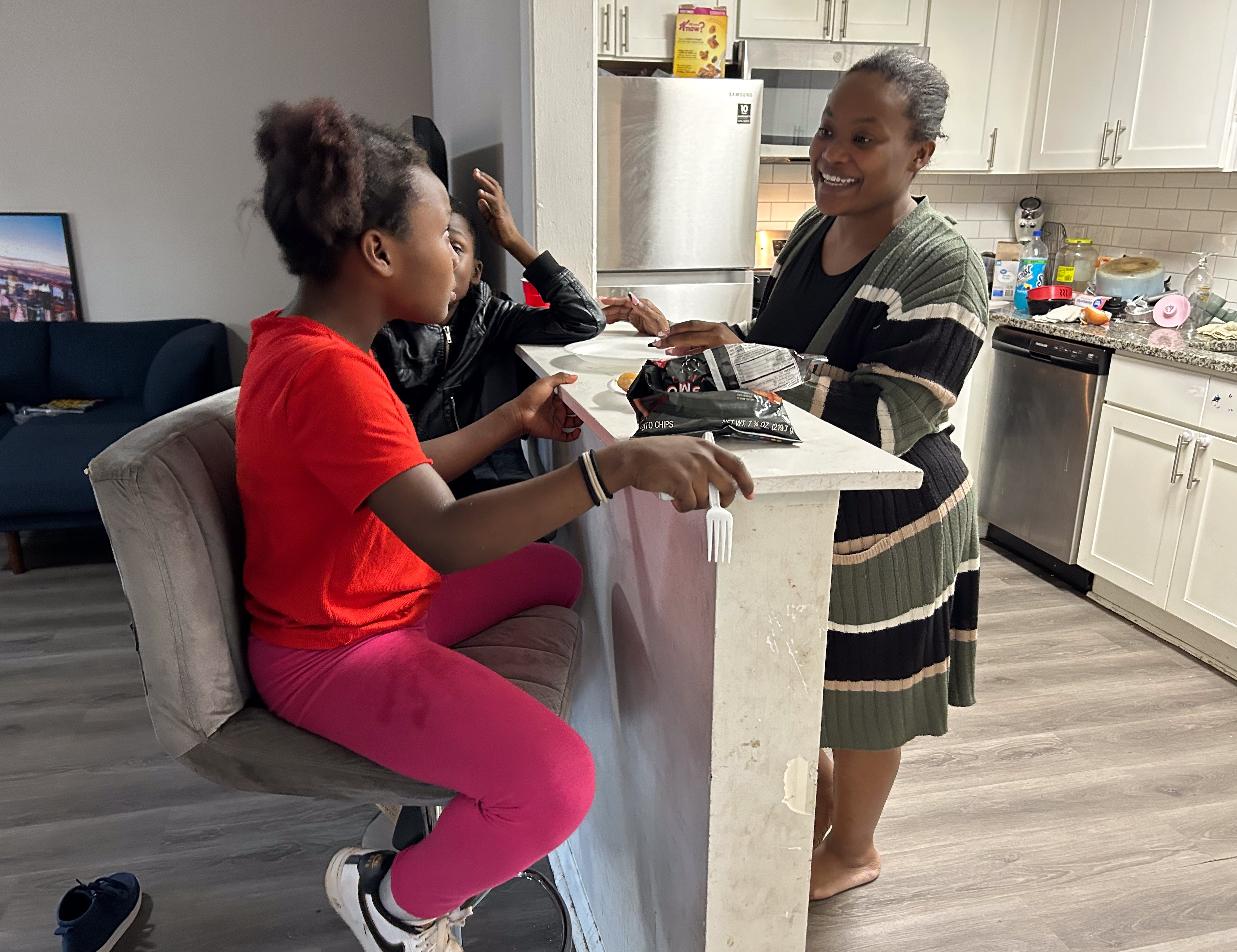
On this March day, after seeing Khalia off to the bus, Schields lets Kailyn and Kingston sleep in until 6 a.m., then supervises a quick breakfast, teeth brushing, and hair fixing and helps them dress (showers and baths were taken the night before). They pull clothes out of various plastic-colored bins and plastic bags where Schields tries to keep their clothes in some semblance of order.
Brigid Schulte/New America
That leaves Kash. Schields starts the same morning routine for the third time. By now, she’s tired, feeling an all-too-familiar anxiety and depression creeping back in like a heavy fog. It slows her down. Kash is cranky and, like many four-year-olds, uncooperative. Although she wants to get him to school in time for a healthy breakfast there, he insists on a quick meal of last night’s dinner leftovers. She gives in, dishes out some meat and rice on a Styrofoam plate, zaps it in the microwave, and hands it to him with a plastic fork. With just minutes to spare, the two make it out the door. Gripping Kash’s hand tightly, Schields rushes the two of them across a five-lane highway to the bus stop to catch the 7:58 bus that takes him to preschool. The bus is late. The two wait nearly 30 minutes as Kash wraps himself in his mother’s warm, heavy blue sweater while she checks job listings on her phone. By the time Kash makes it to pre-school, the breakfast service is already over.
After walking the half mile back, Schields cleans the small apartment. “If it’s too much of a mess, I can’t think straight.” She makes herself a juice smoothie of kale, spinach, ginger, pear, cucumber, and apple, hoping it will give her more energy. She yawns. Then she begins her own day looking for a job that will both fit with her kids’ schedules and pay the bills.
At this point, Schields has given up hope of finding a good nursing job. Most places have such serious nursing shortages that they require 10- and 12-hour shifts.27 That feels impossible for a single mother. She’s tried applying for flexible telehealth jobs or nursing jobs in doctors’ offices with regular hours, but none panned out. And after losing so many much-loved patients and family members in the pandemic, including her grandmother, she needs a break from the medical field, even if it means less pay and less steady work. “COVID just sucked the nursing out of me,” she says.
Still, she’s getting desperate. Her $1,330 monthly rent is coming due, plus late fees. She’s been out of work since December. The car financing call center where she’d worked for a few months let her go a few days before Christmas. The reason, they said, is that she had violated their attendance policy and was “unreliable.” She had had to leave work early twice when the school called to say Kingston was acting out, being violent, and was being suspended.
She’s been getting calls like these about Kingston’s behavior ever since the first eviction upended the family’s lives. The calls have become more frequent the more unstable the family’s circumstances have become. Back when Schields was still trying to find well-paying hospice nursing jobs, she lost one after another because of these calls to get Kingston. “They called me unreliable there, too,” she says. At the car financing call center job, she often called on a niece or another family member to get Kingston when he was acting out and suspended from school, regularly paying out $20 to $30 a trip for their ride shares.
By the time the financing company let her go, Schields was exhausted. “I was kind of hurt after all I did to make it to work on time.” With no car, the commute, which began at 5:30 a.m., took two buses, two trains, and two hours. She arrived every morning by 7:26 a.m. She was never late. The return commute was equally long. She’d get back to the apartment close to 8 p.m. some nights. All for $18 an hour, which didn’t come close to covering the family’s bills. With her mother living with them, Schields knew the children were well cared for. “But I didn’t want to keep missing out on my children’s lives to make it work.”
She pulls out her smartphone. In the previous 14 days, her Indeed job hunting app tells her she’s applied for over 100 jobs and has had 10 interviews. The news media is full of reports of a strong labor market, plentiful jobs, and workers now able to hold out for better positions. But nothing seems to be working for her. And with her mother now living on her own, Schields can no longer work the long hours that she had at the car financing company. “I’ll look at anything. I’m willing to humble myself if it will get my family what we need,” she says. “I’m constantly checking my email as if it’s going to change my luck.”
Today, she’s hoping she can find a flexible, work-from-home job at Apple. On the advice of a family member, she paid someone $40 who promised to secure an interview at Apple if she passed an assessment test. She failed once but thinks she’ll pay another $40 to try again. She begins to dream. With a work-from-home job, she could just walk up the street to get Kingston if he were having a difficult day at school and keep working with him at home. “I can’t afford to keep losing jobs because I have to go get him.”
Kingston’s teachers say he is doing well academically. The serious, slight, sensitive third grader already reading at the fifth grade level. But any change in routine can set him off. Schields worries that the child’s ADHD is making him prone to paranoia and violence, thinking people are laughing at him or out to get him, and she isn’t sure who to ask for help about it. She does know that the medicine amps him up so much that, if given too late in the day, he’ll be so wired he can’t get to sleep until well into the middle of the night. She’s hoping to get Kingston on a special education plan to give him specialized services but isn’t sure how to wade through the confusing bureaucracy necessary to create one for him.28
She scrolls through job listings on her phone. She’s mindful that if she finds a job that pays more than about $21 an hour, she’ll lose Medicaid health care benefits for the kids and likely the child care subsidies that help her afford before- and after-school care and child care for the littles. Although she’d been applying for the child care subsidies for years, she was finally approved in the summer of 2023 after the family’s stint in the homeless shelter.
She sits at her kitchen table in front of her laptop and interviews for what turns out to be a multi-level marketing scheme. On the phone, she interviews for a part-time job as a children’s swim instructor. It pays $20 an hour. The pool is nearly two hours away by bus. She schedules an interview for an office assistant job. She almost signs up to take a typing test, then looks at her new, long, and sparkly acrylic lavender nails. Her boyfriend, David, who works the overnight shift at a refrigerated warehouse, had surprised her with a spa day not long before. Though she loves how the nails look in private, she’s embarrassed by them when she goes out in public. She sees how some people in the grocery store eye them as she pays for groceries with her Electronic Benefits Transfer card, signifying she’s poor enough to qualify for a public food nutrition subsidy. She tries not to wither under their judgmental stares.29 She can guess what they’re thinking. She hears the politicians on TV who say that if people are struggling in poverty, they must not be working hard enough. Lazy even. Such people don’t deserve to have pretty nails. She shakes her head at the thought. “I can’t wait to get back to work,” she says.
As she considers each job that pops up on her phone app, she envisions how she would get there, whether she’d have time to get her children ready for the day, and if the hours are flexible. Then she looks at the numbers to see if pursuing the job would even be worth it. Often it’s not. Like the $18-an-hour manager position at a juice spot far from home she decided to take a pass on. Between interviews, she prepares taxes. Her clients, mostly friends and family, owe her hundreds, if not thousands, of dollars. Only three of the 15 with completed tax forms have paid her. But many are themselves struggling, like her, so she’s had a hard time asking them for payment. She avoids conflict when she can. “It’s probably a trauma response. I try to be a people pleaser,” she says.
She worries that her appearance may be the reason she isn’t getting a job. She’d undergone gastric bypass surgery in the fall of 2023 to help her lose weight, thinking that would help with her energy, her depression, and her ability to find a stable job. “I’ve never been out of work for so long. What is it? Is it my hair? I haven’t had my hair done in so long. I’m looking so basic with my hair in a ponytail. Is it just me?” she asks. “Maybe I’m not giving off the right vibe.”30
She pauses and looks out toward the winter light flooding in through the sliding glass doors by the air mattress on the living room floor. The light, she says, calms her. A black poster propped up on the floor against the opposite wall under the TV set proclaims, “I can do all things through Christ, who strengthens me.” She misses going to church. Without a car, it’s been months. “Maybe that’s why things aren’t going so good for me.” She sighs. “I really don’t know. Some days, I just don’t even know who I am or what my purpose is anymore,” she says. “I used to trust that my purpose was to care for others. Now I don’t know what my purpose is. I can’t get ahead. I’m trying not to give up. I’ll do any little odd job to make sure money’s flowing in. It’s just really tough.”
Pandemic Aid Eased the Pain But Didn’t Stop the Slide Into Poverty
When the pandemic hit in March 2020, Schields first thought she could weather it. She had savings. She had a steady job. And, like most people, she had no idea it would last as long as it did. But losing child care, then losing her job, and then being evicted sent her on a rapid downward spiral.
The federal government’s unprecedented response to the pandemic helped keep millions of families housed and fed.31 And it did help Schields and her family. Between March of 2020 and March of 2022, the U.S. government spent $5.2 trillion on pandemic aid, the largest share of gross domestic product outside wartime.32 Analyses have shown that the aid made a significant difference in the lives of millions of people and in the health and economic stability of the nation.33 What made the most difference in peoples’ lives, research has found, were the cash stimulus payments, expanded Child Tax Credit (CTC), Medicaid, food and nutrition assistance, unemployment insurance, and the eviction moratorium and mortgage forbearance programs.34 “The aid kept struggling families from being pulled over the financial cliff,” said Scott Fulford, an economist and author of The Pandemic Paradox, about how the federal investments actually improved financial well-being for many people and averted what could have been what he called a nationwide “financial apocalypse.”
Schields remembers getting the expanded CTC payments in 2021, $200 to $300 per month per child. “We used that for rent.” As for any other pandemic aid, she doesn’t really remember. The past few years have been too much of a blur of stress and the struggle to survive that she isn’t sure. She knows she received unemployment insurance for a few months in 2020 but doesn’t remember the $600 monthly top up the federal government provided to the millions of unemployed workers from March to July that year. When the state cut off her unemployment insurance benefits, she appealed and was rejected, though she still doesn’t understand why. She became active for a time in a national advocacy group, Unemployed Action, with other workers whose applications or appeals for unemployment insurance were rejected without explanation.
When it comes to child care, the issue that sparked so much of Schields’s troubles, one analysis found that two-thirds of child care centers across the country were closed in April 2020, and one-third remained closed in April 2021.35 As many as half the child care facilities in the Atlanta area where Schields lives were shuttered. Child care just wasn’t available during the pandemic, forcing millions of parents, primarily mothers like Schields, out of the workforce.36
Schields also applied for state child care subsidies, but was repeatedly rejected until 2023, when her stay at a homeless shelter bumped her to the top of the list. During the pandemic, Georgia used some of the $24 billion child care stabilization dollars that the federal government sent to states to help shore up the shortage of child care workers. The state offered $1,000 bonuses to child care workers, who are typically paid poverty wages and can’t afford to stay in their jobs. The state also increased reimbursement rates to providers, and it expanded the number of subsidies to 73,000 children from 50,000. The additional investment was still nowhere near the need.
Georgia’s child care subsidies typically reach only about 18 percent of those eligible.37 And though the federal government recommends that states reimburse providers who accept subsidies at the 75th percentile of market rates that providers typically charge, the state of Georgia reimburses providers only at the 25th percentile, far below what it truly costs to run a child care program.38 That leaves providers scrambling to cover bills and, without raising tuition that they know parents can’t afford to pay, scrape together enough funding to pay staff.39
Even with the meager boost in child care spending, nearly half of all families in Georgia live in child care deserts. One Georgia survey found that child care struggles directly impact the financial security of more than eight in 10 parents.40 Nearly half said they’d had to turn down job opportunities because of a lack of adequate child care, and one-third, like Schields, had to leave the labor force.
With such little state support, child care is expensive for parents. One analysis by the Department of Labor’s Women’s Bureau found that annual child care costs range from more than $5,000 to $17,000 per child, depending on the type of care, a child’s age, and the population size of a county.41 For single parents like Schields, infant care costs can eat up anywhere from 24 to 75 percent of family income. At one point, Schields did find child care, but she was paying more than $600 a week in child care costs and earning $800 a week. She couldn’t sustain it. “Child care. That’s my issue,” Schields says.
In the spring of 2022, one year before the federal government officially declared an end to the pandemic emergency, Georgia cut off federal emergency funds. By the fall of 2023, one report estimated that nearly 1,000 child care programs in the state were expected to close as a result.42
“We talk about these values of hard work, that if you work hard, you should have a life of stability—be able to save and take care of your kids. But the reality is, you cannot work if you do not have the proper and affordable care in place,” said Ife Finch Floyd, director of economic justice at the Georgia Budget and Policy Institute (GBPI). “This not only harms families but local employers and it’s impacting our state economy as well. It’s not just families that hold the burden of this underinvestment in our care system,” she said.
As the pandemic raged, the unpredictable income swings from Schields’s various odd jobs prevented her from qualifying for some pandemic benefits. She remembers being rejected at least three times for health insurance for herself through Medicaid. But at least the children were covered. “I haven’t been to the dentist in so long,” she muses. Because of the swings in her income, she also found that the food and nutrition help provided through the Supplemental Nutrition Assistance Program (SNAP) also varied. Sometimes, she was denied, or had her benefits reduced. But when she was out of work and out of money and needed it most, she says, SNAP was a lifeline.
But the eviction moratorium? “I don’t know why I didn’t get that,” she said. At the height of the pandemic, when local jurisdictions were using federal pandemic aid for eviction diversion programs and rental assistance, Schields’s mother, Rhonda, went to court when she was facing an eviction. A stranger approached her. “I was so scared,” Rhonda recalls. “Then he said they were going to help me. They worked out a payment with my landlord. They saved me once. Later, the second time, I did get evicted.” Schields remembers going to court every month for four months seeking the kind of rent relief that had helped her mother once. “Every time, they told me they were out of money,” she said. Instead, she ran into a barrage of scammers, promising help but wanting between $500 and $1,000 from her up front. “I never trusted that,” she says.
It makes Rhonda angry to see her daughter struggle. “The government came through so big for so many of us during the pandemic, then they just let everyone down,” she said. “Now, you’re on your own again.”
At Schields’s lowest point, in early June 2023, she was out driving DoorDash late at night and was so tired she fell asleep at a traffic light. She’d called Khalia to talk to her to help her stay awake. But the fatigue took over. A police officer knocked on her window and ordered her out of the car to stand on one foot and walk a straight line to test if she was drunk. “I told the officer, ‘I’m tired. I promise you, I’m not drunk. Breathalyze me.’ But he said, no, I had to do a field sobriety test. I said, ‘Sir, I’m so fat I could not do them.’”
She failed the field sobriety test, which is a flawed measure of inebriation, research has found, particularly for those overweight.43 The police took her license away, and she spent the night in jail. Although the court gave her a document stating she could drive to and from work and the children’s schools, Schields lost it in one of the family’s many moves, along with the number for the public defender fighting the DUI charge. Worried she’d be caught driving with a suspended license, she voluntarily turned her car back in to the dealer. With no car, she couldn’t keep up with the commute to work and lost another job.
Sometimes, when she felt hopeless, her mind went to dark places. “The only thing that saved me is thinking, ‘Who the heck is going to raise my kids if I do something crazy?’”
She remembers sitting with her children on their luggage in the middle of a desolate motel parking lot, surrounded by trash bags containing all their belongings. They’d just returned to Atlanta after a monthlong stay at the homeless shelter in Vidalia. She had no money, and literally nowhere to go. “I was crying. The kids were crying. Everybody was hungry,” she recalls. “Then Kash—he’s obsessed with YouTube gospel stuff and always looking for the positive—he said, ‘Why don’t we just go fishing and fry up some fish for dinner?’”
She begins to weep at the memory. “My whole life, what I’ve wanted was a stable home for my kids so they don’t have to go through the things I did,” she says. “My biggest thing now, I have kids who have to heal from the childhood trauma I put them through.”
Poverty Is a Preexisting Condition. Where You Live Can Make It Worse
Life has never been easy for Schields. She was born in 1991, she says, as a so-called “crack baby,” which refers to children exposed in utero to crack cocaine who were widely vilified during the crack epidemic in the 1980s and ‘90s. Though fears that these children were damaged and would never amount to much never materialized and were instead shown to be racist mythology, the stigma has followed her.44 Her father was shot and killed when she was seven. Her mother and stepfather, both military veterans, struggled with addiction. Family members cycled in and out of jail. Raised largely by an aunt who was often working long hours, Schields was left to fend for herself in an unsupervised house full of older siblings and cousins. Schields says that, for years, she blocked out memories of abuse and violence.
She quit school at 13 to care for a relative’s baby and worked in a restaurant. At 17, she became pregnant with Khalia. That’s the moment she says a lightbulb went off. She decided she wanted something better for her daughter. She got her GED. She found a spot in a group home for teen mothers started by Jane Fonda, then-wife of CNN founder Ted Turner, an Atlanta-based mogul. Schields enrolled in the nursing program at Columbus State University and studied diligently while working at the Waffle House and caring for both Khalia and her relative’s child. She graduated with a nursing degree and began working in 2011.
She later married Kailyn and Kingston’s father, a truck driver, and stayed even after the marriage became abusive. She suffered six miscarriages. That and the two pregnancies changed her body. “He would say how I was fat and unattractive, and he wanted my old body back from before I had kids. He told me I was hard on the eyes,” Schields says. But like Khalia now, she yearned for stability. “I just wanted stability. I stayed longer than I should have, because I know how heavy it is to do it all alone.” Still, she hates to admit that sometimes, in the back of her mind, she thinks, “Man, my life would have been easier if I’d stayed.”
After a particularly brutal fight in 2017, when Kingston was five months old, Schields left the Atlanta area and took the children to a domestic violence shelter in rural Carnesville, about an hour and a half away. The shelter helped her find affordable public housing, affordable child care, and connected the whole family to mental health services. Schields found good work as a hospice nurse. She met Kash’s father at a conference and surprised both of them when she found out she was pregnant. Her IUD birth control device had failed.
Still, Schields was able to manage. Khalia’s father sometimes sent money to his daughter. Kash’s father sometimes helped cover his expenses. She hung onto all the paperwork she needed to apply for child support from her ex-husband. That March morning, she pulls it out of a kitchen junk drawer. She leafs through page after complicated page, looking bewildered. “I’m not sure I understand what they want.” She puts it back in the drawer. She’s received no child support from her ex-husband since leaving him in 2017.
More than anything, Kiarica Schields’s story illustrates how the pandemic aid, for all the good that it did to help millions of families, did not solve poverty. The aid did, however, provide important lessons for how we as a nation can begin to do so. And that starts with understanding how poverty functions like a “preexisting” condition, with long-term costs and consequences to individuals, communities, businesses, and society.
“The pandemic aid, for all the good that it did to help millions of families, did not solve poverty.”
Zach Parolin, a senior research fellow at Columbia University’s Center on Poverty and Social Policy, writes in his book, Poverty in the Pandemic: Policy Lessons from COVID-19, that while the unprecedented federal investments in safety net programs were, indeed, lifesaving, they proved a “fragile victory.”45
People who had experienced poverty at some point in their lifetimes, like Schields had growing up, were substantially more likely to face greater health challenges and financial struggles during the pandemic, Parolin explained. They were about twice as likely to lose a job compared to those with higher incomes. “U.S. counties with the highest poverty rates, for example, had twice the per capita COVID death rate relative to U.S. counties with the lowest poverty,” Parolin said.
The pandemic aid “didn't fix the structural and long-term challenges of poverty that this country has,” he said. “Poverty is not just a single point-in-time state. It’s a condition that lingers over your life once you’ve experienced it. There are health challenges associated with growing up in poverty. There are neighborhood conditions associated with higher poverty rates. The disadvantages accrue throughout someone’s life. The additional aid in 2020 and 2021 didn’t make those disappear for good. It just helped out quite a lot temporarily. Though the federal government’s interventions were extraordinary, they weren’t the antidote for fixing long-term poverty problems. There’s still a lot to do.”
To start, we can revive a broken social contract between government, business, and workers and build upon the powerful lessons of the unprecedented pandemic aid: that government, business, and workers can work together to alleviate poverty and suffering and make life better for everyone—when they choose to.
“Government, business, and workers can work together to alleviate poverty and suffering and make life better for everyone—when they choose to.”
The government investment and creative, flexible government response is a good place to work together to mend and strengthen the safety net. Workers can share their stories and demands. Lawmakers and business leaders must ensure that all jobs are good jobs, big enough to support lives and families, with flexible schedules that enable people to both work and care for loved ones. A renewed social contract, focused on equity and human well-being, would ensure that housing is affordable, health care is available, and that child care is high-quality, easy to find, and reasonably priced. And, perhaps most importantly, this new social contract would be dedicated to addressing the challenges of geography and structural racism.
Before the pandemic, Georgia, which has one of the highest shares of Black residents46 of any state, also had one of the highest rates of poverty of any state in the nation, with Black residents hit particularly hard.47 Georgia ranks lower on measures of economic security, economic opportunity, and overall well-being than most other states, especially for Black individuals and families.48 Georgia had one of the highest rates of childhood poverty, 15.1 percent, prior to the pandemic. The Biden administration’s expanded Child Tax Credit (CTC) of 2021 opened up eligibility and boosted payments to families, bringing that rate down to 8.7 percent, an astounding 43 percent drop. But, like the national average, once the tax credit expired and Congress failed to renew it, poverty rates bounced right back up. Nationally, the expanded CTC cut the child poverty rate to 5.2 percent, the lowest ever recorded since measurements began in 1967. Once the credit expired, the rate more than doubled, to 12.4 percent in September 2023.49
Georgia also has one of the highest rates of housing loss, evictions, and mortgage foreclosures in the country, one analysis found.50 And among the least affordable housing51 options or subsidized housing vouchers.52 The state allots the housing vouchers by lottery to those on a waiting list. But the waiting list is so long it’s often closed. In 2023, the state opened the waiting list to new applicants for just three days.53 Schields knows some people who’ve been on the waiting list for 20 years. A lot of landlords won’t accept a voucher even if you get one, she says. Or if they do, landlords can barge in at any moment for a surprise “cleanliness” inspection, which Schields finds insulting. Or the housing is in dangerous neighborhoods. “I want my kids to be able to go out and play,” she says. Even if that means paying more. Even if that means risking eviction.
By 2023, the eviction rate in Atlanta exceeded pre-pandemic levels.54 Half of all renters in the state are “cost burdened,” spending more than 30 percent of their income on rent.55 One-fourth of all renters are “extremely low income,” and nearly 80 percent of that group are “severely” cost burdened, paying 50 percent or more of their income on rent.56
Incomes are low because Georgia’s minimum wage is one of the lowest in the country. Although employers who fall under the federal Fair Labor Standards Act must pay the federal minimum wage of $7.25 an hour—a level that hasn’t changed since 2009—Georgia’s state minimum wage is $5.15 an hour.57
Georgia, like many Southern states, is stingy when it comes to investing in subsistence programs, and anti-poverty and family-supportive policies. It is one of about 20 states that do not have a state Earned Income Tax Credit to bolster low-wage and working-class workers.58
Schields’s story is all too familiar to Amit Khanduri, director of programs for the Georgia Resilience and Opportunity Fund (GRO), who focuses on its baby bonds pilot. “There’s not enough help,” he said. And what help there is, is cumbersome and confusing. “It underscores the deep failures across systems and the need for substantive policy solutions that address the root causes for the racial wealth income gap,” Khanduri said. “Some might argue these systems were designed to work in this way.” Instead of weaving a bouncier safety net to propel people up and forward, the systems can trap people.
“Our work at GRO is focused on thinking in new ways to help close this income divide now and for the future,” he said. That’s why Khanduri and GRO are part of a growing movement experimenting with cash and guaranteed basic income (GBI) pilots. GRO is running one of the largest GBI programs in the country focused on Black women. They’ve found that recipients use the funds to pay rent and bills, pay off debt, invest in education, and take time to care for themselves and others.
Experiments like this are seeking to address a root cause of poverty that keeps people stuck—namely, the lack of money. They also are trying to challenge deeply held stereotypes about poverty that have led to policymakers shaping ineffective and punitive safety net policies.
Poverty narratives aren’t based in reality, said poverty researcher Zach Parolin. The prevailing view among many policymakers and in the general public, he said, is that people are poor not because the system has been designed to favor the wealthy from the start, but because those in poverty haven’t worked hard enough or because they’ve made bad decisions. With this line of thinking, “Not only do [those in poverty] not deserve our support, but their way out of poverty is to overcome all the obstacles in their way and start making ‘better’ choices, and magically, things will be okay,” he said. “That’s really a false understanding of how disadvantage is generated in our society.”
Racism, and the false belief that Black people are the primary beneficiaries of safety net programs, work together to prevent policymakers from weaving more effective, and humane, ones. “The facts generally don’t bear out these false perceptions,” Parolin said. “But they’re strong in driving down political support for a more generous welfare state that works better for everyone.”
“I’m Just Tired”
In the early afternoon on that March day, the kids begin spilling back into the tiny apartment, flush with energy after long days at school. Khalia brightens as she tells her mother how she’s passed her midterms in Advanced Placement Human Geography, 11th grade language arts, and 10th grade math. Schields listens intently. Khalia’s in ninth grade, the very grade when Schields dropped out of school. She wants to make sure her daughter stays on track. As they prepare for her parent-teacher conference at the school the next evening—Schields hopes her mother Rhonda can drive them—Khalia shares that she’s happy to be back in a physical classroom. “Zoom school was so bad,” she says. She and her siblings all lined up with separate devices at the same table in whichever small apartment or room or shelter they were crammed into. The noise got to be too much. “I couldn’t focus,” she says. “I stopped learning. I’d just turn off my camera and sit looking at the computer screen.”
The only class she’s failing is culinary arts, which most people who know her can’t believe because Khalia has been helping her mother cook for the family for years. The two break open an economy pack of chicken wings that had been defrosting on the counter and begin to coat them in French’s mustard and hot sauce for dinner. Khalia talks about the flag football team she plays on and how much she loves being on the wrestling team. “I was going to run track, but I didn’t have a way to get home,” she says. Her mother bristles. Already, Schields is out $600 in the past three months paying for Uber rides to get Khalia home from wrestling practice. Kingston has been pestering her about playing football, which will mean paying for expensive equipment. With no steady income, and no car, she’s had to tell them that she just can’t afford either activity. The conversations make her literally sick to her stomach.
The littles burst in. Kailyn bubbles with excitement about reading Charlotte’s Web and the upcoming polka dot day. “Mom! Do I have anything with polka dots?” she asks, as she begins to paw through pink plastic tubs with her clothes.
“I don’t think so,” Schields says, turning toward her younger daughter.
“Could you make something?”
Schields turns back to the chicken and whispers to herself, “Yikes. Spirit Day always catches me off guard.” Schields knows her kids have been bullied for not having the right name-brand shoes, so tries to save up when she can. A bewildered Kingston, hoping to fit in at his new school, asked not long ago, “Mama, are we poor?”
Kailyn stops her search. “I miss my old clothes.” Like previous furniture sets and important paperwork, the family has lost clothes, shoes, and keepsakes with every move.
The afternoon is a busy jumble of kids playing with neighbor kids outside; searching for scant crayons inside; scattering homework packets on the couch, table, and bed while the show Bluey blares from the TV; and clamoring for $1 each when the ice cream truck tinkles through the apartment complex. Khalia curls up on the couch with her laptop, headphones on to help her focus on her homework assignments. Stray cats wander in and out of the sliding glass doors, which the children leave open in the sunny, warming afternoon. Rhonda stops by while taking her home care client out for a drive. A cousin who lives nearby drops in and tries to talk Schields into investing in cryptocurrency with her. The cousin isn’t quite sure how it works, but she’s heard you can quadruple your $800 investment in four weeks. Schields listens impassively, then moves into the kitchen to fry the chicken. Once it’s golden brown, she takes it out of the pan to drain on sheets of blank notebook paper. All the while, she keeps checking her phone for job prospects.
The 6:30 dinner goes quickly. The family eats on paper plates and uses plastic utensils. The children eat variously at the kitchen counter or small dining room table. Once the dirty plates are tossed in the trash and the leftovers wrapped up and stored in the fridge, the children take turns in the bath or shower and wrestle with Khalia on the blowup mattress in the living room.
“Why didn’t you win your last match?” Kingston demands angrily of Khalia.
“I lost my confidence,” Khalia shrugs. “She seemed so big.”
“Mommy! The water is cold!” Kash cries out from the tub.
By 8 p.m., Schields has turned on soothing spa music. She gives the children melatonin from the health food store to help them sleep. She leads them in their daily affirmations and prayers and the hope that tomorrow will somehow be better. They repeat in unison, “I love myself. I trust myself. I believe in myself. I have faith in myself. I have confidence in myself. I am a leader.”
As the children stretch out on the couch and the air mattress, Schields turns out the lights. She creeps back into her bedroom, knowing full well that in the nightly game of musical beds, someone, most often the littles, will end up sleeping with her. Her mind races as she lays in the dark. She worries that Kash’s child care hasn’t sent her a bill, and she isn’t sure how much she owes. She wonders if she should apply for Social Security disability benefits for Kingston. She frets that she isn’t paying enough attention to Kailyn, the middle child. All the while, she’s scrolling through her phone looking at job listings. She’s put herself on a “Facebook fast” because, she told a friend, she was on the site to escape the reality of her own life too often. The phone lights her face in the darkness as the jobs fly by. Juice joint manager. High-volume recruiter for a staffing company. Dunkin’ counter help. Scrolling, scrolling, and scrolling. She closes her eyes. “I’m just tired.”
Epilogue
By August 2024, Schields had found a good job as a nursing scheduler at a big hospital. But it wasn’t on a bus line, and without a car, she had no way to get there. She worked seven days a week as a dispatcher for a plumbing company for a while, earning $21 an hour. With that rate of pay, she lost all her public benefits—child care subsidies, Medicaid for the children, and SNAP. But when she passed out at work from exhaustion, she was fired.
Unable to pay the rent, the family was evicted for a fourth time. They were “bunching up” again with Schields’s mother, Rhonda, sleeping on her couch in another Atlanta suburb in Cobb County. Schields’s sister, a dental hygienist, who had also recently been evicted because she was unable to juggle rent and college tuition payments for her children, was also staying there.
The move from DeKalb to Cobb County meant that Schields had no way to get to the job as office manager for a home care company she’d lined up.
She’d also received a text from a public defender in May saying she’d missed three court dates on her DUI charge. All the notices had gone to one of her old addresses. Given the missed appearances, the defender counseled her to plead guilty, so she did. She spent the summer juggling community service hours, work, and caring for her kids. Once she pays $360 for a risk reduction class, $150 for a substance abuse evaluation, and $200 every time she sees a probation officer, she should get her license back.
The children have started the school year in new schools. And she starts a new job in a customer service call center in September. Kingston is on new medication that appears to be working much better for him.
Although Kash is now in kindergarten, without the child care subsidy that made care just $21 a week for the littles, she can no longer afford the $385 a week for before- and after-school care for them.
She plans to reapply for Medicaid for the children and hopes she’ll get health insurance herself through the new job. She wants to save enough to move the family out of her mother’s apartment as soon as she can. “I’m just hoping,” she said, “to start fresh.”
The Have and Have-Nots: A Child Center Faces the End of Federal Funding in West Virginia
By Rebecca Gale
Tiffany Gale59 says she has wanted to work with children for “as long as [she] can remember.” In late 2019, months before the COVID-19 pandemic, she opened her own in-home child care center in Weirton, West Virginia. She stayed open during the pandemic so that essential workers in the area could have a place for their children to go while receiving free child care from the state. Then, additional funds came in through the American Rescue Plan Act (ARPA). There was more money for nutritious food, equipment, and activities. Stabilization funds allowed her to purchase a second building and begin renovation to enroll more children from the waiting list. Once funds from ARPA ran out, many of the benefits she’d accrued began to slip. Essential workers no longer received free child care and had to find other informal care arrangements. Even though Gale still has a long waiting list, she cannot raise her rates because families cannot afford to pay more. There are some efforts in West Virginia—and across the country—to make the child care funds through ARPA permanent. But for Gale, it may come too late.
It’s 5 a.m. and Tiffany Gale is up, as she is every morning, and the first thing she does is check to see if any of her staff have called out sick.
“They each have kids of their own, and someone is always sick,” she explains. If, indeed, someone is out, Gale will be the one to step in and take over that classroom at the child care center she owns and runs. Until recently, she’d had enough money to hire a floating staff person to fill in the gaps or offer extra support, thanks to federal funds for child care providers under the American Rescue Plan Act (ARPA).
Across the country, ARPA stabilization dollars went to more than 220,000 child care programs, affecting 9.6 million children, with many child care providers claiming such funds kept their doors open at a time when they financially could not break even.60 But the funds ran out in September 2023. Since then, Gale—and thousands more child care providers just like her—have had to change the way they operate. The historic investment the ARPA funds provided revealed just how much child care could improve in this country with sustained federal support. Now, policymakers will have to decide whether to make that vision a long-lasting reality or accept the old status quo.
Tiffany Gale has known she wanted to work with young kids ever since she can remember. “I grew up going through many adverse childhood experiences, and I always had teachers who made a positive impact on my life and wanted the same,” she says.
In August 2019, she opened Miss Tiffany’s Early Childhood Education House, a child care center run in her home in Weirton, West Virginia. When the COVID-19 pandemic hit early the following year, Gale stayed open by accepting children whose parents were considered “essential workers”: teachers, nurses, and mill workers. She got up early and stayed open late to accommodate people who worked 12-hour shifts and needed to drop kids off as early as 5 a.m.
By serving these families, Gale got access to federal child care subsidies. Child care, Gale explains, was essential to allowing these workers to do their jobs, and during the emergency phase of the pandemic, the federal government seemed to agree, sending between $30 and $34 per day per child of each essential worker directly to the providers who cared for them. Leaders in Washington routed additional money through state agencies to child care centers like Miss Tiffany’s, which meant that these small businesses, accustomed to slim margins, finally had some financial breathing room.
Before the pandemic, many child care centers were already in precarious positions because of the low staff-to-child ratios legally required to run them and because so few providers and families received federal and state support.61 The health crisis pushed many centers over the edge, and they closed. But for the ones that could stay open and take advantage of federal investment, there was an opportunity to make substantial improvements, which Gale recognized. She immediately set to work to improve the child care experience at her center.
Renovations, Meals, and Activities
Before the pandemic, Gale had a waiting list “a mile long” for families who wanted a spot. More than 40 percent of children in West Virginia under age six who need child care can’t access it, she explains, pointing to data from Child Care Aware and TEAM for West Virginia Children.62 But she was constrained by the limited space in her home and couldn’t accommodate any additional kids.
Then Gale received money through the ARPA stabilization grants that she could use to expand. She put a down payment on a commercial space in downtown Weirton and then began the renovations needed to open a second location, which she named Miss Tiffany’s School for Young Children. She oversaw the renovation herself, which was primarily carried out by her husband and father-in-law, working on weekends and evenings. “Everyone spent all of our ‘free time’ renovating the space,” she says.
There was enough space—three units and one house—for four classrooms, and as soon as the renovation was completed on the first room, she enrolled 12 more kids. But then, the permitting and construction process grew complicated. Gale discovered she would have to move two HVAC systems, which could cost $12,000 apiece. The timeline for renovation grew longer. “The plan was to have all four [rooms] opened by the time funding ran out, but I only have one open right now,” she says.
Without the extension of the ARPA funds, she faces having to sell the unfinished units. “It’s a shame because there is such a demand for child care,” Gale says.
In Weirton, Form Energy is building a high-volume battery manufacturing facility at the site of the former Weirton Steel plant. The job fairs are already at capacity—the company has an attractive array of benefits, including a 401(k) and paid time off—and expects more than 750 new jobs to come to the area, including in manufacturing, operations, human resources, and administrative roles.63 “But we don’t have the child care infrastructure to support this,” Gale says. “If I have to sell the other two units, that’s going in the opposite direction of where we need to be.”
Each day, Miss Tiffany’s offers two meals and two snacks for each child. It’s food Gale shops for and her staff prepares on-site. Her child care facilities qualify for meal subsidies through the Child and Adult Care Food Program, which is administered by the West Virginia Department of Education. Because of the high poverty levels in the area, all children receive a subsidy for their meals: $1.65 for breakfast, $3.12 for lunch, and 93 cents for a snack.
Extra pandemic funding meant Gale could serve fresh foods, including fruit, vegetables, and meat. Breakfasts started to include sliced peaches, apples, tomatoes, and scrambled eggs. Lunches included chicken stir fry, chicken enchiladas, roast beef, or broccoli quiche, among other options. For an afternoon snack, the children had sliced apples with peanut butter.
But when that money dried up, Gale switched back to the more affordable food options for children that still fall well within state nutrition guidelines: peanut butter and jelly, hot dogs, mac and cheese, and breakfast cereal.64 Instead of fresh versions, teachers now serve canned beans, meats, fruits, and vegetables. Snacks are graham or saltine crackers instead of apples.
Gale laments the switch away from fresh food and knows that her kids do too. “Quality food access supports a child’s brain growth and development during one of the most critical points in their life,” Gale says. But the cost of groceries continues to rise, along with the price of nearly everything else, and Gale knows she can’t raise her rates higher than her families can afford to cover better food for the kids.65
ARPA funds allowed Gale to try new teaching activities. She used grant money to purchase raised garden beds and sunflower kits so that her kids could take on gardening projects. She purchased notebooks for the kids so they could document the growth of the sunflowers, soil, seeds, and water. She also received a Regional Outdoor Play Improvement grant through the West Virginia Early Childhood Training Connections and Resources program, which she used to purchase additional jungle gym climbers for the children to improve their gross motor skills.66 She also purchased sensory tables, which can be filled with items like beans or sand for kids to play in.
Photo courtesy of Tiffany Gale, used with permission.
The ARPA funds allowed her to bring in outside teachers to lead dance and music classes and teach social-emotional learning lessons, but those programs stopped when the funding was cut off. Now, she has “no more outside experts unless they can do it for free,” Gale says.
Instead of new notebooks and arts and crafts supplies, Gale now offers the kids more worksheets and crayons. “It’s stripping children of learning in a meaningful way,” she says.
Naptime also changed. With the new downtown location, Gale had sufficient funds to purchase cots for each kid with sheets, blankets, and pillows instead of the vinyl heavy-duty KinderMats she uses at her home location. Those mats had previously been the best option she could afford that complied with state regulations. They have since worn down, and rips are visible. “We are duct-taping them to keep them around as long as possible,” Gale says. At the home location of her center, it’s still up to families to bring in bedding for each kid, but not all of them can. “We see a lot of kids who are sleeping on a bare mat,” Gale says.
Revenue and Subsidies
Gale’s primary source of revenue is what she collects from the families who use her center, with some additional funding from the state for families who qualify for a subsidy. She has 12 kids at each location, between the ages of six weeks and 12 years, though she estimates that most kids are between the ages of two and five years old. She charges $45 per day or $165 per week, and though demand for spots remains high, Gale feels the need to cap her rates. “Parents can’t afford to pay any more,” she says. “I have to keep my rates at a certain level, or I am not going to be able to keep my doors open.”
Gale estimates that 50 to 75 percent of children who are in her care on a regular basis receive a state subsidy. The process of collecting reimbursement is complicated and cumbersome. Families are required to sign in and out with a black pen (blue pen doesn’t count, she explains, adding, “I don’t know why”). Hard copies of the papers must be mailed to a central office in Charleston, West Virginia. But with so many parents signing kids in and out each day, there are inevitable errors and snags in the process, and the papers will be sent back (again by regular mail, not electronically) for corrections before Gale can receive payment.
One of the major shifts under ARPA—and one that child care advocates have long called for—was a change in the way providers are reimbursed for children who receive state subsidies for child care.67 Previously, providers like Gale were given a subsidy reimbursement based on the child’s attendance—if a child were out sick or opted to spend the day with a grandparent instead of coming to child care, Gale wouldn’t receive payment—or she’d receive a partial day rate if the child left early.68 Her child care facility is considered Tier II on her state’s quality rating, just below the Tier III level that requires national accreditation, so she is reimbursed $34 a day for an infant, $33 per day for a toddler, and $30 a day for children over three years old (25 to 30 percent below market rate). In every instance, Gale was still required to have staff on hand for the children who were enrolled, and she had to cap her waiting list based on those enrollment numbers. “Kids get sick all the time,” Gale says. “If we are forced to reserve that space, then we should get paid for that day.” This is one of the ways that early childhood education is penalized, something that doesn’t happen in K–12 education, which receives broad federal and state support, she explains. “If a child in K–12 is out one day, the teacher doesn't get paid less. For some reason, we don’t see child care as education,” Gale says.
With the ARPA funds, Gale and other child care providers received reimbursement from the state for any child enrolled in their program, regardless of any days they missed. This allowed for a more consistent revenue stream and to more effectively plan staff schedules. This change in subsidy reimbursement policy was made permanent in several states, including California, Michigan, New Jersey, New Hampshire, Vermont, and Montana.69 West Virginia is also continuing to pay providers based on enrollment rather than attendance, and though this policy has been extended several times, it has not yet been made permanent through legislation.
In addition to the more comprehensive reimbursement plan, the state raised the income eligibility limit (to families making 85 percent of the state median income) so that more families would qualify for child care subsidies. But with the end of the ARPA funding, families who had received funds for child care also lost their spots.
Rick Poling is a 59-year-old metal worker in Weirton, with custody of two of his grandchildren, Leona and Tyler, ages five and six. They had relied on Miss Tiffany’s for child care during the pandemic when Poling was working. Since he was considered an essential worker, the state used ARPA funding to provide him with free child care, regardless of income eligibility. Poling was among those who worked 12-hour shifts and appreciated that Gale kept her center open early and late for him. “The kids loved going there,” he says. “Miss Tiffany was really great with them.”
Poling’s case of raising grandchildren is not unusual in this country. More than 2.5 million kids70 in the United States are being raised by a relative who is not a parent—approximately 3 percent of all kids—and the prevalence of opioids71 makes the caregiving arrangement more likely for children in West Virginia, which has one of the highest rates of kinship care.72
But the child care subsidies for essential workers ended in October 2023. Poling received a letter from West Virginia’s family services agency explaining that his child care benefit would be cut off. Poling had also switched jobs, and at his new income level, he no longer qualified for any additional state subsidy. Paying $300 per week for child care for his two grandchildren at Miss Tiffany’s was too much for him. “They liked being at Miss Tiffany’s with the other kids,” Poling says. “But it’s not something I can afford right now.”
Poling’s new job is just across the state border in Ohio. He works with titanium metal: “You see any airplane in the sky, and we’re the place that put the metal on there,” he says. His shift schedules change by week and can be either 6 a.m. to 2 p.m., 2 p.m. to 10 p.m., or 10 p.m. to 6 a.m. Shift work hours like this make securing child care complicated, even with a provider like Gale who had been willing to extend hours and open early.
Without the child care option at Miss Tiffany’s, Poling relies on a friend, a retired teacher, and his girlfriend to help with the kids. For his overnight shift, he drops the grandkids off at the friend’s house, who he pays $250 “every few weeks” for helping him out. Tyler is now in a pre-K program that ends at 1 p.m., and Leona is in kindergarten until 3 p.m. “It’s much easier for them now that they’re in school,” Poling says. But this patchwork arrangement comes with its own challenges and requires mental energy to manage all of it.
Child Care Staff
Years of low wages and no benefits for child care workers have created a drastic staffing shortage in the industry, one that Gale has felt with her team.73 But the influx of ARPA funds allowed providers like Gale to provide bonuses for staff, which were better than raises since future funding was uncertain. ARPA also helped Gale to pay for a floating staff member, without whom Gale has had to step in, bringing paperwork into the classroom to try and finish while the kids are playing or taking a rest. On some short-staffed days, Gale wouldn’t get home until 10 p.m. after starting at 5 a.m.
In exchange for these round-the-clock hours, Gale estimates her take-home pay is $40,000 per year. That’s better than the average child care worker in the state, who makes $10.66 an hour, but the precarity of the business means that she is constantly concerned about money. And it’s less than the median household income in West Virginia, which is about $55,000.74
Low wages lead to other problems for her staff, like securing access to reliable transportation. Gale says many of her employees cannot afford a car. “Or if they can, it’s an extremely unreliable car,” she says, “a beater car.” She has one or two staff members without access to any car, so they find ways to get rides from friends and relatives. Public transit options in Weirton are extremely limited.
Many of her staff are already working 9- to 12-hour shifts per day, and being short-staffed means that Gale offers overtime when someone calls out sick. But even with time-and-a-half overtime pay, it’s just $15 an hour. “It’s still not a ton of money,” she says.
One of Gale’s own staff members made so little money that she also qualified for child care subsidies. This worker recently had to leave her job to care for a new baby with complications, which meant she no longer qualified for a subsidy for her older child. West Virginia’s state legislature has another bill pending, House Bill 4002, which would provide child care assistance to child care staff regardless of their income.75 This could also have the effect of providing some relief to child care providers who give their staff steep discounts for their own children; instead of Gale’s business taking the financial hit, the state would cover the cost of her staff’s child care.
What Comes Next
ARPA funds brought about historic investment in child care. A number of states have seen the changes ARPA made possible as a positive shift that should be continued, and their governments have poured in historic investment to build better child care infrastructure. But, as experts have advocated, a state-by-state solution isn’t enough for a national child care crisis,76 particularly for states like West Virginia, a state with one of the highest poverty ratings and lowest economic opportunity rating.77
Manufacturers in West Virginia have expressed concerns that the lack of child care hurts the state’s competitive edge, contributing to its low ranking in child well-being.78 Gale mentioned that Form Energy coming to town speaks directly to this crisis: Good jobs are arriving in the region, and yet there still aren’t enough child care spots for the families who need them.
Gale has become a vocal supporter of passing the child care legislation in her state and speaking out on how more investment is needed for child care. The ARPA funds shifted Gale’s mindset about what’s possible and how and why she believes the government should play a role in child care—as it does in nearly every other industrialized country.
“I dumped every last penny I had into my business before COVID hit,” she says. “I did a Google search about who makes decisions in West Virginia and started reaching out to the state legislators and bringing [other child care providers] together.” She began volunteering with the West Virginia Association for Young Children and joined the board as secretary, going to Charleston and advocating for more child care funding. Her advocacy has started to take on a larger role in her life: She recently accepted a position as the executive director for the West Virginia Women’s Alliance.
With these new responsibilities, Gale will retain ownership of her two child care centers but not manage the day-to-day work. “I have to be prepared for the next funding cliff,” she explains. “In case we have to close our doors.”
Llegó la Pandemia Y Conoció a la Pobreza: Los Fondos Federales Resguardo a Una Familia, Pero No Por Mucho Tiempo
By Ashley Álvarez
Note: This case study is written in Spanish, the language in which the interviews were conducted. An estimated 17.5 million Spanish speakers live in the United States who speak English less than “very well,”79 and they’re overrepresented among families living in poverty.80 We felt it was important to include this perspective in the project. The case study isn’t fully translated because translation is an art, not a science, especially when discussing personal and sensitive issues. We prioritized preserving Valadez Solano’s voice and intentions in line with our values. A shorter summary in English is available below the main text.
Un Estudio Sobre Las Experiencias de Una Familia Latina Con Las Ayudas Por El COVID-19
En marzo del 2020, COVID-19 fue algo novedoso para Ivonne Valadez Solano, un relato de las noticias que escuchó durante el poco tiempo en que se encontró cerca de un televisor. Pero Valadez Solano no tenía tiempo para sentarse a mirar la televisión. Ella es madre de dos hijos y trabajaba tiempo completo cuando su trabajo en una cafetería cerró por las órdenes de “permanecer en casa” del gobernador de California.81 Calculó dos cosas: había una enfermedad grave que podría afectar a sus hijos, en ese entonces de cinco años y diez meses, y Valadez Solano y su pareja ya no tenían ingresos para sostener a su familia.
La situación no era la que Valadez Solano se imaginó cuando emigró a los Estados Unidos (EE.UU.) de México. Llegó a los veinte años a Los Ángeles (LA) con sueños de avanzar sus estudios en ciencia de ingeniería y informática. Desafortunadamente, las barreras sistémicas que enfrentan los Latinos que emigran a los EE.UU. impidieron sus sueños, incluyendo dificultad en acceder recursos para aprender inglés y oportunidades limitadas de empleo.
Durante la pandemia, Valadez Solano recibió asistencia de desempleo y dos cheques estímulos.82 Por parte de su bebé, recibió el beneficio WIC (sus siglas en inglés),83 o el Programa Especial de Nutrición Suplementaria para Mujeres, Infantes y Niños.84 De vez en cuando, la familia iba a una escuela local para recoger los alimentos gratis que el distrito de LA ofrecía a familias con estudiantes escolares.85 Aunque Valadez Solano trató de aplicar para la asistencia para el alquiler en LA, el proceso era demasiado frustrante y, al final, no completó el proceso.86
Este estudio relata la realidad de millones de familias en los EE.UU. Los programas de asistencia durante la pandemia proporcionaron un alivio para familias, pero no significa que fueron suficientes. Con muchas de estas ayudas terminando por la falta de financiamiento adicional del congreso estadounidense, ¿qué va a pasar cuando las ayudas desaparezcan por completo?
El Sueño de Ivonne
Ivonne Valadez Solano emigró de Guerrero, México a los EE.UU. en junio del 2010 con grandes sueños. Completó dos años de su carrera en ciencia de ingeniería y informática antes de emigrar para aprender inglés, una competencia crítica para su profesión. Emigró a los EE.UU. con el apoyo de sus padres quienes ya habían emigrado al país y vivían en LA. Desde el hogar de sus padres en Mid-City, Valadez Solano tomó el transporte público por una hora, ida y vuelta, a una escuela para adultos en el centro de LA.
El transporte público de LA es difícil de navegar. Solo el 6.8% de Angelinos utilizan transporte público87 y la mayoría son Latinos.88 La mayoría reportan ingresos bajo de $15,000 al año.89 Aunque el transporte público no es utilizado frecuentemente en Los Ángeles, es crítico para familias Latinos y otros usuarios de bajos recursos.
Pero el profesor de inglés dejó a Valadez Solano más confundida que cuando empezó. Determinada en aprender inglés, se transfirió a un centro ocupacional donde encontró cursos que sí le ayudaron. “Fue desesperante porque no sabia ingles,” recanto Valadez Solano. “Para tener oportunidades, se tiene que dar oportunidad.”
Pero su transporte no era gratis. Valadez Solano busco trabajo para pagar las tarifas del autobús y sus otros gastos. Encontró un puesto en un restaurante de comida rápida al otro lado de la ciudad, a una hora y media de su escuela por autobús. Entre el horario fijo de sus cursos, el horario de noche hasta la madrugada de su nuevo trabajo, y las rutas del autobús, Valadez Solano estudió cuatro meses antes de dejar los cursos. “No era lo mejor, pero era un empiezo. No es lo que quería, pero adelante,” dijo Valadez Solano.
Valadez Solano siguió trabajando en servicios al cliente por varios años. Aprendió más inglés a través de sus trabajos, y aprendió más sobre cómo las barreras sistémicas funcionan a nivel interpersonal. En el 2019, durante su sexto año trabajando en una famosa cadena de cafeterías, se dio cuenta del racismo en el trabajo. Cuando una nueva directora, quien era Negra, fue promocionada, la gerente de la tienda—quien era blanca—hizo varios comentarios racistas.
“No eran educados, ni en su carácter o su pensamiento. Más la manager decía comentarios que eran muy irrespetuosos. La DM [district manager] era nueva, pero buena. Yo como supervisor escuché muchos comentarios de la manager. Y no me pareció bien. Para nada bien,” relato Valadez Solano. “Así no se puede trabajar.”
Cuando Valadez Solano reportó los comentarios de forma anónima, fue ignorada. “Nada cambió. Nada pasó.”
Después de reportar los comentarios, el ambiente en su trabajo fue tan hostil que Valadez Solano decidió dejar su puesto, que coincidió con el tiempo que dio a luz a su segundo hijo en mayo del 2019.
“Antes, yo respetaba la misión de la compañía. Pero eso me enseñó que los valores habían cambiado.” Valadez Solano empezó un nuevo puesto con otra cadena popular de cafeterías en septiembre del 2019. Aunque quedaba más lejos de su casa, no se arrepintió de reportar los comentarios racistas.
Valadez Solano conoció a su pareja en su primer trabajo en el 2010, formando una familia de estatus migratorio mixta. Su pareja es primera generación estadounidense, cuya familia es de México. Los padres de Valadez Solano, como ella, son inmigrantes de México. La mamá de Valadez Solano ayudaba—y sigue ayudando—con el cuidado infantil. En California, este tipo de cuidado infantil está exento del requisito de tener licencia.90 Conocida por sus siglas en inglés, FFNs (Family, Friends, and Neighbors) o familiares, amigos, y vecinos pueden proveer cuidado infantil a menores de edad de su familia biológica y a niños de hasta una familia más.
Empezando en 2020, Valadez Solano tenía dos hijos con su pareja. Su hija tenía cuatro años y su hijo era recién nacido. Todo estaba bien. Valadez Solano trabajaba en la cafetería, su pareja trabajaba por su propia cuenta como pastelero, su hija asistía a Head Start, y su mamá ayudaba con el cuidado infantil cuando era necesario. La familia de cuatro vivía en un apartamento de una recámara.
“Estábamos bien,” dijo Valadez Solano.
Llegó la Pandemia
En el 2020, Valadez Solano trabajaba de tiempo completo en una cafetería y aprovechaba el tiempo que tenía con sus hijos. “De pasada escuchaba las noticias, cuando la televisión estaba prendida y dejaba a mis hijos con mi mamá,” ella explicó. Pero empezó a deducir que el coronavirus era grave cuando sus horarios en la cafetería empezaron a disminuir. Y, en marzo de 2020, por órdenes del gobernador de California, todos los que no eran trabajadores esenciales tenían que quedarse en casa.91
De repente, Valadez Solano y su pareja ya no tenían fuente de ingresos.
Asistencia al Desempleo
El primer mes, la pareja usó los pocos ahorros que tenían para pagar sus fracturas. En el segundo mes, usaron sus tarjetas de crédito y Valadez Solano aplicó a la asistencia al desempleo.92 Uno en cada cuatro trabajadores americanos recibieron al menos un pago del beneficio de desempleo durante la pandemia.93 Valadez Solano empezó a recibir la asistencia después de aproximadamente dos meses. Dijo que recibió $450 cada dos semanas, lo máximo que una persona viviendo en California puede recibir.94
Mientras tanto, su pareja tomó la decisión difícil de regresar a trabajar ese verano. Encontró empleo con un pequeño negocio de pastelitos. Valadez Solano dijo, “Fui super cuidadosa. Hice que se quite su ropa cuando regresaba cada día y los lavaba. Uno como madre es demasiada exagerada.” Cada día que trabajaba su pareja, Valadez Solano desinfectaba la ropa y la ponía en una bolsa separada hasta que iba a lavar.
Durante el año del 2020, solo ella o su pareja salían. Valadez Solano salía primariamente para ir al mercado y a la lavandería. Aunque el edificio tenía máquinas de lavar comunales, la mayoría de las ocasiones estaban ocupadas. Hay aproximadamente cuarenta y cinco apartamentos en su edificio, y solo cuatro máquinas para lavar. Y, Valadez Solano no se sentía cómoda usarlas con el virus cuando, en ese entonces, no había vacunas disponibles.
Beneficios Alimentarios
La familia utilizó una variedad de ayudas durante la pandemia. Por parte de su bebé, Valadez Solano recibió un aumento del beneficio de WIC, que salió a $10 más para comprar frutas y vegetales, un aumento que terminó siendo $26 cada mes.95 De vez en cuando, la familia pasaba a una escuela local para recoger los alimentos gratis que el distrito escolar de LA ofrecía a familias con estudiantes escolares.96
Cheques de Estímulo
Valadez Solano también recibió dos de los tres cheques estímulos.97 No sabe porque nunca recibió el tercero. Esta ocurrencia de cheques de estímulo no recibidos o de suma menos de lo que debería de ser no fue incomun, con un noticiero popular reportando en español como sugerir ayuda.98
Asistencia Para el Alquiler
Aunque Valadez Solano consideró aplicar para la asistencia para el alquiler en LA, el proceso era demasiado frustrante y, al final, no aplicó.99 “Mi pareja me dijo que no aplique, que solo sería una pérdida de tiempo,” contó Valadez Solano. Sin decirle a su pareja, ella fue al sitio web que vio promocionada en las noticias.
El proceso era complicado. La aplicación requería que el aplicante y el propietario proporcionen documentos, un paso que se sentía demasiado burocrático. Y, cuando Ivonne leo que uno de los requisitos era que los aplicantes tengan ingresos iguales o menos del 80 por ciento del ingreso medio del área, le dio hesitación. “No sabía si calificamos. Y, para no estar segura y tener que poner tantos documentos, mejor no traté.”
El 80 por ciento del ingreso medio del área antes de la pandemia era $83,500 para una familia de cuatro. En el 2019, Valadez Solano y su pareja reportaron aproximadamente $75,000 de ingresos.
Aunque vivieron muchos desafíos, la familia de Valadez Solano también tuvo momentos felices. En el primer año de la pandemia, Valadez Solano se encargó de apoyar a sus hijos. La hija de Valadez Solano, Delilah,100 se graduó de Head Start en junio de 2020, con la ceremonia pasada en vehículo como fue la práctica común durante las órdenes de “permanecer en casa.”101 Fue una de las pocas veces que los hijos de Valadez Solano salieron. Puede ser, por su precaución, que nadie en la familia ha contratado COVID hasta el día de hoy.
Delilah empezó una nueva etapa de su vida durante la pandemia, pero por medios poco convencionales: empezó el kinder en línea. El distrito escolar de Los Ángeles (LAUSD, o Los Angeles Unified School District) anunció102 que iba a continuar clases en línea para el año escolar del 2020-21, como la mayoría de las escuelas en el país.103
“Fue estresante para ella. Trate de hacer algo normal, para su futuro,” explicó Valadez Solano. Construyó una “esquina de escuela” para su hija. Hasta el día de hoy, esta esquina se encuentra en la sala de su apartamento. Pegatinas de letras, números, y dibujos cubren la pared. La mesa de comer se convirtió en un escritorio para la niña por cuatro horas cada día.
“Le hice una rutina. Se cambiaba a su uniforme, y haci sabía que tenía que enfocarse en la escuela,” dijo Valadez Solano. “Yo la vi enfocada, respetuosa. Se adaptó. Y eso fue lo que me importaba. Que este comoda.”
La rutina de Delilah sirvió para promover un sentimiento de normalidad y calma. Delilah se ponía su uniforme en la mañana y desayunaba. Usando la computadora proporcionada por el distrito, Delilah empezó su medio-dia de kinder. En LAUSD, una de cada tres familias no tenían acceso a una computadora y/o a una conexión a Internet estable y rápida.104 Afortunadamente, Delilah tenía una conexión al Internet en su apartamento, aunque no tenía su propia computadora o dispositivo. La rutina le ayudó a seguir en curso y seguir las normas de la escuela. Los estudiantes no tenían permitido tomar las clases en sus camas o pijamas. Aunque no era permitido que apaguen sus cámaras, varios si las apagaban.
Cuando le pregunté a Valadez Solano como le hablo a su hija sobre la pandemia, me contestó en Spanglish. “Le dije que era como cuando te da gripe, pero dos veces más peor. Muchas personas iban al cielo. And you don’t want to get sick, right?”
Cada día, la clase de Delilah empezó con un check-in, un ejercicio para evaluar cómo estaban los estudiantes. Usaban colores para representar sus emociones. A la memoria de Valadez Solano, verde era genial, o great; amarillo era mas o menos, o okay; y rojo era triste o enojado, o sad o mad. “También usaron azul, pero no recuerdo exactamente cual emoción representaba ese,” dijo Valadez Solano.
En general, Delilah usaba el color verde o amarillo, aunque Valadez Solano notaba que se miraba “un poco triste” por no poder conocer a sus compañeros como lo hacia en Head Start.
A través del día, los estudiantes tenían una variedad de actividades. Miraban videos o les enseñaban por boca usando materiales que las escuelas hicieron disponibles a los estudiantes. Hacían ejercicio con sus cámaras prendidas. A medio día, tomaban un descanso de quince minutos.
Valadez Solano notaba que Delilah se adaptó bien al cambio de aprendizaje en línea. “Era mi prioridad asegurarme que ella estuviera cómoda. Vi muchos niños con sus cámaras apagadas, o fuera de uniforme. No miraba a sus padres ahí con ellos. Puede ser que sus padres no les ayudaban, y puede ser que es porque sus padres tenían que trabajar.”
Viendo que su bebé tenía solo diez meses en marzo de 2020, él no entendía la realidad de vivir sus primeros 24 meses primariamente en el apartamento de sus padres o abuelos. Todavía se está investigando el impacto en los niños en pasar sus primeros años durante las órdenes de permanecer en casa. Un estudio105 encontró impactos negativos a su desarrollo y a la salud mental de los padres, y otro estudio detallo los impactos al desarrollo socioemocional de infantes nacidos un poco antes o durante de la pandemia.106
Los recursos locales y federales ayudaron a Ivonne y su familia, pero no lo suficiente. Valadez Solano tuvo que regresar a trabajar en febrero de 2021, un mes después107 que levantaron las órdenes de “permanecer en casa” en California y antes108 de que la población general pudiera obtener la vacuna. Aunque los beneficios que recibió Valadez Solano le ayudaron por un tiempo, no fueron suficientes.
“Fue demasiado estrés como madre. No me quería enfermar,” confesó Valadez Solano. “Pero necesitábamos el dinero.” Durante el día, ella dejó a sus hijos al cuidado de su mamá mientras que ella trabajaba en un concesionario de coches.
El Día de Hoy
Un día típico para Valadez Solano es extremadamente ocupado. “Trabajo desde la madrugada esos días. No quiero despertar los niños cuando entro al cuarto, so los dejo con mi mama,” explicó Valadez Solano. “Ella los deja a la escuela en la mañana y yo los recojo. Los traigo a la casa, les doy de comer, hacemos lo que necesitamos. Y los dejo con mi mama para que no los despierte en la mañana y pierdan sueño.”
Descansa dos días de la semana, los martes y miércoles. Esos días, ella pasa el tiempo con sus hijos mientras que su pareja trabaja como pastelero en una cafetería. Cuando él descansa los domingos y lunes, él cuida a los niños mientras que ella trabaja. Los jueves a sábados, dejan a sus hijos con la mamá de Valadez Solano para dormir.
Valadez Solano tiene un nuevo trabajo situado cerca del aeropuerto internacional de LA (LAX), al otro lado de la ciudad. Es una manager con una compañía que ayuda con el manejo de los restaurantes y otros negocios en los aeropuertos. Empezó en diciembre del 2023 después de dejar otro trabajo en servicio al cliente con una compañía de restaurantes.
“Lo deje por lo mismo que deje el otro trabajo,” explicó. “Escuche a una compañera, también Latina, preguntarle a mi otra compañera, ‘Why don’t you speak English?’” Valadez Solano se rió y dijo, “Vives en Los Ángeles.” Valadez Solano puso un énfasis en la pronunciación de la ciudad, reconociendo con humor que el nombre de la ciudad es una frase en español, señalando que fueron españoles que colonizaron el área. A pesar de su humor, Valadez Solano sabía por experiencia que difícil es aprender el inglés. Ambos pueden internalizar la retórica racista y xenófobo de priotizar el ingles apesar de las barreras para aprenderlo, como las que vivío Valadez Solano.
La familia de Valadez Solano sigue en su apartamento de una recamara. Ella y su pareja comparten una cama, mientras que sus hijos comparten una litera. Si ella se levanta, también se levantarian sus hijos.
Los días que cuida a sus nietos, la mamá de Valadez Solano los deja en la escuela además de irse a su trabajo. Su mamá trabaja en una lavandería mientras que su esposo está jubilado. Su mamá es la única fuente de ingreso para ella, su esposo, y la hermana menor de Ivonne. Su hermana, en ese entonces de cinco años, nació en los EE.UU. y asistía a la escuela primaria de la hija de Valadez Solano.
Cuando visité a Valadez Solano en la primavera del 2024, me sentí agradecida. Pasé uno de los dos días que tiene libre para pasar con sus hijos.
Valadez Solano me contó cómo están sus hijos, ahora de nueve y cuatro años. Su hija va en el tercer grado y le encanta la escuela. Su hijo empezó el transitional kindergarten (TK)109, un año escolar en California que expandirá el acceso al prekinder gratis a todas familias en el estado, independiente de sus ingresos.110 Empezando en el año escolar de 2025-26, TK estará disponible para todos los niños de cuatro años.111
Para el hijo de Valadez Solano, este año es su primera vez interactuando con niños de su edad por tanto tiempo. Más estudios dirán cómo la pandemia afectó a los niños que eran bebés durante las órdenes de “permanecer en casa.”112
Valadez Solano relata que su hijo es “un poco tímido, pero ahí va.” En eso le doy la razón. Cuando llegué a su apartamento, el niño me veía con timidez pero curiosidad. Después de un rato, me ofreció galletas, jugo, y me enseñó sus juguetes favoritos. Cuando me fui, me dio permiso de abrazarlo de despedida.
Le pregunté a Valadez Solano de lo que piensa que los legisladores y el público general deberían saber sobre la experiencia de familias Latinas de bajos recursos durante la pandemia.
Fue directa. Habló sobre más ayudas para la renta. “Tiene que haber rent control. Si no le van a seguir subiendo a la renta. A mí me la acaban de subir unos setenta dólares. Para el que tiene dinero, setenta dólares no es mucho. Pero para mí, para el que tiene el dinero contado, si es mucho. Es menos tiempo que puedo pasar con mis hijos.”
Habló sobre más ayudas para los trámites de imigracion. “Yo tuve suerte que mi papá me ayudó con mis trámites. Pero para el que no tiene alguien aquí, ¿que no conoce el sistema?” Valadez Solano supuso que si ella no tenía el apoyo de su familia, no sería posible acceder a las ayudas del gobierno. ”Puede ser por no tener seguro social o por miedo,” ella explicó.
En torno de las ayudas de la pandemia, dijo, “No hubieran esperado que la gente pasara hambre o tenga gran necesidad para ayudar. Esperaban que estes en la calle para darnos ayuda.” Agregó, “Antes, durante, y después, uno tiene que estar todo el día en el trabajo para que le alcance. Eso no es vida.”
Habló sobre sus hijos, y los apoyos que necesitan para que sigan adelante y cumplan sus sueños como los que ella tenía. “A mi ya se me fue el chance, y pienso en lo que hubiera hecho diferente para terminar mi carrera. Ahora me gusta el servicio al cliente; me gusta hablar con las personas. Y ahora trabajo por mis hijos, que ellos cumplan sus sueños y no los cambien.”
- Beneficio de desempleo: El beneficio de desempleo provee una ayuda económica a trabajadores elegibles.113 Fue extendido114 por las políticas federales, Coronavirus Aid, Relief, and Economic Security (CARES) Act,115 y luego continuado por el American Rescue Plan Act (ARPA) del 2021.116 En California, una persona es elegible para el beneficio de desempleo si: gano suficiente sueldo durante un período reglamentario; está totalmente o parcialmente desempleado; está desempleado por causa ajena; y es físicamente capaz, disponible, y listo para trabajar inmediatamente.117 Los beneficios de desempleo no están exentos de impuestos federales.118
- Aumento de WIC: El Programa Especial de Nutrición Suplementaria para Mujeres, Infantes y Niños, conocido por su sigla en inglés como WIC, es un programa federal.119 Ayuda a mujeres embarazadas y mujeres con niños hasta la edad de cinco con beneficios financieros para comprar alimentos, incluyendo fórmula para bebés, frutas, y vegetales. Los beneficios son aceptados en ciertas tiendas. El beneficio para frutas y vegetales fue aumentado durante la pandemia, de $16 a $26 cada mes.120
- Alimentos gratis: El Programa Nacional de Almuerzo Escolar es el programa federal administrado por el Departamento de Agricultura (USDA, su sigla en inglés) que maneja las comidas de precio reducido o gratis en las escuelas.121 Durante la emergencia por el coronavirus, el USDA autorizó a los distritos escolares que distribuyan alimentos gratis, conocida como el programa de alimentos ‘grab-and-go.’122 Empezando en marzo 18 del 2020, el distrito escolar de Los Ángeles (LAUSD, su sigla en inglés) distribuyó millones de comidas gratis a niños y familias sin requisitos de edad o que los niños sean estudiantes de LAUSD.123
- Cheques estímulos: El acta de CARES distribuyó dos cheques estímulos o, como se llamaron en la política, dos pagos de impacto económico.124 El acta de ARPA distribuyó un tercer cheque estímulo. Los pagos fueron distribuidos por depósito o por el correo como cheque.125
- Programa de Asistencia de Emergencia para inquilinos: El propósito de Programas de Asistencia de Emergencia para Inquilinos fue proveer asistencia financiera para inquilinos de bajos ingresos en riesgo de quedarse sin hogar debido a la pandemia. La política federal Consolidated Appropriations Act126 proveyó la primera fase de ayuda, y el acta de ARPA brindó fondos adicionales.127 Los Ángeles estableció su propio programa para inquilinos en la ciudad.128
A Brief Timeline of Ivonne Valadez Solano’s Story and Experience with COVID-19 Aid
June 2010: Twenty-year-old Ivonne Valadez Solano emigrates to the United States from Guerrero, Mexico, with dreams of learning English to further her computer science and engineering career. She moves in with her parents who are already residing in Mid-City Los Angeles.
Summer to Fall 2010: Valadez Solano attends an adult school to learn English while commuting by bus from her parents’ home. After a few weeks, she transfers to another school because the education center’s teaching methods don’t work for her. The roundtrip travel time at her new school is an hour-and-a-half to two hours, depending on traffic.
Fall 2010: Valadez Solano begins working at a fast food restaurant to cover her travel and miscellaneous expenses. She meets her long-term romantic partner there. After several months, she stops attending school due to difficulty coordinating her overnight work shifts, daytime classes, and hours of travel by bus.
2012: Valadez Solano begins working at a major retailer that is a long-distance commute from her parents’ home, requiring her to take two buses. It’s still closer than her previous employment and exclusively has daytime hours.
2013: The retail store where Valadez Solano works permanently closes. She finds work at a major national cafe chain where she will work for the next six years. She moves in with her romantic partner and his cousin and saves up money to purchase a car.
January 2015: Valadez Solano gives birth to her first child, Delilah.129 Once her maternity leave is up, she returns to work and leaves Delilah in her mother’s care. This form of care is known as Family, Friend, and Neighbor care and is license-exempt in California.130
August 2018: Valadez Solano moves into a one-bedroom apartment with her partner and child.
May 2019: Valadez Solano gives birth to her second child, Mark, and takes maternity leave to care for her newborn. Prior to this, she had witnessed racial discrimination at her workplace and was frustrated with the company’s lack of response to her reports.
September 2019: Valadez Solano quits her previous job and begins a new manager role at a west coast cafe chain.
March 2020: Valadez Solano’s hours are slowly reduced before pandemic stay-at-home orders are announced, leading her hours to be “paused” indefinitely.131 Valadez Solano quits her job to remain home with her two children.
Spring 2020: Valadez Solano considers applying for the Los Angeles City Emergency Renters Assistance Subsidy Program.132 Her partner warns her it “would be a waste of time.”133 She looks into it regardless but becomes disillusioned with the application process. The application required the applicant and landlord to provide documentation, and to qualify, applicants needed to have an annual household income at or below 80 percent of the Area Median Income level. Valadez Solano was unclear where her family’s income would fall on the scale or how to verify it, so she abandoned the endeavor.
A household income at 80 percent of the local Area Median Income level in Los Angeles before the pandemic was $83,500 for a family of five. In 2019, Valadez Solano and her partner reported a household income below that amount.
May 2020: Valadez Solano waits over a month after applying for the unemployment benefit to receive it.134 She begins receiving $450 every two weeks, income that is subject to federal taxation but not state taxes.135 She receives some help with groceries from the Women, Infants, and Children Nutrition Program (WIC), with the fruits and vegetables benefit increased from $16 to $26 each month.136
June 2020: Delilah finishes Head Start preschool and the family attends drive-through graduation at her local Head Start center.
Summer 2020: Valadez Solano’s partner returns to work despite pandemic lockdowns out of financial need. Occasionally, the family picks up free meals from local schools participating in the Los Angeles Unified School District’s Grab-N-Go initiative.137
Fall 2020: Delilah begins kindergarten through remote learning. Valadez Solano creates a ‘learning corner’ for her child to establish a routine.
February 2021: Valadez Solano returns to work with an online used car retailer out of financial need. She is responsible for driving a tow truck and delivering the vehicles.
June 2023: Valadez Solano finds another job in customer service for a major catering company after her hours were reduced with the online car retailer. She begins searching for new employment after the long hours of sitting in an office impact her physical health.
December 2023: Valadez Solano begins her current job at Los Angeles International Airport with a company that operates restaurants and shops in airports.
February 2024: Mark enrolls in Transitional Kindergarten, attending institutional schooling for the first time. Delilah is in third grade. Valadez Solano continues to work to provide for her children, with hopes they accomplish their dreams even if she feels she did not.
Citations
- Valdez refers to herself as Native American, though American Indian is frequently used in federal and state data collection; the author uses “American Indian” only to remain consistent with these data sources.
- U.S. Census Bureau, “Blanding City, Utah,” source.
- Blanding City, “Welcome to Blanding City,” source.
- U.S. Census Bureau, “Blanding City, Utah,” source.
- U.S. Census Bureau, “Blanding City, Utah,” source.
- Utah Department of Workforce Services, “Pandemic-Electronic Benefit Transfer (P-EBT) School Year 2021–2022,” source.
- U.S. Department of the Treasury, “Economic Impact Payments,” source.
- National Kidney Foundation and the American Society of Nephrology, “COVID-19 and Its Impact on Kidney Patients Utilizing U.S. Dialysis Centers,” press release, January 18, 2022, source.
- Office of the Press Secretary, “Presidential Proclamation—Establishment of the Bears Ears National Monument,” The White House, December 28, 2016, source.
- Navajo Nation v. San Juan County, No. 18-4005 (10th Cir. 2019), source.
- Julie Turkewitz, “For Native Americans, a ‘Historic Moment’ on the Path to Power at the Ballot Box,” New York Times, January 4, 2018, source.
- Riis L. Williams, “COVID-19 Highest Among Racial Groups,” Princeton School of Public and International Affairs, December 2, 2021, source.
- Kranthi Swaroop Koonisetty, Brittney Okada, and Annika Machado, COVID-19 Health Disparities in Utah 2020–2021: Race/Ethnicity Profile (Utah Department of Health and Human Services, Office of Health Equity, September 2022, updated January 2024), source.
- Betsy Ladyzhets and Shaena Montanari, “Community Response Helped Reverse COVID’s Devastating Toll on Indigenous Communities in Arizona,” AZ Mirror, January 6, 2023, source.
- Haoying Wang, “Why the Navajo Nation Was Hit so Hard by Coronavirus: Understanding the Disproportionate Impact of the COVID-19 Pandemic,” Applied Geography 134 (September 2021), source.
- Krista Langlois, “How a Utah County Silenced Native American Voters, and How Navajos Are Fighting Back,” High Country News, June 13, 2016, source.
- Indian Health Service, “Basis for Health Services,” U.S. Department of Health and Human Services, January 2015, source.
- “COVID-19 and its Impact on Kidney Patients Utilizing U.S. Dialysis Centers,” National Kidney Foundation, January 22, 2022, source.
- “Hardship Assistance Frequently Asked Questions,” Navajo Times, January 7, 2022, source.
- Utah State Board of Education (USBE) American Rescue Plan Act (ARPA) Afterschool and Summer Funding Grant Handbook (Utah State Board of Education, 2022), source.
- 4-H, “About: What is 4-H?” source.
- Utah State University Extension, “Utah 4-H,” source.
- Megan Banta, “Utah is Trying to Keep People on Medicaid, But Many—Including Kids—Are Still Losing Coverage,” Salt Lake Tribune, February 14, 2024, source.
- Martha Ross, Nicole Bateman, and Alec Friedhoff, A Closer Look at Low-Wage Workers Across the Country (Brookings Institution, March 2020), source.
- Ying-Chun Lin and Meghan McDoniel, Understanding Child Care and Early Education Program Closures and Enrollment during the First Year of the COVID-19 Pandemic (Administration for Children and Families, U.S. Department of Health and Human Services, August 2023), source.
- Andrew Young School of Policy Studies, Georgia State University, and Carl Vinson Institute of Government, University of Georgia, Initial Impact of the COVID-19 Pandemic on Georgia’s Early Care and Education Industry (Georgia Department of Early Care and Learning, February 2024), source.
- National Council of State Boards of Nursing, “NCSBN Research Projects Significant Nursing Workforce Shortages and Crisis,” news release, April 13, 2023, source.
- Georgia Department of Education, Section 504 of the Rehabilitation Act of 1973: Guidance for Georgia Local Education Agencies (Georgia Department of Education, August 2018), source.
- Natalie Meade, “‘See You Next Time’ Explores the Meaning of the Manicure for Black Women,” New Yorker, June 17, 2020, source.
- Claretta Bellamy, “25% of Black Women Say They Were Denied Job Interviews Because of Their Hair, Survey Says,” NBC News, March 24, 2023, source.
- Jillian McKoy, “Child Tax Credits Provided Significant Relief to Families Experiencing Economic Shocks during COVID,” Boston University School of Public Health, February 16, 2024, source.
- Brigid Schulte, “Giving People Money Made Americans More Financially Secure During the Pandemic,” Better Life Lab (blog), New America, August 8, 2024, source.
- Brigid Schulte, “Federal Spending During the Pandemic Changed Lives. What Happens Now That It’s Gone?” Better Life Lab (blog), New America, March 22, 2024, source.
- Kalee Burns and Liana E. Fox, “The Impact of the 2021 Expanded Child Tax Credit on Child Poverty,” SEHSD Working Paper #2022-2, U.S. Census Bureau, 2022, source.
- Emma K. Lee and Zachary Parolin, “The Care Burden during COVID-19: A National Database of Child Care Closures in the United States,” Socius 7 (July 2021): 1–10, source.
- Tyler Boesch, Rob Grunewald, Ryan Nunn, and Vanessa Palmer, “Pandemic Pushes Mothers of Young Children Out of the Labor Force,” Federal Reserve Bank of Minneapolis, February 2, 2021, source.
- Ife Finch Floyd, “Overview: 2025 Fiscal Year Budget for the Georgia Department of Early Care and Learning,” Georgia Budget & Policy Institute, January 2024, source.
- Center for American Progress (CAP), “FAQ: Provider Reimbursement Rates,” CAP, May 2023, source.
- The governor’s 2025 budget includes raising the reimbursement rate to the 50th percentile. See Floyd, “Overview: 2025 Fiscal Year,” source.
- Georgia Early Education Alliance for Ready Students (GEEARS), “New Poll Finds Georgia’s Families Are Struggling: Findings and Insights From a Survey of Parents of Children Age Birth to Five,” GEEARS, March 2024, source.
- Liana Christin Landivar, Nikki L. Graf, and Giorleny Altamirano Rayo, “Childcare Prices in Local Areas: Initial Findings from the National Database of Childcare Prices,” U.S. Department of Labor, January 2023, source.
- Julie Kashen, Laura Valle-Gutierrez, Lea Woods, and Jessica Milli, Child Care Cliff: 3.2 Million Children Likely to Lose Spots with End of Federal Funds (Century Foundation, June 2023), source.
- Justia, “Standardized Field Sobriety Tests by Law Enforcement in DUI & DWI Cases,” last modified October 2023, source.
- “Crack Babies: Twenty Years Later,” Tell Me More, National Public Radio, May 3, 2010, source.
- Zach Parolin, Poverty in the Pandemic: Policy Lessons from COVID-19 (Russell Sage Foundation, 2023).
- World Population Review, “Black Population by State 2024,” source.
- Jessica Semega, Melissa Kollar, Emily A. Shrider, and John F. Creamer, Income and Poverty in the United States: 2019 (U.S. Census Bureau, revised September 2021), source.
- American Academy of Arts and Sciences, Advancing a People-First Economy (American Academy of Arts and Sciences, November 2023), source.
- Anastasia Koutavas, Christopher Yera, Sophie Collyer, et al., What Would 2022 Child Poverty Rates Have Looked Like if an Expanded Child Tax Credit Had Still Been in Place? (Columbia University Center on Poverty and Social Policy, September 2023), source.
- Tim Robustelli, Yuliya Panfil, Katie Oran, et al., Displaced in America: Mapping Housing Loss Across the United States (New America, September 2020), source.
- USAFacts Team, “Which States Have the Most and Least Subsidized (Section 8) Housing?” USAFacts, November 17, 2023, source.
- Jared Brey, “If Congress Cuts Section 8 Housing, These States Will Suffer,” Governing, March 20, 2023, source.
- Sam Sachs, “Georgia Officials Say ‘No Plan’ to Reopen Housing Choice Voucher Waitlist,” WSB-TV Atlanta, May 14, 2024, source.
- Elora Lee Raymond, Sarah Stein, Erik Woodworth, et al., Metro Atlanta Evictions Data Collective Database: Version 1.0 (School of City and Regional Planning, Georgia Institute of Technology, 2020), source.
- Harvard Joint Center for Housing Studies, America’s Rental Housing 2024 (Harvard University, 2024), source.
- National Low Income Housing Coalition (NLIHC), “Housing Needs By State: Georgia,” NLIHC, retrieved October 2024, source.
- U.S. Department of Labor, Wage and Hour Division, “State Minimum Wage Laws,” updated July 1, 2024, source.
- National Conference of State Legislatures (NCSL), Earned Income Tax Credit Overview (NCSL, 2024), source.
- No relation to the author.
- Office of Child Care, “ARP Child Care Stabilization Funding State and Territory Fact Sheets,” Administration for Children and Families, source.
- ChildCare.gov, “Supervision: Ratios and Group Sizes,” accessed October 2024, source.
- Child Care Aware of America, “Child Care Access in West Virginia: Mapping the Gap,” September 2024, source.
- Form Energy, “Form Energy to Host Hiring Event for Form Factory 1 in Weirton, WV on Thursday, January 4,” news release, December 20, 2023, source.
- Child and Adult Care Food Program (CACFP), “Sample Cold Lunch and Supper Menus for CACFP Child Care Centers and Homes,” CACFP, September 2023, source.
- Economic Research Service, “Summary Findings: Food Price Outlook, 2024 and 2025,” U.S. Department of Agriculture, last updated October 25, 2024, source.
- West Virginia Early Childhood Training Connections and Resources, “Homepage,” accessed October 2024, source.
- Girouard and Cooper, “Child Care Payments,” source.
- West Virginia Department of Health and Human Resources (DHHR), “Tiered Reimbursement Application,” DHHR, May 2021, source.
- Anna Lovejoy, “States Are Taking Action To Address the Child Care Crisis,” Center for American Progress, February 21, 2024, source.
- Annie E. Casey Foundation, “Kinship Care,” accessed October 2024, source.
- Rachel Merino, Nicholas Bowden, Sruthi Katamneni, and Alberto Coustasse, “The Opioid Epidemic in West Virginia,” Health Care Manager 38 (Spring 2019): 187–195, source.
- Legal Aid of West Virginia, “Kinship Care,” accessed October 2024, source.
- Child Care Aware of America, Demanding Change: Repairing our Child Care System (Child Care Aware of America, 2022), source.
- U.S. Census Bureau, “QuickFacts: West Virginia,” last updated July 2023, source.
- LegiScan, “WV HB4002,” accessed October 2024, source.
- Julie Kashen and Laura Valle-Gutierrez, With Arrival of Child Care Cliff, Some States Have Stepped in to Save the Sector (Century Foundation, Janurary 17, 2024), source.
- Steven Ross Johnson, “The 10 States With the Highest Poverty Rates,” U.S. News & World Report, May 7, 2024, source.
- Steven Allen Adams, “Manufacturers Concerned About Childcare Gap in West Virginia,” Intelligencer and Wheeling News-Register, December, 11, 2023, source.
- U.S. Census Bureau, U.S. Department of Commerce, “Language Spoken at Home,” American Community Survey, ACS 1-Year Estimates Subject Tables, Table S1601, 2023, accessed on November 1, 2024, source.
- U.S. Census Bureau, U.S. Department of Commerce, “Poverty Status in the Past 12 Months by Age by Language Spoken at Home for the Population 5 Years and Over,” American Community Survey, ACS 1-Year Estimates Detailed Tables, Table B16009, 2023, accessed on November 1, 2024, source.
- Office of Governor Gavin Newsom, “COVID-19 Order N-33-20,” March 19, 2020, source.
- “Asistencia Para Personas y Familias,” California State Controller’s Office, January 12, 2022, source.
- California Women, Infants, and Children (WIC), “Fruits and Veggies Benefit,” WIC, June 10, 2024, source.
- “Encuentre Beneficios y Ayuda Económica,” USAGov en Español, accessed October 2024, source.
- Manish Singh, “Subject: Food Services Division Services During Virtual Learning,” Los Angeles Unified School District, August 19, 2020, source.
- “LA County Rent Relief Program Now Accepting Applications,” County of Los Angeles, December 12, 2023, source.
- Juan Lopez, “Access to Public Transit” Neighborhood Data for Social Change, accessed October 10, 2024, source.
- Vinod Pabba, “2022 Metro Customer Experience Survey Results,” LA Metro, accessed October 10, 2024, source.
- Pabba, “2022 Survey Results,” source.
- California Department of Social Services Child Care and Development Division (CDSS), “Parent Resources,” CDSS, accessed October 2024, source.
- Office of Governor Gavin Newsom, “COVID-19 Order N-33-20,” source.
- California State Controller’s Office, “Asistencia Para Personas y Familias,” source.
- Andrew Stettner and Elizabeth Pancotti, “1 in 4 Workers Relied on Unemployment Aid During the Pandemic,” Century Foundation, March 17, 2021, source.
- “Eligibility Requirements,” California Employee Development Department, accessed October 2024, source.
- California Women, Infants, and Children, “Fruits and Veggies Benefit,” source.
- Singh, “Subject: Food Services,” source.
- “Detalles Actualizados Acerca de Tercera Ronda de Pagos de Impacto Económico,” Internal Revenue Service, last updated June 24, 2024, source.
- Carmen Reinicke, “¿No ha Recibido el Último Cheque de Estímulo? Todavía está a Tiempo de Reclamarlo,” Noticias Telemundo, January 14, 2022, source.
- Los Angeles Housing Department (LAHD), “City of Los Angeles Emergency Renters Assistance Program,” LAHD, accessed October 2024, source.
- Los nombres de los niños fueron cambiados para proteger su privacidad.
- Staff, “Drive-through Graduation Ceremonies are the Rite of Passage in the Coronavirus Era,” Los Angeles Times, June 26, 2020, source.
- “Joint Statement from Los Angeles Unified, San Diego Unified School Districts Regarding Online Start to School Year,” Los Angeles Unified School District, July 13, 2020, source.
- National Center for Education Statistics, U.S. Education in the Time of COVID (Institute of Educational Sciences, August 2022), source.
- Hernan Galperin, “COVID-19 and the Distance Learning Gap,” Annenberg Research Network on International Communication, April 19, 2020, source.
- Mona Katharina Sprengeler, Janna Mattheß, Mirijam-Griseldis Galeris, et al., “Being an Infant in a Pandemic: Influences of the COVID-19 Pandemic on Infants, Toddlers and Their Mothers in a Clinical Population,” Children (Basel) 10 (December 2023): 1885, source.
- Larisa M. Kuehn, Ashley Jones, Laura Helmkamp, et al., “Socioemotional Development of Infants and Toddlers During the COVID-19 Pandemic,” JAMA Pediatrics 178 (December 2023): 151–159, source.
- Richard Procter, “Remember When? Timeline Marks Key Events in California’s Year-Long Pandemic Grind,” CalMatters, March 4, 2021, source.
- Procter, “Remember When?” source.
- “Qué Son el Kínder de Transición y el Kindergarten,” First 5 California, accessed October 2024, source.
- California Universal PreKindergarten (UPK), “Information for Families,” UPK, accessed October 2024, source.
- “AB-22 Preschool Data: Data Collection,” California Legislative Information, October 3, 2022, source.
- Brianna Flavin, “Pandemic Babies: What Early Childhood Educators Need to Know,” Education Blog, Rasmussen University, August 15, 2022, source.
- “How Do I File for Unemployment Insurance?” Internal Revenue Service, accessed October 2024, source.
- Pandemic Oversight, “How Much Money Did Pandemic Unemployment Programs Pay Out?” Pandemic Response Accountability Committee, accessed October 2024, source.
- H.R.748 – 116th Congress (2019-2020): CARES Act, H.R.748, 116th Cong. (2020), source.
- H.R.1319 – 117th Congress (2021-2022): American Rescue Plan Act of 2021, H.R.1319, 117th Cong. (2021), source.
- “Requisitos de Elegibilidad,” California Employment Development Department, accessed October 2024, source.
- “Unemployment: Personal Income Types,” State of California Franchise Tax Board, last updated January 1, 2024, source.
- Food and Nutrition Service, “Special Supplemental Nutrition Program for Women, Infants, and Children,” U.S. Department of Agriculture, last updated September 26, 2024, source.
- California Women, Infants, and Children, “Fruits and Veggies Benefit,” source.
- Food and Nutrition Service, “National School Lunch Program Factsheet,” U.S. Department of Agriculture, November 2017, source.
- Singh, “Subject: Food Services,” source.
- “Los Angeles Unified Surpasses 40 Million Mark In Food Relief Effort in Just 15 Weeks,” Los Angeles United School District, June 30, 2020, source.
- “Economic Impact Payments: What You Need to Know,” Internal Revenue Service, last updated January 11, 2024, source.
- “Updated Details About the Third Round of Economic Impact Payments,” Internal Revenue Service, last updated June 24, 2024, source.
- H.R.133 – 116th Congress (2019-2020): Consolidated Appropriations Act, 2021, H.R.133, 116th Cong. (2020), source.
- “Emergency Rental Assistance Program,” U.S. Department of the Treasury, accessed October 2024, source.
- Los Angeles Housing Department (LAHD), “City of Los Angeles Emergency Renters Assistance Program,” LAHD, source.
- Pseudonyms were used to protect the identities of the children.
- “Parent Resources,” California Department of Social Services, accessed November 2024, source.
- Office of Governor Gavin Newsom, “COVID-19 Order N-33-20,” source.
- Los Angeles Housing Department (LAHD), “City of Los Angeles Emergency Renters Assistance Program,” LAHD, source.
- Translated from Spanish to Standard American English.
- Pandemic Oversight, “How Much Money Did Pandemic Unemployment Programs Pay Out?” Pandemic Response Accountability Committee, accessed October 2024, source.
- “Unemployment: Personal Income Types,” State of California Franchise Tax Board, last updated January 1, 2024, source.
- California Women, Infants, and Children, “Fruits and Veggies Benefit,” source.
- Singh, “Subject: Food Services,” source.