
Table of Contents
- Chapter 1. Introduction and Overview
- Chapter 2. How Pandemic-Era Policies Impacted Study Participants
- Chapter 3. New Key Poverty Narratives
- Chapter 4. The Path Forward: What Families Told Us They Need to Thrive
- Chapter 5. Case Studies
- Appendix A. Methodology
- Appendix B. Ethical Storytelling Guidelines
- Appendix C. Framework for Narrative Change
- Appendix D. Historical Timeline
- Appendix E. Selected Reading
Chapter 2. How Pandemic-Era Policies Impacted Study Participants
By Haley Swenson
Participants in the study consistently described policies passed during the COVID-19 pandemic as having a significant and overwhelmingly positive impact on their lives and the lives of their families.
Participants described numerous material benefits from these policies, including the ability to stay in their current housing arrangement or to find a better one, access to medical insurance for themselves or their children, financial security despite pandemic job loss, and additional access to cash that allowed them to pay for their families’ basic needs or created access to enriching activities or experiences they would not otherwise have been able to afford. Participants described feelings of temporary security and possibility as a result of these benefits. They also expressed positive attitudes toward these government interventions and what they enabled.
Delivery of the benefits was far from perfect. The structure of most social programs in the United States meant that many benefits funded by the federal government were ultimately designed, administered, and distributed by state officials under systems and regulations that vary wildly not only from state to state but also county by county and city by city. In the case of unemployment insurance, for example, each state sets its own standards for who qualifies and how much money they receive. Some states were set up better than others to process the surge in applications for benefits at the outset of the pandemic. The Pandemic Oversight Committee, an independent organization created in the Coronavirus Aid, Relief, and Economic Security (CARES) Act to oversee the $5 trillion government pandemic relief spending, found it took the state of Ohio 70 days to process half of its initial unemployment insurance payments, despite a federal goal of 14 days.1
Other inequities grew due to pre-pandemic racial inequalities that shaped access to benefits and the magnitude of the damage wrought by the pandemic.
A study by the Urban Institute found that there were major disparities across race and income in who received federal stimulus checks in a timely manner.2 For instance, people who earned too little to be required to file income taxes were not visible to the Internal Revenue Service when it sent the checks, requiring them to take the extra step of registering online. Study authors Janet Holtzblatt and Michael Karpman wrote, “Nearly three-quarters (73.7 percent) of non-Hispanic white adults reported receiving the payment, compared with 68.6 percent of non-Hispanic Black adults and 63.7 percent of Hispanic adults.” They also found that citizenship and immigration status were factors in who received the benefits: “Only 54.1 percent of Hispanic adults in families with noncitizens reported receiving the payment.”
Yet people of color and low-income people were disproportionately impacted by the pandemic. An Urban Institute analysis of the U.S. Census Bureau’s Pulse Survey found that Black and Latin people faced higher rates of hardship when it came to the loss of income due to the pandemic, food insecurity, worries about rent, and worries about mortgages.3
One participant, Chantel Valdez, a Navajo woman from Utah, said the difference between her Native community’s experience of the pandemic and the local white population’s experience was staggering. She cried one day as a white community member argued with her online that masks were a ridiculous imposition while her grandmother was in the hospital dying from COVID-19. In Utah in 2020, less than 1 percent of the population was American Indian, and yet they accounted for 3 percent of deaths from COVID in that first year of the pandemic. The case/death rate from COVID was nearly three times as high for American Indians as for the population as a whole, with just six deaths per thousand cases of COVID for all state residents but almost 16 deaths per thousand cases among American Indians.4
Racial disparities meant that people of color needed these government interventions more urgently than others and faced additional barriers to receiving them. However, pandemic reforms to these existing programs represented such vast improvements in both the magnitude of assistance and the simplification of qualification that they reached far more families and in more profound ways.
“The post-pandemic environment has returned to one of patchwork, piecemeal programs that are difficult to understand, time-consuming, and confusing to apply for.”
The brief duration of these expanded benefits also impacted these families in ways they are still grappling with today. The end of the benefits brought frustrations and material losses, as well as magnified hardship for those who had not fully recovered from the pandemic or were in similar or more difficult financial positions than before the pandemic. Unlike the context of the COVID-19 Public Health Emergency (PHE) declaration in which multiple family-supportive policies were expanded and made more accessible to families who needed them all at once, the post-pandemic environment has returned to one of patchwork, piecemeal programs that are difficult to understand, time-consuming, and confusing to apply for. These programs often give too little help for too short a time to families struggling to get by.
Below are descriptions of key pandemic-era interventions that impacted participants and their families, as well as summaries of the impact of receiving and then losing the benefits.
Expanded Unemployment Insurance
On March 25, 2020, Congress passed the CARES Act, creating the Federal Pandemic Unemployment Compensation (FPUC) program, which gave individuals receiving state unemployment benefits a weekly supplemental $600 on top of their existing payment. That supplement was lowered to $300 in December 2020 and lasted through March 14, 2021.5 Pandemic unemployment assistance expanded the types of workers who could qualify for unemployment benefits to include self-employed workers and independent contract and gig workers for the first time. The FPUC program also extended the amount of time a person could receive unemployment insurance from 26 weeks to up to 79 weeks.6
When the pandemic started, one study participant, Chantel Valdez, kept her job as an after-school program grant coordinator even though the public schools she served had shut down. She continued to report to the elementary school where she worked most days, coordinating after-school programming online and helping with other tasks at the school as needed. But when summer came, her boss advised her and the other employees of the program to apply for expanded unemployment since the grant would not continue the following year. Valdez began receiving expanded unemployment benefits that, when combined with the initial stimulus checks she received, actually improved her financial position. She and her children were able to support local businesses struggling to survive the pandemic and take a few road trips to enjoy hikes and destinations like the Four Corners Monument, a landmark administered by the Navajo Nation just 70 miles away from home that they had never seen.
Case study participant Ivonne Valadez Solano worked in a coffee shop when the pandemic began, but she became unemployed when California Governor Gavin Newsom issued a “stay at home” order on March 19, 2020.7 Her partner, a pastry chef, also lost his job at that time. They were relieved that unemployment insurance allowed them to stay home rather than risk contracting COVID-19 or bringing it home to their children. However, her partner took a job in a cupcake business starting in the summer of 2020, ending his benefits. With the high cost of living in the Los Angeles area, Valadez Solano and her family struggled to pay their bills throughout the pandemic.
Kiarica Schields knows she received unemployment insurance in Georgia for a few months in 2020 after she lost her job as a hospice nurse for lack of child care. But she doesn’t remember the temporary $600 additional monthly payment, known as a “top up.” The state later denied her unemployment benefits after just a few months for reasons that were unclear and denied her subsequent appeals. That prompted her to become active for a time in a national advocacy group, Unemployed Action, with other workers like her whose applications or appeals for unemployment insurance were rejected without explanation.
Ruaa Sabek’s husband worked in restaurants in Philadelphia when the pandemic began. His hours were cut from 40 to 24 hours a week, which meant the family’s income took a massive hit. Yet, because he was still earning, he did not receive unemployment.
Expanded Child Tax Credit
As a result of the American Rescue Plan Act (ARPA), passed in March 2021, the Child Tax Credit (CTC) for U.S. citizens only increased from $1,200 per child to $3,000 per child between ages six and 17 and to $3,600 per child for those under age six. The full benefit was available to single parents making less than $112,500 and married couples earning less than $150,000 and phased out for single parents making over $200,000 and married couples making more than $400,000.8
ARPA also made the expanded credit fully refundable, meaning a person did not need to earn income or owe income taxes to qualify. Rather than receiving one lump sum at tax payment time, up to half of it was paid in advance in monthly payments sent directly to children’s households from July to December 2021.9
Nearly every participant in our research mentioned the positive impact of this tax credit on their lives. Though one immigrant parent, Blessing Aghayedo, was under so much strain during the pandemic that she did not remember receiving the expanded advanced payments.
Another participant in our facilitated stories series, Ruaa Sabek, said of the CTC: “I remember they sent us $300 or $400 a month three or four times, and it was really helpful. We used it for expenses—the bills, the food, everything at home. The kids were growing up, and they need more stuff. Diapers. Milk. More clothes.”
Philipa Nwadike-Laster, a widow and mother of a disabled young adult son she cares for and a 14-year-old daughter, used the money she received through the CTC to enroll her daughter in music and dance classes she could not otherwise have afforded. She also used some of it for her son’s care. Because he is over 17, he did not qualify for the expanded CTC.
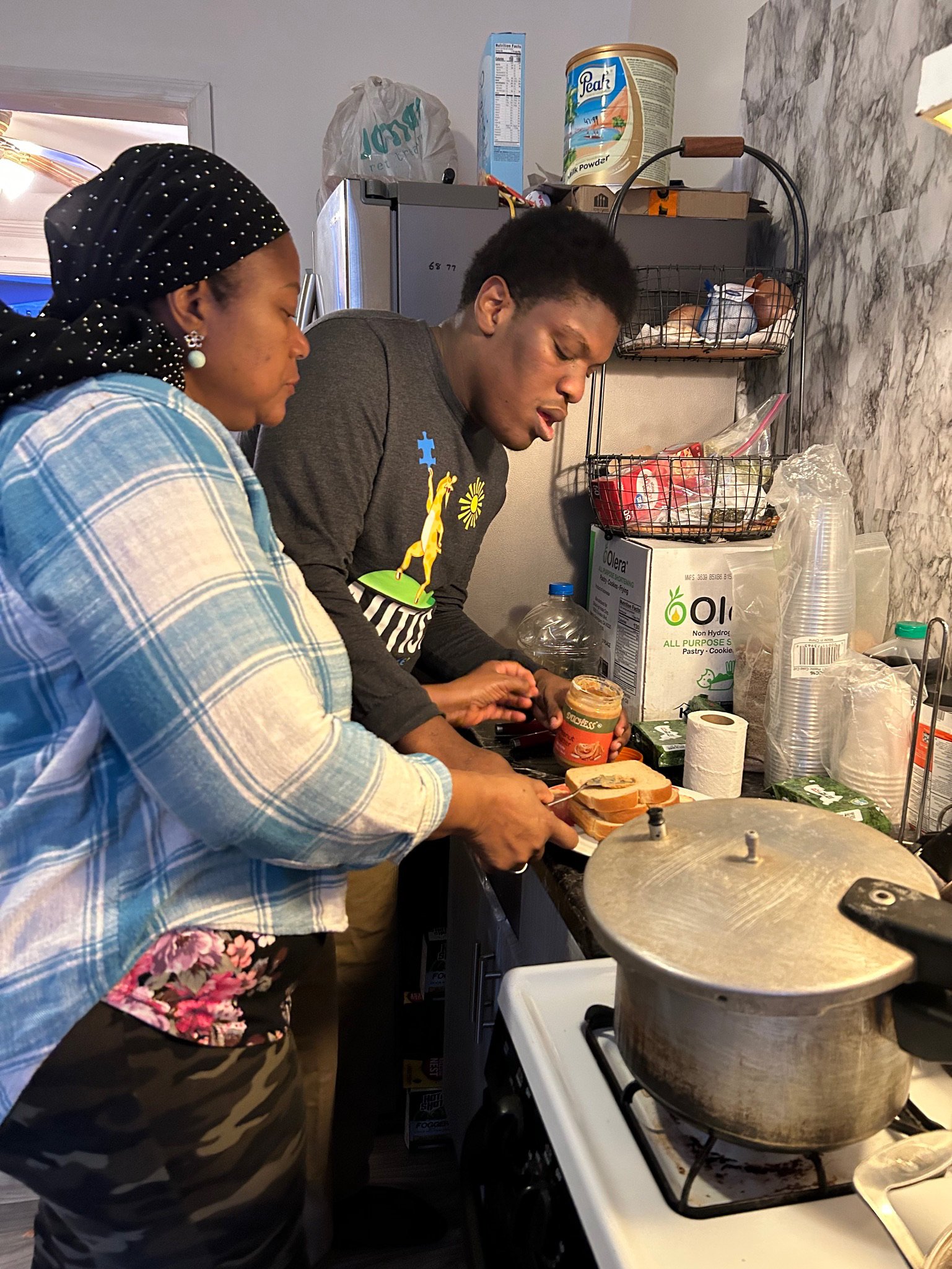
Brigid Schulte/New America
The CTC was helpful not only because of the increased income it provided families temporarily but also because it came every month instead of once a year with their tax returns. Nwadike-Laster could not understand why this was not the norm but an exception. She said, “I still don’t understand why [the Child Tax Credit] only comes once in a year with my tax refund. The kids are not growing once in a year. They grow every day. When you give the money to the parents every month, we use it for the kids because it’s the kids’ money. But when you give it to us at the end of the year, when there’s a lot of debts to be covered and everything, sometimes it’s like, ‘Heck, how do I manage these funds?’”
Kiarica Schields, a single mother of four children in Georgia who lost her hospice nursing job early in the pandemic, was so cash-poor when she received the monthly expanded tax credits that she used them to cover her family’s rent.
Simplified Access to Medicaid
With the Families First Coronavirus Response Act (FFCRA) in 2020, Congress provided a 6.8 percent increase in funding to states and territories that gave those qualified for Medicaid continuing coverage through the end of the public health emergency. In effect, this law lowered requirements for Medicaid and automated re-enrollments so that most people who qualified for unemployment insurance in their state, as well as their immediate family members, automatically qualified for Medicaid through March 2023 rather than having to go through the complicated re-enrollment process every year. More than 21 million people were added to Medicaid and Children’s Health Insurance Program (CHIP) rolls between 2020 and 2022, giving access to affordable health care to millions who either previously did not have health insurance or lost their employer-provided health insurance when they lost their jobs. Enrollments to Medicaid and CHIP rose by 32 percent between February 2020 and March 2023.10
Chantel Valdez enrolled herself and her two children in Medicaid in June 2020, when she became unemployed. Though she began working part time again in the fall of 2021, the continuous enrollment policy meant that she and her children continued to receive Medicaid coverage through 2023. This hassle-free, continuous enrollment allowed them to begin accessing mental health care, in addition to medical care, to help cope with the grief of losing family members to COVID-19.
Kel, a Michigan single parent who uses she/they pronouns and asked that her last name not be included in the study, was able to enroll herself and her four children in Medicaid during the pandemic. With their company closing as a result of the pandemic and the stress of managing bills, they were grateful that the requirement to re-enroll every year was lifted during that period. “During the pandemic, the process of Medicaid renewal was really nice because they suspended needing to do an annual renewal,” said Kel. Both Kel and her children have complex medical needs, and Medicaid coverage allowed them much-needed care even during the Public Health Emergency.
Eviction Moratorium and Mortgage Forbearance
In the earliest days of the pandemic, February and March 2020, several state and local leaders noted that stable housing was critical to containing the spread of COVID-19, and they issued bans on eviction in their jurisdictions. As millions of Americans lost their jobs and the means to pay their rent or mortgage, the federal government began to take note of the alarming rising eviction rates where there were no bans. With the Consolidated Appropriations Act11 and ARPA, Congress approved $46.5 billion in rental assistance to help households cover the cost of rent and to prevent people from being evicted. This was the first time in U.S. history that the federal government offered help to people behind on rent. The funds were administered by the U.S. Treasury Department to state and local governments.
As evictions continued unabated in locations without eviction moratoria in place, the Centers for Disease Control and Prevention (CDC) issued a federal moratorium on evictions between September 2020 and August 2021.12 Though national and many local moratoria were temporary, some jurisdictions used the pandemic-era funds to build robust diversion programs that can be just as effective at keeping people housed. As the Better Life Lab has reported previously about one city, for example:
“Philadelphia’s Eviction Diversion Program (EDP) requires landlords to participate in a 30-day mediation with tenants who owe less than $3,000 in back rent before pursuing a formal eviction. It began as a city pilot initiative and was bolstered by federal COVID-19 relief funding into a national exemplar of eviction prevention, with 85 percent of cases reaching a settlement or an agreement to continue negotiations beyond the mandated 30 days. The program has been incredibly beneficial to Black women raising children in Philadelphia, where, according to city data, 74 percent of evictions involved a Black tenant, 70 percent involved a woman, and 50 percent involved a parent or caretaker. Philly’s EDP is bolstered by being coupled with rental assistance. Between May 2020 and January 2023, Philadelphia’s Emergency Rental Assistance Program distributed almost $300 million in federal, state, and local emergency COVID-19 relief funds to more than 46,500 households, according to city data.”13
For homeowners who became unemployed or lost income during the pandemic, the Federal Housing Administration (FHA) extended mortgage forbearance options to borrowers whose mortgages were insured by the FHA, beginning October 1, 2021, and ending May 31, 2023.
Mariam Dewi was unable to pay her rent for several early months of the pandemic. She worked as a certified nursing assistant in a memory care unit, which, like many other long-term care facilities, had high rates of COVID-19. She herself contracted the virus, and, fearing for her pregnancy, her doctor advised her to stop working. She and her family live in Minnesota, where the governor issued an executive order banning evictions in March 2020 and extended it through August 2021. The experience of working with her landlord to figure out how to get the rent paid by the state represented the best of the communal spirit that emerged in the early days of the pandemic. She said, “Where I live, [the landlords] were very nice and very gracious. They worked with us. This epidemic, everybody came together and worked as a team. Everyone was helping each other. Everybody was trying to make sure that their neighbor or their neighborhood, that everyone was good. People were doing so many things—dropping off food for people, dropping off clothes. It was just beautiful just watching how everybody came together and worked as a team. It was just so beautiful.”
Chantel Valdez used emergency rental assistance twice in late 2021 when she lost her unemployment benefits and needed help to cover her $720 per month rent in Blanding, Utah. That helped ensure that she and her children and their dog could remain in their two-bedroom apartment at a time when they were experiencing profound grief from the loss of two close family members to COVID-19.
In Philadelphia, Philipa Nwadike-Laster got 18 months of mortgage forbearance after she lost all her work as a certified nursing assistant so she and her two children could stay in their home.
Eviction moratoria policies across the United States prevented millions of evictions, but application was uneven and benefits were often difficult to apply for and receive.14 According to data analysis by the Eviction Lab, “These policies cut eviction filings over the first two years of the pandemic by more than half.”15 Still, it says, “Evictions never fully stopped,” and it estimates that hundreds of thousands of renters were threatened with eviction even while these policies stood.16 Case study participant Ivonne Valadez Solano, for example, found the application process for rental assistance in California too overwhelming. In the end, she did not complete her application. And study participant Kiarica Schields was evicted with her four children four times between 2020 and 2024.
Child Care Funding
At the outset of the COVID-19 pandemic, child care in the United States was already unaffordable and difficult to find for the vast majority of parents. The only public funding for child care was the Child Care Development Block Grant (CCDBG), which allocates funding to states that can spend the money as they choose, within certain federal guidelines, to provide subsidies to help those with very low incomes pay for child care. States face the impossible task of distributing their federal grants, with far more families and providers in need of support than they can possibly cover. Only 15 percent of low-income families eligible for support (earning less than 85 percent of the median state income) actually receive it.17
The pandemic closure of schools, workplaces, and many child care centers across the country further fractured the already patchwork child care sector in the United States. The child care workforce plummeted, and the price of care began to skyrocket. In the first year of the pandemic, as lock-down orders shuttered schools and businesses, an estimated 63 percent of child care centers and nearly one-third of family child care homes closed down.18
“The pandemic closure of schools, workplaces, and many child care centers across the country further fractured the already patchwork child care sector in the United States.”
Congress first took action to support the child care sector in the 2020 CARES Act, authorizing $3.5 billion to help keep open child care facilities experiencing a drastic revenue loss. These funds also helped low-income workers and essential workers pay for child care. By comparison, the same law allotted the airline industry up to $32 billion in direct grants to support employee salaries and benefits.19 Child care advocates quickly recognized that child care needed far more funding to maintain the already dire status quo and asked for an additional $90 billion.
As many workplaces began to open again with the introduction of vaccines against COVID-19 in late 2020 and early 2021, demand for child care grew while the child care supply continued to shrink. With the passage of ARPA in March 2021, Congress dedicated an additional $39 billion to child care, with $24 billion in stabilization grants to child care providers and $15 billion in CCDBG discretionary funding, much of which states used to increase child care assistance payments to low-income families.
Tiffany Gale opened a child care center in her Weirton, West Virginia, home in late 2019. She had a long waitlist for her child care slots when the pandemic began. As schools and workplaces closed in early March 2020, Gale decided to remain open. She primarily served the children of essential workers—teachers, mill workers, and nurses—who needed care. She even worked 12-hour shifts to accommodate their schedules. Some of these workers received between $30 and $34 a day from federal aid to help them afford care.
In 2021, Gale became one of the 220,000 child care programs to receive ARPA stabilization funds. For the first time since she opened, she finally felt breathing room. She used the funds for a down payment on a new commercial building for her business so she could serve even more children. The funds enabled her to hire teachers to come into the centers for dance, music, and social-emotional lessons. The State of West Virginia also raised its income eligibility limit for child care assistance from 53 to 85 percent of the state median income, enabling more working-class families to qualify for the help.
Other participants in the study benefited in other ways from this injection of funding into child care. Chantel Valdez lost her job as an after-school program grant coordinator when the grant that supported her work ended in the summer of 2021. The American Rescue Plan Act provided money for new after-school programs, in part to help students who had fallen behind during remote schooling catch up with their grade levels. Beginning in January 2022, Valdez was hired as a site coordinator for a 4-H after-school program at her local elementary school funded through ARPA.
Most participants, however, continued to handle child care on their own throughout the pandemic. Child care is expensive for parents. One analysis by the Department of Labor’s Women’s Bureau found that annual child care costs range from more than $5,000 to $17,000 per child, depending on the type of care, a child’s age, and the population size of a county.20 For single parents like case study participant Kiarica Schields, infant care costs can eat up anywhere from 24 to 75 percent of family income. At one point during the pandemic, Schields did find child care, although she was not able to receive a subsidy. So she paid more than $600 a week in child care costs for her four children. She was earning $800 a week at the time. She couldn’t sustain it. “Child care. That’s my issue,” Schields said.
Like Schields, Mariam Dewi, a certified nursing assistant, didn’t have access to child care subsidies. But she did have extended family nearby to help:
“What I’ve noticed about the child care [subsidy] is it’s a long waiting list. Once you apply, you wait for forever. We’ve applied, but we’re still on the waiting list, and I cannot sit and wait to get approved. I have to go back to work. My husband cannot be the only one working. Both of us have to provide,” she said. “So right now, I have my mom and my dad who help watch the kids. Mostly my mom. We take turns. If I work in the morning, then my mom works in the afternoon. We work with each other’s schedule. And my husband, the days that he’s off, if I have to work a double that day, he would take my younger one. We try to make it work for each other. I’m blessed to have my mom and dad watch the kids. I know it’s not the case for everybody. It’s hard if you don’t have anyone.”
Food and Nutrition
As part of the March 2020 Families First Coronavirus Response Act (FFCRA), Congress raised all Supplemental Nutrition Assistance Program (SNAP) benefits by 15 percent and boosted every eligible household’s benefit to the maximum possible for their household size. The FFCRA also gave the U.S. Department of Agriculture the authority to grant waivers to give schools and community organizations flexibility to distribute food and food assistance due to school closures.
Chantel Valdez and her children qualified for SNAP benefits for the first time during the pandemic because she qualified for unemployment benefits. Her children each received a pandemic electronic benefit (P-EBT) amounting to just over $7 a day because they qualified for reduced-cost school lunches due to her low income prior to the pandemic. Valdez described this additional money for food as a major benefit to her family’s diet, happiness, and well-being. When she and her kids caught COVID-19 in late 2020, for example, she was able to cook a big pot of chicken noodle soup from scratch, something she normally could not afford to do. She was able to purchase and prepare fresh foods for her children for a few months.
Latoya Dyer’s children also qualified for P-EBT for the summer of 2020, allowing Dyer to have additional food on hand. She said, “My kids love vegetables and food. I don’t have a problem with them with that, but I think it’s more along the lines of they’re so accustomed to mommy cooking. ‘Mom, did you make the spaghetti? Mom? Where’s the chicken and the rice?’ They’re always looking for food.” She said, “The summer with the P-EBT, I was able to have food for the kids and not have to worry about them in my ears, [with] ‘Mom, I’m hungry.’”
Child care center owner Tiffany Gale used expanded child care subsidies provided to child care providers through ARPA to improve the food and nutrition she provided the children in her center’s care. Extra pandemic funding meant Gale could serve the children fresh foods, including fruit, vegetables, and meat. Breakfasts started to include sliced peaches, apples, tomatoes, and scrambled eggs. Lunches included chicken stir fry, chicken enchiladas, roast beef, or broccoli quiche, among other options. For an afternoon snack, children had sliced apples with peanut butter.
The End of Pandemic Benefits
“There’s a powerful sense of vertigo you feel from having financial security suddenly taken away. And I’ve learned how quickly a family who is doing well can slide right off the tracks and get stuck. Our social safety net has a whole lot of holes in it.”—Kel, Michigan
Between 2021 and March 2023, nearly all these pandemic-era benefits came to an end, and many participants felt the suddenness of these changes both in their material circumstances and in their relationship to the government and government programs. In interviews conducted with participants in 2024, they described feelings of stress with making ends meet and frustrations with what they could give their children. After having so recently been able to give their children healthier food, better health care, and stable housing, the post-pandemic period has brought with it a vivid awareness of the things their children go without, even as they work hard to provide and care for them.
With the end of child care subsidy expansions under ARPA, Tiffany Gale contemplates closing the doors of her child care centers. She has shifted away from serving fresh fruits and vegetables and is back to peanut butter and jelly, hot dogs, mac and cheese, and breakfast cereal. Instead of fresh produce, teachers now serve canned beans, meats, fruits, and vegetables. Snacks are graham or saltine crackers instead of apples. In 2023, as ARPA funds were dwindling, child care spots in West Virginia had already declined by 700.21
As of June 2024, 14 million people had been removed from Medicaid and CHIP rolls, a 15 percent drop from its peak at approximately 94 million in March 2023.22 Chantel Valdez and her children were disenrolled from Medicaid in 2024. She was waiting to hear from the State of Utah about whether her children qualified for CHIP. As a Navajo woman, Valdez now receives health care through the Indian Health Service, though in the spring of 2024, she was contemplating paying for a root canal out of pocket because the surgery was not covered through her tribal affiliation.
Valdez and her children lost two close family members—an uncle who was her father figure and a grandmother—to COVID-19 in 2020. The entire family has suffered from anxiety and depression as a result of these losses and finding and affording therapy for them has been difficult without Medicaid. She is also saving her paychecks to pay for a grave marker for her uncle and grandmother. Valdez observed that “before the pandemic, [Congress] used to say they didn’t have the money to do more. Then the pandemic happened, and they somehow found it.” But “now they say they don’t have the money anymore. Why can they find the money when they want to?” She added, “There have to be better ways to support families in a more gradual way, maybe with reduced benefits as their income goes up. But it can’t be all or nothing.”
Although Blessing Aghayedo and her family qualified for Medicaid prior to the pandemic, the temporary easing of re-enrollment made it significantly less stressful for them during the pandemic. When the pandemic Medicaid policies expired, however, Aghayedo and her husband were disenrolled and no longer qualified, likely because Aghayedo was working again as a licensed practical nurse. Only her children now qualify for Medicaid. Aghayedo has been suffering from a bladder prolapse that requires surgery, but without insurance, she cannot afford it. For now, she is treating the symptoms with a stool softener.
Aghayedo observed that when she was unemployed during the pandemic, she and her family were more comfortable financially. When she was not working, they all had health insurance and could afford healthy and nutritious food. Now that she is working, they do not qualify for these benefits because they earn too much. But, she and her husband do not earn nearly enough at their jobs to make up for their losses. “Sometimes you are working, and you are not okay,” she said. “If our jobs paid us enough money, we wouldn’t need any help at all. If I earn good money, I’m not going to be looking for benefits. I’ll take care of my bills.”
Aghayedo feels unable to give her children what she would like, even though she and her husband are both working. “These children, they grow so fast. By the time you buy the winter clothes the next winter, it doesn’t fit them anymore. You buy the summer clothes this year. The next summer, it doesn’t fit them anymore. So it goes with shoes,” she said. “And the food they are going to eat, what they are going to drink. They need to eat fruits and vegetables. They need to eat healthy. And the healthy food is much expensive. That’s why a lot of people eat junk. It’s not like they want to eat junk. They don’t want to. But they don’t have a choice.”
The end of the emergency allotments of SNAP resulted in an average benefit cut of $86 per person, or $163 per household.23 As Chantel Valdez put it, her family is back to “eating out of a box.”
Mariam Dewi felt she still needed the kind of help she had been receiving during the pandemic:
“I would love for the government to do more and help still. I think they’re still helping; it’s just it might not be as much as when the epidemic was happening. I believe they could do better. I mean, help a little more. I don’t know where the economy is at right now, but they could do better to help families, because we still need help. Even though we’re working…sometimes you feel like you’re living from paycheck to paycheck. You gotta make ends meet. It’s hard for a lot of us. You try to pay your mortgage, pay your bills, and stuff. It’s hard.”
Kel and her children were able to enroll in Medicaid in the State of Michigan during the pandemic and enjoyed not having to re-enroll every year during that period. But that ended in 2023, and they found themselves having to go through the complex, multistep process of renewal once again. “When [renewals] came back, it was a nightmare to deal with,” Kel said.
Struggling to get by as a single parent after divorcing her husband after domestic violence, Kel feels the strain emotionally as well as financially. “I didn’t realize how much shame was involved in struggling financially. I don’t know why that didn’t occur to me as something that would be so painful,” they said. “There were so many instances where, on the days when my mental health was not as good as it can be, I would throw up my hands and say, ‘I just can’t even cope with this. This is so stressful and so impossible.’ And I don’t feel like there’s anyone here to help me figure this out. Or cares to help me figure it out.”
Latoya Dyer feels she is in an impossible predicament as a low-wage worker and a parent. She and her husband are working but not earning enough money to cover all of her family’s basic needs. But they also earn too much to qualify for the programs that helped them the most during the pandemic, like Medicaid and SNAP:
“We’re the working class, and we’re trying our best to be sustainable, pay our taxes, be a proper citizen, do all the things that we’re supposed to. Sometimes, you just feel like you’re being punished just for doing those simple things. You have inflation, and then there’s no ease to the inflation.” “The government,” she continued, “should think about other ways that they can help people. I felt like they gave it, and then they just took it away so quickly without waiting for people to get back to normalization because I felt like we were so—I don’t want to say dependent, but we were so sure that we were getting those funds and we were putting them in places that were beneficial to us. And when it stopped, it kind of hindered us. It wasn’t a gradual way for us to reach financial stability.”
To Philipa Nwadike-Laster, the math of caring for two children as a widow simply does not add up. “For two parents with kids that have no special needs or no therapy, most of the time, they still have to work two jobs. And now, I am a single parent with a special needs child,” she said. Despite once again working as a certified nursing assistant and running a small business selling herbal supplements, she is struggling to cover her bills. She has to decide which bills to prioritize:
“I have been able to pay my mortgage for two months and put food on the table. I’ve not paid any other bills for two months now.” But “No parent should be deciding between paying the mortgage, bills, or buying food,” she said. “This is what poverty does. This is what I mean by earning nothing doing an important job [as a mother.] I decided to pay my mortgage and buy food for these children, so other bills will need to wait.”
In 2023, Ruaa Sabek was earning just $16 an hour as a cashier at a fast food restaurant where she had worked for over three years. She heard about a job training program at the Opportunities Industrialization Center in Philadelphia, preparing workers to apply for jobs at banks. She completed the program and now earns $45,000 a year as a bank teller. Still, between her job and her husband’s, they are struggling to afford basic necessities. She finds it difficult to balance parenting and working full-time work hours with her commute. “I need to work a full-time job. My husband needs to work a full-time job if we want a better life for our kids. But before, I picked the kids up at three from school, then spent all afternoon with them, all the evening. I was more engaged. We do all the homework together. We talk,” said Sabek. Now, she has just one or two hours with her children each day.
The post-pandemic policy environment has been more dire for many of those who were poor at the pandemic’s outset. Kiarica Schields is now facing so many competing demands for her time and limited income as a single mother to four children, and with so few supports, she is flailing. She needs to work but has no access to a car. She needs to make sure her children are looked after, but getting them safely to and from their schools and care interferes with the time she could be at a job. The need to pick up her son from school when he acts out and is suspended has led to her dismissal from jobs she badly needs. Without a job, she cannot maintain her housing and that means her children are constantly in and out of their care and school situations. Her immediate family, which has at times been a support system for her and her children, is now less able to offer help. She has had and lost multiple jobs and been evicted multiple times since 2020.
Citations
- Pandemic Oversight, “Key Insights: State Pandemic Unemployment Insurance Programs,” Pandemic Response Accountability Committee, last updated November 6, 2023, source.
- Janet Holtzblatt and Michael Karpman, Who Did Not Get the Economic Impact Payments by Mid-to-Late May, and Why? (Urban Institute, July 2020), source.
- Margery Austin Turner and Monique King-Viehland, “Economic Hardships from COVID-19 Are Hitting Black and Latinx People Hardest,” Urban Wire (blog), Urban Institute, August 12, 2020, source.
- Kranthi Swaroop Koonisetty, Brittney Okada, and Annika Machado, COVID-19 Health Disparities in Utah 2020–2021: Race/Ethnicity Profile (Department of Health and Human Services Office of Health Equity, September 2022, updated January 2024), source.
- U.S. Department of Labor, “U.S. Department of Labor Issues Guidance on Federal Pandemic Unemployment Compensation and Mixed Earner Unemployment Compensation,” press release, January 5, 2021, source.
- Pandemic Oversight, “How Much Money Did Pandemic Unemployment Programs Pay Out?” Pandemic Response Accountability Committee, last updated July 3, 2024, source.
- Office of Governor Gavin Newsom, “COVID-19 Order N-33-20,” March 19, 2020, source.
- Tax Policy Center (TPC), “How Did the 2021 American Rescue Plan Act Change the Child Tax Credit?” in The Tax Policy Briefing Book (TPC, 2024), source.
- Internal Revenue Service (IRS), “Advance Child Tax Credit Payments in 2021,” IRS, last updated October 2024, source.
- KFF, “Medicaid Enrollment and Unwinding Tracker,” October 9, 2024, source.
- H.R. 133–116th Congress (2019–2020): Consolidated Appropriations Act, 2021, source.
- Centers for Disease Control and Prevention, “Temporary Halt in Residential Evictions To Prevent the Further Spread of COVID–19,” Federal Register 85 (September 2020): 55292–55297, source.
- Julia Craven, “Eviction Is One Of The Biggest Health Risks Facing Black Children,” accessed December 7, 2023, source.
- Emily A. Benfer, Robert Koehler, Alyx Mark, Valerie Nazzaro, Anne Kat Alexander, Peter Hepburn, Danya E. Keene, and Matthew Desmond, “COVID-19 Housing Policy: State and Federal Eviction Moratoria and Supportive Measures in the United States During the Pandemic,” Housing Policy Debate 33 (Spring 2023): 1390–1414, source.
- Peter Hepburn, Jacob Haas, Nick Graetz, Renee Louis, Devin Q. Rutan, Anne Kat Alexander, Jasmine Rangel, Olivia Jin, Emily Benfer, and Matthew Desmond, “COVID-Era Policies Cut Eviction Filings by More Than Half,” Eviction Lab, May 3, 2023, source.
- Nick Graetz, Peter Hepburn, Carl Gershenson, Emily Lemmerman, and Matthew Desmond, “Eviction was a Deadly Risk During the COVID-19 Pandemic,” Eviction Lab, February 20, 2024, source.
- Nina Chen, “Factsheet: Estimates of Child Care Subsidy Eligibility & Receipt for Fiscal Year 2021,” September 11, 2024, source.
- Ying-Chun Lin and Meghan McDoniel, Understanding Child Care and Early Education Program Closures and Enrollment during the First Year of the COVID-19 Pandemic (Administration for Children and Families, U.S. Department of Health and Human Services, August 2023), source.
- Rachel Y. Tang, CARES Act Payroll Support to Air Carriers and Contractors (Congressional Research Service, October 22, 2020), source.
- Liana Christin Landivar, Nikki L. Graf, and Giorleny Altamirano Rayo, Childcare Prices in Local Areas: Initial Findings from the National Database of Childcare Prices (U.S. Department of Labor, January 2023), source.
- Amelia Ferrell Knisely, “‘We Are at a Breaking Point:’ Child Care Providers, Families Rally at Capitol Amid Funding Debacle,” West Virginia Watch, August 25, 2024, source.
- KFF, “Medicaid Enrollment and Unwinding Tracker,” October 9, 2024, source.
- Lauren Hall, “End of SNAP’s Temporary Emergency Allotments Resulted in Substantial Benefit Cut,” Off the Charts (blog), Center on Budget and Policy Priorities, September 21, 2023, source.