Aaron Loewenberg
Senior Policy Analyst, Early & Elementary Education
Today the National Institute for Early Education Research (NIEER) released its 2015 State of Preschool yearbook. This annual report presents helpful data on the state of pre-K programs nationally as well as breakdowns of each state’s progress in providing high-quality pre-K services to three- and four-year-olds.
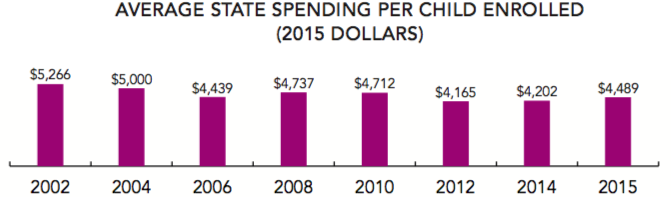
The report details modest gains in pre-K access, quality, and funding across the nation. Average state spending per child enrolled in pre-K increased by $287 in 2015 to a national average of $4,489 per child. This is the third straight year in which average spending has increased, though average spending levels are still lower than they were in 2002 and 2004 (as depicted below). Nationwide, state spending on pre-K rose by about $553 million in 2015, an increase of 10 percent. It’s important to note however, that two-thirds of this funding increase is the result of New York City’s rapid expansion of full-day pre-K under the leadership of Mayor Bill de Blasio.
The number of students enrolled in state-funded pre-K grew modestly in 2015, with an increase of about 37,000 children bringing the total of all children nationwide enrolled in state-funded pre-K to almost 1.4 million. Most of the enrollment gains produced as a result of the New York City pre-K expansion were canceled out by enrollment cuts in other states. Most of the enrollment growth came from three-year-olds, with only about 7,000 more four-year-olds served in 2015 compared to the previous year.
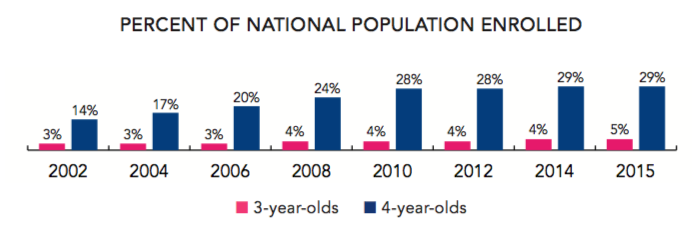
As shown in the graph below, the percentage of the national population of three-year-olds enrolled in state-funded pre-K modestly increased from 4 to 5 percent, while the percentage of four-year-olds remained flat at 29 percent. Steve Barnett, the Director of NIEER, expressed exasperation at the slow pace of government support for pre-K, writing that at the current rate of growth “it will be another 50 years before states can reach all low-income children at age four, and it will take 150 years to reach 75 percent of all four-year-olds.
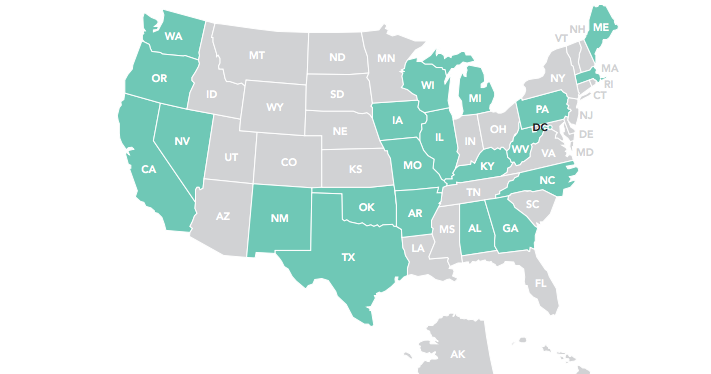
While a national overview of the pre-K landscape reveals modest improvements, a few states took steps backwards in 2015. Of particular concern are California, Florida, and Texas. These three states enroll almost 40 percent of all children in state-funded pre-K nationally, yet all three meet only a few of NIEER’s Quality Standards Benchmarks checklist. These research-based quality standards do not guarantee high-quality, but they do establish the floor for standards that states should have in place. The 10 quality standards include measures such as:
Texas’s pre-K program meets only two of the 10 quality benchmarks, while Florida meets just three, and California only four. Both Texas and Florida also experienced reduced pre-K enrollment and funding during 2015.
Several other states made noticeable progress in their pre-K programs during 2015. For the first time, the pre-K programs of Mississippi and West Virginia met all 10 of NIEER’s benchmarks. There are now six states that meet all of NIEER’s benchmarks, up from four states in 2014: Alabama, Alaska, North Carolina, and Rhode Island.
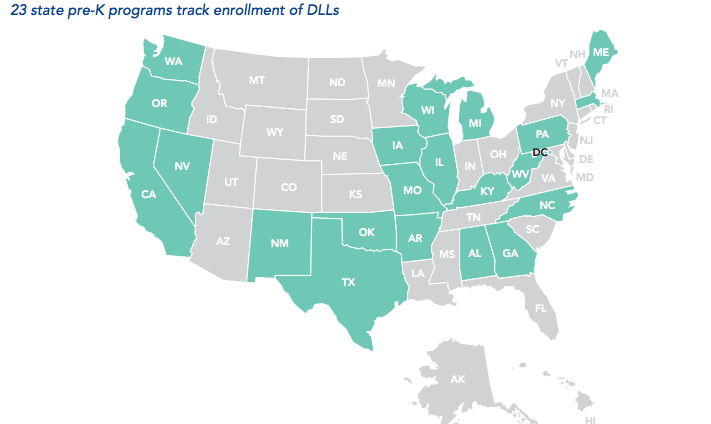
This year’s report is notable because, for the first time, it includes a special report on the pre-K workforce and policies for Dual Language Learners (DLLS). The workforce data confirms prior research suggesting that pre-K teachers are poorly paid compared to their K-12 peers with equivalent qualifications. Pre-K teachers in public school settings earn about $12,000 less than public elementary school teachers. The data on policies to support DLLs illustrate the progress yet to be made in serving this growing population. For example, only 23 state pre-K programs currently track enrollment of DLLs.
Research suggests that high-quality pre-K programs have the potential to significantly reduce achievement gaps for African-American, Hispanic, and low-income children. What NIEER’s newest report illustrates is that the country continues to make small strides towards making pre-K a reality for all children, but there’s still much work to be done and a long way to go on access and quality for three- and four-year-olds. We’ll be digging deeper into NIEER’s new data in the coming weeks. Stay tuned.
Senior Policy Analyst, Early & Elementary Education