2013 Appropriations Process Underway, but Far from Complete

Washington is gearing up for the fiscal year 2013 appropriations process, and lawmakers face major obstacles to completing the process before the new fiscal year begins on October 1, 2012. Republicans in the House want lower overall spending limits than those they passed in the debt ceiling agreement reached less than a year ago. And for their part, Senate Democrats have proposed a slightly smaller budget for the Labor-Health and Human Services-Education Appropriations Subcommittee to divide across the agencies under its jurisdiction. Nearly all federal education programs are funded one year at time through the annual appropriations process, and the developments of the past few weeks will affect the final outcome.
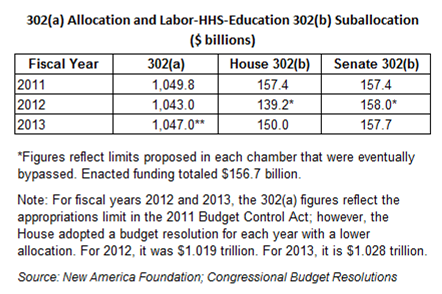
The Budget Control Act of 2011 (the debt ceiling agreement) that Congress passed in August 2011 set limits for discretionary spending (subject to annual appropriations) at $1.047 trillion for fiscal year 2013. The Senate has already skipped the traditional budget resolution process and agreed to stick to that limit. But the Republican-controlled House passed its own budget resolution with a spending limit (called a 302(a) allocation) of $1.028 trillion. That is $19 billion below the amount signed into law last summer. That leaves an already-substantial gap between the House and Senate as they work to reach an agreement.
Congress took another key step in the fiscal year 2013 appropriations process starting last week when the Senate Appropriations Committee released its 302(b) subcommittee allocations. The subcommittee allocations divide the 302(a) allocation – the spending limit applied to the entire appropriations process – across 12 subcommittees. The Senate would provide $157.7 billion to the Labor-Health and Human Services-Education subcommittee. That is $3 million below the subcommittee’s fiscal year 2012 allocation of $158.0 billion.
Although the 302(b)s don’t specify how individual programs will be funded, or even the total amount that the Department of Education will receive, they demonstrate the direction in which Congress may move throughout the appropriations process.
Then yesterday, the House Appropriations Committee passed its 302(b) subcommittee allocations for 2013. The House 302(b) allocation to the Labor-HHS-Education subcommittee is $150.0 billion, $7.7 billion below the Senate’s allocation. However, the House 302(b) actually provides nearly $11 billion more to the Labor-HHS-Education subcommittee than House Republicans first proposed for last year’s fiscal year 2012 allocation ($139.2 billion). Note that enacted funding for programs covered by the bill was higher, $156.8 billion, after the House and Senate negotiated a final bill.
The fiscal year 2013 process is especially complicated by the fact that automatically-triggered cuts (called ‘sequestration’) are set to reduce the fiscal year 2013 appropriations by $94 billion in January 2013 unless Congress passes and the president signs a law averting the cuts. So unless that happens, the spending limits outlined above are moot.
Keep in mind that the fiscal year 2013 budget process is nowhere near complete. Even after each chamber passes its 302(b) allocations, both must assemble and pass detailed appropriations bills and then reconcile the two to create a final bill.
This process has not gone smoothly in recent years and is unlikely to this year considering that sequestration looms. Given Congress’s preoccupation with the presidential election, not to mention members’ own elections, the president is unlikely to sign a budget into law before the start of the fiscal year on October 1 (more likely, it will come after the end of campaign season in November). In the meantime, another series of continuing resolutions may be in store.
More About the Authors
Issues
Related

Representation Matters for Women of Color in Youth Apprenticeships

Meet the Commissioners

New America & ACCT Invite Community Colleges to Apply for Work-Based Learning Capacity-Building Cohort