
Key Takeaways: Learning from Maine’s Experience
While Maine’s First 10 state team was assessing their agencies’ collective programs, resources, and policies, Maine's 13 First 10 community teams conducted needs assessments and developed First 10 plans. Despite local differences, commonalities emerged. Communities created new structures like play and learn groups, family resource centers, and family liaison positions to engage and support families with young children, often well before children enter kindergarten and often connecting families to health and social services. They worked to align their new high-quality PEG pre-K classrooms and kindergarten instructionally and improve information about rising kindergarteners within elementary schools while in some cases also supporting collaboration across district, Head Start, and community-based preschool educators located in separate buildings. And they integrated pre-K and kindergarten into elementary school instructional improvement initiatives focused, for instance, on using standards and data to guide teaching and learning, response-to-intervention, and/or literacy, math, or social-emotional standards.
A year and a half into Maine’s combined state and local First 10 initiatives, a number of challenges and lessons are becoming apparent, all of which have implications for the design of similar initiatives in other states and communities.
Challenges
Structuring Teams for First 10
Although birth-to-third-grade alignment was one of the six original goals of the first PEG awards, the primary focus of the PEG teams was pre-K expansion, and the teams were configured for that purpose. Almost all of the 13 communities embraced the First 10 initiative wholeheartedly, yet a few were not ideally configured to design and implement First 10 strategies (i.e., they didn’t have the right district and community-based leaders at the table). For instance, in a couple of instances, an early childhood coordinator or principal was not able to engage elementary school leaders located in other district buildings. Likewise, the initial composition of the teams did not include community-based preschool educators and addressing the quality of early grades teaching and learning was not part of the teams’ original charge. Moving forward, Maine’s state First 10 team would like to create a grant opportunity specifically for First 10 partnerships and configure the teams accordingly.
Staying Comprehensive
As is common in ambitious initiatives of all types, several of the Maine communities became especially excited about one of their initiatives and/or strategies and then lost track of some of the others. For instance, in some communities addressing trauma in children and families became a big priority, and as a result teaching and learning strategies received less attention. Focusing more on family engagement and less on improving teaching and learning is a common initial dynamic in early childhood-elementary school partnerships.1 Maine’s technical assistance to the communities included regular plan management check-in meetings, which helped the teams maintain the comprehensiveness of their plans while allowing them to sequence and prioritize strategies according to their needs.

Identifying and Accessing Service Providers
The paucity of health and social services in rural Maine is a problem common in many rural areas in the United States. In some cases there are providers that serve communities, but due to Maine’s overlapping service jurisdictions (i.e., district, county, and other geographical units of service provision), districts were not aware of the available offerings, a problem the partnerships can address with state support. In other communities, the services were simply not available. For this reason, both the Maine First 10 state team and many of the community teams are interested in providing integrated student supports, including to children ages 0 to 4 and their families, through First 10 community school hubs.2
Staffing
Both the state team members and the community teams identified staffing as a challenge for First 10 teams. Often the team leader or convener was a district leader with many other responsibilities. The state team determined that establishing dedicated staff time to support the coordination and implementation of the First 10 plan and/or to help coordinate health and social services for families (particularly in the First 10 school hub model) is a priority.
Encountering Turmoil
A couple of communities encountered major changes or challenges that slowed down the implementation of their plans. Lewiston merged the pilot First 10 elementary school with another school while addressing severe trauma in parts of its community. Another community faced an unusual amount of staff turnover in a short period of time. First 10 initiatives can expect that a portion, ideally small, of community planning efforts will encounter periods of turbulence. In these cases, they should be prepared to scale back ambitions accordingly and maintain plans to resume full implementation as soon as possible.
Lessons Learned
Exemplar Strategies Can Be Adapted to Initial Budgets
The First 10 model, while drawing on the P–3 and community school movements and the long history of work on transitions, early childhood system-building, and comprehensive services, was also inspired by communities such as Multnomah County, Oregon, metro Omaha, Nebraska, the CPC P–3 initiative in Normal, Illinois (and elsewhere in the Midwest), and Boston and Cambridge, Massachusetts. Most of these communities are making significant investments of public funds in this work. Maine’s First 10 initiative demonstrates that smaller communities and communities just beginning this work can draw on the examples of these leading-edge communities while adapting strategies to meet their specific needs, and importantly, their initial budgets. While Maine’s state First 10 team and the local partnerships would like to be able to invest more in and grow these initiatives over time, they have already implemented a number of strategies that they see as making significant differences.
Exemplar Strategies Can Be Adapted to Rural and Urban (and Suburban) Contexts
The lack of transportation, long travel distances for families, and the paucity of health and social services in some areas are significant challenges in rural contexts. First 10-type initiatives in rural Blue Mountain Oregon, Venango County, Pennsylvania, and Normal, Illinois have illustrated how First 10 strategies and practices can be creatively and profitably adapted to rural circumstances.3 Likewise, Broader, Bolder, Better includes a chapter specifically on rural communities. Now, in addition, we have the examples of 12 small, largely rural communities in Maine, plus Lewiston as an economically distressed urban setting.
These communities, as in urban environments, have found that play and learn groups, transition to kindergarten planning, pre-K and kindergarten collaboration, early grades curriculum improvement and alignment, and efforts to deepen partnerships with families have met critical needs. And there is no reason why suburban communities would not be able to do the same. While identifying service providers and funding coordinators remain significant challenges in rural communities, the Maine communities have also identified rural advantages: leaders and educators who know one another and see each other around town, relative ease in convening important stakeholders around the table, and the de facto centrality of elementary schools serving as community hubs.
The School Hub Model is Particularly Appealing in Rural Contexts
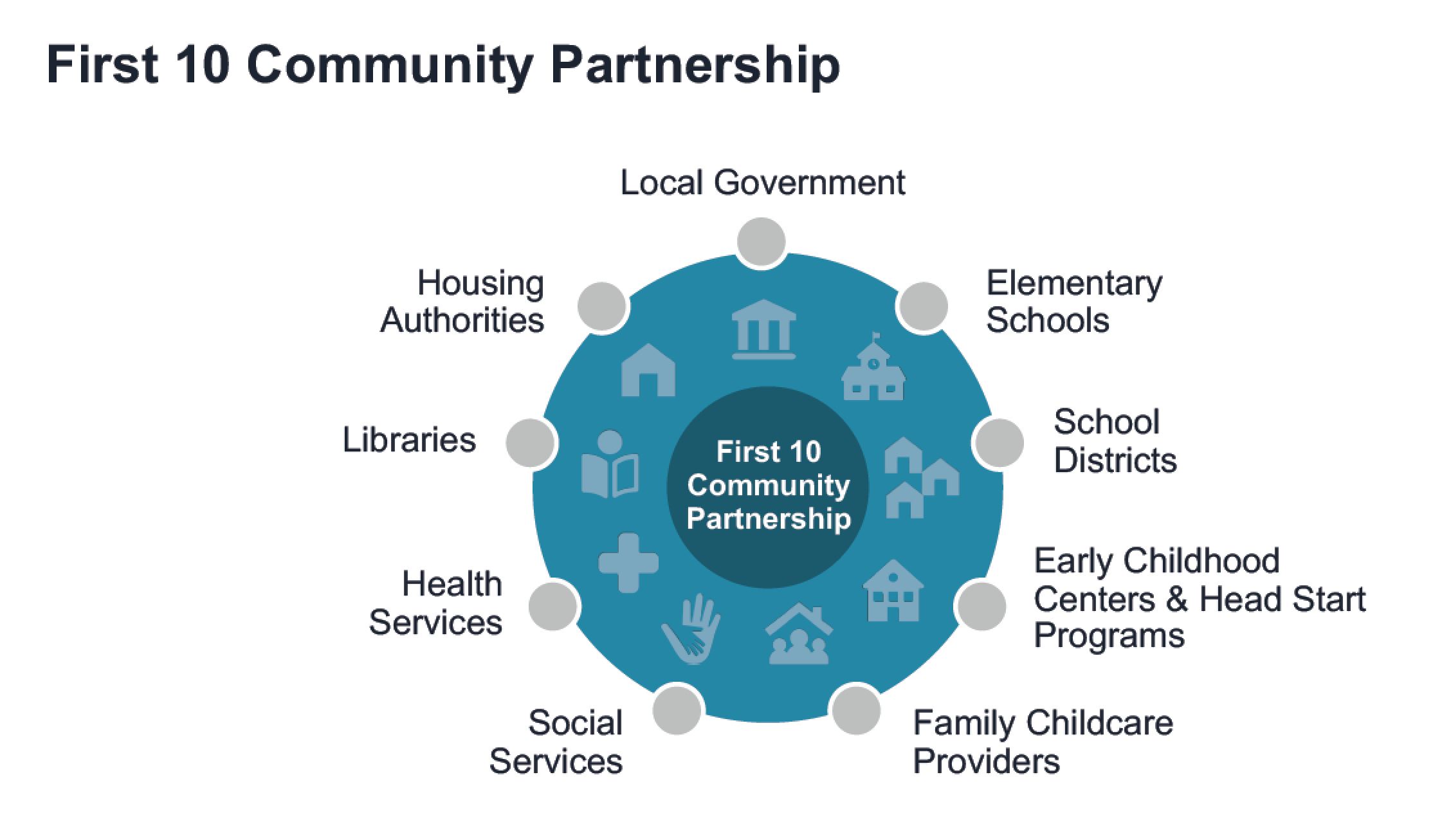
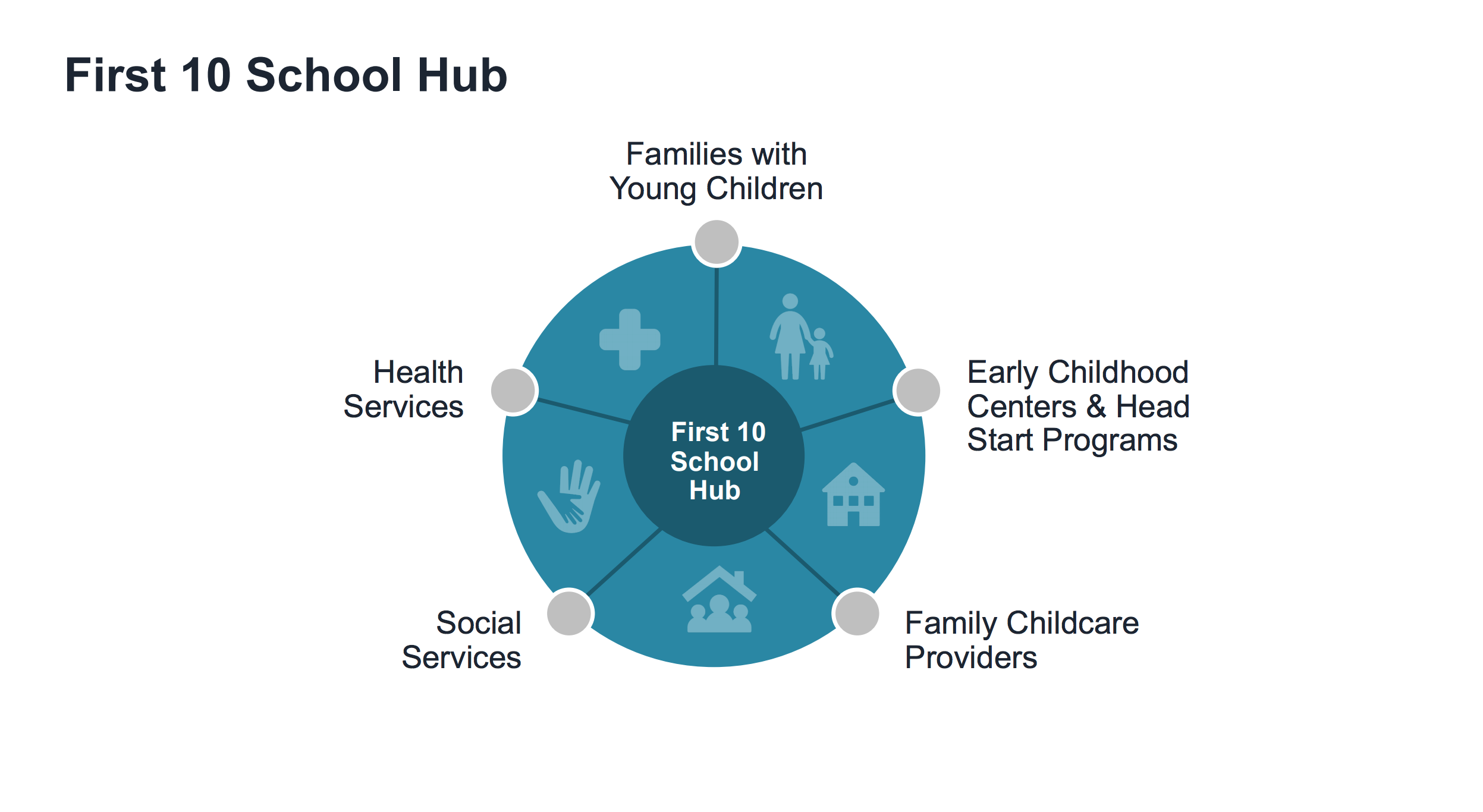
There are two different First 10 structures. First 10 School Hubs are anchored by a single elementary school that partners with providers in its catchment area and extends supports to children ages 0 to 4 and their families. First 10 Community Partnerships serve geographic areas that include at least two or more elementary schools and (ideally, over time) all the Head Start programs, community-based preschools, and family child care, home-visiting, and health and social service providers in that area. Given that elementary schools play important roles as community hubs in rural communities, the First 10 School Hub model has had particular resonance in Maine, and the First 10 state team has been eager to identify a funding source to support local First 10 hub coordinators. Future First 10 efforts should nonetheless keep an eye out for instances where services could be substantially improved through coordination at the district, county, and/or other regional unit levels (e.g., district-wide transition plans, family child care quality improvement initiatives, and/or resource and referral services).
Early Childhood-Elementary School Partnerships Provide Benefits, and Often Head Start Programs Play a Special Role
Maine’s PEG teams were formed as collaborations between school districts and pre-K providers, many of which were Head Start programs, to create and administer high-quality pre-K classrooms. By the beginning of the fourth year of the grant, most had established good working relationships, and some have developed strong partnerships. As the teams expanded their work to develop and implement First 10 plans, the value-added benefits of these partnerships became even more evident in the eyes of the participants, and a common theme was the value of Head Start’s expertise in early childhood pedagogy, family engagement, and the provision of comprehensive services.4
Head Start providers in RSU 12 helped in this context simply by asking why pre-K teachers did not participate in the regular K–2 team meetings established by the school district. This question led not only to what are now PreK–2 vertical team meetings, but a systematic process of pre-K inclusion in all elementary school professional learning opportunities and guidance materials. This collaboration also led to the health institute for 100 families mentioned above.
Likewise, the collaboration between the district early learning coordinator and the Head Start education manager in Lewiston has led to joint monthly professional development sessions, collaboration on curriculum implementation and instructional strategies, close working relationships between the organizations’ family advocates, and plans to extend transitions to kindergarten activities throughout the district and throughout the region that the Head Start provider serves.
Several of the Maine partnerships do not have many community-based private preschool providers in their communities. Given the original purpose of the PEG grants, those that do have these providers did not initially include them on their preschool expansion teams. Some, like Sacopee Valley, have made outreach to and collaboration with community-based preschools a priority. Future iterations of Maine’s First 10 work could include, where applicable, community-based providers—as well as other community early childhood programs—in First 10 partnerships.
Assessing Needs and Ongoing Plan Management are Critical to Successful Implementation
All of Maine’s local First 10 plans were based on an assessment of each community’s strengths and needs in the domains of the First 10 framework: professional collaboration on teaching and learning, coordinated comprehensive services, culturally responsive partnerships with families, and strategic leadership and ongoing assessment. Successful implementation of the resulting initiatives and strategies developed by the teams requires active management of the plans to ensure that strategies are implemented in a timely fashion, obstacles and coordination challenges are addressed, and the teams do not lose sight of some of their strategies and thus maintain the comprehensiveness of their plans. Maine’s teams benefited from technical assistance provided by the state that encouraged active plan management.
State and Local Initiatives Can Be Complementary and Reciprocal
Finally, Maine’s two-level First 10 initiative created a structure in which the state team was able to support community efforts while learning from their experiences, with the aim of informing policymaking and technical assistance. The state team received regular updates on the progress of the local partnerships, including a couple of presentations by local leaders at state team meetings during the first implementation year. Further, at Maine’s First 10 Summit in May 2019, state team representatives sat in on the community-to-community presentations. Afterwards, the local teams participated in a session with the state representatives in which they shared their suggestions for how the state could best support their First 10 work, including ideas such as providing guidance to local school boards, streamlining licensure, continuing to facilitate cross-community learning and exchange, and helping to identify and coordinate comprehensive services, especially around mental health. Those suggestions are informing the working agenda of the First 10 state team.
Citations
- Jacobson, Building State P–3 Systems: Learning from Leading States, Chapter 1.
- The Coalition for Community Schools, the Center for Optimized Supports, and the recent book, Weiss and Reville, Broader, Bolder, Better: How Schools and Communities Help Students Overcome the Disadvantages of Poverty (Cambridge, MA: Harvard Education Press, 2019), are excellent resources regarding comprehensive services and integrated student supports. See also: Mary Kingston Roche, Martin Blank, and Reuben Jacobson, Community Schools: A Whole-Child Framework for School Improvement (Washington, DC: Coalition for Community Schools, Institute for Educational Leadership, 2017); and Joan Wasser Gish, Building Systems of Integrated Student Support: A Policy Brief for Local and State Leaders. (Washington, DC: America’s Promise Alliance, 2019).
- Jacobson, Building State P-3 Systems; Jacobson, All Children Learn and Thrive.
- On this point, see Ashley LiBetti and Sara Mead, Leading by Exemplar: Lessons from Head Start Programs, (Sudbury, MA: Bellwether Education Partners, 2019), especially page 31: “In some cases, they [Head Start programs] are the only high-quality early childhood program available to the children they serve; in others, they are a crucial partner in larger state pre-K or early childhood systems, combining resources from Head Start, pre-K, childcare, and local or philanthropic sources to address the comprehensive needs of children growing up in poverty.”