Alexandra Simon
Senior Policy Analyst, Center on Education & Labor at New America


In 2017, New America conducted focus groups with parents, students, and young adults to better understand how families viewed existing postsecondary options, what they understood (or misunderstood) about apprenticeship, and whether apprenticeship could address common concerns about college costs and career preparation. That initial research explored how participants in Charlotte, North Carolina, and Denver, Colorado, perceived apprenticeships within the broader landscape of post–high school pathways. What we heard then was a mix of strong biases toward college, limited awareness of alternatives, and a clear desire for more practical, hands-on pathways than schools were typically offering.
Fast forward eight years, and perceptions have evolved. To understand what has changed, New America’s Partnership to Advance Youth Apprenticeship convened new focus groups in November 2025, during which families shared how they are recalibrating their views of post-secondary pathways. Young people and their parents are actively searching for pathways that feel practical, flexible, and financially responsible. Youth apprenticeship fits that moment well once people learn more about today’s programs and realize that they expand options after high school. Below, we explore the notable findings and reflections that emerged.
In the 2017 focus groups, apprenticeships were a peripheral consideration. Parents, students, and young adults all defaulted to the idea that “going to college” was simply what came next after high school. Credible alternatives were not top of mind. When apprenticeships did come up, they were often misunderstood, narrowly defined, or associated almost exclusively with the skilled trades. The landscape has shifted since then, and apprenticeships feel more real and relevant now, according to our more recent respondents. While college remains the dominant aspiration, people across audiences are far more open to earn-and-learn models that combine paid work, education, and real-world experience. Apprenticeships are increasingly seen by respondents as a way to build a strong foundation early, and once explained further, offer more options for next steps.
At the same time, attitudes around college have grown more complicated. Across focus group audiences, a four-year degree is still seen as the safest route to long-term stability. However, people are far more uneasy about the cost, the debt, and the payoff. College is no longer just expensive for students who are not sure what they want to do; affordability issues affect everyone. Parents talk openly about the financial strain of college. Young adult respondents describe graduating with “a bucket of loans.” Affordability concerns are also seen in New America’s Varying Degrees 2025 report, which found that of 1,600 respondents, only half think Americans can access a high-quality, affordable education after high school, and 91% think students are accumulating too much student loan debt to attend college.
Students today face a dilemma: they worry that higher-paying jobs require a degree, but their confidence in college has eroded somewhat as they see the transition from high school or college to career as less predictable than it once was due to economic and technological shifts. Students and families from focus groups are far more open than before to other pathways that promise real skills and real income.
Apprenticeships and other earn-and-learn models have gained visibility. Amid continued concern about the cost of college, a clear shift among focus group audiences is the way they articulate the value of getting paid while learning. Parents appreciate the reduced financial burden, young adults say they wish they had access to programs like this earlier, and students are drawn to the idea of gaining skills, mentorship, and a paycheck at the same time.
In 2017, apprenticeships were intriguing but misunderstood, often associated with old stereotypes of skilled trades. At that time, many focus group participants assumed that apprenticeships locked students into a narrow track. However, perceptions of where apprenticeships can lead differ today. Now, apprenticeships feel more relevant, though some stigma still lingers. Parents, students, and young adults still picture “the trades” and a narrow type of student, but the tone has shifted from dismissive to curious. Once participants in the focus groups begin to understand that apprenticeships can offer transferable college credit, professional networks, and multiple post-completion options, their skepticism fades, and they see apprenticeships as a way to generate more options and opportunities.
Some Barriers Still Exist for Apprenticeship
Outdated beliefs still persist, and many parents, students, and young adults from our focus groups still instinctively picture apprenticeships as skilled trades and male-dominated. The fact that fields like healthcare, IT, and finance now have apprenticeship programs is new information that pleasantly surprises participants and challenges their preconceived notions.
Parent and student audiences worry about committing too early, choosing the “wrong” field, and feeling stuck. This anxiety is not unique to apprenticeships, though. It is a fear they also raise about college and choosing a major that they come to regret. However, the earlier start for youth apprenticeship programs, potentially starting sophomore year, makes it feel more acute.
Finally, students and parents from focus groups continue to worry about balance. They already think that high schoolers have a lot of responsibilities and time commitments. Apprenticeship programs that combine high school and college coursework with work raise questions about workload, stress, and missing out on the social side of being a teenager, such as sports, time with friends, and milestones like prom, all of which still matter deeply for students and parents alike.
Seeing Is Believing
One of the most revealing moments in the conversations came when participants were shown a visual outlining what a youth apprenticeship looks like.
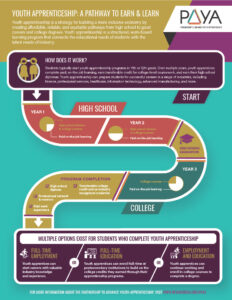
Seeing the pathway laid out made it clear that this was a structured progression with clear milestones and choices along the way, rather than a single, high-stakes decision. The visual also shifted how people talked about their perceived risk of being “stuck.” Before seeing it, parents and students worried that an apprenticeship would lock them into one path too early. Once they saw that students could earn a diploma, get paid, build a professional network, and still choose between work, college, or a hybrid after completion, that anxiety dissipated. At the same time, new questions surfaced about workload and the balance between social life and extracurricular activities.
Importantly, it helped reframe apprenticeships as more than “just a job.” Participants responded strongly to the inclusion of mentorship and a professional network, transferable college credit, and credentials built into the apprenticeship design. The visual also made apprenticeships feel intentional and credible while also giving people permission to be honest about tradeoffs. The combination of clarity and concern points directly to the bigger question these conversations raise: how do we interpret this mix of excitement and hesitation, and what does it mean for how apprenticeships should be positioned and explained?
The paid experience, practical skills, professional networks, and multiple options that apprenticeships offer resonated clearly with all of the focus groups. Apprenticeships feel appealing when they are positioned as a way to open doors and expand opportunities.
Position apprenticeships as “both/and” instead of an “either/or.”
Reframing apprenticeships as an integrated pathway WITH college, which can still lead to a 4-year education and even reduce its financial burden, overcomes people’s initial hesitations and creates greater appeal for apprenticeships
Show the immediate economic value.
Getting paid while learning and avoiding unnecessary debt are compelling to audiences across the board. Demonstrate that apprenticeship programs can be a pathway toward a 4-year college that pays students instead of incurring debt.
Emphasize breadth and flexibility.
Highlight the range of industries, transferable credentials, and multiple paths after completion to reduce fear of being boxed in. Focusing on the options students have shows that apprenticeships pose less of a risk “trapping” someone than a 4-year college, because you can either continue working in the field or continue your education.
Use success stories to center trusted messengers.
Students want to hear from a variety of trusted sources who can offer honest, unfiltered perspectives. They want to hear from people who have gone through the program and model its potential benefits.
Meet students early, but not too early.
Sophomore and junior years are the ideal window to reach students about the program, as it is early enough to influence their academic and career planning, without being so early that the information feels irrelevant.
Youth apprenticeship is far from replacing college as a default next step, but it no longer needs to compete with it to be taken seriously, especially when people think of it as a “both/and” choice. For families navigating an increasingly complex transition from school to work, apprenticeships are becoming something else entirely: a smart place to start.
Senior Policy Analyst, Center on Education & Labor at New America
Voss
Jonathan Voss works with organizations to understand how people think about challenging issues and develop strategies to move opinion. He has conducted research across the country and on six continents. Jonathan has an MPA from NYU’s Robert F. Wagner School of Public Service and a BA in politics from NYU.