The Commons Live!: Questions for the Slow Lane Panelists

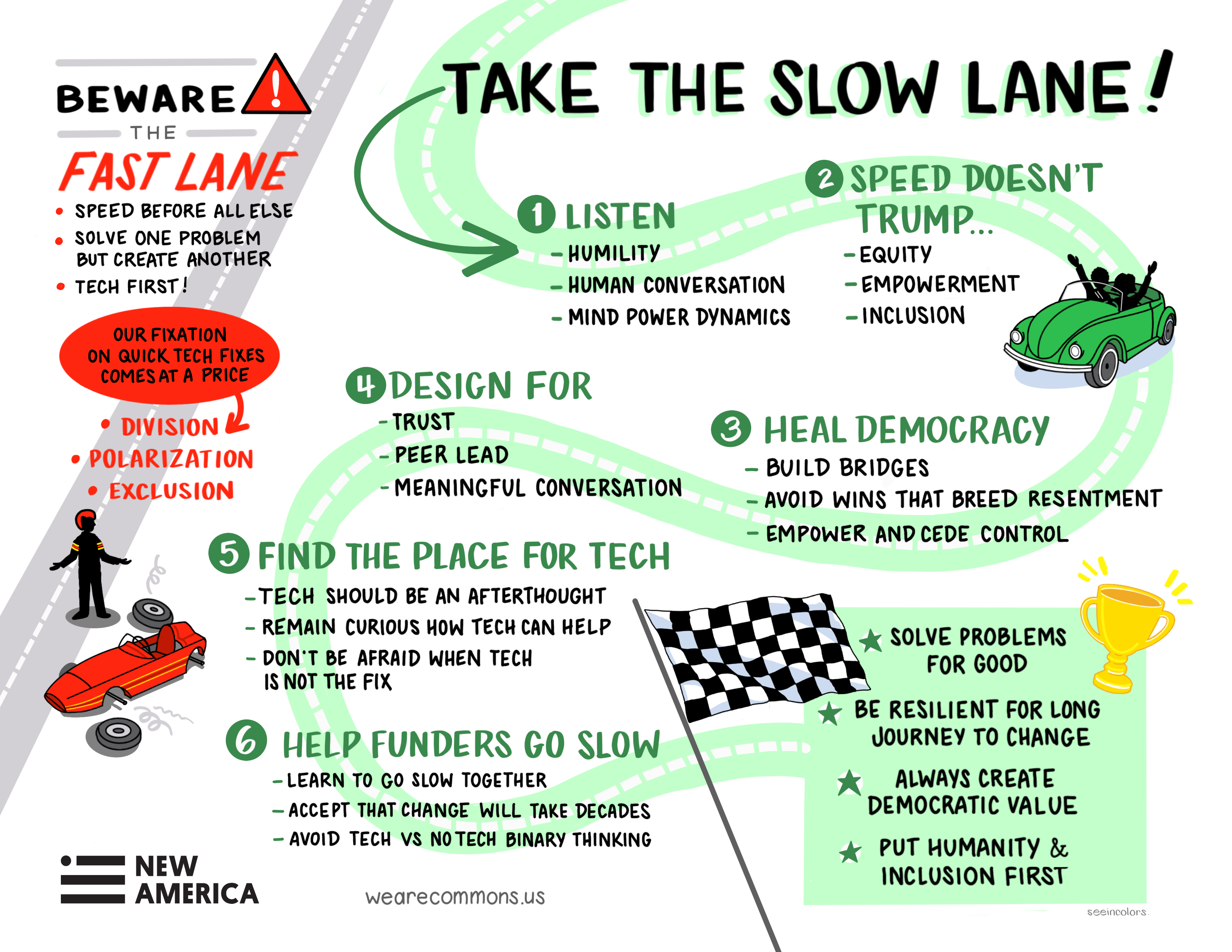
Sascha Haselmayer, founder of Citymart and a globally recognized leader on urban and local government innovation in January completed his year-long fellow position by guest editing The Commons. His issue, called The Slow Lane, focused on a common misconception: that technology will speed processes and improve outcomes. Sascha capped his year of work with a webinar, The Commons Live! The Slow Lane, where he led a 90-minute discussion about why technology is only part of the solution. Panelists included Eric Dawson, CEO and co-founder of Peace First, an organization dedicated to youth-led social change and Sonya Passi, Founder and CEO of FreeFrom.org, a national organization creating pathways to financial security and long-term safety for survivors of gender-based violence.
Q: What was your biggest takeaway from the event?
Eric: Going slow doesn’t mean that you aren’t working with urgency. Just with intention.
KB: I really liked hearing that it was okay and even preferable to push back at funders when they are asking you to do something with technology that you know will damage your project and organization.
Sascha: I loved the question, “If we are going fast, who for?” Whether we talk about our youth, people suffering intimate partner violence or civil servants — the people we are trying to help are often neither empowered nor fully served by the kind of fixes we can provide at speed and scale.
Q: Sascha, could you please elaborate on the “new” metrics you now use to measure what success looks like/the impact your work has in communities in the slow lane?
Sascha: In our case, delivering at speed came at the known cost of not building local community engagement. In practice, this meant that we focused on having people in government run better procurements and helping more entrepreneurs bid. All this delivered value to communities. But they did not own the process, which meant, among other things, that they did not push for more widespread use and improvements. Today, I would measure how local communities are involved in the process.
Q: Have you seen examples where a slow lane approach is taken in government in spite of election cycles and administration changes? If so, could you share?
Sascha: I propose you look at Wigan Council, in the UK – an example we presented in a recent post. Check out Part 3 of that mini-series also.
Q: Isn't this really a both/and and not an either/or reality? That is, don't we need to do some things fast AND some things slow, and find the right balance? Drive in the correct lane as the needs and goals demand?
Sascha: I propose we don’t confuse the Slow Lane with slack or slowness. People in the Slow Lane act with a lot of urgency, they move as fast as they can without rushing to fixes that could prove harmful in other ways. I propose we think of the Slow Lane as itself moving at the fastest possible speed. Eric Dawson made a great observation when he said, “Fast for whom?” — that seems to be a good guiding principle to determine how fast we can move.
Q: Do you apply user centered design when you develop technical solutions within communities? If so, why is technology development and its use being described as the fast lane? Is it a matter of method or process and incorporating interdisciplinary viewpoints? Or the need to have a better understanding of the community impacted by tech, when developed and pre and post implementation, – not the use of technology itself? Or is this about big tech and social responsibility?
Sascha: Technology development in and of itself is neither Fast or Slow Lane. But all too often we approach a problem with technology. We may ask how technology can help, which may lead us to overlook other ways of helping. To me, that would be a Fast Lane approach – and also not very empowering. I have spoken to a lot of community organizers over the past years and learned again and again that listening is not a task. True listening is not asking people whether they want this option or that. Instead, listening is a commitment to put yourself unconditionally at the service of the community, expecting no immediate outcome. It is very hard, if not impossible, to do this within the constraints of a project on a timeline. That’s why Peace First or FreeFrom are not projects but movements.
Q: The slow lane is fine for those driving, but for those subjugated it is not and no longer acceptable. We also need to be cognizant that privilege has the luxury of forgetfulness and those subjugated never have that luxury.
Sascha: That’s a very important observation and there are a lot of different scenarios for this to play out. Generalizing here, but again, slow doesn’t mean any less urgent. I mentioned my own professional awakening in a slum in Venezuela some 25 years ago where I saw highly trained architects putting themselves at the service of a slum community. Not for a few months, or a year. But years, even decades, moving in with their families to work from within. This mattered because all government efforts until then to help the community were quick interventions and investments provided by outsiders without participation. The community kept rejecting those government fixes because they were just another form of dominance. For about a decade architects, economists, engineers, sociologists and others put themselves at the service of the community as it was growing its capacity to dream, plan, negotiate, implement. If that sounds alien, look at what the Brownsville Partnership is doing in Brooklyn or check out Hilary Cottams fabulous book ‘Radical Help’ with really complete stories of redesigning systems from within in the U.K.
Q: What privileges are required in order to elect to choose the slow lane?
Sascha: My fairly informed estimate is that there are millions of Slow Lane movements in the world. Do the young people joining Fridays for Future have privilege, or those Eric and Sonya are empowering through their work? The secret to success in the Slow Lane is empowerment, eventually putting those you are helping in charge. I mentioned User Voice in the panel, also referred to in our recent blog post here. User Voice was founded by an ex-offender, Mark Johnson, who experienced a terrifying youth marked by domestic abuse and drug addiction. User Voice is staffed (and managed) entirely by ex-offenders and works within the UK Prison and Probation System helping offenders take more ownership of their own rehabilitation. A privilege I hope we can overcome, though, is what I experienced myself. I did not know anything like the Slow Lane when I started out and I think it is all too easy to miss out embracing its tried and tested methods for all our obsession with quick fixes.
Q: What is your position on "co-design"? The empowerment of end-users to build WITH and not FOR?
Sascha: Yes, this is a really central feature and we heard Eric talk about it also. With technology it can be tricky because co-production can be hard. But often, technology is the expression of many choices, tactics and strategies in which communities can be more easily involved. I would also not underestimate the power of educating communities about measuring the outcomes they are getting, for example from public services, as an entry point to demand improvements.
Q: How do you all personally play a role in actively decolonizing tech either in your personal lives and/or with the work you do?
Sascha: I have two teenage daughters and still have a lot to learn to be Slow Lane with them, meaning to truly free myself from imposing my own judgement on them in our relationship. I would say, starting at home is hard but a good measure to see how far I have to go still.
Q: Can all three speakers please provide links to the resources you mentioned?
Sascha: The Colombian project, and the examples of The UK, as well as Project Echo (here a feature in SSIR and here Project ECHO), referenced by Sascha, and The Public Interest Blog as well as User Voice.
More About the Author
Issues
Programs/Projects/Initiatives
Topics
Related

Executive Branch Announces $100M in New Funding for Public Interest Technology

New Report on Latines in Tech Underscores Need for PIT Pathways
Beyond Elections: PIT & Civic Engagement