
Sarah Forland
Policy Analyst, Open Technology Institute, New America
Collective Action from the Technology for Democracy Cohort affiliated with the Summit for Democracy
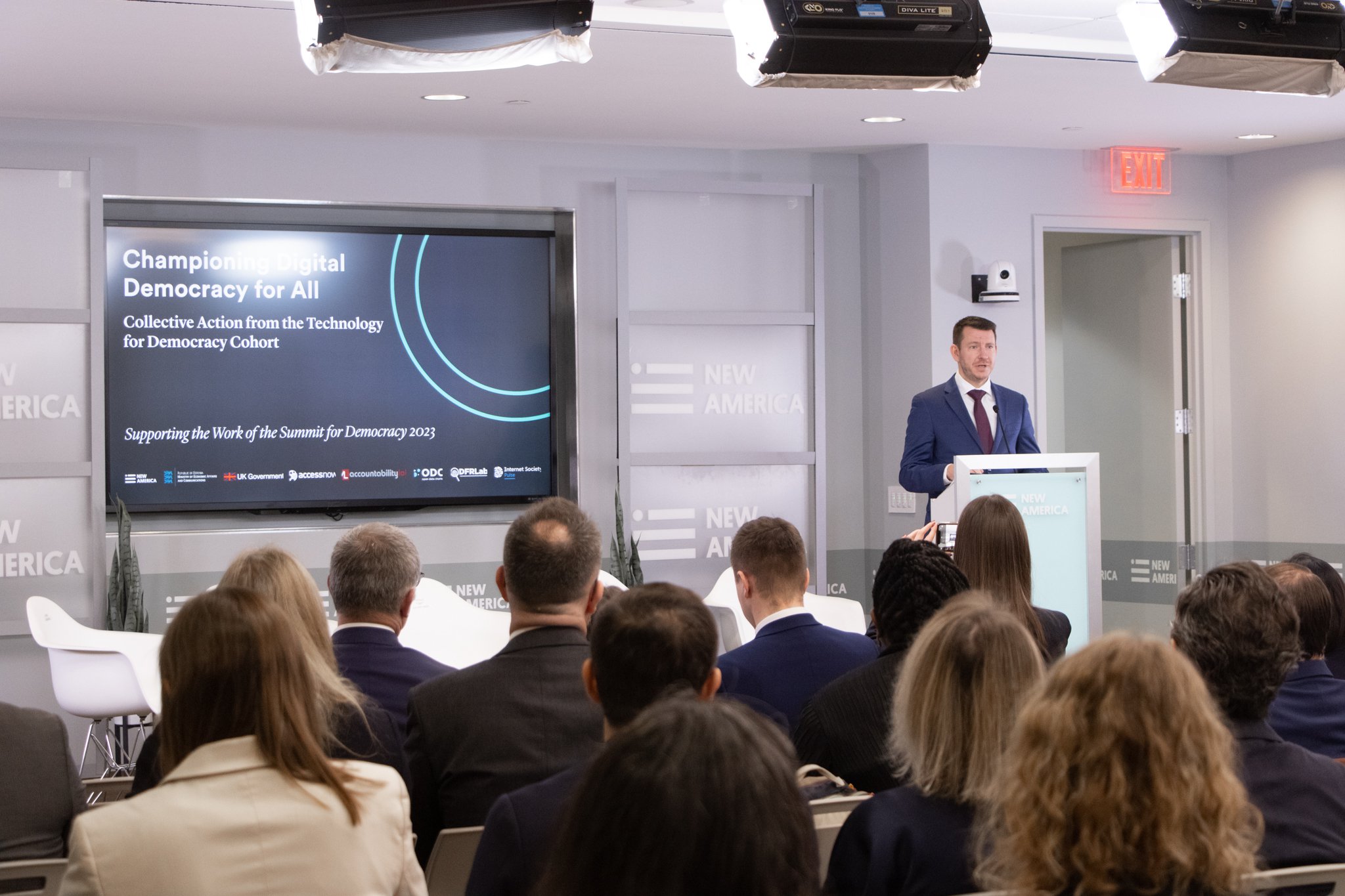
The Technology for Democracy Cohort co-leads Estonia, the United Kingdom, and Access Now, together with the Digital Impact and Governance Initiative at New America, Open Data Charter, Accountability Lab, the Digital Forensic Research Lab at the Atlantic Council, and Internet Society convened in Washington, D.C. on March 30th to discuss priority action areas in the field of technology for democracy and how to encourage opportunities for cross-sector collaboration among open societies beyond this year’s Summit for Democracy.
The event convened 21 speakers and panelists representing cross-sector perspectives to increase understanding of priority action areas identified by the cohort—using technology to support open and secure access to the Internet, strengthening digital public infrastructure, and advancing technology for good governance.
Paul Butler, President of New America, welcomed the assembled guests and online viewers, and USAID Deputy Administrator Isobel Coleman provided opening remarks calling for continued collaboration to advance a global digital governance model supported by democratic values and respect for human rights.
“The internet was built on a multistakeholder vision. […] Today it is maintained and regulated, not by governments alone, but by a diverse group of stakeholders with varying strengths, contributions, and goals. But all too common violations of privacy and safety remind us that democracy in the digital age is only as strong as those multistakeholder partnerships.” – Isobel Coleman, USAID Deputy Administrator
After a brief introductory video about the work of the cohort, Estonia’s Ambassador-at-Large for Human Rights H.E. Minna-Liina Lind introduced representatives from the cohort’s co-leadership organizations: Hon. Jonatan Vseviov, Secretary General; Ministry of Foreign Affairs of Estonia; Brett Solomon, Executive Director; Access Now; and Kanbar Hossein-Bor, Deputy Director of Democratic Governance and Media Freedom Department; Foreign, Commonwealth and Development Office of the United Kingdom.
Pictured left to right: Allie Funk, Freedom House; Scott Carpenter, Jigsaw; Carolyn Tackett, Access Now; Kenny Olmstead, Internet Society; and Waris Husain, American Bar Association. Photo by Samantha Webster.
Prefacing the panel on technology to support open and secure access to the Internet, Courtney Radsch, U.S. Advisor with ARTICLE 19, detailed the human rights impacts of internet shutdowns, especially in times of crisis and violent conflict. Moderated by Allie Funk, Research Director for Technology and Democracy at Freedom House, the panel included: Scott Carpenter, Director of Policy and International Engagement at Jigsaw; Carolyn Tackett, Campaigns and Rapid Response Director at Access Now; Kenny Olmstead, Senior Internet Security and Privacy Expert at Internet Society; and Waris Husain, Legal Advisor for South and Southeast Asia at the American Bar Association.
Key points from the first panel include:
Pictured left to right: Silvana Rodriguez, New America’; H.E. Nele Leosk, Ministry of Foreign Affairs of Estonia; Robert Opp, United Nations Development Programme; Manuel Muñiz, IE University in Madrid; and Roslyn Docktor, IBM. Photo by Samantha Webster.
The second panel focused on using technology for good governance and strengthening digital public infrastructure (DPI). A brief video introduced GovStack’s work to help governments create human-centered digital services. This panel was moderated by New America’s Digital Impact and Governance Research Fellow Silvana Rodriguez and featured: H.E. Nele Leosk, Ambassador-at-Large for Digital Affairs for the Ministry of Foreign Affairs of Estonia; Robert Opp, Chief Digital Officer at the United Nations Development Programme; Manuel Muñiz, Provost of IE University in Madrid; and Roslyn Docktor, Vice President of Technology and Science Policy at IBM.
Key insights from the second panel include:
Following the DPI panel, Muñiz with IE University and Teresa Hutson, Corporate Vice President of Technology and Corporate Responsibility at Microsoft, announced the global Tech4Democracy Challenge winner, EVoting Global. The challenge is a cross-sector effort to identify and elevate start-ups and entrepreneurs developing innovative digital technologies that contribute to the advancement of democracy around the world. EVoting Global, based in Chile, facilitates secure user responses for more participatory and transparent processes across institutions.
To close the event H.E. Minna-Liina Lind returned to the stage to lead the final segment highlighting opportunities for additional collaboration. Scott Busby, Deputy Assistant Secretary in the Bureau of Democracy, Human Rights and Labor at the U.S. Department of State; Natalia Carfi, Executive Director at Open Data Charter; Brett Solomon, Executive Director at Access Now; and H.E. Anne Marie Engtoft Larsen, Tech Ambassador for the Ministry of Foreign Affairs of Denmark, together, shared insight into what comes next for strengthening technology for democracy. Speakers highlighted resources and events like RightsCon 2023 (June 5-8), coalitions such as Freedom Online Coalition and Open Government Partnership, and multistakeholder initiatives like Tech for Democracy Initiative and Declaration for the Future of the Internet as opportunities to collaborate and expand the range of voices discussing technology and democracy.
The Tech for Democracy Cohort has grown into a coalition of over 150 civil society, government, and private sector organizations across 40 countries. The cohort is one of 15 cross-sector cohorts associated with the 2023 Summit for Democracy.
Watch the entire event here.
Resources shared during the event:
Speakers shared a variety of resources to help strengthen technology for democracy efforts.
Opportunities for collaboration:
Spotlighted Resources:
Upcoming Events:
Tweet us at @DIGI_NewAmerica or subscribe for news and events from our program.
Policy Analyst, Open Technology Institute, New America