Ashley LiBetti
Founder and Principal Consultant, Pillars Research + Strategy
To build a robust early childhood system, states need access to accurate and reliable data.


To build a robust early childhood system, states need access to accurate and reliable data. With data, states can identify areas of need, inform policy, support continuous quality improvement, and most importantly, ensure that children and families have access to the high-quality services they need to succeed and thrive.
Many states, however, lack comprehensive early childhood data. For example, during the onset of COVID-19, states lacked data on how to answer basic questions about children’s access to care, program quality, and workforce needs, affecting their ability to efficiently and effectively respond to family and community needs.
In October 2022, New America, with support from Pillars Research and Strategy, released a brief that helps policymakers identify what they need to improve early learning assessments and data systems. As part of our research for that work, we explored how different states created and leveraged early childhood integrated data systems (ECIDS).
An ECIDS collects, stores, and maintains early childhood data across multiple agencies that serve young children and families. Creating an ECIDS requires significant investment, coordination, and collaboration. States’ progress toward a comprehensive ECIDS varies from the early stages of conceptualization to the cusp of publicly launching. One state that has made major strides in building an ECIDS is South Carolina. In this blog post, we’ll discuss the genesis of South Carolina’s ECIDS (SC ECIDS) and the essential components that contributed to its progress.
The mission of the SC ECIDS is to establish and maintain a comprehensive infrastructure for accurate and actionable data to support young children and their families. The SC ECIDS is designed to create standard definitions and reports; inform policies and practices; connect early childhood data to longitudinal data systems; understand the effects of public investment from birth through the workforce; and improve the quality of life for all South Carolinians. Additionally, the SC ECIDS is designed to answer critical questions about the state’s young children and families. For example: How many children in the state are enrolled in early learning programs? Which public programs are families of young children accessing? Are there eligible families that are not accessing these services? What program characteristics are associated with positive outcomes for children?
The evolution of SC ECIDS was largely influenced by actions of legislative and oversight bodies. The genesis of the SC ECIDS began with recommendations from the South Carolina Education Oversight Committee (EOC). The EOC is an independent, nonpartisan group of 18 educators, business people, and elected officials who have been appointed by the legislature and governor to enact the South Carolina Education Accountability Act of 1998. Each year, the EOC is legislatively mandated to report about the reach and impact of the South Carolina Child Early Reading Development and Education Program (CERDEP), a state-funded, full-day four-year-old kindergarten program targeted for Medicaid-eligible children. CERDEP is administered in public schools by the South Carolina Department of Education and in non-public school settings by South Carolina First Steps.
In the 2014 annual CERDEP report, the EOC highlighted that the lack of integrated data was a barrier to answering key questions (e.g. how are children assessed and for what purpose?). In response to their findings, the EOC recommended that the South Carolina Department of Education and South Carolina First Steps must mutually agree upon how students in the program will be monitored over time and enter into a formal memorandum of agreement that will be a condition of participation by non-public school providers participating in the program.
The EOC’s recommendation, in addition to other questions from legislators about the reach and impact of early childhood programs, led the state to create SCProfile in 2017. SCProfile was a strong first step in the state’s journey toward a proof of concept for a product displaying data across multiple early childhood programs. The profile displays aggregate data on the number of children in publicly funded early childhood programs at the state and county level. However, there are several issues with the data. For example, data displayed on SCProfile are not integrated at the child-level, so it is difficult to understand how participants in these programs intersect or move from one program to another. Aggregate data are displayed at the county-level, but not by other important subgroups, like age, race, or ethnicity. Also, data are updated annually and are typically a year or two old by the time they are displayed. Data are submitted as reports from programs, so there is little room to dig into data. Finally, data are not linked to any outcomes, so it is difficult to understand the impact of participation in these programs.
These issues revealed to state leaders that a more comprehensive system was necessary. In 2019, the Senate Legislative Oversight Committee during a review of First Steps recommended several actions related to data. For example, one recommendation was that children receiving services by First Steps or other early childhood entities should be assigned a Student Unique Numbering System ID number. Another recommendation was that First Steps must enhance the student tracking system to improve the agency’s capacity to utilize data. As a result, discussions began for how early childhood programs broadly could obtain a Student Unique Numbering System (SUNS) ID number. The South Carolina Department of Education currently uses this number to longitudinally track students as they matriculate through public school.

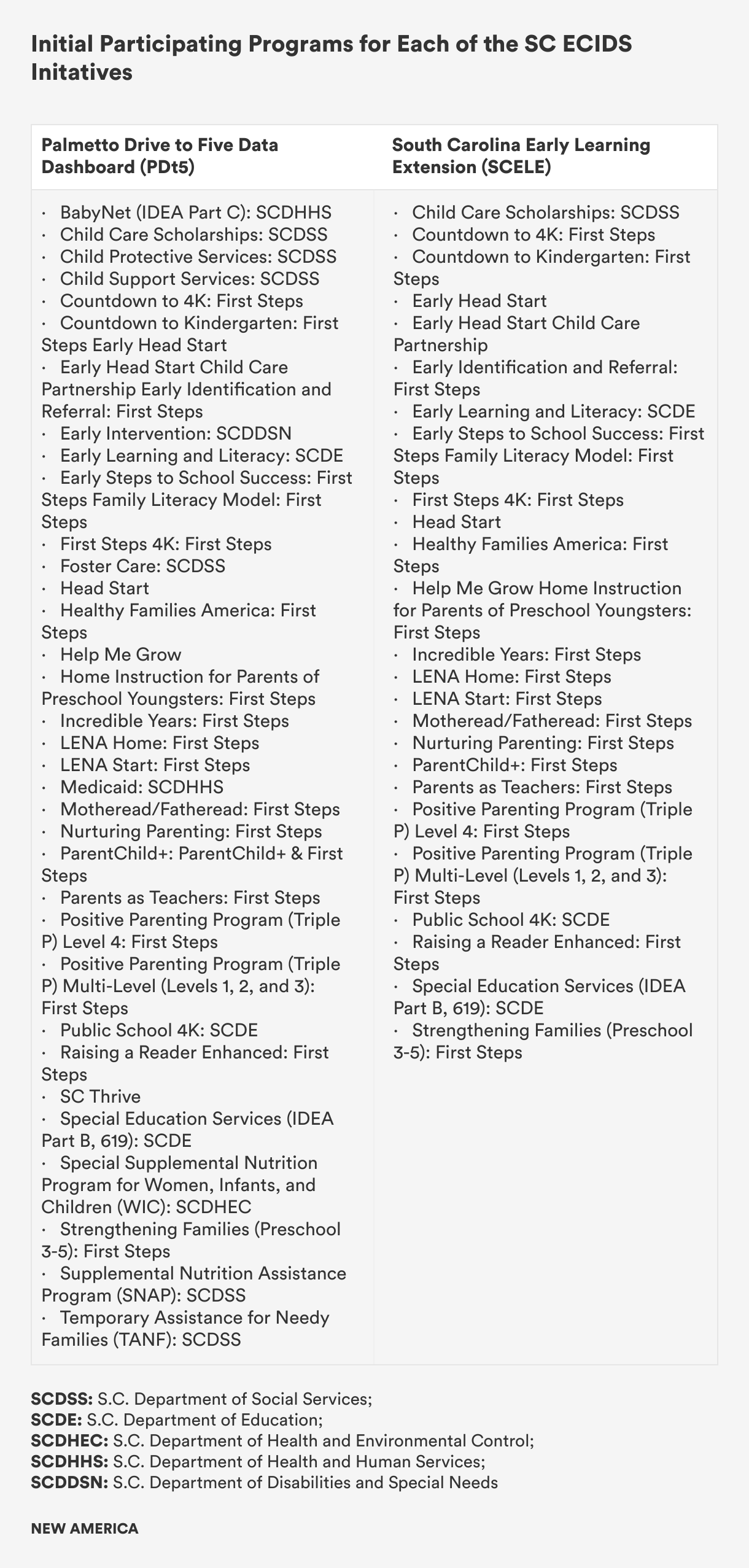
A range of early childhood programs can be included in any early childhood integrated data initiative. The program areas pictured above describe the breadth of South Carolina’s publicly funded early childhood system as an initial snapshot of the possibilities. For SC ECIDS, early childhood programs are defined broadly, beyond state and federally-funded programs, so additional program areas, like care coordination, are being added as participating programs are onboarded into ECIDS and its initiatives. Integrating child-level data across departments and programs allows the state to holistically address all aspects of children's and families' well-being; enhance service delivery; and assess program outcomes and investments.
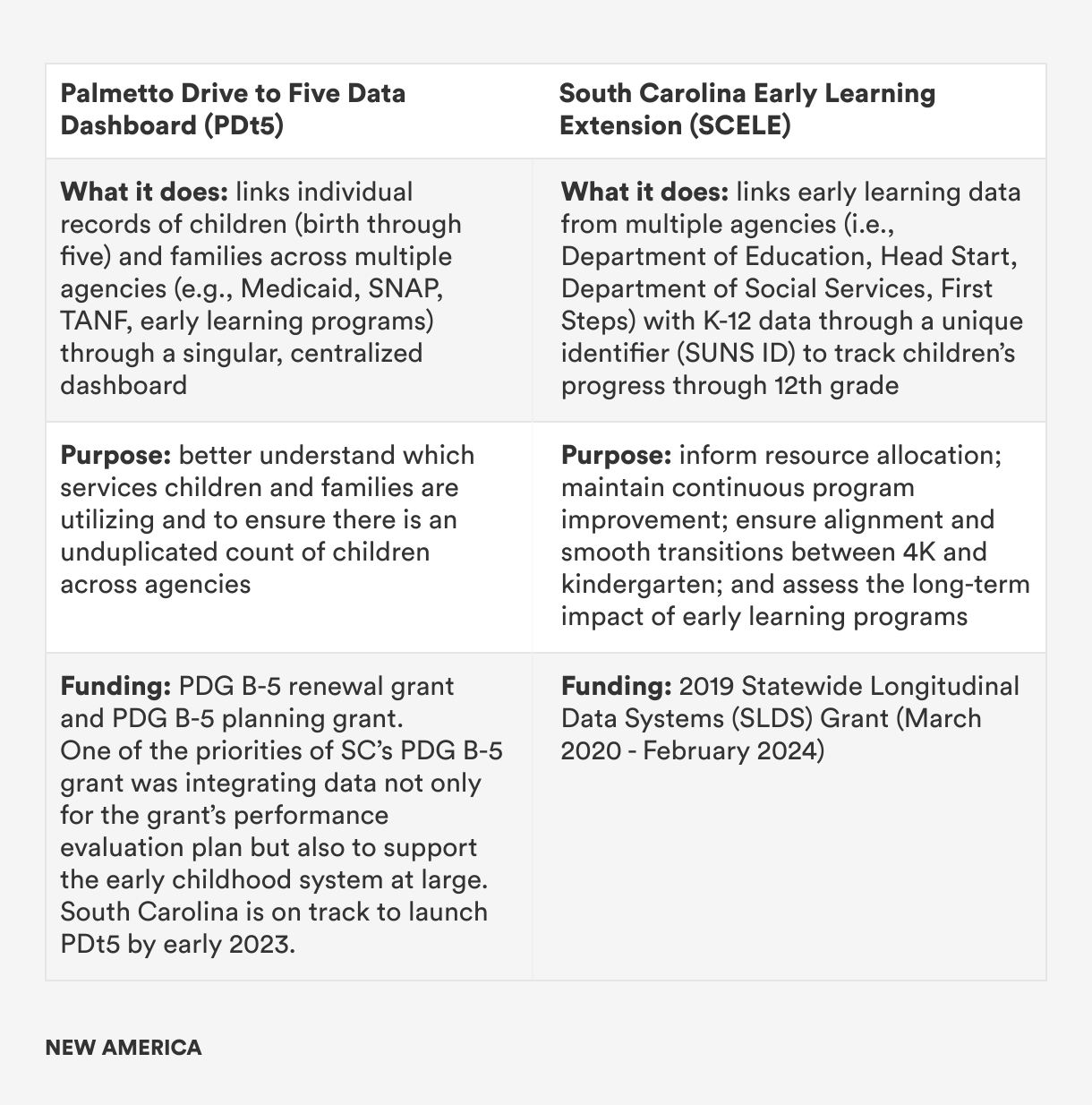
Currently, two early childhood initiatives leverage the data governance structure of SC ECIDS: The Palmetto Drive to Five Data Dashboard and the South Carolina Early Learning Extension. The table below provides details about each. The initial participating programs for each of the SC ECIDS Initiatives are included in the table at the end of this blog post.
Several enabling conditions have allowed South Carolina to build an ECIDS. These include:
South Carolina has made notable progress in building an ECIDS that is aligned, coordinated, and family-centered. As the state moves forward with this work, leaders will be able to more confidently, efficiently, and effectively assess and improve on the services that children and families need.
Acknowledgments
Thank you to the state leaders who contributed valuable insights and information to this blog post. In particular, we appreciate Chelsea Richard, Beth Moore, and Myrelo King from South Carolina First Steps. Any errors are the authors’ alone.
** Updated on 4/27/23 based on feedback from South Carolina state officials
Enjoy what you read? Subscribe to our newsletter to receive updates on what’s new in Education Policy!
Founder and Principal Consultant, Pillars Research + Strategy
Policy Analyst, Pillars Research + Strategy