Emmy Liss
Independent Researcher and Policy Consultant
The Intersection of Electoral Politics and Early Childhood Policy

This is the fifth blog in our series on the recently relaunched Early Care and Education (ECE) Implementation Working Group. For more information on the group’s origin and activities, please see our first blog Implementation is Everything, and Early Care and Education is No Exception and a recent update Meet the Early Care and Education Implementation Working Group. For a deep dive into some of the findings from the initial working group cohort, see our briefs on Family Outreach and Centralized Enrollment.
The October meeting of the ECE Implementation Working Group focused on the intersection of local electoral politics and early childhood policy. Why talk about local politics in a group focused on implementation? When we surveyed group members earlier this year about what was most top of mind, they highlighted local politics as particularly relevant and timely, and with good reason. In many cities and counties, launching or expanding early care and education programs like universal pre-K is driven by the mayor or equivalent local executive who has the ability to prioritize funding, resources, attention, and support toward implementation.
So what happens when that person leaves office? When a newly elected official brings fresh support for early childhood programs and wants to hit the ground running, what can teams do quickly?
Local politics can hinder or enable effective implementation significantly; therefore, understanding how to navigate changes in the local political environment—and where there may be opportunities to influence how transitions happen—is critical.
Local politics have outsized impacts on early childhood education–even more so than K-12 education because of how programs are funded and managed. Understanding the dynamics will help program leaders advocate for their communities’ priorities and manage the political forces more strategically. Across communities, we see that:
Electoral change can bring positive opportunities – and risks to mitigate. Local political transitions can trigger impacts across the board:
Mapping out potential changes due to local leadership transitions can help program leaders and policymakers think about what is more or less in their control given their role and position, and prioritize where to focus time and energy during a transition. For example, the civil servants leading pre-K implementation probably cannot change a messy interpersonal dynamic between a mayor and a governor, but local leaders can focus on building staff-level relationships with state counterparts that allow them to get things done regardless of the political dynamic.
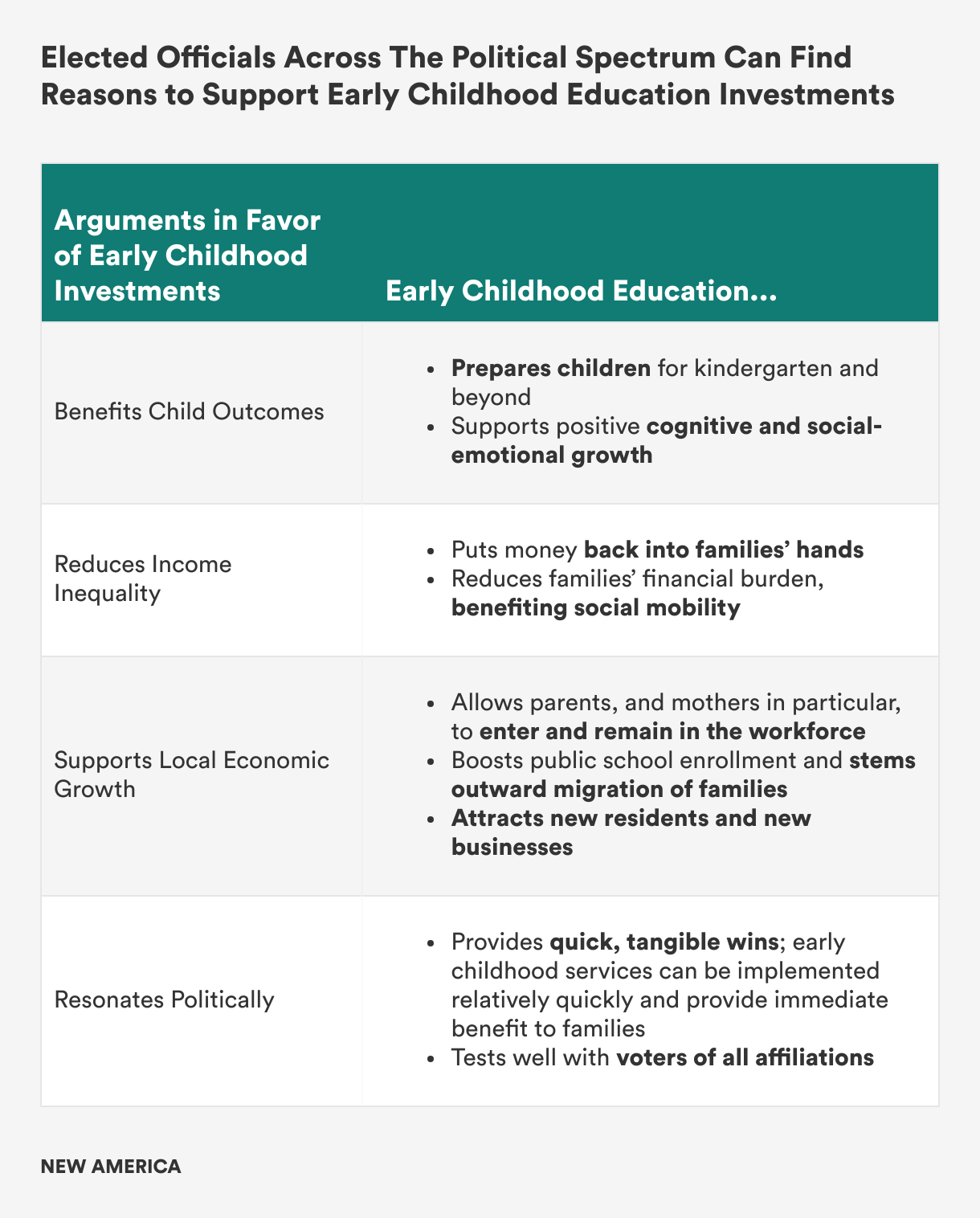
Successfully navigating a political transition may require demonstrating to an elected official how early care and education aligns with their priorities. Efforts from around the country have shown us that there are a wide range of reasons for elected officials to support early childhood investments. Supporting child development, enabling parental workforce participation, and invigorating the economy can all be effective messages for elected officials. Understand what motivates specific leaders and who they listen to, and then align ECE investments to outcomes that will resonate most.
During the October meeting, local leaders reflected on a few big themes: When you know a political transition is coming, what can you do to prepare? If the incoming executive does see early childhood education as a priority, how can you be ready to leverage their support on day one? If the incoming executive does not see early childhood education as a priority, how can you build connections to help them see the value? And lastly, what steps can administrators take to “future-proof” early childhood programs from political transitions?
To protect group members’ confidentiality, we are sharing thematic takeaways from the discussion without attributing the examples to specific cities or counties.
The ECE Implementation Working Group is a group of early childhood education leaders from cities and counties across the country. These leaders gather to share best practices from their experience working with families and local communities, and their work aligns with the New Practice Lab’s theory of change: that implementation lessons should inform policy design from the start. More information about the Working Group can be found here. You can reach out to us with questions about the group and its work at [email protected].
Independent Researcher and Policy Consultant
Senior Policy Manager, New Practice Lab