
Sarah Sattelmeyer
Director of Education, Opportunity, and Mobility
While many seniors have been in this status for years, a new wave of defaults puts more at financial risk.


After close to five years of relief and protections against new defaults for those with federal student loans, borrowers who had fallen behind on their payments began entering default again in fall 2025. Within a year, the number of Americans in this status had surpassed pre-pandemic levels and reached a record high. Today, close to 10 million borrowers are in default, and more than 1 million of these are likely seniors.
In the first part of this series, we examined how, even after pandemic-era relief efforts, many older borrowers (more than 900,000) remained stuck in default in 2025. This blog explores how a new wave of defaults is also disproportionately comprised of older borrowers. A final blog will propose solutions that policymakers should consider to protect seniors’ financial security.
At the beginning of the pandemic in March 2020, almost 8 million borrowers were in default on their federally managed student loans. That figure declined slowly over the next five and a half years, as the government suspended payments and collections, prevented any new defaults, and provided expanded access to forgiveness programs. By the fall of 2025, close to 5 million borrowers remained in this status. These numbers do not include more than half a million borrowers with federally guaranteed loans held by non-federal entities who were also in default.
After pandemic-era protections ended, borrowers who missed payments again began entering, or reentering, default in fall 2025 (see Figure 1).
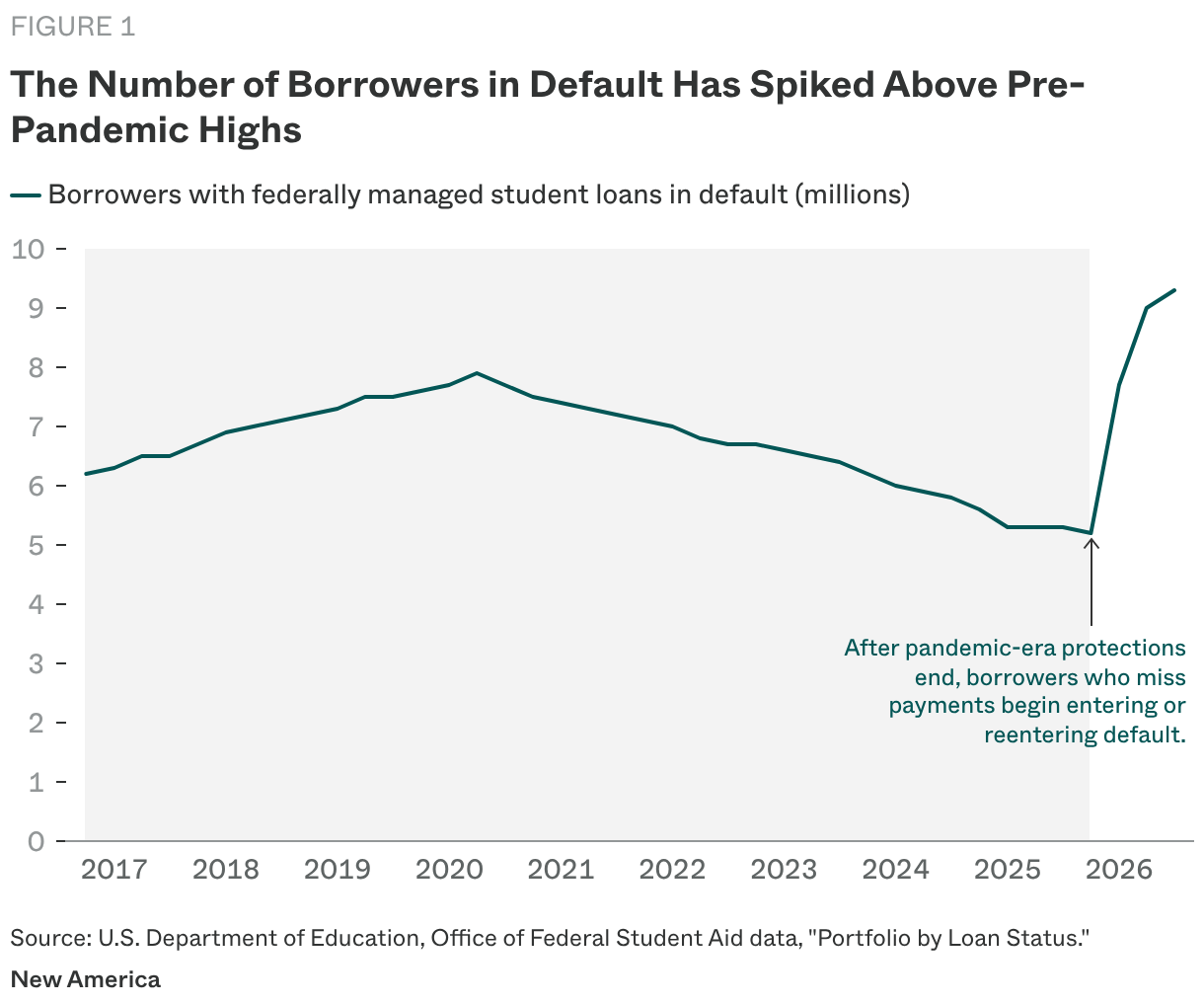
Many borrowers had become disconnected from the student loan system during the lengthy payment pause and after relatively little communication about their loans. Millions of others left school during the pandemic and faced their first required loan payments. A number of borrowers took advantage of Fresh Start, an initiative that temporarily provided a streamlined pathway out of default, to exit default during the pandemic period but did not resume payments once they became due. Some lost or changed jobs, had other financial circumstances change, or took on new debt, leaving less room in their budgets for a loan payment. And others were either unaware of or unable to access tools to prevent default, such as income-driven repayment (IDR) plans. By June 2026, the Department of Education reported that almost 10 million borrowers were more than 270 days behind on their payments.
Although the Department of Education has not yet released detailed data on new defaults by borrower age, credit bureau data provide strong evidence that older borrowers are disproportionately among those newly defaulting. According to the Federal Reserve Bank of New York, the rate at which student loan balances fell into serious delinquency—meaning at least 90 days behind on payments—spiked more for borrowers aged 50 and older in 2025 than other age groups (see Figure 2). Rates of new serious delinquencies have since declined, but older borrowers continue to experience higher rates than younger borrowers.
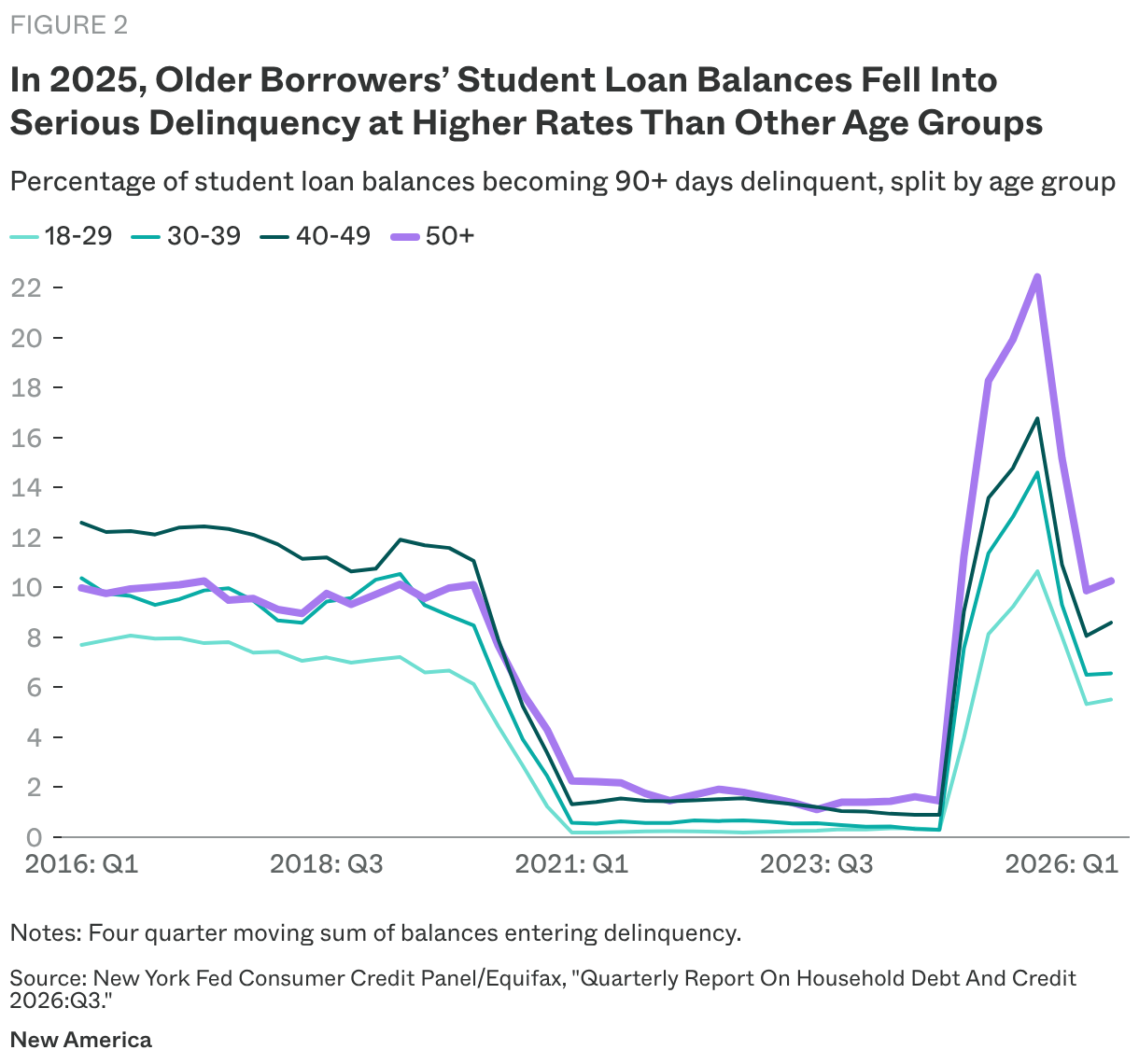
Other research from the New York Fed confirms that the population of newly defaulting borrowers is getting older. Among borrowers who entered default in late 2025 and early 2026, the average age was 38.9, compared to 36.4 among borrowers who entered default before the pandemic. These data suggest that older Americans are being hit especially hard, which is troubling not only because older borrowers often have fewer years of employment ahead of them to repay their debt, but also because default can threaten their financial security as some approach more limited resources in retirement.
Since fall 2025, about 10 percent of borrowers who were previously in good standing have defaulted on their loans. During that time, data from the Department of Education (released during a rulemaking process) show that at least 930,000 federal student loan borrowers aged 62 and older were in default. Older borrowers are more likely to be in default on their loans, but if we conservatively estimate that 10 percent of the seniors who were not already in default have also since entered default, that would mean that more that 1 million older borrowers are now in default.
These are rough estimates that do not take into consideration new borrowers, borrowers aging into the 62-and-older category, loan closures, or borrowers leaving default. Nevertheless, they illustrate the potential scale of the recent surge, which threatens to deepen hardship for a population already struggling with financial insecurity. These numbers also raise questions about the effectiveness of recent student loan outreach and relief efforts for older borrowers and how to better serve these borrowers in the future.
Older borrowers tend to be financially insecure, which for many, is a key reason they are carrying debt from years ago into their 60s and beyond. As we previously reported, borrowers who were able to leverage their higher education into economic security and a higher-paying job tend to repay their loans or access forgiveness more quickly. These people close out their loans and are no longer student loan borrowers by the time they approach retirement age. This leaves the Americans who still have outstanding student loan debt at older ages, on average, more disadvantaged than the typical borrower. Our previous research has confirmed that older borrowers tend to have low incomes, limited savings, and other outstanding debts.
As a result, even older borrowers who managed to avoid default before the pandemic—or who reached retirement age during the payment pause—are likely to be more financially vulnerable than younger borrowers. When payments resumed, many faced the same financial difficulties that had prevented them from paying off their loans earlier in life.
Older borrowers are also less likely to be enrolled in IDR plans, which can reduce monthly payments and help prevent default. Our earlier research suggests that lack of awareness may be a key reason. A 2022 New America survey found that just 64 percent of borrowers aged 60 and older had heard of IDR, compared to 74 percent of borrowers under 30 and 77 percent of those ages 30 to 44. Yet older borrowers who knew about IDR were especially likely to enroll. This suggests that helping more older borrowers understand and access affordable repayment plans could make a meaningful difference in preventing default.
The pandemic and recent reform efforts offered an opportunity to lower the number of older borrowers in default, but instead, most older borrowers in default remained there. Now, hundreds of thousands more are joining them. Without policies that better account for the financial circumstances of older Americans, student debt will continue to follow growing numbers of borrowers into retirement. In the coming weeks, the final blog in our series will present policy ideas for helping older borrowers approaching and trapped in default.
Director of Education, Opportunity, and Mobility
Senior Policy Analyst, Higher Education; Policy Research Consultant