
Sarah Sattelmeyer
Director of Education, Opportunity, and Mobility


Student debt is increasingly following financially vulnerable Americans into retirement age, and today, a record number of those older borrowers are in default on their loans—a status that comes with steep financial penalties, including the withholding of wages, tax refunds, and federal benefits. During the COVID pandemic, student loan operations were suspended, and there were additional opportunities for borrowers to exit default. But instead of leaving this status, most older borrowers who entered the pandemic already in default remained stuck there. And many more seniors newly entered default after the pandemic-era protections expired.
This blog examines data from the pandemic period, highlighting the fact that many older borrowers never exited default, even when additional relief was available. The next blog in this series examines why more and more continue to enter this status. And a final blog will propose solutions that policymakers should consider to protect seniors’ financial security.
Over the last two decades, the number of older Americans with student debt has grown by over 500 percent. More than 3 million borrowers over the age of 62 currently hold federal student loans, most from their own education decades ago. Many have struggled to pay down this debt because they did not see the financial return on their college investments that others enjoyed. These borrowers tend to be economically insecure, with low incomes, limited savings, and other outstanding debt. Even as their peers have successfully repaid their loans and leveraged their degrees to move up the economic ladder, these seniors have missed payments, entered default, and seen their balances grow.
As a result of these decades-long trends, in late 2020, more than one-third (35 percent) of federal borrowers aged 62 and older were in default, a higher proportion than in other age groups. While only five percent of federal student loan borrowers were 62 or older, they made up 10 percent of those in default.
When the pandemic hit in March 2020, the federal government acted quickly to pause payments and collections on federal student loans. This student loan repayment pause was extended through the fall of 2023 and followed by a one-year “on-ramp,” intended to ease borrowers back into repayment. During this time, bills were again due, but the consequences of missed payments, including default, remained suspended. The Biden administration also created the Fresh Start program, an initiative that temporarily provided a streamlined pathway out of default, and it took steps to expand access to existing student loan forgiveness programs.
Together, these changes offered an opportunity to relieve the burden of default. And many borrowers did exit default during this period: At the start of the pandemic, almost 8 million borrowers were in default on their federally managed student loans. At the end of the payment pause, that number had decreased by approximately 20 percent, and two years later, in fall 2025, close to 5 million borrowers remained in this status (see Figure 1).
These numbers do not include more than half a million borrowers with federally guaranteed loans held by non-federal entities who were also in default.
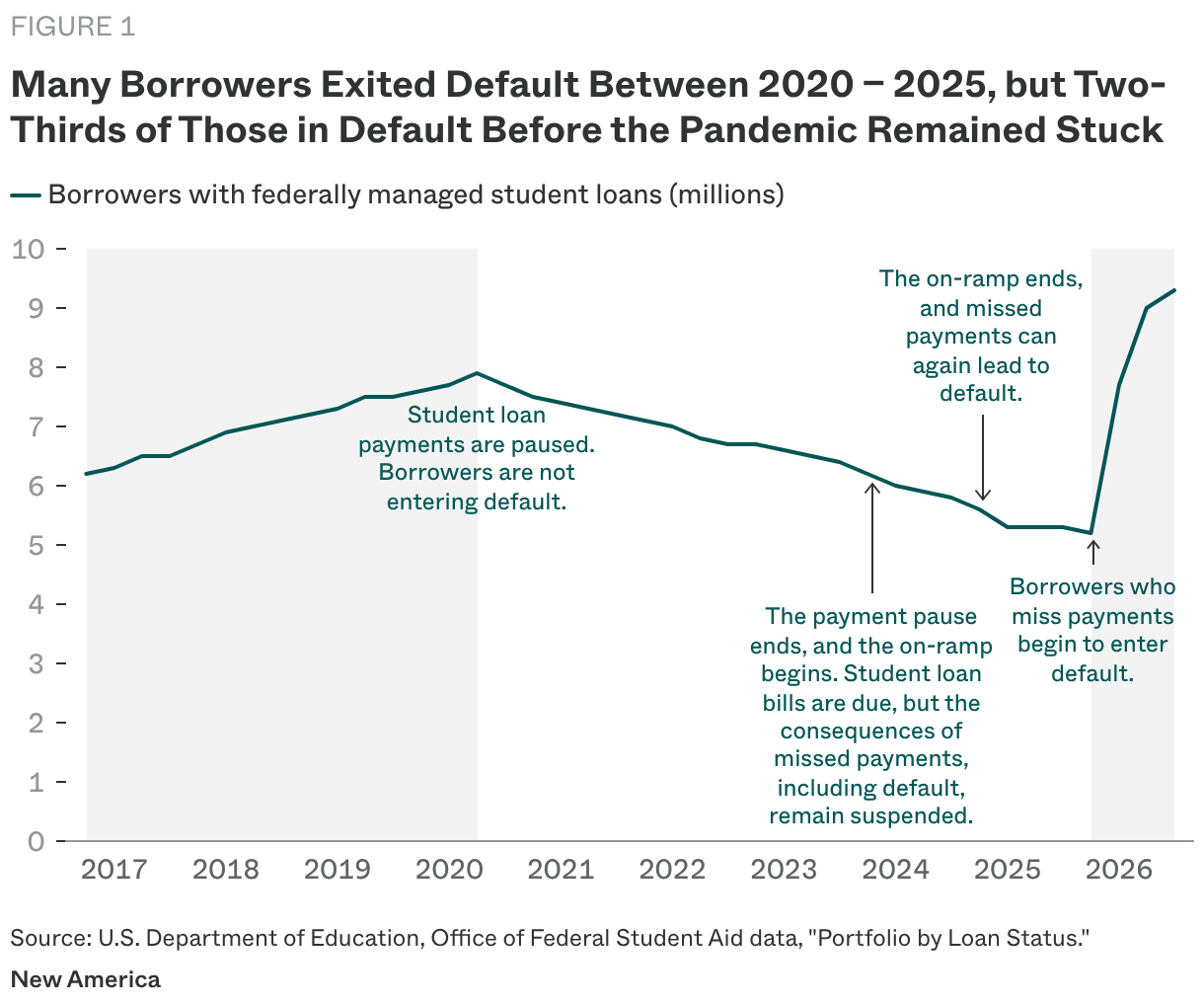
While this was a meaningful decline, two-thirds of borrowers with federally managed loans who were in default before the pandemic remained in default half a decade later, including a disproportionate number of older borrowers. Last year, the Department of Education (Department) provided a snapshot of the status of older borrowers in fall 2023 (at the end of the payment pause), confirming that older borrowers were heavily represented among those stuck in default. At that point, 30 percent of borrowers 62 and older were in default, compared to 12 percent of those under 62.
On the surface, it might seem like 30 percent of older borrowers in default in 2023 is an improvement over the 35 percent of older borrowers (noted above) who had been in default in 2020. But the number of older borrowers in default actually grew during this time period, from roughly 800,000 in 2020 to close to 1 million in 2023. Although borrowers were typically not newly entering default during this period, some borrowers who were younger than 62 in 2020 aged into the older borrower category by 2023. It is likely that these borrowers had lower default rates than those already in the older age group, bringing down the older borrower default rate even as the number of older borrowers in default increased.
Almost a million seniors were in default in fall 2023, at the start of the on-ramp and end of the payment pause. According to Department data, few left this status over the next two years. In fall 2025—when the first wave of those who missed payments after the payment pause and on-ramp were entering default on their loans—88 percent of all borrowers who were in default in 2023 were still there, including 92 percent of older borrowers. This included more than 900,000 seniors (see Figure 2).
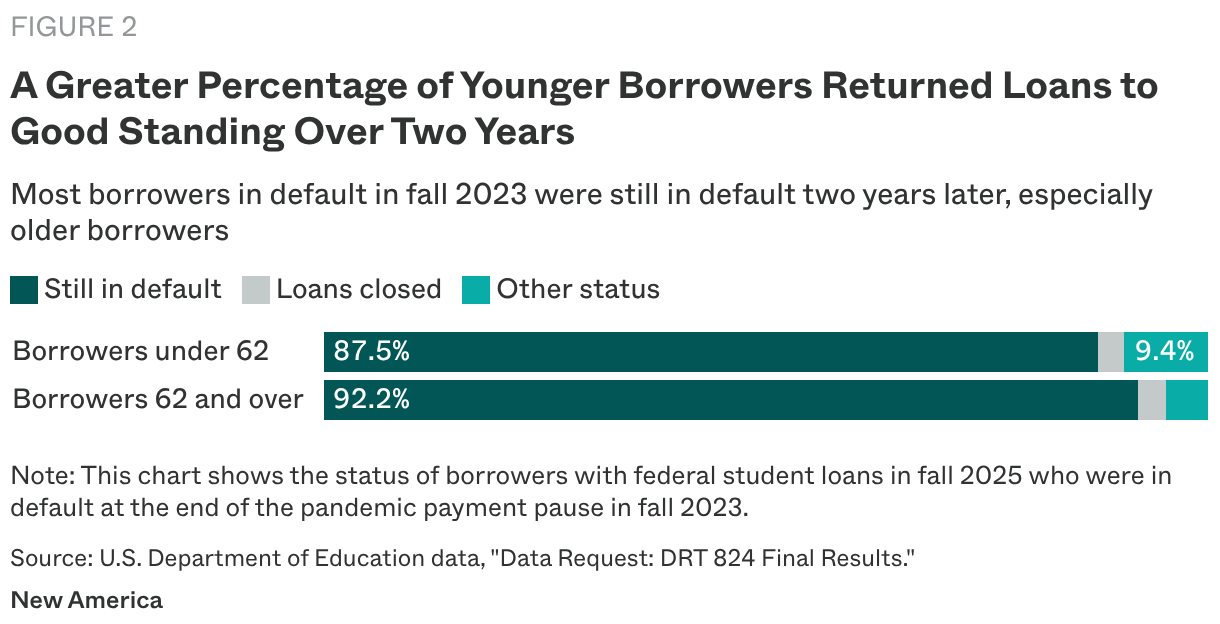
While similarly small proportions of older and younger borrowers who were in default at the end of the payment pause had their loans forgiven or otherwise closed during this two-year period—approximately three percent—almost twice the percentage of younger borrowers were able to return their loans to good standing.
The low rate of loan closures is likely partially due to the suspension of involuntary collections, which would otherwise have paid off some defaulted loans through garnished wages and withheld tax refunds. Suspending these collections provided protections for vulnerable borrowers, but it also meant fewer defaulted loans were being paid off through the government’s usual collection methods. Loan close out rates for those in default could also be low because—although these borrowers may have benefitted from improvements in some forgiveness programs, like the Total and Permanent Disability discharge program—they may not have had a large number of qualifying payments toward other student loan forgiveness programs, including Public Service Loan Forgiveness and income-driven repayment, which typically don’t count time in default. In addition, many borrowers with federally guaranteed loans issued by private lenders before 2010—disproportionately likely to be older Americans and disproportionately likely to be in default—face additional administrative hurdles to access forgiveness programs.
Unfortunately, these missed opportunities, both for borrowers to exit default and for the repayment system to support them, are only part of the story. Since pandemic-era protections ended, millions of borrowers who had previously avoided default have fallen behind on their payments and entered default again or for the first time. By June 2026, the number of federally managed borrowers in default had surged to almost 10 million, surpassing pre-pandemic levels. In the second part of this series, we examine how this new wave of defaults is hitting older Americans especially hard, threatening seniors’ financial security.
Director of Education, Opportunity, and Mobility
Senior Policy Analyst, Higher Education; Policy Research Consultant