Hollie Russon Gilman
Senior Fellow, Political Reform Program
Now that Lexington’s first civic assembly is finally complete, what did it take to get there?

In March 2026, 30 randomly selected Lexington residents came together for a civic assembly. Over seven sessions spanning a month, members deliberated on updates to the joint city-county government’s Urban County Council charter. The assembly was entirely run by CivicLex — a local nonprofit strengthening civic health in Lexington, Kentucky — and took three years to develop and implement.
The assembly produced three recommendations: updating councilmember salaries, creating publicly viewable attendance and accountability expectations for the Urban County Council, and requiring the charter to be reviewed every eight years by a deliberative body of residents. Shortly after the assembly concluded, members presented the recommendations to a committee, which voted to advance them to the full council at a work session on June 2. The full council approved the recommendations on June 18, which meant that all three proposals appeared on the ballot this November for public consideration.
On November 3, voters approved all three recommendations, including making assemblies a permanent part of the city’s charter.
Founded nearly a decade ago, CivicLex has become a cornerstone of civic life in the region. Hollie Russon Gilman and Sarah Jacob spoke with Executive Director Richard Young and Deputy Director Kit Anderson about the design and implementation of the assembly process.
These interviews have been condensed and lightly edited for clarity.
How did you all first conceive of the idea of a civic assembly in Lexington?
Richard: We first started [internal conversations] about this assembly in 2022. We had a growing awareness of assemblies as a concept out in the field, and they really land right at the center of our model: helping people understand and get involved in local issues, connect with their neighbors, and reimagine how decisions get made. Theoretically, an assembly does all three of those things.
On the other side of it, we had been in conversation with some members of the Urban County Council about doing a charter review and potentially making some recommendations for changes. At a certain point, having both of these conversations happening, it sort of clicked. We were like, this is a perfect process for this particular problem.
There had been a charter review in 1998 that was unsuccessful — it wasn’t very engaged with the public, and so it’s not terribly surprising that the outcome wasn’t well received either. Knowing that anything coming out of a charter review has to go on a public ballot to be adopted, we had read in the literature, talked to practitioners, and heard that there’s often a pretty strong correlation between recommendations adopted by assemblies and [those approved through] public referenda. So we thought, well, this seems like it would make a really interesting process for charter review. We brought that to our council, and they were on board.
And one of the things we talked to council about early on was that we wanted this to be a fairly independent process — not necessarily tied closely to local government. But we also wanted some assurance from council that if we did this process, they would listen to the results. I think those are two really important facets: being separate from government, but also having a tangible impact with government. Those are some of the reasons the framing of our assembly made so much sense.
What did the early design stages of planning the assembly look like?
Kit: We wanted to build a local advisory group to help us think through the adaptation [of the civic assembly model] and bring in some key stakeholders who we thought needed to be engaged. We asked our county clerk to join that group because she manages ballot initiatives. We also included someone who helped run a successful ballot initiative in Lexington recently, plus engaged residents. Eight people total. That was the group we started digesting the model with and figuring out what it should look like in Lexington.
The other early thing we did, which I think was really beneficial, was a test run assembly in the summer of 2025 with 15 people on a semi-related topic: the compensation of boards and commissions members. We didn’t do full sortition, but we had a semi-demographically representative group of volunteers and learned a lot — especially about facilitation, which had been a pretty big question mark for us. [CivicLex had] done a ton of facilitation, but facilitating through that specific arc of starting with no preexisting information and arriving at a really narrow decision was something else entirely. One of the big takeaways was: we need help with this. But it also gave us confidence that it could work. The group engaged really well with the material, and we learned a lot about the importance of testimony and other things we ended up carrying forward.
From there, our team started tackling the assembly itself — thinking through the communications and public engagement side, the topic selection process, building out the sortition and mailing process, which was a pretty significant early lift, and then building out the flow of the actual assembly
Can you expand more on the decision-making around running the process yourself?
Richard: We made a decision about a year ago that one of the ways we could add value to the broader field — for folks trying to do assemblies — was to show what it looks like for a community to do this itself. And I think we learned a lot of lessons from that. What I mean is: we relied on publicly available resources, we went to as many group calls as we could, we had one-on-one conversations — but we didn’t hire a national firm to come in and design, run, or facilitate our assembly. We were really intentional about doing it ourselves.
We did end up hiring a local facilitator – Tanya Torp – which was maybe one of the best decisions we made in the entire process. [Otherwise,] we tried to lift the whole thing ourselves, both to put our own stamp on it and to demonstrate what it looks like for CivicLex to run an assembly. And also to show: if these things are going to take root and grow in communities across the country, you can’t have 80 national organizations doing 1,000 assemblies a year. Communities have to be able to hold these themselves. So that was part of our thinking.
Who were the experts involved?
Kit: Locally, a few come to mind. On the sortition process, we worked with two faculty members at the University of Kentucky — a public policy professor, Catherine Annis, and JS Butler, an econometrician, who is kind of a wizard of numbers. They helped us vet the sortition and selection protocol statistically, including the alternate drawing process, which ended up being really key. We sent the postcards in November and December, and by the time March rolled around, about a third of our panel was alternates — so it was important that the process was also rigorous. Panelot [a not-for-profit sortition tool] wasn’t designed for that, so we had to figure it out.
With content, CivicLex was in a somewhat unique position because we do civic education. Where some assemblies use an information review panel, we didn’t go that route. Our whole organization is about compiling reliable, nonpartisan information on civic issues. So our Director of Civic Education taught our local government 101 workshop, which we’ve spent six or seven years honing. That ended up being one of the most impactful things in the whole assembly — people were referencing it throughout.
We had a variety of testimonials too. Our county clerk, our Mayor and Vice Mayor — who more or less represent the two polar opposite perspectives on the charter, which was really fun — and an attorney from the Kentucky League of Cities, who served as our legal consultant and helped lead the conversation on what is and isn’t actually a charter issue. That was one of the core tensions specific to our topic: there are lots of interesting policy changes that might need to happen, but not necessarily through a charter amendment.
Also, just bringing the assembly members into direct conversation with council members was really valuable — particularly on council compensation, which was one of our topics. That was by far the best way to present the range of perspectives: they met council members who were for raising compensation and members who were for keeping it the same, with a variety of levels of participation and expertise. The more we could step back and let other people talk, the better I felt about the sessions. That’s probably one of my bigger takeaways.
How did you secure funding for the assembly?
Richard: Ours came from a handful of national philanthropies. That actually made local conversations a lot easier, because the most likely local funding source would have been local government — and that would have made things significantly more complicated. It would have given them a much clearer avenue to influence the process, intentionally or not. We also made a point not to go public [with the assembly] until we had all the resources in place.
What were some of the challenges you encountered with the design process?
Kit: We tried to do a lot of research on how other assemblies actually run, and the things we kept running into: one, what does the daily schedule actually look like? What’s happening in the room each day? That was weirdly hard to find.
The other thing I really struggled to find was anything about staffing. Everything we read was like: you need a head facilitator and an assembly member concierge, these two roles are important for these two reasons. And I absolutely agree — but I’m like, who is writing the agenda? Who is designing the breakout groups? Who is doing all the research? We did a Zoom public input session — who is building the Zoom webinar? I’m still genuinely confused about how assemblies are staffed and how different teams are structured around them. I think ours was more hands-on than many, but to this day, I don’t really know what those teams look like elsewhere. And none of the literature I found gave me a real sense of what sessions actually look like in the room. That was the hardest thing for me and the biggest source of anxiety going in.
The other big thing I’m still working through is topic-specific legal complexity. Our topic was the charter, which is a legal document, and we are not lawyers. We kept running into landmines. Four days before the first session, someone mentioned in casual conversation, “it sure is a shame you can only do one charter amendment per year in an election.” I nearly lost it. One amendment? We had two topics and were potentially looking at three amendments. That is not an easy question to get an answer to, it turns out — we had to hire a lawyer to write a memo on whether there’s even a limit.
And to clarify, we had already researched this and were under the impression more than one amendment was allowed, but the credibility of the person saying it worried us. However, it ended up being okay in the end.
When you’re doing this in a smaller community, you don’t necessarily have a ready-made panel of experts to draw from. France did an assembly on nutrition. Obviously you can find experts to speak to nutrition in France. There is no expert panel on Lexington’s Urban County charter and council compensation. That bench doesn’t exist. So when you’re doing this in a smaller community, you’re not just curating resources — you’re creating them.
Richard: We know local government really well, we know how to educate people on it, it’s literally what we do. I still felt like we didn’t have nearly enough time to truly immerse people in these two narrow topics. And that raises a question I keep sitting with: when an assembly’s topic is something large and complex like housing, how are people getting enough information to actually make informed decisions? By maybe the last session, I felt like participants were finally starting to grapple with the real-world implications of the changes they were considering. And we were dealing with pretty binary decisions — people get paid more, less, or the same. It’s not like “what should we do about transit.” So I keep wondering: did our background make us over-index on education? Or were we just three sessions short of where we should have been?
Did you use any new tools or technologies for the assembly process?
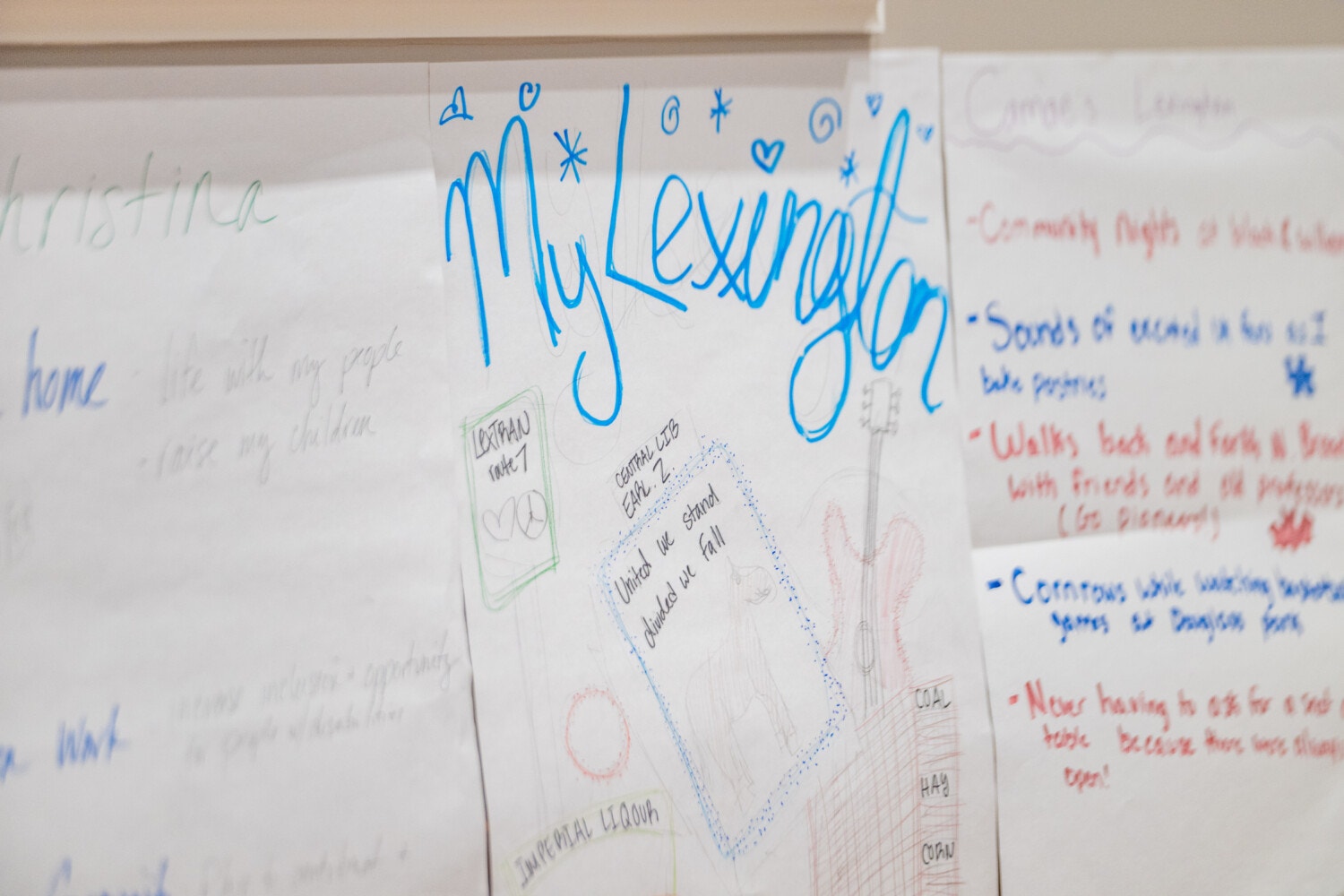
Kit: It was intentionally very low tech. It turns out when you mail people postcards to apply to a program, you get applicants who have different levels of comfort with technology. Two of our assembly members didn’t have functional email addresses, so all communication with them had to be by phone, mail, or in person. In the sessions themselves, everything was flip charts — no one had a computer except us, everything was handwritten. People had binders where they kept all their materials.
Why was transparency of materials and the process important?
Kit: Transparency was a core value throughout. We’re not normally in the business of turning people away from a program, but we had people saying, “I want to be in the assembly, I didn’t get a postcard, let me in” — and the answer was no. There’s a very narrowly defined process, 36 people selected, and that’s that. So we wanted to bring as many other people along as possible, even those who weren’t selected or couldn’t apply. Part of the transparency was about that. Part of it was knowing that if these decisions end up on the ballot, we need to be able to show exactly where they came from — especially on council compensation, where people are understandably skeptical about career politicians potentially voting to increase their own pay. Given that transparency is such a core part of CivicLex’s mission and values, this was a must for us.
I’ll be honest though: actually bringing the public along through the assembly itself was hard. It moved fast, there was so much happening at every session, and while sessions were almost all open to the public [through both livestream and public seating], they weren’t really designed to be a great spectator experience. They’re long, we’re covering a lot. The resources were there, but I personally wouldn’t have attended all those sessions.
What elements of the process would you maintain if you were to do it again?
Kit: The first really key piece is the sortition. We came out of this experience really, really believing in it — it does what it says it does. The diversity in the room was genuinely important and the assembly members themselves celebrated it. They liked that they were all different ages, backgrounds, and races; they were proud of that. And maybe my biggest surprise from the whole process was how low the cynicism in the room was. People were open and genuinely interested, because they weren’t already burned out on civic engagement. They were new to it. They didn’t have the accumulated frustration of trying to engage local government. People had their own perspectives and baggage, of course, but the room as a whole was just really fresh and I think that mattered enormously.
The stipend was also key. We did $1,200, which came out to about $26 an hour over the number of sessions. That was probably on the higher end. Many people cited it as a reason for participating, but nobody was just there for the check — that was very much not the vibe.
We offered stipends for transportation and childcare, which people really appreciated and helped reduce barriers.
For us it was really about people and relationships and building trust in the room so we could get through the process together. Our hired facilitator was way more important in the earlier sessions for building that trust and anchoring the group. By later sessions, we were more in the mode of: here’s what we need to accomplish in this session, how should we pace and structure it?
Richard: We’re really into sortition now — but I think even if we never do another full assembly, sortition has a clear home at CivicLex. There are so many ways it can be applied in our everyday work and in government’s everyday work. It feels accessible. It feels like: with not a lot of money, you could actually get meaningful outcomes on things. That’s really sticking with me.
What would you do differently?
Kit: We spent way too much time thinking about the schedule and, for some reason, felt it was really important to keep everything within one month. It should have been two months. A month was too short. It was really hard on us as facilitators because so much of your plan shifts based on what happened in the previous session, and turning around from a Thursday session to a Saturday session was brutal. I also wish the schedule had been more regular — like every Saturday, or every Thursday evening — rather than different days and times each week. That was needlessly complicated, especially when some participants don’t have email and you’re calling everyone individually.
Another thing I’d do differently: have a social mixer or get-to-know-you event before the first session. People would have liked that. In general, assembly members weren’t very interested in add-ons — they were serious about the work. We did an optional bowling outing about three-quarters of the way through, and decent folks came, but a lot didn’t because they were like, I’m here to work. So I think something more like a mandatory get-to-know-you at the start would have landed better.
How might another city replicate your model?
Richard: I think CivicLex is kind of an outlier in a way that makes it hard to cleanly transfer our experience to other communities. In a way, all that we’ve been up to in Lexington for the past decade – broad, public civic education about local government, co-governance practices in partnership with city government, adapting and changing governmental processes — prepared us to host this assembly. Without that deep well of expertise, I’m not sure if we’d have been able to do this assembly. In my ideal world, every assembly at this scale is being fully run by the community that it’s for — and the one that must implement the recommendations. That said, I’m leaving this process with a much greater appreciation for the role of intermediary organizations. I was skeptical of how important intermediaries in this space are going into this process, but I’m not as skeptical anymore.
This was hard. Probably the hardest thing CivicLex has ever done. And I had a conversation recently where someone asked whether AI or tech interventions would have made it easier. The answer was absolutely not — at least for ours. The challenges were human challenges. Talking with panelists about family trauma and emotional difficulties. Keeping constant communication with assembly members so they stayed engaged. Managing expectations in the moment. Pivoting our schedule and facilitation in response to their needs. All of that was really hard — and I think also a little unusual for assemblies. My sense is that most assemblies run pretty tightly to their structure. Ours was structured, but we left a lot of room to respond to participants’ needs. That made it much harder operationally, but it built trust. Assembly members told us repeatedly in the takeaways, in breakouts that they really appreciated how responsive we were. And I think that responsiveness is part of why it worked.
This process took a significant toll — physically, emotionally, and maybe spiritually — on all of us. I think it was worth it. But for an organization that doesn’t have our history doing similar adjacent work, or this level of existing trust in the community, I think doing it on your own would be even more challenging.
At the same time, I see some red flags for government running this directly. Government typically doesn’t respond to people’s needs in the moment. There would need to be a lot of training — more on facilitation than on the assembly itself, really — on how to do deeply human, emotionally responsive group facilitation. Every single day during the assembly, I was thinking, thank God Tanya is doing this. So I’m leaving this process with a much clearer sense of where intermediaries provide real expertise value.
The human and emotional dimension of this seems like such a huge part of both the labor and what made the assembly what it was. How did art fit into that?
Kit: I think a lot of it came from our commitment to being local. Cricket Press is a really established print shop in Lexington. As we were thinking about the postcard artwork, we were like, “what if it’s a local artist? What if it is Cricket Press?” And our local facilitator, Tanya Torp, brought poems to the first session [by] Georgia Ella Lyon, a Kentucky poet. Our commitment to place made those choices feel natural, they just kind of came with it. Even the food, [the question was] “what local restaurants should we use?”
And I want to underscore the point I made about sortition and how fresh people were — I was actually worried about the poem. I thought people were going to roll their eyes, like they do with icebreakers. People loved the poem. Genuinely. And I think that speaks to what happens when people aren’t already burned out on these spaces. For most of them, it was the first time they’d ever been in a facilitated setting like that. So all of it just felt really good and new and real.
Richard: It was one of the least cynical spaces I’ve ever been in. People felt genuinely happy to be there. And I think anchoring it in things that felt of our place was really important to making it feel like somewhere people could actually be themselves. People were incredibly vulnerable — not just about their views on policy topics, but about their lives. People talked about family trauma, really hard things.
Kit: They talked about loneliness. Grief and loss. Uncertainty and home. It was kind of remarkable how quickly people were willing to go there. And I think having place as common ground — everyone being in Lexington, having some relationship to whether Lexington was home — created a shared foundation that made that possible.
Richard: In our very first introductions, one of our assembly members wrote a poem in response to the opening poem. I almost cried. I was getting misty.
Would you do it again?
Richard: That’s a great question. I think we’d need to give it some time. If the stars aligned — the right funding, a better sense of things coming in, and the lessons we’ve now learned — I could see it. One thing we definitely wouldn’t do again is the topic selection process. We spent about three or four months asking our community to help us pick the topics within the city charter that our assembly should focus on. We had a digital survey that 800–900 residents responded to, but the bulk of our outreach was through in-person events and tabling. All of this meant we spent those months not really knowing what the specific deliberation items would be, which made it very hard to prepare the structure, facilitation, and details of the assembly. That created real challenges. If there was a clear, pre-existing decision that needed to be made [next time] – a genuinely sticky question – and we had the resources and staff capacity and adequate time, I could see it. But it would probably look pretty different.
Senior Fellow, Political Reform Program
Senior Research Associate, Political Reform Program