
About the Eviction Data Response Network

Each year, more than 10 million Americans face eviction. This profoundly destabilizing experience leads to homelessness, job loss, adverse mental and physical health impacts, educational attainment gaps, and downward economic mobility—and disproportionately affects Black and Latino families, and families with young children.
And yet, most state and local leaders don’t track how many evictions are happening in their communities, where they occur, or who is impacted. Without comprehensive and reliable data on evictions, decision makers can’t design or implement effective policies that keep families stably housed. And many of the government and nonprofit actors interested in addressing the eviction crisis lack the bandwidth, funding, or mandate to tackle the complex data and stakeholder engagement challenges of eviction prevention.
New America’s Eviction Data Response Network (EDRN) is a bold initiative to change that reality. From 2026 to 2028, New America is supporting 11 state-level teams across the country to build pipelines of reliable and comprehensive eviction data and craft data-driven policies and programs that keep people housed. EDRN provides technical assistance, financial support and peer-to-peer learning to states and their local, on-the-ground partners to move the needle on eviction prevention.
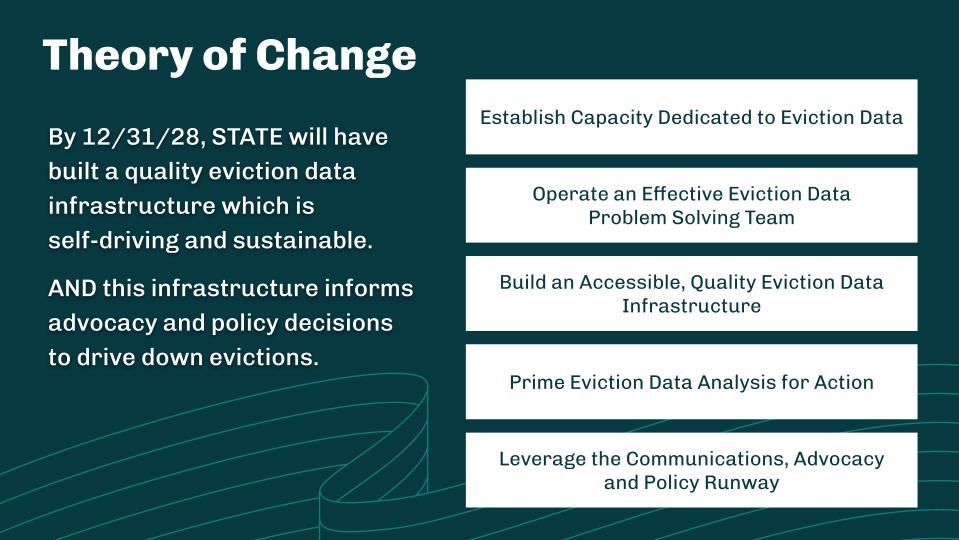
By December 31, 2028 New America’s Eviction Data Response Network will support 11 state-level partners to:
- Develop eviction data infrastructure via a pipeline of reliable, comprehensive, centralized, and demographically specific eviction data that can be analyzed, visualized, and shared regularly with local partners to drive decision-making.
- Assemble a collective problem-solving network via an Eviction Data Problem-Solving Team composed of local and state-level actors inside and outside government, working around shared data to drive down evictions.
New America
Issues
Programs/Projects/Initiatives
Topics
Related

Inaugural Eviction Data Response Network Convening Highlights Tenacity of State and Local Champions

Columbus, Ohio: Innovative Pathways to a Comprehensive Eviction Dataset