
Tegan Lecheler
Director, Mother & Infant Cash Coalition
A shared framework for measuring and delivering perinatal cash transfers could strengthen the field and deliver for moms and babies.


In cities across the country, direct cash transfer programs for moms and babies are gaining traction. Programs such as the Bridge Project, California Abundant Birth Project, Georgia Resilience & Opportunity (GRO) Fund, Rx Kids, and Philly Joy Bank have collectively reached thousands of families, scaled pilots from cities into statewide efforts, and taken lessons learned and program adaptations across state borders. Separate from “universal basic income” or “guaranteed income” efforts writ large, these perinatal cash transfer programs specifically support mothers—often from early pregnancy through the first months (or in some cases years) of a child’s life.
The connecting theory of change is quite simple: Families know what they need, and parents know how to care for their children. Providing unrestricted cash during this formative period in which so many later outcomes depend can create breathing room to attend prenatal appointments, buy nutritious food, secure housing, or simply worry less. As a result, children can be born at term and at healthier weights, be breastfed longer, and have mothers at less risk of postpartum depression—all of which are connected to longer-term child health outcomes.
We believe these programs work and should be expanded. But we also know we need a more coordinated approach to build our evidence base for how to design and implement these efforts most effectively.
The Mother & Infant Cash Coalition (MICC), which the New Practice Lab supports through in-kind staff time, was formed to bring these programs together and connect practitioners, researchers, and advocates working to advance the policies and funding streams that can further scale efforts, secure sustainable public funding, and strengthen results. While results across these pilots are promising, the field is still young and, we hope, increasingly coordinated due to efforts such as MICC. A recent piece in Pediatrics, by our MICC collaborators Drs. Kamaria Taylor and Zea Malawa, provides an overview of the field to date.
One goal of bringing programs together is to build a stronger evidence base to help inform decision-making among practitioners and policymakers. The field does not yet have a standardized measurement infrastructure (unlike, say, educational outcome research) to tell a single coherent story about its impact across programs. Every individual organization, and even each program site operated by a single organization, measures something slightly different at slightly different intervals using slightly different instruments and—making measurement harder still—with slightly different program designs.
This makes cross-program comparison, impact aggregation, and learning more difficult than they need to be. A more coordinated approach could help us point to program design elements that work, don’t work, or work better in different contexts, especially if specific communities have particular outcomes they care most about.
We know that parents at all income levels across the country seek more time with their families and more money to make ends meet.1 For the lowest-income families, this need is even more acute. At least at the state and local level, this is the moment to deliver concrete outcomes that tackle the desire to make choices for one’s family and have the financial breathing room to spend quality time together. And yet we risk building on an unstable foundation and creating an environment in which a single study can shake confidence in the broader effort.2
This moment is precarious for young families. The United States has the highest infant mortality rate, the highest premature birth rate, and by far the highest maternal mortality rate among peer nations.3 Our child poverty rate has climbed back to roughly 13.4 percent nationally4 from a record low of 5.2 percent in 2021. Nearly one in three households with children and more than one in two with low incomes reported food insecurity in 2025.5 The “One Big Beautiful Bill Act,” passed last year, is already reducing the number of children accessing the Supplemental Nutrition Assistance Program (SNAP) and is expected to reduce children’s access to health care when it’s fully implemented.6 Both food and health insurance safety nets are shrinking as costs for essentials such as food, housing, and child care keep rising, hitting families with the youngest children just as their income typically declines.7
This confluence matters medically, not just economically: The perinatal period is already a documented moment of acute financial strain—families’ economic well-being reliably dips in the months around birth—and it overlaps almost exactly with the most sensitive window for fetal and infant cognitive and physical development. We need good evidence for how we can turn the tide. This piece aims to introduce a framework for the indicators we use to evaluate outcomes and program design elements so that we have a common language, common impact benchmarks, and a common understanding of how we collectively build and strengthen this much-needed intervention.
At the highest-need moment for families, amid a shrinking safety net, research suggests small, well-timed cash infusions do the most good—not because money is a cure-all but because it arrives when stress, hunger, and instability are most likely to leave a lasting mark. However, design and delivery matter to how much good is done, how it is received politically, and whether a program is sustained.
We encourage all perinatal cash pilots and programs to share critical program elements with one another in a standardized, streamlined format. (MICC is working to create a lightweight submission form to aggregate information in a bank of perinatal cash programs; see an initial proposed draft here.) This could help those seeking to launch and administer perinatal programs understand what may work and which approaches have been taken.
Implementation design elements, though not proprietary, are often not publicly shared until final reports are released. These details are frequently left out of academic papers, formal studies, and impact reports, yet are some of the most useful information for those working to design and deliver these efforts. Just as preregistration is important in the social sciences, openness about our program design and outcomes can strengthen our collective work.
In the following sections, we focus on two elements of this framework—measures and delivery mechanisms—that are increasingly suited to collective exploration and consideration.
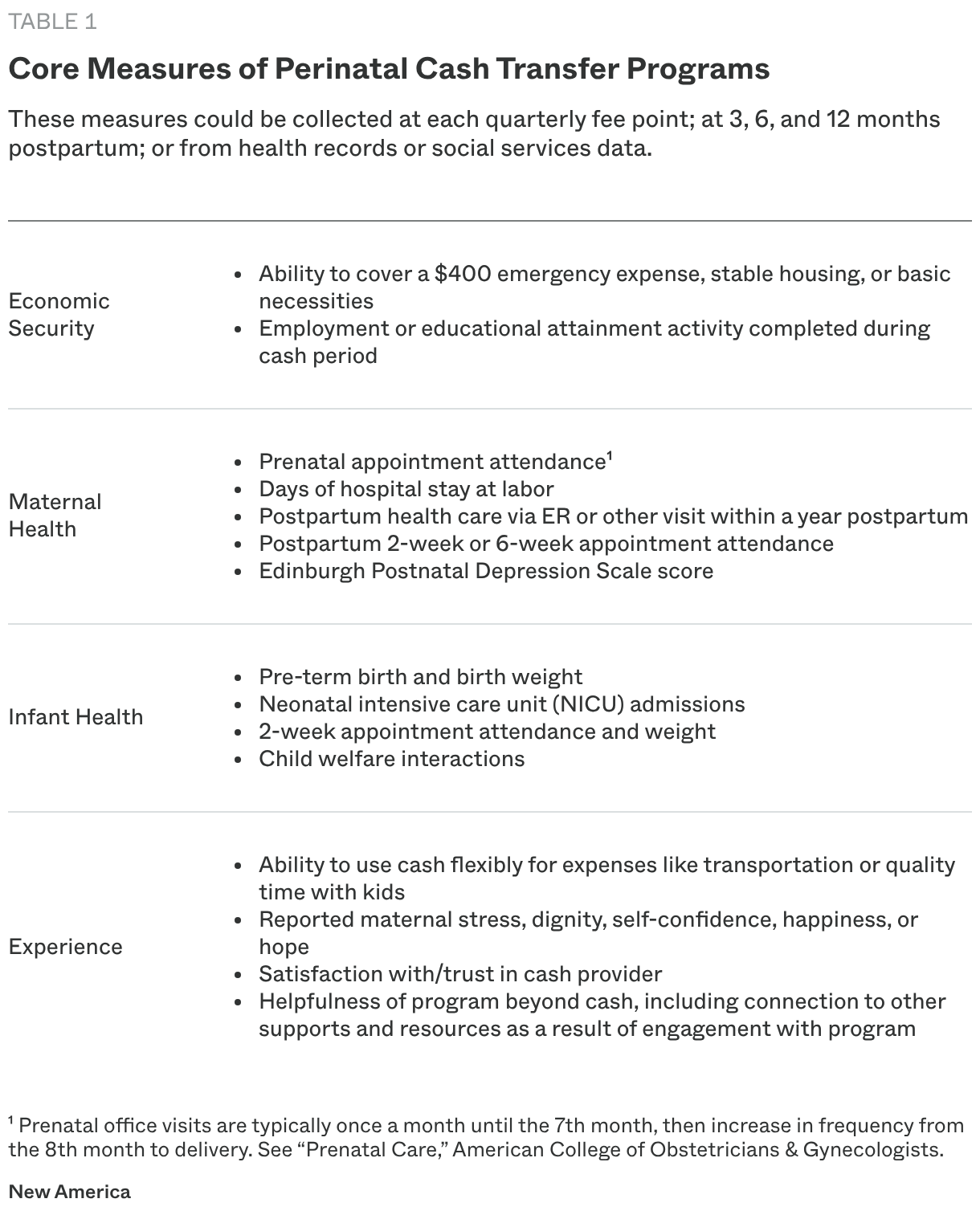
Our team has cataloged a variety of measures of impact used across different perinatal cash programs, some of which include rigorous evaluations. This “measure bank” offers a landscape of possible measures—from administrative data and self-reported survey data to directly sourced clinical, financial, and employment outcome data.
It is not realistic or necessary for every program to collect all these measures, but it is important that at the start of a pilot or larger program, we include at least a few common supporting measures across core areas of security, maternal and infant health, and experience. We can then employ the data collection methods that are least burdensome for staff and families.
MICC will create a common bank of survey instruments, example data-sharing agreements, and other resources that new pilot design teams can look to as they create their learning approaches. Even the timing of measurements (at enrollment, two weeks postpartum, three months postpartum, six months postpartum, 12 months postpartum) is important to name and begin to align for cross-program comparison.
In Table 1 below, we’ve identified a few key “common core” measures that programs could build on.
The mechanism by which cash is delivered is important. The means by which cash reaches a family affects eligibility criteria and assessment, whether payments can begin before birth, what the administrative burden looks like for families, and whether the program has a trusted avenue for connecting families to wraparound services.
As we look to the future scaling of perinatal cash programs, it’s important to think about these different options and how pilot design could scale up to broader future efforts. We also suspect that the specifics of implementation affect outcomes.
In Table 2 below, we’ve started a basic comparison of some existing and potential delivery mechanisms; this is by no means exhaustive, and we hope it can generate other creative approaches to explore.
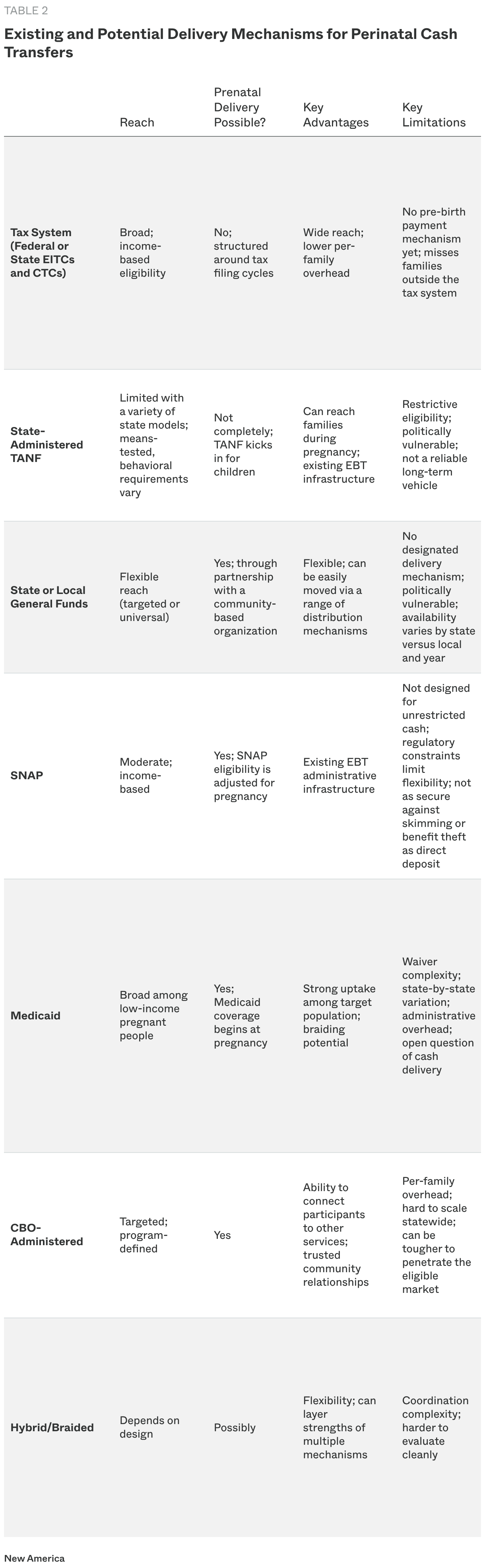
As we consider the best way to get cash to families, one example of trade-offs in delivery mechanism models and their outcomes, particularly in the U.S. context, concerns the tax system versus CBO administration of economic supports. Programs administered through community-based organizations consistently achieve higher uptake than government-only delivery models. That is partly because CBOs are trusted by families and can connect enrollment to wraparound services, including local doctors; prenatal and pediatric care navigation; Women, Infants, and Children (WIC) and SNAP; and housing supports.
But that advantage can come at a cost: CBO-administered programs involve added overhead costs and may be difficult to scale statewide without a strongly built infrastructure layer underneath them. Conversely, the operation of the tax system is in a way a sunk cost that will exist in perpetuity, with broad reach and a consistent touchpoint as people go through different phases of life, different locations, and different needs.
In the United States, anti-poverty policy has focused squarely on the tax system as the delivery mechanism for cash (refundable credits), which creates specific barriers to access. Efficiency matters deeply to the next wave of family support policies, but rushing implementation without thoughtfully considering long-term sustainability will cost us. Our maternal and infant health crisis is urgent, but it also demands thoughtful, long-term solutions.
As these hyperlocal pilots continue and some scaled state programs launch, we must consider how the federal government can be connected to this body of work if we hope to maximize its impact.
Several federal tools could serve as enabling infrastructure for state-level innovation without requiring a new federal program. Income verification as a service at the Centers for Medicare & Medicaid Services (CMS), which is already built partly for Medicaid eligibility,8 could dramatically reduce administrative burdens for state programs trying to reach pregnant people quickly. TANF block grant flexibility, CHIP Health Services Initiative authority, and Title V Maternal and Child Health (MCH) Block Grant funding all offer financing pathways that states are only beginning to use deliberately for perinatal cash.
This is where the delivery mechanism table above becomes more than a reference. Because different states are piloting different rows in that table, the field has an opportunity to treat that variation as a coordinated experiment. Are uptake rates higher when programs are administered by CBOs versus through Medicaid? Does prenatal care utilization improve when cash comes through a trusted community partner but not when it arrives via EBT with no accompanying navigation? These are answerable questions, but only if programs commit to standardized outcome measurement and sharing of core program design elements from the start.
Uniformity is not the goal; programs should be designed for their contexts. But an openness to transparency and collective learning grounded in a shared implementation framework for perinatal cash efforts—such as agreed-upon common measures, timing, and delivery mechanisms across pilots—would allow the field to build the cumulative evidence it lacks. States that take this seriously now are not just running local programs; they are creating a road map for what federal perinatal cash policy could look like.
The delivery plumbing, it turns out, determines the impact of a cash transfer program. The sooner the field treats it that way, the stronger the case we’ll be able to make together.
Director, Mother & Infant Cash Coalition
Chief of Staff, New Practice Lab