Oscar Pocasangre
Senior Data Analyst, Political Reform Program
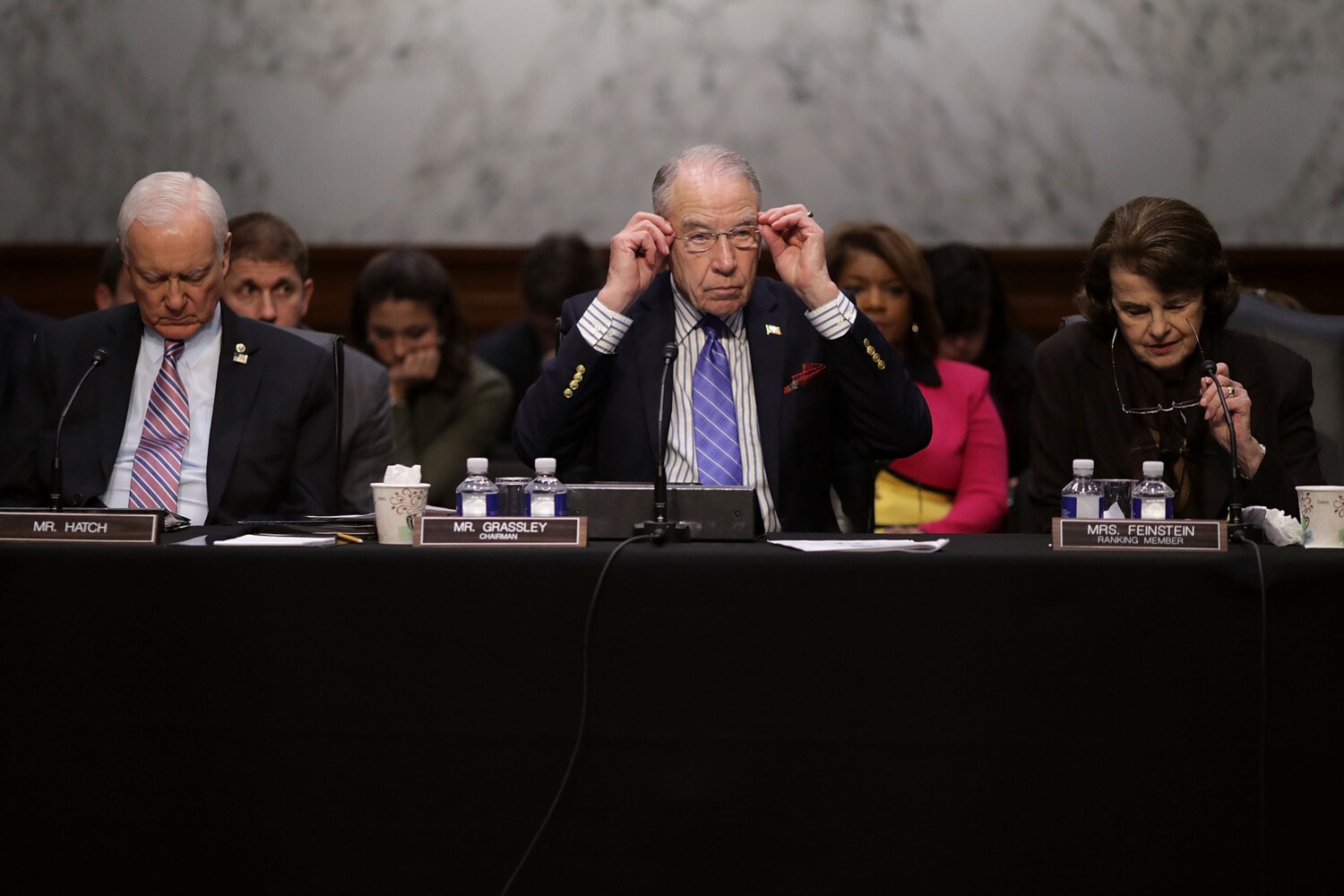
The average age of a member of Congress is much higher than that of the U.S. population as a whole—an issue seen starkly in news headlines this summer. Between June and September, 84-year-old Senator Mitch McConnell was absent from the Senate for three months following a fall. In July, weeks after winning the primary for his reelection, Senator Lindsey Graham passed away at age 71.
But throughout the primary season, there were signs that young people were making important inroads. At 29, Melat Kiros won the primary for a House seat in Colorado against the 69-year-old incumbent who has been in office since before Kiros was born. In New York, 32-year-old Darializa Avila Chevalier defeated the 72-year-old incumbent House representative, Adriano Espaillat. And in Texas, Christian Menefee, 38, won the nomination for a House seat, besting 79-year-old Representative Al Green.
Unfortunately, wins like these will not significantly ease the gerontocratic spell on American politics or close much of the age divide between legislators and the citizens they represent, a continuation that has serious consequences for the country. Older legislators tend to overlook issues prioritized by young people, and the legislative process misses out on combining the ideas and talent of younger generations with the perspective and experience of older ones. The underrepresentation of young people in elected offices also discourages young people from engaging in politics and from participating in elections, as they’ve come to see politics as the domain of older generations.
Data shows that 2026 candidates could move the needle slightly on the age divide, but to disrupt the status quo and reliably bring younger voices into Congress, structural change is needed.
In this year’s midterm elections, the estimated median age of candidates for the House is 55 years, compared to a median age of 39.4 among the U.S. population. Among Democratic candidates for the House, the median age is 52 while for Republicans it’s slightly higher at 57. The age divide is even wider among candidates for the Senate, whose median age is 60. Among Democratic Senate candidates, the median age is 53 while Republican candidates have a median age of 63.
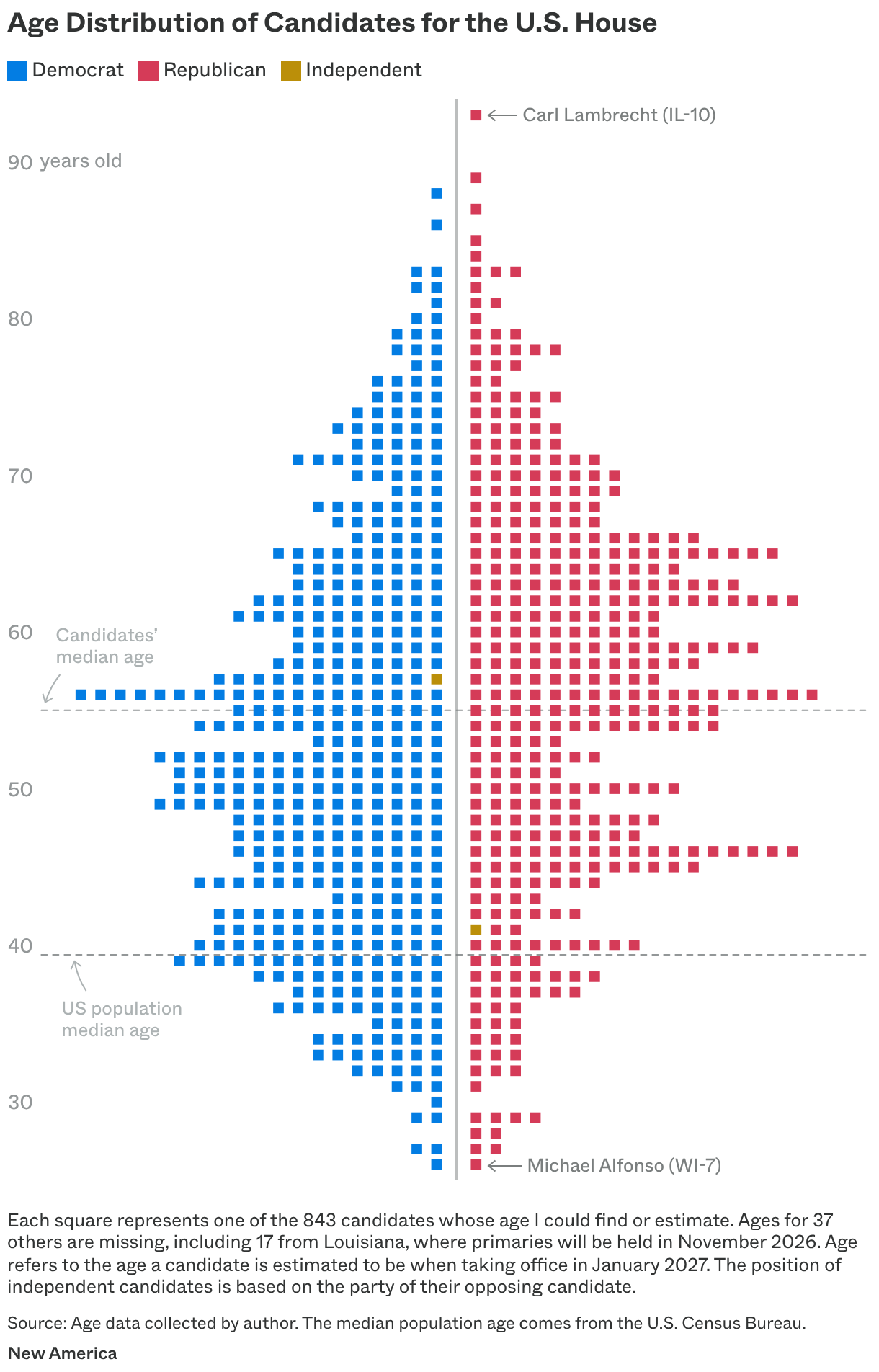
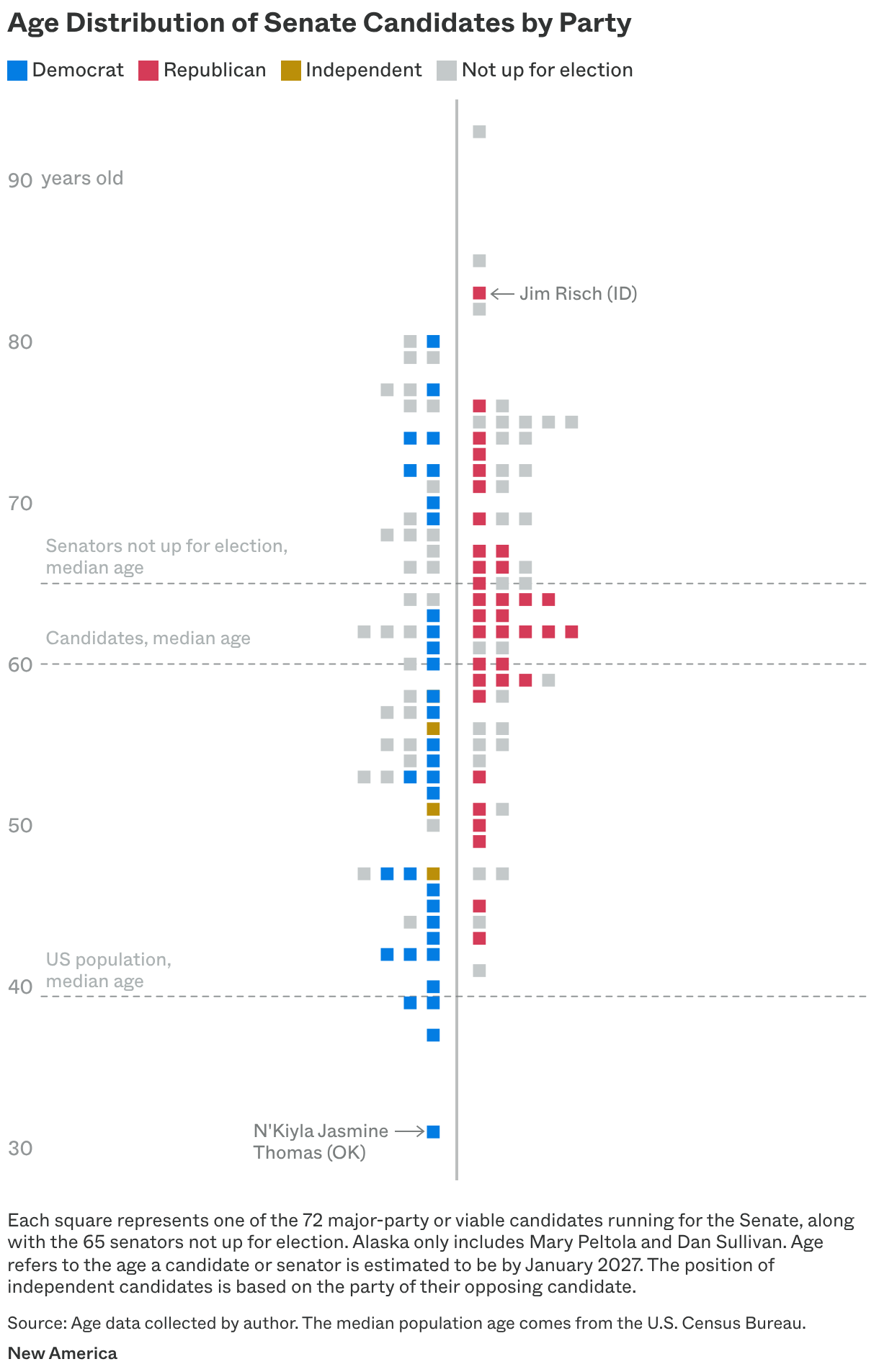
These numbers come from days spent scouring candidate websites, news articles, and the depths of the internet to find the age (or enough biographical details to estimate it) of the candidates who won primaries for Congress. I was able to find or estimate the age of 843 candidates for the House and of all the 72 major-party or viable candidates for the Senate. (For Alaska, I only counted the leading candidates, Mary Peltola and Dan Sullivan). Most of the House candidates for whom I couldn’t find an age are from Louisiana, where primaries were moved to November.
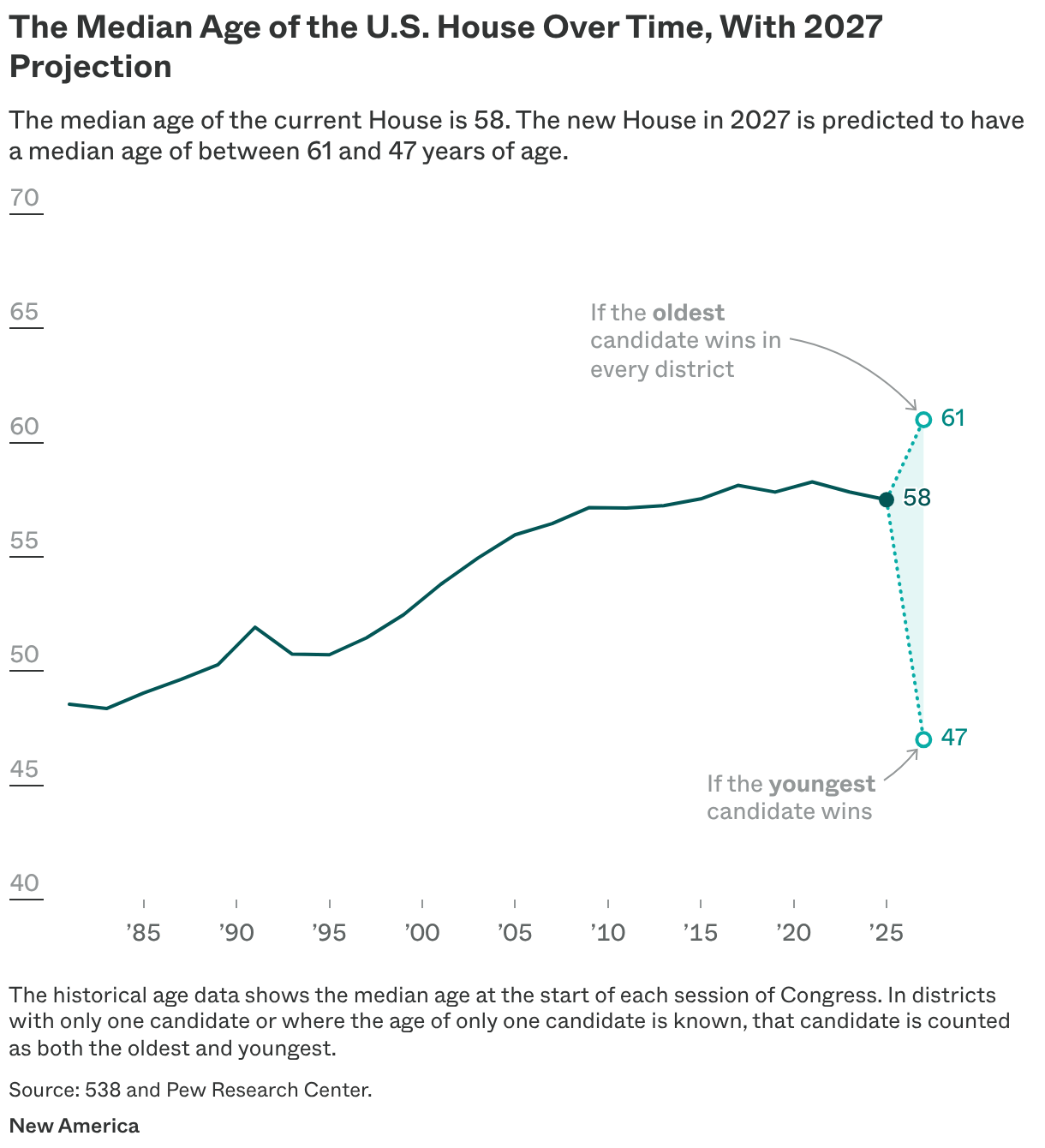
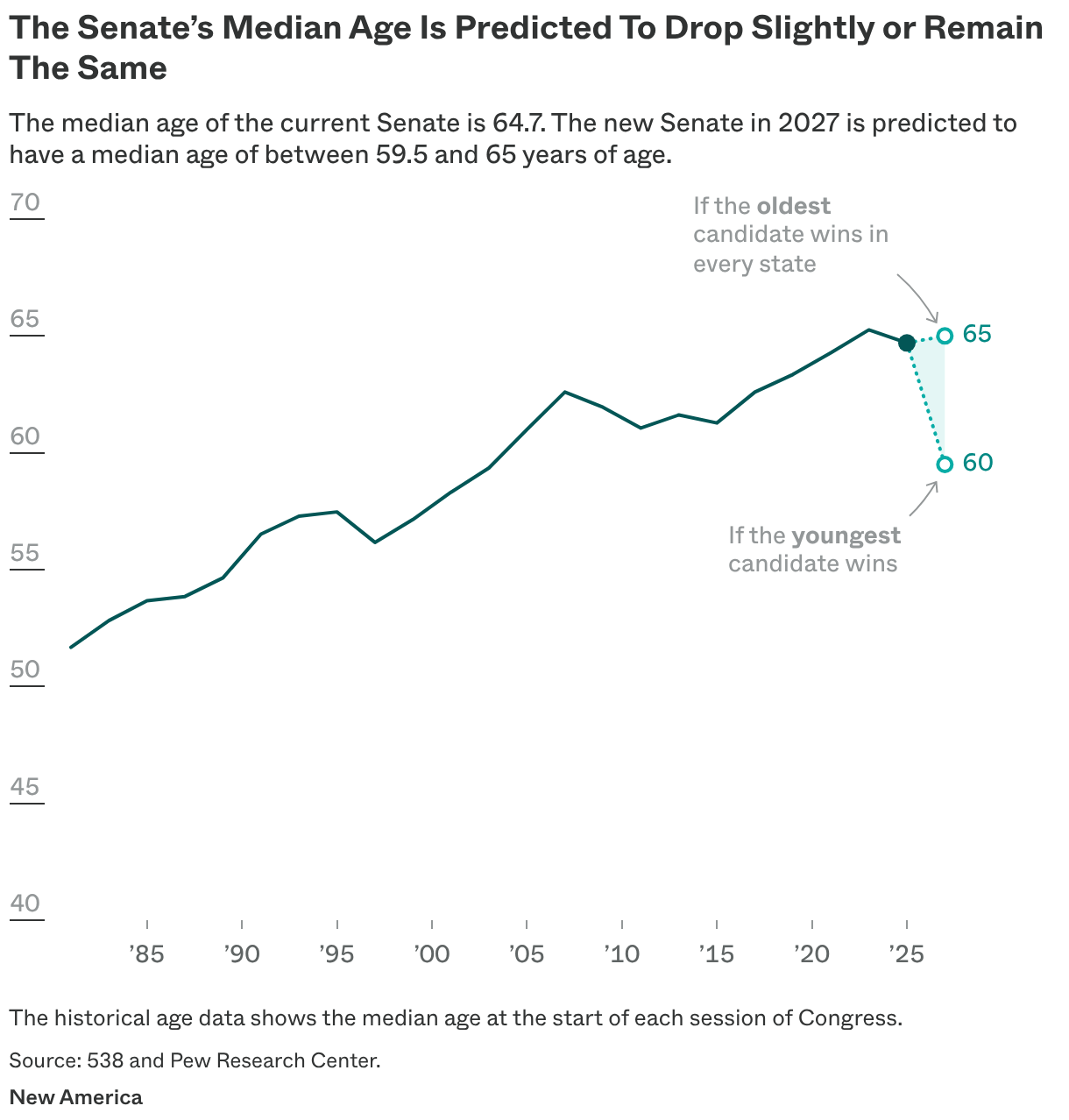
With this data on candidate age, I also estimated the possible median age range of the new Congress by finding the median age of each chamber if the youngest candidate in each district wins (or in a state for Senate races) and if the oldest candidate in each district wins. Compared to the median age of the House when it first met in 2025 (58 years), the new House will be as old as 61 or as young as 47. This range might change slightly once the Louisiana candidates are defined, but not by much, considering the state has only six districts. In the Senate, the median age will either remain the same at roughly 65 years or fall slightly to 60.
This year, young candidates benefited from anti-incumbent waves and deep dissatisfaction with how major-party candidates have handled issues that young people care about, like climate change, affordability, and American foreign policy. But those conditions may change in the next electoral cycle, or young office holders might just keep their seats for years. (Joe Biden was elected to the Senate at 30 in 1972 and kept the seat until 2009.) Getting more young candidates to run for office and win seats—and sustaining that participation over time—will require structural changes to how Americans elect their legislators.
The Senate is challenging to reform because most of its structure is constitutionally defined, but the House can define how its members are elected and adopt an alternative electoral system, like proportional representation, that makes it easier for younger candidates to run for office and more meaningful for young people to vote for their preferred candidates. A proportional system for the House of Representatives would combine multi-member districts with a rule allocating seats to parties in proportion to their vote share. In such systems, multiple candidates from the same or from different parties can win in a district and fewer votes are wasted, unlike in the current winner-take-all system where only one candidate wins in each district.
Proportional representation systems make it easier for young candidates to run for office and win. For one, these systems are friendlier to multi-party competition, so young people can more credibly and realistically organize a new party if they don’t see themselves represented in any of the existing ones. But existing parties also have incentives to include young people as candidates: Because they can win multiple seats in a district, parties have incentives to diversify their candidate lists to appeal to different voting blocs. Moreover, young candidates who lack the financial resources or fundraising networks of older politicians can benefit from the resources of a party interested in maximizing its vote share. And because votes are pooled by party before allocating seats to candidates, young candidates can also win by running on the same party list as a popular or well-funded older candidate without necessarily displacing the older incumbent.
Congress’s current winner-take-all elections force young voters to choose between parties they don’t like or trust or to not vote at all, discourage young people from running for office, and pit young candidates against older politicians trying to keep their jobs. Under these conditions, the success of young candidates is impressive, but it’s also quite rare. We might see younger faces in Congress after this year’s midterms, but those gains by young people are fragile. Proportional representation would help make politics more inclusive and representative, bringing more young people into the political fray.
Senior Data Analyst, Political Reform Program