
Michael Calabrese
Director, Wireless Future, New America; Senior Advisor, Technology & Democracy, New America
Under the three-tier spectrum sharing framework of the Citizens Broadband Radio Service (CBRS), the U.S. Navy and other incumbent users are protected from harmful interference by Federal Communications Commission (FCC)-certified Spectrum Access Systems (SAS)—automated coordination databases supplemented by a network of coastal sensors. Below this top tier, CBRS divides commercial use into two distinct tiers: Priority Access Licenses (PALs) and General Authorized Access (GAA). Seven 10-MHz PALs were auctioned for each U.S. county in 2020. A PAL operator has exclusive rights in locations where it deploys and commences operations. In contrast, GAA channels (80 MHz in total) are shared and, like unlicensed bands, have no protection from interference. A use-it-or-share-it rule allows registered users to operate freely on a GAA basis across the entire 150 MHz band, subject to the obligation (enforced by the SAS) to protect both top-tier incumbents and PAL users in areas where they are actually deployed.
Six years into full commercial operation, the impact of General Authorized Access to CBRS spectrum is clear: Although GAA carries no guaranteed interference protection, GAA has become the indispensable engine of the band. Most CBRS users—including most Priority Access licensees—have become deeply dependent on GAA channels. More than 1,000 separate entities operating in the band have deployed more than 446,000 active base and user stations (Citizens Broadband Radio Service Devices, or CBSDs) as of late July 2026. Real-time data collected by the SAS administrators that coordinate use of the band reveal that 96.3 percent of all CBSDs use GAA channels to provide service. Nearly two-thirds (63.2 percent) use GAA spectrum only, while one-third (33.1 percent) use both GAA and PAL channels.
This means that virtually every radio in the band, including those registered by Priority Access licensees, is either relying entirely on GAA spectrum or is enhancing its capacity and quality of service by aggregating PAL and GAA channels. PALs, in turn, remain essential where interference-free capacity is needed most—for example, by broadband internet service providers in dense urban markets or for mission-critical operations that cannot tolerate contention for channels.
The United States leads the world by far in the deployment of private 5G and LTE mobile networks, with at least 75 percent operating on CBRS spectrum and most relying entirely on GAA channels, a share projected to increase to 80 percent by 2032. Recognizing the increased demand for localized enterprise networks—and its enormous value for productivity gains—since 2020 at least 17 nations have followed the FCC’s lead in making lower-power mid-band spectrum available to enterprises on a localized basis, albeit in a less flexible and streamlined fashion compared to CBRS.
Among enterprise users, the reliance on CBRS is greatest among manufacturers, which account for a quarter of CBRS private networks—a share projected to rise to 36 percent by 2032. A recent study projects that 85 percent of all private mobile networks in the manufacturing sector will rely on CBRS by 2032, increasing from 260 to 2,200. Demand is expected to further rise as artificial intelligence accelerates the deployment of private wireless networks for factory automation, logistics, sensing analytics, and other productivity-enhancing upgrades. Only a small share of manufacturers and other enterprises utilizing CBRS bought PALs at auction; most rely either entirely or principally on GAA channels. In addition, millions of Americans in rural and Tribal areas are the primary beneficiaries of the local wireless ISPs, electric cooperatives, and other operators that almost predominantly rely on GAA channels to deliver high-capacity fixed wireless broadband service in less densely populated communities.
The dependence on shared GAA spectrum has raised red flags in relation to mobile industry proposals to dramatically increase allowed power levels in the band, which studies show will drastically shrink the availability of GAA. High power limits would undermine a CBRS ecosystem premised on relatively low power, spectrum re-use, and coexistence.
The medium power limits the FCC set for CBRS—much higher than unlicensed bands but much lower than wide-area, exclusively licensed mobile bands—are specifically engineered for local and relatively dense small-cell deployments, not traditional high-power macro towers. If high-power operations were authorized in CBRS, current GAA users would suffer a classic tragedy of the commons as more and more operators raise power levels to expand coverage or, more likely, to defend themselves against other GAA and adjacent-channel PAL users who have increased their power or could be expected to do so in the future.
When the Federal Communications Commission (FCC) voted 5–0 to create the Citizens Broadband Radio Service (CBRS) in 2015, it intended to “open a new chapter in the history of the administration of one of our nation’s most precious resources—the electromagnetic radio spectrum.”1 The FCC aimed to solve what it called “a long-standing problem in spectrum policy”: No traditional authorization model—exclusive licensing, site-based coordination, or unlicensed sharing—would both accommodate coexistence with incumbent U.S. military operations and meet the increasing needs for wireless connectivity among a wide range of commercial operators.2 CBRS combines elements of all three traditional approaches with dynamic database coordination to enable what the Commission called an “innovation band” and a proving ground for “greater productivity in other parts of the radio spectrum.”3
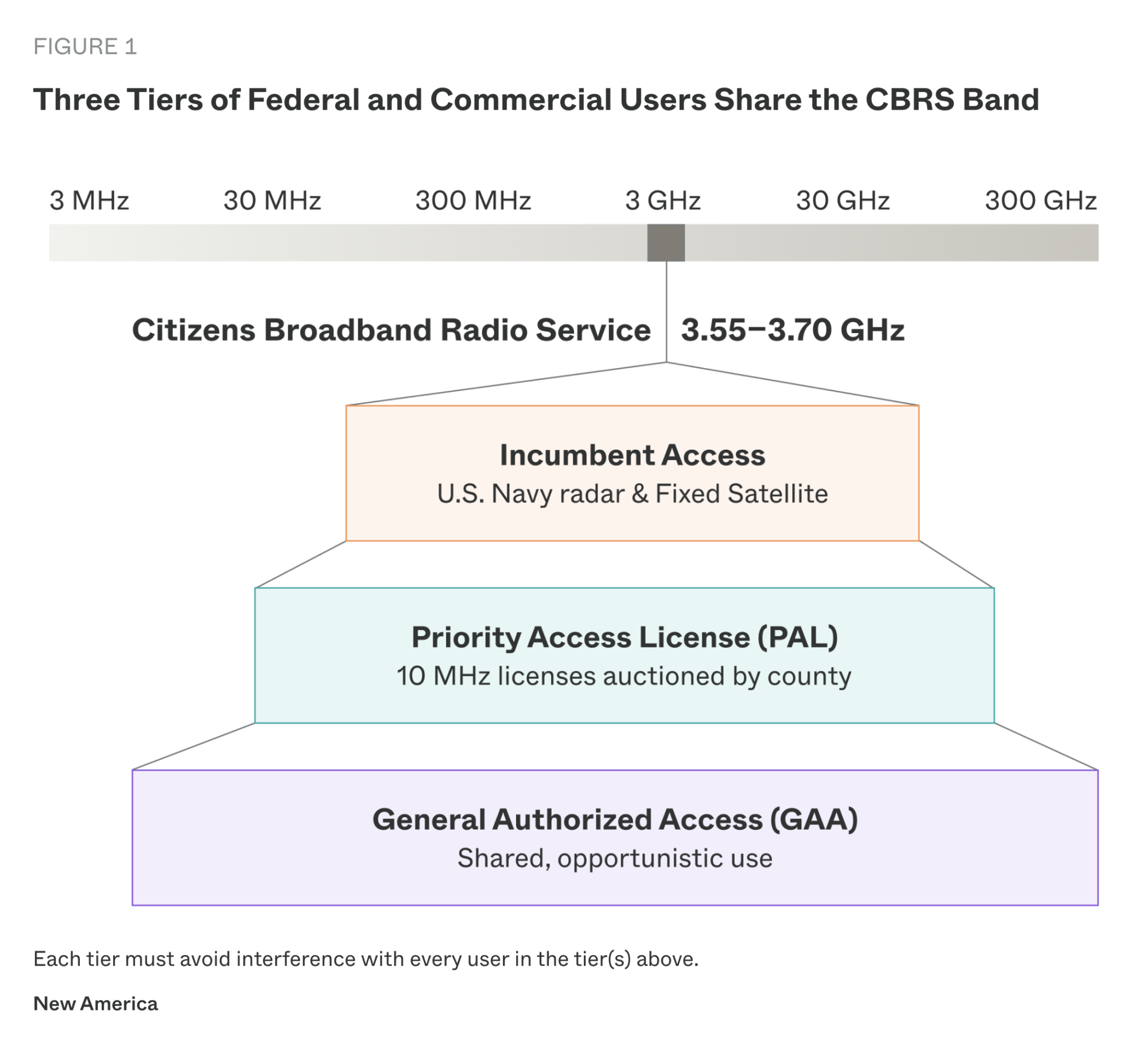
The FCC’s 2015 Report and Order creating CBRS established a unique dynamic sharing framework that unlocked 150 MHz of prime mid-band spectrum, most of it assigned exclusively to the military for U.S. Navy radar operations. Under the CBRS three-tier sharing framework (see Figure 1), the Navy and other incumbent users represent the highest tier. They are protected from harmful interference by FCC-certified Spectrum Access Systems (SAS)—automated coordination databases supplemented by a network of coastal sensors that listen for active Navy radar transmissions—which grant channel assignments and modify them dynamically as conditions change. When Navy radar is active in dynamic protection areas along U.S. coastlines, commercial users are automatically moved to other channels; where the Navy is not operating, the full band is available for private sector use. In addition, unlike traditional mobile carrier bands, power limits are relatively low to reduce interference risk and facilitate spectrum re-use, thereby enabling more diverse and intensive use of the band.
Importantly, the Commission’s innovative framework took dynamic spectrum sharing beyond mere coexistence: “Our new rules use these tools to dissolve some age-old regulatory divisions, between commercial and federal users, exclusive and non-exclusive authorizations, and private and carrier networks.”4 Following a recommendation by the President’s Council of Advisors for Science and Technology (PCAST),5 CBRS divides commercial use of the band into two tiers: Priority Access Licenses (PALs) and General Authorized Access (GAA). PCAST specifically recommended that the FCC “modify its rules to allow ‘generalized authorized access’ devices to operate in…the 3550–3650 MHz (radar) band.”6
Seven 10-MHz PALs were auctioned to cover each U.S. county in 2020.7 A PAL operator has exclusive rights to that channel in any local area where it has actually deployed and is operating. GAA channels are shared and, like unlicensed bands, have no guaranteed protection from interference. Any user registered with an SAS can operate freely on a GAA basis across the entire 150 MHz band, subject to the obligation (enforced by the SAS) to protect both top-tier incumbents and PAL users in areas where they are actually deployed.8 As a result, in many rural and remote areas a single operator can make use of the entire 150 MHz if no Priority Access licensee is operating. Conversely, PAL channels are most valuable where interference-free capacity is needed most—for wireless broadband in dense urban markets or for mission-critical operations that cannot tolerate contention for channels.
This use-it-or-share-it feature of CBRS, together with the reservation of the top 50 MHz for free GAA use, is intended to lower barriers to entry and promote more intensive use that better meets the local connectivity needs of a wide range of enterprises and institutions. As the 2015 Report and Order explained, where rivalry for spectrum is low, GAA provides a low-cost entry point akin to unlicensed access; where rivalry is high, auctions assign PALs.9 Critically, the Commission concluded that a “meaningful amount” of the band should be reserved for GAA everywhere—at least 80 MHz, and up to all 150 MHz in locations where PAL spectrum is unused or unassigned.10
Another key element of the CBRS framework is the Commission’s decision to adopt common technical rules across the entire band that apply equally to devices operating on PAL or on GAA spectrum, or on both.11 This band-wide operability requirement ensures that operators can easily utilize both Priority Access and GAA spectrum in their networks and seamlessly switch between tiers without purchasing additional equipment. Perhaps more importantly, since most PALs in urban and suburban markets were purchased by large mobile operators (for example, Verizon, Charter, Comcast), common technical rules promote a mass-market device ecosystem and economies of scale for LTE and 5G equipment globally standardized through 3GPP. This has facilitated a robust small-cell equipment market and reduced costs for the hundreds of small wireless ISPs (WISPs) and enterprises that rely primarily or entirely on GAA access to the band.
The Commission’s 2015 Report and Order predicted the CBRS three-tier sharing framework would serve “market needs not adequately served by our conventional licensed or unlicensed rules.”12 In retrospect, this prediction understated the demand for very localized, low-cost, and lower-power access to mid-band spectrum. Although Verizon was the largest buyer of PALs (paying nearly $1.9 billion for 557 licenses), the overwhelming majority of operators and base stations (Citizens Broadband Radio Service Devices, or CBSDs) deployed today rely on GAA. These include hundreds of small and mostly rural WISPs, at least 260 manufacturers, and a wide variety of other use cases that connect airports, ports, farms, schools, hospitals, stadiums, utilities, public-safety operations, military bases, and Tribal lands, supporting billions in private investment.
Overall, after just six years of commercial operation, more than 1,000 entities operating in the band have deployed more than 446,000 active CBSDs as of late July 2026,13 roughly the same as the total number of mobile industry macrocell and outdoor small-cell sites.14 According to data aggregated by SAS provider Key Bridge Wireless, CBRS has been deployed across 2,639 counties in 56 states and territories, although adoption is uneven. For example, Texas hosts the most extensive deployments by far—more than 80,800 CBSDs, which amounts to 18 percent of the total nationally. A device ecosystem supporting both consumers and enterprise IoT networks has also mushroomed, with more than 1,600 certified device models and more than 200 million smartphones and other handsets able to communicate on the band.15
It was always expected that hundreds of smaller and more rural WISPs would leverage CBRS to boost the coverage, capacity, and quality of fixed wireless broadband service in rural and other less densely populated areas. While this has proven true (and is described further below), CBRS has also rapidly evolved into the primary spectrum for private enterprise 5G and LTE networks in manufacturing, energy and chemical processing, warehouse automation, precision agriculture, supply chain management, transportation, and other verticals.
A recent study by Analysys Mason reported that 75 percent of private 5G and LTE networks in the United States rely on CBRS rather than on the traditional macro-cellular networks.16 Across all sectors, the study projects that the total number of private mobile networks will increase from 1,500 to 7,580 between 2025 and 2032, with the share of networks relying on CBRS increasing from 75 percent at the end of 2025 to 80 percent by 2032.
This reliance on CBRS is greatest among manufacturers. Analysys Mason estimates that “the manufacturing sector alone accounted for a quarter of CBRS private networks in 2025—more than any other sector—and this share will rise to 36 percent by 2032.”17 The study projects that more than 85 percent of all private mobile networks in the manufacturing sector will rely on CBRS by 2032, increasing from 260 to 2,200.18
Analysys Mason also found that a large portion of the anticipated productivity gains show up in reductions in factory downtime, which costs American manufacturers about $50 billion a year—a cost one automaker cut by 30 percent after installing a CBRS network.19 The IT director at a large U.S. food and beverage manufacturer explained why localized access to substantial 3 GHz spectrum through CBRS, at a higher power level than Wi-Fi permits, fills an important gap for enterprise connectivity: “It comes down to three major topics: reliability, coverage and control….Predictable performance and low and consistent latency are a big deal [and led us to invest] in private 5G. We struggled to get the same results consistently from public cellular or Wi-Fi.”20
Finally, it is noteworthy that the Commission designed CBRS to promote innovation, to provide very localized access to spectrum, and to facilitate use cases that cannot benefit as readily from either exclusively licensed or traditionally unlicensed spectrum. “Providing for both GAA and PAL operations allows the Commission to create a band ‘well suited to exploring the next generation of shared spectrum technologies, to drive greater productivity and efficiency in spectrum use.’”21 The market’s response to this uniquely accessible sharing framework has confirmed the Commission’s prediction that “this regulatory adaptability should make the 3.5 GHz Band hospitable to a wide variety of users, deployment models, and business cases, including some solutions to market needs not adequately served by our conventional licensed or unlicensed rules.”22
Six years into full commercial operation, the impact of General Authorized Access to CBRS spectrum—the license-by-rule, no-auction, opportunistic bottom layer of the three-tier sharing framework—is clear: Although it lacks interference protection, GAA has become the indispensable engine of the band for most operators. As the Commission intended when it allocated 80 MHz of CBRS for open, shared use, the “GAA-tier…provide[s] a low-cost entry point into the Citizens Broadband Radio Service for a wide array of users” and for the “rapid deployment of small cells by a wide range of users, including consumers, enterprises, and service providers, at low cost and with minimal barriers to entry.”23
Most CBRS deployments (63.25 percent) operate solely on GAA spectrum.24 Many Priority Access licensees likewise combine their PAL spectrum with GAA to expand capacity or fill coverage gaps, illustrating how the two tiers reinforce each other. The National Telecommunications and Information Administration (NTIA) confirmed this in its most recent analysis of SAS deployment data. Unlike other terrestrial bands, where regulators have little if any visibility into the actual use of spectrum they license, CBRS operators must constantly renew their grants through an SAS to operate on particular channels in particular locations. Every assignment and interference event is recorded. This SAS data gives the NTIA and FCC access to a very granular record of PAL and GAA use of each of the band’s 15 channels.
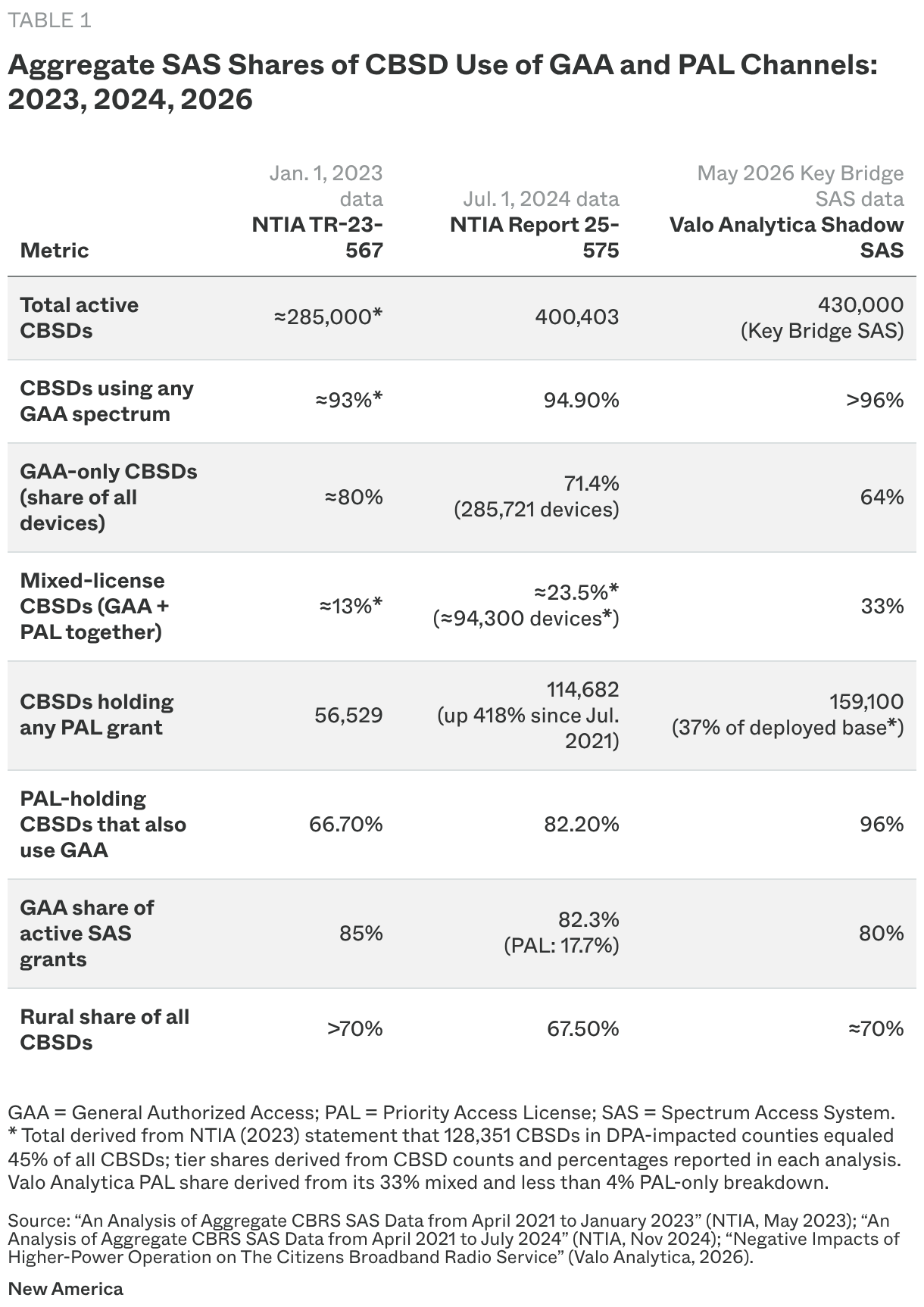
Relying on aggregated SAS data, NTIA reported that as of July 2024:25
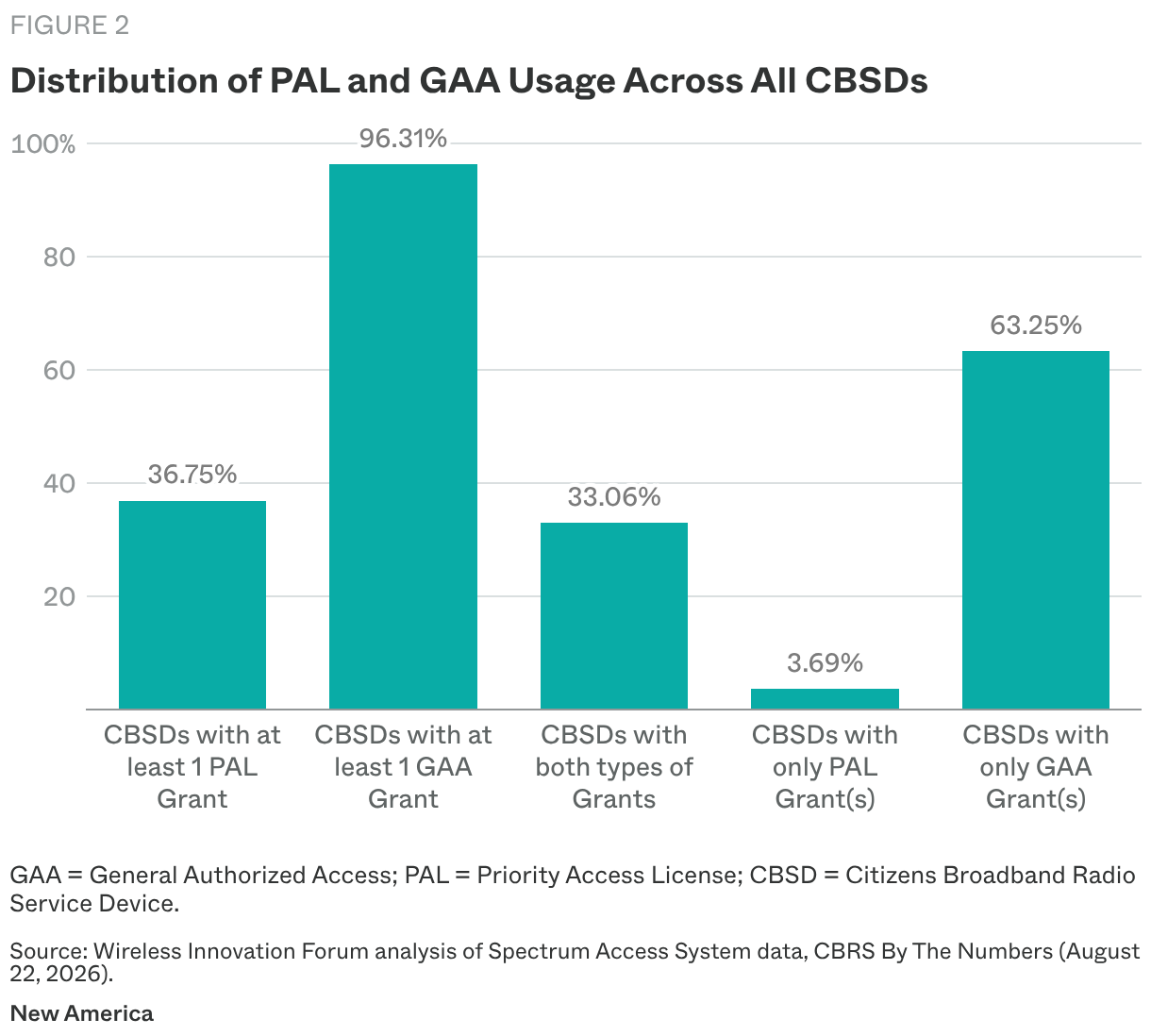
During the period since NTIA’s 2024 update, aggregated SAS data shows that virtually all CBRS operators are either relying entirely on or leveraging GAA channels. SAS provider Key Bridge Wireless tracks the share of CBSDs currently using GAA channels, including those operated by Priority Access licensees. As of July 2026, Key Bridge reports that 96.3 percent of all CBSDs use GAA spectrum to provide service.26 Nearly two-thirds (63.2 percent) use GAA spectrum only, while one-third (33.1 percent) use both GAA and PAL. Only a tiny fraction (3.7 percent) operates using only one or more PAL channels. (See Figure 2.) With respect to capacity, 80 percent of CBRS channel assignments are GAA spectrum, while 20 percent of requested assignments are PAL channel grants.27
Another recent analysis of aggregate SAS data, by Valo Analytica, confirmed that virtually every radio in the band, including those registered by Priority Access licensees, either relies entirely on GAA spectrum or combines PAL and GAA channels to enhance capacity, coverage, or quality of service.28 In March 2026, Valo Analytica released what it called a “Shadow SAS” study by former co-developers of the SAS systems operated by Google and CommScope, relying on live registration data from more than 430,000 CBSDs.29 Table 1 compares their 2026 findings with the NTIA’s findings from 2024 and 2023. Valo Analytica’s findings confirmed that the vast majority of deployments on CBRS spectrum either rely on or at least incorporate GAA channels.
Verizon is the prime example of an operator that treats PAL and GAA as complementary layers of the same network. At the 2020 CBRS auction, Verizon bought more PALs than any of the other 227 winning bidders, spending nearly $1.9 billion on 557 PALs in 157 counties. Yet even the largest PAL holder in the band also built out GAA capacity: As RootMetrics reported, its spectrum measurements detected Verizon using the band on a GAA basis in 70 metro markets during the months before the PAL auction.30
Not surprisingly, Verizon has deployed the largest number of CBSDs, which the company has been able to add to expand the capacity of existing cell sites. In late 2024, it told the FCC it had deployed “about 15 percent of the total number of CBSDs in operation today,” or roughly 60,000 CBRS access points at that time.31
When it adopted CBRS, the FCC anticipated a demand for enterprise wireless networks with major implications for the productivity and competitiveness of American manufacturing and other industry verticals. Although the nationwide mobile carriers have claimed for years that they will be able to “slice” their 5G mobile networks to offer specialized connectivity services to factories, warehouses, ports, and other enterprises, the reality is that leading manufacturers and others are choosing to customize, control, and integrate their own highly localized private 5G networks. They do so to better meet their specific needs more reliably and at lower cost.
Artificial intelligence (AI) is accelerating what was already a strong trend toward factory automation, logistics, sensing analytics, and other productivity-enhancing upgrades that justify substantial investments in customized private 5G or LTE networks by individual firms, venues, and other entities. The latest market forecast from STL Partners, a leading telecoms and technology research firm, predicts a nearly tenfold growth in private mobile network revenue globally over the next five years, “from $2.3 billion in 2025 to $22 billion by 2030, a CAGR [compound annual growth rate] of 58 percent.”32 STL Partners estimates that the total number of private network sites deployed globally will increase from about 4,000 at the end of 2025 to over 40,000 by 2030. Manufacturing will remain by far the largest industry vertical, with an 86 percent CAGR, driven increasingly by the rise of AI automation.33
The United States leads the world by far in the deployment of private wireless networks, most operating on CBRS spectrum. The Global mobile Suppliers Association (GSA) reports that as of year-end 2025, it had identified 513 U.S. entities deploying one or more private 5G or LTE networks as of March 30, 2026.34 This represents 25 percent of private mobile network customers globally and more than three times the number of organizations deploying private networks in Germany, which had the second highest number (152). GSA also reports that “CBRS spectrum is the most widely assigned” band for private mobile networks worldwide, owing to the fact that 483 of the 513 entities deploying private networks in the United States rely on CBRS.35
As the GSA data suggests, CBRS has proven essential to this global leadership. A recent study by Analysys Mason for the American Made 5G coalition found that 75 percent of total private 5G networks in the United States today run on CBRS.36 Analysys Mason forecasts that the total number of private networks in the United States will grow from 1,500 in 2025 to more than 7,500 by 2032, with 80 percent operating on CBRS spectrum.37 Private wireless networks operating on CBRS already represent substantial capital investments. According to a recent study by SNS Telecom, annual investments in LTE and 5G NR-based CBRS RAN, mobile core, and transport network infrastructure will exceed $1.3 billion by the end of 2027.38
Although CBRS gave the United States a substantial head start in providing enterprises and other entities with direct local access to prime mid-band spectrum, other advanced economies are fast following. More than a dozen nations have followed the FCC in making lower-power mid-band spectrum available for a variety of uses. These “local shared licensing” regimes are typically characterized by licenses authorizing the use of upper 3 GHz in particular locations where it will not interfere with incumbent Fixed Satellite Service (FSS) or other incumbent uses.
While the United States has by far the largest number of private 5G and LTE network deployments, roughly 25 percent of the total globally, of which more than 80 percent rely on CBRS, other countries have begun dedicating spectrum to private networks. According to the above-referenced GSA report, which tracks private networks globally: “There is typically a strong, positive correlation between the number of private network [customers] and countries with dedicated spectrum.”39 The United Kingdom, Germany, Japan, Australia, France, Canada, and China are among the countries that have designated spectrum for local access for enterprise networks and small ISPs since the FCC’s adoption of CBRS—and these same nations top the list of countries with respect to deployments of private 5G and LTE mobile networks.
Ofcom, the UK’s telecoms regulator, jump-started this trend by adopting a local shared licensing framework in 2019 that covers the 3.8–4.2 GHz band, as well as 10 MHz in each of the 1800 MHz and 2300 MHz bands.40 In its decision, Ofcom noted that “there is growing interest in the use of mobile technology, including 5G, to develop solutions to meet local wireless connectivity needs.”41 Unlike CBRS, obtaining a local license in these shared bands involves a traditional manual coordination process that requires interested parties to apply for a license, notify incumbents, and demonstrate there will be no interference to incumbent licensees. Other advanced nations have followed suit, most relying on the upper 3 GHz band and coordination with FSS earth stations.
One unintended advantage of the U.S. approach is that because access to CBRS requires avoiding interference with Navy radar, which is inherently mobile, coordination is managed by an automated dynamic database system (SAS) that determines and tracks exactly where CBRS spectrum is available to use and at what maximum power level. The SAS enables immediate, low-cost, and more densely coordinated access to locally unused CBRS spectrum. This particularly benefits GAA users who can freely access unused CBRS spectrum at will, based on automated SAS coordination, rather than being burdened by a cumbersome, manual application and coordination process. The FCC’s approach has paid dividends for the United States, which, as detailed just above, leads the world by far in private wireless networking.
While the CBRS auction of county-sized and low-power PALs successfully facilitated a wide diversity of spectrum users, with 228 auction winners from a dozen industry sectors,47 GAA has proven to be the workhorse that both complements PALs and supports a far larger number of CBRS deployments that rely entirely on GAA channels. Analysys Mason’s survey found that while some manufacturers acquired PALs at auction, “the majority of CBRS deployments in the manufacturing sector utilize GAA spectrum.”48 The exceptions are some large manufacturers and utilities that anticipated a need for a highly reliable base layer of connectivity and purchased PALs at the 2020 auction. These PALs are predominantly in rural and remote counties where the price was low because Verizon and other large broadband ISPs focused on large metro markets where PALs can add capacity to existing mobile cellular networks. However, as enterprise PAL holders actually deployed, extended, and deepened their CBRS networks, most are relying increasingly on GAA channels as well.
OnGo Alliance and other CBRS industry groups have published extensive lists of entities using CBRS across a wide variety of use cases and industry verticals.49 What follows are some examples in key sectors that rely heavily on GAA channels:
As we have seen, private mobile networks in factories, warehouses, airports, universities, and a variety of other locations have confirmed the FCC’s original depiction of CBRS as an “innovation band.” In addition, millions of Americans in rural and Tribal areas are the primary beneficiaries of the local wireless ISPs, electric cooperatives, and other operators that increasingly rely on CBRS to deliver high-capacity fixed wireless broadband service in less densely populated communities. Most WISPs rely entirely on GAA channels and even those that purchased PALs at auction routinely leverage GAA channels to increase capacity.
GAA channels offer rural broadband providers, large and small, low-cost access to the sort of medium-power spectrum they need to extend coverage in rural and exurban areas at a reasonable cost. While unlicensed spectrum supports greater capacity, its low power levels limit coverage and make it less practical in many areas. In contrast, fixed wireless broadband service using CBRS provides a basic level of reliable service over larger areas. As a WISP adds customers, it can increase capacity—enabling higher throughput and lower latency—by leveraging unlicensed 5 GHz and 6 GHz spectrum as well. For example, Silicon Valley-based equipment vendor Tarana Wireless is a leading manufacturer of base stations that use simultaneous multi-band aggregation of CBRS and unlicensed spectrum in CBSDs to deliver up to 6.4 Gbps in a single sector.69
CBRS is paying off for rural connectivity in part because WISPs laid the groundwork in today’s GAA spectrum long before the Commission adopted CBRS. Since 2005, WISPs relied on the current GAA-only portion of CBRS (3650–3700 MHz) as a mainstay for rural fixed wireless broadband service.70 That particular sub-band is immediately above the lower 100 MHz of the CBRS band (3550–3650 MHz) that is shared with the Navy and where PAL holders have priority over GAA use. Prior to CBRS, it was a shared, licensed-by-rule band where WISPs had no protection from interference but coordinated with other users to maximize coexistence. WISPs operate in the upper portion of CBRS today in much the same way—on a GAA basis—but also benefit from the purchase of PALs, or the opportunistic use of additional GAA bandwidth, in the lower 100 MHz portion of the band.
The importance of GAA channels for high-capacity fixed wireless broadband service has become particularly salient as the states begin deployments to the nation’s remaining unserved locations, most in rural and remote areas, funded under the federal $42.5 billion Broadband Equity Access and Deployment (BEAD) program. As of August 2026, 13 percent of the 3.79 million eligible BEAD locations are set to receive coverage from fixed wireless providers.71 The share of locations relying on high-capacity fixed wireless is higher in certain states: Illinois’s BEAD plan, the last of the states to be approved, allocates roughly 24 percent of locations to fixed wireless coverage.72 In New York, fixed wireless providers managed to secure bids for upward of 44 percent of eligible locations.73
The Trump administration’s BEAD program is placing significant faith in fixed wireless using CBRS to provide durable coverage able to meet the program’s speed and reliability requirements. U.S. Senators Deb Fischer and Ben Ray Luján, the chair and ranking member of Senate Commerce Committee’s Communications Subcommittee, recently emphasized this need in a letter to the FCC: “Recently approved BEAD subgrantees…depend on CBRS to meet statutory speed and latency requirements. Consequently, the overall success of the BEAD program now leans heavily on the continued dependability of the CBRS band as it exists today.”74
Today, according to WISPA, the trade association for hundreds of wireless ISPs providing broadband to roughly 9 million mostly rural and small-town Americans, a far larger number of WISPs “routinely use both PAL and General Authorized Access (GAA) spectrum, operating with 20 MHz and 40 MHz channels where neighbors exist, and 80 MHz channels in very rural areas, supporting speeds from 100/20 Mbps up to gigabit service.”75 Although 60 WISPs have purchased one or more PALs, nearly all rely heavily on GAA channels for added coverage or capacity. Some examples include the following:76
As the sections above demonstrate, CBRS has exceeded expectations as an innovation band for direct local spectrum access—fueling a growing diversity of use cases for private enterprise networks, as well as more high-capacity and reliable fixed wireless networks that are narrowing the rural broadband gap. Moreover, CBRS has demonstrated that a three-tier sharing framework combining PALs and GAA use under common technical rules fills a productive gap in the wireless ecosystem. Although local PALs have proven very useful for boosting wireless broadband coverage and capacity, the broader and unique impact of CBRS is reflected in the fact that two-thirds of the band’s users rely entirely on GAA channels, while 96 percent of all CBSDs are using GAA channels.
This dependence of virtually the entire CBRS ecosystem on shared GAA channels has raised red flags in relation to proposals to dramatically increase allowed power levels in the band—and thereby drastically shrink the availability of GAA spectrum. This would undermine today’s thriving CBRS ecosystem premised on local use at relatively low power. The medium power limits the FCC set for CBRS—much higher than unlicensed bands, but much lower than exclusively licensed mobile bands—are specifically engineered for dense small-cell deployments, not traditional high-power macro towers. “As a result, the band ensures that a manufacturing plant, a rural ISP, and a municipal airport can all operate their own private networks in the same area without interfering with one another, or the military.”80
This would change radically if the FCC adopts the significantly higher transmit power levels proposed by national mobile carriers. As Figure 3 illustrates, proposals still pending in the FCC’s ongoing proceeding to update CBRS rules “seek to raise allowable power levels by 32 times (‘Category C’) and 320 times (‘Category D’) compared to the existing power limits.”81 Another useful comparison: The CBSDs (base stations) referred to throughout this paper are Category B devices—and already operate at far higher power levels than the 4-watt EIRP maximum allowed for Wi-Fi devices in the unlicensed bands. Category A devices are typically consumer handsets, IoT devices, or other types of receivers.
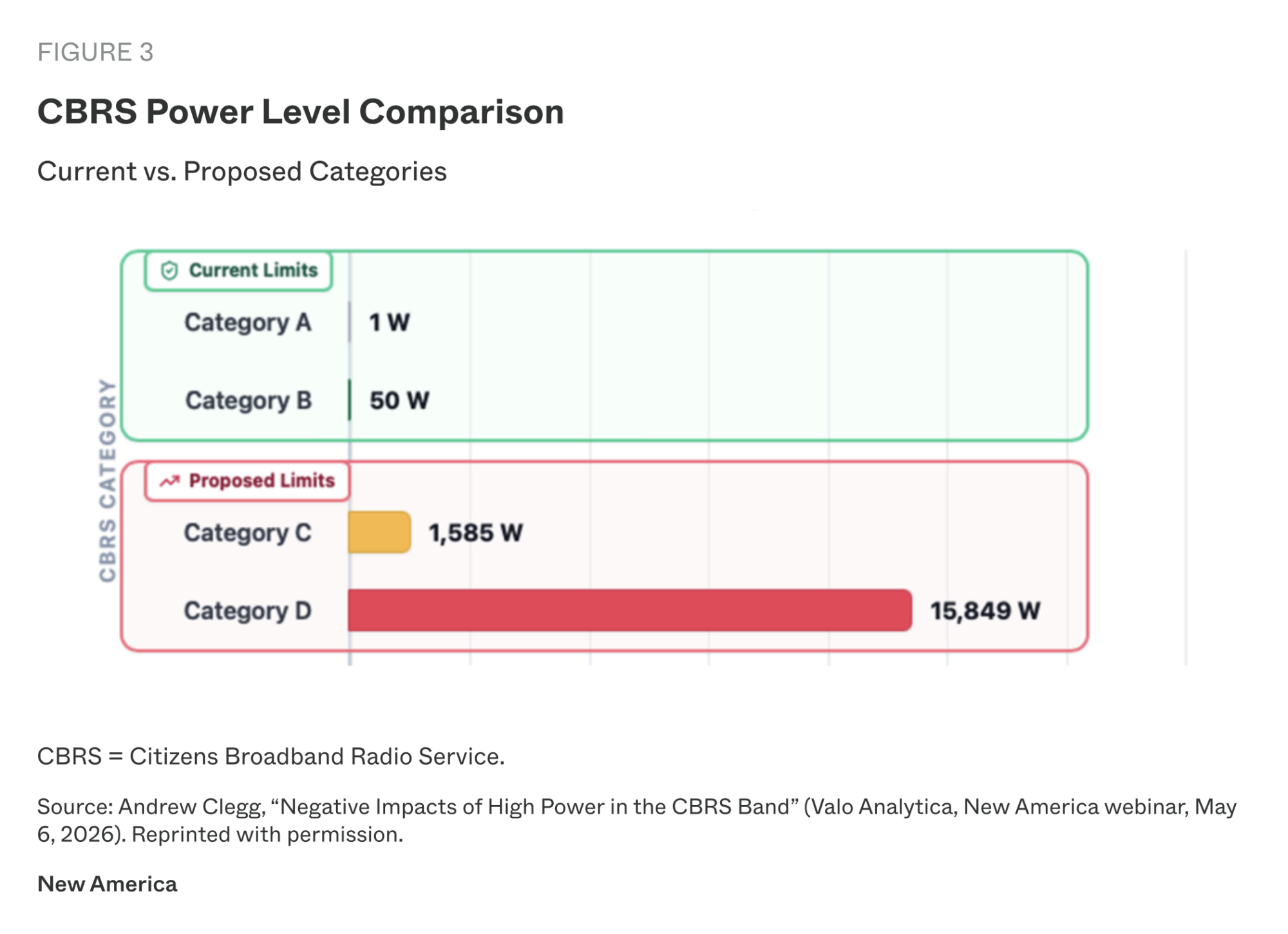
A recent technical study by Valo Analytica, led by co-developers of the SAS systems deployed by Google and CommScope, used actual CBRS deployment data to simulate the impact of higher power on three very different CBRS operators: John Deere, a manufacturer; Miami International Airport; and Amplex Internet, a WISP serving homes in northern Ohio proximate to the Canadian border.82
Valo Analytica’s “Shadow SAS” simulations found that raising power to these levels would severely disrupt the existing CBRS ecosystem. For example, Miami International Airport “risks losing nearly a third of its network capacity if higher power is allowed,” undermining its baggage handling, public safety, and Customs and Border Protection operations.83 More broadly, it found that “if fewer than 2 percent of CBRS base stations are converted to high power, there would be a massive loss of data throughput across the CBRS ecosystem.”84 Its overall conclusion, based on the data, is unequivocal: “Increasing CBRS transmission power would dramatically increase harmful interference levels, thereby disrupting the carefully calibrated CBRS ecosystem, reducing how many network operators can co-exist in the band, and effectively overpowering and undermining existing PAL and GAA operators’ ability to use the band….As a result of increased power levels, the diverse and fast-growing array of operators using the CBRS band today would be reduced to a fraction.”85
In addition to the fact that a substantial increase in CBRS power limits would severely disrupt users relying on GAA channels, it is simply antithetical to the stated purpose of a three-tier sharing framework premised on a small-cell, local-access alternative to wide-area and exclusive spectrum licensing. In adopting its CBRS rules, the Commission carefully considered and rejected proposals for higher power limits. The Commission found that lower power limits would enable a more efficient use of this spectrum by (1) allowing greater spatial re-use of the band, (2) reducing coexistence challenges, and (3) increasing network capacity.86
A substantial increase in CBSD power limits will be most disruptive, inefficient, and harmful if it applies to the GAA portion of the band. Current GAA users would suffer a classic tragedy of the commons as more and more operators turn up their power levels either to expand coverage or, more likely, to preemptively defend themselves against other GAA and adjacent-channel PAL users who have increased their power or could be expected to do so in the future.87
The harmful impacts of higher power limits are certain: Fewer GAA channel assignments will be available as coverage areas grow and overlap, and as aggregate interference is magnified. GAA channels will be used less efficiently as spectrum re-use diminishes. Anywhere near the U.S. coastline—where the majority of Americans live—the dynamic protection areas and the frequency of intermittent loss of channel availability will almost certainly increase enormously as the Navy and NTIA demand more restrictions to account for high power. Mutual interference will substantially increase among GAA users on both a co-channel and adjacent-channel basis. Mutual interference between GAA and PAL users on adjacent channels will also become more common.
Many GAA users will find their investments in CBRS degraded or unusable as conflicts and harmful interference from other users become more common, or because they cannot afford to replace the CBSDs they purchased in reliance on the Commission’s current rules. New entrants and innovation in the band will be deterred, particularly among less sophisticated and less deep-pocketed users seeking direct local access for private networks, including especially schools, hospitals, libraries, college campuses, and other public sector entities. Moreover, even if a GAA user is able and willing to purchase Priority Access licenses, the vast majority of the seven PALs in each county are already owned and therefore unavailable for purchase or lease unless the current owners agree to part with them.
Similarly, the impact on WISPs leveraging CBRS to deliver higher-capacity fixed wireless broadband to rural, Tribal, and other less densely populated communities could be catastrophic.88 Rural WISPs are typically not in a position to purchase multiple county-sized PALs that might insulate them somewhat from the harmful impact of high power levels. Like most users that rely on GAA, WISPs are in a poor position to “rip and replace” recently purchased CBSDs and end user devices designed in reliance on the Commission’s rules and current power levels. Moreover, the point-to-multipoint CBSDs already deployed at current power levels can already reach customer locations at distances of up to 20 miles while still providing broadband service in excess of the 100/20 Mbps BEAD requirement, a reality that has further reduced WISP support for higher power.
These harms will be compounded by the fact that, contrary to the expectations set by the FCC’s 2015 Report and Order, current CBRS rules do not allow Spectrum Access Systems to mandate or enforce coordination among GAA users, nor do they actively assist voluntary coordination. Because SAS administrators simply grant requested channels—and do not inform which are in use or propose which channels would avoid conflicts with other users—raising the power levels would only increase potentially avoidable conflicts and interference. Worse, because there is no transparency about actual channel use or deployment locations, GAA users cannot readily coordinate to minimize conflicts and interference.
The FCC’s innovative three-tier sharing framework in CBRS has proven to be a winning formula. It is working as designed and projected to grow significantly in its current form. The current GAA tier is particularly indispensable. Although GAA lacks guaranteed interference protection, GAA has become the indispensable engine of the band for most operators. Virtually all CBRS users—including PAL holders—are deeply dependent on GAA channels. Most CBRS deployments rely entirely on GAA spectrum, while many PAL holders combine their licensed spectrum with GAA to expand capacity or fill coverage gaps. The PAL and GAA tiers are successfully working in tandem, as complementary layers of the same shared-access framework.
As dynamic sharing and other shared spectrum approaches become increasingly necessary, the CBRS sharing framework is critical as a model and proving ground. This is particularly true for sharing additional military and other federal spectrum bands that cannot be cleared for high-power and contiguous use over very large areas by exclusively licensed operators. CBRS—and GAA coexistence in particular—is an evolving model for an alternative to clearing the military off bands and is therefore crucial given the reality that military systems have few places to move, making more dynamic forms of sharing essential.
Director, Wireless Future, New America; Senior Advisor, Technology & Democracy, New America