Heela Rasool-Ayub
Co-Director, Power, People, and Planet Initiative
Since the Iran war began, the price of oil and gas has risen and fallen with the news from one narrow stretch of water. Before the war, about a fifth of the world’s oil and liquefied natural gas passed through the Strait of Hormuz, between Iran and Oman. When that traffic slowed to a trickle, oil jumped from around $70 to more than $100 a barrel, reaching its highest price since Russia’s invasion of Ukraine
People around the world felt the impact immediately, but it hit hardest in poor countries that import most of their fuel. In Pakistan, gasoline prices rose by about half—averaging $7.12 per gallon. In Bangladesh, gas and power shortages forced the garment industry, which employs about 4 million people, to cut production, with nearly 8 in 10 knitwear factories partially shutting down. Governments already struggling with debt are spending more to keep fuel and electricity affordable. Families are paying more for transportation, food, and other basic goods.
Many Americans may have thought we’d be isolated from this. After all, the United States produces more oil than any other country. But oil is bought and sold on a global market, which means when supplies are disrupted in the Persian Gulf, prices rise at gas stations in Ohio too. By early September, we had collectively spent an estimated $100 billion more on gasoline and diesel, or roughly $760 per household, because of the war.
And the impact on Americans goes well beyond the gas pump. With diesel above $6 a gallon, it costs more to grow food and get it to market. Higher transportation costs follow goods all the way to store shelves and increase the cost of shipping and supplies for businesses of all kinds.
Put simply: Our economy is connected to the rest of the world’s. When a factory in Asia pays more to keep the lights on, the goods it produces get more expensive. And when households in the hardest-hit countries have even less money to spend, it affects American companies trying to sell to them.
The crisis is nudging more countries toward cleaner, less vulnerable alternatives to fossil fuels. But in the United States, the response has largely been to double down. The administration has pushed for more drilling and liquified natural gas exports and is considering using the Defense Production Act to expand U.S. refining, even though refineries are already running at close to 98 percent capacity. It has also sought more oil from Venezuela and proposed a $5 billion fund to rebuild Gulf energy infrastructure and create new oil and gas routes to bypass the Strait of Hormuz.
These moves are just swapping one chokepoint for another, rather than eliminating the vulnerability. Saudi Arabia’s East-West pipeline, for example, was built during the Iran-Iraq War as an alternative to the strait. It became one of the world’s most important alternative routes during this war, carrying roughly 4 million barrels a day to the Red Sea. Then, in September, drones hit three of the pipeline’s pumping stations and shut it down for two weeks.
The question becomes: How long will we continue to allow our energy security to depend on a single narrow stretch of water? And can we use this moment to jumpstart a just energy transition? Some countries were already shifting toward energy sources that require less imported fuel, and the war in Iran is giving them reason to move faster. Solar, wind, and other clean power sources added since 2020 have saved fossil fuel-importing countries an estimated $36 billion in foreign energy costs during the Hormuz crisis.
Pakistan is one of the most interesting examples of the value of these investments. The country’s solar boom began years before the war, largely because households and businesses were fed up with expensive and unreliable electricity. By the time the crisis hit, Pakistan had already avoided more than $12 billion in oil and gas imports as a result. The country was hardly immune from the shock, but the rapid growth of rooftop solar ensured that less fuel had to be imported when it became much more expensive.
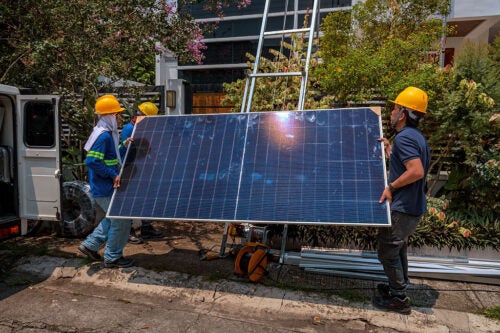
In the Philippines, the current crisis appears to be accelerating clean energy adoption. As the war pushed fuel prices higher, interest in rooftop solar there surged. Between February and May, the country imported $407 million worth of solar panels, 145 percent more than during the same period last year.
Renewable energy isn’t completely free of geopolitical risk, of course. China dominates much of the manufacturing supply chain for solar panels, batteries, and the minerals that go into them, for example. But there is a difference between relying on another country for equipment and counting on one for fuel. A solar panel has to be shipped once, but a gas-fired power plant needs more gas every day.
This crisis may not immediately be the thing that moves the needle on clean energy. The world still runs on oil and gas, and no single country can replace that infrastructure overnight. But the past seven months have made the costs of that dependence much harder to ignore. The war in Iran is reminding governments of the risks of relying on imported fuel as they decide what to build next.
Co-Director, Power, People, and Planet Initiative