Melissa Tooley
Director, Educator Quality
The First Publication in a Series on Hidden Trade-Offs in State Pathways into Teaching

This series investigates how some state policy choices can lead to unexpected trade-offs between the short-term supply, effectiveness, and long-term stability of their public school educator workforces.
To illustrate these trade-offs, and inform and guide ongoing educator policy decisions, the series assesses recent policies governing first-time pathways into teaching in Texas.
The first part (this brief) reviews Texas’s novice teacher preparation and certification policies in the 30 years prior to the passage of the state’s 2025 HB 2 reform law, and the corresponding shifts in the state’s teacher workforce. The second part (forthcoming) will outline Texas’s new HB 2 policies for first-time pathways into teaching alongside an assessment of where they appear to incorporate lessons learned from the prior 30 years, and where there is more work to be done. The third part in the series (forthcoming) will offer state education leaders insights into high-potential approaches for balancing what can feel like competing goals for their public school teacher workforce—in Texas and beyond.
Ultimately, this series strives to help states strengthen their teacher workforces and support their students and communities in reaching their full potential.
Over the past three decades, in response to real and perceived shortages in the public PreK–12 teacher workforce, many states have experimented with reducing requirements for becoming a first-time teacher. Texas was one of the first states to do so, with a teacher preparation and certification experiment as big and dramatic as the state itself.
Beginning in the late 1990s, Texas radically loosened its requirements to become a first-time teacher in the state by opening the door to alternative certification programs that provided little to no pre-employment training. Over a decade later, the state made it extremely easy for many of its school districts to hire individuals as teachers who had no state certification at all.
But in 2025, Texas revisited its approach to its novice teacher workforce. As part of an extensive new education law, HB 2, state lawmakers raised expectations and public transparency around certification for teachers working in public non-charter schools, alongside financial incentives to encourage currently employed uncertified teachers to become certified quickly. The policy also provides financial incentives to encourage PreK–12 schools to partner with—and prospective teachers to engage in—educator preparation programs (EPPs) that offer some pre-employment clinical training in a certified teacher’s PreK–12 classroom.
Understanding Texas’s historical policies is essential to evaluating the 2025 reforms now underway: What led the state to change course, and is it the right change of course?
This brief answers the first part of this question by reviewing the teacher preparation and certification policies that preceded HB 2, alongside multiple rigorous research studies on the teacher workforce and student learning outcomes associated with them. Our review finds that Texas’s earlier teacher policy changes appeared to fuel a boom in underprepared teachers and, eventually, a surge in the number of uncertified teachers leading classrooms.
Overall, Texas’s loosening of its initial teacher certification requirements was associated with negative shifts in outcomes for its public school teachers, which in turn affected the state’s students. Our findings lay the evidentiary groundwork for part 2 of this brief series, which evaluates whether HB 2 is an appropriate and sufficient response to the concerns documented here.
While shortages in teacher supply have become more common over the past decade, they have been an issue in some geographic and subject areas since before the turn of the twenty-first century. For Texas, this has included longstanding shortages in science and mathematics,1 particularly in rural areas, which forced schools to fill vacancies with “uncertified” teachers (i.e., individuals who lacked a state teaching credential).2
At that time, the traditional path into teaching in most states entailed (1) completing an undergraduate education preparation program that confers a bachelor’s degree in education3 and (2) fulfilling any additional certification requirements, such as passing the state’s content and/or pedagogy exams.
Texas, like many other states, responded to its staffing challenges by creating additional pathways to becoming a teacher.4
In 1984, as part of a larger education reform effort, the Texas legislature passed a law allowing for experimentation with new approaches to becoming a first-time public school teacher. The first to be authorized was Houston Independent School District’s Alternative Certification Program,5 which offered individuals with a bachelor’s degree outside of the field of education the opportunity to lead their own classroom while taking courses and fulfilling other state certification requirements. Between 1984 and 1999, Texas authorized roughly 80 independent school districts, state-legislated regional education service centers, and universities to offer similar pathways to teacher certification for career changers, often referred to as “alternative” routes.6
In 1999, in an effort to address increasing teacher shortages in certain subjects, such as math and science, the legislature mandated that the State Board for Educator Certification (SBEC) allow “other entities” besides universities, school districts, and education service centers to offer alternative certification educator preparation programs (EPPs).7
However, the SBEC still required that all teacher candidates have relevant hands-on experience with the teaching role before entering the profession, regardless of whether they pursued a traditional degree-granting pathway or an alternative one. As with other states, Texas required all candidates to complete a substantive number of pre-service clinical training hours in PreK–12 classrooms while students were present. (See the box below, “Why Pre-Employment Training in Classrooms Is Critical for Prospective Teachers,” to learn more about the research rationale for this requirement.)
But in 2001, the Texas Higher Education Coordinating Board issued a memorandum stating that the number of student contact hours the SBEC required to earn a teaching certificate via an alternative EPP were merely guidelines, not binding rules. Soon after, the state legislature passed a law authorizing the creation of an “Intern” certificate in addition to its traditional “Standard” certificate, and making Texas one of only three states that did not require individuals pursuing alternative certification to gain experience working in a certified teacher’s classroom before leading their own.8
Following this policy change, many for-profit alternative EPPs emerged, which offered an Intern teaching certificate. Not only did they offer teacher candidates negligible experience in PreK–12 classrooms prior to becoming a “teacher of record” in charge of their own classrooms, but they primarily offered training in an asynchronous, online format.9
Like medical doctors and mental health clinicians, teachers must have adequate skills and expertise to effectively guide and promote positive outcomes for those they serve. In medicine and mental health, we don’t leave this to chance. Laws require those seeking to enter these professions to engage in training in the same kind of clinical environment they will be working in, under the supervision of a trained and vetted experienced mentor who can offer real-time support and feedback. They must complete this training prior to being authorized to practice in the profession.
The same kind of clinical training is not always required to enter the teaching profession, even though first-time teachers’ responsibilities are typically identical to, if not greater than, those of veteran teachers.
But research finds that when novice teacher candidates do engage in a high-quality clinical experience prior to employment, it benefits not only themselves, but also their colleagues and their students. For example, high-quality teacher residencies—which offer coursework and assignments that are intentionally integrated with a full school year of training in a mentor teacher’s classroom—promote significantly greater teacher retention and, to a lesser extent, better instructional quality than EPPs that offer less robust pre-employment training in schools.
Combining an integrated, hands-on preparation model—such as high-quality teacher residency and Registered Apprenticeships—with a “Grow Your Own” (GYO) recruitment approach that targets teachers from the local community is expected to further boost teacher retention and student achievement.
Ensuring that novice teachers arrive on the job with the ability to manage their classrooms and effectively guide student learning also frees up school and district resources to provide individualized, ongoing professional learning support to other teachers besides their newest ones. Prioritizing the professional growth of more experienced teachers is critical for promoting positive and effective teaching and learning environments, and it will ultimately create a virtuous cycle, increasing the efficacy, satisfaction, and retention of all teachers in the building, not just novices.
Prior to 2015, if a Texas independent school district (ISD) wanted to fill a vacant teaching position with an individual who did not qualify for the state’s Standard or Intern teaching certificates, it had several options.10 It could apply to the state for a “Nonrenewable” permit (for individuals who had completed all EPP and certification requirements except passing the state’s content and pedagogy exams) or for an “Emergency” permit.11 For a teacher candidate ineligible for a state-issued credential, districts could request local school board approval and submit evidence to the state detailing how the candidate met statutory requirements for a “School District Teaching Permit.” If unable to find a candidate who met any of these criteria, districts could request a waiver from the state commissioner of education and employ an uncertified teacher.
But in 2015, Texas passed a law that changed this. Under the new Districts of Innovation policy, Texas ISDs that met certain performance criteria could choose to exempt themselves from any state policies that charter schools in Texas are exempt from. One of the possible exemptions was the requirement that educators be certified in the grade span and subject they teach. Another was that schools notify students’ families if they were assigned a teacher who had not earned a state-issued teaching certificate.12
Texas’s 2001 law removing pre-service clinical training requirements for teachers certified by alternative EPPs had a seismic impact on the state’s novice teacher workforce.
In accordance with their mission to maximize revenue, most of the new for-profit alternative EPPs minimized their costs by offering fully online programs that provided little to no training in PreK–12 classrooms. Some of them conducted extensive sales and marketing campaigns. For example, Texas’s largest for-profit online EPP, Teachers for Tomorrow, became notorious for blanketing the state in billboards and other materials promoting the fact that candidates could be employed as fully salaried teachers of record without any preparation. Many prospective teachers were understandably attracted to the pitch of a faster, lower-cost, lower-effort way to enter teaching, particularly candidates who needed to earn money to support themselves and their families while completing their full certification requirements.13
A 2025 National Bureau of Economic Research (NBER) working paper, “Should States Reduce Teacher Licensing Requirements? Evidence from the Rise of For-Profit Training Programs in Texas,” found that the share of teachers in Texas earning their initial “Intern” certification from for-profit alternative EPPs grew from zero in 2000 to 30 percent by 2010, while the share of first-year teachers who were uncertified dropped from above 30 percent to around 4 percent. Meanwhile, the share of teachers earning a “Standard” certificate via the traditional process of earning an education degree and via not-for-profit “Other Alternative” Intern-certificate-granting EPPs both dropped dramatically over this timeframe (by roughly 20 percentage points each) (see Figure 1).
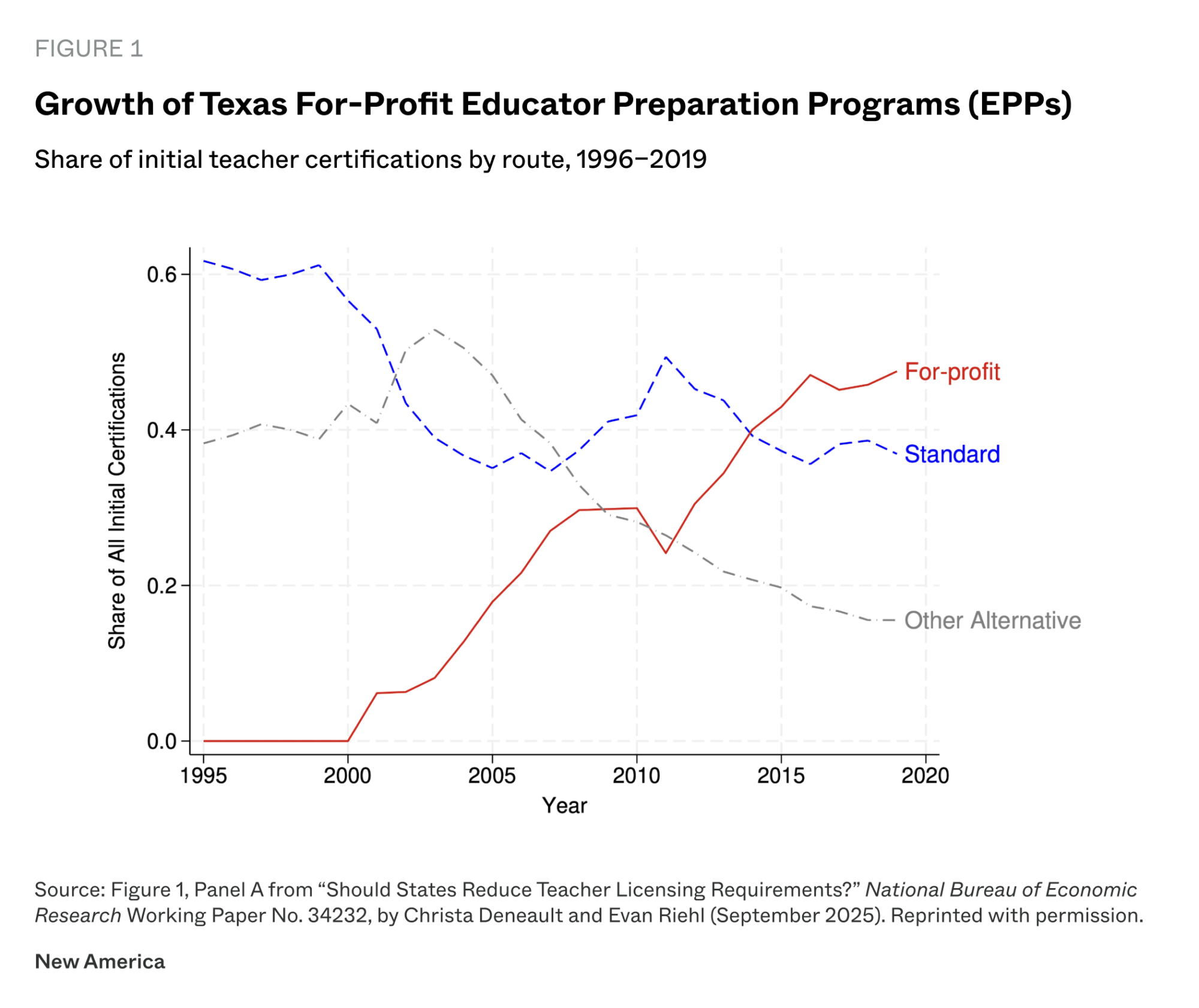
Note: The researchers use “For-profit” to refer to for-profit alternative EPPs that lead to an Intern certificate, “Other Alternative” to refer to not-for-profit alternative EPPs that lead to an Intern certificate, and “Standard” to refer to the certificate earned via baccalaureate degree-granting EPPs. They include post-baccalaureate degree-granting EPPs in “Other Alternative.”
By 2019, more than half of all novice teachers had been certified by for-profit EPPs. On the positive side, the proliferation of for-profit alternative EPPs in Texas substantially reduced the overall proportion of uncertified teachers working in Texas public schools during this time frame, from 5 to 1 percent.14 It also made the novice teacher workforce more representative of the state’s student population by increasing the proportion of male teachers and Black teachers.15
But it also harmed many of Texas’s teacher candidates and novice teachers. Despite typically being cheaper and easier to complete than other EPPs, a much smaller share of candidates enrolled at for-profit alternative EPPs successfully completed their programs than those enrolled in traditional degree-granting or not-for-profit alternative EPPs (see Table 1).
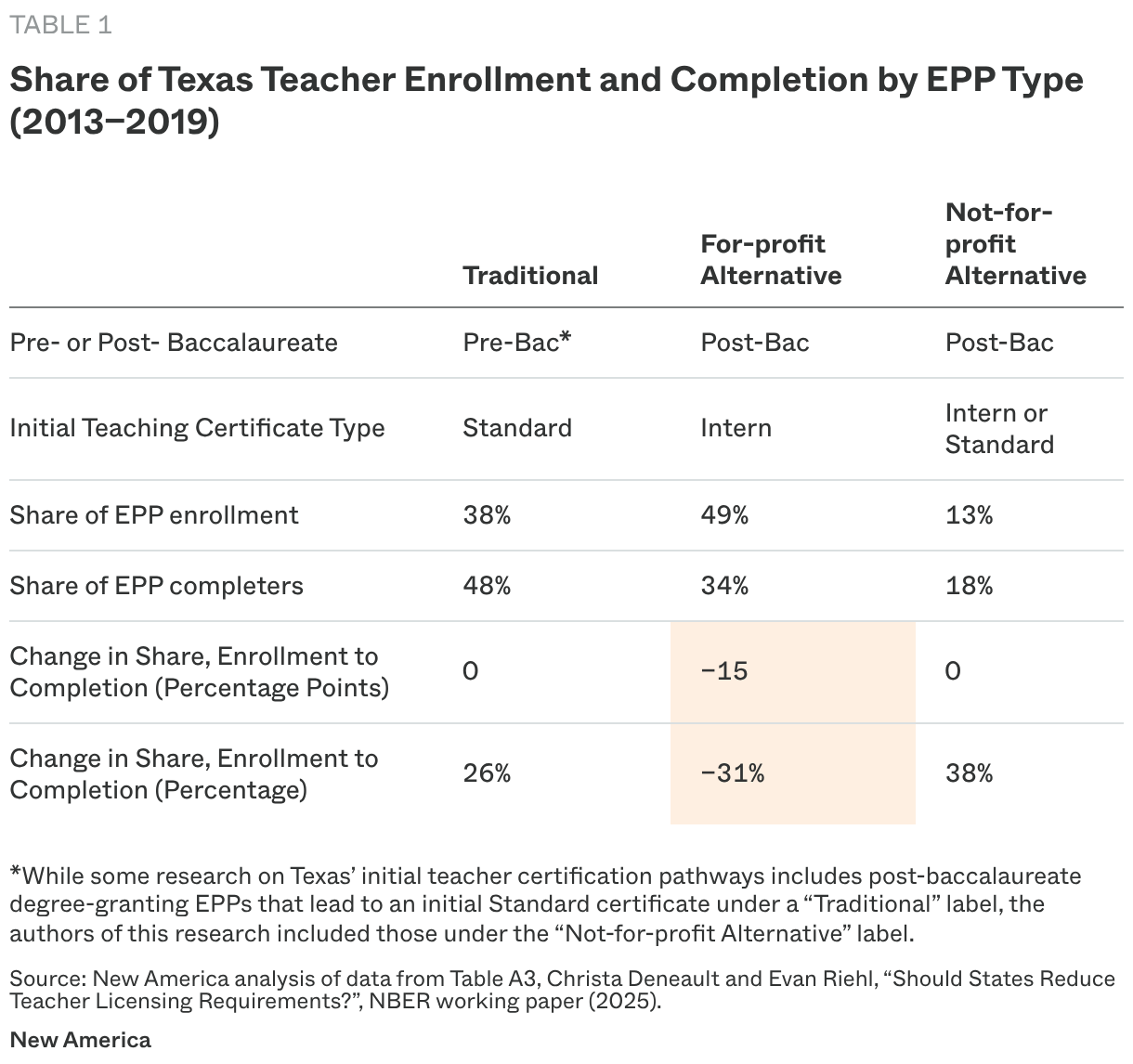
Additionally, teachers who earned an Intern certification via Texas’s for-profit EPPs also left the profession at significantly higher rates than their peers.16
These findings corroborate other research indicating that prospective teachers who enroll in for-profit alternative EPPs—who are disproportionately candidates of color—ultimately tend to experience higher unemployment and lower earnings than candidates who enroll in other types of EPPs.17
One of Texas’s goals in instituting its new alternative certification pathways in 2001 was to reduce the number of teachers working without any state certification, and the policy was successful in this regard. Ironically, the state’s 2015 Districts of Innovation (DOI) policy undermined these efforts by allowing eligible districts to hire uncertified teachers without any state oversight.18 The policy also allowed Texas’s ISDs to exempt themselves from the state requirement that parents be informed if their child is taught by an uncertified teacher.
Although Deneault and Riehl’s NBER working paper analyzes Texas’s teacher certification data through 2019, it omits any mention of the state’s 2015 DOI policy, or the effect it had on its novice teacher workforce. But a recent Learning Policy Institute (LPI) analysis finds that the shifts in Texas’s novice teacher landscape that followed DOI’s enactment were even more substantial than those that preceded it.
In the first five years that the DOI policy was in place, LPI found that the number of teachers with no state-issued certification (not even an Emergency permit) increased slowly, while the number with Standard and Intern certificates both declined.19 Then, in the 2020–2021 school year—presumably due to increased teacher resignations during the COVID-19 pandemic20—the number of districts using the DOI policy to bypass Texas’s typical teacher certification requirements exploded. University of Houston researchers found that, by the end of 2021, 82 percent of all Texas school districts (93 percent of all DOI-eligible districts) had exempted themselves from state teacher certification requirements under the DOI policy.21
The effect on Texas’s teacher workforce was monumental. By 2024, the share of newly hired teachers with no state-issued certification was six times greater than it was prior to the DOI policy. Meanwhile, the share with Standard certification dropped by half, and the share with Intern certification (i.e., those enrolled in alternative EPPs while teaching) dropped by two-thirds. See Figure 2.
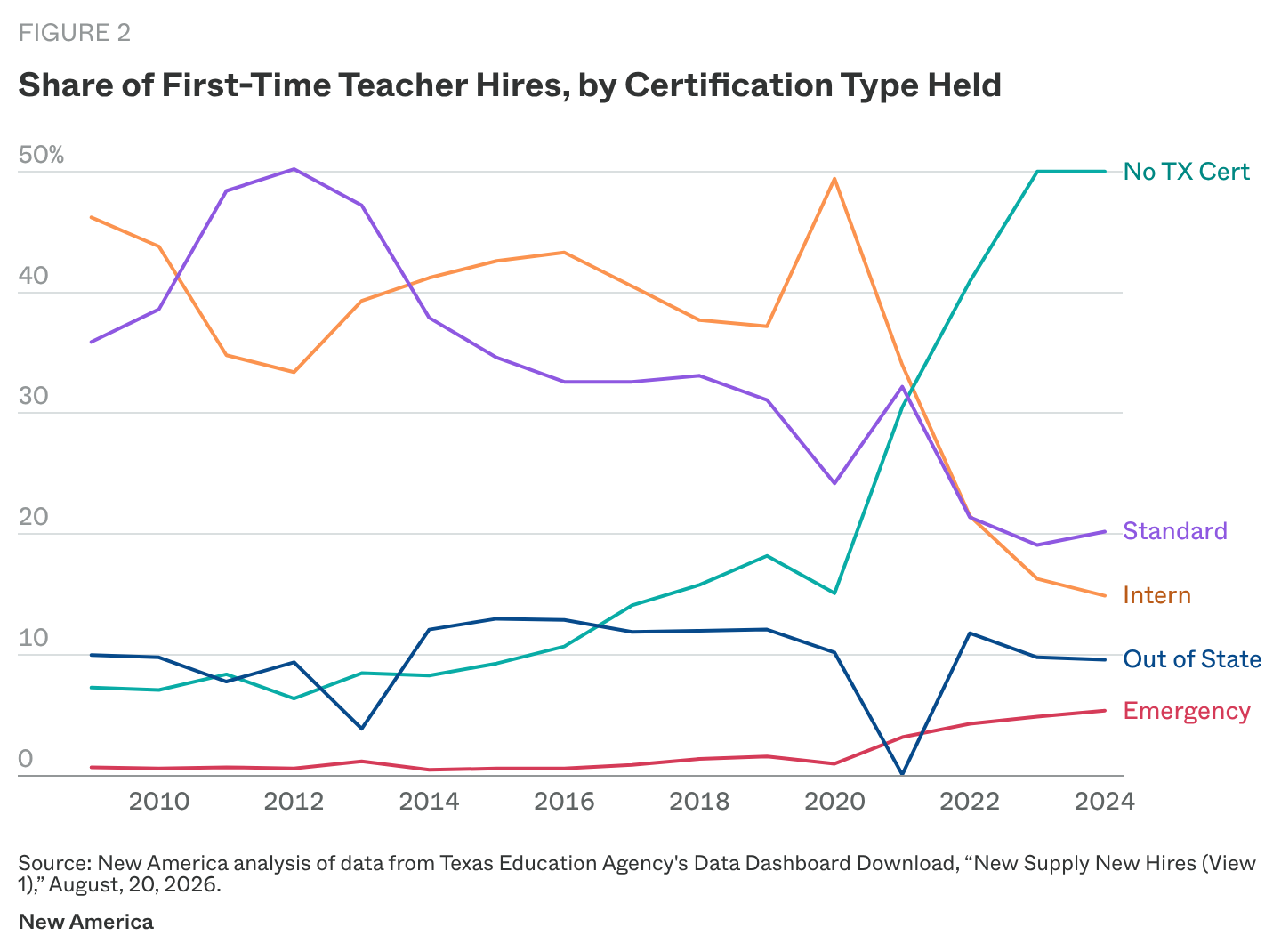
Note: Figure shows first-time teacher hires only, excluding those who have reentered the workforce or previously worked as a teacher part time. “No TX Cert” includes individuals who may hold a School District Teaching Permit, but have no state-issued authorization to teach, not even a temporary one.
With this shift, the overall number of uncertified teachers employed in Texas’s independent school districts spiked, from roughly 1 percent in 2019 to 12 percent in 2024.22 This uptick in uncertified teachers occurred in spite of the state’s support for research-backed pathways into teaching from 2021 through 2024 as part of its Texas COVID Learning Acceleration Supports (TCLAS) initiative. The TCLAS supported school district-EPP partnerships in creating and maintaining sustainably-funded, paid pre-service teacher residencies, as well as Grow Your Own (GYO) teacher programs, which recruit members of the community to become teachers, including individuals already working in schools in a non-teaching role.23
As its number of uncertified teachers rose, the rate at which Texas’s teachers left the profession did also, surpassing the national average and destabilizing the state’s educator workforce.
Teachers’ influence on students goes beyond the actual instruction they provide. For example, teachers with strong classroom management practices and emotional support for students have been found to improve students’ behavior, attendance, and feelings of self-efficacy in math.24 Not surprisingly, decades of research show that teachers play an outsized role in not only helping students learn, but in helping them become successful, productive members of their communities.25
So when teachers are stressed, it impacts students–and it is no secret that most novice teachers feel particularly overwhelmed by the demands of their job, which, unlike in other professions, are the same or even greater than those of veteran teachers.26 What is less frequently discussed is how novice teachers who engage in little to no hands-on training in PreK–12 schools prior to employment report feeling significantly less prepared than those who engage in more substantive training.27
Most Alternative EPPs in Texas do not offer substantive hands-on pre-employment training in schools, particularly for-profit ones. While we are unable to draw a direct line between the changes to Texas’s pathways into teaching and their novice teachers’ feelings of preparedness or stress, we can assess how shifts in the composition of the novice teacher workforce affected the state’s students.28
In their working paper, Deneault and Riehl assessed the impact that middle-grade novice teachers with different certification types had on their students’ learning by calculating the difference between students’ actual and expected performance on end-of-year state tests in math and English language arts (ELA) from 2012 to 2019. After accounting for factors outside of teachers’ control, such as student demographics, the researchers found that, in general, novice teachers generally had a negative impact on their students’ learning, irrespective of certification type (see “mean residual” in Figure 3).
While first-year teachers certified by for-profit alternative EPPs in Texas impacted students’ math performance significantly less negatively than uncertified teachers did, they had a significantly greater negative impact on performance than teachers certified by “other” (i.e., not-for-profit) alternative EPPs did. In both math and ELA, for-profit-certified teachers had a significantly greater negative impact on their students’ performance than teachers with a Standard certification from a baccalaureate-degree-granting EPP did. These disparate impacts on student performance did not diminish over teachers’ first five years in the profession. See Figures 3 and 4.
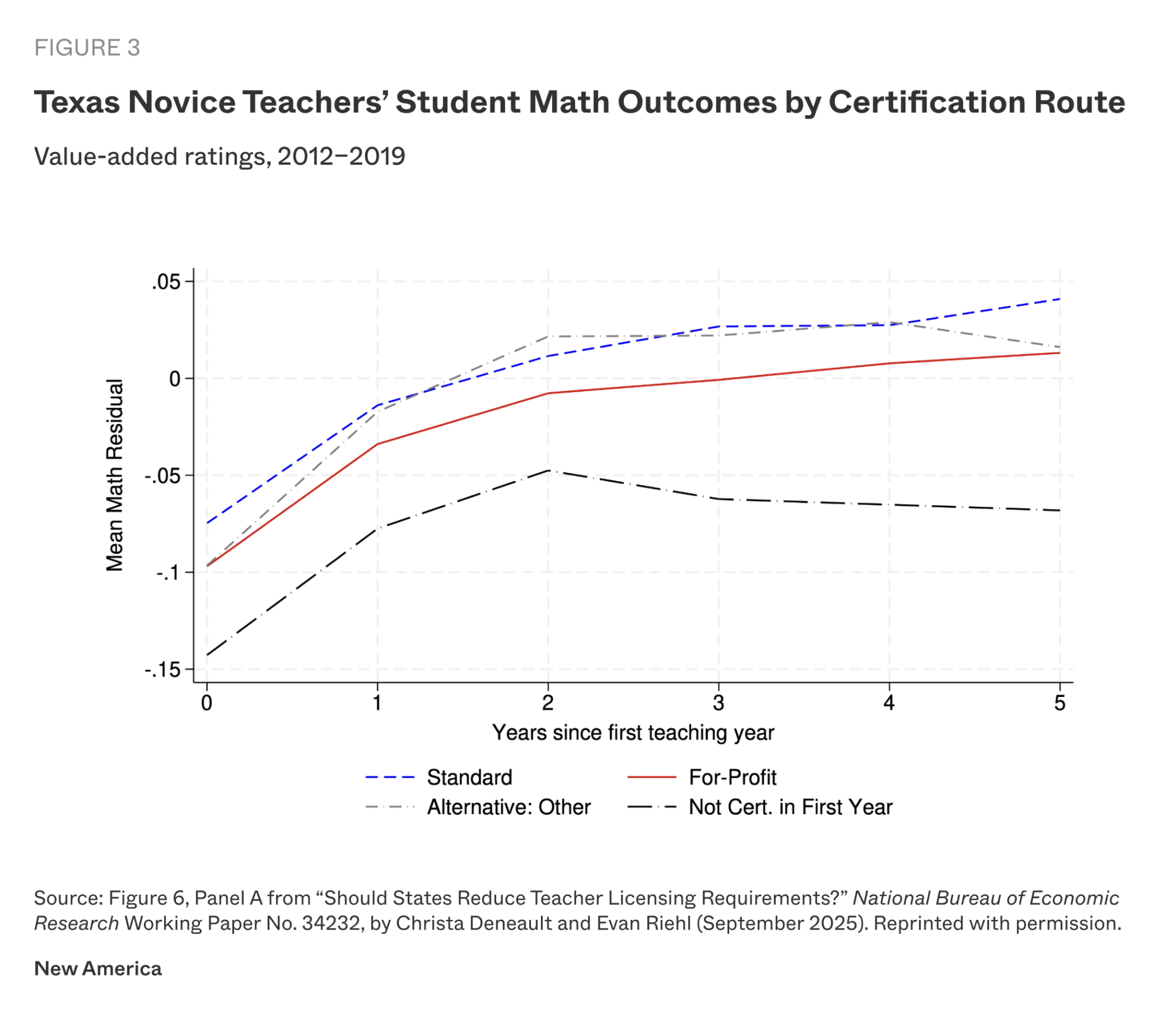
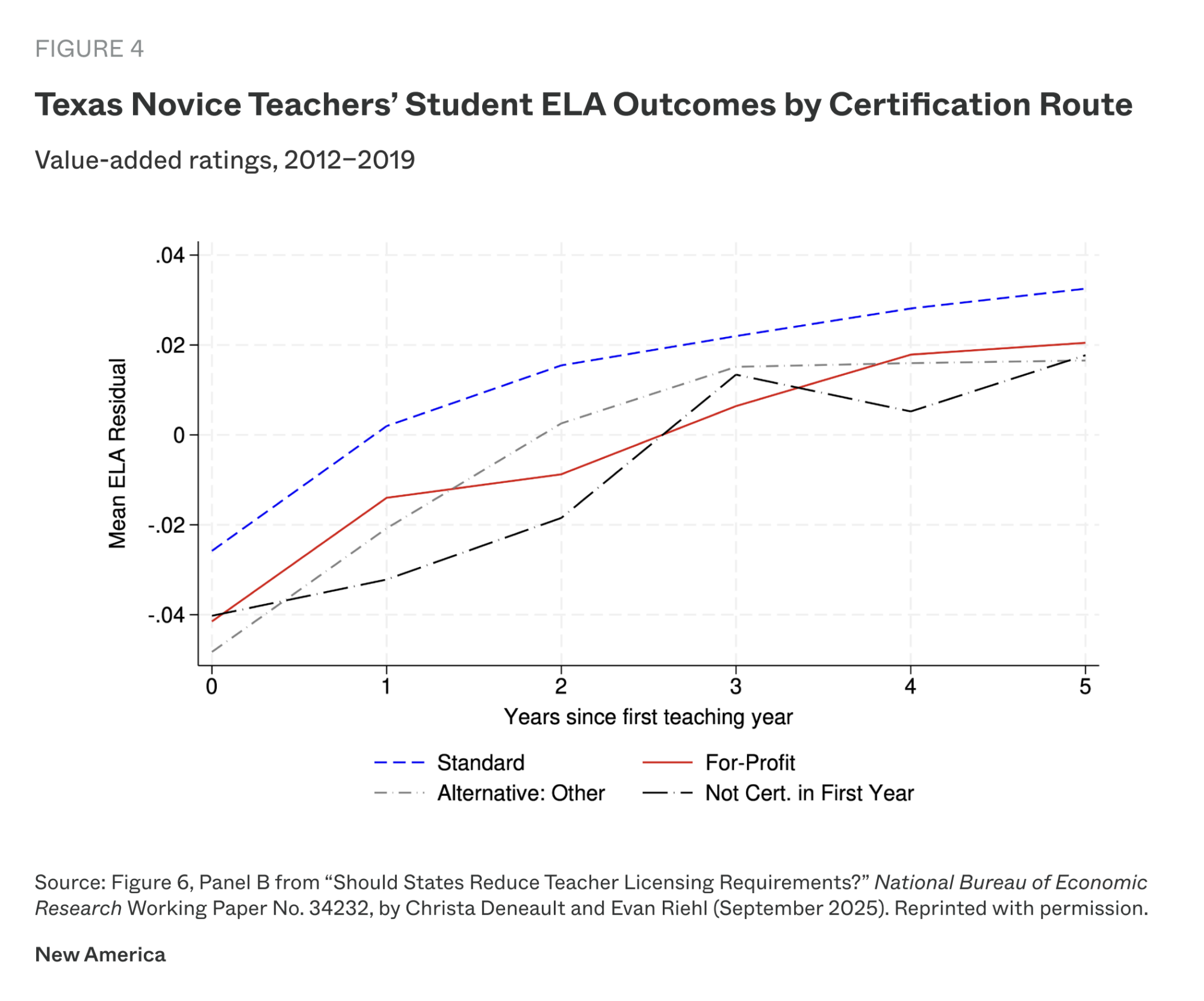
Note: Unlike the other research summarized in this brief, which categorizes teachers working via state-issued temporary permits separately from those working via school district-issued permits, the authors include both in the “not certified in first year” category. See pages 72–73 of the original source for more details.
Accounting for the certification types of the novice teachers that for-profit certified teachers supplanted, Deneault and Riehl concluded that allowing the proliferation of for-profit-certified teachers in Texas had a neutral effect on student achievement overall. However, this conclusion appears to ignore evidence that the rise of for-profit EPPs in Texas catalyzed a race-to-the-bottom competition for teacher candidates that led to a decline in the quality of the state’s other EPP types.29 Following this logic leads to the conclusion that, if the for-profit EPP sector had never existed in Texas, the rest of its certified novice teachers would have been better prepared, and the achievement of its students would have been higher.30
This would mean that Deaneault and Riehl’s analysis understates the overall negative impact of for-profit alternative EPPs on Texas’ students. However, we are unable to assess if or how students’ longer-term educational attainment was affected by any differences in classroom management and/or student engagement skills by first-time teacher certification type.
Most research on Texas’s certification policies has focused on the impact on the state’s overall student population, not on specific student populations. But those that have looked more closely at specific subgroups tend to find that historically disadvantaged students were most adversely affected.
One of the most extensive studies of its kind, by Rhodes and Marder, draws on seven years of student outcome data in grades 3 through 11 across reading, mathematics, science, and history. In the 2012–2019 timeframe studied, the authors found that students from low-income households, emergent bilingual students, and Black and Hispanic students were disproportionately assigned to teachers certified by alternative for-profit EPPs, even relative to alternative not-for-profit EPPs.31
And while all of the student subgroups analyzed by the researchers benefited from being taught by teachers who earned the Standard certificate via a traditional degree-granting EPP, the researchers noted that students flagged to receive special education services benefited the most, while students flagged as gifted benefited the least.
The evidence reviewed in this brief shows that Texas’s late-1990s and mid-2010s policy choices—first loosening standards for teacher certification, then allowing districts to bypass certification requirements altogether—contributed to a significant decline in the quality and stability of the state’s novice teacher workforce, with real costs to students’ learning.
After a concerted effort by state education advocates, Texas lawmakers passed HB 2 in 2025 in an attempt to reverse these trends. The second brief in this series will examine the policies HB 2 that puts in place relative to the research and best practices summarized here—and it will recommends ways to build on them to fully deliver on the law’s promise of giving Texas’s students the stable and effective teacher workforce needed to reach their full potential.
Director, Educator Quality