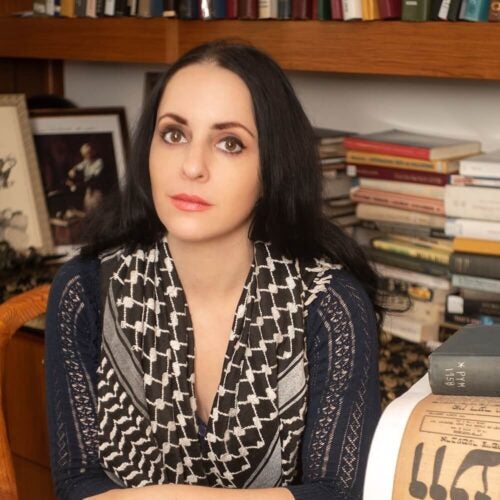
Molly Crabapple
New America (Eric & Wendy Schmidt) Fellow, 2020
New America 2020 Fellow Molly Crabapple spoke about the history of the Jewish Labor Bund, political art, and creative collaboration for “Three questions” in The Fifth Draft, the Fellows Program’s monthly newsletter. Crabapple is an artist and writer whose work explores politics, social movements, and human rights.
Your Fellows Project is a book about the history of the Jewish Labor Bund. Can you share the genesis of this project?
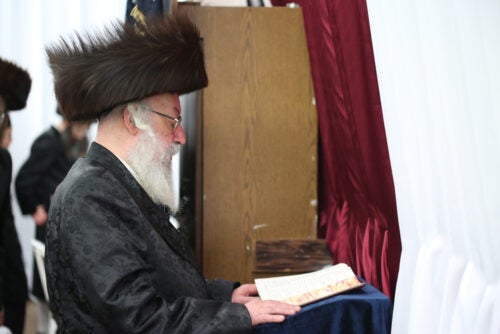
I grew up surrounded by the work of my great grandfather, a post-impressionist painter named Sameul Rothbort. One day, leafing through watercolors he had painted of his long-murdered schtetl in Belarus, I saw an image that struck me. A young woman with Gibson Girl hair and a corseted waist was hurling rocks through windows. Her boyfriend stood next to her, holding a bag filled with more rocks. “Itka the Bundist”, read the title. Bundist? I wondered. What was that? This question led me to discover a forgotten history of Jewish resistance that is still powerfully relevant today. When I wrote an essay about the Bund for The New York Review of Books, it spread farther and faster than I would ever have imagined, which led me to decide to explore the group further in a book.
I wanted to show a future that was humane, human and beautiful—something worth fighting for.
The short film you illustrated, “A Message From the Future,” was co-written and narrated by Rep. Alexandria Ocasio-Cortez. What drew you to this project and was its political nature, an imagined future where the Green New Deal is in place, part of that appeal?
Naomi Klein and I met at a protest commemorating the one year anniversary of Hurricane Maria. My father is Puerto Rican and I spent a lot of time there after the hurricane, both reporting and trying to support the work my friends were doing creating a mutual aid center in a rural mountain barrio—Naomi reported on the same center. We got along, and when she decided to try to mobilize artists for the Green New Deal, she asked me what I wanted to create. I had the idea of creating an animation, similar to what I had done with Jay Z about the war on drugs, where Alexandria Ocasio Cortez could explain the Green New Deal as she envisioned it. Naomi, Avi Lewis and AOC wrote the script together, then Kim Boekbinder and Jim Batt (the co-directors) and I went back and forth making storyboards that jived with their vision.
In both the news and in popular culture, we have so many visions of dystopia—but what we lack are ideas for how a better world might be. I wanted to show a future that was humane, human and beautiful—something worth fighting for.
Like the film your last book, Brothers of the Gun, was a collaboration with writer Marwan Hisham. What about collaboration appeals to you and what does your collaborative process look like?
Marwan is one of my best friends, and one of the most brilliant, brave and fiercely individual people I’ve ever been blessed to know. To give you an idea of what I mean, he did surreptitious journalism under ISIS, after the group invaded his hometown, then became the first person to break the story of American airstrikes on Raqqa. Because of this, Brothers of the Gun was a collaboration like none I’ve ever done before, and one which I’ll probably never repeat. We wrote the book together, sometimes drafting sentences five or six times each, rewriting each other’s chapters, arguing to make sure each word was right. He art directed the 82 drawings I did, never allowing me to get away with inaccuracy or cliché. I wanted them to look as if I had seen Raqqa through his eyes. We were attempting to mix Homage to Catalonia and Goya’s Disasters of War, and together we created something better than anything either of us could have created alone.
Subscribe here to receive next month’s issue of The Fifth Draft.
New America (Eric & Wendy Schmidt) Fellow, 2020