Jeremy Bauer-Wolf
Investigations Manager
The Trump administration is trying to create a policy avenue that would allow it to completely circumvent the American higher education accountability system as Congress envisioned it.
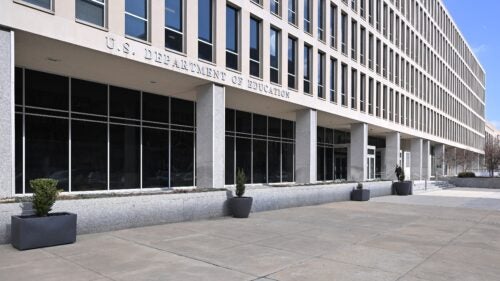
It’s part of the U.S. Department of Education’s regulatory proposal on college accreditation, an obscure but key piece of the accountability framework. The department is currently negotiating the plan with those who would be affected by the regulatory change.
Accreditors picked by the federal government vet colleges to determine whether they’re sound enough in their operations to access the $120 billion in federal student aid distributed annually. Congress made this explicit in law. The department’s proposal, though, would allow it to keep sending financial aid to colleges that had their accreditation revoked. If the Education Department decided accreditors had violated their rules when rescinding accreditation, it would be able to keep federal aid flowing to that now-unaccredited school.
Should its plan stand, the Education Department could control which colleges keep getting financial aid––taxpayer money. Why have accreditors at all if the Education Department can override them?
The Education Department has described the provision as a “safety valve.” If an accreditor errs, the department could allow aid to continue flowing to a college, avoiding disruption to students, officials have argued.
During the negotiations, Jake Lallo, an Education Department attorney, said that about a decade ago, an accreditor mistakenly walked back an institution’s accreditation. The resulting budget hole from the lost federal aid spurred the institution’s demise, and “very much left students holding the bag,” Lallo said.
Lallo did not name either the accreditor or the college in his anecdote. But the timeline he referenced appears to point to a particular case: the saga of the Dream Center, a now-defunct college operator. Part of the controversy involved Education Department officials accusing an accreditor of bungling its policies.
The Dream Center’s problems extended far beyond an accreditor blunder, though.
Roughly eight years ago, the accreditor, the Higher Learning Commission, or HLC, approved the transfer of a for-profit network known as the Art Institutes to the nonprofit Dream Center. But HLC at the time only made the Art Institutes a candidate for accreditation, which usually results in loss of federal aid.
The department under the first Trump administration argued the Art Institutes weren’t fully informed of the consequences of the status change, and of the opportunity to appeal the HLC decision. Department staff at the time recommended HLC be barred from accrediting new institutions for a year, a sanction the agency never applied.
However, the controversy was muddied by the involvement of a top Education Department political appointee, who a House committee investigation found was extensively corresponding with Dream Center executives about the schools’ accreditation status. Diane Auer Jones, the department’s principal deputy under secretary, was found to have coordinated efforts to secure Art Institutes retroactive accreditation. HLC declined, as retroactive accreditation was against its and the Education Department’s policies.
And years before this all occurred, the Art Institutes were struggling, with enrollment flagging and scrutiny and lawsuits against its recruiting practices intensifying in the 2010s, similar to other predatory for-profit outfits.
The Art Institutes lied both about job placement rates and graduate earnings, the Education Department found. One student in an interview described how the institution’s “career services” were simply the school sending her and her peers Craigslist advertisements.
Even if this “safety valve” had existed, it would have kept federal aid flowing to an institution that was failing students. The department of today hasn’t pointed to a clear case where the provision would have been needed.
The department’s negotiators also broadly don’t like it.
Jennifer Blum, Republican appointee to NACIQI, the federal board that advises the Education Department on accreditation, said during debate that this part of the plan would undermine the triad. The triad is the three-pronged oversight system Congress created for colleges: accreditors, which judge academic and operational quality; states, which handle consumer protection and the federal government, which administers aid.
“I find this provision to be completely counter to the congressional intent of the triad,” Blum said. Another negotiator, accreditor president Rebecca Busacca, said it would “destroy” the triad.
Negotiators also pointed out during debate that other entities with clearer legal authority than the department—appeals panels, arbitration boards, and even courts—already adjudicate accreditor mistakes.
An appeal or lawsuit against an accreditor decision would also likely keep federal aid flowing, Michale McComis, another accreditor president and negotiator, said during debate. McComis said he didn’t believe, in fact, that the department had ever cut off aid if a college challenged an accreditor decision until it was final and all due process was exhausted.
“This just provides more opportunity for institutions to make potentially specious complaints against agencies,” he said. “And I just don’t know what value it brings.”
The policy brings no value. It’s a power grab, even if Education Department officials have insisted they wouldn’t abuse it. Jeffrey Andrade, a Trump political appointee, said during discussion the department wouldn’t act “willy-nilly” or “overturn an agency decision.”
His assurances mean little. The department has already shown it will stretch its authority to the point of illegality. Trump 2.0 has already featured a campaign to pressure colleges to abandon diversity efforts—those actions that have crossed legal lines, including the termination of federal grants.
A vague promise now won’t constrain the department later. The language creates the option for the Trump Education Department to decide on its own terms which colleges deserve taxpayer money, even after accreditors said they shouldn’t.
Investigations Manager