
Jeremy Bauer-Wolf
Investigations Manager, Higher Education
New America breaks down the political attacks against a crucial part of the U.S. higher education accountability system in this audio interview.
This analysis is part of Mythbusting Accreditation, a written and multimedia series from New America’s Education Policy program. It features insights from experts across multiple fields to cut through false narratives about a crucial higher education accountability system.
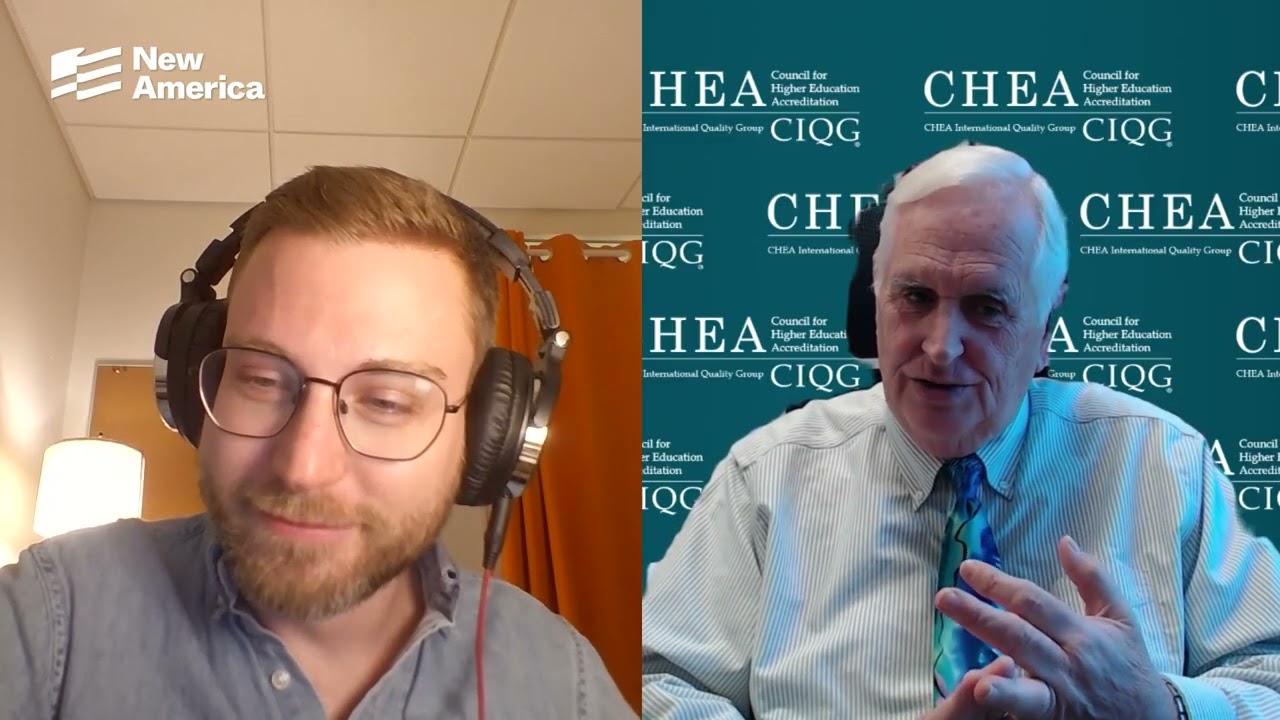
New America’s Jeremy Bauer-Wolf talked with Jan Friis of the Council for Higher Education Accreditation (CHEA) about how the accreditation system works and how the federal government plans to change it. This interview has been edited for length and clarity.
Jeremy Bauer-Wolf: College accreditation has entered the mediasphere in a way not seen in memory. Headlines about accreditors have become common. Politicians all the way up to the likes of Governor Ron DeSantis of Florida and President Donald Trump have attacked the system publicly, labeling it as woke and in step with the liberal agenda.
But what are accreditors? In essence, they are the gatekeepers of federal financial aid. Accreditors assess colleges by their standards and determine whether those institutions should qualify for aid, which is an $120 billion annual funding stream. But they’re not always portrayed accurately, either by policymakers, the press, and particularly right-of-line media. Welcome to Mythbusting Accreditation, a New America multimedia series where we’ll be discussing the truth of how accreditors and the system actually works.
I’m Jeremy Bauer-Wolf, investigations manager for New America’s Higher Ed Policy Program. Today I’m interviewing Jan Friis, senior vice president for government relations at the Council for Higher Education Accreditation, also called CHEA. We spoke about the accreditation policy landscape and what changes are coming down the pike.
Bauer-Wolf: Jan, welcome.
Jan Friis: I’m happy to be here.
Bauer-Wolf: Can you talk to me about the heightened interest in accreditation, both from policymakers and the public? Where does that come from?
Friis: I think there are a few reasons for this. Number one, our current president made it part of his campaign. Governor DeSantis became unhappy about some things that happened in Florida institutions. North Carolina became unhappy about some things that happened in their institutions. That’s what started it for policymakers.
In Congress, ACICS, which was an accreditor, went out of business and it left a number of students in a bad way. That’s what has policymakers upset. That’s also what has the public upset, is that institutions sometimes close and they leave the students without a recourse. They leave their faculty, their staff without salaries. Now, accreditors work very hard to get alternative teach-out programs for them. But I think that’s the genesis.
I think the public and policymakers don’t understand what exactly accreditors are and what they do, though.
Bauer-Wolf: What sort of myths about accreditation do you see being spread around?
Friis: The myths really revolve around the fact that accreditors determine what institutions do. That is not true. Accreditors review institutions for quality. They determine whether the institution is doing what they say they’re going to do at a postsecondary level.
An accreditor will ask—is a program rigorous enough, so that students, if they applied themselves, can come out trained to do a certain profession and become a good member of society?
Accreditors are not job guarantors. Accreditors are organizations that review institutions for quality, asking, are the schools doing what they say they are going to do?
We don’t want students defrauded. We don’t want the government defrauded. The government puts a lot of money into higher education. They should get their money’s worth. Part of the challenge is they’re changing what they think is their money’s worth, it’s becoming much more about return on investment than it used to be.
Bauer-Wolf: I wanted to talk about programmatic accreditors, because there’s specifically some political buzz about them. There’s been headlines about them being a “cartel.” What do you make of that?
Friis: You’re going to talk to me, likely, about two accreditors. One is ABA and the other is the medical accreditor. CHEA doesn’t recognize either of those.They have never come to CHEA for recognition. Are they a cartel? I don’t have an answer to that.
ABA has approved some schools that are not effective.They have required all of their schools to have some social justice sort of admission requirement. There are reasons for that.
But there are also some reasons that the federal government feels like that’s not a good approach. A person has to judge that on their own. For doctors and lawyers, the thought behind those kinds of requirements has always been if an individual is going to use one of those professions, they want to see somebody like themselves. I don’t see anything wrong with that. Does that discriminate against some people? The current administration thinks so. That’s a societal discussion that I would prefer not to be in the middle of.
Bauer-Wolf: For context, programmatic accreditors are entities that look at a particular type of program. Some in the administration and elsewhere have accused these programmatic accreditors essentially functioning like a monopoly, if they were the only one exclusive for an industry. That’s the discussion we’re having.
Friis: Programmatic accreditors really need to be held to a standard, particularly if they are preparing people for licensure. If a programmatic accreditor is preparing a student for licensure, then they are obligated to make sure that the institution meets all the requirements for licensure. That’s really important. There’s been some focus on that. Part of the challenge has been that there’s so much distance education today and the requirements for licensure vary state to state, that accreditors are wondering: What do I have to be? What do I have to prepare students for?
Bauer-Wolf: There are a lot of changes coming to accreditation in the next few months, including the administration engaging in negotiated rulemaking. What should the layperson be watching out for?
Friis: There are a couple of changes that are going to come. Number one, the department is going to try to make it easier for new accreditors to be recognized. There are, in fact, some changes in the recognition process that should apply to all accreditors, including new accreditors.
CHEA has been supportive of new accreditors as long as they are rigorous and meet the requirements that all the current accreditors have to meet. But that doesn’t mean the current requirements are all the best.
There’s also going to be a greater emphasis on data and student learning outcomes. I don’t know an accreditor that doesn’t have a standard on student learning outcomes. But you’re going to have the Education Department be more attentive to what the student outcomes are going to be.
Quite frankly, some of the words out of the department are a little challenging. They use the word like “revolutionize” accreditation. Well, accreditation has been around for 125 years. Accreditors are private entities. Their members are made up of institutions that want to be accredited by them. And so, accreditors are developed. The institutions then agree on a set of standards collectively. Then the accreditor applies them individually to each institution. It’s going to be interesting to see how the department goes about this.
Investigations Manager, Higher Education