
Francie Genz
Fellow, Future of Work & Innovation Economy
Intermediaries are key to workforce and economic development, but what do they actually do? We seek feedback on six coordination functions every region and state needs.
What does it actually take to build a workforce system that can keep pace with a rapidly changing labor market and economy?
This post is the first in a series for New America’s Future of Work & Innovation Economy initiative about intermediaries—the organizations that sit between employers, educators, workforce and economic developers, government, and students and job seekers. Intermediaries have been part of the American workforce and economic development landscape for decades, and there is broad agreement that their role matters. Yet their job remains surprisingly vague.
We say they coordinate and align stakeholders. But coordinate what, exactly? Align around which decisions, and toward what outcomes?
If we want workforce and economic development systems to perform differently, it’s not enough to assert that intermediaries are important. We have to get far more precise about the work itself. That means naming—clearly and concretely—the specific coordination functions required to produce a coherent workforce system aligned with a state or region’s economic development goals.
This series is an attempt to do just that. In this post, I introduce six coordination functions that must be performed somewhere, with enough continuity and authority to shape behavior, both to bring coherence to the workforce system and to connect that system to economic development investments and strategies.
These functions reflect learning from over a decade of building industry-led sector partnerships, as well as themes that have emerged from the National Science Foundation (NSF) Regional Innovation Engines and New America’s Accelerator for Community Colleges in the Innovation Economy.
Consider this a starting place. We are sharing this first draft to invite feedback from practitioners. Please weigh in; do these functions accurately describe the coordination work that you see as most essential?
Meeting the workforce needs of a rapidly changing labor market is as much a coordination challenge as it is a delivery challenge. Policymakers, employers, education and training providers, workforce agencies, economic developers, philanthropies, and community organizations all influence how people enter, move through, and advance in the labor market—but they operate with different mandates, incentives, timelines, and partial information about what is changing and when.
For individuals to successfully move from education into employment and advance, these actors must stay aligned, sharing signals and adapting as conditions shift.
In practice, however, this rarely happens. Coordination is the exception rather than the rule, not because actors are unwilling to collaborate, but because no one is clearly responsible for ensuring coherence across institutional boundaries. The result is familiar: training providers oversupply some skills and undersupply others, employers struggle to hire, and individuals are left to navigate a complex labor market without much guidance. Regional economies stagnate or decline, and economic security becomes out of reach for more workers and families.
These breakdowns are especially pronounced in regions where technology-based economic development investments are creating new industries faster than workforce systems can respond.
In several of the NSF’s Regional Innovation Engines, for example, leaders are trying to grow industries around advanced and emerging technologies while training systems are still structured around legacy occupations. New America’s Accelerator for Community Colleges in the Innovation Economy, a national capacity-building initiative launched with the NSF, is supporting colleges experiencing these challenges within the Engines and beyond.
State and regional leaders need credible, real-time answers to basic but consequential questions: what jobs are being created, where, and when? Which skills will they require? Which workers are closest to meeting those requirements? Which providers can respond—and where are new investments, capacity-building, or support needed?
Without shared mechanisms to answer these questions across institutions and actors, systems default to lagging indicators, guesswork, or fragmented responses that fall behind market reality.
A “coherent” workforce system is one in which employer demand, training supply, learner pathways, and economic development priorities are continuously aligned through shared signals, intentional handoffs, and feedback loops, so the system can adapt as conditions shift. Coherence doesn’t require centralized control. It requires the capacity to coordinate across institutional boundaries when interdependence matters, especially in fast-changing industries where timing and sequencing shape outcomes as much as training itself.
For decades, intermediaries have been recognized as an essential part of workforce development, created to sit between firms and institutions to translate signals and reduce transaction costs. But “intermediary” has become an umbrella term covering very different roles.
Some intermediaries focus on apprenticeships and work-based learning. Some place low-income workers into open jobs without a focus on whether they improve economic security. Others coordinate around a specific grant or cater to only one provider type or sector. These roles are important, but they are not interchangeable. Using the same word to describe them can obscure where a region is strong and where it is missing core coordination capacity.
This series takes a different vantage point. The intermediary functions described here are rooted not only in what’s required to connect educators to employers, but also to align a region’s broader economic development direction.
Not every intermediary organization should perform all of the functions below. But if these functions are not performed somewhere—with enough continuity, credibility, and influence to shape behavior—fragmentation persists even when individual workforce programs are well designed.
The six functions below describe the core coordination capacities required for a workforce system to behave coherently and align with economic development priorities. Over the past year, my colleagues and I have pressure-tested these functions not only with traditional workforce actors but also with those engaged in tech-based economic development like in NSF Engines.
They are not program models; they are functions that must be owned and sustained at state and regional levels if employer demand, training supply, and learner pathways are to stay in sync over time. The question is not simply whether a region has an intermediary organization. The question is whether the essential coordination functions are being performed, at the right scale, with the right expectations, and with enough authority and continuity to shape system behavior rather than merely add another layer of activity.
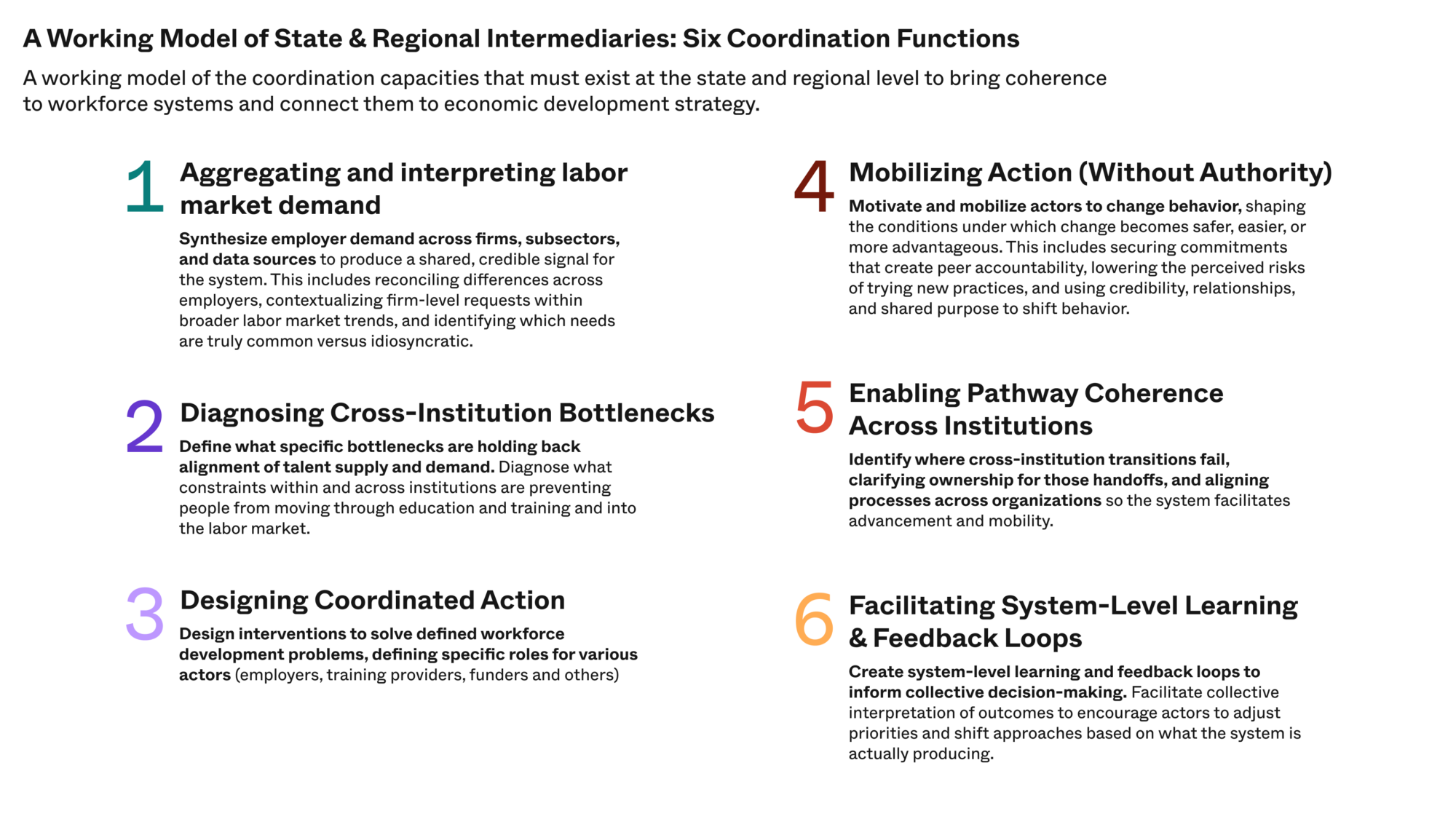
Natalya Brill/New America
Across all six functions runs a design question that is often implicit: who is carrying risk? Workforce systems operate through forward-looking bets. When demand shifts, someone absorbs the downside. In many regions, risk is not intentionally allocated; it defaults to those with the least influence in system design, especially learners who invest time and resources without clear hiring signals. A coherent workforce system does not eliminate uncertainty; it makes risk visible and calibrates investment accordingly.
We’re sharing this framework as a working draft. Before refining it further, we want to test whether these functional descriptions actually map to lived experience on the ground.
For each of the six functions, we’re asking one question: how important is it to achieving a coherent, high-performing workforce and economic development system in your region? We’ll use your responses to sharpen the framework and to inform ongoing research, convening, and storytelling from New America’s Future of Work & Innovation Economy initiative.
In future posts, we’ll unpack each function with concrete examples and explore how they operate at different levels—sector, regional, and state.
The goal is to help regions diagnose where coordination is breaking down, identify which forms of intermediary capacity are weak or missing, and target investment toward the connective tissue that allows workforce systems to function as systems.
For now, the aim is to name the work clearly.
If intermediaries are going to serve as durable infrastructure for the future of work, we need clearer job descriptions and clearer expectations about what success actually looks like.
This article was produced as part of New America’s Future of Work and the Innovation Economy Initiative’s ongoing research on science & tech, workforce, and economic development policy and practice innovation. Subscribe to our newsletter to stay current on our latest research, events, and writing.
Fellow, Future of Work & Innovation Economy