Jeremy Bauer-Wolf
Investigations Manager, Higher Education
The Trump administration’s senior-most higher education official has ordered two college accreditors to strip all references to diversity, equity, and inclusion from their policies, a predictable move from an administration fixated on purging anything DEI from American schools.
Just as predictably, the argument behind this latest demand is convoluted and legally unsound.
The official, Under Secretary Nicholas Kent, is applying a recent U.S. Supreme Court ruling far beyond its scope. His reasoning also leans on assumptions of how one of the accreditors defines diversity, and in his communications to them, he speculates, with seemingly no evidence, that certain policies mandate race-conscious practices.
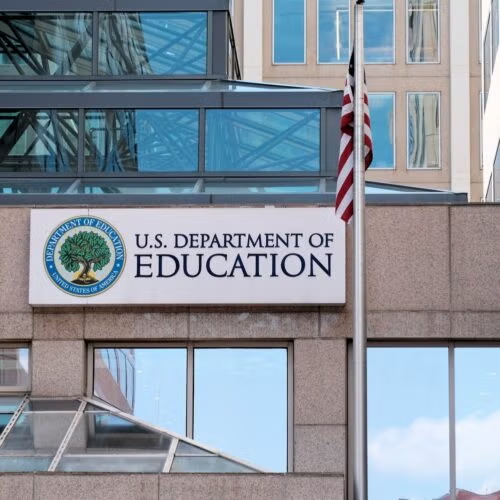
This is all an extension of the White House’s quest to reshape higher education to its ideological mold. As part of that campaign, it’s started to scrutinize accreditors, entities that evaluate colleges’ operations to determine whether they should have access to the $120 billion in student financial aid the U.S. Department of Education doles out every year.
The Education Department picks which accreditors function as these financial aid gatekeepers, a process known as recognition. But by law, accreditors develop their standards independently from the federal government.
This administration, however, has pressured accreditors to conform to its anti-DEI vision. Last year, President Donald Trump issued an executive order threatening to remove recognition from those that maintained DEI-related standards.
The order prompted many accreditors to stop enforcing their DEI standards or eliminate them altogether. This didn’t satisfy the Trump administration, which this week commanded that the two accreditors prove to the Education Department that they will scrub their DEI policies from their books.
Those accreditors must send two reports to the department over the next year confirming they had taken steps “to eliminate standards that violate federal law,” Kent, the under secretary, wrote in public letters. The two targeted accreditors are the Middle States Commission on Higher Education, or MSCHE, which oversees hundreds of mostly mid-Atlantic colleges, and the Commission on Accreditation in Physical Therapy Education, or CAPTE, which evaluates physical therapy programs.
MSCHE made headlines last year, after the Education Department publicly prodded the accreditor to sanction Columbia University, the Ivy League institution that MSCHE oversees. At the time, the department was pressuring Columbia on several fronts, including cutting off some of its research funding.
Now, the department has turned to accreditors themselves.
Kent’s argument—that the two accreditors’ standards are unlawful—simply doesn’t hold up.
He claims the accreditors’ DEI rules flout a 2023 Supreme Court decision, Students for Fair Admissions v. Harvard, which ended the already-limited use of race in college admissions.
Crucially, the decision focused only on admissions, not any other mechanisms of colleges or K-12 schools. But the Trump administration has seized on the ruling and tried to apply it widely in American schools. The Education Department cited the case last year, for instance, when it said it would treat all education programs that touch on race as illegal.
This wrongly tied the Supreme Court case to unrelated programs, and the administration ultimately abandoned the directive after a federal court found it unlawful.
Kent, in the letters, is similarly overbroad with the ruling.
Both accreditors are infringing not only the Supreme Court’s conclusions, but also likely Title VI, the civil rights law, Kent wrote, by forcing colleges to run race-conscious programs. This puts them in a position to either follow the law, or the accreditors’ standards, Kent wrote.
This is a “malicious interpretation” of the Supreme Court’s ruling, James S. Murphy, a senior fellow with the nonprofit group Class Action, told me. Murphy, a researcher specializing in admissions and access, most recently published data illustrating the demographic enrollment shifts since the ruling came down in June 2023.
The opinion is intentionally narrow, Murphy said. It doesn’t forbid colleges from pursuing diversity-related goals. The ruling actually compliments colleges’ reasons for using race-conscious admissions, Murphy pointed out.
Chief Justice John Roberts, author of the opinion, wrote that Harvard University’s admissions goals were “commendable.” Harvard, a defendant in the case, had cited reasons like “promoting a robust marketplace of ideas, and preparing engaged and productive citizens” for preserving race-conscious admissions.
“This idea that you can’t pursue diversity without it being discriminatory is false,” Murphy told me. “The kindest thing you can say is that this is a misinterpretation of the decision.”
Separately, in the letter to CAPTE, Kent essentially assumes the accreditor is promoting race-conscious policies. He then condemns those assumed policies.
CAPTE requires programs it accredits to promote “a culture of justice, equity, diversity, inclusivity, belonging, and anti-racise.”
Kent wrote that he was assuming the word “diversity” in that policy refers to racial diversity. He then argued that the term’s inclusion in the policy meant it was racist.
“A policy cannot promote racial diversity by discriminating against some people on the basis of race while simultaneously being antiracist,” Kent wrote. “Affirmative action in any context is itself racist because certain individuals get treated differently based on nothing more than the color of their skin.”
He continues later: a “practical understanding of contemporary American culture suggests that some institutions may reasonably interpret CAPTE’s policy to call for a race-conscious definition of ‘diversity.’”
Kent wrote that ultimately, CAPTE would not have suspended its diversity policies unless they were not being “administered in a race-neutral manner.”
But CAPTE likely felt it had little choice, given the president’s public coercion in the form of the executive order.
This is all part of the bigger story, of the White House’s attempts to break and rebuild higher education, this time through accreditors.
Kent’s contorted logic gives away the agenda, one this administration pursues incessantly in place of meaningful accomplishments. The Education Department has branded any diversity effort as harmful and prejudicial. It will always prioritize that conclusion and then find arguments to support it, even if they’re weak. And these are extraordinarily weak.
Investigations Manager, Higher Education