A Chapter of: The Subprime PLUS Loan Crisis: How Universities Steer Low-Income Families Into Unaffordable Debt
Private Universities
More than 26,000 families who had children who either graduated or left these 23 private universities in 2020 and 2021 borrowed PLUS loans to help pay for college. Nearly 12,000 of them, or 44 percent, were the families of Pell recipients. They borrowed a median debt load of nearly $40,000. Table 1 shows the school-by-school numbers:
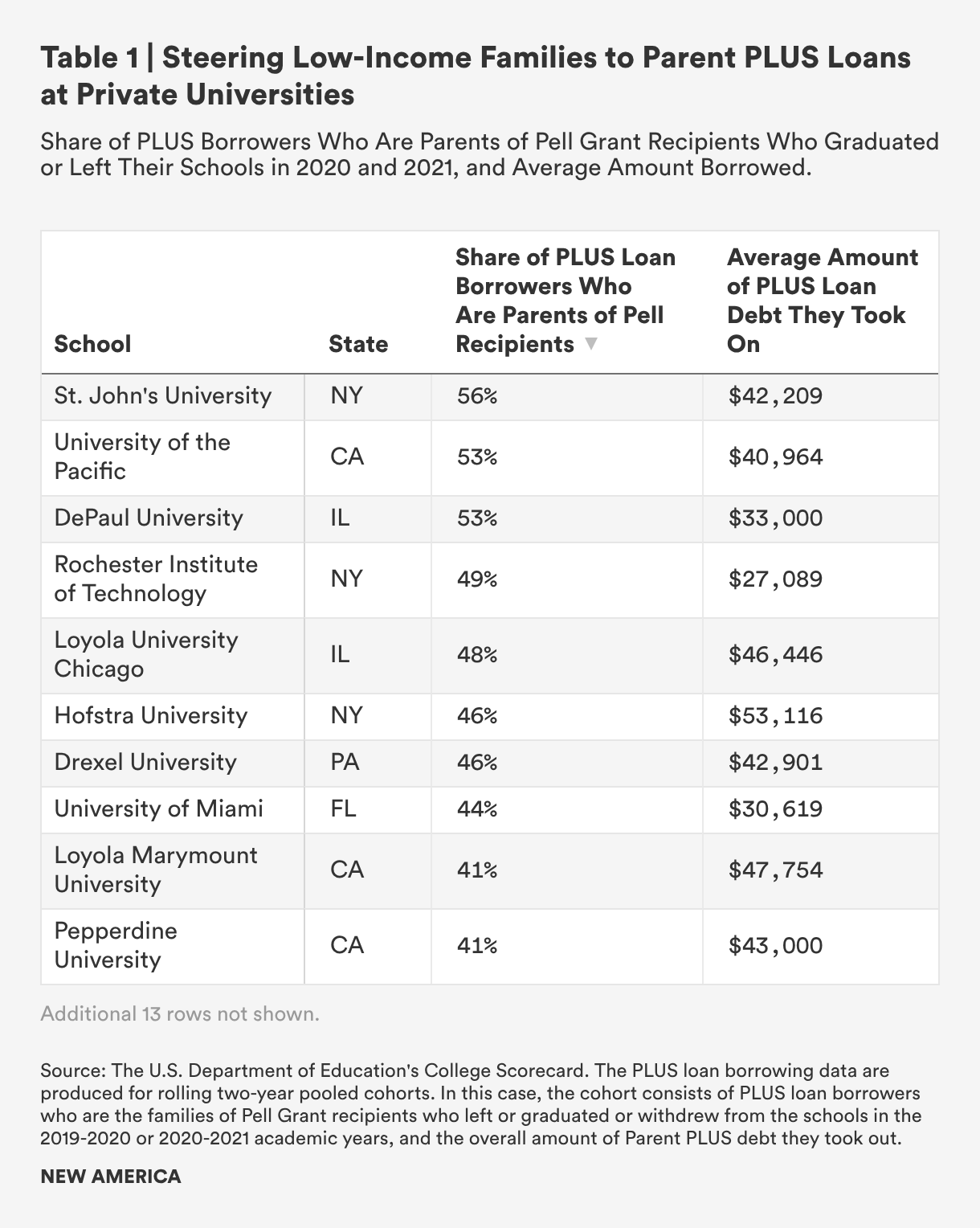
Here’s how the 23 private universities stack up in terms of how much they spend on institutional aid, meet financial need, and charge the lowest-income families:
Private University Profile
- Amount of non-need-based aid: The median amount of non-need-based aid the 23 private universities awarded in 2023 was about $61 million. The three schools that gave out the most were St. John’s University, $218 million; Drexel University, $100 million; and Texas Christian University, $98 million.
- Share of freshmen receiving non-need-based aid and median amount of non-need-based aid award they received: At the 23 private universities, the median share of freshmen receiving non-need-based aid was 27 percent and they received about $22,000 each. The three schools that awarded aid to the largest share of non-needy freshmen were the University of Miami, 62 percent (an average of $23,000 each); Loyola Marymount University, 56 percent (an average of $11,000 each); and University of Denver, 54 percent (an average of $22,000 each).
- Percentage of financial need met: The median share of financial need that the 23 private universities met of their freshmen financial recipients was 85 percent. The schools that met the lowest share of financial need were Quinnipiac University, 66 percent; Hofstra University, 71 percent; and Loyola Marymount University, 71 percent.
- The average net price the lowest income freshmen pay: After all grants and scholarships were considered, these 23 private universities charged freshmen from families with annual incomes of $30,000 or less an average net price of nearly $24,000. The schools that charged the lowest-income students the most were Pepperdine University, $36,000; Quinnipiac University, $31,000; and Fordham University, $31,000.
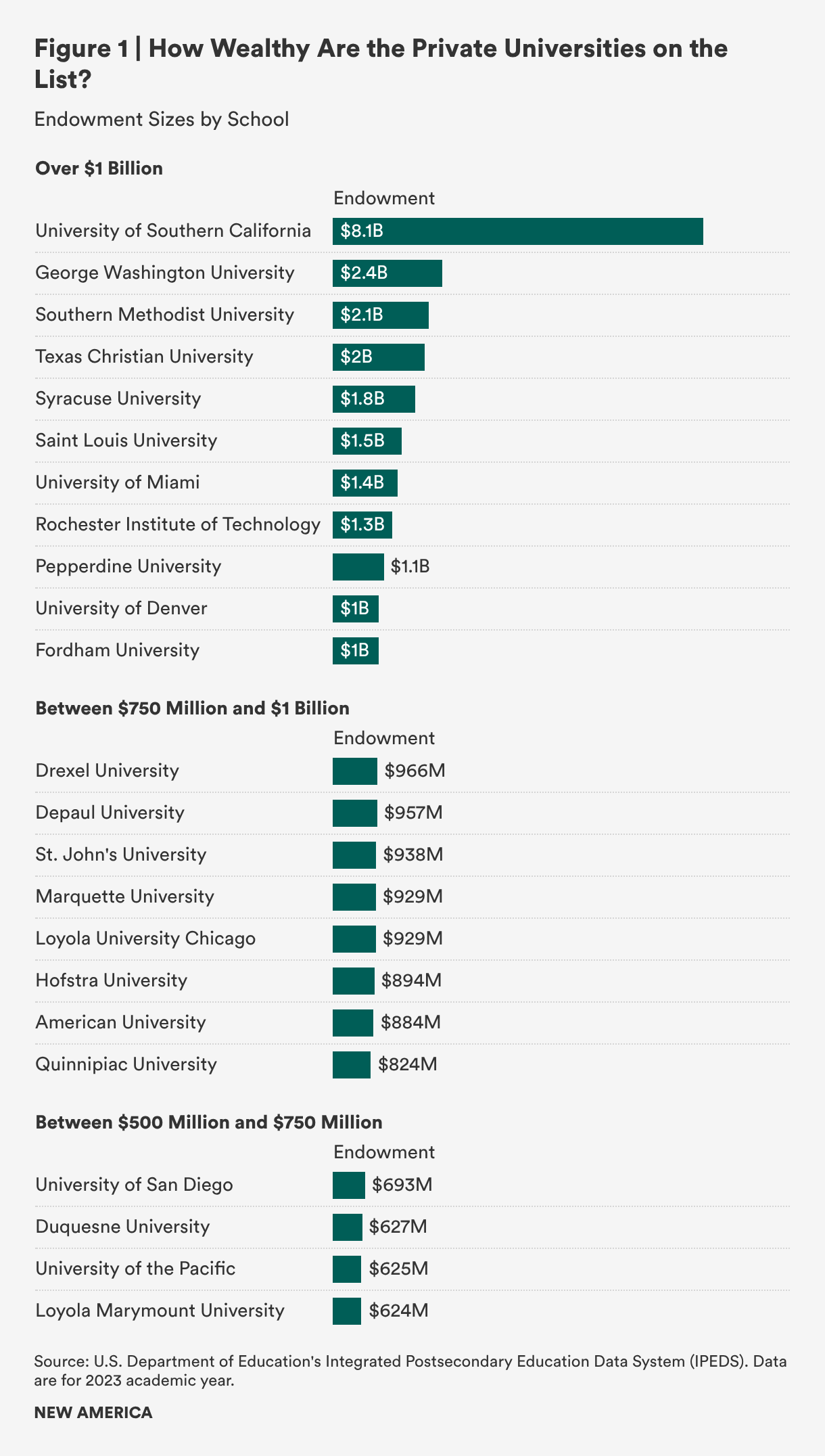
As Figure 1 shows, all the private universities on the list have endowments of $500 million or more. Eleven are among the wealthiest universities in the country, with endowments over $1 billion. Of the remaining 12, 8 have endowments between $750 million and $1 billion, and the remaining ones exceeding $500 million. These schools generally do not engage in financial aid leveraging to keep their doors open or to fill seats. They are doing so to rise in the rankings, increase their revenues, and compete against their rivals.
Over half the private universities on the list have religious affiliations: Nine of the schools are Catholic and four are Protestant. Of the Catholic schools, five are Jesuit institutions. As the journalist and author Neil Swidey wrote in my book Lifting the Veil on Enrollment Management shows, Jesuit schools like Saint Louis University were among the first to become more analytical in their use of data comparing colleges’ success in enrolling students and strategic in their use of financial aid.30 Catholic colleges have at times wrestled with the tension between their historic missions to provide an affordable education to low-income students and the desire to raise their academic profile and compete for higher-achieving students.31
Like Baylor, the Protestant universities on the list have engaged in financial aid leveraging aggressively not only to raise their academic profile but to compete with one another to be considered the top Christian university in the country, the Protestant version of Notre Dame University. For example, the online site Niche in 2025 named Texas Christian University the country’s top Christian college—besting Southern Methodist University, which won the honor the year before. Like Baylor, these schools are leaving the families of Pell recipients with loads of Parent PLUS loan debt many of them are unlikely to be able to repay.
This list also contains some bigger-name, non-sectarian universities—such as The George Washington University, the University of Miami, and the University of Southern California—that have used enrollment management and financial aid leveraging to climb up the rankings and become national institutions. They have followed similar paths as they have sought to rise up the pecking order.
Here’s the story of one of those universities, and another that is trying to follow in its footsteps.
The George Washington University
For most of its history, which goes back to 1821, The George Washington (GW) University was an affordable commuter school that served a diverse group of working adults seeking credentials that would help them advance in their careers—a much different clientele than its tonier neighbor, Georgetown University, enrolled.
That all changed with the arrival of the university’s new president, Stephen Joel Trachtenberg, in 1988. Trachtenberg, the former president of the University of Hartford, immediately set an ambitious course for GW: to be a destination of choice for affluent students who did not make the cut at the nation’s most selective colleges. To accomplish this, he applied lessons he had learned as a senior administrator at Boston University in the 1970s under the tutelage of John Silber, who helped transform BU from a commuter school into a major research university.32 Trachtenberg took those lessons and wrote a blueprint that countless other universities—both public and private—have followed to raise their stature.
Trachtenberg’s goal was to make GW more appealing to an upscale crowd. To carry out that mission, he turned what had been a relatively low-cost institution into one of the most expensive colleges in the country. He believed the higher the price, the more alluring the school would be to the top-end students and families he sought. In a 2015 New York Times article entitled “How to Raise a University’s Profile: Pricing and Packaging,” New America’s Kevin Carey wrote, “Trachtenberg convinced people that George Washington was worth a lot more money by charging a lot more money.”33
And he went on a building spree to provide the kind of amenities that wealthier students crave, such as state-of-the art dormitories and a fancy student union that won the American Institutes of Architects’ highest award. For Trachtenberg, the constant construction on campus signaled the dynamism of the university. “Mr. Trachtenberg understood the centrality of the university as a physical place. New structures were a visceral sign of progress,” Carey wrote. “They told visitors, donors, and civic leaders that the institution was, like beams and scaffolding rising from the earth, ascending.”34
And Trachtenberg opened up the university’s financial aid coffers for the sole purpose of “buying talent,” as he told The Atlantic.35 He operated under the philosophy “that students were more interested in attending a $40,000 school with a $20,000 discount than they were in attending a $20,000 school,” the magazine reported in a profile of Trachtenberg entitled “Meet the High Priest of Runaway College Inflation.”36
Although it has been many years since Trachtenberg retired as president of George Washington University, the school is still “buying talent.” In 2023, 29 percent of GW freshmen received non-need-based aid, averaging over $23,000 each. At the same time, the university charged the lowest-income students an average net price of more than $21,000.
According to the Education Department’s College Scorecard data, 722 families with children who either graduated or left GW in 2020 and 2021 borrowed PLUS loans to help pay for college. Of those, 261, or 36 percent, were the families of Pell recipients. They carried a median debt load of $26,000.
Trachtenberg’s vision of making GW into a popular destination for affluent students who did not make it into the nation’s most selective colleges has panned out. But the changes were made on the backs of the low- and lower-middle-income students who had once been the lifeblood of the university.
St. John’s University
It may be surprising to learn that the selective college that has awarded the most non-need-based aid in each of the past 15 years is St. John’s University in Queens, New York, which is still considered a commuter campus. The university, which spent $218 million on non-need-based aid in 2023, primarily serves students from New York City’s five boroughs and Long Island.
St. John’s leaders, however, have long had higher aspirations for the university, which have been fueled by the school’s athletic prowess. The school sports 17 NCAA Division 1 teams, none more famous than the men’s basketball team. The Red Storm, now coached by the infamous Rick Patino, has appeared in 31 NCAA tournaments (including in 2025).
St. John’s president, Rev. Donald J. Harrington, started to make those aspirations a reality in 1999, by breaking ground on its residence village, which housed the school’s first five dormitories.37 Speaking to The New York Times in 2001, Harrington said that the new dorms were just a start: “We see ourselves as being a national university.”38
Father Harrington followed GW’s blueprint closely—jacking up tuition, going on a building spree, and, of course, buying higher-achieving students from outside the boroughs. While the vast majority of students still commute to the school, St. John’s has built a large residential presence. Last year, 2,500 students lived in residential facilities on or near campus, and they came from 45 states and 106 countries.39
St. John’s traditional low- and lower-middle-income clientele have paid a high price for these changes. In 2023, the university charged freshmen from families with annual incomes of $30,000 or less an average net price of nearly $23,500, leaving their parents with little choice but to borrow PLUS loans.
According to the Education Department’s College Scorecard data, 3,068 families who had children who either graduated or left St. John’s in 2020 and 2021 borrowed PLUS loans to help pay for college. Of those, 1,707, or 56 percent, were the families of Pell recipients, and they assumed a median debt load of more than $42,000.
St. John’s use of the Parent PLUS loan program has helped fuel its transformation. Today, the families of former St. John’s students carry about $633 million in outstanding Parent PLUS loan debt, third among all selective colleges in the country, public or private.
Harrington stepped down as president of St. John’s in 2013, in the midst of a financial scandal at the university. But he made clear that his aspirations for the school remained sky-high. “St. John’s has been transformed and stands today a truly world-class global university,” he wrote to the universities’ trustees at the time.40
Citations
- Neil Swidey, “Reign and Ruin: The Rise of Enrollment Management and the U.S. News College Rankings,” in Lifting the Veil on Enrollment Management: How a Powerful Industry is Limiting Social Mobility in American Higher Education, ed. Stephen J. Burd (Harvard Education Press, 2024),15–19.
- For more on the tensions some Catholic colleges have experienced regarding their competing enrollment priorities, see Becky Supiano, “Catholic Colleges Work to Maintain Access as Their Profiles Rise,” Chronicle of Higher Education, October 4, 2009, https://www.chronicle.com/article/catholic-colleges-work-to-maintain-access-as-their-profiles-rise/?sra=true.
- Kevin Carey, “How to Raise a University’s Profile: Pricing and Packaging,” New York Times, February 6, 2015, https://www.nytimes.com/2015/02/08/education/edlife/how-to-raise-a-universitys-profile-pricing-and-packaging.html.
- Carey, “How to Raise a University’s Profile,” https://www.nytimes.com/2015/02/08/education/edlife/how-to-raise-a-universitys-profile-pricing-and-packaging.html.
- Carey, “How to Raise a University’s Profile,” https://www.nytimes.com/2015/02/08/education/edlife/how-to-raise-a-universitys-profile-pricing-and-packaging.html.
- Julia Edwards, “Meet the High Priest of Runaway College Inflation (He Regrets Nothing),” The Atlantic, September 2012, https://www.theatlantic.com/business/archive/2012/09/meet-the-high-priest-of-runaway-college-inflation-he-regrets-nothing/263032/.
- Edwards, “Meet the High Priest of Runaway College Inflation,” https://www.theatlantic.com/business/archive/2012/09/meet-the-high-priest-of-runaway-college-inflation-he-regrets-nothing/263032/.
- St. John’s University, “Twenty Years Ago: Residence Halls Usher in a New Era for St. John’s,” August 30, 2019, https://www.stjohns.edu/news-media/news/2019-08-30/twenty-years-ago-residence-halls-usher-new-era-st-johns.
- Samuel Weiss, “St. John’s Works to Shake Its Commuter School Image,” New York Times, May 2, 2001, https://www.nytimes.com/2001/05/02/nyregion/st-john-s-works-to-shake-its-commuter-school-image.html.
- St. John’s University, “Fast Facts: Fall 2024,” https://www.stjohns.edu/sites/default/files/2025-03/fast_fact_card_2024.pdf.
- Wendy Ruderman, “Amid Pending Investigation, President of St. John’s Says He Will Retire,” New York Times, May 3, 2013, https://www.nytimes.com/2013/05/04/education/st-johns-president-says-he-will-retire.html.