Kelly Vedi
Senior Policy Analyst, Center on Education & Labor

Trident Technical College had a challenge.
After several years of hard work and experimentation, its youth apprenticeship partnership—Charleston Regional Youth Apprenticeships (CRYA)—was rapidly growing, attracting an increasing number of new apprentices and employers each year. But expansion also brought new hurdles, including the need for better tools to track data on apprentices’ work experience, on-the-job training, and related instruction.
Trident’s Dean of Apprenticeships and Employer Partnerships, Mitch Harp, thought about his wish list. He wanted to create a portable, easy-to-use resource to help apprentices track their progress. He aspired to ensure that all of CRYA’s key partners—employers, K–12 teachers and counselors, and Trident staff—could access students’ data so they could monitor their progress and provide support as needed. And, ideally, he hoped to reduce the burden of data collection so that it would be easier for Trident’s staff to compile reports for funders and other stakeholders.
As he brainstormed solutions, a new idea was sparked: “We’re going to build an app!”
Managing a youth apprenticeship program is a highly complex venture that requires careful planning, coordination, data sharing, and communication with a diverse group of stakeholders. In light of this demanding operating context, a growing number of organizations are seeking technology solutions to help them manage their youth apprenticeships more effectively and efficiently. Yet, given the still-nascent state of youth apprenticeship, there is limited awareness of the options available to programs, much less any standardization or consensus about the most promising tools and technologies.
Noting a growing number of inquiries from programs seeking guidance on the selection of technology products, the Partnership to Advance Youth Apprenticeship (PAYA) launched a study in fall 2023 to document the state of technology adoption across the field of youth apprenticeship and strengthen our understanding of the current landscape. New America researchers surveyed youth apprenticeship programs from our national network of 70+ partners, held follow-up interviews with 11 programs, conducted online research, and collected information from several vendors. This summary of our findings describes why youth apprenticeship programs seek out technology solutions, outlines how technology use varies among programs, lists considerations for making information technology (IT) purchases, discusses common barriers to technology adoption, and explores opportunities to better leverage technology to strengthen and scale up youth apprenticeship programs.
Youth apprenticeship programs are implemented through multi-stakeholder partnerships that include K–12 schools, postsecondary institutions, employers, and community partners who are supported by a backbone organization known as an apprenticeship intermediary. As summarized in a 2019 report by PAYA partner Education Strategy Group, intermediaries fulfill a range of roles and functions that help to ensure the success of a youth apprenticeship program as depicted in Figure 1 below:
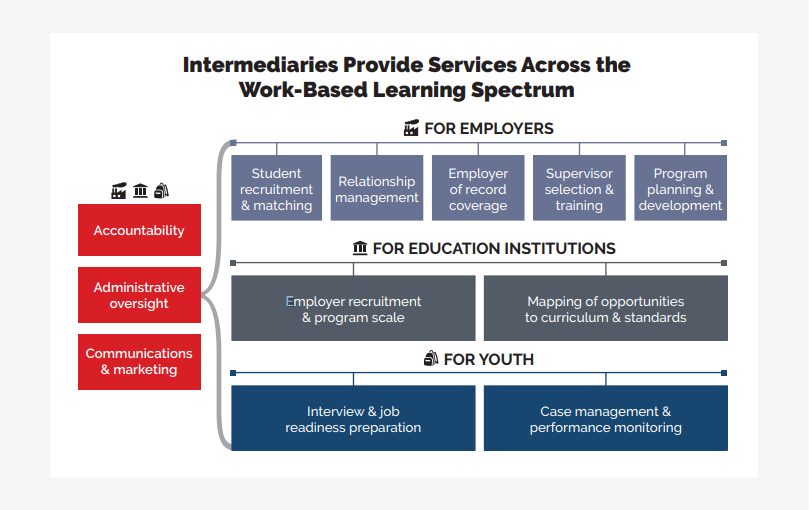
The youth apprenticeship intermediaries that contributed to our study reported seeking technology solutions to manage many of these core responsibilities, particularly tasks related to:
More generally, intermediaries also noted an interest in using technology to realize efficiencies that extend limited staff capacity; provide quick-reference insights into program operations (e.g., dashboards); improve documentation of activities and outcomes; reduce the burden of and increase the accuracy of data tracking; and automate repetitive processes.
Not surprisingly, the types of tools and technologies youth apprenticeship intermediaries use vary significantly, depending on the size of the program and the stage of its development. Small-scale and recently launched youth apprenticeship programs reported that their operations are relatively low tech, often relying heavily on spreadsheets to manage data and information.
For example, education nonprofit Reach Higher Montana’s small but growing program, Montana Youth Apprenticeship Partnership, supports 23 youth apprentices across the state, partnering with five employers in the health care, IT, maintenance, accounting, and early childhood education sectors. Reach Higher Montana uses a collection of relatively low-tech, low-cost tools—such as Excel spreadsheets and Google Docs—to track employer engagement, outreach, apprentice work processes, and demographics. While generally satisfied with these tools, staff members reported that, in anticipation of continued growth, they’ve begun to seek out new software to help better document and manage their interactions with employers and apprentices. They hope that new tools will allow them to reduce their reliance on person-to-person transmission of information and strengthen institutional memory. Staff emphasized that any consideration of new tools will be shaped by budgetary constraints and potential limitations in the level of technical support required to launch and maintain them.
As youth apprenticeship programs scale up, growing operational demands—like the need to manage larger volumes of data or maximize efficiency so they can stretch staff capacity—often lead intermediaries to adopt new tools and technologies. The technology needs of mid-sized intermediaries in our study were extensive, and participants reported that they used as many as nine applications to manage their programs. Commonly cited tools included:
Some tech-enabled programs also reported creative repurposing of off-the-shelf products. For example, one intermediary noted that it has deployed Breezy HR, a human resources employee recruiting software product, to manage its apprenticeship application process.
Indianapolis-based workforce board EmployIndy is typical of intermediaries at this stage of development. Launched in 2020, its Modern Apprenticeship Program began with a two-person staff managing a few dozen apprentices and blossomed into a team of 15 that coordinates 100+ youth apprentices, 12 K–12 partners, and 36 employers across industries that include business operations, IT, construction, and health care. EmployIndy has adopted an assortment of tools to achieve its program management goals, including:
To strengthen day-to-day program management, EmployIndy is working to build out a dashboard using the data visualization tool Microsoft Power BI.
Like the CRYA experience described in the introduction, several of the larger, more experienced youth apprenticeship intermediaries in PAYA’s network identified specific technology needs as their programs grew, prompting them to develop customized technology solutions.
Launched in 2013, CRYA has grown from a small pilot supporting 13 apprentices to a regional talent development engine that serves 200 apprentices and 180 employers across a range of industries. CRYA engaged a software developer to create an app—My Apprentice—to help apprentices understand their program requirements and track and communicate their progress. The app is accessible on mobile devices and the web, allowing apprentices, employers, CRYA staff, and other stakeholders to stay up-to-date on time-sensitive action items. Created with financial support from PAYA, My Apprentice was developed as an open-source application that can be customized and deployed by any youth apprenticeship program.
Ascend Indiana is an initiative of Central Indiana Corporate Partnership, an organization that brings together industry, higher education, and philanthropic leaders to advance regional prosperity and growth. In 2019, Ascend launched a new youth-focused strategy that featured a collaboration with EmployIndy to launch the Modern Apprenticeship Program pilot; a network of youth apprenticeship pilots across the state called the Indiana Youth Apprenticeship Accelerator; and a statewide community of practice that engages more than 100 members and 60 organizations to address systemic barriers to scaling up modern youth apprenticeship across Indiana. Ascend’s statewide network has grown to include 500+ youth apprentices, 50+ employers, and 30+ schools.
To support its youth apprenticeship partners throughout the state, Ascend Indiana has provided them with access to the Ascend Network, a proprietary job-matching platform created to support the organization’s broader workforce development efforts. The Ascend Network facilitates the matching of potential apprentices to employers by allowing youth to create a profile and employers to share information about apprenticeship opportunities.
Founded in 2016 and launching its first cohort in 2017, CareerWise USA has seen more than 2,000 apprentices hired by more than 250 employers. Its growing network includes affiliates in Colorado, Indiana, New York, and Washington, DC. To support this network, CareerWise developed a customized suite of applications built on or integrated with Salesforce. The suite includes both custom and off-the-shelf technology tools. The custom tools include the Apprenticeship Hiring Hub (an applicant tracking system), a performance management system, related instruction tracking platform, and a grant-reporting program that reformats data for uploading to federal systems like the Workforce Integrated Performance System (WIPS). It has also integrated an enterprise learning management system (LMS) and a communications platform into its Salesforce suite. It uses Docebo LMS for its Learning and Resource Hub to customize learning plans for apprentices based on occupation. CareerWise programs use Marketing Cloud to send emails throughout the apprenticeship process, pulse checks to see how apprentices are doing, and event reminders. Alex Peek, CareerWise’s Director of Technology, stresses that the most important part of the technology suite is that there is one source of truth for everything, which is Salesforce, so the organization can easily pull data to measure the program across its network.
Local affiliates are able to use the CareerWise technology suite to help manage their programs. This allows new, smaller programs access to more advanced technology than they would typically use at that stage, hopefully paving the way for faster expansion. However, CareerWise has found that, despite the program model standardization that comes with being a CareerWise affiliate, there is still a large degree of customization required for each local program.
Finally, a number of study participants expressed interest in specialized apprenticeship management systems (AMS). Examples of these platforms include:
| Apprenticeship Tracker | ApprenTrac | myOneFlow |
| ApprentiScope | BuildWithin | Symba |
| Apprentix | GoSprout | WorkHands |
There is an even broader range of AMS products available from companies in Australia and the United Kingdom. Examples include ACE360, Aptem, ARODS, Bud, epaPro, ePortfolio, EOSONE, HEIApply, Mykademy, Olive VLE, TradeSchool, Tribal, and Ready Apprentice. However, differences between U.S. and international apprenticeship models (e.g., end point assessments, variations in standards, etc.) will likely render some of these products less well aligned with the needs of American youth apprenticeship programs.
Several AMS vendors responded to a request for information (RFI) distributed by PAYA in fall 2023. Some of the apprenticeship-specific capabilities they reported for AMS products include:
Two PAYA grantees recently adopted one of these platforms, but reported that they were too early in their deployment to draw any conclusions about their usefulness or share lessons learned. A number of other study participants reported that they were interested in these products but—in light of the significant financial investment required to deploy them—were hesitant to consider them more seriously without feedback from peers about their usefulness and return on investment.
Given the complex landscape of technology products that youth apprenticeship intermediaries must navigate, programs will want to take the following factors into consideration when selecting products.
While recognizing that software tools offered alluring opportunities for increasing their efficiency and effectiveness, youth apprenticeship intermediaries nevertheless reported that they faced significant hurdles to more fully realizing technologies’ potential.
There are also supply-side barriers. The structure and operation of youth apprenticeship programs tend to vary significantly from place to place. A community college may serve as the youth apprenticeship intermediary in one community, while a small nonprofit might serve as the intermediary in another. One program might register apprenticeships through the U.S. Department of Labor’s Office of Apprenticeship, while another registers them via a state apprenticeship agency.
As a result of this variability, a technology solution that helps one youth apprenticeship program excel may have to be significantly modified to meet the needs of another community. Offering this level of place-to-place customization makes it difficult to realize economies of scale. This potentially drives up the price of software and cuts into the profits of developers, potentially creating a disincentive to develop additional products targeted towards youth apprenticeship programs.
“Organizations that are tech-enabled, or are striving to become so, continually try to improve the way they do business. By testing and integrating tools and solutions that streamline operations and services and making it easier for everyone to access the workforce system, they are redefining success for their organizations, their communities, and the people they interact with every day.”—Tech-Enabled: Using New Tools to Build Better Organizations
Policymakers, funders, national thought leaders, and researchers all have a role to play in helping more youth apprenticeship intermediaries identify and deploy digital tools and solutions that improve efficiency, strengthen communication, bolster data management, and increase effectiveness. Four high-potential strategies include:
As is frequently the case, our research raised as many questions as it answered:
Additional research into apprenticeship technology solutions would provide better guidance to the field and help to ensure that technology investments are deployed strategically. Our study also unearthed several interesting examples of apprenticeship technology outside the United States, including a joint effort by several Canadian provinces to develop a custom apprenticeship management system to coordinate efforts across apprentices, journeypersons, employers, training providers, and government apprenticeship management staff. Based on this example and our quick scan of products used in the United Kingdom and Australia, it seems likely that further exploration of lessons learned by international peers could also yield valuable insights.
Philanthropic funders and government leaders can also help to ensure that apprenticeship programs make smart technology investments by facilitating access to expert technical assistance providers who can help intermediaries assess their needs and requirements and then provide objective guidance to help them select high-quality products.
A recent report on apprenticeship registration from Apprenticeships for America hailed the usefulness of USDOL’s Office of Apprenticeship’s web-based Standards Builder, noting that program leaders found it was valuable “both because it makes needed forms and documents accessible and because registrations can be filed electronically and quickly revised if needed.” USDOL and other public agencies can build on this win and leverage their resources and influence to further advance the adoption of technology tools, particularly by working to ensure that public data systems like RAPIDS and WIPS allow for interoperability with solutions created by third-party developers.
Finally, many apprenticeship programs cited funding as a significant barrier to investing in more sophisticated technology solutions. Public and philanthropic funders can help to address this barrier by:
As youth apprenticeship programs grow and evolve, many are turning to technology tools and solutions to help them manage increasingly complex operations, maximize limited staff capacity, and strengthen partnerships. However, apprenticeship intermediaries face hurdles, ranging from tight budgets to bureaucratic procurement policies, that can inhibit adoption of new technologies. Looking forward, expanded research, expert guidance, supportive public policies, and strategic investments can help youth apprenticeship programs overcome these barriers and leverage technology to achieve new levels of efficiency, effectiveness, and scale. If used strategically, technology tools offer significant potential to strengthen data use, streamline administration, enhance alignment among partners, and expand opportunities for youth. With thoughtful planning and support, technology solutions can play an invaluable role in helping apprenticeship intermediaries deliver high-quality programs at scale.
It’s taken Mitch and the rest of the CRYA team a decade to grow their program from 13 apprentices to over 200. Many foundations and governments have significantly more ambitious hopes for the speed that youth apprenticeship programs will grow over the next 10 years. California has a goal to reach 500,000 apprentices by 2029, a significant number of which they hope to be youth apprentices. Maryland’s comprehensive school reform bill, the Blueprint for Maryland’s Future, calls for increasing the number of high schoolers in apprenticeship to 60,000 in seven years. For these hopes to be realized, technology will need to play a central role. Policymakers, funders, thought leaders, and researchers can accelerate adoption of key technologies by equipping youth apprenticeship intermediaries with additional information, guidance, and resources.
The authors wish to thank the following Partnership to Advance Youth Apprenticeship (PAYA) Network members and apprenticeship technology industry representatives for their time and support in the creation of this report:
References in this paper to any specific commercial product, process, or service, or the use of any trade, firm, or corporation name is for the information and convenience of the public, and does not constitute an endorsement or recommendation by New America or PAYA.
PAYA’s work is made possible through the generous financial support of the Annie E. Casey Foundation; Bill & Melinda Gates Foundation; Bloomberg Philanthropies; Carnegie Corporation of New York; JP Morgan Chase & Co.; Ralph C. Wilson, Jr. Foundation; Siemens Foundation; Smidt Foundation; and Walton Family Foundation. The views and opinions expressed in this publication are those of the authors and do not necessarily reflect the views or positions of collaborators or the entities they represent.
Senior Policy Analyst, Center on Education & Labor

Intern, Partnership to Advance Youth Apprenticeship (PAYA), New America